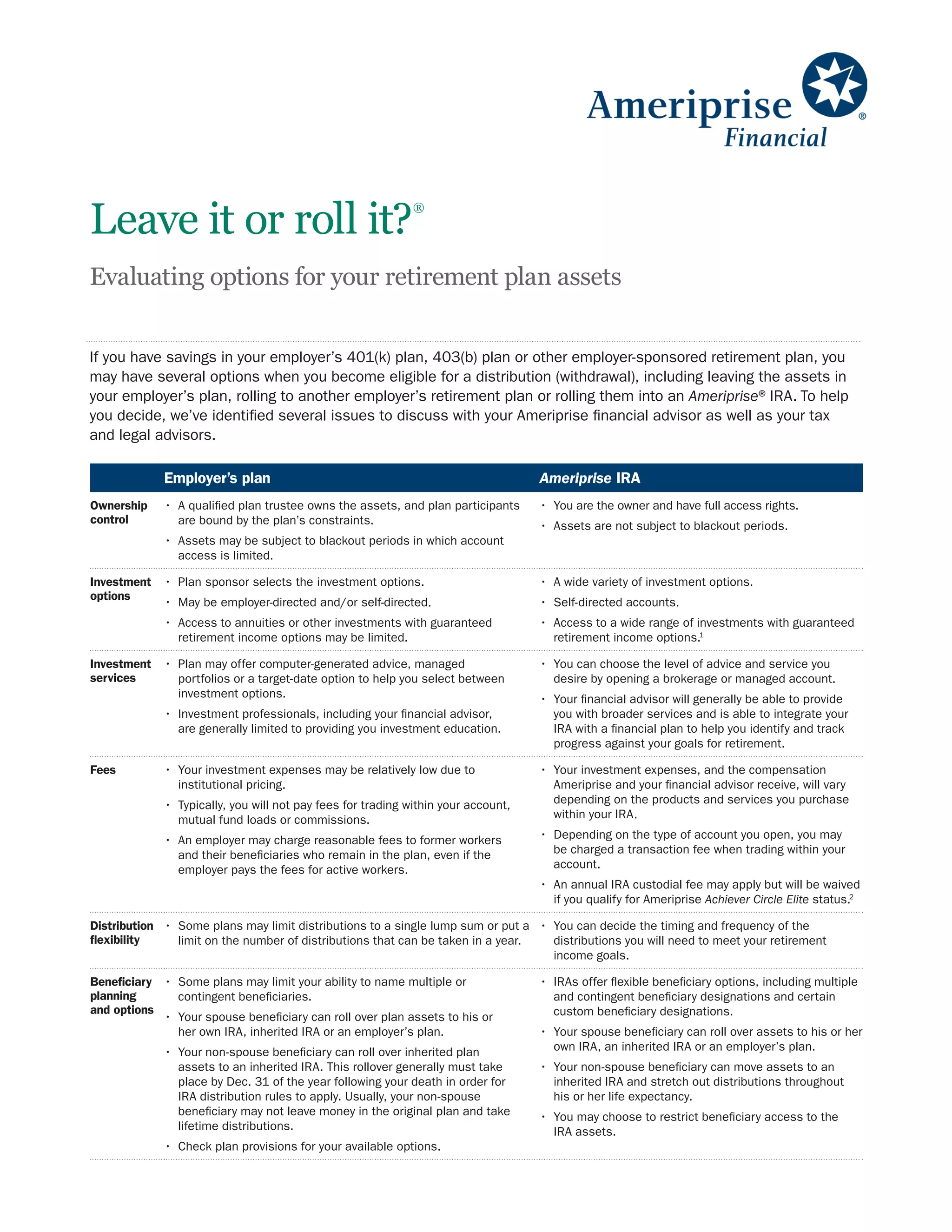
If you have savings in your employer’s 401(k) plan, 403(b) plan or other employer-sponsored retirement plan, you
may have several options when you become eligible for a distribution (withdrawal), including leaving the assets in
your employer’s plan, rolling to another employer’s retirement plan or rolling them into an Ameriprise®IRA. To help
you decide, we’ve identified several issues to discuss with your Ameriprise financial advisor as well as your tax
and legal advisors.
Leave it or roll it?
®
Evaluating options for your retirement plan assets
Employer’s plan Ameriprise IRA
Ownership
control
•	 A qualified plan trustee owns the assets, and plan participants
are bound by the plan’s constraints.
•	 Assets may be subject to blackout periods in which account
access is limited.
•	 You are the owner and have full access rights.
•	 Assets are not subject to blackout periods.
Investment
options
•	 Plan sponsor selects the investment options.
•	 May be employer-directed and/or self-directed.
•	 Access to annuities or other investments with guaranteed
retirement income options may be limited.
•	 A wide variety of investment options.
•	 Self-directed accounts.
•	 Access to a wide range of investments with guaranteed
retirement income options.1
Investment
services
•	 Plan may offer computer-generated advice, managed
portfolios or a target-date option to help you select between
investment options.
•	 Investment professionals, including your financial advisor,
are generally limited to providing you investment education.
•	 You can choose the level of advice and service you
desire by opening a brokerage or managed account.
•	 Your financial advisor will generally be able to provide
you with broader services and is able to integrate your
IRA with a financial plan to help you identify and track
progress against your goals for retirement.
Fees •	 Your investment expenses may be relatively low due to
institutional pricing.
•	 Typically, you will not pay fees for trading within your account,
mutual fund loads or commissions.
•	 An employer may charge reasonable fees to former workers
and their beneficiaries who remain in the plan, even if the
employer pays the fees for active workers.
•	 Your investment expenses, and the compensation
Ameriprise and your financial advisor receive, will vary
depending on the products and services you purchase
within your IRA.
•	 Depending on the type of account you open, you may
be charged a transaction fee when trading within your
account.
•	 An annual IRA custodial fee may apply but will be waived
if you qualify for Ameriprise Achiever Circle Elite status.2
Distribution
flexibility
•	 Some plans may limit distributions to a single lump sum or put a
limit on the number of distributions that can be taken in a year.
•	 You can decide the timing and frequency of the
distributions you will need to meet your retirement
income goals.
Beneficiary
planning
and options
•	 Some plans may limit your ability to name multiple or
contingent beneficiaries.
•	 Your spouse beneficiary can roll over plan assets to his or
her own IRA, inherited IRA or an employer’s plan.
•	 Your non-spouse beneficiary can roll over inherited plan
assets to an inherited IRA. This rollover generally must take
place by Dec. 31 of the year following your death in order for
IRA distribution rules to apply. Usually, your non-spouse
beneficiary may not leave money in the original plan and take
lifetime distributions.
•	 Check plan provisions for your available options.
•	 IRAs offer flexible beneficiary options, including multiple
and contingent beneficiary designations and certain
custom beneficiary designations.
•	 Your spouse beneficiary can roll over assets to his or her
own IRA, an inherited IRA or an employer’s plan.
•	 Your non-spouse beneficiary can move assets to an
inherited IRA and stretch out distributions throughout
his or her life expectancy.
•	 You may choose to restrict beneficiary access to the
IRA assets.
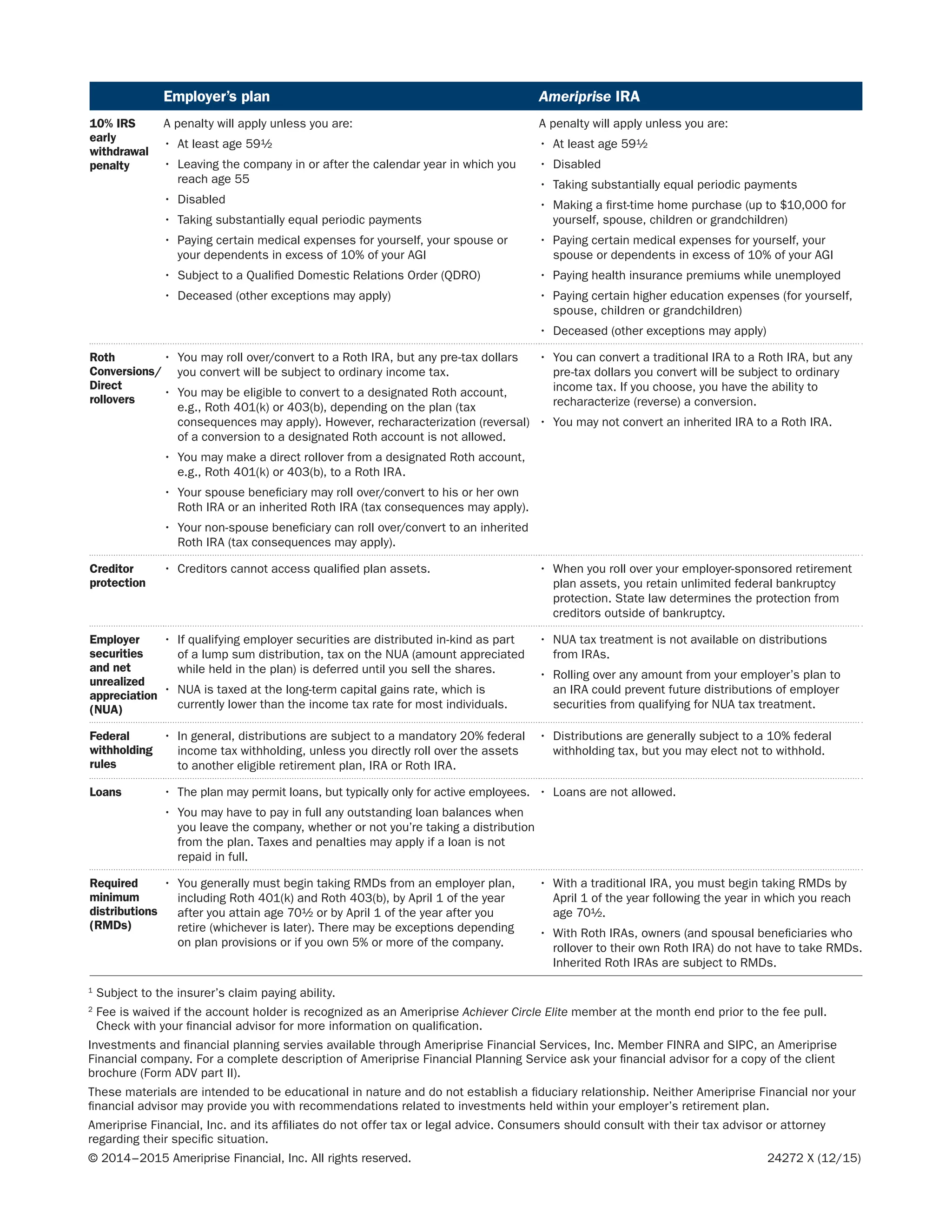
Employer’s plan Ameriprise IRA
10% IRS
early
withdrawal
penalty
A penalty will apply unless you are:
•	 At least age 59½
•	 Leaving the company in or after the calendar year in which you
reach age 55
•	 Disabled
•	 Taking substantially equal periodic payments
•	 Paying certain medical expenses for yourself, your spouse or
your dependents in excess of 10% of your AGI
•	 Subject to a Qualified Domestic Relations Order (QDRO)
•	 Deceased (other exceptions may apply)
A penalty will apply unless you are:
•	 At least age 59½
•	 Disabled
•	 Taking substantially equal periodic payments
•	 Making a first-time home purchase (up to $10,000 for
yourself, spouse, children or grandchildren)
•	 Paying certain medical expenses for yourself, your
spouse or dependents in excess of 10% of your AGI
•	 Paying health insurance premiums while unemployed
•	 Paying certain higher education expenses (for yourself,
spouse, children or grandchildren)
•	 Deceased (other exceptions may apply)
Roth
Conversions/
Direct
rollovers	
•	 You may roll over/convert to a Roth IRA, but any pre-tax dollars
you convert will be subject to ordinary income tax.
•	 You may be eligible to convert to a designated Roth account,
e.g., Roth 401(k) or 403(b), depending on the plan (tax
consequences may apply). However, recharacterization (reversal)
of a conversion to a designated Roth account is not allowed.
•	 You may make a direct rollover from a designated Roth account,
e.g., Roth 401(k) or 403(b), to a Roth IRA.
•	 Your spouse beneficiary may roll over/convert to his or her own
Roth IRA or an inherited Roth IRA (tax consequences may apply).
•	 Your non-spouse beneficiary can roll over/convert to an inherited
Roth IRA (tax consequences may apply).	
•	 You can convert a traditional IRA to a Roth IRA, but any
pre-tax dollars you convert will be subject to ordinary
income tax. If you choose, you have the ability to
recharacterize (reverse) a conversion.
•	 You may not convert an inherited IRA to a Roth IRA.
Creditor
protection
•	 Creditors cannot access qualified plan assets. •	 When you roll over your employer-sponsored retirement
plan assets, you retain unlimited federal bankruptcy
protection. State law determines the protection from
creditors outside of bankruptcy.
Employer
securities
and net
unrealized
appreciation
(NUA)
•	 If qualifying employer securities are distributed in-kind as part
of a lump sum distribution, tax on the NUA (amount appreciated
while held in the plan) is deferred until you sell the shares.
•	 NUA is taxed at the long-term capital gains rate, which is
currently lower than the income tax rate for most individuals.
•	 NUA tax treatment is not available on distributions
from IRAs.
•	 Rolling over any amount from your employer’s plan to
an IRA could prevent future distributions of employer
securities from qualifying for NUA tax treatment.
Federal
withholding
rules
•	 In general, distributions are subject to a mandatory 20% federal
income tax withholding, unless you directly roll over the assets
to another eligible retirement plan, IRA or Roth IRA.
•	 Distributions are generally subject to a 10% federal
withholding tax, but you may elect not to withhold.
Loans •	 The plan may permit loans, but typically only for active employees.
•	 You may have to pay in full any outstanding loan balances when
you leave the company, whether or not you’re taking a distribution
from the plan. Taxes and penalties may apply if a loan is not
repaid in full.
•	 Loans are not allowed.
Required
minimum
distributions
(RMDs)
•	 You generally must begin taking RMDs from an employer plan,
including Roth 401(k) and Roth 403(b), by April 1 of the year
after you attain age 70½ or by April 1 of the year after you
retire (whichever is later). There may be exceptions depending
on plan provisions or if you own 5% or more of the company.
•	 With a traditional IRA, you must begin taking RMDs by
April 1 of the year following the year in which you reach
age 70½.
•	 With Roth IRAs, owners (and spousal beneficiaries who
rollover to their own Roth IRA) do not have to take RMDs.
Inherited Roth IRAs are subject to RMDs.
1
Subject to the insurer’s claim paying ability.
2
Fee is waived if the account holder is recognized as an Ameriprise Achiever Circle Elite member at the month end prior to the fee pull.
Check with your financial advisor for more information on qualification.
Investments and financial planning servies available through Ameriprise Financial Services, Inc. Member FINRA and SIPC, an Ameriprise
Financial company. For a complete description of Ameriprise Financial Planning Service ask your financial advisor for a copy of the client
brochure (Form ADV part II).
These materials are intended to be educational in nature and do not establish a fiduciary relationship. Neither Ameriprise Financial nor your
financial advisor may provide you with recommendations related to investments held within your employer’s retirement plan.
Ameriprise Financial, Inc. and its affiliates do not offer tax or legal advice. Consumers should consult with their tax advisor or attorney
regarding their specific situation.
© 2014–2015 Ameriprise Financial, Inc. All rights reserved.	 24272 X (12/15)

IRA Leave It Roll It 12_15

  • 1.
    If you havesavings in your employer’s 401(k) plan, 403(b) plan or other employer-sponsored retirement plan, you may have several options when you become eligible for a distribution (withdrawal), including leaving the assets in your employer’s plan, rolling to another employer’s retirement plan or rolling them into an Ameriprise®IRA. To help you decide, we’ve identified several issues to discuss with your Ameriprise financial advisor as well as your tax and legal advisors. Leave it or roll it? ® Evaluating options for your retirement plan assets Employer’s plan Ameriprise IRA Ownership control • A qualified plan trustee owns the assets, and plan participants are bound by the plan’s constraints. • Assets may be subject to blackout periods in which account access is limited. • You are the owner and have full access rights. • Assets are not subject to blackout periods. Investment options • Plan sponsor selects the investment options. • May be employer-directed and/or self-directed. • Access to annuities or other investments with guaranteed retirement income options may be limited. • A wide variety of investment options. • Self-directed accounts. • Access to a wide range of investments with guaranteed retirement income options.1 Investment services • Plan may offer computer-generated advice, managed portfolios or a target-date option to help you select between investment options. • Investment professionals, including your financial advisor, are generally limited to providing you investment education. • You can choose the level of advice and service you desire by opening a brokerage or managed account. • Your financial advisor will generally be able to provide you with broader services and is able to integrate your IRA with a financial plan to help you identify and track progress against your goals for retirement. Fees • Your investment expenses may be relatively low due to institutional pricing. • Typically, you will not pay fees for trading within your account, mutual fund loads or commissions. • An employer may charge reasonable fees to former workers and their beneficiaries who remain in the plan, even if the employer pays the fees for active workers. • Your investment expenses, and the compensation Ameriprise and your financial advisor receive, will vary depending on the products and services you purchase within your IRA. • Depending on the type of account you open, you may be charged a transaction fee when trading within your account. • An annual IRA custodial fee may apply but will be waived if you qualify for Ameriprise Achiever Circle Elite status.2 Distribution flexibility • Some plans may limit distributions to a single lump sum or put a limit on the number of distributions that can be taken in a year. • You can decide the timing and frequency of the distributions you will need to meet your retirement income goals. Beneficiary planning and options • Some plans may limit your ability to name multiple or contingent beneficiaries. • Your spouse beneficiary can roll over plan assets to his or her own IRA, inherited IRA or an employer’s plan. • Your non-spouse beneficiary can roll over inherited plan assets to an inherited IRA. This rollover generally must take place by Dec. 31 of the year following your death in order for IRA distribution rules to apply. Usually, your non-spouse beneficiary may not leave money in the original plan and take lifetime distributions. • Check plan provisions for your available options. • IRAs offer flexible beneficiary options, including multiple and contingent beneficiary designations and certain custom beneficiary designations. • Your spouse beneficiary can roll over assets to his or her own IRA, an inherited IRA or an employer’s plan. • Your non-spouse beneficiary can move assets to an inherited IRA and stretch out distributions throughout his or her life expectancy. • You may choose to restrict beneficiary access to the IRA assets.
  • 2.
    Employer’s plan AmeripriseIRA 10% IRS early withdrawal penalty A penalty will apply unless you are: • At least age 59½ • Leaving the company in or after the calendar year in which you reach age 55 • Disabled • Taking substantially equal periodic payments • Paying certain medical expenses for yourself, your spouse or your dependents in excess of 10% of your AGI • Subject to a Qualified Domestic Relations Order (QDRO) • Deceased (other exceptions may apply) A penalty will apply unless you are: • At least age 59½ • Disabled • Taking substantially equal periodic payments • Making a first-time home purchase (up to $10,000 for yourself, spouse, children or grandchildren) • Paying certain medical expenses for yourself, your spouse or dependents in excess of 10% of your AGI • Paying health insurance premiums while unemployed • Paying certain higher education expenses (for yourself, spouse, children or grandchildren) • Deceased (other exceptions may apply) Roth Conversions/ Direct rollovers • You may roll over/convert to a Roth IRA, but any pre-tax dollars you convert will be subject to ordinary income tax. • You may be eligible to convert to a designated Roth account, e.g., Roth 401(k) or 403(b), depending on the plan (tax consequences may apply). However, recharacterization (reversal) of a conversion to a designated Roth account is not allowed. • You may make a direct rollover from a designated Roth account, e.g., Roth 401(k) or 403(b), to a Roth IRA. • Your spouse beneficiary may roll over/convert to his or her own Roth IRA or an inherited Roth IRA (tax consequences may apply). • Your non-spouse beneficiary can roll over/convert to an inherited Roth IRA (tax consequences may apply). • You can convert a traditional IRA to a Roth IRA, but any pre-tax dollars you convert will be subject to ordinary income tax. If you choose, you have the ability to recharacterize (reverse) a conversion. • You may not convert an inherited IRA to a Roth IRA. Creditor protection • Creditors cannot access qualified plan assets. • When you roll over your employer-sponsored retirement plan assets, you retain unlimited federal bankruptcy protection. State law determines the protection from creditors outside of bankruptcy. Employer securities and net unrealized appreciation (NUA) • If qualifying employer securities are distributed in-kind as part of a lump sum distribution, tax on the NUA (amount appreciated while held in the plan) is deferred until you sell the shares. • NUA is taxed at the long-term capital gains rate, which is currently lower than the income tax rate for most individuals. • NUA tax treatment is not available on distributions from IRAs. • Rolling over any amount from your employer’s plan to an IRA could prevent future distributions of employer securities from qualifying for NUA tax treatment. Federal withholding rules • In general, distributions are subject to a mandatory 20% federal income tax withholding, unless you directly roll over the assets to another eligible retirement plan, IRA or Roth IRA. • Distributions are generally subject to a 10% federal withholding tax, but you may elect not to withhold. Loans • The plan may permit loans, but typically only for active employees. • You may have to pay in full any outstanding loan balances when you leave the company, whether or not you’re taking a distribution from the plan. Taxes and penalties may apply if a loan is not repaid in full. • Loans are not allowed. Required minimum distributions (RMDs) • You generally must begin taking RMDs from an employer plan, including Roth 401(k) and Roth 403(b), by April 1 of the year after you attain age 70½ or by April 1 of the year after you retire (whichever is later). There may be exceptions depending on plan provisions or if you own 5% or more of the company. • With a traditional IRA, you must begin taking RMDs by April 1 of the year following the year in which you reach age 70½. • With Roth IRAs, owners (and spousal beneficiaries who rollover to their own Roth IRA) do not have to take RMDs. Inherited Roth IRAs are subject to RMDs. 1 Subject to the insurer’s claim paying ability. 2 Fee is waived if the account holder is recognized as an Ameriprise Achiever Circle Elite member at the month end prior to the fee pull. Check with your financial advisor for more information on qualification. Investments and financial planning servies available through Ameriprise Financial Services, Inc. Member FINRA and SIPC, an Ameriprise Financial company. For a complete description of Ameriprise Financial Planning Service ask your financial advisor for a copy of the client brochure (Form ADV part II). These materials are intended to be educational in nature and do not establish a fiduciary relationship. Neither Ameriprise Financial nor your financial advisor may provide you with recommendations related to investments held within your employer’s retirement plan. Ameriprise Financial, Inc. and its affiliates do not offer tax or legal advice. Consumers should consult with their tax advisor or attorney regarding their specific situation. © 2014–2015 Ameriprise Financial, Inc. All rights reserved. 24272 X (12/15)