Hot IRA TopicsHot IRA Topics
Presented by:
Robert L. Wolff, Esq.
P.O. Box 381
Dumaguete City, Negros Oriental
Philippines 6200
wolff2000@earthlink.net
NY (518) 325-6015
PH 09266485273
Fax: (518) 677-1600
DisclaimerDisclaimer
I am not an attorney admitted to practice law in the Philippines.I am not an attorney admitted to practice law in the Philippines.
I am admitted to practice law in New York.I am admitted to practice law in New York.
The following is not a legal advice, but rather comments andThe following is not a legal advice, but rather comments and
observations.observations.
For answers to legal issues raised by this presentation, you need toFor answers to legal issues raised by this presentation, you need to
consult an attorney admitted to practice law in the Philippines.consult an attorney admitted to practice law in the Philippines.
Problems to be Aware ofProblems to be Aware of
andand
Planning OpportunitiesPlanning Opportunities
Not understanding how your assetsNot understanding how your assets
will be distributed at death canwill be distributed at death can
result in an estate catastrophe.result in an estate catastrophe.
The Three Main Ways Your
Estate is Distributed:
Probate
Right of Survivorship
Contract
Problems with Doing aProblems with Doing a
Rollover to an IRARollover to an IRA
 Rollover from a 401(k) is subject to anRollover from a 401(k) is subject to an
automatic 20% income tax withholdingautomatic 20% income tax withholding
 IRA to IRA rollover, only have 60 days toIRA to IRA rollover, only have 60 days to
complete a rollovercomplete a rollover
 Only the property distributed or cash can beOnly the property distributed or cash can be
rolloverrollover
 Required minimum distributions cannot beRequired minimum distributions cannot be
rolled overrolled over
 One IRA to IRA rollover a year ruleOne IRA to IRA rollover a year rule
Required MinimumRequired Minimum
Distributions fromDistributions from
Multiple Retirement PlansMultiple Retirement Plans
 The total required minimum
distributions from multiple IRAs can
be taken from all or any one of the
IRAs – except for an inherited IRAs
 401(k)s do not have this rule, the
required distribution has to be from
each 401(k)
Problems withProblems with
Pre-Nuptial AgreementsPre-Nuptial Agreements
 The qualified joint and survivor annuity andThe qualified joint and survivor annuity and
qualified pre-retirement survivor annuity rulesqualified pre-retirement survivor annuity rules
 Only a spouse can waive QJSD or QPSA rulesOnly a spouse can waive QJSD or QPSA rules
 This rule does not apply to IRAs.This rule does not apply to IRAs.
It is important to keep yourIt is important to keep your
designation of beneficiary form updesignation of beneficiary form up
to date.to date.
As we age, often the beneficiaries of ourAs we age, often the beneficiaries of our
estate change. It is important that as theestate change. It is important that as the
beneficiaries of our estate change, webeneficiaries of our estate change, we
update our designated beneficiaryupdate our designated beneficiary
selectionselection
The problem of having named an ex-The problem of having named an ex-
spouse, a deceased spouse or a spousespouse, a deceased spouse or a spouse
in a nursing home as a beneficiary.in a nursing home as a beneficiary.
Kennedy v. DuPontKennedy v. DuPont
 Kennedy v. Plan Administrator for DuPont Savings and Investment
Plan, (No. 07-636, Decided January 26, 2009)
 In a court battle that has been ongoing since 2001, Kari Kennedy
lost a $402,000 inheritance because the beneficiary form did not
name her as the beneficiary, even though that is what her father
wanted. The United State Supreme Court UNANIMOUSLY ruled
that the ex-spouse receives the retirement plan money because she
was named on the beneficiary form – even though she waived her
rights to that money in a divorce decree.
 The Supreme Court ruling is the law of the land and there are no
more appeals.
 The beneficiary form controls who inherits the money and all of the
Justices agree.
You need to understand who can beYou need to understand who can be
a designated beneficiarya designated beneficiary
Only an individual or an individualOnly an individual or an individual
who is a beneficiary of a Qualifiedwho is a beneficiary of a Qualified
IRA Trust can be a designatedIRA Trust can be a designated
beneficiary.beneficiary.
Your designated beneficiary isYour designated beneficiary is
important if you want to create aimportant if you want to create a
Stretch-Out-IRA, the gift that keepsStretch-Out-IRA, the gift that keeps
on giving.on giving.
Why use separate accounts for IRAsWhy use separate accounts for IRAs
for multiple IRA beneficiariesfor multiple IRA beneficiaries
 Oldest beneficiary rule.Oldest beneficiary rule.
 The problem of naming an entity,The problem of naming an entity,
such as your estate, as one of thesuch as your estate, as one of the
beneficiaries of an IRA.beneficiaries of an IRA.
 Using separate accounts avoids theUsing separate accounts avoids the
oldest beneficiary rule.oldest beneficiary rule.
Spouse and Non-Spouse and Non-
Spouse RolloversSpouse Rollovers
 Non-spouse can transfer
a 401(k) to an Inherited
IRA (can also convert to
a Roth IRA), but can not
rollover an inherited IRA.
Only a spouse can
rollover a 401(k) or an
IRA.
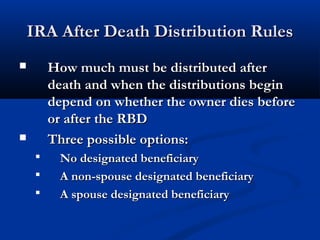
IRA After Death Distribution RulesIRA After Death Distribution Rules
 How much must be distributed afterHow much must be distributed after
death and when the distributions begindeath and when the distributions begin
depend on whether the owner dies beforedepend on whether the owner dies before
or after the RBDor after the RBD
 Three possible options:Three possible options:
 No designated beneficiaryNo designated beneficiary
 A non-spouse designated beneficiaryA non-spouse designated beneficiary
 A spouse designated beneficiaryA spouse designated beneficiary
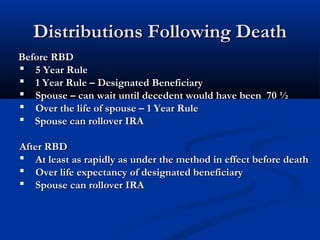
Distributions Following DeathDistributions Following Death
Before RBDBefore RBD
 5 Year Rule5 Year Rule
 1 Year Rule – Designated Beneficiary1 Year Rule – Designated Beneficiary
 Spouse – can wait until decedent would have been 70 ½Spouse – can wait until decedent would have been 70 ½
 Over the life of spouse – 1 Year RuleOver the life of spouse – 1 Year Rule
 Spouse can rollover IRASpouse can rollover IRA
After RBDAfter RBD
 At least as rapidly as under the method in effect before deathAt least as rapidly as under the method in effect before death
 Over life expectancy of designated beneficiaryOver life expectancy of designated beneficiary
 Spouse can rollover IRASpouse can rollover IRA
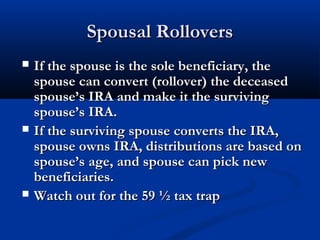
Spousal RolloversSpousal Rollovers
 If the spouse is the sole beneficiary, theIf the spouse is the sole beneficiary, the
spouse can convert (rollover) the deceasedspouse can convert (rollover) the deceased
spouse’s IRA and make it the survivingspouse’s IRA and make it the surviving
spouse’s IRA.spouse’s IRA.
 If the surviving spouse converts the IRA,If the surviving spouse converts the IRA,
spouse owns IRA, distributions are based onspouse owns IRA, distributions are based on
spouse’s age, and spouse can pick newspouse’s age, and spouse can pick new
beneficiaries.beneficiaries.
 Watch out for the 59 ½ tax trapWatch out for the 59 ½ tax trap
Spouse as BeneficiarySpouse as Beneficiary
 Maximum FlexibilityMaximum Flexibility
 Rollover Into Spousal IRARollover Into Spousal IRA
 Opportunity To Create a Stretched Out IRAOpportunity To Create a Stretched Out IRA
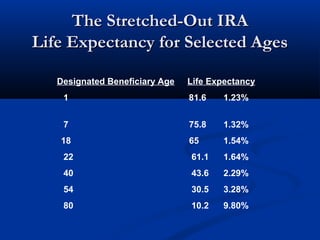
The Stretched-Out IRAThe Stretched-Out IRA
Life Expectancy for Selected AgesLife Expectancy for Selected Ages
Designated Beneficiary Age Life Expectancy
1 81.6 1.23%
7 75.8 1.32%
18 65 1.54%
22 61.1 1.64%
40 43.6 2.29%
54 30.5 3.28%
80 10.2 9.80%
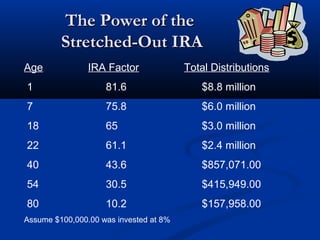
The Power of theThe Power of the
Stretched-Out IRAStretched-Out IRA
Age IRA Factor Total Distributions
1 81.6 $8.8 million
7 75.8 $6.0 million
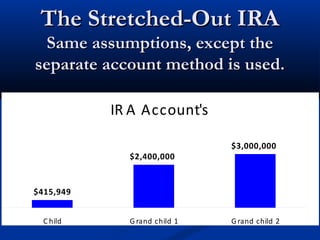
18 65 $3.0 million
22 61.1 $2.4 million
40 43.6 $857,071.00
54 30.5 $415,949.00
80 10.2 $157,958.00
Assume $100,000.00 was invested at 8%
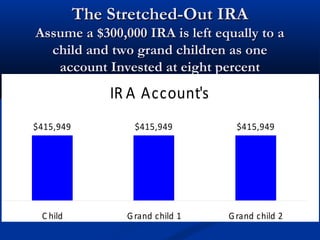
The Stretched-Out IRAThe Stretched-Out IRA
Assume a $300,000 IRA is left equally to aAssume a $300,000 IRA is left equally to a
child and two grand children as onechild and two grand children as one
account Invested at eight percentaccount Invested at eight percent
IR A Account's
$415,949$415,949$415,949
C hild Grand child 1 Grand child 2
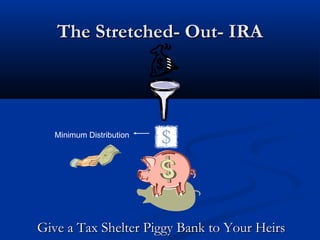
The Stretched- Out- IRAThe Stretched- Out- IRA
Give a Tax Shelter Piggy Bank to Your HeirsGive a Tax Shelter Piggy Bank to Your Heirs
Minimum Distribution
The Stretched-Out IRAThe Stretched-Out IRA
Same assumptions, except theSame assumptions, except the
separate account method is used.separate account method is used.
IR A Account's
$2,400,000
$3,000,000
$415,949
C hild G rand child 1 G rand child 2
Why Name a Trust as a BeneficiaryWhy Name a Trust as a Beneficiary
of an IRA?of an IRA?
Control and AssetControl and Asset
Protection Planning forProtection Planning for
the Trust Beneficiarythe Trust Beneficiary
Benefits of Naming a Trust asBenefits of Naming a Trust as
IRA BeneficiaryIRA Beneficiary
 Spendthrift protectionSpendthrift protection
 Creditor (asset) protectionCreditor (asset) protection
 Divorce protectionDivorce protection
 Estate planningEstate planning
 ““Dead-hand” controlDead-hand” control
DisclaimersDisclaimers
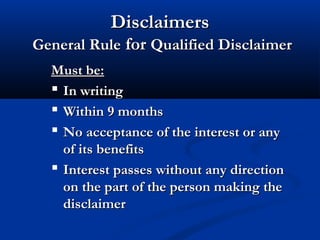
General RuleGeneral Rule forfor Qualified DisclaimerQualified Disclaimer
Must be:Must be:
 In writingIn writing
 Within 9 monthsWithin 9 months
 No acceptance of the interest or anyNo acceptance of the interest or any
of its benefitsof its benefits
 Interest passes without any directionInterest passes without any direction
on the part of the person making theon the part of the person making the
disclaimerdisclaimer
DisclaimersDisclaimers
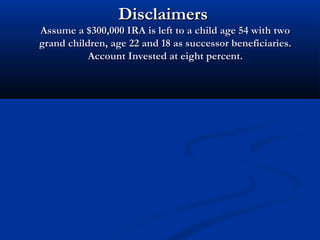
Assume a $300,000 IRA is left to a child age 54 with twoAssume a $300,000 IRA is left to a child age 54 with two
grand children, age 22 and 18 as successor beneficiaries.grand children, age 22 and 18 as successor beneficiaries.
Account Invested at eight percent.Account Invested at eight percent.
DisclaimersDisclaimers
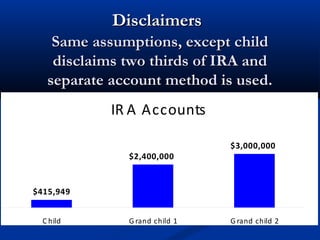
Same assumptions, except childSame assumptions, except child
disclaims two thirds of IRA anddisclaims two thirds of IRA and
separate account method is used.separate account method is used.
IR A Accounts
$2,400,000
$3,000,000
$415,949
C hild G rand child 1 G rand child 2
Taking advantage of the Income TaxTaking advantage of the Income Tax
deduction for an individual IRAdeduction for an individual IRA
 Income in respect of a decedent.Income in respect of a decedent.
 IRA are subject to double taxation.IRA are subject to double taxation.
 Estate tax paid on the IRA deathEstate tax paid on the IRA death
benefits can be used as a deduction tobenefits can be used as a deduction to
off-set income taxes on distributionsoff-set income taxes on distributions
from the inherited IRA.from the inherited IRA.
Net Unrealized AppreciationNet Unrealized Appreciation
 Contribution basis of stock or employer security is taxable,Contribution basis of stock or employer security is taxable,
but not the NUA.but not the NUA.
 Rollover of employer securities to an IRA, the NUARollover of employer securities to an IRA, the NUA
exception is lost. The exception only applies to qualifiedexception is lost. The exception only applies to qualified
plans. There is no NUA exception for IRAs.plans. There is no NUA exception for IRAs.
 Must be a lump sum distribution--with one taxable year. OnMust be a lump sum distribution--with one taxable year. On
account of:account of:
 Employee’s separation from service;Employee’s separation from service;
 Death of employee;Death of employee;
 After employee attains 59 ½; andAfter employee attains 59 ½; and
 Disability of employee.Disability of employee.
Charitable Remainder Trust asCharitable Remainder Trust as
Beneficiaries of an IRABeneficiaries of an IRA
 Creates an Estate Tax
Charitable Deduction
 CRT-Pays no income tax on
distribution
 Creates a stream of income for
the beneficiary
 Benefits the charity
The Skinny on Charitable GivingThe Skinny on Charitable Giving
What is in it for me?
The Internal Revenue Code has a
matching program which basically
states- If you make a charitable
donation, we will give you a tax
deduction
What does this mean to the typical
taxpayer? You can give to your
favorite charity the tax dollars
that would otherwise be pay in
taxes to the IRS and New York
State!
The Roth Do-OverThe Roth Do-Over
 Taxpayers may recharacterize (i.e. “undo”orTaxpayers may recharacterize (i.e. “undo”or
“redo”) the Roth IRA conversion in current“redo”) the Roth IRA conversion in current
year or by the filing date of the current year’syear or by the filing date of the current year’s
tax returntax return
 Recharacterization can take place as late asRecharacterization can take place as late as
10/15 in the year following the year of10/15 in the year following the year of
conversionconversion
Recharacterization in a DownRecharacterization in a Down
MarketMarket
 Mary, in January, 20014 converts herMary, in January, 20014 converts her
$100,000 Traditional IRA to a Roth IRA$100,000 Traditional IRA to a Roth IRA
 By September, 2015, Roth account value isBy September, 2015, Roth account value is
$60,000$60,000
 Mary will pay income taxes on $40,000 thatMary will pay income taxes on $40,000 that
is not in her Roth account, unless Maryis not in her Roth account, unless Mary
recharacterizes her Roth account by Octoberrecharacterizes her Roth account by October
15, 201515, 2015
Roth IRAsRoth IRAs
 Contributions are non-tax deductibleContributions are non-tax deductible
 100% of growth is income free,100% of growth is income free, as opposed to merely taxas opposed to merely tax
deferred.deferred.
 Qualified distributions can be withdrawn income tax freeQualified distributions can be withdrawn income tax free
 Roth IRAs are not subject to the minimum distributionsRoth IRAs are not subject to the minimum distributions
rule (RMD) at age 70 ½rule (RMD) at age 70 ½
Key Points To Consider WhenKey Points To Consider When
Considering a Roth conversionConsidering a Roth conversion
 TTax free income is for your life and your heirs.ax free income is for your life and your heirs.
 The income tax liability paid when you convert isThe income tax liability paid when you convert is
NOTNOT an additional tax liability – the income taxan additional tax liability – the income tax
liability is already built into the tax due onliability is already built into the tax due on
Traditional IRA distribution.Traditional IRA distribution.
 TAX POINT - Some one is going to pay incomeTAX POINT - Some one is going to pay income
taxes, either now or later. The only question istaxes, either now or later. The only question is
when.when.
 The Roth IRA is a POWERFUL WEALTHThe Roth IRA is a POWERFUL WEALTH
TRANSFER VEHICLE because it is not subjectTRANSFER VEHICLE because it is not subject
to RMDs and offers tax free growth, not tax justto RMDs and offers tax free growth, not tax just
deferred growth.deferred growth.
Hedge against increasing Income Tax Rates
 Historically, income tax rates are low.Historically, income tax rates are low.
 If income rates go up, qualifiedIf income rates go up, qualified
distributions from a Roth IRA are notdistributions from a Roth IRA are not
subject to income taxes.subject to income taxes.
Tax Diversification
 The two main sources of tax-exemptThe two main sources of tax-exempt
income are Municipal Bonds and Roth IRA.income are Municipal Bonds and Roth IRA.
 When planning to generate tax-exemptWhen planning to generate tax-exempt
income – Roth offer greater diversification.income – Roth offer greater diversification.
Social Security Tax Reduction Planning
 If your income is too high– 50% to 85% of yourIf your income is too high– 50% to 85% of your
social security benefits are taxable.social security benefits are taxable.
 When calculating income for social securityWhen calculating income for social security
purposes– tax exempt income is included – Rothpurposes– tax exempt income is included – Roth
IRA distributions are not.IRA distributions are not.
 Roth IRA distributions can be used to supplementRoth IRA distributions can be used to supplement
retirement without increasing income for socialretirement without increasing income for social
security purposes.security purposes.
To Reduce Tax On Social SecurityTo Reduce Tax On Social Security
IncomeThink Roth IRA or AnnuityIncomeThink Roth IRA or Annuity
 QQualified income from a Roth IRA is taxualified income from a Roth IRA is tax
free, which will reduce your Provisionalfree, which will reduce your Provisional
Income.Income.
 A deferred Annuity will defer income,A deferred Annuity will defer income,
reducing Provisional Income.reducing Provisional Income.
 An immediate Annuity payment is partAn immediate Annuity payment is part
return of capital, part income. The return ofreturn of capital, part income. The return of
capital part is not taxable, reducingcapital part is not taxable, reducing
Provisional income.Provisional income.
The Tax-Free Stretch Roth IRA
 A compelling reason to convert to aA compelling reason to convert to a
Roth IRA – the beneficiary can stretchRoth IRA – the beneficiary can stretch
tax-free distributions over his or hertax-free distributions over his or her
life time.life time.
 Assets inside the Roth IRA canAssets inside the Roth IRA can
continue to grow tax free, as opposedcontinue to grow tax free, as opposed
to merely tax deferred.to merely tax deferred.
Roth IRA PlanningRoth IRA Planning
Pre Death ConsiderationsPre Death Considerations
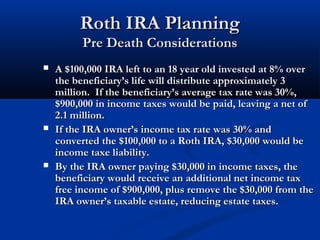
 A $100,000 IRA left to an 18 year old invested at 8% overA $100,000 IRA left to an 18 year old invested at 8% over
the beneficiary’s life will distribute approximately 3the beneficiary’s life will distribute approximately 3
million. If the beneficiary’s average tax rate was 30%,million. If the beneficiary’s average tax rate was 30%,
$900,000 in income taxes would be paid, leaving a net of$900,000 in income taxes would be paid, leaving a net of
2.1 million.2.1 million.
 If the IRA owner’s income tax rate was 30% andIf the IRA owner’s income tax rate was 30% and
converted the $100,000 to a Roth IRA, $30,000 would beconverted the $100,000 to a Roth IRA, $30,000 would be
income taxe liability.income taxe liability.
 By the IRA owner paying $30,000 in income taxes, theBy the IRA owner paying $30,000 in income taxes, the
beneficiary would receive an additional net income taxbeneficiary would receive an additional net income tax
free income of $900,000, plus remove the $30,000 from thefree income of $900,000, plus remove the $30,000 from the
IRA owner’s taxable estate, reducing estate taxes.IRA owner’s taxable estate, reducing estate taxes.
Trust Planning
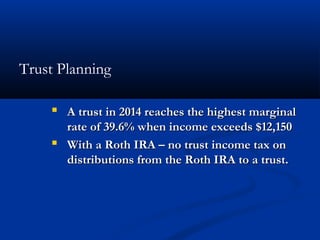
 A trust in 2014 reaches the highest marginalA trust in 2014 reaches the highest marginal
rate of 39.6% when income exceeds $12,150rate of 39.6% when income exceeds $12,150
 With a Roth IRA – no trust income tax onWith a Roth IRA – no trust income tax on
distributions from the Roth IRA to a trust.distributions from the Roth IRA to a trust.
Long-Term PlanningLong-Term Planning
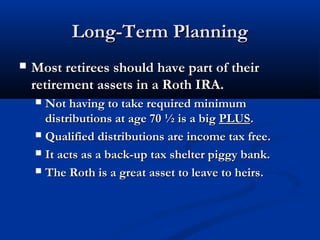
 Most retirees should have part of theirMost retirees should have part of their
retirement assets in a Roth IRA.retirement assets in a Roth IRA.
 Not having to take required minimumNot having to take required minimum
distributions at age 70 ½ is a bigdistributions at age 70 ½ is a big PLUSPLUS..
 Qualified distributions are income tax free.Qualified distributions are income tax free.
 It acts as a back-up tax shelter piggy bank.It acts as a back-up tax shelter piggy bank.
 The Roth is a great asset to leave to heirs.The Roth is a great asset to leave to heirs.
If you are thinking about taking retiring, youIf you are thinking about taking retiring, you
should also be thinking about estate planningshould also be thinking about estate planning
and such documents as:and such documents as:
 Power-of-Attorney
 Health Care Proxy
 Living Will
 Last Will and Testament
 Living Trust
You should also be thinking about protectingYou should also be thinking about protecting
your estate from catastrophic illness.your estate from catastrophic illness.
HOW TO PLAN FOR
A FUTURE YOU
CAN’T PREDICT
THE WOLFF
YOU need to make a PLANYOU need to make a PLAN
then WORK the planthen WORK the plan
We Offer aWe Offer a FREEFREE ConsultationConsultation
to Review Yourto Review Your
IRA Designation ofIRA Designation of
Beneficiary FormBeneficiary Form
Pursuant to Internal Revenue Service Circular 230, we
hereby inform you that the advice set forth herein with respect
to U.S. federal tax issues was not intended or written by the law
firm of Robert L. Wolff to used, and cannot be used, by you or
any taxpayer, for the purpose of (i) avoiding any penalties that
may be imposed on you or any other person under the Internal
Revenue Code or (ii) promoting, marketing or recommending
to another party any transaction or matter addressed herein.
Taxpayers should seek advice based on the taxpayer’s particular
circumstances from an independent tax advisor.
IRS Circular 230

Ira hot ira topics

  • 1.
    Hot IRA TopicsHotIRA Topics Presented by: Robert L. Wolff, Esq. P.O. Box 381 Dumaguete City, Negros Oriental Philippines 6200 wolff2000@earthlink.net NY (518) 325-6015 PH 09266485273 Fax: (518) 677-1600
  • 2.
    DisclaimerDisclaimer I am notan attorney admitted to practice law in the Philippines.I am not an attorney admitted to practice law in the Philippines. I am admitted to practice law in New York.I am admitted to practice law in New York. The following is not a legal advice, but rather comments andThe following is not a legal advice, but rather comments and observations.observations. For answers to legal issues raised by this presentation, you need toFor answers to legal issues raised by this presentation, you need to consult an attorney admitted to practice law in the Philippines.consult an attorney admitted to practice law in the Philippines.
  • 3.
    Problems to beAware ofProblems to be Aware of andand Planning OpportunitiesPlanning Opportunities
  • 4.
    Not understanding howyour assetsNot understanding how your assets will be distributed at death canwill be distributed at death can result in an estate catastrophe.result in an estate catastrophe. The Three Main Ways Your Estate is Distributed: Probate Right of Survivorship Contract
  • 5.
    Problems with DoingaProblems with Doing a Rollover to an IRARollover to an IRA  Rollover from a 401(k) is subject to anRollover from a 401(k) is subject to an automatic 20% income tax withholdingautomatic 20% income tax withholding  IRA to IRA rollover, only have 60 days toIRA to IRA rollover, only have 60 days to complete a rollovercomplete a rollover  Only the property distributed or cash can beOnly the property distributed or cash can be rolloverrollover  Required minimum distributions cannot beRequired minimum distributions cannot be rolled overrolled over  One IRA to IRA rollover a year ruleOne IRA to IRA rollover a year rule
  • 6.
    Required MinimumRequired Minimum DistributionsfromDistributions from Multiple Retirement PlansMultiple Retirement Plans  The total required minimum distributions from multiple IRAs can be taken from all or any one of the IRAs – except for an inherited IRAs  401(k)s do not have this rule, the required distribution has to be from each 401(k)
  • 7.
    Problems withProblems with Pre-NuptialAgreementsPre-Nuptial Agreements  The qualified joint and survivor annuity andThe qualified joint and survivor annuity and qualified pre-retirement survivor annuity rulesqualified pre-retirement survivor annuity rules  Only a spouse can waive QJSD or QPSA rulesOnly a spouse can waive QJSD or QPSA rules  This rule does not apply to IRAs.This rule does not apply to IRAs.
  • 8.
    It is importantto keep yourIt is important to keep your designation of beneficiary form updesignation of beneficiary form up to date.to date. As we age, often the beneficiaries of ourAs we age, often the beneficiaries of our estate change. It is important that as theestate change. It is important that as the beneficiaries of our estate change, webeneficiaries of our estate change, we update our designated beneficiaryupdate our designated beneficiary selectionselection The problem of having named an ex-The problem of having named an ex- spouse, a deceased spouse or a spousespouse, a deceased spouse or a spouse in a nursing home as a beneficiary.in a nursing home as a beneficiary.
  • 9.
    Kennedy v. DuPontKennedyv. DuPont  Kennedy v. Plan Administrator for DuPont Savings and Investment Plan, (No. 07-636, Decided January 26, 2009)  In a court battle that has been ongoing since 2001, Kari Kennedy lost a $402,000 inheritance because the beneficiary form did not name her as the beneficiary, even though that is what her father wanted. The United State Supreme Court UNANIMOUSLY ruled that the ex-spouse receives the retirement plan money because she was named on the beneficiary form – even though she waived her rights to that money in a divorce decree.  The Supreme Court ruling is the law of the land and there are no more appeals.  The beneficiary form controls who inherits the money and all of the Justices agree.
  • 10.
    You need tounderstand who can beYou need to understand who can be a designated beneficiarya designated beneficiary Only an individual or an individualOnly an individual or an individual who is a beneficiary of a Qualifiedwho is a beneficiary of a Qualified IRA Trust can be a designatedIRA Trust can be a designated beneficiary.beneficiary. Your designated beneficiary isYour designated beneficiary is important if you want to create aimportant if you want to create a Stretch-Out-IRA, the gift that keepsStretch-Out-IRA, the gift that keeps on giving.on giving.
  • 11.
    Why use separateaccounts for IRAsWhy use separate accounts for IRAs for multiple IRA beneficiariesfor multiple IRA beneficiaries  Oldest beneficiary rule.Oldest beneficiary rule.  The problem of naming an entity,The problem of naming an entity, such as your estate, as one of thesuch as your estate, as one of the beneficiaries of an IRA.beneficiaries of an IRA.  Using separate accounts avoids theUsing separate accounts avoids the oldest beneficiary rule.oldest beneficiary rule.
  • 12.
    Spouse and Non-Spouseand Non- Spouse RolloversSpouse Rollovers  Non-spouse can transfer a 401(k) to an Inherited IRA (can also convert to a Roth IRA), but can not rollover an inherited IRA. Only a spouse can rollover a 401(k) or an IRA.
  • 13.
    IRA After DeathDistribution RulesIRA After Death Distribution Rules  How much must be distributed afterHow much must be distributed after death and when the distributions begindeath and when the distributions begin depend on whether the owner dies beforedepend on whether the owner dies before or after the RBDor after the RBD  Three possible options:Three possible options:  No designated beneficiaryNo designated beneficiary  A non-spouse designated beneficiaryA non-spouse designated beneficiary  A spouse designated beneficiaryA spouse designated beneficiary
  • 14.
    Distributions Following DeathDistributionsFollowing Death Before RBDBefore RBD  5 Year Rule5 Year Rule  1 Year Rule – Designated Beneficiary1 Year Rule – Designated Beneficiary  Spouse – can wait until decedent would have been 70 ½Spouse – can wait until decedent would have been 70 ½  Over the life of spouse – 1 Year RuleOver the life of spouse – 1 Year Rule  Spouse can rollover IRASpouse can rollover IRA After RBDAfter RBD  At least as rapidly as under the method in effect before deathAt least as rapidly as under the method in effect before death  Over life expectancy of designated beneficiaryOver life expectancy of designated beneficiary  Spouse can rollover IRASpouse can rollover IRA
  • 15.
    Spousal RolloversSpousal Rollovers If the spouse is the sole beneficiary, theIf the spouse is the sole beneficiary, the spouse can convert (rollover) the deceasedspouse can convert (rollover) the deceased spouse’s IRA and make it the survivingspouse’s IRA and make it the surviving spouse’s IRA.spouse’s IRA.  If the surviving spouse converts the IRA,If the surviving spouse converts the IRA, spouse owns IRA, distributions are based onspouse owns IRA, distributions are based on spouse’s age, and spouse can pick newspouse’s age, and spouse can pick new beneficiaries.beneficiaries.  Watch out for the 59 ½ tax trapWatch out for the 59 ½ tax trap
  • 16.
    Spouse as BeneficiarySpouseas Beneficiary  Maximum FlexibilityMaximum Flexibility  Rollover Into Spousal IRARollover Into Spousal IRA  Opportunity To Create a Stretched Out IRAOpportunity To Create a Stretched Out IRA
  • 17.
    The Stretched-Out IRATheStretched-Out IRA Life Expectancy for Selected AgesLife Expectancy for Selected Ages Designated Beneficiary Age Life Expectancy 1 81.6 1.23% 7 75.8 1.32% 18 65 1.54% 22 61.1 1.64% 40 43.6 2.29% 54 30.5 3.28% 80 10.2 9.80%
  • 18.
    The Power oftheThe Power of the Stretched-Out IRAStretched-Out IRA Age IRA Factor Total Distributions 1 81.6 $8.8 million 7 75.8 $6.0 million 18 65 $3.0 million 22 61.1 $2.4 million 40 43.6 $857,071.00 54 30.5 $415,949.00 80 10.2 $157,958.00 Assume $100,000.00 was invested at 8%
  • 19.
    The Stretched-Out IRATheStretched-Out IRA Assume a $300,000 IRA is left equally to aAssume a $300,000 IRA is left equally to a child and two grand children as onechild and two grand children as one account Invested at eight percentaccount Invested at eight percent IR A Account's $415,949$415,949$415,949 C hild Grand child 1 Grand child 2
  • 20.
    The Stretched- Out-IRAThe Stretched- Out- IRA Give a Tax Shelter Piggy Bank to Your HeirsGive a Tax Shelter Piggy Bank to Your Heirs Minimum Distribution
  • 21.
    The Stretched-Out IRATheStretched-Out IRA Same assumptions, except theSame assumptions, except the separate account method is used.separate account method is used. IR A Account's $2,400,000 $3,000,000 $415,949 C hild G rand child 1 G rand child 2
  • 22.
    Why Name aTrust as a BeneficiaryWhy Name a Trust as a Beneficiary of an IRA?of an IRA? Control and AssetControl and Asset Protection Planning forProtection Planning for the Trust Beneficiarythe Trust Beneficiary
  • 23.
    Benefits of Naminga Trust asBenefits of Naming a Trust as IRA BeneficiaryIRA Beneficiary  Spendthrift protectionSpendthrift protection  Creditor (asset) protectionCreditor (asset) protection  Divorce protectionDivorce protection  Estate planningEstate planning  ““Dead-hand” controlDead-hand” control
  • 24.
    DisclaimersDisclaimers General RuleGeneral Ruleforfor Qualified DisclaimerQualified Disclaimer Must be:Must be:  In writingIn writing  Within 9 monthsWithin 9 months  No acceptance of the interest or anyNo acceptance of the interest or any of its benefitsof its benefits  Interest passes without any directionInterest passes without any direction on the part of the person making theon the part of the person making the disclaimerdisclaimer
  • 25.
    DisclaimersDisclaimers Assume a $300,000IRA is left to a child age 54 with twoAssume a $300,000 IRA is left to a child age 54 with two grand children, age 22 and 18 as successor beneficiaries.grand children, age 22 and 18 as successor beneficiaries. Account Invested at eight percent.Account Invested at eight percent.
  • 26.
    DisclaimersDisclaimers Same assumptions, exceptchildSame assumptions, except child disclaims two thirds of IRA anddisclaims two thirds of IRA and separate account method is used.separate account method is used. IR A Accounts $2,400,000 $3,000,000 $415,949 C hild G rand child 1 G rand child 2
  • 27.
    Taking advantage ofthe Income TaxTaking advantage of the Income Tax deduction for an individual IRAdeduction for an individual IRA  Income in respect of a decedent.Income in respect of a decedent.  IRA are subject to double taxation.IRA are subject to double taxation.  Estate tax paid on the IRA deathEstate tax paid on the IRA death benefits can be used as a deduction tobenefits can be used as a deduction to off-set income taxes on distributionsoff-set income taxes on distributions from the inherited IRA.from the inherited IRA.
  • 28.
    Net Unrealized AppreciationNetUnrealized Appreciation  Contribution basis of stock or employer security is taxable,Contribution basis of stock or employer security is taxable, but not the NUA.but not the NUA.  Rollover of employer securities to an IRA, the NUARollover of employer securities to an IRA, the NUA exception is lost. The exception only applies to qualifiedexception is lost. The exception only applies to qualified plans. There is no NUA exception for IRAs.plans. There is no NUA exception for IRAs.  Must be a lump sum distribution--with one taxable year. OnMust be a lump sum distribution--with one taxable year. On account of:account of:  Employee’s separation from service;Employee’s separation from service;  Death of employee;Death of employee;  After employee attains 59 ½; andAfter employee attains 59 ½; and  Disability of employee.Disability of employee.
  • 29.
    Charitable Remainder TrustasCharitable Remainder Trust as Beneficiaries of an IRABeneficiaries of an IRA  Creates an Estate Tax Charitable Deduction  CRT-Pays no income tax on distribution  Creates a stream of income for the beneficiary  Benefits the charity
  • 30.
    The Skinny onCharitable GivingThe Skinny on Charitable Giving What is in it for me? The Internal Revenue Code has a matching program which basically states- If you make a charitable donation, we will give you a tax deduction What does this mean to the typical taxpayer? You can give to your favorite charity the tax dollars that would otherwise be pay in taxes to the IRS and New York State!
  • 31.
    The Roth Do-OverTheRoth Do-Over  Taxpayers may recharacterize (i.e. “undo”orTaxpayers may recharacterize (i.e. “undo”or “redo”) the Roth IRA conversion in current“redo”) the Roth IRA conversion in current year or by the filing date of the current year’syear or by the filing date of the current year’s tax returntax return  Recharacterization can take place as late asRecharacterization can take place as late as 10/15 in the year following the year of10/15 in the year following the year of conversionconversion
  • 32.
    Recharacterization in aDownRecharacterization in a Down MarketMarket  Mary, in January, 20014 converts herMary, in January, 20014 converts her $100,000 Traditional IRA to a Roth IRA$100,000 Traditional IRA to a Roth IRA  By September, 2015, Roth account value isBy September, 2015, Roth account value is $60,000$60,000  Mary will pay income taxes on $40,000 thatMary will pay income taxes on $40,000 that is not in her Roth account, unless Maryis not in her Roth account, unless Mary recharacterizes her Roth account by Octoberrecharacterizes her Roth account by October 15, 201515, 2015
  • 33.
    Roth IRAsRoth IRAs Contributions are non-tax deductibleContributions are non-tax deductible  100% of growth is income free,100% of growth is income free, as opposed to merely taxas opposed to merely tax deferred.deferred.  Qualified distributions can be withdrawn income tax freeQualified distributions can be withdrawn income tax free  Roth IRAs are not subject to the minimum distributionsRoth IRAs are not subject to the minimum distributions rule (RMD) at age 70 ½rule (RMD) at age 70 ½
  • 34.
    Key Points ToConsider WhenKey Points To Consider When Considering a Roth conversionConsidering a Roth conversion  TTax free income is for your life and your heirs.ax free income is for your life and your heirs.  The income tax liability paid when you convert isThe income tax liability paid when you convert is NOTNOT an additional tax liability – the income taxan additional tax liability – the income tax liability is already built into the tax due onliability is already built into the tax due on Traditional IRA distribution.Traditional IRA distribution.  TAX POINT - Some one is going to pay incomeTAX POINT - Some one is going to pay income taxes, either now or later. The only question istaxes, either now or later. The only question is when.when.  The Roth IRA is a POWERFUL WEALTHThe Roth IRA is a POWERFUL WEALTH TRANSFER VEHICLE because it is not subjectTRANSFER VEHICLE because it is not subject to RMDs and offers tax free growth, not tax justto RMDs and offers tax free growth, not tax just deferred growth.deferred growth.
  • 35.
    Hedge against increasingIncome Tax Rates  Historically, income tax rates are low.Historically, income tax rates are low.  If income rates go up, qualifiedIf income rates go up, qualified distributions from a Roth IRA are notdistributions from a Roth IRA are not subject to income taxes.subject to income taxes.
  • 36.
    Tax Diversification  Thetwo main sources of tax-exemptThe two main sources of tax-exempt income are Municipal Bonds and Roth IRA.income are Municipal Bonds and Roth IRA.  When planning to generate tax-exemptWhen planning to generate tax-exempt income – Roth offer greater diversification.income – Roth offer greater diversification.
  • 37.
    Social Security TaxReduction Planning  If your income is too high– 50% to 85% of yourIf your income is too high– 50% to 85% of your social security benefits are taxable.social security benefits are taxable.  When calculating income for social securityWhen calculating income for social security purposes– tax exempt income is included – Rothpurposes– tax exempt income is included – Roth IRA distributions are not.IRA distributions are not.  Roth IRA distributions can be used to supplementRoth IRA distributions can be used to supplement retirement without increasing income for socialretirement without increasing income for social security purposes.security purposes.
  • 38.
    To Reduce TaxOn Social SecurityTo Reduce Tax On Social Security IncomeThink Roth IRA or AnnuityIncomeThink Roth IRA or Annuity  QQualified income from a Roth IRA is taxualified income from a Roth IRA is tax free, which will reduce your Provisionalfree, which will reduce your Provisional Income.Income.  A deferred Annuity will defer income,A deferred Annuity will defer income, reducing Provisional Income.reducing Provisional Income.  An immediate Annuity payment is partAn immediate Annuity payment is part return of capital, part income. The return ofreturn of capital, part income. The return of capital part is not taxable, reducingcapital part is not taxable, reducing Provisional income.Provisional income.
  • 39.
    The Tax-Free StretchRoth IRA  A compelling reason to convert to aA compelling reason to convert to a Roth IRA – the beneficiary can stretchRoth IRA – the beneficiary can stretch tax-free distributions over his or hertax-free distributions over his or her life time.life time.  Assets inside the Roth IRA canAssets inside the Roth IRA can continue to grow tax free, as opposedcontinue to grow tax free, as opposed to merely tax deferred.to merely tax deferred.
  • 40.
    Roth IRA PlanningRothIRA Planning Pre Death ConsiderationsPre Death Considerations  A $100,000 IRA left to an 18 year old invested at 8% overA $100,000 IRA left to an 18 year old invested at 8% over the beneficiary’s life will distribute approximately 3the beneficiary’s life will distribute approximately 3 million. If the beneficiary’s average tax rate was 30%,million. If the beneficiary’s average tax rate was 30%, $900,000 in income taxes would be paid, leaving a net of$900,000 in income taxes would be paid, leaving a net of 2.1 million.2.1 million.  If the IRA owner’s income tax rate was 30% andIf the IRA owner’s income tax rate was 30% and converted the $100,000 to a Roth IRA, $30,000 would beconverted the $100,000 to a Roth IRA, $30,000 would be income taxe liability.income taxe liability.  By the IRA owner paying $30,000 in income taxes, theBy the IRA owner paying $30,000 in income taxes, the beneficiary would receive an additional net income taxbeneficiary would receive an additional net income tax free income of $900,000, plus remove the $30,000 from thefree income of $900,000, plus remove the $30,000 from the IRA owner’s taxable estate, reducing estate taxes.IRA owner’s taxable estate, reducing estate taxes.
  • 41.
    Trust Planning  Atrust in 2014 reaches the highest marginalA trust in 2014 reaches the highest marginal rate of 39.6% when income exceeds $12,150rate of 39.6% when income exceeds $12,150  With a Roth IRA – no trust income tax onWith a Roth IRA – no trust income tax on distributions from the Roth IRA to a trust.distributions from the Roth IRA to a trust.
  • 42.
    Long-Term PlanningLong-Term Planning Most retirees should have part of theirMost retirees should have part of their retirement assets in a Roth IRA.retirement assets in a Roth IRA.  Not having to take required minimumNot having to take required minimum distributions at age 70 ½ is a bigdistributions at age 70 ½ is a big PLUSPLUS..  Qualified distributions are income tax free.Qualified distributions are income tax free.  It acts as a back-up tax shelter piggy bank.It acts as a back-up tax shelter piggy bank.  The Roth is a great asset to leave to heirs.The Roth is a great asset to leave to heirs.
  • 43.
    If you arethinking about taking retiring, youIf you are thinking about taking retiring, you should also be thinking about estate planningshould also be thinking about estate planning and such documents as:and such documents as:  Power-of-Attorney  Health Care Proxy  Living Will  Last Will and Testament  Living Trust You should also be thinking about protectingYou should also be thinking about protecting your estate from catastrophic illness.your estate from catastrophic illness.
  • 44.
    HOW TO PLANFOR A FUTURE YOU CAN’T PREDICT THE WOLFF
  • 45.
    YOU need tomake a PLANYOU need to make a PLAN then WORK the planthen WORK the plan
  • 46.
    We Offer aWeOffer a FREEFREE ConsultationConsultation to Review Yourto Review Your IRA Designation ofIRA Designation of Beneficiary FormBeneficiary Form
  • 47.
    Pursuant to InternalRevenue Service Circular 230, we hereby inform you that the advice set forth herein with respect to U.S. federal tax issues was not intended or written by the law firm of Robert L. Wolff to used, and cannot be used, by you or any taxpayer, for the purpose of (i) avoiding any penalties that may be imposed on you or any other person under the Internal Revenue Code or (ii) promoting, marketing or recommending to another party any transaction or matter addressed herein. Taxpayers should seek advice based on the taxpayer’s particular circumstances from an independent tax advisor. IRS Circular 230