






UNDERSTANDING
REACTIVE
PROGRAMMING
ANDRES ALMIRAY
@AALMIRAY
ANDRESALMIRAY.COM
@aalmiray
@aalmiray
JCP Executive Committee Associate Seat
Committer
Committer
JSR377 Specification Lead
@aalmiray
CONCEPTS
@aalmiray
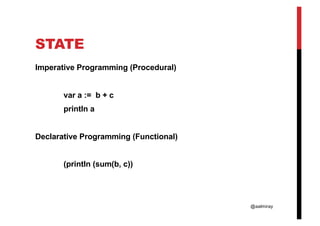
STATE
Imperative Programming (Procedural)
var a := b + c
println a
Declarative Programming (Functional)
(println (sum(b, c))
@aalmiray
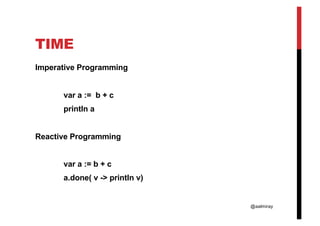
TIME
Imperative Programming
var a := b + c
println a
Reactive Programming
var a := b + c
a.done( v -> println v)
@aalmiray
SYNC VS ASYNC
Synchronous operations block the flow until they yield a
result (success or error).
Asynchronous operations DO NOT block the flow, rather they
allow the program to continue. Results (or errors) will be
handled at a later point in time, typically using functions
(callbacks).
@aalmiray
FUTURES AND PROMISES
They describe an object that acts as mediator for a value that
may be unknown at init time.
The terms Future and Promise are normally used
interchangeably but there’s a difference:
• A Future is a read-only reference of the expected value.
• A Promise is a write-once container that sets the value of
the Future.
https://en.wikipedia.org/wiki/Futures_and_promises
@aalmiray
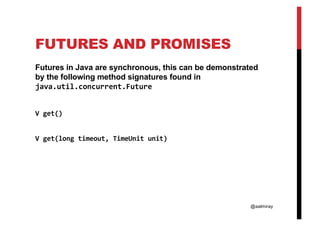
FUTURES AND PROMISES
Futures in Java are synchronous, this can be demonstrated
by the following method signatures found in
java.util.concurrent.Future
V get()
V get(long timeout, TimeUnit unit)
@aalmiray
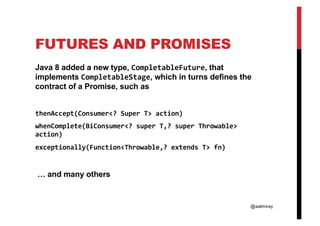
FUTURES AND PROMISES
Java 8 added a new type, CompletableFuture, that
implements CompletableStage, which in turns defines the
contract of a Promise, such as
thenAccept(Consumer<? Super T> action)
whenComplete(BiConsumer<? super T,? super Throwable>
action)
exceptionally(Function<Throwable,? extends T> fn)
… and many others
@aalmiray
FUTURES AND PROMISES
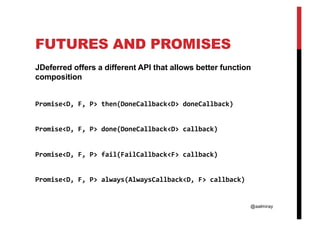
JDeferred offers a different API that allows better function
composition
Promise<D, F, P> then(DoneCallback<D> doneCallback)
Promise<D, F, P> done(DoneCallback<D> callback)
Promise<D, F, P> fail(FailCallback<F> callback)
Promise<D, F, P> always(AlwaysCallback<D, F> callback)
@aalmiray
EXAMPLES
@aalmiray
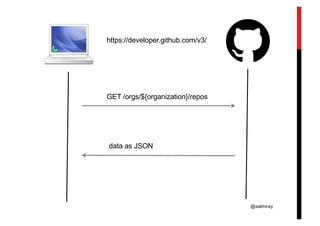
GET /orgs/${organization}/repos
data as JSON
https://developer.github.com/v3/
@aalmiray
CODE AVAILABLE AT
https://github.com/aalmiray/javatrove/
@aalmiray
IMPERATIVE :’(
@aalmiray
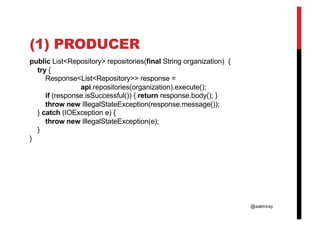
(1) PRODUCER
public List<Repository> repositories(final String organization) {
try {
Response<List<Repository>> response =
api.repositories(organization).execute();
if (response.isSuccessful()) { return response.body(); }
throw new IllegalStateException(response.message());
} catch (IOException e) {
throw new IllegalStateException(e);
}
}
@aalmiray
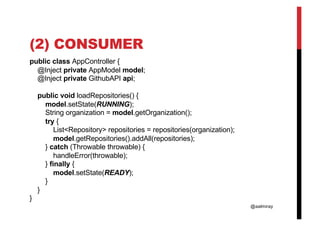
(2) CONSUMER
public class AppController {
@Inject private AppModel model;
@Inject private GithubAPI api;
public void loadRepositories() {
model.setState(RUNNING);
String organization = model.getOrganization();
try {
List<Repository> repositories = repositories(organization);
model.getRepositories().addAll(repositories);
} catch (Throwable throwable) {
handleError(throwable);
} finally {
model.setState(READY);
}
}
}
@aalmiray
PROMISES ;-)
(JAVA8)
@aalmiray
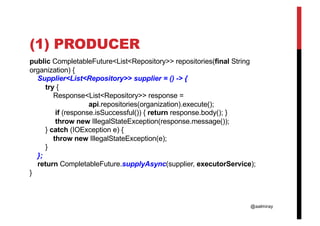
(1) PRODUCER
public CompletableFuture<List<Repository>> repositories(final String
organization) {
Supplier<List<Repository>> supplier = () -> {
try {
Response<List<Repository>> response =
api.repositories(organization).execute();
if (response.isSuccessful()) { return response.body(); }
throw new IllegalStateException(response.message());
} catch (IOException e) {
throw new IllegalStateException(e);
}
};
return CompletableFuture.supplyAsync(supplier, executorService);
}
@aalmiray
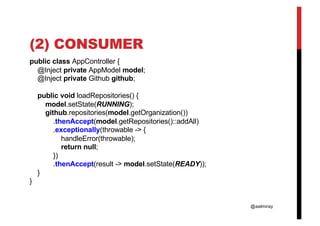
(2) CONSUMER
public class AppController {
@Inject private AppModel model;
@Inject private Github github;
public void loadRepositories() {
model.setState(RUNNING);
github.repositories(model.getOrganization())
.thenAccept(model.getRepositories()::addAll)
.exceptionally(throwable -> {
handleError(throwable);
return null;
})
.thenAccept(result -> model.setState(READY));
}
}
@aalmiray
PROMISES ;-)
(JDEFERRED)
@aalmiray
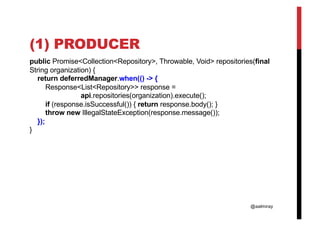
(1) PRODUCER
public Promise<Collection<Repository>, Throwable, Void> repositories(final
String organization) {
return deferredManager.when(() -> {
Response<List<Repository>> response =
api.repositories(organization).execute();
if (response.isSuccessful()) { return response.body(); }
throw new IllegalStateException(response.message());
});
}
@aalmiray
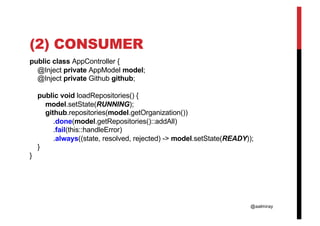
(2) CONSUMER
public class AppController {
@Inject private AppModel model;
@Inject private Github github;
public void loadRepositories() {
model.setState(RUNNING);
github.repositories(model.getOrganization())
.done(model.getRepositories()::addAll)
.fail(this::handleError)
.always((state, resolved, rejected) -> model.setState(READY));
}
}
@aalmiray
REACTIVE :D
(RXJAVA)
@aalmiray
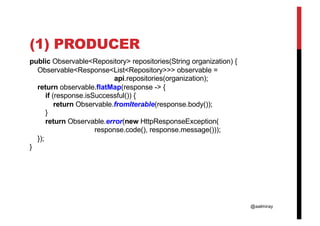
(1) PRODUCER
public Observable<Repository> repositories(String organization) {
Observable<Response<List<Repository>>> observable =
api.repositories(organization);
return observable.flatMap(response -> {
if (response.isSuccessful()) {
return Observable.fromIterable(response.body());
}
return Observable.error(new HttpResponseException(
response.code(), response.message()));
});
}
@aalmiray
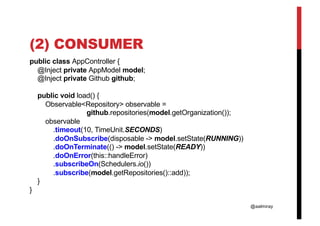
(2) CONSUMER
public class AppController {
@Inject private AppModel model;
@Inject private Github github;
public void load() {
Observable<Repository> observable =
github.repositories(model.getOrganization());
observable
.timeout(10, TimeUnit.SECONDS)
.doOnSubscribe(disposable -> model.setState(RUNNING))
.doOnTerminate(() -> model.setState(READY))
.doOnError(this::handleError)
.subscribeOn(Schedulers.io())
.subscribe(model.getRepositories()::add));
}
}
@aalmiray
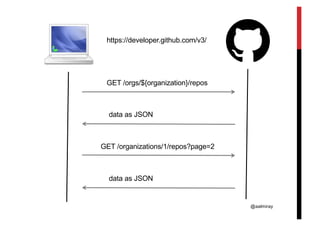
GET /orgs/${organization}/repos
data as JSON
data as JSON
https://developer.github.com/v3/
GET /organizations/1/repos?page=2
@aalmiray
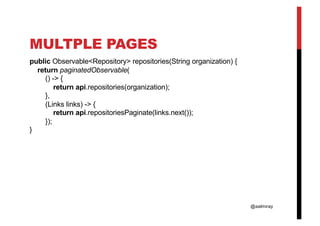
MULTPLE PAGES
public Observable<Repository> repositories(String organization) {
return paginatedObservable(
() -> {
return api.repositories(organization);
},
(Links links) -> {
return api.repositoriesPaginate(links.next());
});
}
@aalmiray
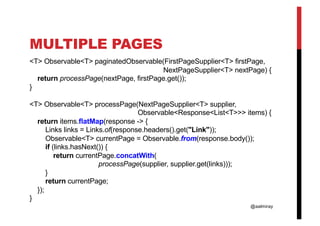
MULTIPLE PAGES
<T> Observable<T> paginatedObservable(FirstPageSupplier<T> firstPage,
NextPageSupplier<T> nextPage) {
return processPage(nextPage, firstPage.get());
}
<T> Observable<T> processPage(NextPageSupplier<T> supplier,
Observable<Response<List<T>>> items) {
return items.flatMap(response -> {
Links links = Links.of(response.headers().get("Link"));
Observable<T> currentPage = Observable.from(response.body());
if (links.hasNext()) {
return currentPage.concatWith(
processPage(supplier, supplier.get(links)));
}
return currentPage;
});
}
@aalmiray
HTTP://REACTIVEX.IO/
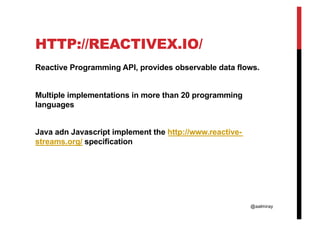
Reactive Programming API, provides observable data flows.
Multiple implementations in more than 20 programming
languages
Java adn Javascript implement the http://www.reactive-
streams.org/ specification
@aalmiray
HTTP://REACTIVEX.IO/
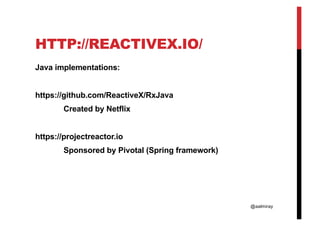
Java implementations:
https://github.com/ReactiveX/RxJava
Created by Netflix
https://projectreactor.io
Sponsored by Pivotal (Spring framework)
@aalmiray
DATA STREAMS
@aalmiray
DATA STREAMS
A sequence of values calculated over time.
Values are emitted when ready; they are computed without
blocking consumers.
Consumers listen to changes in the data stream and react to
said changes (hence the name Reactive Programming).
Push vs pull model.
@aalmiray
OBSERVABLE/OBSERVER
Data streams are of type Observable while consumer are of
type Observer.
The Observable type exposes multiple operations that allow
value composition, combinations, filtering, and other value
transformations.
NOTE: many operations from RxJava/Reactor generate a new
Observable (decorator pattern)
@aalmiray
OPERATIONS
(A SMALL SAMPLE OF)
@aalmiray
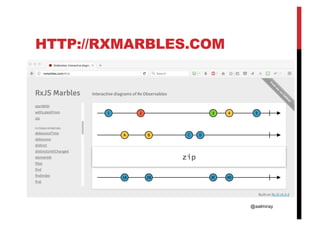
HTTP://RXMARBLES.COM
@aalmiray
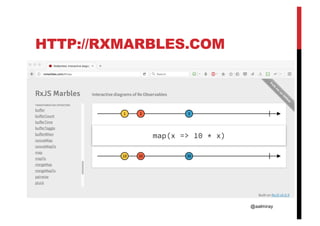
HTTP://RXMARBLES.COM
@aalmiray
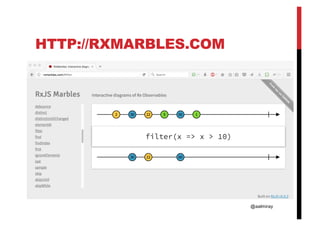
HTTP://RXMARBLES.COM
@aalmiray
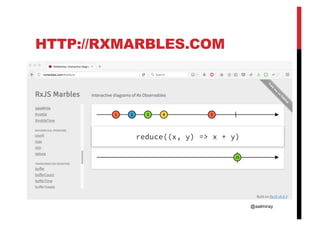
HTTP://RXMARBLES.COM
@aalmiray
HTTP://REACTIVEX.IO/RXJAVA/2.X/JAVADOC/INDEX.HTML
@aalmiray
FUNCTIONAL
PROGRAMMING
@aalmiray
FUNCTIONS
Functions should follow two concepts:
• Do not produce side effects during invocation.
• Given the same input they must produce the same output.
@aalmiray
IMMUTABILITY
Immutable data structures and/or data containers (POJOs)
complement Functional Programming in a natural way.
They allow data sharing with multiple consumers and/or
functions without fear of changes affecting the original data.
They help reduce synchronization points.
@aalmiray
OTHER OPTIONS
http://vertx.io/
Toolkit for reactive applications
Based on Netty.
https://grpc.io/
RPC framework.
Supports data streaming both ways
@aalmiray
RXGRPC
https://github.com/salesforce/reactive-grpc
Combines gRPC with Reactive Streams
Encapsulates gRPC’s API
Producers/Consumers only see Rx API
@aalmiray
THE FUTURE
@aalmiray
JAVA 9+ FLOW
Java 9 implements the Reactive Streams in its own way with
java.util.concurrent.Flow
This API allows combining streams from different providers
(RxJava, Reactor, etc).
Additions to the CompletableStage/CompletableFuture API.
@aalmiray
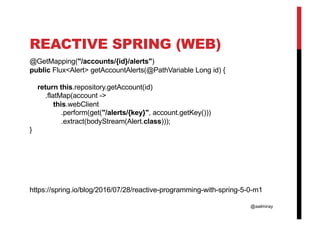
REACTIVE SPRING (WEB)
@GetMapping("/accounts/{id}/alerts")
public Flux<Alert> getAccountAlerts(@PathVariable Long id) {
return this.repository.getAccount(id)
.flatMap(account ->
this.webClient
.perform(get("/alerts/{key}", account.getKey()))
.extract(bodyStream(Alert.class)));
}
https://spring.io/blog/2016/07/28/reactive-programming-with-spring-5-0-m1
@aalmiray
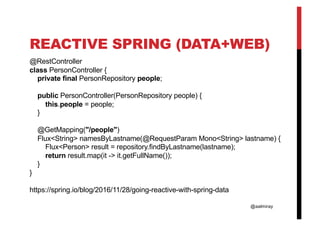
REACTIVE SPRING (DATA+WEB)
@RestController
class PersonController {
private final PersonRepository people;
public PersonController(PersonRepository people) {
this.people = people;
}
@GetMapping("/people")
Flux<String> namesByLastname(@RequestParam Mono<String> lastname) {
Flux<Person> result = repository.findByLastname(lastname);
return result.map(it -> it.getFullName());
}
}
https://spring.io/blog/2016/11/28/going-reactive-with-spring-data
@aalmiray
RESOURCES
http://download.java.net/java/jdk9/docs/api/java/util/concurrent/Flow.ht
ml
http://docs.oracle.com/javase/8/docs/api/java/util/concurrent/Completab
leFuture.html
http://jdeferred.org/
http://andresalmiray.com/articles/jdeferred-simple-handling-of-
promises-and-futures/
http://andresalmiray.com/articles/testing-rxjava2/
https://www.infoq.com/articles/rxjava2-by-example
@aalmiray
REACTIVE
PROGRAMMING
IMPLIES AND
PARADIGM
CHANGE!
@aalmiray
HTTP://ANDRESALMIRAY.COM/NEWSLETTER
HTTP://ANDRESALMIRAY.COM/EDITORIAL
@aalmiray
THANK YOU!
ANDRES ALMIRAY
@AALMIRAY
ANDRESALMIRAY.COM

Understanding Reactive Programming