IP Service Assurance Solutions for WiMAX Operators
WiMAX is the first commercially available and deployed 4G
wireless system. WiMAX uses all-IP network architecture that
enables operators the ability to offer multiple services over a
common platform while reducing operating and capital
expenditures, rapid service, and application introduction. To
successfully realize all the advantages of WiMAX, operators
require visibility into IP subscriber, service and network data.
The NetScoutnGenius® Service Assurance Solution provides
detailed IP level insight, end-to-end visibility and assurance into
the subscriber, network and service domains. This visibility
enables operators to manage the entire IP network, to monetize,
support the demand and growth for data, voice and video
services.
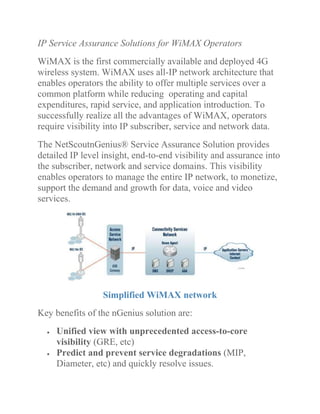
Simplified WiMAX network
Key benefits of the nGenius solution are:
Unified view with unprecedented access-to-core
visibility (GRE, etc)
Predict and prevent service degradations (MIP,
Diameter, etc) and quickly resolve issues.
Intuitive network and service
troubleshooting workflows.
Extensive back-in-time forensic analysis.
Full visibility into significant revenue (HSI, etc) and
over-the-top services.
Detailed drill-down into control, data and user domains
Broad support for WiMAX specific metrics (GRE, SIP,
etc.)
The nGenius Solution provides complete visibility, from KPIs to
flow data to packet details, into service metrics and statistical
information gathered by monitoring all key access-to-core
interfaces. The nGenius Service Assurance Solution leverages
intelligent deep packet capture and inspection technology to
deliver real-time service-level intelligence that spans from high
level services, application and conversation flow information all
the way down to actual packets. This enables WiMAX operators
to improve network, subscriber and service monitoring and
reduce time to repair.
Mobile IP in the WiMAX Environment
Worldwide Interoperability for Microwave Access (WiMAX) is
the international standard for wide area radio access networks. It
provides a framework for networks that are implemented in
different ways to successfully interoperate with mobile
subscribers that roam among the networks. This interoperability
enables the subscribers to be authenticated by their home
network wherever they roam, and to receive the services for
which they are authorized.
The Mobile IP home agent can operate in either of two access
modes, generic and WiMAX. The generic access type is
appropriate when the home agent is deployed in a generic
Mobile IP home network. When deployed as a home agent in a
WiMAX home connectivity services network (H-CSN), you
must configure the WiMAX access type. The WiMAX access
type enables the Mobile IP home agent to receive, process, and
send WiMAX vendor-specific attributes (VSAs) that are used by
AAA and the RADIUS server to authenticate the mobile
subscriber. When the access type is generic, the Mobile IP home
agent cannot handle these VSAs.
A WiMAX H-CSN is analogous to the Mobile IP home network
for non-WiMAX implementations. When WiMAX is enabled
for the Mobile IP home agent in an H-CSN, the Mobile IP home
agent triggers subscriber authentication when the agent receives
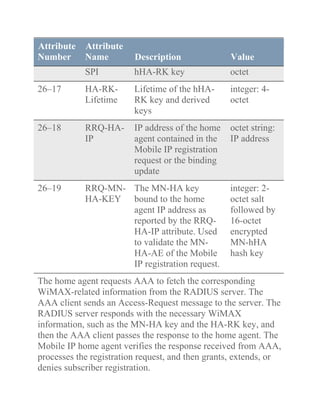
the registration request. The home agent stores WiMAX Forum
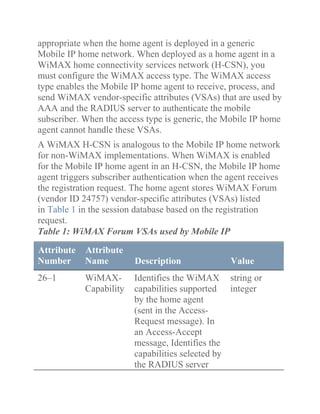
(vendor ID 24757) vendor-specific attributes (VSAs) listed
in Table 1 in the session database based on the registration
request.
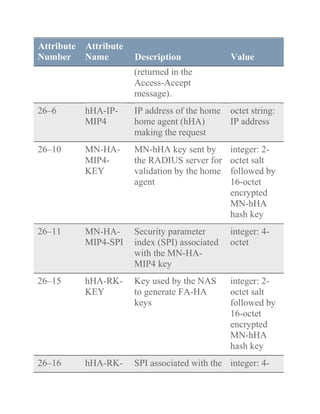
Table 1: WiMAX Forum VSAs used by Mobile IP
Attribute
Number
Attribute
Name Description Value
26–1 WiMAX-
Capability
Identifies the WiMAX
capabilities supported
by the home agent
(sent in the Access-
Request message). In
an Access-Accept
message, Identifies the
capabilities selected by
the RADIUS server
string or
integer
Attribute
Number
Attribute
Name Description Value
(returned in the
Access-Accept
message).
26–6 hHA-IP-
MIP4
IP address of the home
home agent (hHA)
making the request
octet string:
IP address
26–10 MN-HA-
MIP4-
KEY
MN-hHA key sent by
the RADIUS server for
validation by the home
agent
integer: 2-
octet salt
followed by
16-octet
encrypted
MN-hHA
hash key
26–11 MN-HA-
MIP4-SPI
Security parameter
index (SPI) associated
with the MN-HA-
MIP4 key
integer: 4-
octet
26–15 hHA-RK-
KEY
Key used by the NAS
to generate FA-HA
keys
integer: 2-
octet salt
followed by
16-octet
encrypted
MN-hHA
hash key
26–16 hHA-RK- SPI associated with the integer: 4-
Attribute
Number
Attribute
Name Description Value
SPI hHA-RK key octet
26–17 HA-RK-
Lifetime
Lifetime of the hHA-
RK key and derived
keys
integer: 4-
octet
26–18 RRQ-HA-
IP
IP address of the home
agent contained in the
Mobile IP registration
request or the binding
update
octet string:
IP address
26–19 RRQ-MN-
HA-KEY
The MN-HA key
bound to the home
agent IP address as
reported by the RRQ-
HA-IP attribute. Used
to validate the MN-
HA-AE of the Mobile
IP registration request.
integer: 2-
octet salt
followed by
16-octet
encrypted
MN-hHA
hash key
The home agent requests AAA to fetch the corresponding
WiMAX-related information from the RADIUS server. The
AAA client sends an Access-Request message to the server. The
RADIUS server responds with the necessary WiMAX
information, such as the MN-HA key and the HA-RK key, and
then the AAA client passes the response to the home agent. The
Mobile IP home agent verifies the response received from AAA,
processes the registration request, and then grants, extends, or
denies subscriber registration.
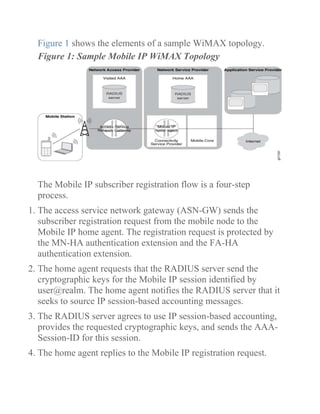
Figure 1 shows the elements of a sample WiMAX topology.
Figure 1: Sample Mobile IP WiMAX Topology
The Mobile IP subscriber registration flow is a four-step
process.
1. The access service network gateway (ASN-GW) sends the
subscriber registration request from the mobile node to the
Mobile IP home agent. The registration request is protected by
the MN-HA authentication extension and the FA-HA
authentication extension.
2. The home agent requests that the RADIUS server send the
cryptographic keys for the Mobile IP session identified by
user@realm. The home agent notifies the RADIUS server that it
seeks to source IP session-based accounting messages.
3. The RADIUS server agrees to use IP session-based accounting,
provides the requested cryptographic keys, and sends the AAA-
Session-ID for this session.
4. The home agent replies to the Mobile IP registration request.
Reauthentication of WiMAX subscribers is not currently
supported.
You can configure the Mobile IP home agent for WiMAX
access by including the wimax statement at the [edit services
mobile-ip access-type] hierarchy level. You can prevent the
Mobile IP home agent from being able to process WiMAX
VSAs by either removing the wimax statement at the [edit
services mobile-ip access-type] hierarchy level or by including
the generic statement at the [edit services mobile-ip access-type]
hierarchy level. The default access type for Mobile IP home
agent is generic.

Ip service assurance solutions for wimax operators.. Giải pháp IP cho nhà khái thác wimax

  • 1.
    IP Service AssuranceSolutions for WiMAX Operators WiMAX is the first commercially available and deployed 4G wireless system. WiMAX uses all-IP network architecture that enables operators the ability to offer multiple services over a common platform while reducing operating and capital expenditures, rapid service, and application introduction. To successfully realize all the advantages of WiMAX, operators require visibility into IP subscriber, service and network data. The NetScoutnGenius® Service Assurance Solution provides detailed IP level insight, end-to-end visibility and assurance into the subscriber, network and service domains. This visibility enables operators to manage the entire IP network, to monetize, support the demand and growth for data, voice and video services. Simplified WiMAX network Key benefits of the nGenius solution are: Unified view with unprecedented access-to-core visibility (GRE, etc) Predict and prevent service degradations (MIP, Diameter, etc) and quickly resolve issues.
  • 2.
    Intuitive network andservice troubleshooting workflows. Extensive back-in-time forensic analysis. Full visibility into significant revenue (HSI, etc) and over-the-top services. Detailed drill-down into control, data and user domains Broad support for WiMAX specific metrics (GRE, SIP, etc.) The nGenius Solution provides complete visibility, from KPIs to flow data to packet details, into service metrics and statistical information gathered by monitoring all key access-to-core interfaces. The nGenius Service Assurance Solution leverages intelligent deep packet capture and inspection technology to deliver real-time service-level intelligence that spans from high level services, application and conversation flow information all the way down to actual packets. This enables WiMAX operators to improve network, subscriber and service monitoring and reduce time to repair. Mobile IP in the WiMAX Environment Worldwide Interoperability for Microwave Access (WiMAX) is the international standard for wide area radio access networks. It provides a framework for networks that are implemented in different ways to successfully interoperate with mobile subscribers that roam among the networks. This interoperability enables the subscribers to be authenticated by their home network wherever they roam, and to receive the services for which they are authorized. The Mobile IP home agent can operate in either of two access modes, generic and WiMAX. The generic access type is
  • 3.
    appropriate when thehome agent is deployed in a generic Mobile IP home network. When deployed as a home agent in a WiMAX home connectivity services network (H-CSN), you must configure the WiMAX access type. The WiMAX access type enables the Mobile IP home agent to receive, process, and send WiMAX vendor-specific attributes (VSAs) that are used by AAA and the RADIUS server to authenticate the mobile subscriber. When the access type is generic, the Mobile IP home agent cannot handle these VSAs. A WiMAX H-CSN is analogous to the Mobile IP home network for non-WiMAX implementations. When WiMAX is enabled for the Mobile IP home agent in an H-CSN, the Mobile IP home agent triggers subscriber authentication when the agent receives the registration request. The home agent stores WiMAX Forum (vendor ID 24757) vendor-specific attributes (VSAs) listed in Table 1 in the session database based on the registration request. Table 1: WiMAX Forum VSAs used by Mobile IP Attribute Number Attribute Name Description Value 26–1 WiMAX- Capability Identifies the WiMAX capabilities supported by the home agent (sent in the Access- Request message). In an Access-Accept message, Identifies the capabilities selected by the RADIUS server string or integer
  • 4.
    Attribute Number Attribute Name Description Value (returnedin the Access-Accept message). 26–6 hHA-IP- MIP4 IP address of the home home agent (hHA) making the request octet string: IP address 26–10 MN-HA- MIP4- KEY MN-hHA key sent by the RADIUS server for validation by the home agent integer: 2- octet salt followed by 16-octet encrypted MN-hHA hash key 26–11 MN-HA- MIP4-SPI Security parameter index (SPI) associated with the MN-HA- MIP4 key integer: 4- octet 26–15 hHA-RK- KEY Key used by the NAS to generate FA-HA keys integer: 2- octet salt followed by 16-octet encrypted MN-hHA hash key 26–16 hHA-RK- SPI associated with the integer: 4-
  • 5.
    Attribute Number Attribute Name Description Value SPIhHA-RK key octet 26–17 HA-RK- Lifetime Lifetime of the hHA- RK key and derived keys integer: 4- octet 26–18 RRQ-HA- IP IP address of the home agent contained in the Mobile IP registration request or the binding update octet string: IP address 26–19 RRQ-MN- HA-KEY The MN-HA key bound to the home agent IP address as reported by the RRQ- HA-IP attribute. Used to validate the MN- HA-AE of the Mobile IP registration request. integer: 2- octet salt followed by 16-octet encrypted MN-hHA hash key The home agent requests AAA to fetch the corresponding WiMAX-related information from the RADIUS server. The AAA client sends an Access-Request message to the server. The RADIUS server responds with the necessary WiMAX information, such as the MN-HA key and the HA-RK key, and then the AAA client passes the response to the home agent. The Mobile IP home agent verifies the response received from AAA, processes the registration request, and then grants, extends, or denies subscriber registration.
  • 6.
    Figure 1 showsthe elements of a sample WiMAX topology. Figure 1: Sample Mobile IP WiMAX Topology The Mobile IP subscriber registration flow is a four-step process. 1. The access service network gateway (ASN-GW) sends the subscriber registration request from the mobile node to the Mobile IP home agent. The registration request is protected by the MN-HA authentication extension and the FA-HA authentication extension. 2. The home agent requests that the RADIUS server send the cryptographic keys for the Mobile IP session identified by user@realm. The home agent notifies the RADIUS server that it seeks to source IP session-based accounting messages. 3. The RADIUS server agrees to use IP session-based accounting, provides the requested cryptographic keys, and sends the AAA- Session-ID for this session. 4. The home agent replies to the Mobile IP registration request.
  • 7.
    Reauthentication of WiMAXsubscribers is not currently supported. You can configure the Mobile IP home agent for WiMAX access by including the wimax statement at the [edit services mobile-ip access-type] hierarchy level. You can prevent the Mobile IP home agent from being able to process WiMAX VSAs by either removing the wimax statement at the [edit services mobile-ip access-type] hierarchy level or by including the generic statement at the [edit services mobile-ip access-type] hierarchy level. The default access type for Mobile IP home agent is generic.