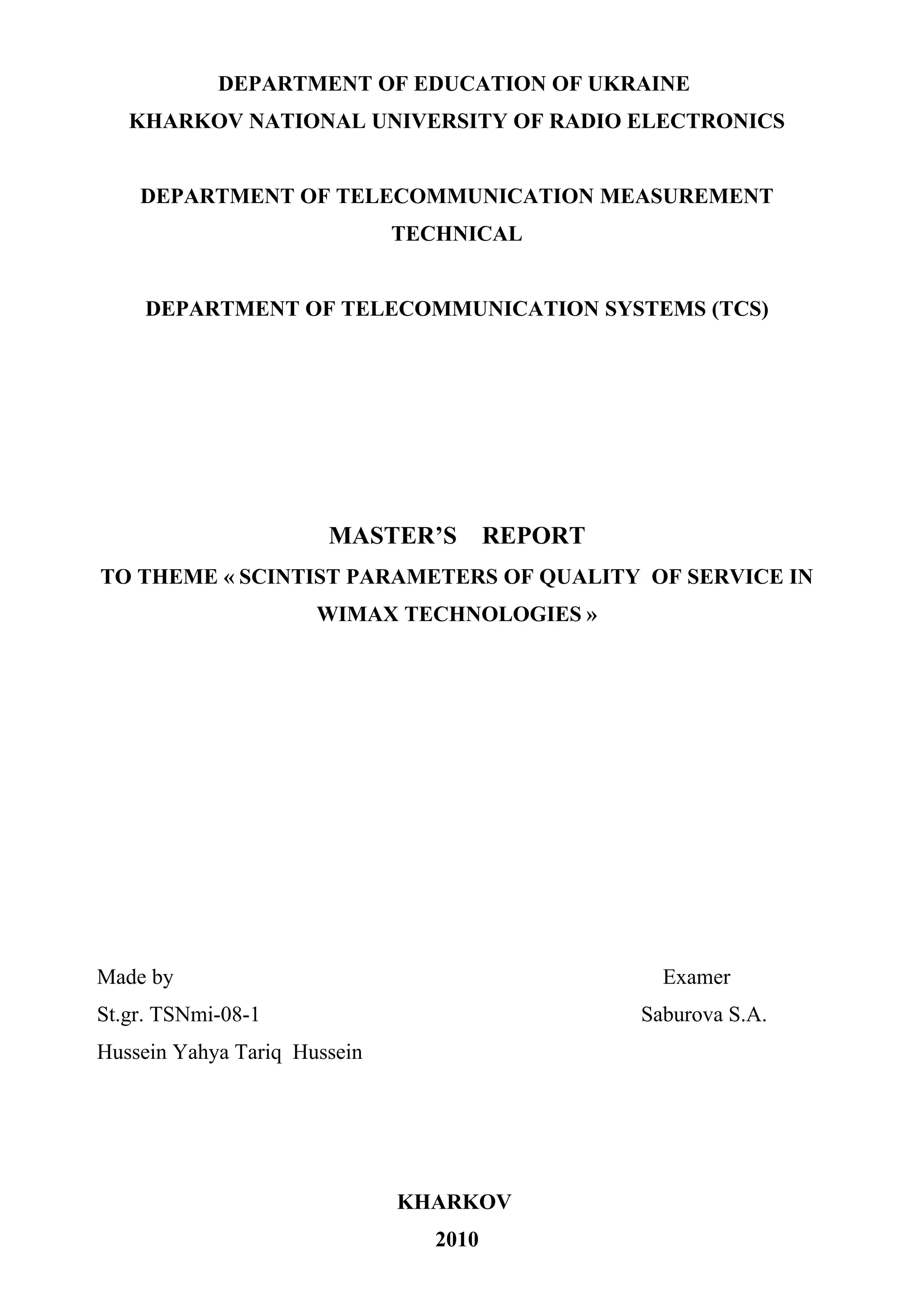
DEPARTMENT OF EDUCATION OF UKRAINE
   KHARKOV NATIONAL UNIVERSITY OF RADIO ELECTRONICS


    DEPARTMENT OF TELECOMMUNICATION MEASUREMENT
                              TECHNICAL


     DEPARTMENT OF TELECOMMUNICATION SYSTEMS (ТСS)


                       MASTER’S         REPORT
TO THEME « SCINTIST PARAMETERS OF QUALITY OF SERVICE IN
                      WIMAX TECHNOLOGIES »


Made by                                            Examer
St.gr. TSNmi-08-1                                Saburova S.A.
Hussein Yahya Tariq Hussein


                              KHARKOV
                                 2010
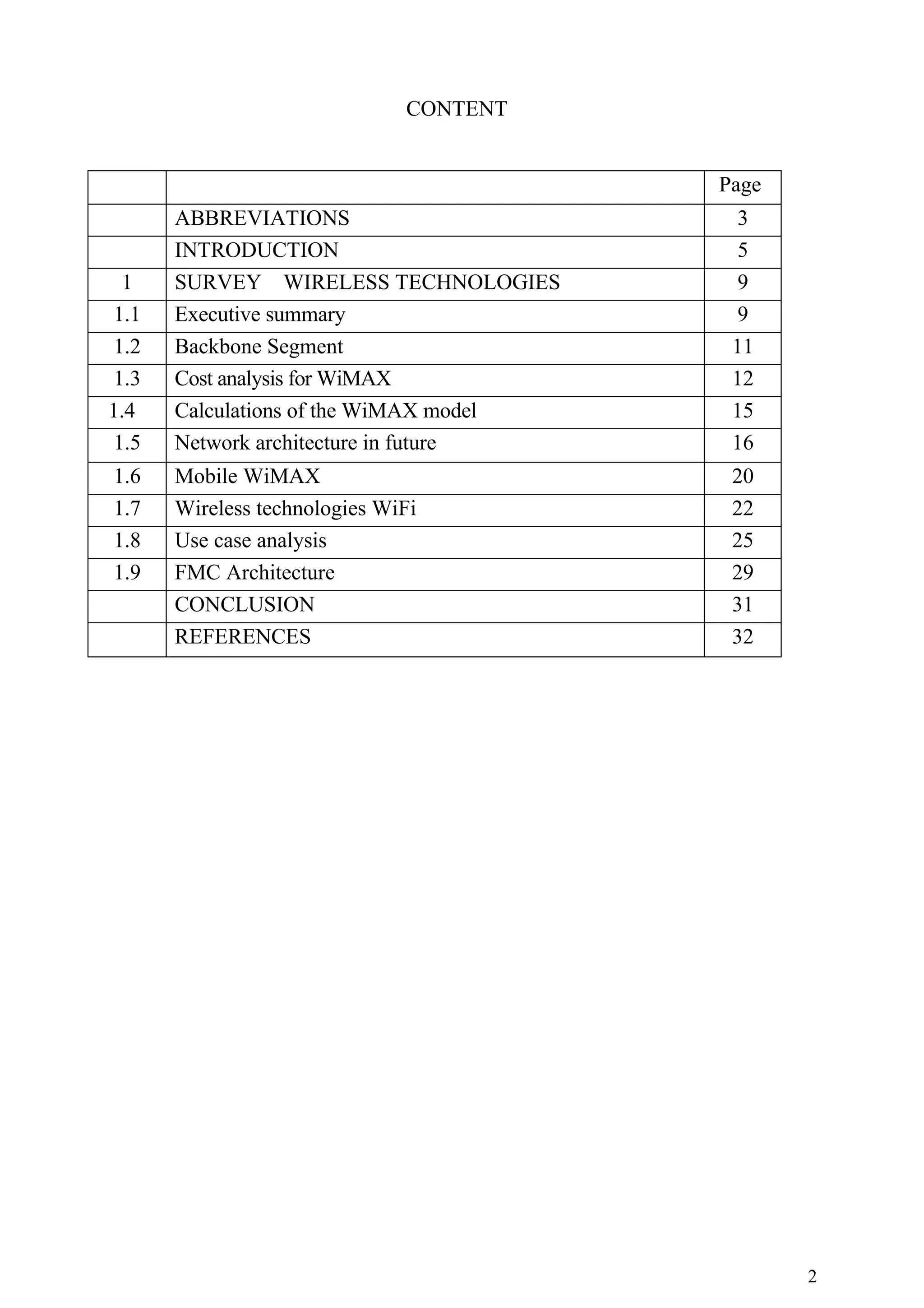
CONTENT


                                        Page
      ABBREVIATIONS                       3
      INTRODUCTION                        5
 1    SURVEY WIRELESS TECHNOLOGIES        9
1.1   Executive summary                   9
1.2   Backbone Segment                   11
1.3   Cost analysis for WiMAX            12
1.4   Calculations of the WiMAX model    15
1.5   Network architecture in future     16
1.6   Mobile WiMAX                       20
1.7   Wireless technologies WiFi         22
1.8   Use case analysis                  25
1.9   FMC Architecture                   29
      CONCLUSION                         31
      REFERENCES                         32


                                               2
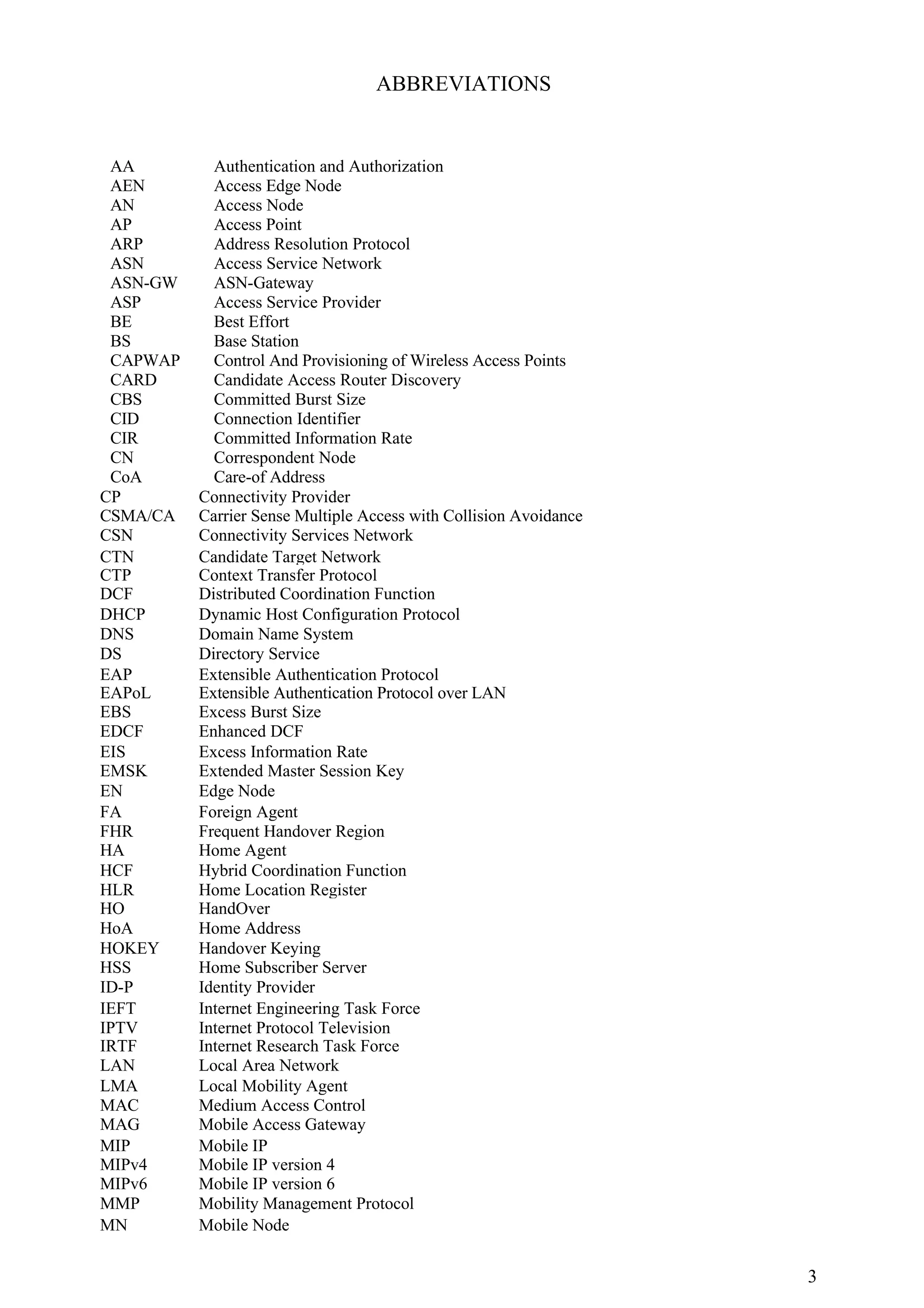
ABBREVIATIONS


 AA         Authentication and Authorization
 AEN        Access Edge Node
 AN         Access Node
 AP         Access Point
 ARP        Address Resolution Protocol
 ASN        Access Service Network
 ASN-GW     ASN-Gateway
 ASP        Access Service Provider
 BE         Best Effort
 BS         Base Station
 CAPWAP     Control And Provisioning of Wireless Access Points
 CARD       Candidate Access Router Discovery
 CBS        Committed Burst Size
 CID        Connection Identifier
 CIR        Committed Information Rate
 CN         Correspondent Node
 CoA        Care-of Address
CP        Connectivity Provider
CSMA/CA   Carrier Sense Multiple Access with Collision Avoidance
CSN       Connectivity Services Network
CTN       Candidate Target Network
CTP       Context Transfer Protocol
DCF       Distributed Coordination Function
DHCP      Dynamic Host Configuration Protocol
DNS       Domain Name System
DS        Directory Service
EAP       Extensible Authentication Protocol
EAPoL     Extensible Authentication Protocol over LAN
EBS       Excess Burst Size
EDCF      Enhanced DCF
EIS       Excess Information Rate
EMSK      Extended Master Session Key
EN        Edge Node
FA        Foreign Agent
FHR       Frequent Handover Region
HA        Home Agent
HCF       Hybrid Coordination Function
HLR       Home Location Register
HO        HandOver
HoA       Home Address
HOKEY     Handover Keying
HSS       Home Subscriber Server
ID-P      Identity Provider
IEFT      Internet Engineering Task Force
IPTV      Internet Protocol Television
IRTF      Internet Research Task Force
LAN       Local Area Network
LMA       Local Mobility Agent
MAC       Medium Access Control
MAG       Mobile Access Gateway
MIP       Mobile IP
MIPv4     Mobile IP version 4
MIPv6     Mobile IP version 6
MMP       Mobility Management Protocol
MN        Mobile Node


                                                                   3
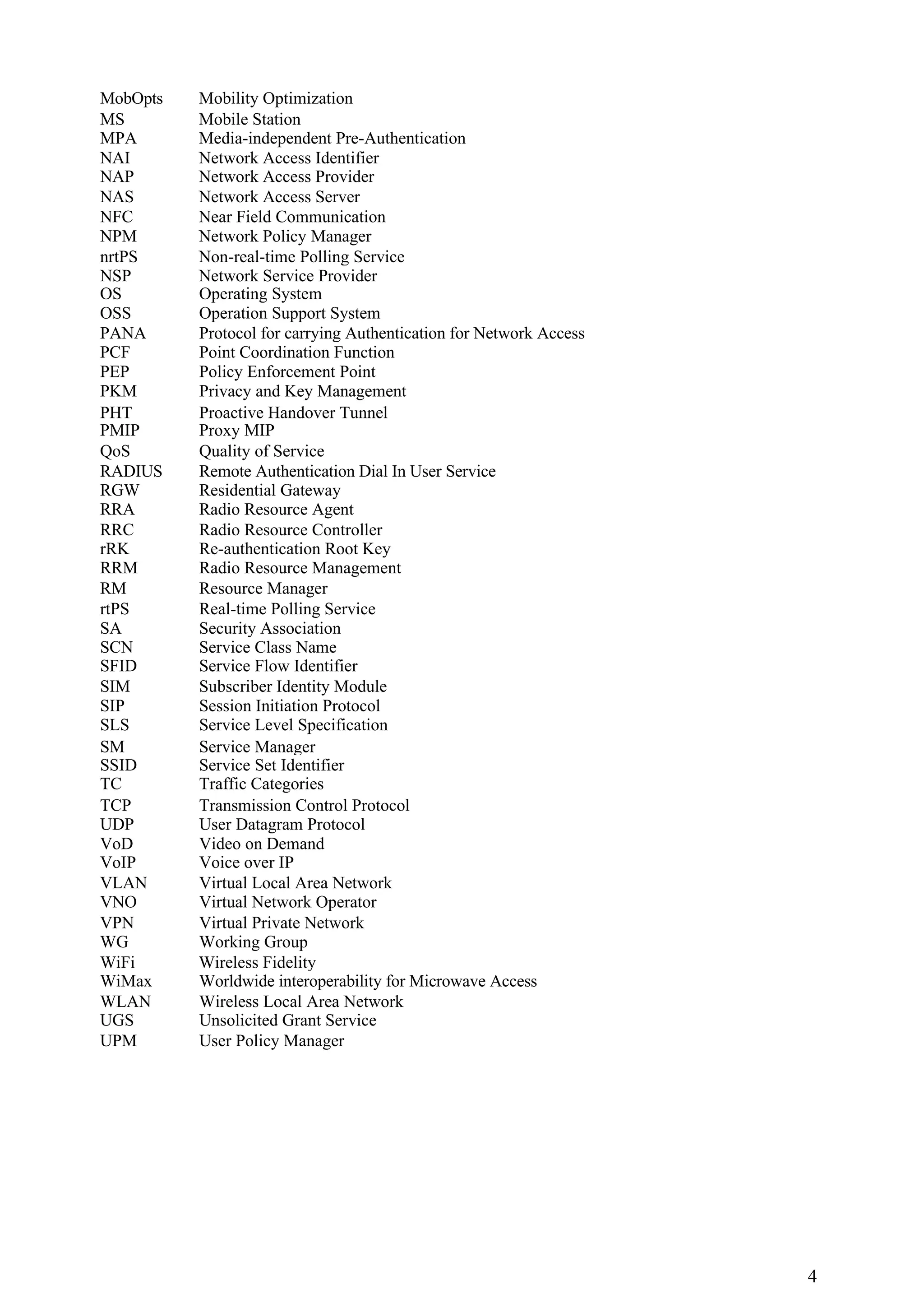
MobOpts   Mobility Optimization
MS        Mobile Station
MPA       Media-independent Pre-Authentication
NAI       Network Access Identifier
NAP       Network Access Provider
NAS       Network Access Server
NFC       Near Field Communication
NPM       Network Policy Manager
nrtPS     Non-real-time Polling Service
NSP       Network Service Provider
OS        Operating System
OSS       Operation Support System
PANA      Protocol for carrying Authentication for Network Access
PCF       Point Coordination Function
PEP       Policy Enforcement Point
PKM       Privacy and Key Management
PHT       Proactive Handover Tunnel
PMIP      Proxy MIP
QoS       Quality of Service
RADIUS    Remote Authentication Dial In User Service
RGW       Residential Gateway
RRA       Radio Resource Agent
RRC       Radio Resource Controller
rRK       Re-authentication Root Key
RRM       Radio Resource Management
RM        Resource Manager
rtPS      Real-time Polling Service
SA        Security Association
SCN       Service Class Name
SFID      Service Flow Identifier
SIM       Subscriber Identity Module
SIP       Session Initiation Protocol
SLS       Service Level Specification
SM        Service Manager
SSID      Service Set Identifier
TC        Traffic Categories
TCP       Transmission Control Protocol
UDP       User Datagram Protocol
VoD       Video on Demand
VoIP      Voice over IP
VLAN      Virtual Local Area Network
VNO       Virtual Network Operator
VPN       Virtual Private Network
WG        Working Group
WiFi      Wireless Fidelity
WiMax     Worldwide interoperability for Microwave Access
WLAN      Wireless Local Area Network
UGS       Unsolicited Grant Service
UPM       User Policy Manager


                                                                    4
INTRODUCTION

      The objective of this study is to create an up-dated techno-economic model
for comparing different ways of deploying broadband communication networks
and services. The resulting simulation model Capital Expenditure (CAPEX) of
different implementation strategies comprising of predefined access technologies,
service profiles, and geographical scenarios. More specifically the model shall
include the following components (definitions and term descriptions follow later in
the report):
      Access Technologies:
      ·        ADSL
      ·        ADSL2+
      ·        HFC Cable modem
      ·        FTTH
      ·        WiMax
      Service Profiles:
      ·        S1: Slow Internet Browsing
      ·        S2: Fast Internet Browsing
      ·        S3: Multimedia
      ·        S4: Interactive Multimedia
      Geographical Profiles:
      ·        Urban
      ·        Suburban
      ·        Rural
      Scenarios:
      ·        Greenfield
      ·        Existing Infrastructure Upgrade


                                                                                 5
Methodology and Relation to other Research Projects
      The model developed in this report draws on the work carried out in various
other research projects. The terminology, methodology, and theoretical framework
are influenced by European techno-economic research projects:
       TONIC, TETRA, ECOSYS and BROADWAN while the infrastructure and
technology aspects draw from BREAD, FAN and BROADWAN. More specifically
the relationship to these projects is as follows:
      BREAD
      Broadband in Europe for All: a multi-disciplinary approach aims at
developing a roadmap for the deployment of broadband and realisation of the
'broadband for all' concept within Europe. This report relies on the access and
backbone network overview provided in deliverable 2 [2]
      TONIC
      IST-2000-25172 TONIC (TechnO-EcoNomICs of IP optimised networks
and services) concentrates on techno-economic evaluation of new communication
networks and services. Following up on older projects, TONIC was carried out in
1998-2002 and provides the foundation of most theoretical and methodological
work on techno-economic studies. This project therefore provided a starting point
for development of the simulation model [11].
      ECOSYS
      An ongoing research project on the techno-economics of integrated
communication systems and services. The most interesting part of the ECOSYS
project for this study is the advancement and evolution of the theoretical and
methodological     framework      developed    for   techno-economic   analysis   of
telecommunications networks in the TONIC project. [5]
      BROADWAN
      The goal of the “Broadband services for everyone over fixed wireless
access networks” is to investigate how wireless networks can be used to provide
true broadband services.


                                                                                  6
The most interesting aspects of the BROADWAN project for this study is
the analysis of market potential and deployment scenarios and future development
of wireless access technologies. Additionally, the project has developed a
simulation model for deployment cost based on methods developed in the TONIC
project. [3]
      FAN
EURESCOM P1117-FAN evaluates the technical specifications of future access
networks, the impact of IP and infrastructure architectures. For this report it was
used to reinforce the infrastructure and access technology selection. [6,7]
      Model Structure and Functionality
      The overall model structure is based on dividing the network into two
segments: Access Segment and Backbone Segment. The Access Segment covers
the so called “first mile” from user premises to an aggregation node in the
respective zone. This part is characterized by a diversity of transmission media
(copper, fibre, cable, radio), and topologies (star, tree).
      Several technical solutions exist for provision of broadband to customers in
different types of demographic areas.
      Research indicates that the future market will be characterised by different
coexisting technologies, the choice of which is determined by technological
capabilities as well as economic factors.
      The BREAD project has on basis of results from other projects in the EU
Framework Program 6 analysed technological alternatives, future trends, and
status of broadband initiatives. Results from following European techno-economic
projects have been applied in the modelling work: BREA D, TONIC, ECOSYS,
BROADWAN and FAN. For the purpose of this report techno-economic methods
are used to analysed and compare deployment scenarios for five of the most
widely used technological alternatives. A simulation model has been developed to
examine the effect of influential factors, such as transmission speed and level of
existing infrastructure, in providing broadband connectivity in urban, suburban
and rural areas. For those technologies building on use of existing infrastructures
calculations are made both for a two different scenarios: Upgrade of existing
infrastructures and greenfield.
                                                                                 7
The strength of this study in comparison to many of the detailed feasibility
studies of broadband deployment is the general overview and comparison of the
deployment cost for different technologies and deployment scenarios.
       The goal of this study is therefore to provide rough estimates that indicate
competitive strengths and weaknesses of technologies, rather than to aid in
execution. In the absence of reliable data on operational cost from operators, the
model only calculates CAPEX.
      This century, wireless has grown rapidly as one of the most cost effective
ways of delivering broadband to rural areas. The main reasons are:
      •Wireless equipment has dropped in price, reducing the cost for

      organisations wishing to deliver data over wireless.
      •Availability of radio spectrum – no need to obtain a license before

      providing a service.
•Low cost end user equipment.
There are a number of different types of wireless broadband, each offering
different levels of performance, security and robustness. This paper will cover
some of the main technologies and examine the issues around them. It focuses on
wireless technologies that are being used to deliver broadband in rural areas now.
      The key technologies which will be discussed are:
      •WiFi
      •WiMax
      •GPRS / 3G
      This report does not aim to be overtly technical and is aimed at people who
are working to provide broadband in rural areas. It looks at services that end users
can access directly and will not cover microwave and other carrier class wireless
technologies.
      The report gives an overview of the benefits and disadvantages. We then
look at the radio spectrum to how this impacts on service delivery. The main
technologies are then examined, with a look at what will happen in the future.
      In master’s report about externship is present “SURVEY WIRELESS
TECHNOLOG”


                                                                                     8
1 SURVEY WIRELESS TECHNOLOGIES

      1.1 Executive summary


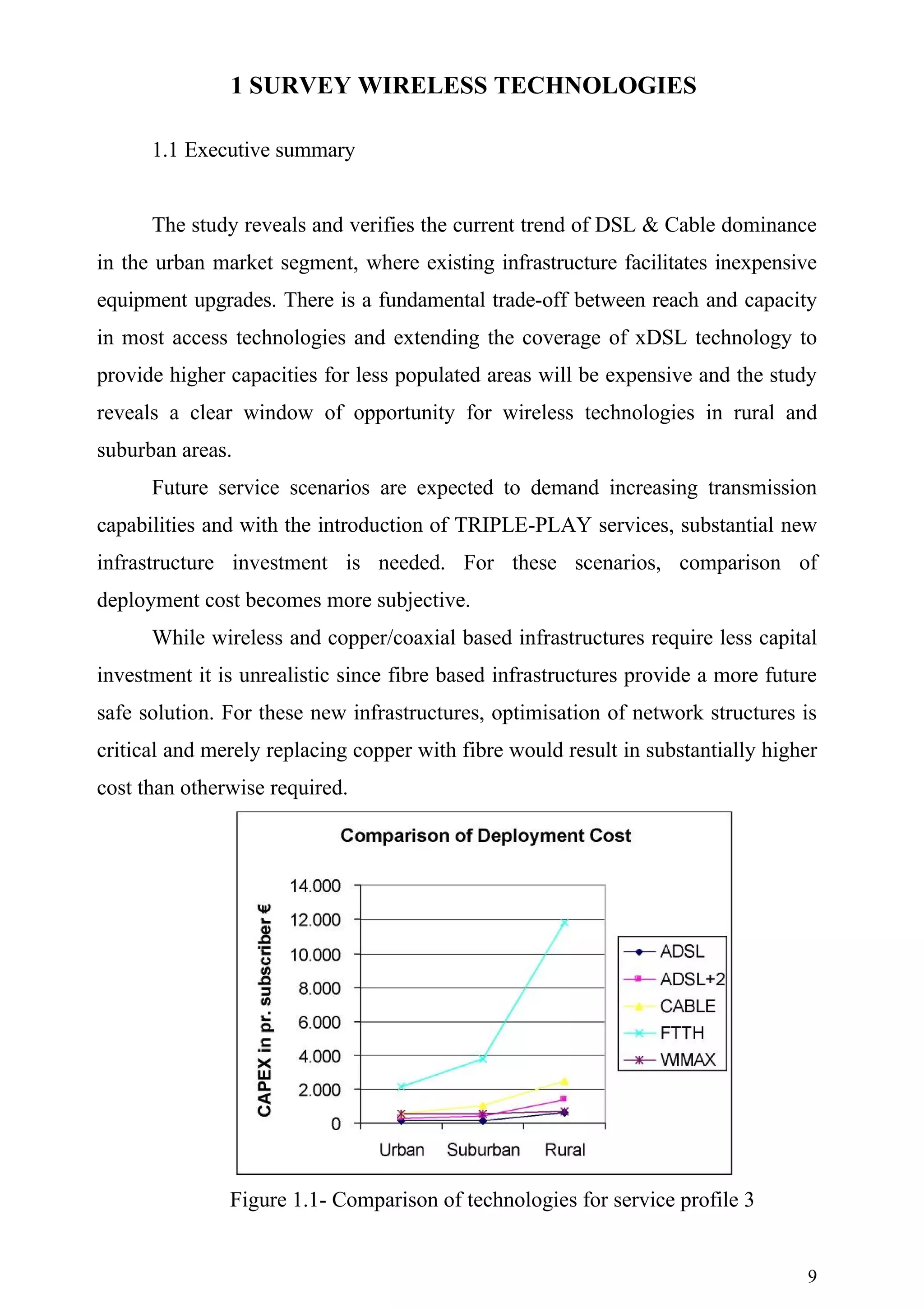
      The study reveals and verifies the current trend of DSL & Cable dominance
in the urban market segment, where existing infrastructure facilitates inexpensive
equipment upgrades. There is a fundamental trade-off between reach and capacity
in most access technologies and extending the coverage of xDSL technology to
provide higher capacities for less populated areas will be expensive and the study
reveals a clear window of opportunity for wireless technologies in rural and
suburban areas.
      Future service scenarios are expected to demand increasing transmission
capabilities and with the introduction of TRIPLE-PLAY services, substantial new
infrastructure investment is needed. For these scenarios, comparison of
deployment cost becomes more subjective.
      While wireless and copper/coaxial based infrastructures require less capital
investment it is unrealistic since fibre based infrastructures provide a more future
safe solution. For these new infrastructures, optimisation of network structures is
critical and merely replacing copper with fibre would result in substantially higher
cost than otherwise required.


               Figure 1.1- Comparison of technologies for service profile 3


                                                                                  9
The cost study examines CAPEX cost structures involved in deployment of
DSL, HFC, FTTH and wireless technologies (WiMAX). The study reveals
difference in cost structures between technologies and their ability to handle
varying services and transmission speeds. The study reveals that currently all
technologies are competitive in the urban settings, with the exception of FTTH,
which is only feasible if other groundwork is carried out at the same time.
      For the suburban and rural areas, there will be a gap between those living in
the vicinity of existing telecommunications infrastructure, such as PSTN, and
those living further away.
      Although detached DSLAMs have the possibility of decreasing this gap for
DSL, the additional cost of establishing a backbone fibre connection to these
aggregation points results in a ten times higher cost. For these users, WIMAX
provides and excellent short-term solution for providing internet connectivity. The
drawback of WiMAX is the temporary nature due to expensive transmission pr.
bit and thus high upgrade costs for increased throughput.
      In all areas, FTTH provides an expensive but future-proof solution. Our
analysis shows that roughly 60% of the CAPEX for FTTH in all scenarios is due
to civil work, ducts, and cables. In rural and suburban areas, the result of this could
be smaller deployment zones where citizens reduce the cost by participating in
ground work, and / or local governments reduce the cost by granting connectivity
to established backbone networks.
      Of the technologies studied, DSL and cable modem (HFC) are currently by
far the most dominating broadband access technologies worldwide in terms of
volume. These two technologies are now quite mature – a fact that is reflected in
the price evolution of equipment during the past few years. Given a similar
evolution for fibre and wireless equipment, the dominant cost component,
Customer Premises Equipment, will greatly improve competitiveness in urban
areas, and similarly advanced digging methods have the potentials of greatly
reducing the dominant cost of civil work of fibre in rural areas.


                                                                                    10
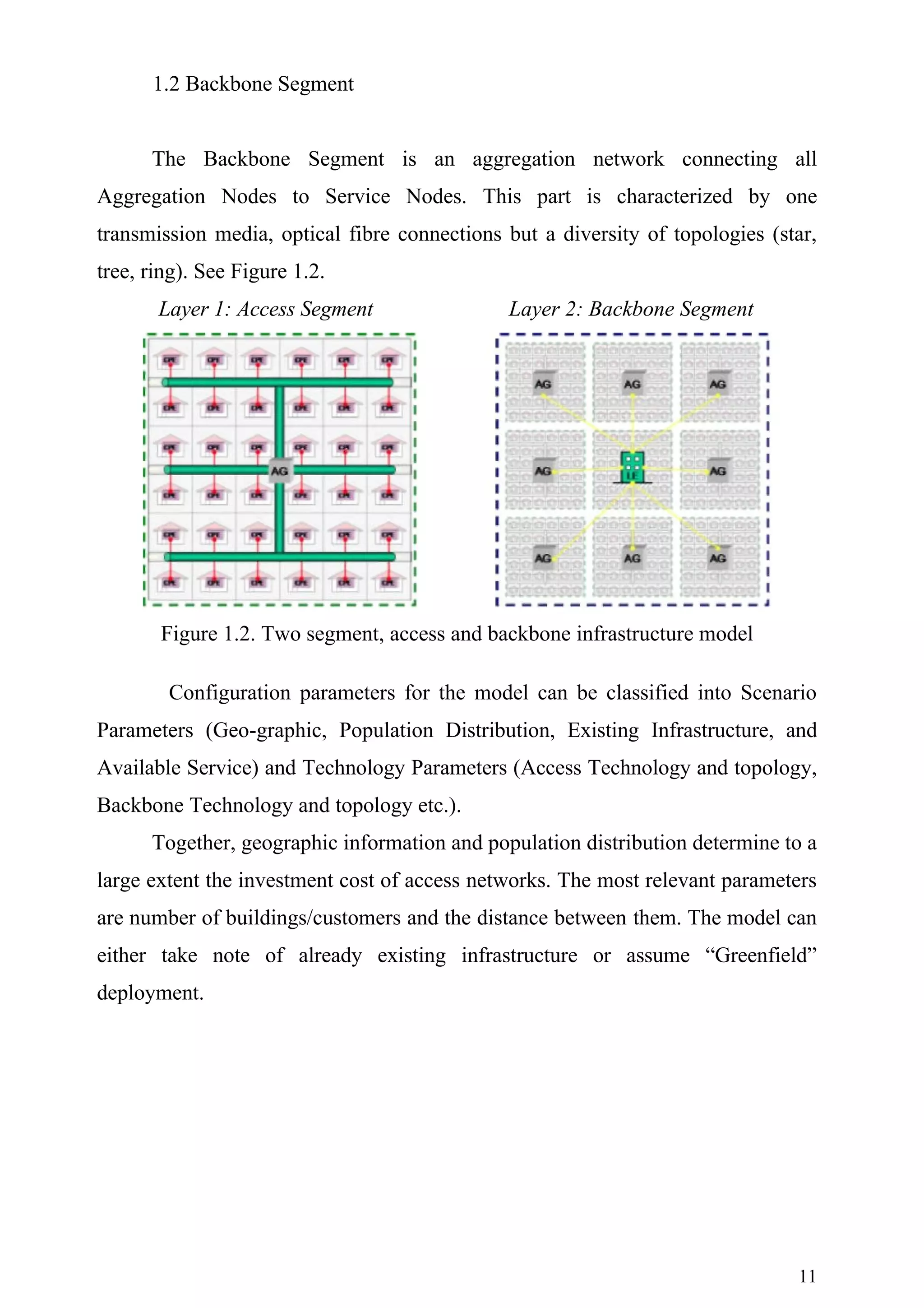
1.2 Backbone Segment


      The Backbone Segment is an aggregation network connecting all
Aggregation Nodes to Service Nodes. This part is characterized by one
transmission media, optical fibre connections but a diversity of topologies (star,
tree, ring). See Figure 1.2.
       Layer 1: Access Segment                Layer 2: Backbone Segment


       Figure 1.2. Two segment, access and backbone infrastructure model

        Configuration parameters for the model can be classified into Scenario
Parameters (Geo-graphic, Population Distribution, Existing Infrastructure, and
Available Service) and Technology Parameters (Access Technology and topology,
Backbone Technology and topology etc.).
      Together, geographic information and population distribution determine to a
large extent the investment cost of access networks. The most relevant parameters
are number of buildings/customers and the distance between them. The model can
either take note of already existing infrastructure or assume “Greenfield”
deployment.


                                                                               11
1.3 Cost analysis for WiMAX

      WiMAX: WiMAX refers to broadband wireless networks that are based on
the IEEE 802.16 standard, which ensures compatibility and interoperability
between broadband wireless access equipment. WiMAX, is an acronym that
stands for Worldwide Interoperability for Microwave Access.

 General Description
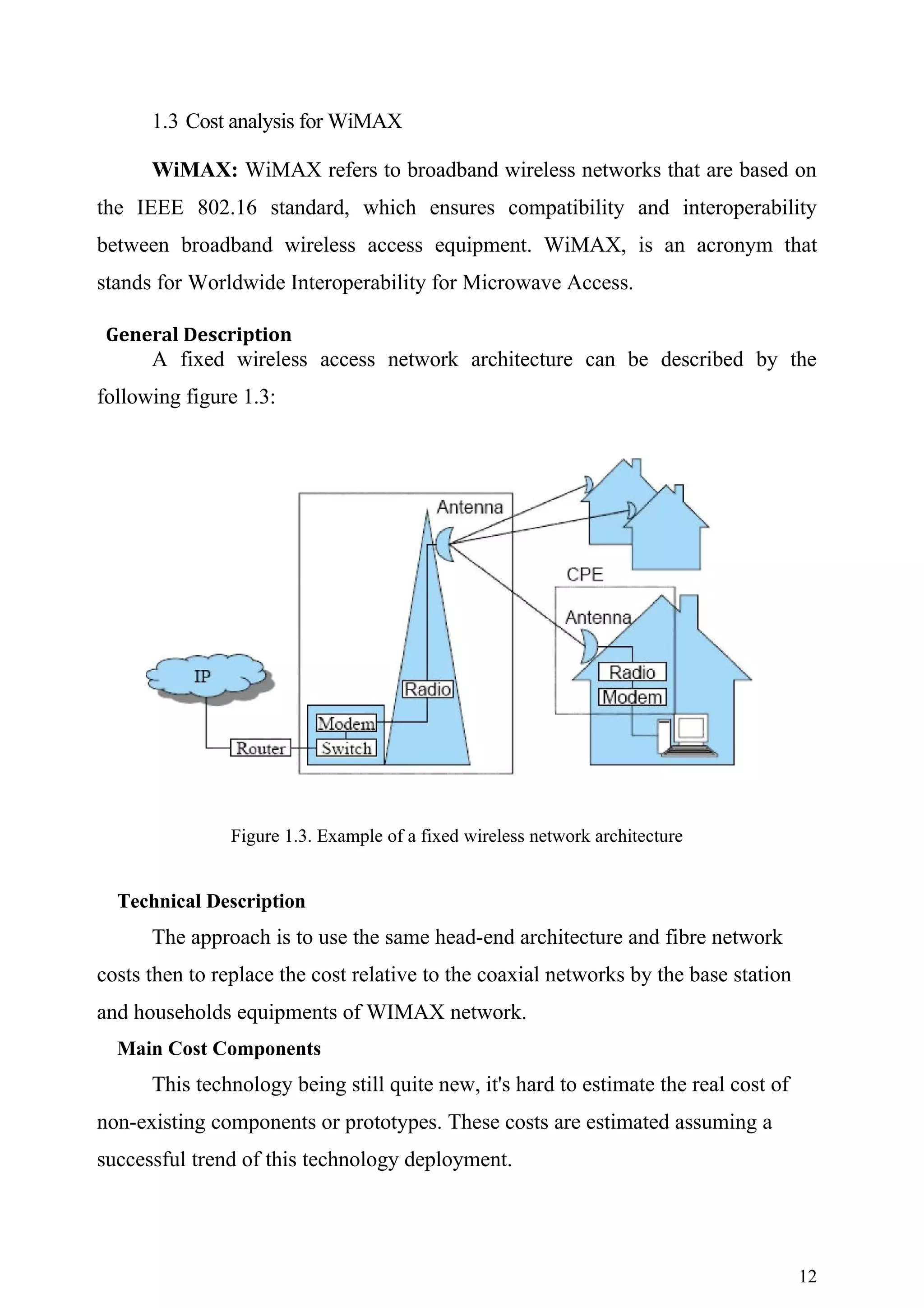
      A fixed wireless access network architecture can be described by the
following figure 1.3:


               Figure 1.3. Example of a fixed wireless network architecture


  Technical Description
      The approach is to use the same head-end architecture and fibre network
costs then to replace the cost relative to the coaxial networks by the base station
and households equipments of WIMAX network.
  Main Cost Components
      This technology being still quite new, it's hard to estimate the real cost of
non-existing components or prototypes. These costs are estimated assuming a
successful trend of this technology deployment.


                                                                                      12
Base station
      The cost of installation and equipment of a base station is reduced to the
following items (tabl.1.1)/
Table 1.1.- The cost of installation and equipment of a base station
Base station              40 000,00 €
Sector antenna                3 000,00 €
Total base station        43 000,00 €
Total bandwidth (Mb/s)              320


  The WiMAX Model
   In this section we will calculate the required CAPEX for a greenfield scenario.
Deployment cost of WiMAX networks is to traffic characteristics where increased
traffic e.g. results in higher number of sector antennas and/or smaller coverage
area pr. base station. The details of the scenario and assumptions as well as a
demonstration of the calculation can be seen in Appendix II.


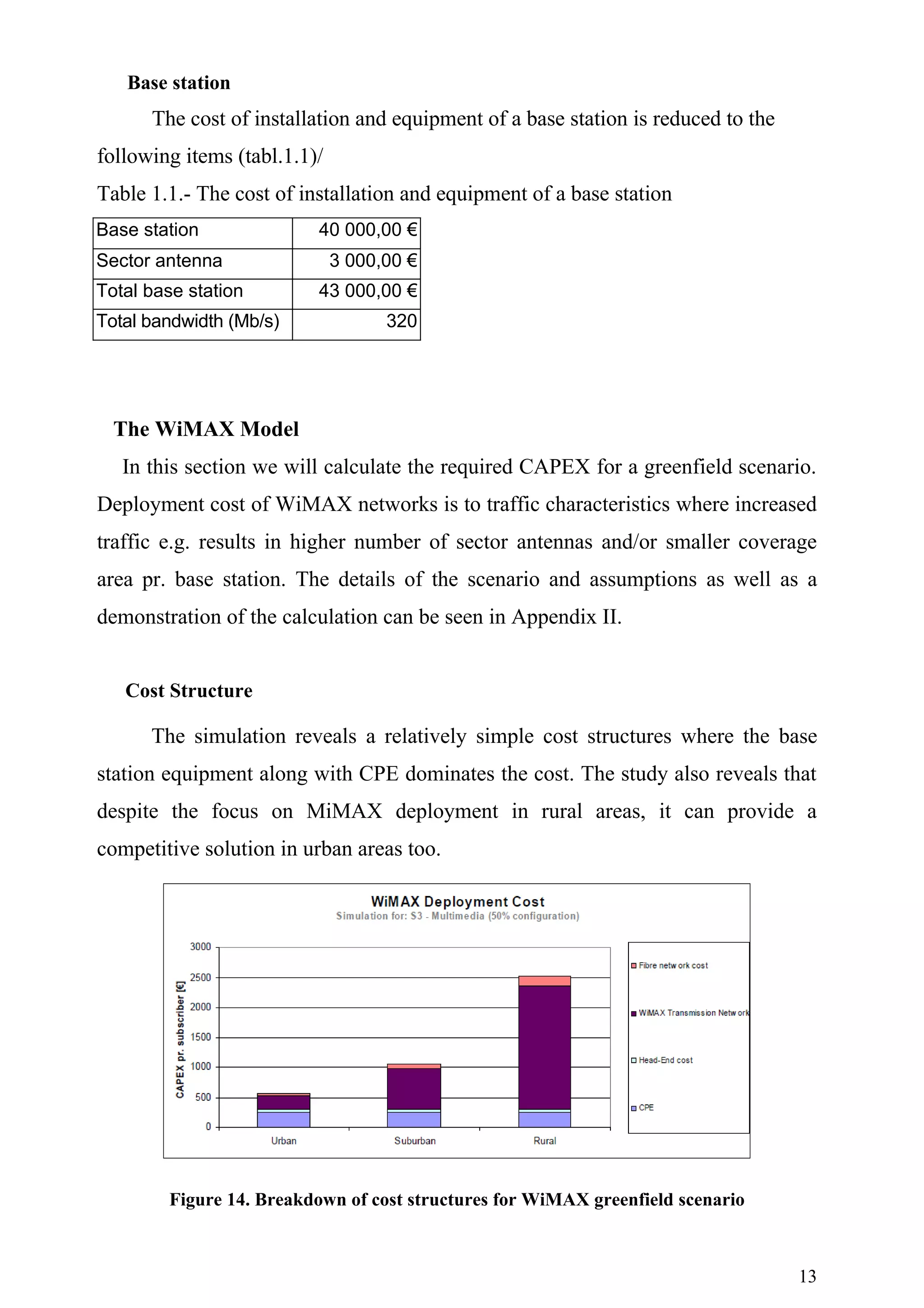
   Cost Structure

      The simulation reveals a relatively simple cost structures where the base
station equipment along with CPE dominates the cost. The study also reveals that
despite the focus on MiMAX deployment in rural areas, it can provide a
competitive solution in urban areas too.


        Figure 14. Breakdown of cost structures for WiMAX greenfield scenario


                                                                                   13
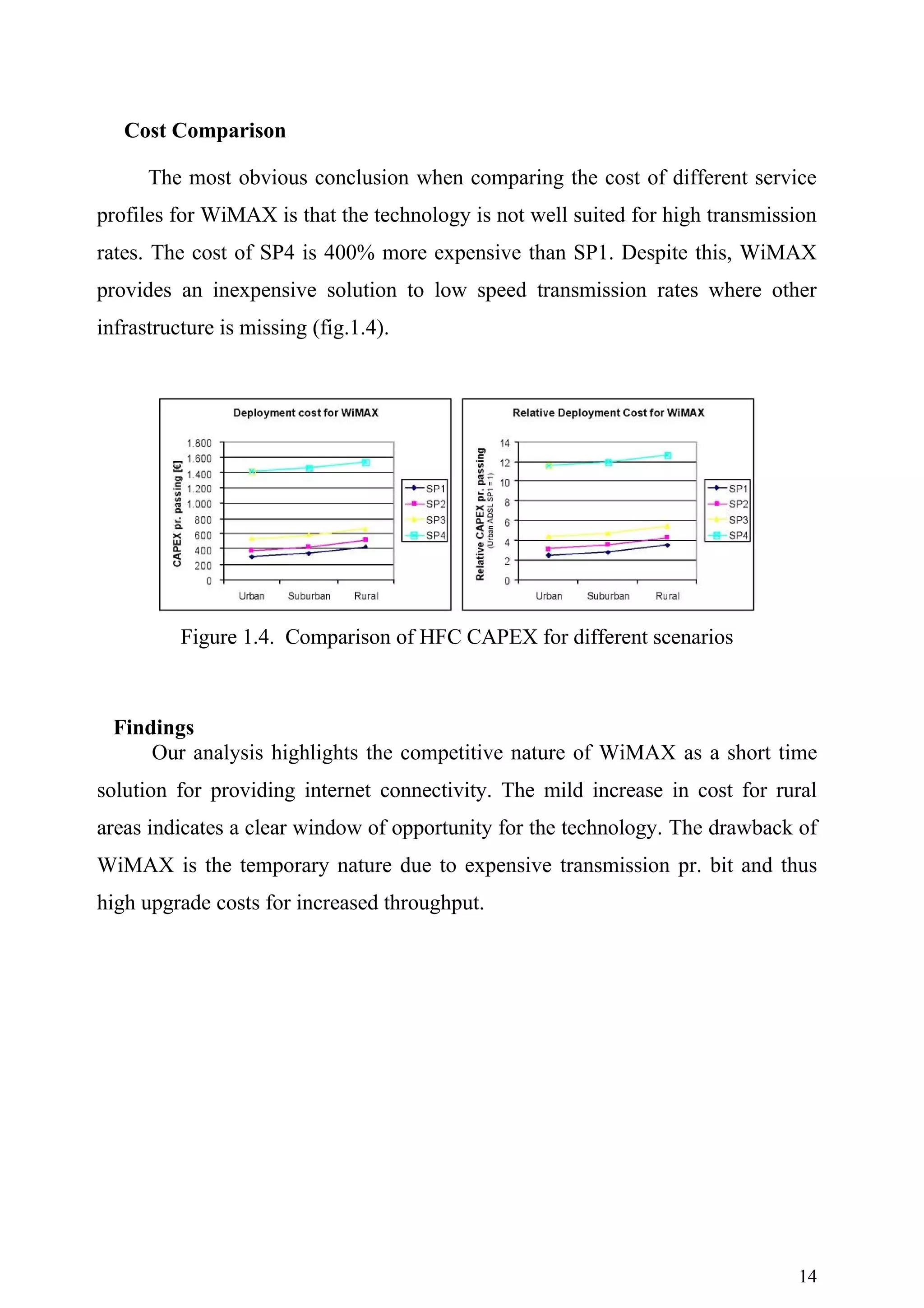
Cost Comparison

      The most obvious conclusion when comparing the cost of different service
profiles for WiMAX is that the technology is not well suited for high transmission
rates. The cost of SP4 is 400% more expensive than SP1. Despite this, WiMAX
provides an inexpensive solution to low speed transmission rates where other
infrastructure is missing (fig.1.4).


          Figure 1.4. Comparison of HFC CAPEX for different scenarios


  Findings
      Our analysis highlights the competitive nature of WiMAX as a short time
solution for providing internet connectivity. The mild increase in cost for rural
areas indicates a clear window of opportunity for the technology. The drawback of
WiMAX is the temporary nature due to expensive transmission pr. bit and thus
high upgrade costs for increased throughput.


                                                                               14
2. Calculations of the WiMAX model


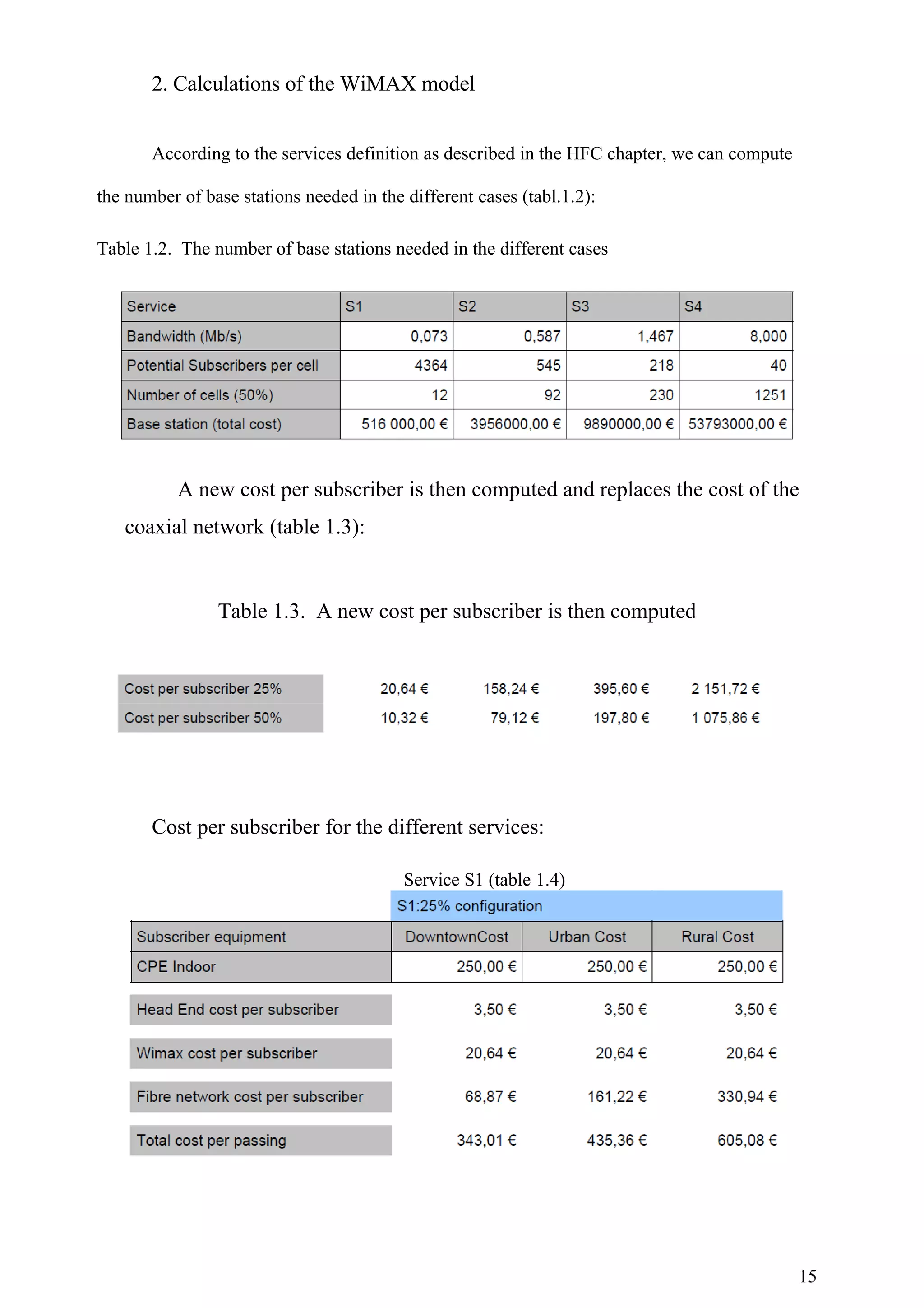
       According to the services definition as described in the HFC chapter, we can compute

the number of base stations needed in the different cases (tabl.1.2):

Table 1.2. The number of base stations needed in the different cases


           A new cost per subscriber is then computed and replaces the cost of the
   coaxial network (table 1.3):


                Table 1.3. A new cost per subscriber is then computed


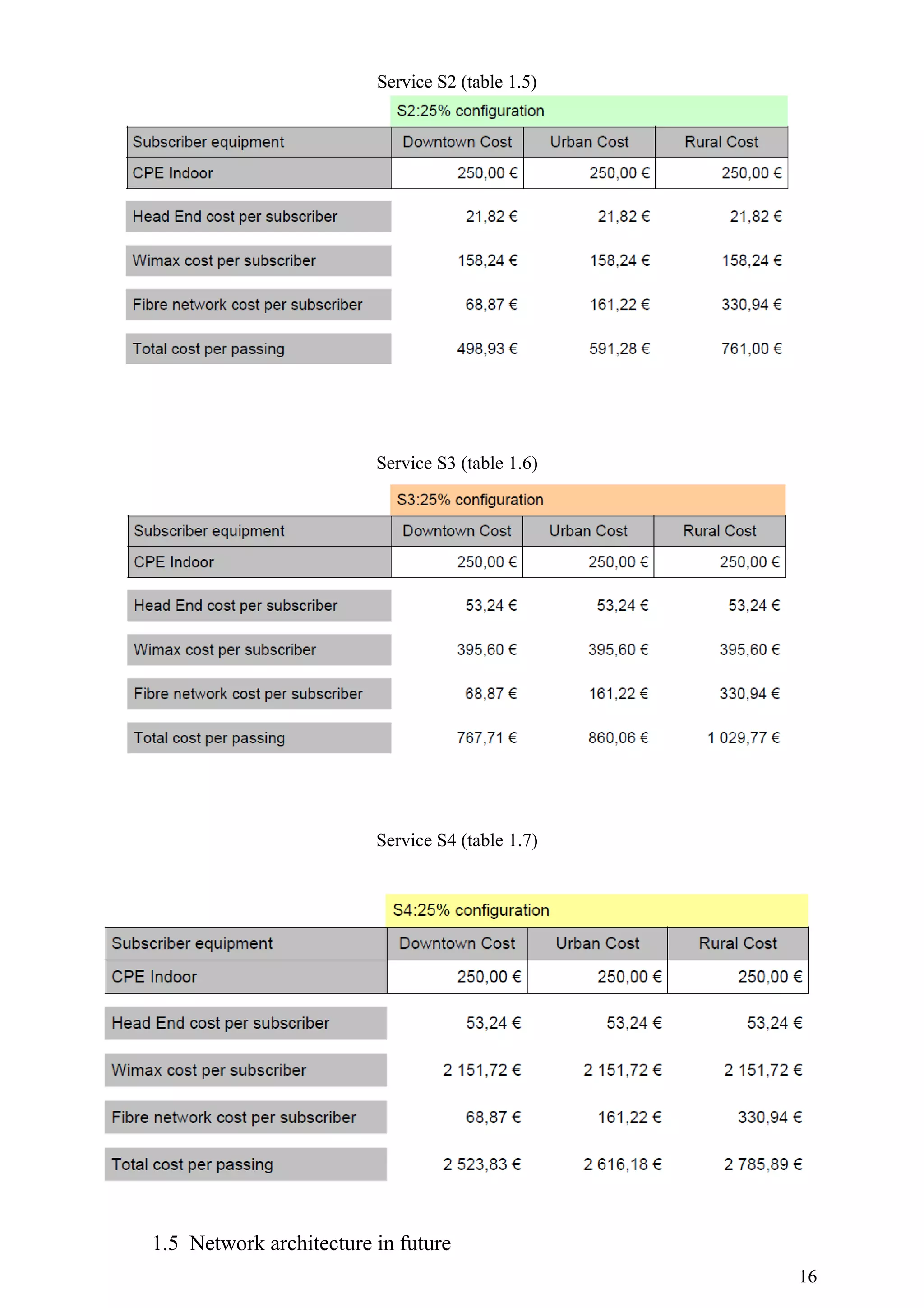
       Cost per subscriber for the different services:

                                          Service S1 (table 1.4)


                                                                                              15
Service S2 (table 1.5)


                         Service S3 (table 1.6)


                         Service S4 (table 1.7)


1.5 Network architecture in future
                                                  16
The network architecture considered in this deliverable consists of a
heterogeneous network, which includes fixed and mobile access networks. It is in
line with the overall FMC access architecture defined in DTF1.8 [4]. As the scope
is limited to session continuity in a single operator domain, there is no need for
roaming agreement in order to support mobility within or between the different
networks. Session continuity in case of roaming was not considered because it is
an additional level of complexity. Note that also today's GSM networks generally
do not support session continuity when crossing provider domains. However, all
the technical details that are required to maintain and transfer an ongoing session
must be worked out. To begin with the user devices must have multiple types of
interface cards to be able to communicate with the different types of networks.
Before a user is allowed to connect to the fixed or the Mobile access networks she
has to be authenticated and authorized to connect and access her subscribed
services.


                     Figure 1.5. Reference Network architecture


                                                                                17
As a result of the authorization process, a layer-2 connection is provisioned
between the user device and the Edge Node (EN) in the access network. And
when the user moves to a -different attachment point new layer-2 connectivity has
to be re-provisioned after the user has been re-authenticated and authorized.
Therefore the provisioning, authentication and authorization architecture must be
designed to support the required horizontal and vertical HandOver (HO) processes
under the prescribed HO delay. In this deliverable, as the user mobility is
constrained within the same provider domain, the HO delay can be minimized by
using pre-authentication or by transferring user and session related information,
such as session keys, user policy, QoS, etc to the new attachment point.
    The reference architecture used in this deliverable is depicted in Figure 1.5. It
shows a fixed network, which in this case is the MUSE SPC type of access
network, and a mobile network, which could either be a mobile WiMAX or 3GPP
network.
    In this model, end users will be able to access their services from different
networks, and are not tied to a fixed only or mobile only type of subscription as is
the case in today’s subscription offers. In DC1.7 we have provided a solution for
the inter-working and integration of the SPC access solution and WiMAX
network.
    WiMAX was selected for the implementation of a session continuity solution
instead of 3GPP, because the interworking with 3GPP is far more complex. TF1.8
has defined the interworking architecture, but only at a later stage of MUSE and
hence too late for a detailed study in WPC1. Session continuity between a fixed
access network and 3GPP is a topic that deserves more attention in future research
during FP7.

 Platform Overview
    The SPC platform is aimed at providing a multi-access, multi edge, multi
service platform for public broadband access. The network architecture is Ethernet
based, although different technologies are supported for end user access, e.g.,
FTTx and xDSL.


                                                                                  18
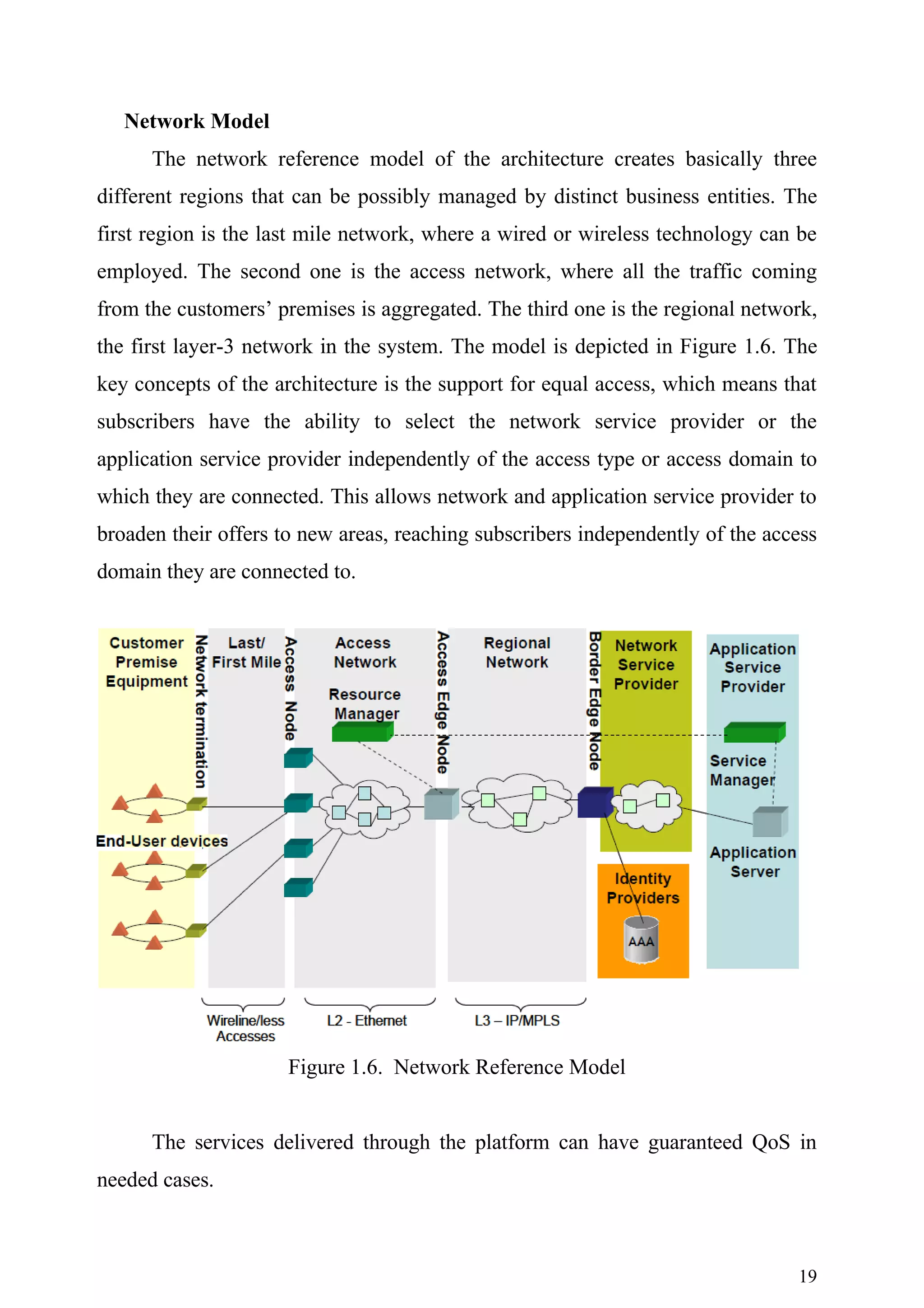
Network Model
      The network reference model of the architecture creates basically three
different regions that can be possibly managed by distinct business entities. The
first region is the last mile network, where a wired or wireless technology can be
employed. The second one is the access network, where all the traffic coming
from the customers’ premises is aggregated. The third one is the regional network,
the first layer-3 network in the system. The model is depicted in Figure 1.6. The
key concepts of the architecture is the support for equal access, which means that
subscribers have the ability to select the network service provider or the
application service provider independently of the access type or access domain to
which they are connected. This allows network and application service provider to
broaden their offers to new areas, reaching subscribers independently of the access
domain they are connected to.


                      Figure 1.6. Network Reference Model


      The services delivered through the platform can have guaranteed QoS in
needed cases.


                                                                                19
This is done through the negotiation of connection parameters with the
Resource Manager, performed at service subscription and/or execution time.
      In case the resources are not available for a given customer and traffic class,
he may be offered other options spanning from access with reduced quality to
denial of access to the service depending on the domain policies and traffic load of
the network. For example, if the traffic is best effort it can be accommodated with
no bandwidth guarantees, despite of the current usage of the link. In this respect
the resource manager performs functionalities of admission control of new
subscriptions. Traffic separation is performed via the use of different VLANs. In
order to simplify the authentication of end-user in nomadic scenarios in an access
domain and across access domains boundaries a framework was developed. This
framework is strongly founded in the Identity Provider (IDP) functionalities.
Service subscriptions, along with identity, are stored there for future use when the
end-user is not located at his home network.


      1.6 Mobile WiMAX
      In order to support end-to-end mobility, the WiMAX forum has defined an
end-to-end Network Reference Model (NRM), consisting of the Access Service
Networks (ASN) run by a Network Access Provider and Connectivity Service
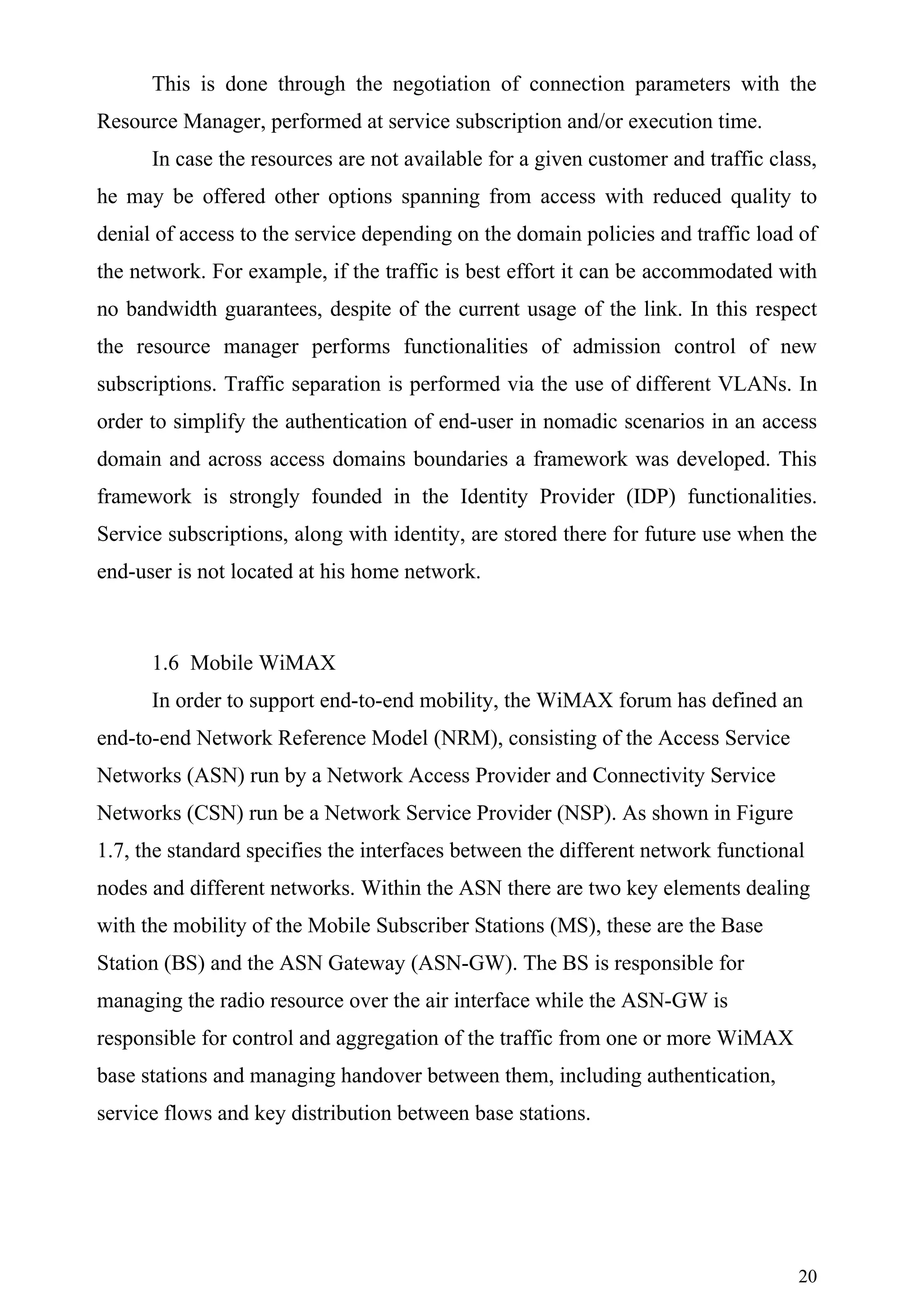
Networks (CSN) run be a Network Service Provider (NSP). As shown in Figure
1.7, the standard specifies the interfaces between the different network functional
nodes and different networks. Within the ASN there are two key elements dealing
with the mobility of the Mobile Subscriber Stations (MS), these are the Base
Station (BS) and the ASN Gateway (ASN-GW). The BS is responsible for
managing the radio resource over the air interface while the ASN-GW is
responsible for control and aggregation of the traffic from one or more WiMAX
base stations and managing handover between them, including authentication,
service flows and key distribution between base stations.


                                                                                  20
Figure 1.7. WiMAX Network Reference Model


      The R6 interface between the BS and the ASN GW specifies an IP network
or alternatively a pure layer 2 network, which means that it should be possible to
manage all the connections between the different BSs associated with that
particular ASN GW at link layer.
      Furthermore, the specification of the R4 interface, for communication
between ASN-GWs in different ASNs will enable multi-provider WiMAX
networks in line with the MUSE Access Network Architecture. The R3 Interface
specifies the communication between the ASN and the CSN which is at the core
of the network providing control and management functions such as AAA, HA
and DHCP
      Within the WiMAX specifications, different types of ASN Profiles have
been specified as a tool to manage diversity in ASN node usage and
implementation. The main 3 ASN profiles are:
− Profile A:
      − Centralized ASN Model with BS and ASN GW in separate platforms
      through
      R6 interface
      − Split RRM: RRA in BS and RRC in ASN-GW
      − Open interfaces for Profile A: R1, R6, R4, and R3

                                                                               21
− Profile B:
        − Distributed ASN solution with the BS and ASN GW functionalities
        implemented in a single platform
        − Open interfaces Profile B: R4 and R3
− Profile C:
        − Similar to Profile A, except for RRM being non-split and located in BS.


        1.7. Wireless technologies WiFi

        WiFi: Short for ‘wireless fidelity’. A term for certain types of wireless local
area networks (WLAN) that use specifications conforming to IEEE 802.11b. WiFi
has gained acceptance in many environments as an alternative to a wired LAN.
Many airports, hotels, and other services offer public access to WiFi networks so
people can log onto the Internet and receive emails on the move.
        The IEEE 802.11b Standard was accepted in 1999 in development of the
standard IEEE 802.11 accepted before. He also foresees the use of range of
frequencies 2,4 GGts, but only with the DSSS modulation. This standard provides
the carrying capacity of to 11 Mb/with calculating on one point of access.
        The products of the IEEE 802.11b standard, supplied by different
manufacturers, are tested on compatibility and is certified by the Wireless
Ethernet Compatibility Alliance (WECA) organization, which presently is
anymore known under the Wi-Fi Alliance name. Compatible wireless products,
the last tests on the program of the WH "Alliance can be marked by the Wi-Fi
sign.
        Presently EEE 802.11b it is the most widespread standard which most
wireless local networks are built on the base of.
        One of the most widely available wireless connections, WiFi is split into
different standards, capable of different speeds and penetration. They each offer
different rates of data transfer. Manufacturers develop equipment, which works
together and this has helped to dramatically reduce costs. WiFi is typically used to
provide a low cost link to a home or business from a central access point in a
village or town. In most cases, a fast internet link arrives via a local council,
                                                                                    22
business or school and this is “shared out” using a wireless network to customers
in a community.
      The main WiFi standards are:

      802.11a – capable of high data speeds over relatively short distances using
the 5Ghz frequency. This is good for delivering video and large amounts of data,
but the limited range means it is hard to make a case for dispersed rural areas.

802.11b – capable of 11Mb/s although in reality the throughput is closer to 5Mb/s.
Equipment is now available at relatively low cost and most new laptops have
WiFi connectivity built in as standard. It is good at covering short distances and is
popular with many WiFi operators.

      802.11g – capable of 54Mb/s is capable of high data rates but can only
cover relatively short ranges compared to 802.11b.
      Spectrum
      These standards do not require a license in most European countries,
making them quick and easy to deploy. They mainly operate in the 5Ghz and
2.4Ghz range. For details on licensing for each EU state, check with the national
government.
      Case Study
      Cybermoor in the UK uses WiFi to deliver broadband to a remote rural
community. Cybermoor takes a broadband service from the school.
      802.1x pre-authentication
    This enhancement to 802.1X authentication is presented in [19] and is aimed
at speeding up the authentication process of a 802.11 MS by doing an
authentication with a new point of attachment before actually moving to this point
of attachment.
     The main principle, as depicted in Figure 1.8, is that the serving AP is used
to communicate with the target AP via the distribution system that connects both
APs together. Hence, the MS will exchange all the authentication information
with the target AP via the serving AP. Once the authentication is done, the MS
could move to the new AP, where access would be granted for it.


                                                                                   23
Figure 1.8. 802.1X pre-authentication principle


      For this scenario to be completely inline with MUSE requirements
regarding trust of RGW devices, the CAPWAP approach should be applied. As
described in [18], this approach enables the separation of the radio and the
management functions for the APs. In this situation the authenticator function of
the AP is located at the ANs. However, this fact does not change the pre-
authentication principle described above. The only difference is that the
authenticator entity for each AP is located at the AN instead of being physically
located at the AP itself. This is depicted in Figure 1.9. However, for the sake of
simplicity, the remaining text refers only to the APs as whole (regardless if the
functions are physically separated or not, the AP could still be seen one element).


        Figure 1.9. Pre-authentication principle for extended APs due to the separation
                                proposed by CAPWAP

                                                                                          24
As described in [19], there are a number of issues related to 802.1X pre-
authentication deployment:
      -The MS starts the authentication with the target AP. There should be a
      mechanism through which the MS decides which is the best AP to move to.
      This mechanism is not defined by the 802.1X pre-authentication and could
      be based on basic signal strength measurements or on more sophisticated
      mechanism as describe in [20] and [21], where a Frequent Handover Region
      (FHR) is defined.
      -In order to forward the 802.1X pre-authentication packets correctly to the
      target AP, the BSSID of the target AP is used as its MAC. This might have
      certain configuration constrains
      -Another Ethertype is defined to differentiate between 802.1X pre-
      authentication frames and normal 802.1x frames. This is due to the switch
      traversal problem of 802.1X messages.
    As stated before, the distribution system that connects the APs is used to
forward the 802.1X messages between the MS and the target AP. Hence, layer 2
connectivity between APs is required because 802.1X is encapsulated directly
over L2 frames.


     For this communication to take place in the SPC platform there are two
different approaches that could be taken:
      1.The first approach would be that messages between APs are forwarded
      via EN. This way, the forwarding principles of the SPC platform persist.
      2.Another possibility would be to configure the intermediate switches in the
      aggregation network to permit inter AP communication. This mechanism
      would go against the SPC forwarding principles but would still be possible


      1.8 Use case analysis


    As can be seen by the use cases studied in the previous section, there are
several mobility types that need to be considered.


                                                                                  25
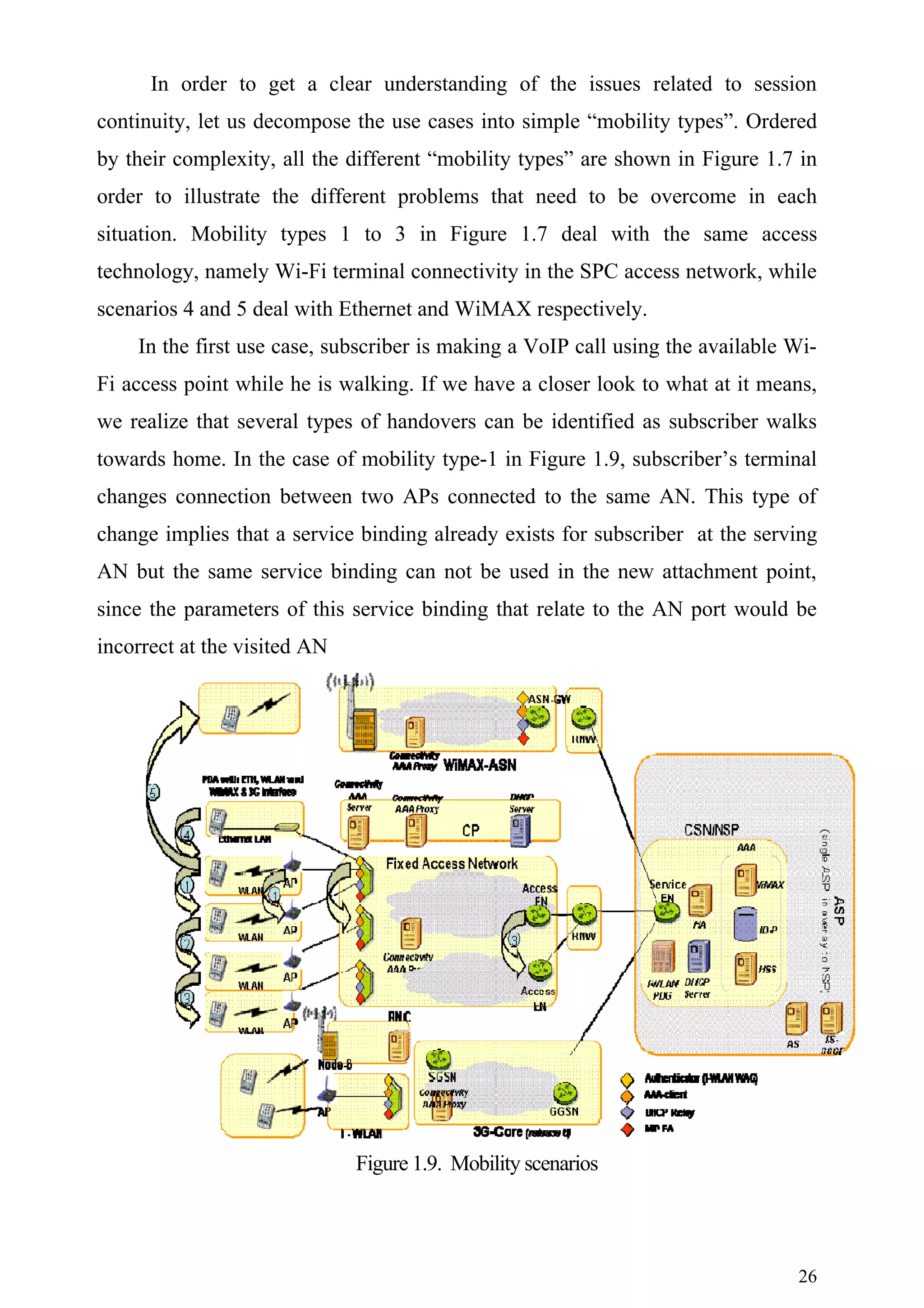
In order to get a clear understanding of the issues related to session
continuity, let us decompose the use cases into simple “mobility types”. Ordered
by their complexity, all the different “mobility types” are shown in Figure 1.7 in
order to illustrate the different problems that need to be overcome in each
situation. Mobility types 1 to 3 in Figure 1.7 deal with the same access
technology, namely Wi-Fi terminal connectivity in the SPC access network, while
scenarios 4 and 5 deal with Ethernet and WiMAX respectively.
    In the first use case, subscriber is making a VoIP call using the available Wi-
Fi access point while he is walking. If we have a closer look to what at it means,
we realize that several types of handovers can be identified as subscriber walks
towards home. In the case of mobility type-1 in Figure 1.9, subscriber’s terminal
changes connection between two APs connected to the same AN. This type of
change implies that a service binding already exists for subscriber at the serving
AN but the same service binding can not be used in the new attachment point,
since the parameters of this service binding that relate to the AN port would be
incorrect at the visited AN


                              Figure 1.9. Mobility scenarios


                                                                                26
In mobility type 2, subscriber´s terminal is changing its point of attachment
between two APs connected to different ANs but under the same EN range (both
AN connected to the same EN). This implies that the service binding connection is
completely new for the new AN.
    However this information is already known for the EN, which will not need
to create a new record for subscriber but only an update of his point of attachment.
    Mobility type 3 imposes a stronger impact for the network adaptation. In this
case subscriber´s terminal moves between AN connected to different ENs. This
means that the service binding is completely new for both the AN and the EN and
needs to be updated accordingly.
    These three “mobility types” described above could be seen as L2 mobility
scenarios. The reason for this is the L2 orientation of the SPC platform together
with the single operator scope of this work.
    The L2 orientation means that connections between the end user and the edge
of the access network are managed at L2. Accordingly an appropriate adaptation of
the L2 parameters will enable the continuation of the end user session as long as
the IP parameters are not changed.
    However, these are not the only “mobility types” to be considered if we
analyze the second use case, where Eva changes her point of attachment between
her Ethernet network and external WLAN network when she is at a patient’s
house. Mobility type 4 in Figure 1.8 depicts this case. In this case the L2 mobility
management is not enough. Using a different type of interface would mean, most
likely, a new IP address assignment. For this reason, higher layer mobility
management, such as MIP, is needed to guarantee the continuation of the session
in Eva’s terminal.
    A similar approach is true for the “mobility-type” 5 in Figure 1.8. In this
situation Eva changes her point of attachment between a WLAN AP and a
WiMAX BS. As before, the new technology will impose a change of the IP
address and accordingly L3 mechanisms need to be considered. However, this is
not the only adaptation that the network needs.


                                                                                    27
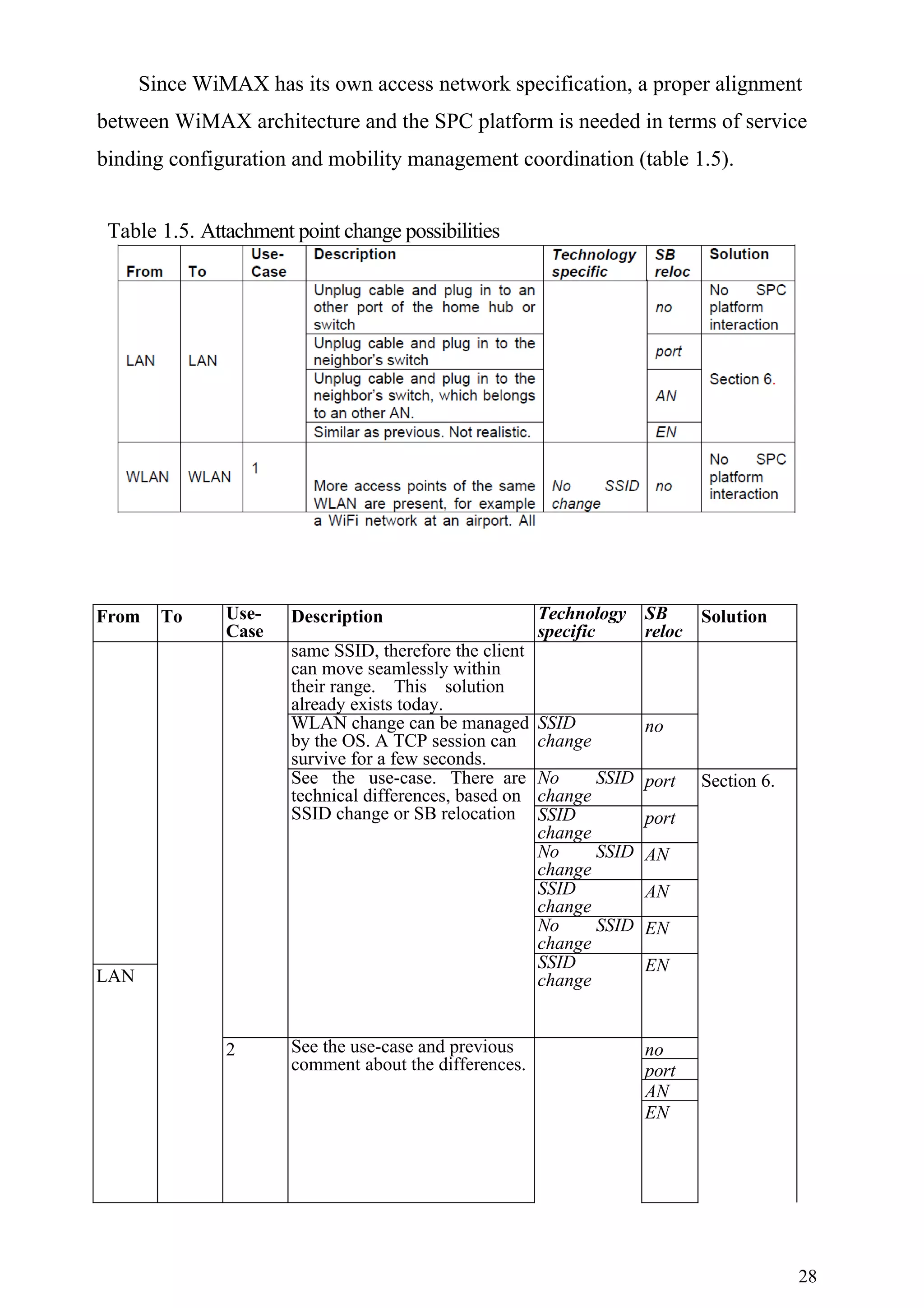
Since WiMAX has its own access network specification, a proper alignment
between WiMAX architecture and the SPC platform is needed in terms of service
binding configuration and mobility management coordination (table 1.5).


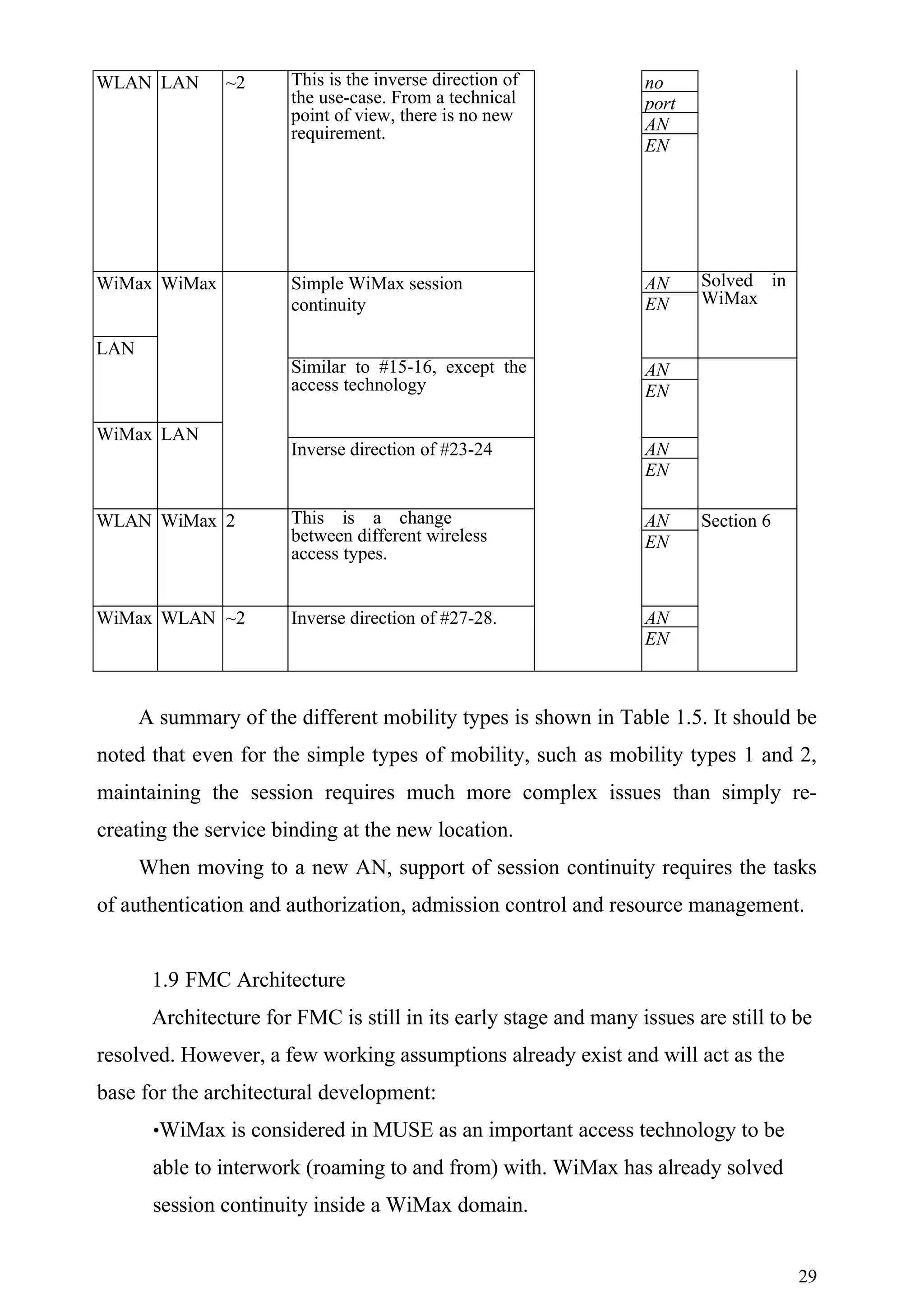
 Table 1.5. Attachment point change possibilities


From    To     Use-    Description                       Technology    SB    Solution
               Case                                      specific      reloc
                       same SSID, therefore the client
                       can move seamlessly within
                       their range. This solution
                       already exists today.
                       WLAN change can be managed        SSID          no
                       by the OS. A TCP session can      change
                       survive for a few seconds.
                       See the use-case. There are       No     SSID   port   Section 6.
                       technical differences, based on   change
                       SSID change or SB relocation      SSID          port
                                                         change
                                                         No     SSID   AN
                                                         change
                                                         SSID          AN
                                                         change
                                                         No     SSID   EN
                                                         change
                                                         SSID          EN
LAN                                                      change


               2       See the use-case and previous                   no
                       comment about the differences.                  port
                                                                       AN
                                                                       EN


                                                                                           28
WLAN LAN       ~2      This is the inverse direction of           no
                       the use-case. From a technical             port
                       point of view, there is no new             AN
                       requirement.
                                                                  EN


WiMax WiMax            Simple WiMax session                       AN     Solved in
                       continuity                                 EN     WiMax

LAN
                       Similar to #15-16, except the              AN
                       access technology                          EN

WiMax LAN
                       Inverse direction of #23-24                AN
                                                                  EN

WLAN WiMax 2           This is a change                           AN     Section 6
                       between different wireless                 EN
                       access types.


WiMax WLAN ~2          Inverse direction of #27-28.               AN
                                                                  EN


      A summary of the different mobility types is shown in Table 1.5. It should be
noted that even for the simple types of mobility, such as mobility types 1 and 2,
maintaining the session requires much more complex issues than simply re-
creating the service binding at the new location.
      When moving to a new AN, support of session continuity requires the tasks
of authentication and authorization, admission control and resource management.


       1.9 FMC Architecture
       Architecture for FMC is still in its early stage and many issues are still to be
resolved. However, a few working assumptions already exist and will act as the
base for the architectural development:
       •WiMax is considered in MUSE as an important access technology to be

       able to interwork (roaming to and from) with. WiMax has already solved
       session continuity inside a WiMax domain.


                                                                                     29
•SIP and IMS are included in MUSE from an interacting perspective; no real

      protocol development is included.
      •The focus for MUSE FMC architecture is for network layer solutions.
      •SAE/LTE architecture is considered in the work but 3GPP drafts are

      currently not stable enough to base a FMC architectural solution on.
      •I-WLAN is considered as one of the most reasonable starting points even

      though many challenges remain.
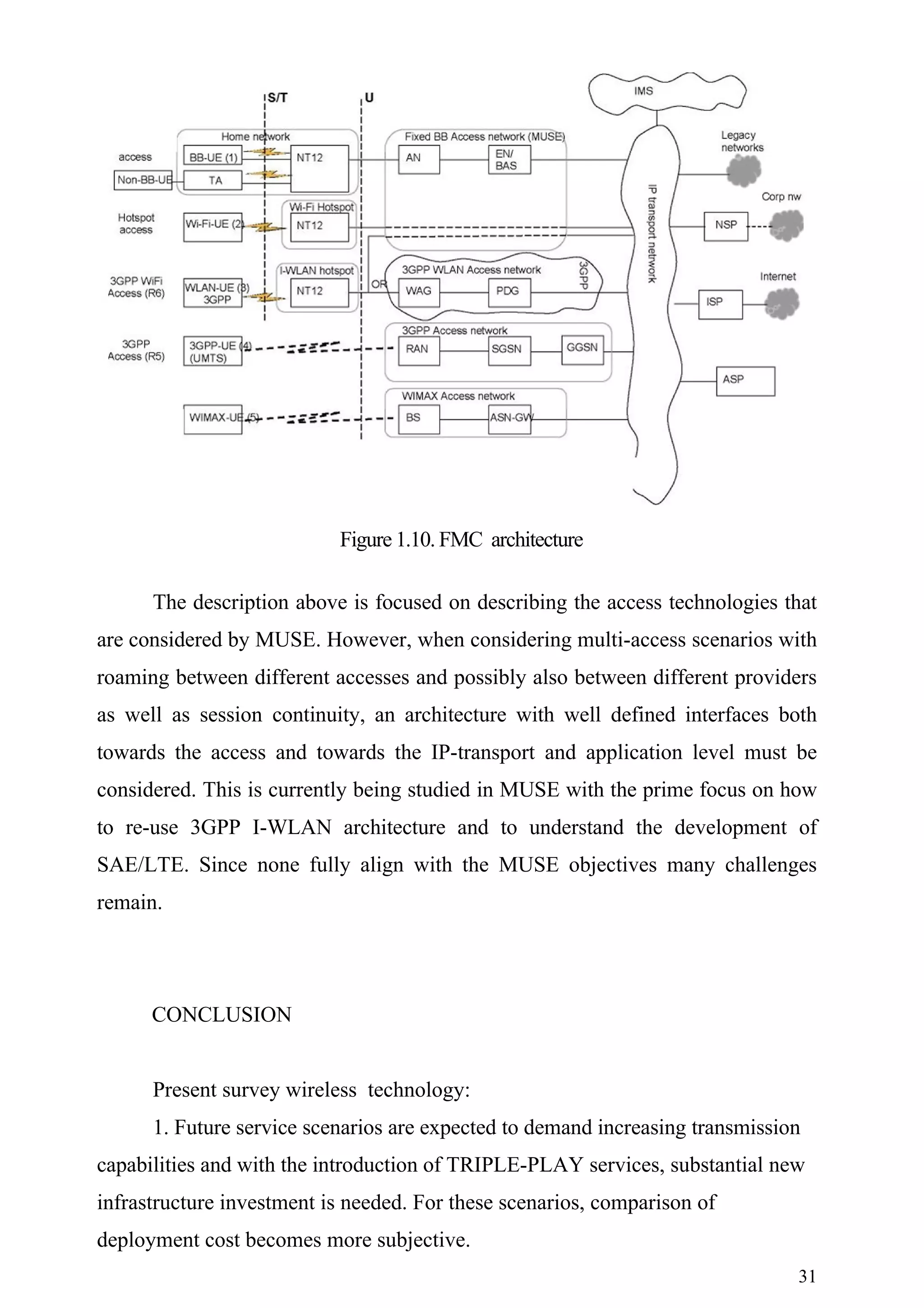
      With these assumptions the following architecture pictures can be drawn.
The initial access shows a user using a DSL, Fibre or WLAN connection in his
home and connecting via a RGW to a broadband access network. The device can
be SIP/IMS enabled but it is more likely that the RGW (NT12) will have this
capability.
      The next access shows a dual hand-set where access can be achieved by
either 3GPP or WLAN. For pure 3GPP access the terminal accesses the IP
network through the 3GPP network.
      For the non-3GPP access the terminal either connects through the
broadband access network as in the first case (#1).
      Alternatively, the terminal establishes a tunnel through the broadband access
network to the 3GPP WLAN access network where the tunnel is terminated in the
WAG (#2). The preferred solution depends on the type of terminal and the type of
clients it supports. The preferred solution for this case is currently being studied
and includes investigations of I-WLAN, SAE/LTE etc.


      The WiMax access is an access that uses its own architecture and connects
to the IP network through an edge node (ASN-GW) that is WiMax specific.
      The hot-spot access is separated from the broadband access since the access
point (AP) is typically not belonging to the residential gateway (RGW). But
towards the IP transport network, this access connects in the same manner as the
broadband access edge node (Fig.1.10).


                                                                                       30
Figure 1.10. FMC architecture

      The description above is focused on describing the access technologies that
are considered by MUSE. However, when considering multi-access scenarios with
roaming between different accesses and possibly also between different providers
as well as session continuity, an architecture with well defined interfaces both
towards the access and towards the IP-transport and application level must be
considered. This is currently being studied in MUSE with the prime focus on how
to re-use 3GPP I-WLAN architecture and to understand the development of
SAE/LTE. Since none fully align with the MUSE objectives many challenges
remain.


      CONCLUSION


      Present survey wireless technology:
      1. Future service scenarios are expected to demand increasing transmission
capabilities and with the introduction of TRIPLE-PLAY services, substantial new
infrastructure investment is needed. For these scenarios, comparison of
deployment cost becomes more subjective.
                                                                               31
3.The cost study examines CAPEX cost structures involved in deployment

       of DSL, HFC, FTTH and wireless technologies (WiMAX). The study
       technologies and their ability to handle varying services and transmission
       speeds.
       4.For these users, WIMAX provides and excellent short-term solution for
       providing internet connectivity. The drawback of WiMAX is the temporary
       nature due to expensive transmission pr. bit and thus high upgrade costs for
       increased throughput.
       5.Research cost structure of WiMAX and network architecture in future.

      In this model, end users will be able to access their services from different
networks, and are not tied to a fixed only or mobile only type of subscription as is
the case in today’s subscription offers. In DC1.7 we have provided a solution for
the inter-working and integration of the SPC access solution and WiMAX
network.
       6.Present FMC Architecture and wireless technologies WiFi. In the first

       use case, subscriber is making a VoIP call using the available Wi-Fi access
       point while he is walking.
       Architecture for FMC is still in its early stage and many issues are still to be
resolved. However, a few working assumptions already exist and will act as the
base for the architectural development


                                       REFERENCES

[I]    BREAD (FP6-IST-507554), Deliverable 1 “First, combined, report on the multi-
       technological and multi-
       disciplinary analysis of the ‘broadband for all’ concept“, April 2004.
[2]    BREAD (FP6-IST-507554), Deliverable 2, “Second report on the multi-technological
analysis of the
       ‘broadband for all’ concept, focus on the listing of multi-technological key issues and
       practical roadmaps on how to tackle these issues“, August 2005.
[3]     BROADWAN (FP6-2002-IST-1), Deliverable 15 “Broadband access roadmap
based on market
        assessment and technical-economic analysis” , February 2005.
[4]     BROADWAN (FP6-2002-IST-1), Project Web Page: http://www.telenor.no/broadwan/
[5]     ECOSYS (CELTIC CP1-021), Project Web Page:
http://optcomm.di.uoa.gr/ecosys/index.html


                                                                                                 32
[6]     FAN (Eurescom P-1117), Deliverable 1 “IP based access technologies and QoS”, May
2003.
[7]     FAN (Eurescom P-1117), Deliverable 2 “Broadband access network target architectures -
access network
        evolution scenarios and strategies”, May 2003.
[8]     Green P.E., “Fiber To The Home – The New Empowerment”, Wiley Interscience, N.J.,
2006
[9]     Indenrigs- og Sundhedsminesteriet (e. Danish Ministry of the Interior and Health),
Statistical Database
        on the Internet: http://www.noegletal.dk/, Accessed March 2006
[10]      Sigurdsson H.M., “Implementing Next -Generation-Networks in Iceland”, CTI M.Sc.
        Thesis, Danish Technical University, June 2003.
[II]    TONIC (IST-2000-25172), Deliverable number 7 “Report on tool and methodology”,
February 2002.
[12]      TONIC (IST-2000-25172), Project Web Page: http://www-nrc.nokia.com/tonic/
     [I]      Technical Annex MUSE Phase II
     [2]     DC1.5 “Network Solution to Support Nomadism in a fixed access network and
              dual packager roaming in a multi operator scenario”, MUSE Phase II, deliverable,
              June 2007. [3]     DC1.6 “Solution to Support Nomadism and roaming in between fixed
     and wireless
              networks in a multi operator scenario”, MUSE Phase II, deliverable, June 2007. [4]
     DTF1.8 "FMC in Fixed Access Architecture", MUSE Phase II, deliverable,
     June 2007. [5]      http://www.airspan.com/pdfs/WP_Mobile_WiMAX_Security.pdf [6]
     Tanenbaum, A. S., “Computer Networks”, Fourth Edition, Prentice Hall, ISBN 0-13-066102-3. [7]
     http://www.microsoft.com/technet/community/columns/cableguy/cg0405.mspx [8]             P.
     Arvidsson and M. Widell, “Design of a session layer based system for endpoint
             mobility”. Master's thesis, KTH, 2006. [9]     Y. Ismailov, J. Holler, S. Herborn, A.
     Seneviratne, “Internet Mobility: An Approach
             to Mobile End-System Design”, International Conference on Mobile
             Communications and Learning Technologies, ISBN 0-7695-2552-0, IEEE
             Computer Society, Los Alamitos, CA, USA, 2006. [10] Microsoft: “Performance
     Enhancements in the Next Generation TCP/IP Stack”,
             http://www.microsoft.com/technet/community/columns/cableguy/cg1105.mspx,
             2005
     [II]    Microsoft:             “Windows            TCP/IP              Registry            Entries”,
             http://support.microsoft.com/kb/158474, 2007
     [12] R. Stewart, Q. Xie, K. Morneault, C. Sharp, H. Schwarzbauer, T. Taylor, I. Rytina,
              M. Kalla, L. Zhang and V. Paxson: “Stream Control Transmission Protocol”,
              Request for Comments: 2960, 2000 [13] L. Ong and J. Yoakum: “An Introduction to the
     Stream Control Transmission
              Protocol (SCTP)”, Request for Comments: 3286, 2002 [14] Perkins, Ed. C., IP Mobility
     Support for IPv4, RFC 3344, August 2002. [15] S. Gundevelli, K. Leung, V. Devarapalli,
     K.Chowhury and B. Patil: “Proxy Mobile
              IPv6”, Internet Draft 2007 [16] MUSE D T1.8 – “FMC Support in Fixed Access
     Architecture”, MUSE Phase II,
              deliverable, June 2007 [17] Stefan Mangold, et al, “IEEE 802.11e Wireless LAN for
     Quality of Service” [18] T. Clancy et al, “EAP Re-authentication Extensions”, draft-ietf-hokey-
     erx-02, work
              in progress, July 2007 [19] “IEEE Std 802.11i™-2004 (Amendment to IEEE Std
     802.11™, 1999 Edition
              (Reaff 2003))” [20] S. Pack and Y. Choi, “Fast Inter-AP Handoff using Predictive-
     Authentication
              Scheme in a Public WirelessLAN,” IEEE Networks 2002, August [21] S. Pack and Y.
     Choi, “Pre-Authenticated Fast Handoff in a Public Wireless LAN
              based on IEEE 802.1x Model,” IFIP TC6 Personal Wireless Communications

                                                                                                      33
2002 , October 2002. [22]   M. Liebsch et al, “Candidate Access Router Discovery”
RFC 4066, July 2005


                                                                                          34
35

Qos WiMax

  • 1.
    DEPARTMENT OF EDUCATIONOF UKRAINE KHARKOV NATIONAL UNIVERSITY OF RADIO ELECTRONICS DEPARTMENT OF TELECOMMUNICATION MEASUREMENT TECHNICAL DEPARTMENT OF TELECOMMUNICATION SYSTEMS (ТСS) MASTER’S REPORT TO THEME « SCINTIST PARAMETERS OF QUALITY OF SERVICE IN WIMAX TECHNOLOGIES » Made by Examer St.gr. TSNmi-08-1 Saburova S.A. Hussein Yahya Tariq Hussein KHARKOV 2010
  • 2.
    CONTENT Page ABBREVIATIONS 3 INTRODUCTION 5 1 SURVEY WIRELESS TECHNOLOGIES 9 1.1 Executive summary 9 1.2 Backbone Segment 11 1.3 Cost analysis for WiMAX 12 1.4 Calculations of the WiMAX model 15 1.5 Network architecture in future 16 1.6 Mobile WiMAX 20 1.7 Wireless technologies WiFi 22 1.8 Use case analysis 25 1.9 FMC Architecture 29 CONCLUSION 31 REFERENCES 32 2
  • 3.
    ABBREVIATIONS AA Authentication and Authorization AEN Access Edge Node AN Access Node AP Access Point ARP Address Resolution Protocol ASN Access Service Network ASN-GW ASN-Gateway ASP Access Service Provider BE Best Effort BS Base Station CAPWAP Control And Provisioning of Wireless Access Points CARD Candidate Access Router Discovery CBS Committed Burst Size CID Connection Identifier CIR Committed Information Rate CN Correspondent Node CoA Care-of Address CP Connectivity Provider CSMA/CA Carrier Sense Multiple Access with Collision Avoidance CSN Connectivity Services Network CTN Candidate Target Network CTP Context Transfer Protocol DCF Distributed Coordination Function DHCP Dynamic Host Configuration Protocol DNS Domain Name System DS Directory Service EAP Extensible Authentication Protocol EAPoL Extensible Authentication Protocol over LAN EBS Excess Burst Size EDCF Enhanced DCF EIS Excess Information Rate EMSK Extended Master Session Key EN Edge Node FA Foreign Agent FHR Frequent Handover Region HA Home Agent HCF Hybrid Coordination Function HLR Home Location Register HO HandOver HoA Home Address HOKEY Handover Keying HSS Home Subscriber Server ID-P Identity Provider IEFT Internet Engineering Task Force IPTV Internet Protocol Television IRTF Internet Research Task Force LAN Local Area Network LMA Local Mobility Agent MAC Medium Access Control MAG Mobile Access Gateway MIP Mobile IP MIPv4 Mobile IP version 4 MIPv6 Mobile IP version 6 MMP Mobility Management Protocol MN Mobile Node 3
  • 4.
    MobOpts Mobility Optimization MS Mobile Station MPA Media-independent Pre-Authentication NAI Network Access Identifier NAP Network Access Provider NAS Network Access Server NFC Near Field Communication NPM Network Policy Manager nrtPS Non-real-time Polling Service NSP Network Service Provider OS Operating System OSS Operation Support System PANA Protocol for carrying Authentication for Network Access PCF Point Coordination Function PEP Policy Enforcement Point PKM Privacy and Key Management PHT Proactive Handover Tunnel PMIP Proxy MIP QoS Quality of Service RADIUS Remote Authentication Dial In User Service RGW Residential Gateway RRA Radio Resource Agent RRC Radio Resource Controller rRK Re-authentication Root Key RRM Radio Resource Management RM Resource Manager rtPS Real-time Polling Service SA Security Association SCN Service Class Name SFID Service Flow Identifier SIM Subscriber Identity Module SIP Session Initiation Protocol SLS Service Level Specification SM Service Manager SSID Service Set Identifier TC Traffic Categories TCP Transmission Control Protocol UDP User Datagram Protocol VoD Video on Demand VoIP Voice over IP VLAN Virtual Local Area Network VNO Virtual Network Operator VPN Virtual Private Network WG Working Group WiFi Wireless Fidelity WiMax Worldwide interoperability for Microwave Access WLAN Wireless Local Area Network UGS Unsolicited Grant Service UPM User Policy Manager 4
  • 5.
    INTRODUCTION The objective of this study is to create an up-dated techno-economic model for comparing different ways of deploying broadband communication networks and services. The resulting simulation model Capital Expenditure (CAPEX) of different implementation strategies comprising of predefined access technologies, service profiles, and geographical scenarios. More specifically the model shall include the following components (definitions and term descriptions follow later in the report): Access Technologies: · ADSL · ADSL2+ · HFC Cable modem · FTTH · WiMax Service Profiles: · S1: Slow Internet Browsing · S2: Fast Internet Browsing · S3: Multimedia · S4: Interactive Multimedia Geographical Profiles: · Urban · Suburban · Rural Scenarios: · Greenfield · Existing Infrastructure Upgrade 5
  • 6.
    Methodology and Relationto other Research Projects The model developed in this report draws on the work carried out in various other research projects. The terminology, methodology, and theoretical framework are influenced by European techno-economic research projects: TONIC, TETRA, ECOSYS and BROADWAN while the infrastructure and technology aspects draw from BREAD, FAN and BROADWAN. More specifically the relationship to these projects is as follows: BREAD Broadband in Europe for All: a multi-disciplinary approach aims at developing a roadmap for the deployment of broadband and realisation of the 'broadband for all' concept within Europe. This report relies on the access and backbone network overview provided in deliverable 2 [2] TONIC IST-2000-25172 TONIC (TechnO-EcoNomICs of IP optimised networks and services) concentrates on techno-economic evaluation of new communication networks and services. Following up on older projects, TONIC was carried out in 1998-2002 and provides the foundation of most theoretical and methodological work on techno-economic studies. This project therefore provided a starting point for development of the simulation model [11]. ECOSYS An ongoing research project on the techno-economics of integrated communication systems and services. The most interesting part of the ECOSYS project for this study is the advancement and evolution of the theoretical and methodological framework developed for techno-economic analysis of telecommunications networks in the TONIC project. [5] BROADWAN The goal of the “Broadband services for everyone over fixed wireless access networks” is to investigate how wireless networks can be used to provide true broadband services. 6
  • 7.
    The most interestingaspects of the BROADWAN project for this study is the analysis of market potential and deployment scenarios and future development of wireless access technologies. Additionally, the project has developed a simulation model for deployment cost based on methods developed in the TONIC project. [3] FAN EURESCOM P1117-FAN evaluates the technical specifications of future access networks, the impact of IP and infrastructure architectures. For this report it was used to reinforce the infrastructure and access technology selection. [6,7] Model Structure and Functionality The overall model structure is based on dividing the network into two segments: Access Segment and Backbone Segment. The Access Segment covers the so called “first mile” from user premises to an aggregation node in the respective zone. This part is characterized by a diversity of transmission media (copper, fibre, cable, radio), and topologies (star, tree). Several technical solutions exist for provision of broadband to customers in different types of demographic areas. Research indicates that the future market will be characterised by different coexisting technologies, the choice of which is determined by technological capabilities as well as economic factors. The BREAD project has on basis of results from other projects in the EU Framework Program 6 analysed technological alternatives, future trends, and status of broadband initiatives. Results from following European techno-economic projects have been applied in the modelling work: BREA D, TONIC, ECOSYS, BROADWAN and FAN. For the purpose of this report techno-economic methods are used to analysed and compare deployment scenarios for five of the most widely used technological alternatives. A simulation model has been developed to examine the effect of influential factors, such as transmission speed and level of existing infrastructure, in providing broadband connectivity in urban, suburban and rural areas. For those technologies building on use of existing infrastructures calculations are made both for a two different scenarios: Upgrade of existing infrastructures and greenfield. 7
  • 8.
    The strength ofthis study in comparison to many of the detailed feasibility studies of broadband deployment is the general overview and comparison of the deployment cost for different technologies and deployment scenarios. The goal of this study is therefore to provide rough estimates that indicate competitive strengths and weaknesses of technologies, rather than to aid in execution. In the absence of reliable data on operational cost from operators, the model only calculates CAPEX. This century, wireless has grown rapidly as one of the most cost effective ways of delivering broadband to rural areas. The main reasons are: •Wireless equipment has dropped in price, reducing the cost for organisations wishing to deliver data over wireless. •Availability of radio spectrum – no need to obtain a license before providing a service. •Low cost end user equipment. There are a number of different types of wireless broadband, each offering different levels of performance, security and robustness. This paper will cover some of the main technologies and examine the issues around them. It focuses on wireless technologies that are being used to deliver broadband in rural areas now. The key technologies which will be discussed are: •WiFi •WiMax •GPRS / 3G This report does not aim to be overtly technical and is aimed at people who are working to provide broadband in rural areas. It looks at services that end users can access directly and will not cover microwave and other carrier class wireless technologies. The report gives an overview of the benefits and disadvantages. We then look at the radio spectrum to how this impacts on service delivery. The main technologies are then examined, with a look at what will happen in the future. In master’s report about externship is present “SURVEY WIRELESS TECHNOLOG” 8
  • 9.
    1 SURVEY WIRELESSTECHNOLOGIES 1.1 Executive summary The study reveals and verifies the current trend of DSL & Cable dominance in the urban market segment, where existing infrastructure facilitates inexpensive equipment upgrades. There is a fundamental trade-off between reach and capacity in most access technologies and extending the coverage of xDSL technology to provide higher capacities for less populated areas will be expensive and the study reveals a clear window of opportunity for wireless technologies in rural and suburban areas. Future service scenarios are expected to demand increasing transmission capabilities and with the introduction of TRIPLE-PLAY services, substantial new infrastructure investment is needed. For these scenarios, comparison of deployment cost becomes more subjective. While wireless and copper/coaxial based infrastructures require less capital investment it is unrealistic since fibre based infrastructures provide a more future safe solution. For these new infrastructures, optimisation of network structures is critical and merely replacing copper with fibre would result in substantially higher cost than otherwise required. Figure 1.1- Comparison of technologies for service profile 3 9
  • 10.
    The cost studyexamines CAPEX cost structures involved in deployment of DSL, HFC, FTTH and wireless technologies (WiMAX). The study reveals difference in cost structures between technologies and their ability to handle varying services and transmission speeds. The study reveals that currently all technologies are competitive in the urban settings, with the exception of FTTH, which is only feasible if other groundwork is carried out at the same time. For the suburban and rural areas, there will be a gap between those living in the vicinity of existing telecommunications infrastructure, such as PSTN, and those living further away. Although detached DSLAMs have the possibility of decreasing this gap for DSL, the additional cost of establishing a backbone fibre connection to these aggregation points results in a ten times higher cost. For these users, WIMAX provides and excellent short-term solution for providing internet connectivity. The drawback of WiMAX is the temporary nature due to expensive transmission pr. bit and thus high upgrade costs for increased throughput. In all areas, FTTH provides an expensive but future-proof solution. Our analysis shows that roughly 60% of the CAPEX for FTTH in all scenarios is due to civil work, ducts, and cables. In rural and suburban areas, the result of this could be smaller deployment zones where citizens reduce the cost by participating in ground work, and / or local governments reduce the cost by granting connectivity to established backbone networks. Of the technologies studied, DSL and cable modem (HFC) are currently by far the most dominating broadband access technologies worldwide in terms of volume. These two technologies are now quite mature – a fact that is reflected in the price evolution of equipment during the past few years. Given a similar evolution for fibre and wireless equipment, the dominant cost component, Customer Premises Equipment, will greatly improve competitiveness in urban areas, and similarly advanced digging methods have the potentials of greatly reducing the dominant cost of civil work of fibre in rural areas. 10
  • 11.
    1.2 Backbone Segment The Backbone Segment is an aggregation network connecting all Aggregation Nodes to Service Nodes. This part is characterized by one transmission media, optical fibre connections but a diversity of topologies (star, tree, ring). See Figure 1.2. Layer 1: Access Segment Layer 2: Backbone Segment Figure 1.2. Two segment, access and backbone infrastructure model Configuration parameters for the model can be classified into Scenario Parameters (Geo-graphic, Population Distribution, Existing Infrastructure, and Available Service) and Technology Parameters (Access Technology and topology, Backbone Technology and topology etc.). Together, geographic information and population distribution determine to a large extent the investment cost of access networks. The most relevant parameters are number of buildings/customers and the distance between them. The model can either take note of already existing infrastructure or assume “Greenfield” deployment. 11
  • 12.
    1.3 Cost analysisfor WiMAX WiMAX: WiMAX refers to broadband wireless networks that are based on the IEEE 802.16 standard, which ensures compatibility and interoperability between broadband wireless access equipment. WiMAX, is an acronym that stands for Worldwide Interoperability for Microwave Access. General Description A fixed wireless access network architecture can be described by the following figure 1.3: Figure 1.3. Example of a fixed wireless network architecture Technical Description The approach is to use the same head-end architecture and fibre network costs then to replace the cost relative to the coaxial networks by the base station and households equipments of WIMAX network. Main Cost Components This technology being still quite new, it's hard to estimate the real cost of non-existing components or prototypes. These costs are estimated assuming a successful trend of this technology deployment. 12
  • 13.
    Base station The cost of installation and equipment of a base station is reduced to the following items (tabl.1.1)/ Table 1.1.- The cost of installation and equipment of a base station Base station 40 000,00 € Sector antenna 3 000,00 € Total base station 43 000,00 € Total bandwidth (Mb/s) 320 The WiMAX Model In this section we will calculate the required CAPEX for a greenfield scenario. Deployment cost of WiMAX networks is to traffic characteristics where increased traffic e.g. results in higher number of sector antennas and/or smaller coverage area pr. base station. The details of the scenario and assumptions as well as a demonstration of the calculation can be seen in Appendix II. Cost Structure The simulation reveals a relatively simple cost structures where the base station equipment along with CPE dominates the cost. The study also reveals that despite the focus on MiMAX deployment in rural areas, it can provide a competitive solution in urban areas too. Figure 14. Breakdown of cost structures for WiMAX greenfield scenario 13
  • 14.
    Cost Comparison The most obvious conclusion when comparing the cost of different service profiles for WiMAX is that the technology is not well suited for high transmission rates. The cost of SP4 is 400% more expensive than SP1. Despite this, WiMAX provides an inexpensive solution to low speed transmission rates where other infrastructure is missing (fig.1.4). Figure 1.4. Comparison of HFC CAPEX for different scenarios Findings Our analysis highlights the competitive nature of WiMAX as a short time solution for providing internet connectivity. The mild increase in cost for rural areas indicates a clear window of opportunity for the technology. The drawback of WiMAX is the temporary nature due to expensive transmission pr. bit and thus high upgrade costs for increased throughput. 14
  • 15.
    2. Calculations ofthe WiMAX model According to the services definition as described in the HFC chapter, we can compute the number of base stations needed in the different cases (tabl.1.2): Table 1.2. The number of base stations needed in the different cases A new cost per subscriber is then computed and replaces the cost of the coaxial network (table 1.3): Table 1.3. A new cost per subscriber is then computed Cost per subscriber for the different services: Service S1 (table 1.4) 15
  • 16.
    Service S2 (table1.5) Service S3 (table 1.6) Service S4 (table 1.7) 1.5 Network architecture in future 16
  • 17.
    The network architectureconsidered in this deliverable consists of a heterogeneous network, which includes fixed and mobile access networks. It is in line with the overall FMC access architecture defined in DTF1.8 [4]. As the scope is limited to session continuity in a single operator domain, there is no need for roaming agreement in order to support mobility within or between the different networks. Session continuity in case of roaming was not considered because it is an additional level of complexity. Note that also today's GSM networks generally do not support session continuity when crossing provider domains. However, all the technical details that are required to maintain and transfer an ongoing session must be worked out. To begin with the user devices must have multiple types of interface cards to be able to communicate with the different types of networks. Before a user is allowed to connect to the fixed or the Mobile access networks she has to be authenticated and authorized to connect and access her subscribed services. Figure 1.5. Reference Network architecture 17
  • 18.
    As a resultof the authorization process, a layer-2 connection is provisioned between the user device and the Edge Node (EN) in the access network. And when the user moves to a -different attachment point new layer-2 connectivity has to be re-provisioned after the user has been re-authenticated and authorized. Therefore the provisioning, authentication and authorization architecture must be designed to support the required horizontal and vertical HandOver (HO) processes under the prescribed HO delay. In this deliverable, as the user mobility is constrained within the same provider domain, the HO delay can be minimized by using pre-authentication or by transferring user and session related information, such as session keys, user policy, QoS, etc to the new attachment point. The reference architecture used in this deliverable is depicted in Figure 1.5. It shows a fixed network, which in this case is the MUSE SPC type of access network, and a mobile network, which could either be a mobile WiMAX or 3GPP network. In this model, end users will be able to access their services from different networks, and are not tied to a fixed only or mobile only type of subscription as is the case in today’s subscription offers. In DC1.7 we have provided a solution for the inter-working and integration of the SPC access solution and WiMAX network. WiMAX was selected for the implementation of a session continuity solution instead of 3GPP, because the interworking with 3GPP is far more complex. TF1.8 has defined the interworking architecture, but only at a later stage of MUSE and hence too late for a detailed study in WPC1. Session continuity between a fixed access network and 3GPP is a topic that deserves more attention in future research during FP7. Platform Overview The SPC platform is aimed at providing a multi-access, multi edge, multi service platform for public broadband access. The network architecture is Ethernet based, although different technologies are supported for end user access, e.g., FTTx and xDSL. 18
  • 19.
    Network Model The network reference model of the architecture creates basically three different regions that can be possibly managed by distinct business entities. The first region is the last mile network, where a wired or wireless technology can be employed. The second one is the access network, where all the traffic coming from the customers’ premises is aggregated. The third one is the regional network, the first layer-3 network in the system. The model is depicted in Figure 1.6. The key concepts of the architecture is the support for equal access, which means that subscribers have the ability to select the network service provider or the application service provider independently of the access type or access domain to which they are connected. This allows network and application service provider to broaden their offers to new areas, reaching subscribers independently of the access domain they are connected to. Figure 1.6. Network Reference Model The services delivered through the platform can have guaranteed QoS in needed cases. 19
  • 20.
    This is donethrough the negotiation of connection parameters with the Resource Manager, performed at service subscription and/or execution time. In case the resources are not available for a given customer and traffic class, he may be offered other options spanning from access with reduced quality to denial of access to the service depending on the domain policies and traffic load of the network. For example, if the traffic is best effort it can be accommodated with no bandwidth guarantees, despite of the current usage of the link. In this respect the resource manager performs functionalities of admission control of new subscriptions. Traffic separation is performed via the use of different VLANs. In order to simplify the authentication of end-user in nomadic scenarios in an access domain and across access domains boundaries a framework was developed. This framework is strongly founded in the Identity Provider (IDP) functionalities. Service subscriptions, along with identity, are stored there for future use when the end-user is not located at his home network. 1.6 Mobile WiMAX In order to support end-to-end mobility, the WiMAX forum has defined an end-to-end Network Reference Model (NRM), consisting of the Access Service Networks (ASN) run by a Network Access Provider and Connectivity Service Networks (CSN) run be a Network Service Provider (NSP). As shown in Figure 1.7, the standard specifies the interfaces between the different network functional nodes and different networks. Within the ASN there are two key elements dealing with the mobility of the Mobile Subscriber Stations (MS), these are the Base Station (BS) and the ASN Gateway (ASN-GW). The BS is responsible for managing the radio resource over the air interface while the ASN-GW is responsible for control and aggregation of the traffic from one or more WiMAX base stations and managing handover between them, including authentication, service flows and key distribution between base stations. 20
  • 21.
    Figure 1.7. WiMAXNetwork Reference Model The R6 interface between the BS and the ASN GW specifies an IP network or alternatively a pure layer 2 network, which means that it should be possible to manage all the connections between the different BSs associated with that particular ASN GW at link layer. Furthermore, the specification of the R4 interface, for communication between ASN-GWs in different ASNs will enable multi-provider WiMAX networks in line with the MUSE Access Network Architecture. The R3 Interface specifies the communication between the ASN and the CSN which is at the core of the network providing control and management functions such as AAA, HA and DHCP Within the WiMAX specifications, different types of ASN Profiles have been specified as a tool to manage diversity in ASN node usage and implementation. The main 3 ASN profiles are: − Profile A: − Centralized ASN Model with BS and ASN GW in separate platforms through R6 interface − Split RRM: RRA in BS and RRC in ASN-GW − Open interfaces for Profile A: R1, R6, R4, and R3 21
  • 22.
    − Profile B: − Distributed ASN solution with the BS and ASN GW functionalities implemented in a single platform − Open interfaces Profile B: R4 and R3 − Profile C: − Similar to Profile A, except for RRM being non-split and located in BS. 1.7. Wireless technologies WiFi WiFi: Short for ‘wireless fidelity’. A term for certain types of wireless local area networks (WLAN) that use specifications conforming to IEEE 802.11b. WiFi has gained acceptance in many environments as an alternative to a wired LAN. Many airports, hotels, and other services offer public access to WiFi networks so people can log onto the Internet and receive emails on the move. The IEEE 802.11b Standard was accepted in 1999 in development of the standard IEEE 802.11 accepted before. He also foresees the use of range of frequencies 2,4 GGts, but only with the DSSS modulation. This standard provides the carrying capacity of to 11 Mb/with calculating on one point of access. The products of the IEEE 802.11b standard, supplied by different manufacturers, are tested on compatibility and is certified by the Wireless Ethernet Compatibility Alliance (WECA) organization, which presently is anymore known under the Wi-Fi Alliance name. Compatible wireless products, the last tests on the program of the WH "Alliance can be marked by the Wi-Fi sign. Presently EEE 802.11b it is the most widespread standard which most wireless local networks are built on the base of. One of the most widely available wireless connections, WiFi is split into different standards, capable of different speeds and penetration. They each offer different rates of data transfer. Manufacturers develop equipment, which works together and this has helped to dramatically reduce costs. WiFi is typically used to provide a low cost link to a home or business from a central access point in a village or town. In most cases, a fast internet link arrives via a local council, 22
  • 23.
    business or schooland this is “shared out” using a wireless network to customers in a community. The main WiFi standards are: 802.11a – capable of high data speeds over relatively short distances using the 5Ghz frequency. This is good for delivering video and large amounts of data, but the limited range means it is hard to make a case for dispersed rural areas. 802.11b – capable of 11Mb/s although in reality the throughput is closer to 5Mb/s. Equipment is now available at relatively low cost and most new laptops have WiFi connectivity built in as standard. It is good at covering short distances and is popular with many WiFi operators. 802.11g – capable of 54Mb/s is capable of high data rates but can only cover relatively short ranges compared to 802.11b. Spectrum These standards do not require a license in most European countries, making them quick and easy to deploy. They mainly operate in the 5Ghz and 2.4Ghz range. For details on licensing for each EU state, check with the national government. Case Study Cybermoor in the UK uses WiFi to deliver broadband to a remote rural community. Cybermoor takes a broadband service from the school. 802.1x pre-authentication This enhancement to 802.1X authentication is presented in [19] and is aimed at speeding up the authentication process of a 802.11 MS by doing an authentication with a new point of attachment before actually moving to this point of attachment. The main principle, as depicted in Figure 1.8, is that the serving AP is used to communicate with the target AP via the distribution system that connects both APs together. Hence, the MS will exchange all the authentication information with the target AP via the serving AP. Once the authentication is done, the MS could move to the new AP, where access would be granted for it. 23
  • 24.
    Figure 1.8. 802.1Xpre-authentication principle For this scenario to be completely inline with MUSE requirements regarding trust of RGW devices, the CAPWAP approach should be applied. As described in [18], this approach enables the separation of the radio and the management functions for the APs. In this situation the authenticator function of the AP is located at the ANs. However, this fact does not change the pre- authentication principle described above. The only difference is that the authenticator entity for each AP is located at the AN instead of being physically located at the AP itself. This is depicted in Figure 1.9. However, for the sake of simplicity, the remaining text refers only to the APs as whole (regardless if the functions are physically separated or not, the AP could still be seen one element). Figure 1.9. Pre-authentication principle for extended APs due to the separation proposed by CAPWAP 24
  • 25.
    As described in[19], there are a number of issues related to 802.1X pre- authentication deployment: -The MS starts the authentication with the target AP. There should be a mechanism through which the MS decides which is the best AP to move to. This mechanism is not defined by the 802.1X pre-authentication and could be based on basic signal strength measurements or on more sophisticated mechanism as describe in [20] and [21], where a Frequent Handover Region (FHR) is defined. -In order to forward the 802.1X pre-authentication packets correctly to the target AP, the BSSID of the target AP is used as its MAC. This might have certain configuration constrains -Another Ethertype is defined to differentiate between 802.1X pre- authentication frames and normal 802.1x frames. This is due to the switch traversal problem of 802.1X messages. As stated before, the distribution system that connects the APs is used to forward the 802.1X messages between the MS and the target AP. Hence, layer 2 connectivity between APs is required because 802.1X is encapsulated directly over L2 frames. For this communication to take place in the SPC platform there are two different approaches that could be taken: 1.The first approach would be that messages between APs are forwarded via EN. This way, the forwarding principles of the SPC platform persist. 2.Another possibility would be to configure the intermediate switches in the aggregation network to permit inter AP communication. This mechanism would go against the SPC forwarding principles but would still be possible 1.8 Use case analysis As can be seen by the use cases studied in the previous section, there are several mobility types that need to be considered. 25
  • 26.
    In order toget a clear understanding of the issues related to session continuity, let us decompose the use cases into simple “mobility types”. Ordered by their complexity, all the different “mobility types” are shown in Figure 1.7 in order to illustrate the different problems that need to be overcome in each situation. Mobility types 1 to 3 in Figure 1.7 deal with the same access technology, namely Wi-Fi terminal connectivity in the SPC access network, while scenarios 4 and 5 deal with Ethernet and WiMAX respectively. In the first use case, subscriber is making a VoIP call using the available Wi- Fi access point while he is walking. If we have a closer look to what at it means, we realize that several types of handovers can be identified as subscriber walks towards home. In the case of mobility type-1 in Figure 1.9, subscriber’s terminal changes connection between two APs connected to the same AN. This type of change implies that a service binding already exists for subscriber at the serving AN but the same service binding can not be used in the new attachment point, since the parameters of this service binding that relate to the AN port would be incorrect at the visited AN Figure 1.9. Mobility scenarios 26
  • 27.
    In mobility type2, subscriber´s terminal is changing its point of attachment between two APs connected to different ANs but under the same EN range (both AN connected to the same EN). This implies that the service binding connection is completely new for the new AN. However this information is already known for the EN, which will not need to create a new record for subscriber but only an update of his point of attachment. Mobility type 3 imposes a stronger impact for the network adaptation. In this case subscriber´s terminal moves between AN connected to different ENs. This means that the service binding is completely new for both the AN and the EN and needs to be updated accordingly. These three “mobility types” described above could be seen as L2 mobility scenarios. The reason for this is the L2 orientation of the SPC platform together with the single operator scope of this work. The L2 orientation means that connections between the end user and the edge of the access network are managed at L2. Accordingly an appropriate adaptation of the L2 parameters will enable the continuation of the end user session as long as the IP parameters are not changed. However, these are not the only “mobility types” to be considered if we analyze the second use case, where Eva changes her point of attachment between her Ethernet network and external WLAN network when she is at a patient’s house. Mobility type 4 in Figure 1.8 depicts this case. In this case the L2 mobility management is not enough. Using a different type of interface would mean, most likely, a new IP address assignment. For this reason, higher layer mobility management, such as MIP, is needed to guarantee the continuation of the session in Eva’s terminal. A similar approach is true for the “mobility-type” 5 in Figure 1.8. In this situation Eva changes her point of attachment between a WLAN AP and a WiMAX BS. As before, the new technology will impose a change of the IP address and accordingly L3 mechanisms need to be considered. However, this is not the only adaptation that the network needs. 27
  • 28.
    Since WiMAX hasits own access network specification, a proper alignment between WiMAX architecture and the SPC platform is needed in terms of service binding configuration and mobility management coordination (table 1.5). Table 1.5. Attachment point change possibilities From To Use- Description Technology SB Solution Case specific reloc same SSID, therefore the client can move seamlessly within their range. This solution already exists today. WLAN change can be managed SSID no by the OS. A TCP session can change survive for a few seconds. See the use-case. There are No SSID port Section 6. technical differences, based on change SSID change or SB relocation SSID port change No SSID AN change SSID AN change No SSID EN change SSID EN LAN change 2 See the use-case and previous no comment about the differences. port AN EN 28
  • 29.
    WLAN LAN ~2 This is the inverse direction of no the use-case. From a technical port point of view, there is no new AN requirement. EN WiMax WiMax Simple WiMax session AN Solved in continuity EN WiMax LAN Similar to #15-16, except the AN access technology EN WiMax LAN Inverse direction of #23-24 AN EN WLAN WiMax 2 This is a change AN Section 6 between different wireless EN access types. WiMax WLAN ~2 Inverse direction of #27-28. AN EN A summary of the different mobility types is shown in Table 1.5. It should be noted that even for the simple types of mobility, such as mobility types 1 and 2, maintaining the session requires much more complex issues than simply re- creating the service binding at the new location. When moving to a new AN, support of session continuity requires the tasks of authentication and authorization, admission control and resource management. 1.9 FMC Architecture Architecture for FMC is still in its early stage and many issues are still to be resolved. However, a few working assumptions already exist and will act as the base for the architectural development: •WiMax is considered in MUSE as an important access technology to be able to interwork (roaming to and from) with. WiMax has already solved session continuity inside a WiMax domain. 29
  • 30.
    •SIP and IMSare included in MUSE from an interacting perspective; no real protocol development is included. •The focus for MUSE FMC architecture is for network layer solutions. •SAE/LTE architecture is considered in the work but 3GPP drafts are currently not stable enough to base a FMC architectural solution on. •I-WLAN is considered as one of the most reasonable starting points even though many challenges remain. With these assumptions the following architecture pictures can be drawn. The initial access shows a user using a DSL, Fibre or WLAN connection in his home and connecting via a RGW to a broadband access network. The device can be SIP/IMS enabled but it is more likely that the RGW (NT12) will have this capability. The next access shows a dual hand-set where access can be achieved by either 3GPP or WLAN. For pure 3GPP access the terminal accesses the IP network through the 3GPP network. For the non-3GPP access the terminal either connects through the broadband access network as in the first case (#1). Alternatively, the terminal establishes a tunnel through the broadband access network to the 3GPP WLAN access network where the tunnel is terminated in the WAG (#2). The preferred solution depends on the type of terminal and the type of clients it supports. The preferred solution for this case is currently being studied and includes investigations of I-WLAN, SAE/LTE etc. The WiMax access is an access that uses its own architecture and connects to the IP network through an edge node (ASN-GW) that is WiMax specific. The hot-spot access is separated from the broadband access since the access point (AP) is typically not belonging to the residential gateway (RGW). But towards the IP transport network, this access connects in the same manner as the broadband access edge node (Fig.1.10). 30
  • 31.
    Figure 1.10. FMCarchitecture The description above is focused on describing the access technologies that are considered by MUSE. However, when considering multi-access scenarios with roaming between different accesses and possibly also between different providers as well as session continuity, an architecture with well defined interfaces both towards the access and towards the IP-transport and application level must be considered. This is currently being studied in MUSE with the prime focus on how to re-use 3GPP I-WLAN architecture and to understand the development of SAE/LTE. Since none fully align with the MUSE objectives many challenges remain. CONCLUSION Present survey wireless technology: 1. Future service scenarios are expected to demand increasing transmission capabilities and with the introduction of TRIPLE-PLAY services, substantial new infrastructure investment is needed. For these scenarios, comparison of deployment cost becomes more subjective. 31
  • 32.
    3.The cost studyexamines CAPEX cost structures involved in deployment of DSL, HFC, FTTH and wireless technologies (WiMAX). The study technologies and their ability to handle varying services and transmission speeds. 4.For these users, WIMAX provides and excellent short-term solution for providing internet connectivity. The drawback of WiMAX is the temporary nature due to expensive transmission pr. bit and thus high upgrade costs for increased throughput. 5.Research cost structure of WiMAX and network architecture in future. In this model, end users will be able to access their services from different networks, and are not tied to a fixed only or mobile only type of subscription as is the case in today’s subscription offers. In DC1.7 we have provided a solution for the inter-working and integration of the SPC access solution and WiMAX network. 6.Present FMC Architecture and wireless technologies WiFi. In the first use case, subscriber is making a VoIP call using the available Wi-Fi access point while he is walking. Architecture for FMC is still in its early stage and many issues are still to be resolved. However, a few working assumptions already exist and will act as the base for the architectural development REFERENCES [I] BREAD (FP6-IST-507554), Deliverable 1 “First, combined, report on the multi- technological and multi- disciplinary analysis of the ‘broadband for all’ concept“, April 2004. [2] BREAD (FP6-IST-507554), Deliverable 2, “Second report on the multi-technological analysis of the ‘broadband for all’ concept, focus on the listing of multi-technological key issues and practical roadmaps on how to tackle these issues“, August 2005. [3] BROADWAN (FP6-2002-IST-1), Deliverable 15 “Broadband access roadmap based on market assessment and technical-economic analysis” , February 2005. [4] BROADWAN (FP6-2002-IST-1), Project Web Page: http://www.telenor.no/broadwan/ [5] ECOSYS (CELTIC CP1-021), Project Web Page: http://optcomm.di.uoa.gr/ecosys/index.html 32
  • 33.
    [6] FAN (Eurescom P-1117), Deliverable 1 “IP based access technologies and QoS”, May 2003. [7] FAN (Eurescom P-1117), Deliverable 2 “Broadband access network target architectures - access network evolution scenarios and strategies”, May 2003. [8] Green P.E., “Fiber To The Home – The New Empowerment”, Wiley Interscience, N.J., 2006 [9] Indenrigs- og Sundhedsminesteriet (e. Danish Ministry of the Interior and Health), Statistical Database on the Internet: http://www.noegletal.dk/, Accessed March 2006 [10] Sigurdsson H.M., “Implementing Next -Generation-Networks in Iceland”, CTI M.Sc. Thesis, Danish Technical University, June 2003. [II] TONIC (IST-2000-25172), Deliverable number 7 “Report on tool and methodology”, February 2002. [12] TONIC (IST-2000-25172), Project Web Page: http://www-nrc.nokia.com/tonic/ [I] Technical Annex MUSE Phase II [2] DC1.5 “Network Solution to Support Nomadism in a fixed access network and dual packager roaming in a multi operator scenario”, MUSE Phase II, deliverable, June 2007. [3] DC1.6 “Solution to Support Nomadism and roaming in between fixed and wireless networks in a multi operator scenario”, MUSE Phase II, deliverable, June 2007. [4] DTF1.8 "FMC in Fixed Access Architecture", MUSE Phase II, deliverable, June 2007. [5] http://www.airspan.com/pdfs/WP_Mobile_WiMAX_Security.pdf [6] Tanenbaum, A. S., “Computer Networks”, Fourth Edition, Prentice Hall, ISBN 0-13-066102-3. [7] http://www.microsoft.com/technet/community/columns/cableguy/cg0405.mspx [8] P. Arvidsson and M. Widell, “Design of a session layer based system for endpoint mobility”. Master's thesis, KTH, 2006. [9] Y. Ismailov, J. Holler, S. Herborn, A. Seneviratne, “Internet Mobility: An Approach to Mobile End-System Design”, International Conference on Mobile Communications and Learning Technologies, ISBN 0-7695-2552-0, IEEE Computer Society, Los Alamitos, CA, USA, 2006. [10] Microsoft: “Performance Enhancements in the Next Generation TCP/IP Stack”, http://www.microsoft.com/technet/community/columns/cableguy/cg1105.mspx, 2005 [II] Microsoft: “Windows TCP/IP Registry Entries”, http://support.microsoft.com/kb/158474, 2007 [12] R. Stewart, Q. Xie, K. Morneault, C. Sharp, H. Schwarzbauer, T. Taylor, I. Rytina, M. Kalla, L. Zhang and V. Paxson: “Stream Control Transmission Protocol”, Request for Comments: 2960, 2000 [13] L. Ong and J. Yoakum: “An Introduction to the Stream Control Transmission Protocol (SCTP)”, Request for Comments: 3286, 2002 [14] Perkins, Ed. C., IP Mobility Support for IPv4, RFC 3344, August 2002. [15] S. Gundevelli, K. Leung, V. Devarapalli, K.Chowhury and B. Patil: “Proxy Mobile IPv6”, Internet Draft 2007 [16] MUSE D T1.8 – “FMC Support in Fixed Access Architecture”, MUSE Phase II, deliverable, June 2007 [17] Stefan Mangold, et al, “IEEE 802.11e Wireless LAN for Quality of Service” [18] T. Clancy et al, “EAP Re-authentication Extensions”, draft-ietf-hokey- erx-02, work in progress, July 2007 [19] “IEEE Std 802.11i™-2004 (Amendment to IEEE Std 802.11™, 1999 Edition (Reaff 2003))” [20] S. Pack and Y. Choi, “Fast Inter-AP Handoff using Predictive- Authentication Scheme in a Public WirelessLAN,” IEEE Networks 2002, August [21] S. Pack and Y. Choi, “Pre-Authenticated Fast Handoff in a Public Wireless LAN based on IEEE 802.1x Model,” IFIP TC6 Personal Wireless Communications 33
  • 34.
    2002 , October2002. [22] M. Liebsch et al, “Candidate Access Router Discovery” RFC 4066, July 2005 34
  • 35.