- By Sameer Jain
• What is “IOT”?
• IOT Strategy for Telecom Operators
o Selling Connectivity
o Become a “Thing” company in few Verticals
o “Partner” with other parties in IOT ecosystem
o Provide “Horizontal” solution to support multiple Vertical markets
• Need of Standardization
• Challenges
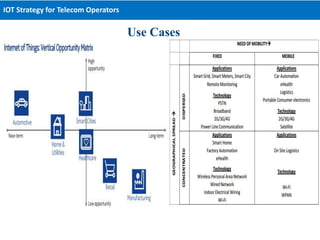
• Use Cases
Agenda
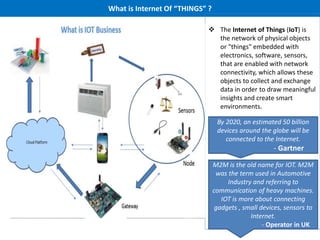
What is Internet Of “THINGS” ?
 The Internet of Things (IoT) is
the network of physical objects
or "things" embedded with
electronics, software, sensors,
that are enabled with network
connectivity, which allows these
objects to collect and exchange
data in order to draw meaningful
insights and create smart
environments.
By 2020, an estimated 50 billion
devices around the globe will be
connected to the Internet.
- Gartner
M2M is the old name for IOT. M2M
was the term used in Automotive
Industry and referring to
communication of heavy machines.
IOT is more about connecting
gadgets , small devices, sensors to
Internet.
- Operator in UK
• Selling Connectivity Packages (approach – 1)
o Leverage the potential in existing space by providing High-Quality & Reliable
Communication.
o Leverage an existing “customer base of millions”.
o Utilize proven mechanisms for “billing” & “supporting” huge customer base.
IOT Strategy for Telecom Operators
Benefits:
o Telecom Operators provides an
economical cellular connectivity
package of Pricing & Services.
o Gaining revenue by selling the
connectivity package to companies
using operator’s SIM in their
devices.
Challenges:
o Less differentiation in
connectivity options that are
being provided by different
operators.
o Pressure to keep connectivity
prices low.
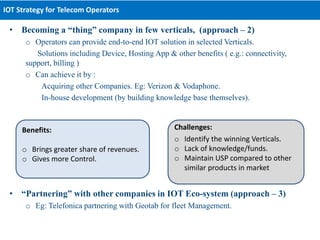
• Becoming a “thing” company in few verticals, (approach – 2)
o Operators can provide end-to-end IOT solution in selected Verticals.
Solutions including Device, Hosting App & other benefits ( e.g.: connectivity,
support, billing )
o Can achieve it by :
Acquiring other Companies. Eg: Verizon & Vodaphone.
In-house development (by building knowledge base themselves).
• “Partnering” with other companies in IOT Eco-system (approach – 3)
o Eg: Telefonica partnering with Geotab for fleet Management.
IOT Strategy for Telecom Operators
Benefits:
o Brings greater share of revenues.
o Gives more Control.
Challenges:
o Identify the winning Verticals.
o Lack of knowledge/funds.
o Maintain USP compared to other
similar products in market
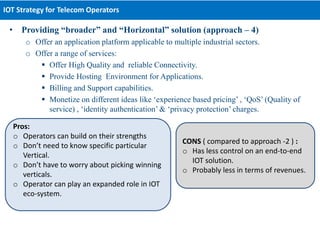
• Providing “broader” and “Horizontal” solution (approach – 4)
o Offer an application platform applicable to multiple industrial sectors.
o Offer a range of services:
 Offer High Quality and reliable Connectivity.
 Provide Hosting Environment for Applications.
 Billing and Support capabilities.
 Monetize on different ideas like ‘experience based pricing’ , ‘QoS’ (Quality of
service) , ‘identity authentication’ & ‘privacy protection’ charges.
IOT Strategy for Telecom Operators
Pros:
o Operators can build on their strengths
o Don’t need to know specific particular
Vertical.
o Don’t have to worry about picking winning
verticals.
o Operator can play an expanded role in IOT
eco-system.
CONS ( compared to approach -2 ) :
o Has less control on an end-to-end
IOT solution.
o Probably less in terms of revenues.
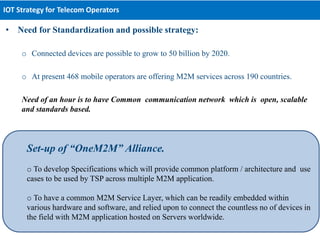
• Need for Standardization and possible strategy:
o Connected devices are possible to grow to 50 billion by 2020.
o At present 468 mobile operators are offering M2M services across 190 countries.
Need of an hour is to have Common communication network which is open, scalable
and standards based.
IOT Strategy for Telecom Operators
Set-up of “OneM2M” Alliance.
o To develop Specifications which will provide common platform / architecture and use
cases to be used by TSP across multiple M2M application.
o To have a common M2M Service Layer, which can be readily embedded within
various hardware and software, and relied upon to connect the countless no of devices in
the field with M2M application hosted on Servers worldwide.
• Challenges
o Lack of one standardization.
o Inter-operability issues & Integration of devices and platforms.
o Data Security & Privacy issues.
o Identifying the right Partner in IOT Ecosystem.
o Identifying the winning Verticals.
o Building strength of sales and support in order to generate more than
connectivity revenue from M2M and IoT services.
IOT Strategy for Telecom Operators
Use Cases
IOT Strategy for Telecom Operators
Thank You
IOT Strategy for Telecom Operators

IOT strategies for telecom operators

  • 1.
  • 2.
    • What is“IOT”? • IOT Strategy for Telecom Operators o Selling Connectivity o Become a “Thing” company in few Verticals o “Partner” with other parties in IOT ecosystem o Provide “Horizontal” solution to support multiple Vertical markets • Need of Standardization • Challenges • Use Cases Agenda
  • 3.
    What is InternetOf “THINGS” ?  The Internet of Things (IoT) is the network of physical objects or "things" embedded with electronics, software, sensors, that are enabled with network connectivity, which allows these objects to collect and exchange data in order to draw meaningful insights and create smart environments. By 2020, an estimated 50 billion devices around the globe will be connected to the Internet. - Gartner M2M is the old name for IOT. M2M was the term used in Automotive Industry and referring to communication of heavy machines. IOT is more about connecting gadgets , small devices, sensors to Internet. - Operator in UK
  • 4.
    • Selling ConnectivityPackages (approach – 1) o Leverage the potential in existing space by providing High-Quality & Reliable Communication. o Leverage an existing “customer base of millions”. o Utilize proven mechanisms for “billing” & “supporting” huge customer base. IOT Strategy for Telecom Operators Benefits: o Telecom Operators provides an economical cellular connectivity package of Pricing & Services. o Gaining revenue by selling the connectivity package to companies using operator’s SIM in their devices. Challenges: o Less differentiation in connectivity options that are being provided by different operators. o Pressure to keep connectivity prices low.
  • 5.
    • Becoming a“thing” company in few verticals, (approach – 2) o Operators can provide end-to-end IOT solution in selected Verticals. Solutions including Device, Hosting App & other benefits ( e.g.: connectivity, support, billing ) o Can achieve it by : Acquiring other Companies. Eg: Verizon & Vodaphone. In-house development (by building knowledge base themselves). • “Partnering” with other companies in IOT Eco-system (approach – 3) o Eg: Telefonica partnering with Geotab for fleet Management. IOT Strategy for Telecom Operators Benefits: o Brings greater share of revenues. o Gives more Control. Challenges: o Identify the winning Verticals. o Lack of knowledge/funds. o Maintain USP compared to other similar products in market
  • 6.
    • Providing “broader”and “Horizontal” solution (approach – 4) o Offer an application platform applicable to multiple industrial sectors. o Offer a range of services:  Offer High Quality and reliable Connectivity.  Provide Hosting Environment for Applications.  Billing and Support capabilities.  Monetize on different ideas like ‘experience based pricing’ , ‘QoS’ (Quality of service) , ‘identity authentication’ & ‘privacy protection’ charges. IOT Strategy for Telecom Operators Pros: o Operators can build on their strengths o Don’t need to know specific particular Vertical. o Don’t have to worry about picking winning verticals. o Operator can play an expanded role in IOT eco-system. CONS ( compared to approach -2 ) : o Has less control on an end-to-end IOT solution. o Probably less in terms of revenues.
  • 7.
    • Need forStandardization and possible strategy: o Connected devices are possible to grow to 50 billion by 2020. o At present 468 mobile operators are offering M2M services across 190 countries. Need of an hour is to have Common communication network which is open, scalable and standards based. IOT Strategy for Telecom Operators Set-up of “OneM2M” Alliance. o To develop Specifications which will provide common platform / architecture and use cases to be used by TSP across multiple M2M application. o To have a common M2M Service Layer, which can be readily embedded within various hardware and software, and relied upon to connect the countless no of devices in the field with M2M application hosted on Servers worldwide.
  • 8.
    • Challenges o Lackof one standardization. o Inter-operability issues & Integration of devices and platforms. o Data Security & Privacy issues. o Identifying the right Partner in IOT Ecosystem. o Identifying the winning Verticals. o Building strength of sales and support in order to generate more than connectivity revenue from M2M and IoT services. IOT Strategy for Telecom Operators
  • 9.
    Use Cases IOT Strategyfor Telecom Operators
  • 10.
    Thank You IOT Strategyfor Telecom Operators