Presented by: Kamrul Islam
Introduction
 What is Internet of Things (IoT)?
 Potentiality of IoT is enormous
 4.9 billion connecting device by 2020 and 25 billion by
2025.
 IoT business and revenue
 IDC forecast 7 Trillion and Gartner forecast 3oo Billion
USD by 2020
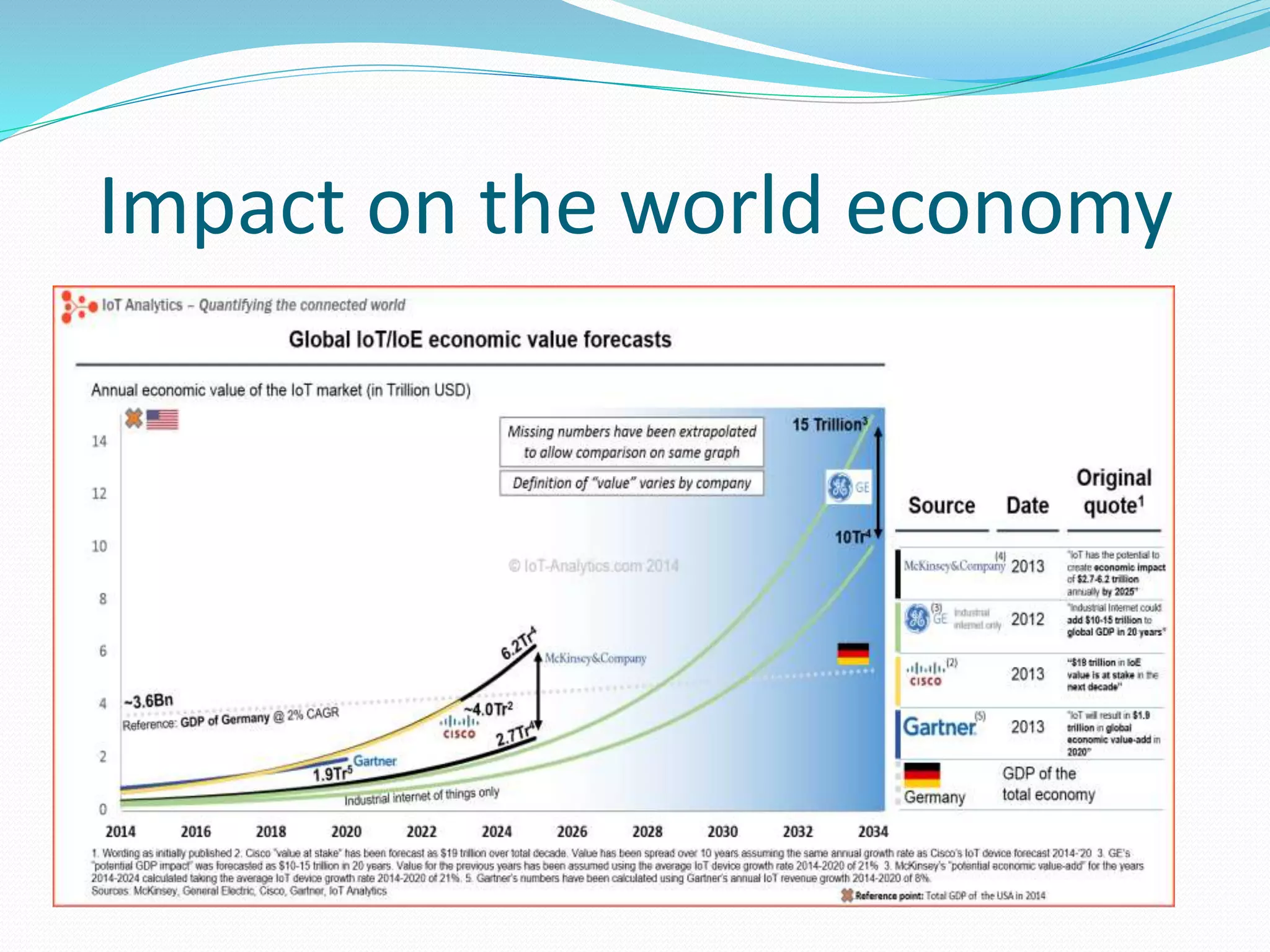
 IoT economical impact worldwide
 1,9 trillion by 2020 and 6.2 trillion by 2025.
Impact on the world economy
Definition of IoT
 “Internet of Things (IoT) is an integrated part of Future Internet and
could be defined as a dynamic global network infrastructure with self
configuring capabilities based on standard and interoperable
communication protocols where physical and virtual ‘things’ have
identities, physical attributes, and virtual personalities and use
intelligent interfaces, and are seamlessly integrated into the information
network. In the IoT, ‘things’ are expected to become active participants
in business, information and social processes where they are enabled to
interact and communicate among themselves and with the environment
by exchanging data and information ‘sensed’ about the environment,
while reacting autonomously to the ‘real/physical world’ events and
influencing it by running processes that trigger actions and create
services with or without direct human intervention. Interfaces in the
form of services facilitate interactions with these ‘smart things’ over the
Internet, query and change their state and any information associated
with them, taking into account security and privacy issues.”
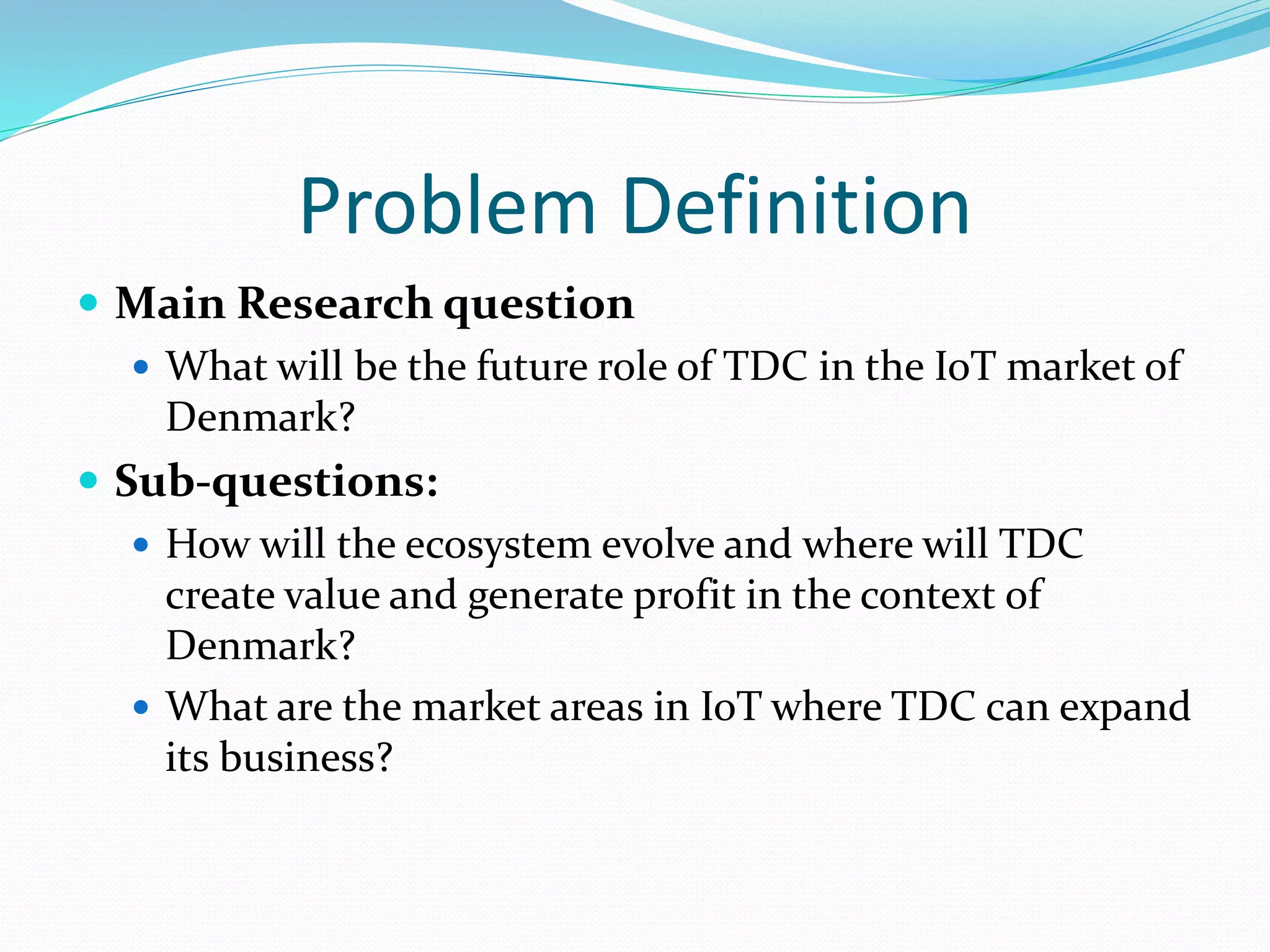
Problem Definition
 Main Research question
 What will be the future role of TDC in the IoT market of
Denmark?
 Sub-questions:
 How will the ecosystem evolve and where will TDC
create value and generate profit in the context of
Denmark?
 What are the market areas in IoT where TDC can expand
its business?
Motivation
 Working with Denmark largest telecom company, TDC
 IoT is growing trend and higher potentiality
 Academic research interest for future PhD endeavour
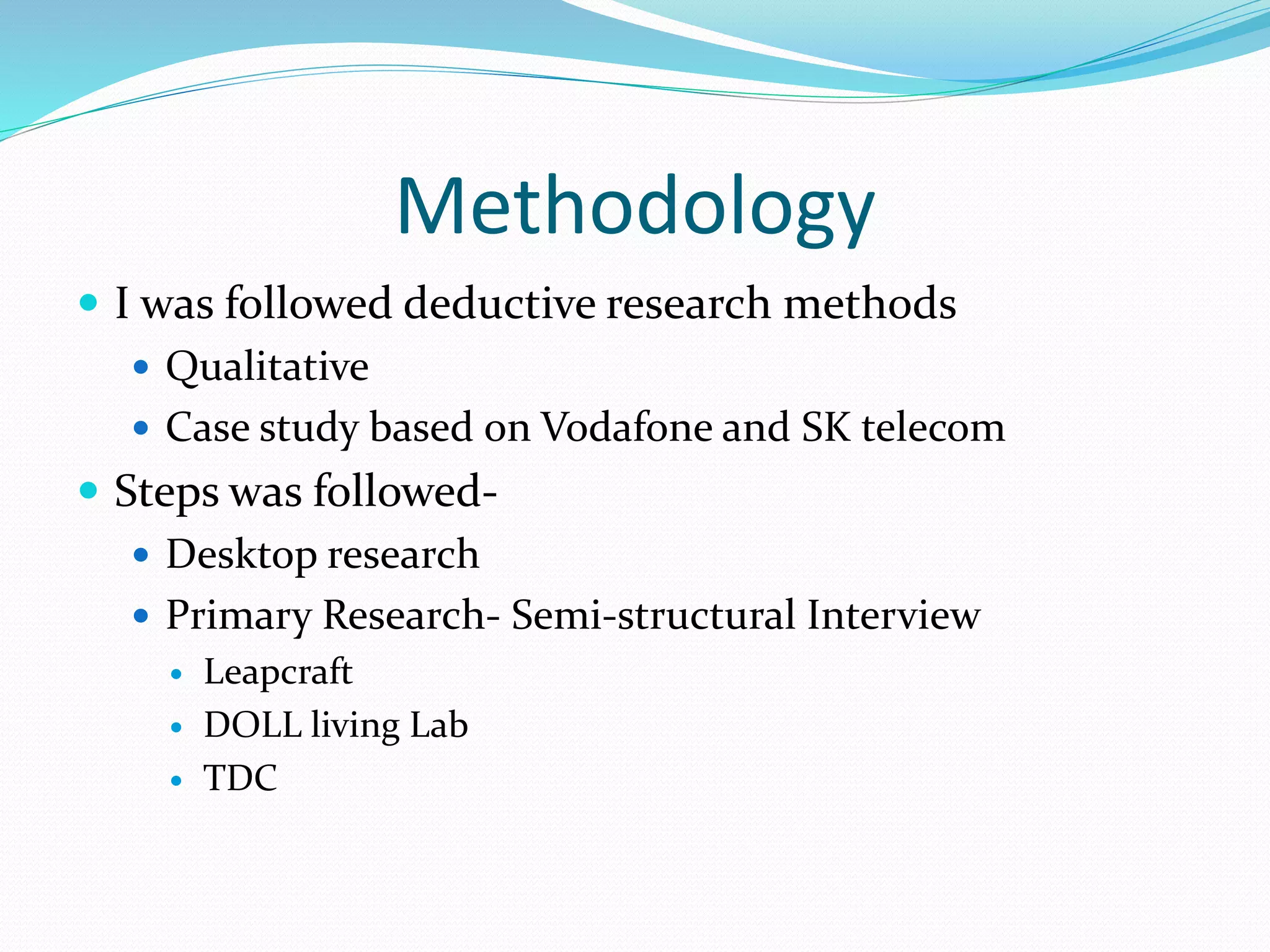
Methodology
 I was followed deductive research methods
 Qualitative
 Case study based on Vodafone and SK telecom
 Steps was followed-
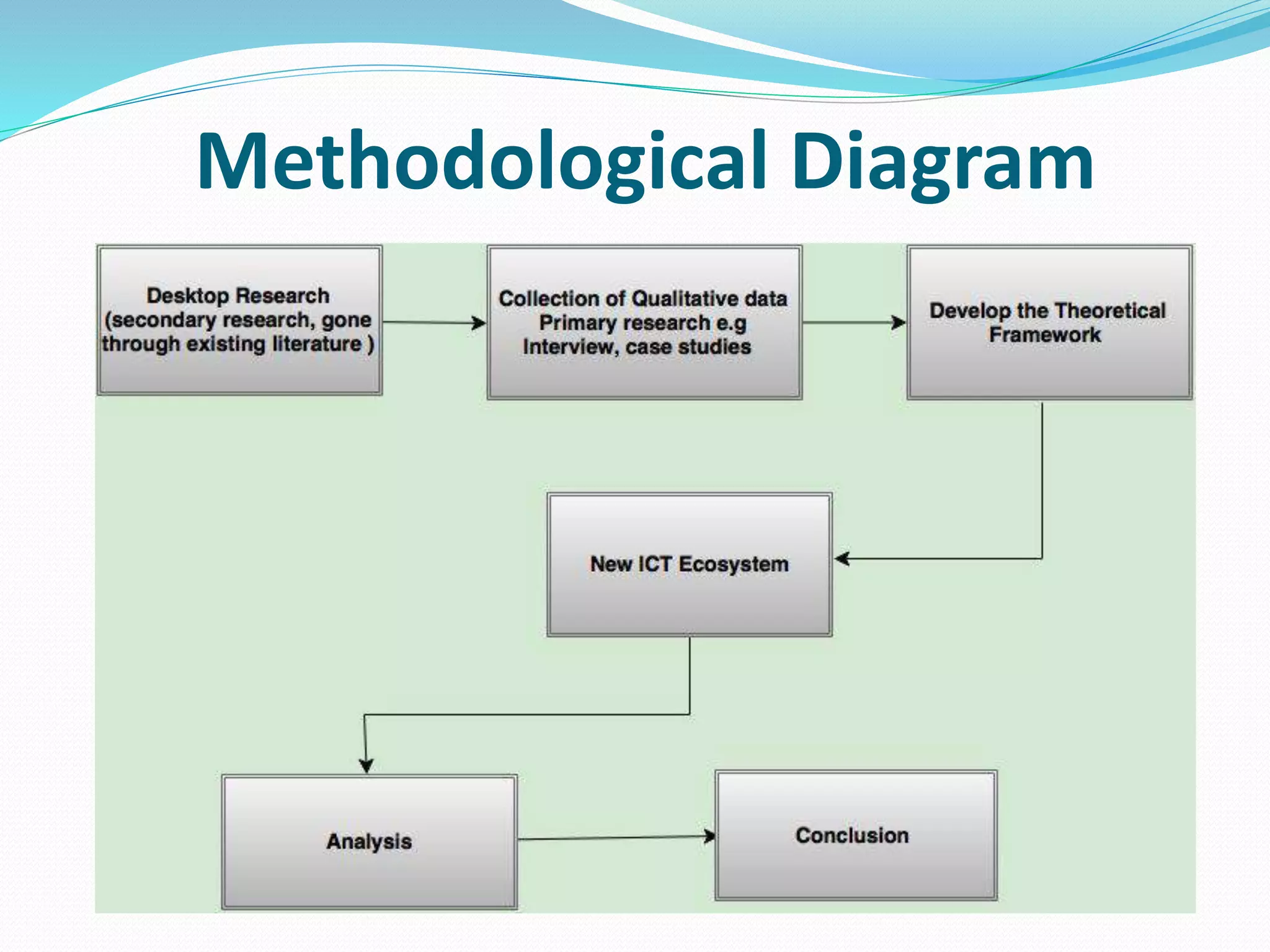
 Desktop research
 Primary Research- Semi-structural Interview
 Leapcraft
 DOLL living Lab
 TDC
Methodological Diagram
Delimitation
 Focused on Telecom sectors
 Avoid regulation
 Avoid security and users privacy aspects
 Macro and micro economics aspects.
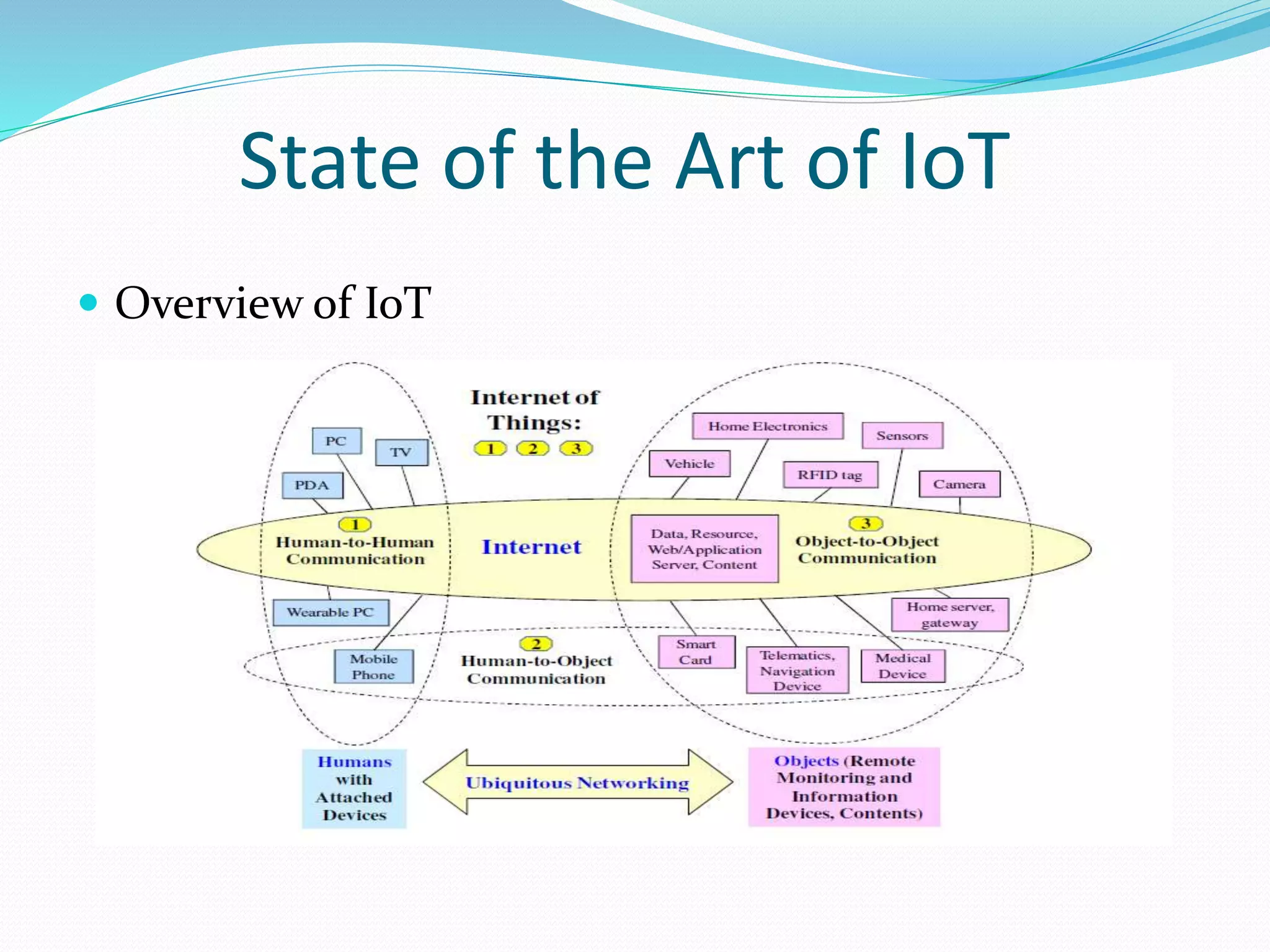
State of the Art of IoT
 Overview of IoT
Machine to machine (M2M) vs
Internet of things (IoT)
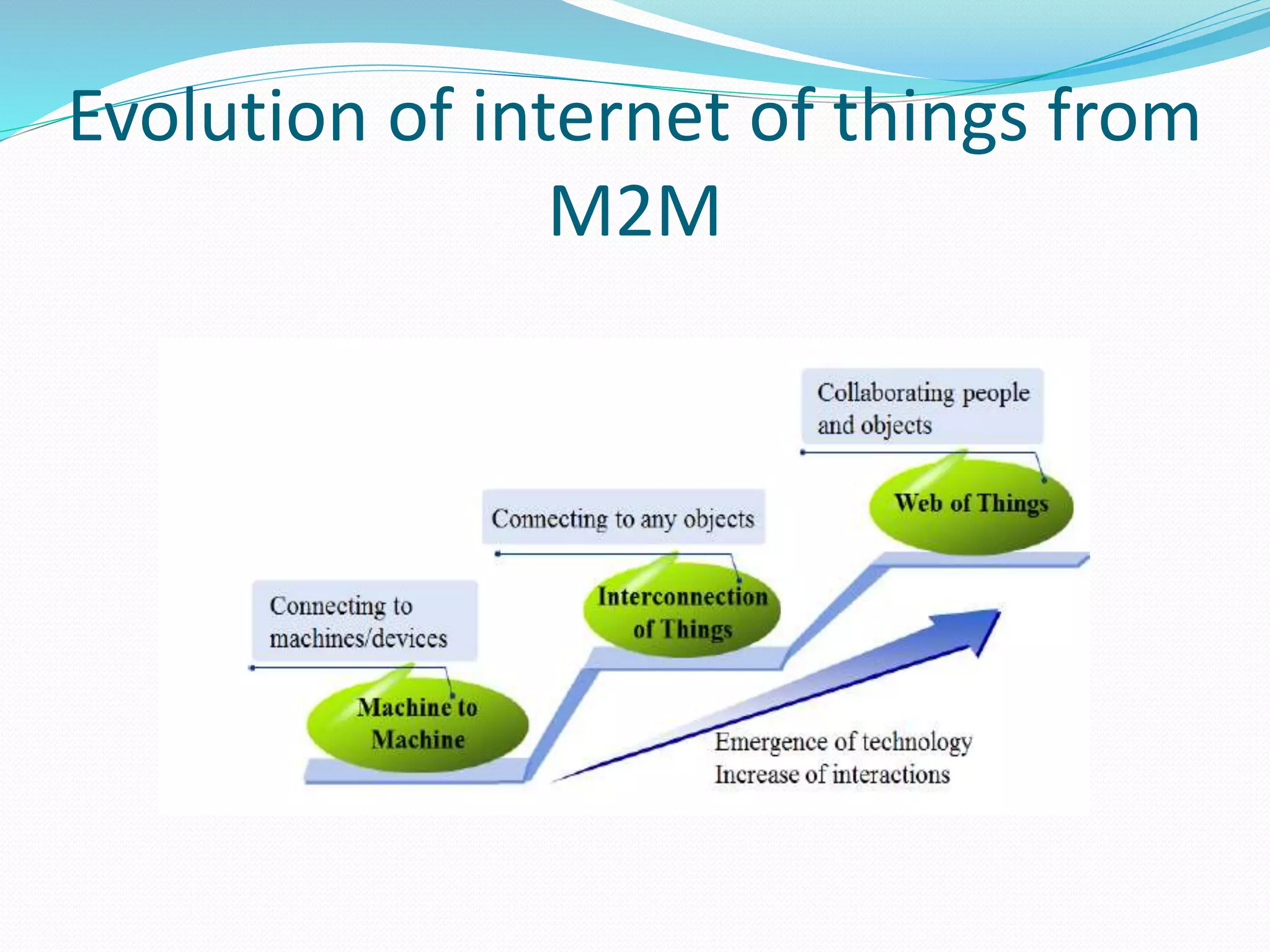
 IoT concepts evolved from M2M
 M2M could communicate over GSM or other similar
network without involvement of IP but IoT is IP based
communication
 M2M consist of hardware and embedded software and
IoT consist of hardware, software, best customers
experience (QoS)
Evolution of internet of things from
M2M
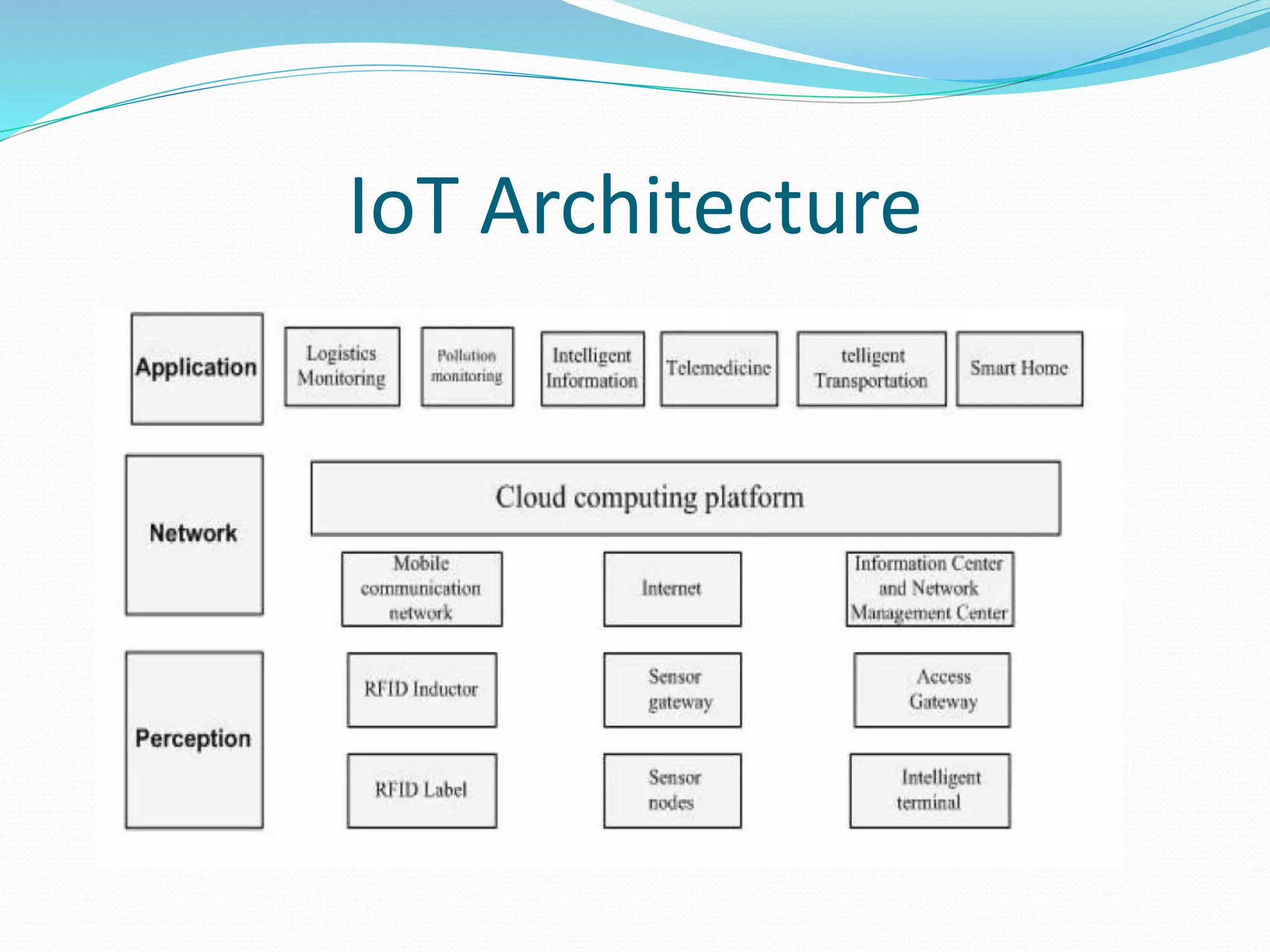
IoT Architecture
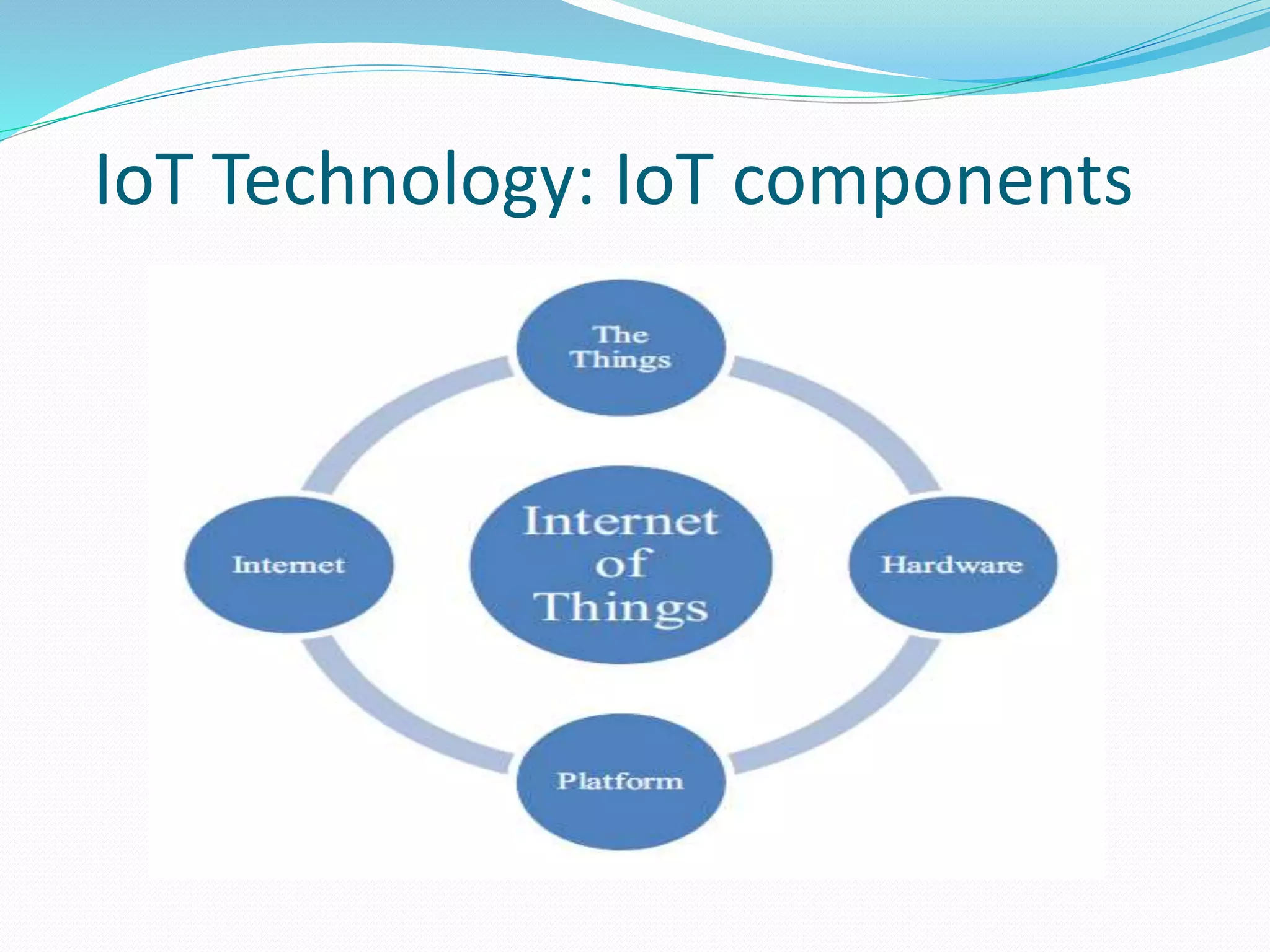
IoT Technology: IoT components
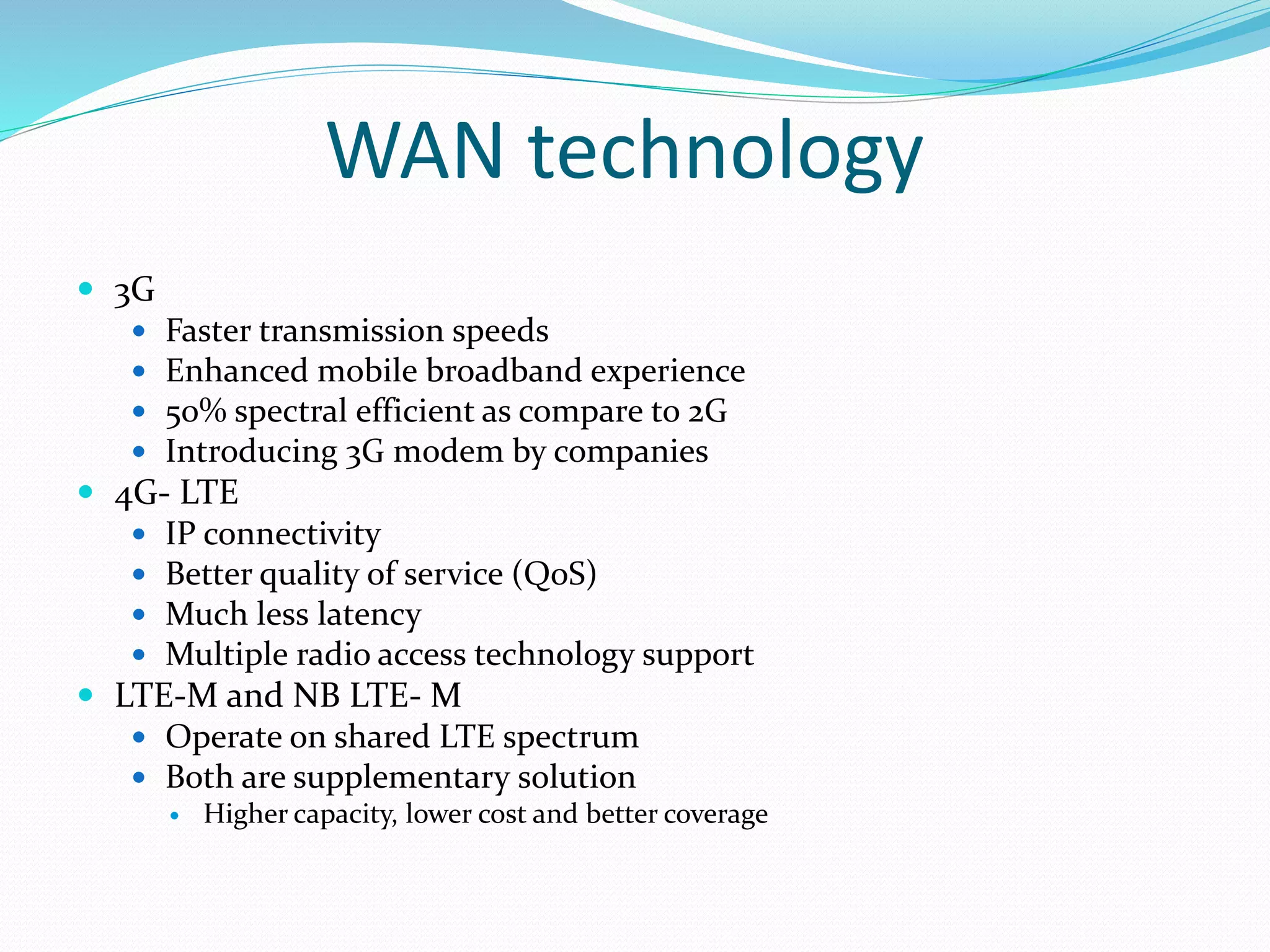
WAN technology
 3G
 Faster transmission speeds
 Enhanced mobile broadband experience
 50% spectral efficient as compare to 2G
 Introducing 3G modem by companies
 4G- LTE
 IP connectivity
 Better quality of service (QoS)
 Much less latency
 Multiple radio access technology support
 LTE-M and NB LTE- M
 Operate on shared LTE spectrum
 Both are supplementary solution
 Higher capacity, lower cost and better coverage
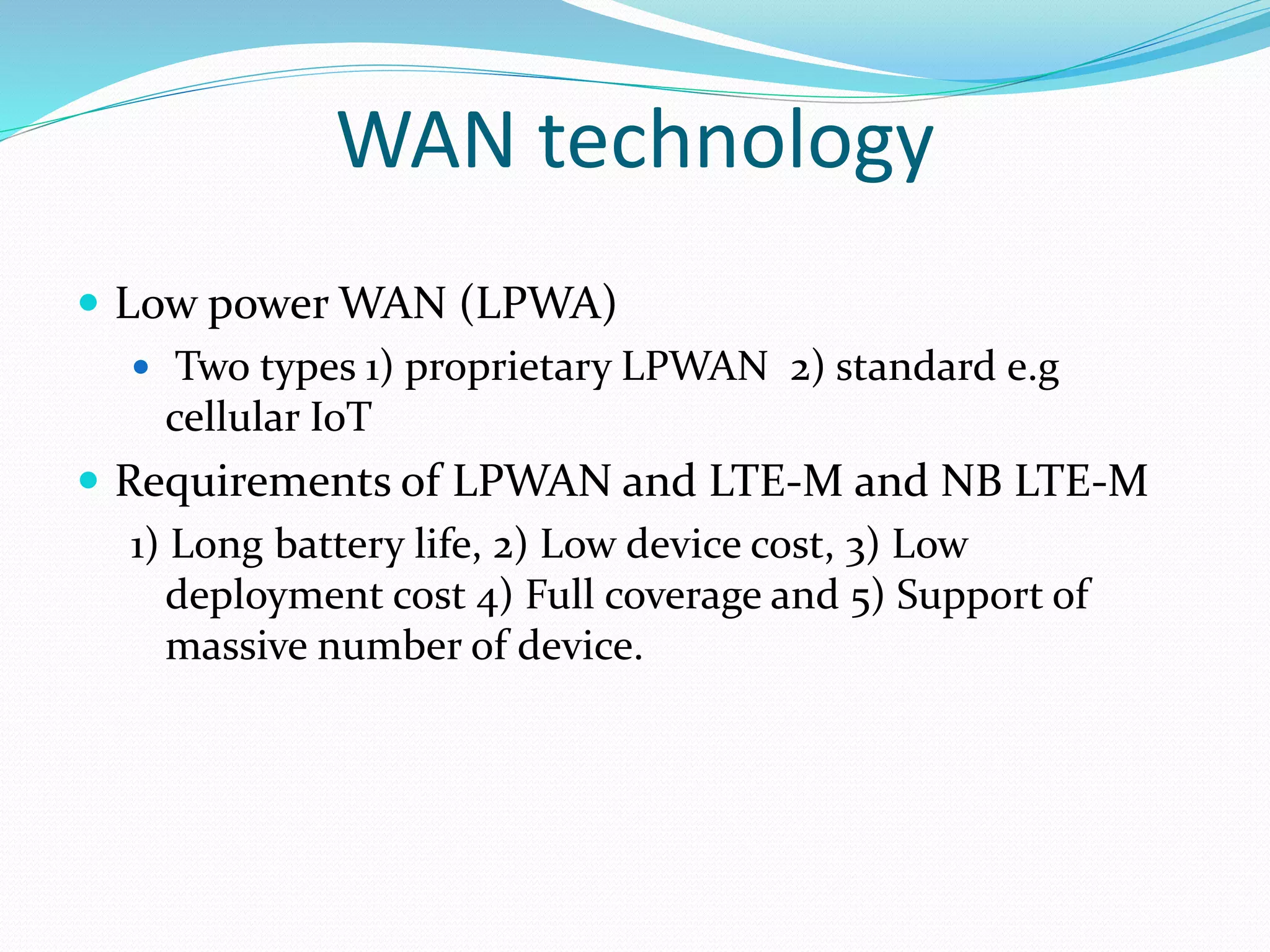
WAN technology
 Low power WAN (LPWA)
 Two types 1) proprietary LPWAN 2) standard e.g
cellular IoT
 Requirements of LPWAN and LTE-M and NB LTE-M
1) Long battery life, 2) Low device cost, 3) Low
deployment cost 4) Full coverage and 5) Support of
massive number of device.
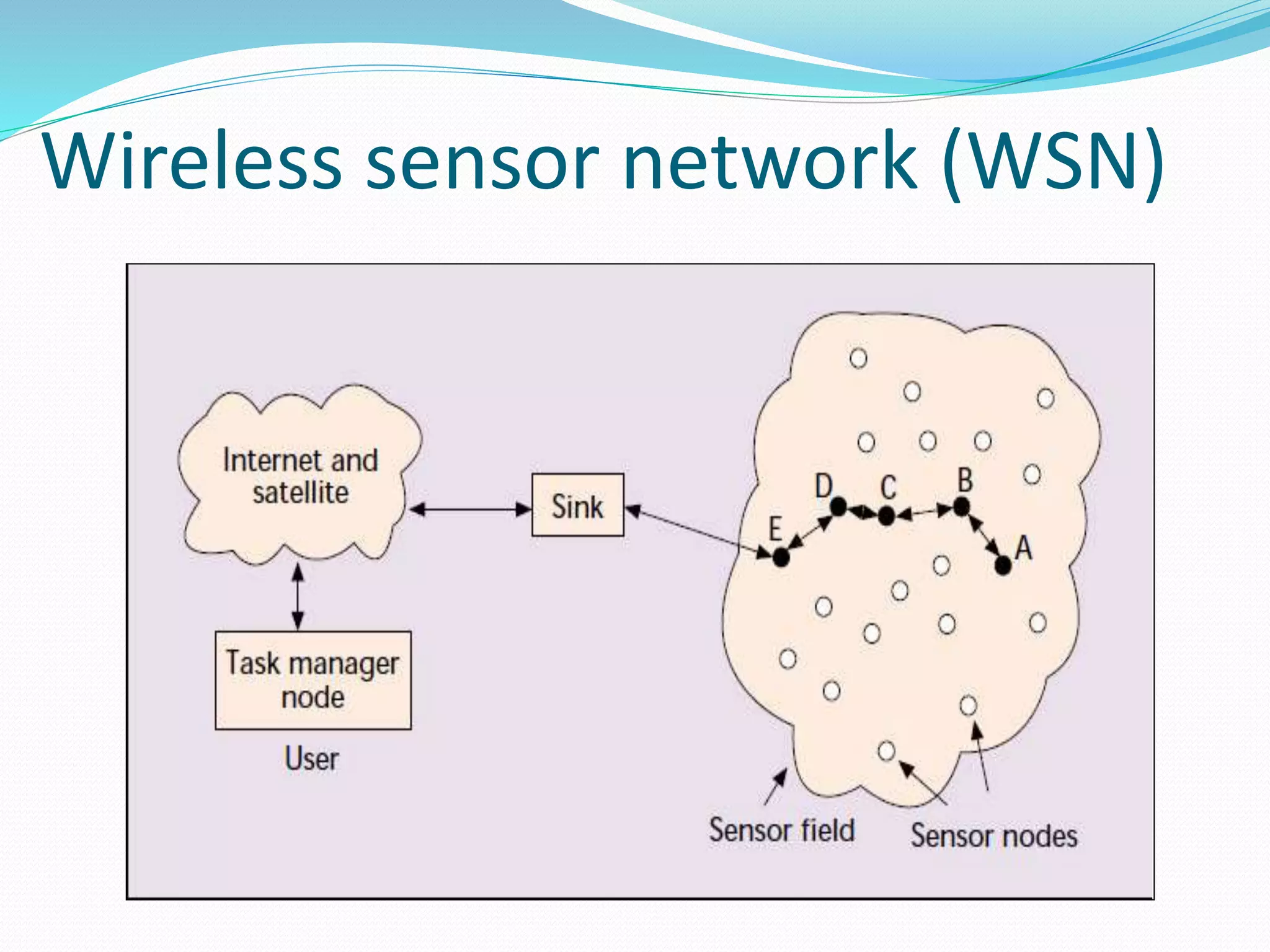
Wireless sensor network (WSN)
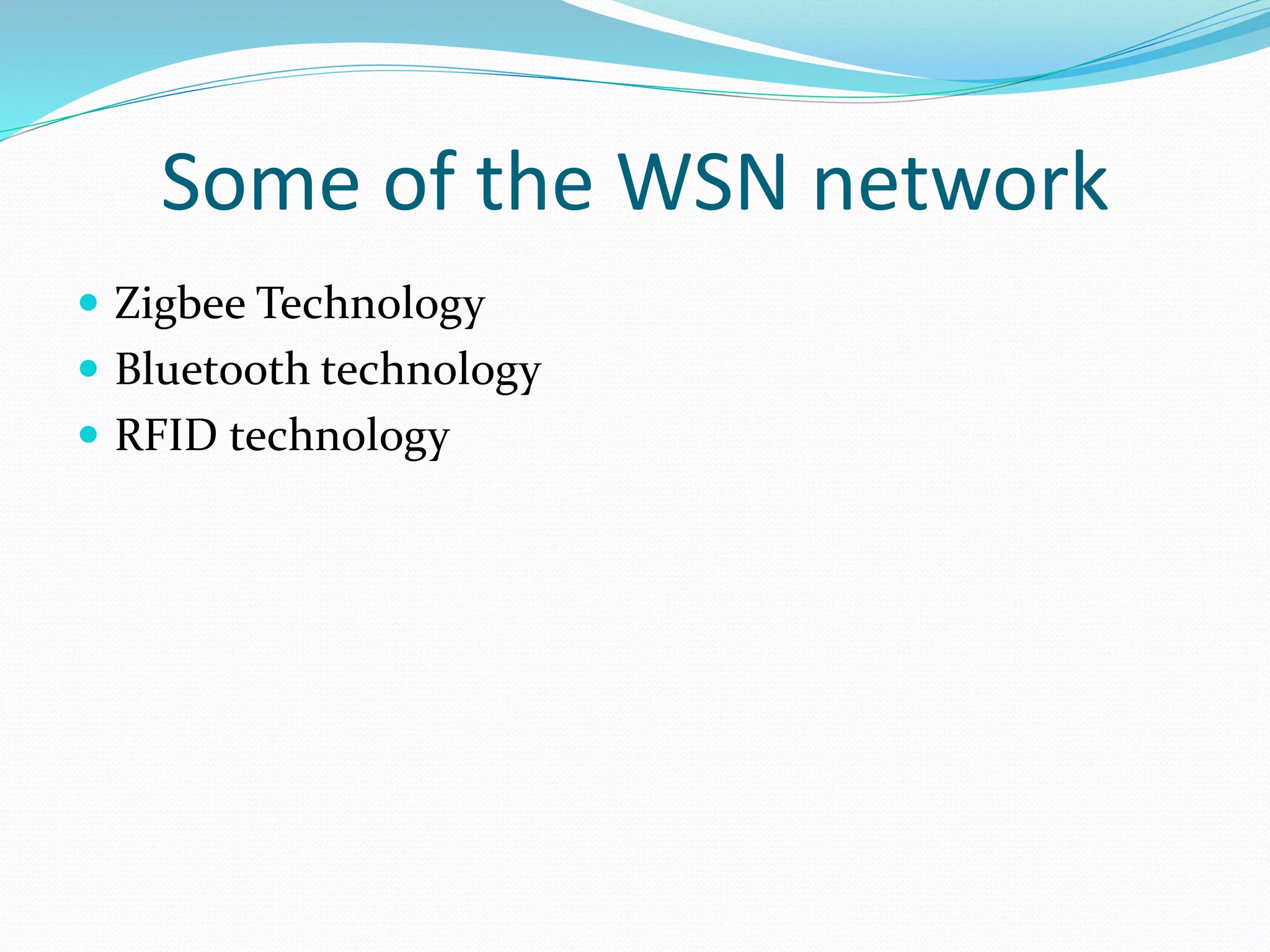
Some of the WSN network
 Zigbee Technology
 Bluetooth technology
 RFID technology
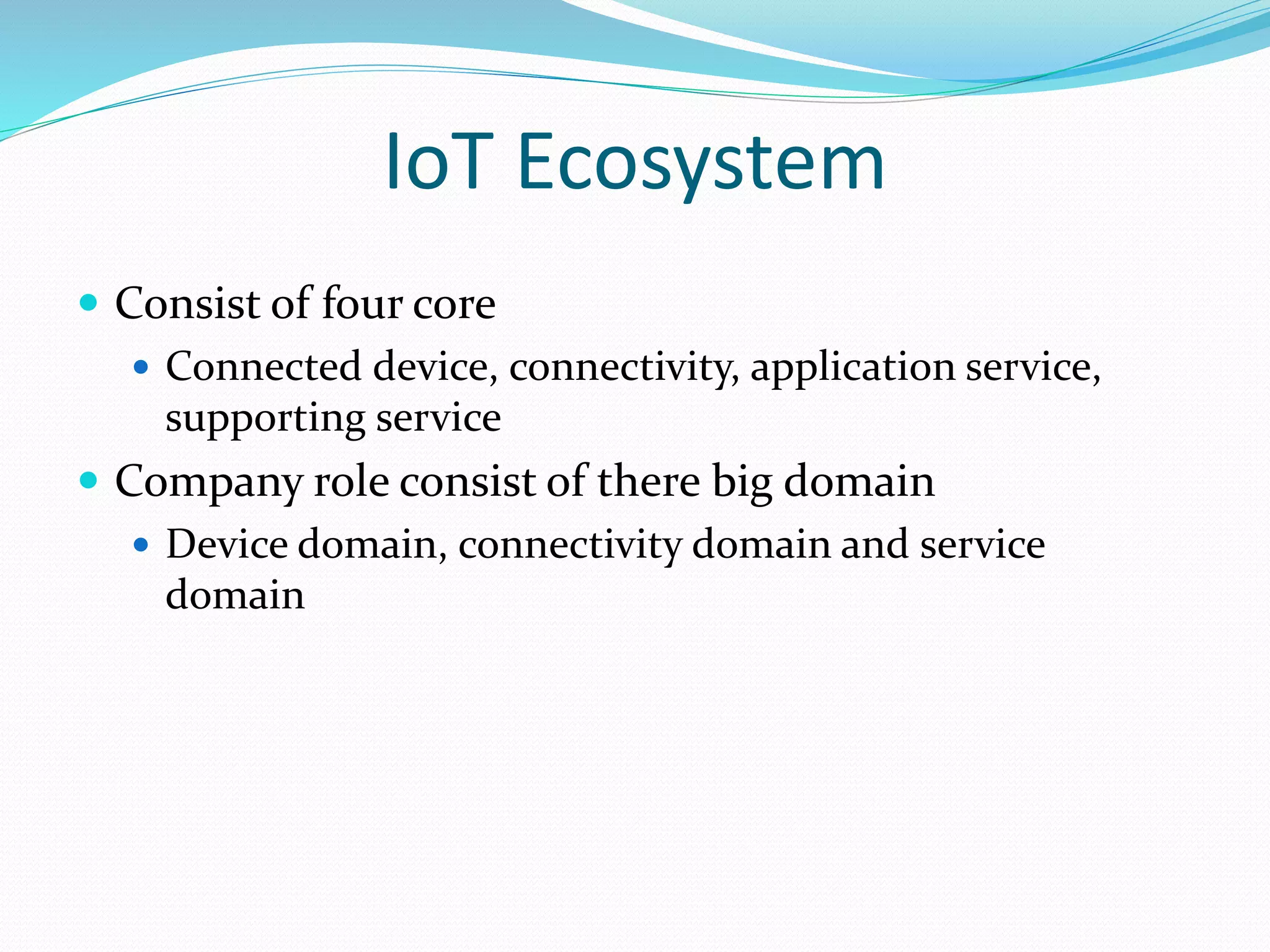
IoT Ecosystem
 Consist of four core
 Connected device, connectivity, application service,
supporting service
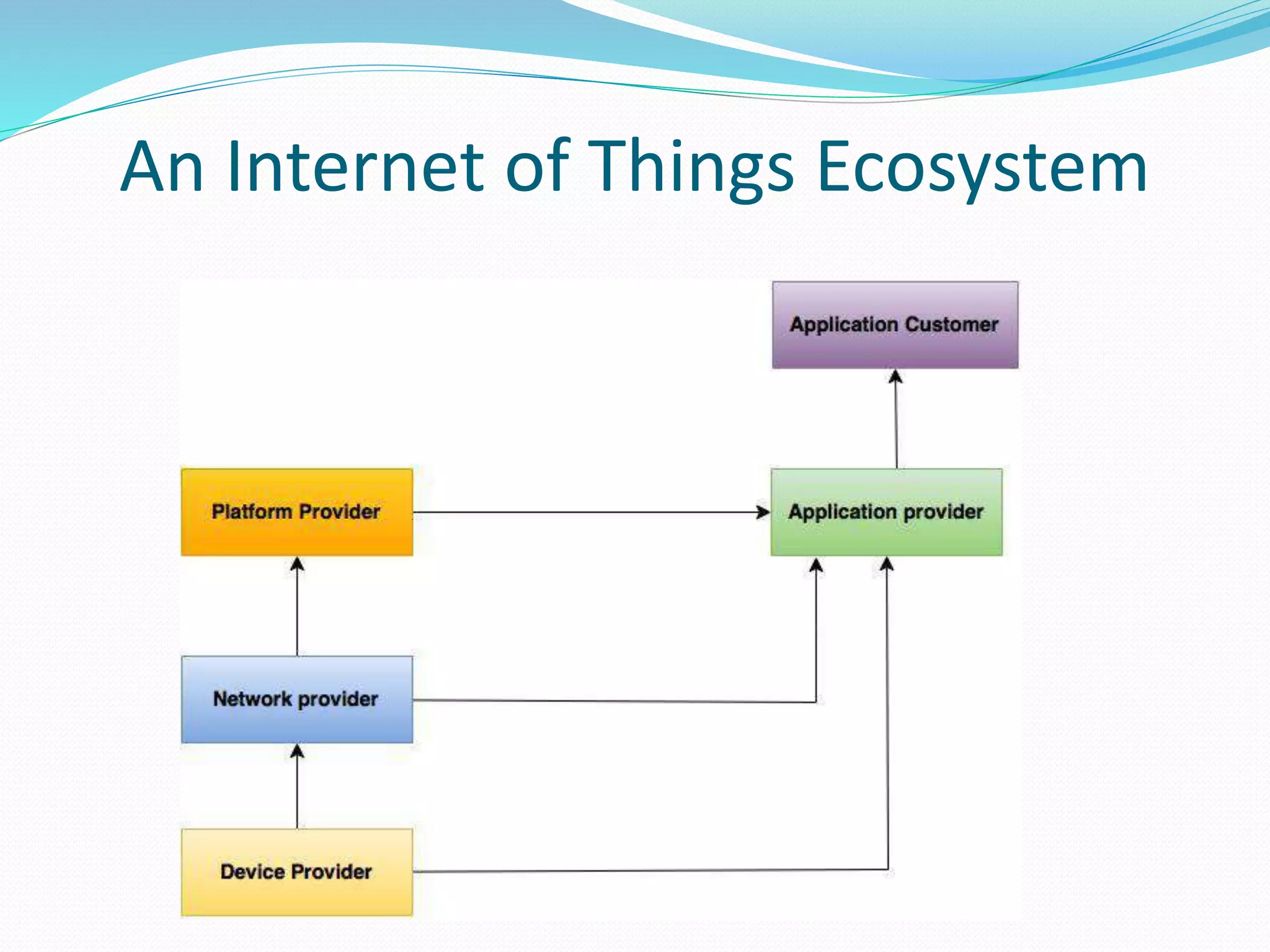
 Company role consist of there big domain
 Device domain, connectivity domain and service
domain
An Internet of Things Ecosystem
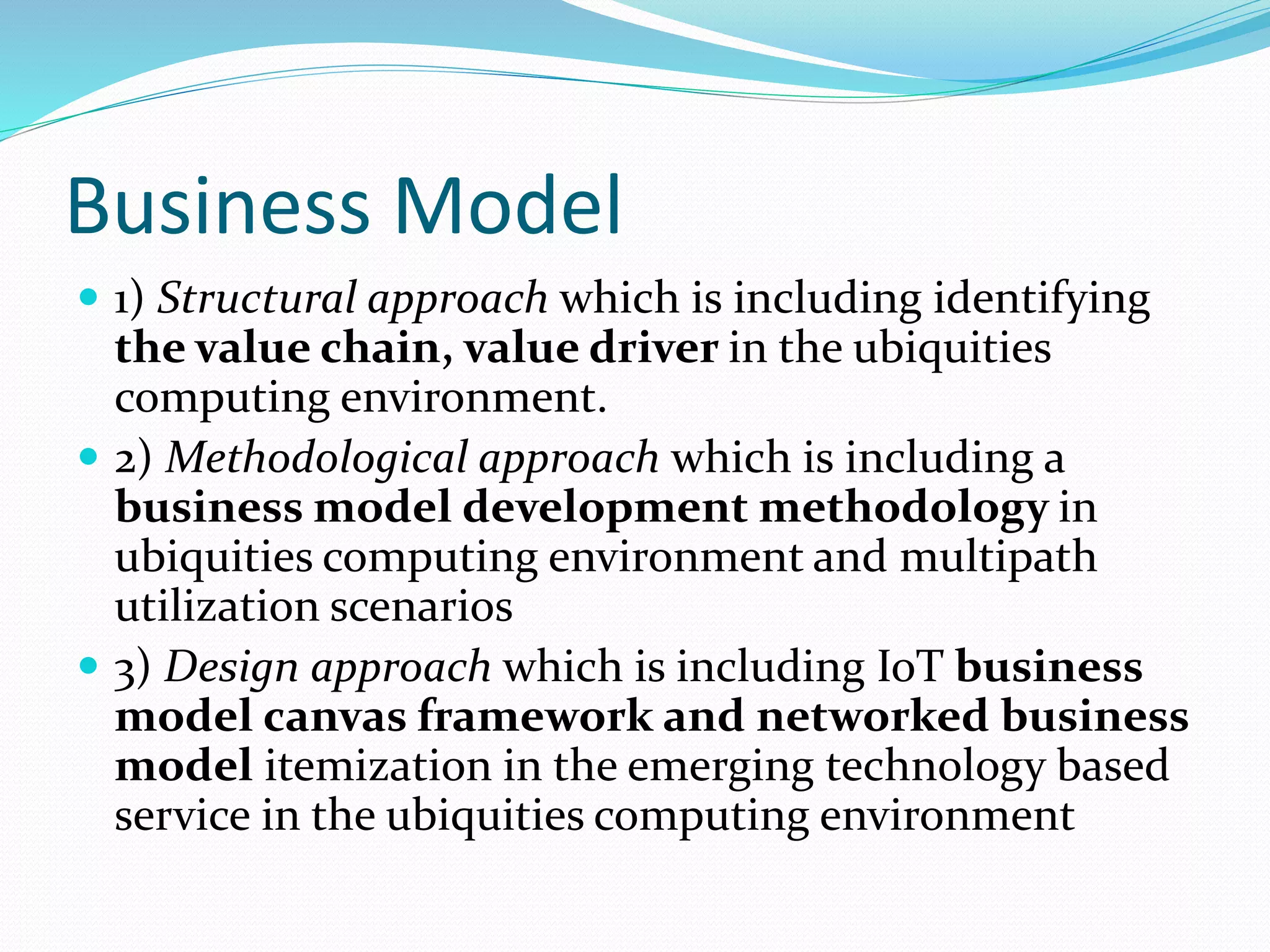
Business Model
 1) Structural approach which is including identifying
the value chain, value driver in the ubiquities
computing environment.
 2) Methodological approach which is including a
business model development methodology in
ubiquities computing environment and multipath
utilization scenarios
 3) Design approach which is including IoT business
model canvas framework and networked business
model itemization in the emerging technology based
service in the ubiquities computing environment
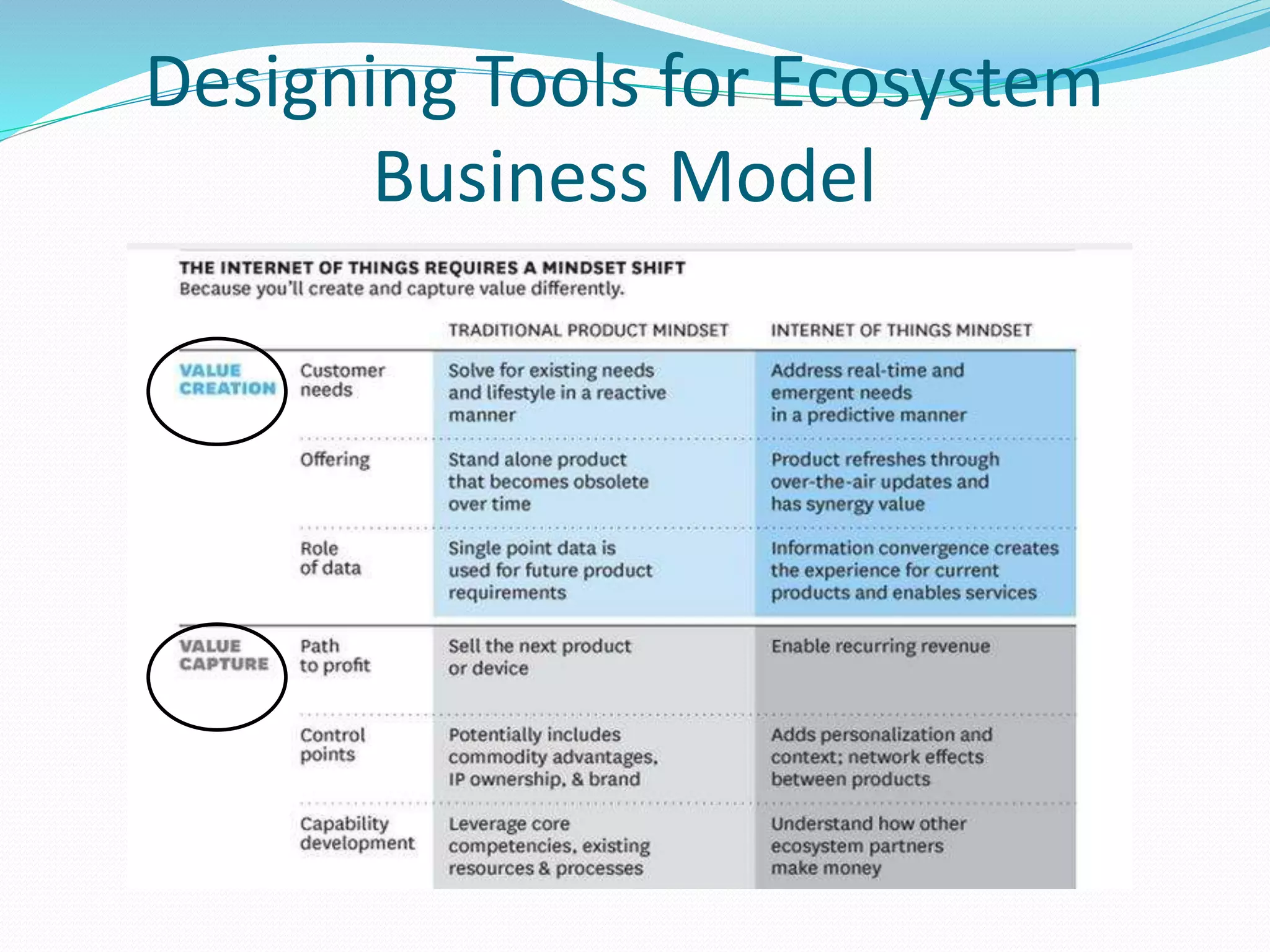
Designing Tools for Ecosystem
Business Model
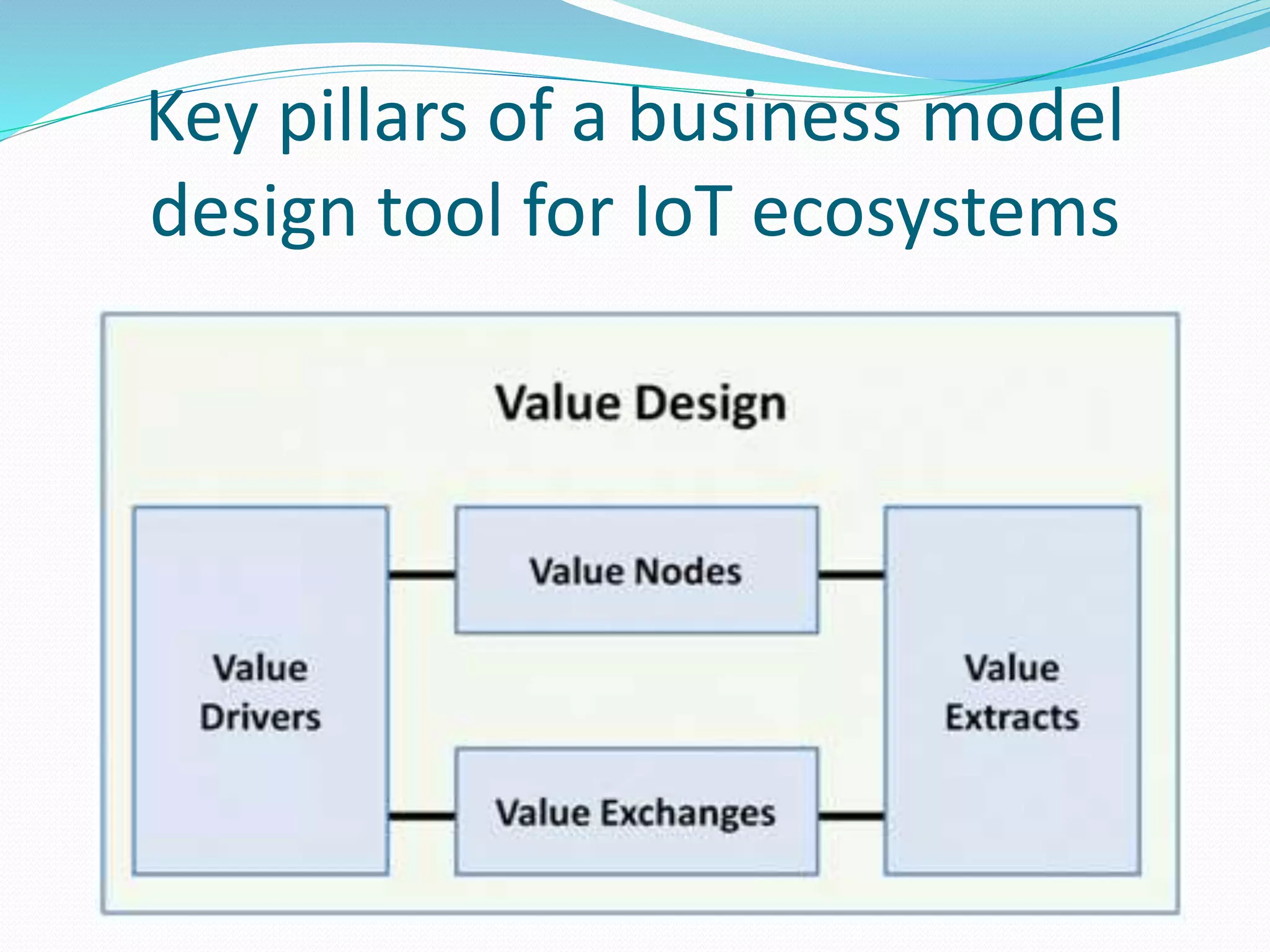
Key pillars of a business model
design tool for IoT ecosystems
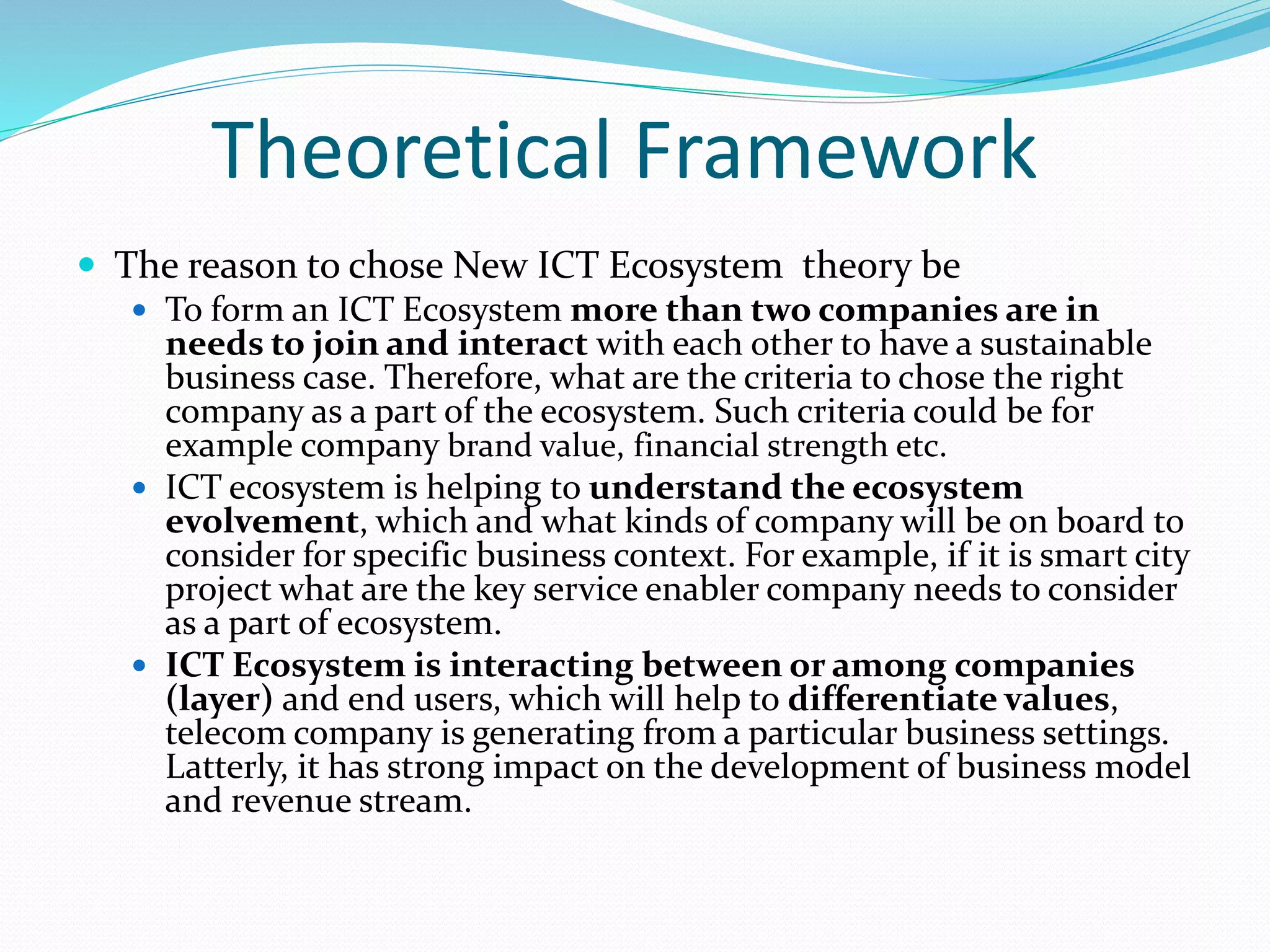
Theoretical Framework
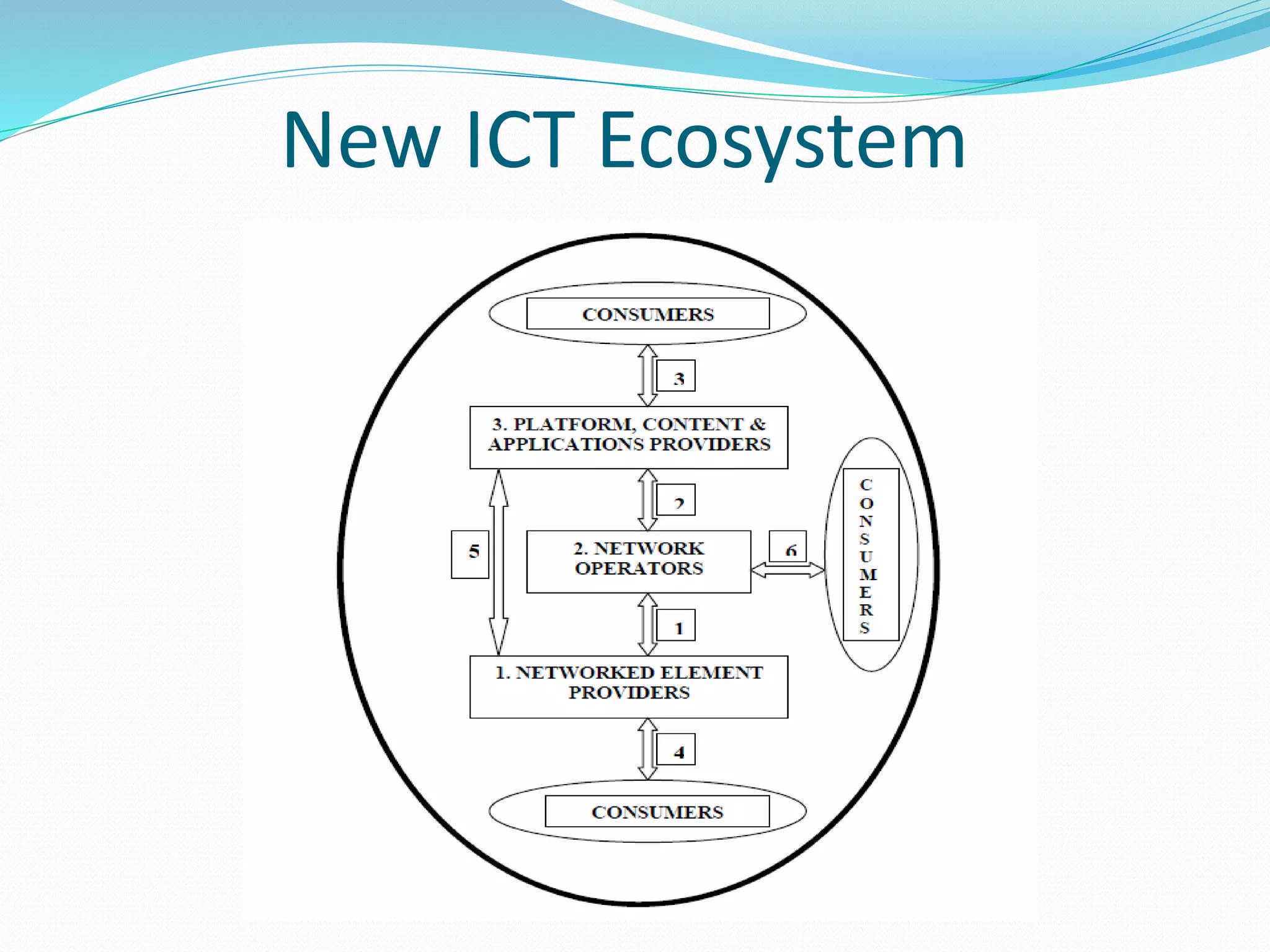
 The reason to chose New ICT Ecosystem theory be
 To form an ICT Ecosystem more than two companies are in
needs to join and interact with each other to have a sustainable
business case. Therefore, what are the criteria to chose the right
company as a part of the ecosystem. Such criteria could be for
example company brand value, financial strength etc.
 ICT ecosystem is helping to understand the ecosystem
evolvement, which and what kinds of company will be on board to
consider for specific business context. For example, if it is smart city
project what are the key service enabler company needs to consider
as a part of ecosystem.
 ICT Ecosystem is interacting between or among companies
(layer) and end users, which will help to differentiate values,
telecom company is generating from a particular business settings.
Latterly, it has strong impact on the development of business model
and revenue stream.
New ICT Ecosystem
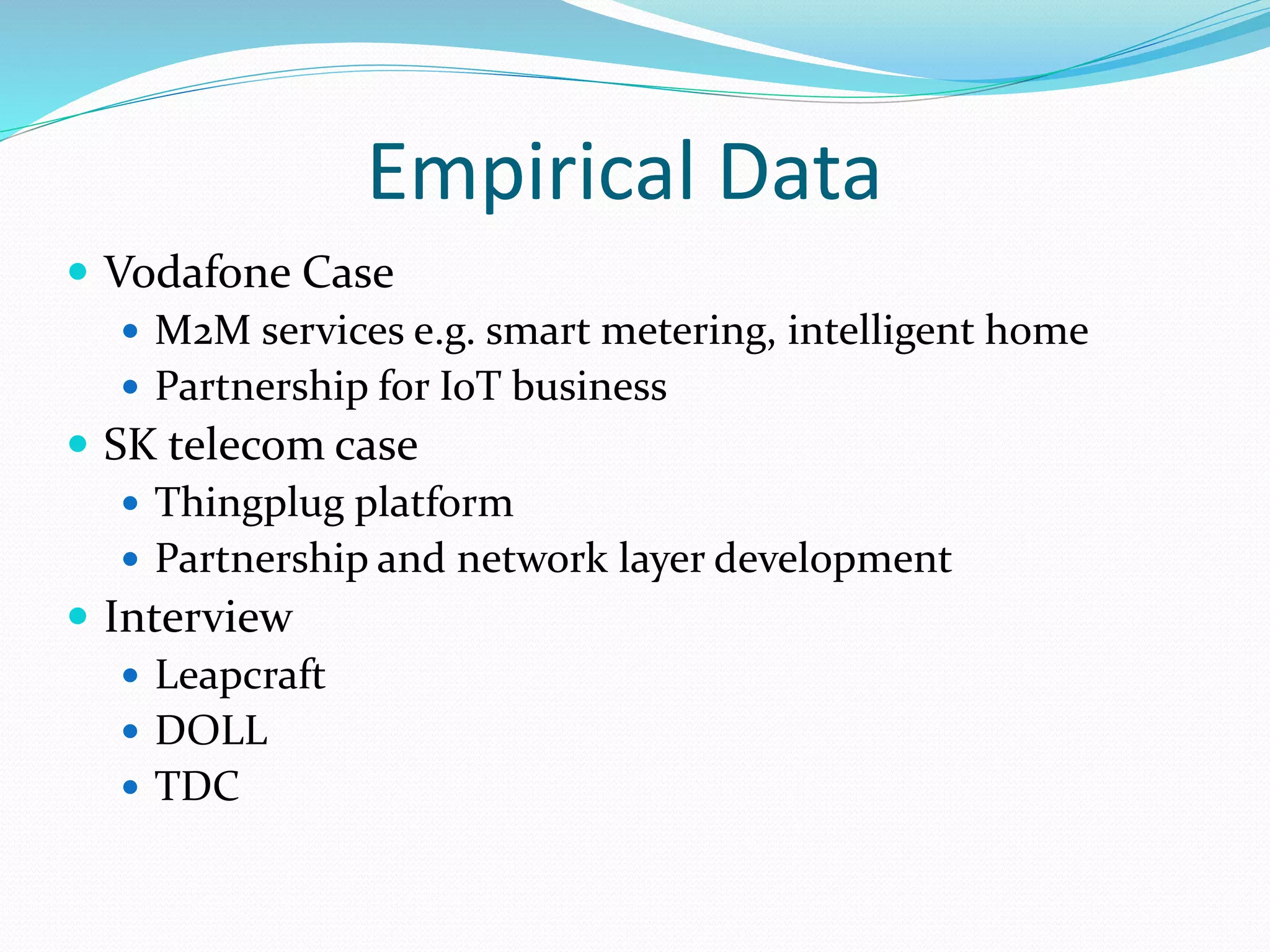
Empirical Data
 Vodafone Case
 M2M services e.g. smart metering, intelligent home
 Partnership for IoT business
 SK telecom case
 Thingplug platform
 Partnership and network layer development
 Interview
 Leapcraft
 DOLL
 TDC
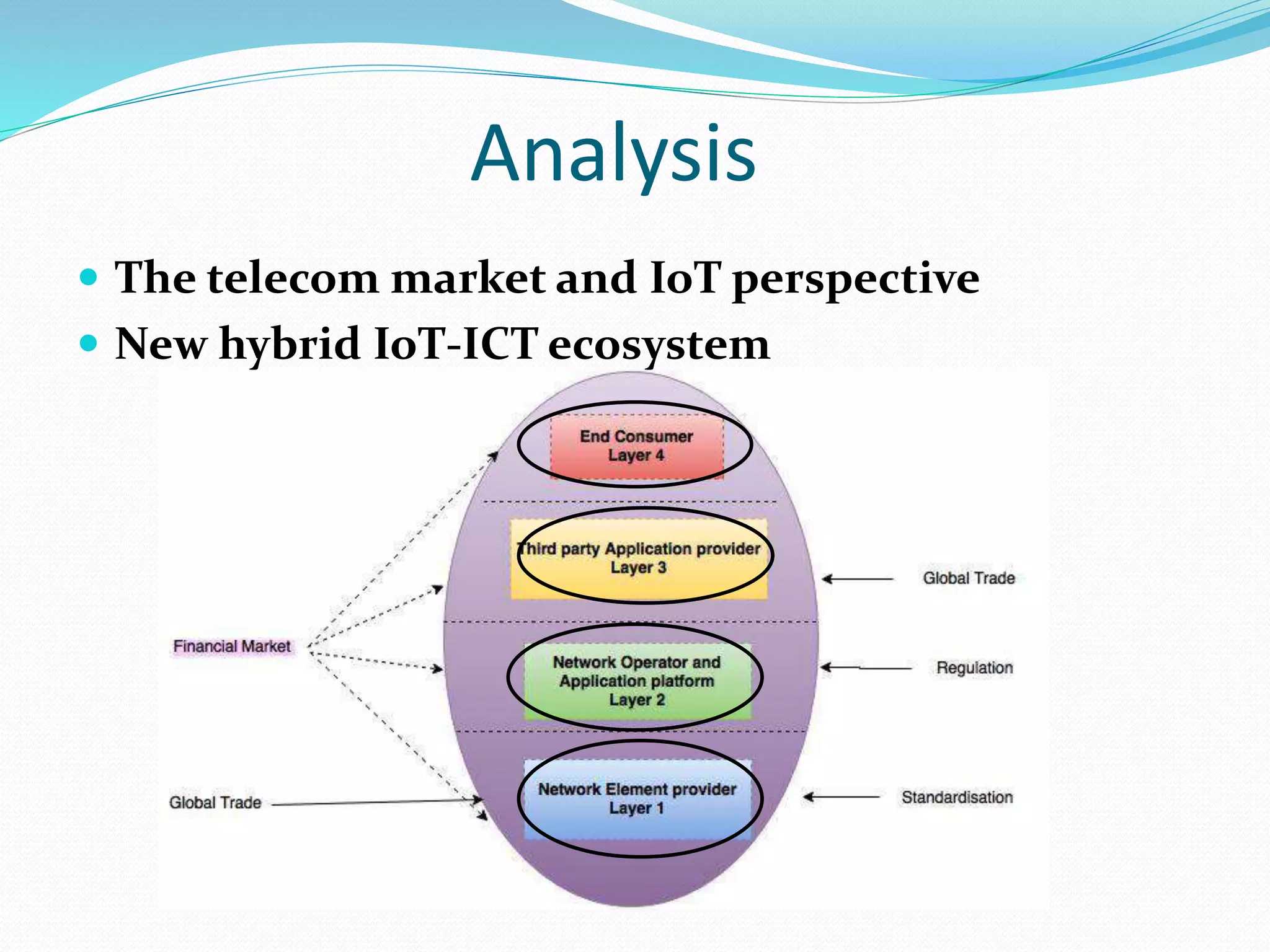
Analysis
 The telecom market and IoT perspective
 New hybrid IoT-ICT ecosystem
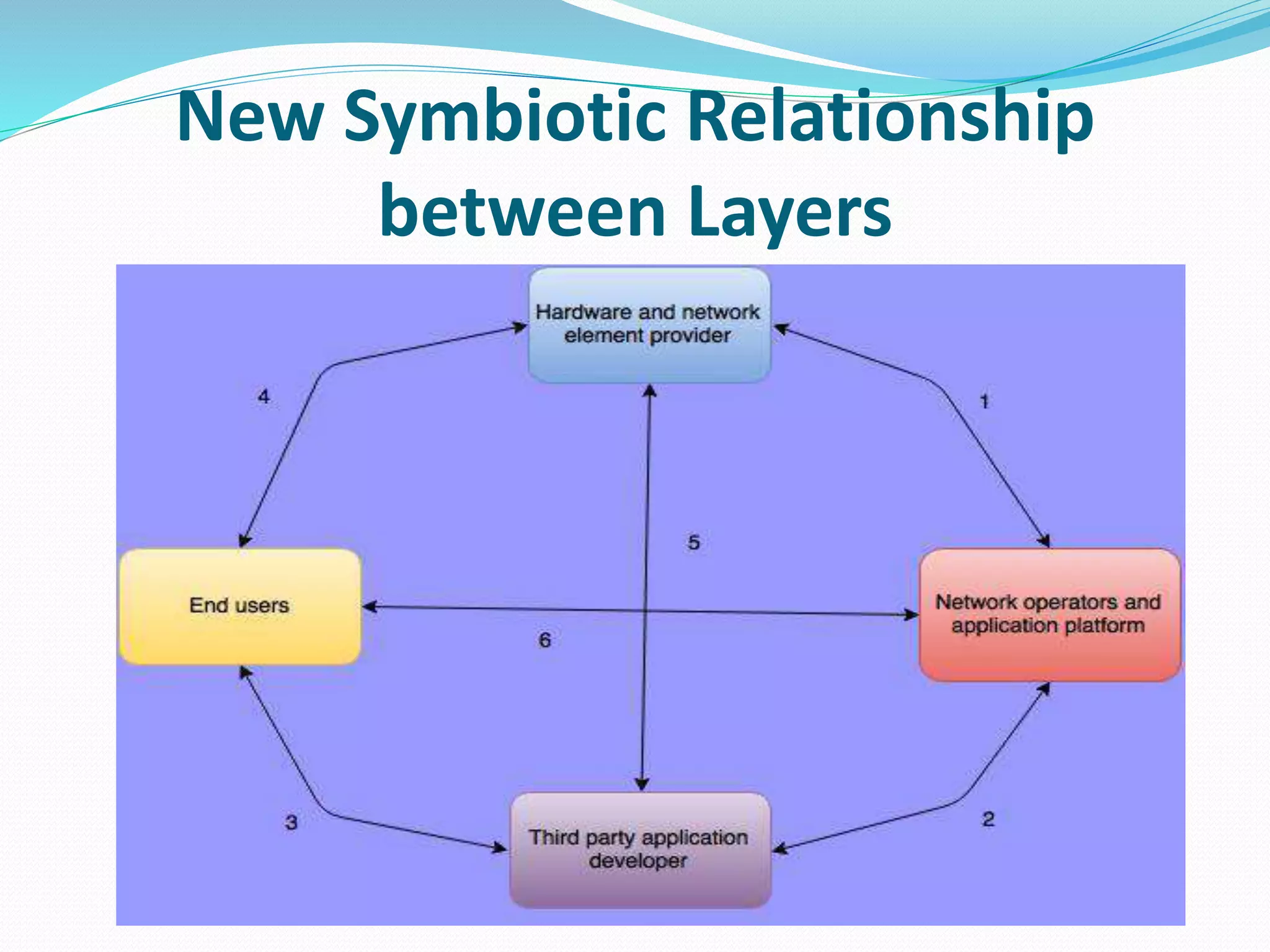
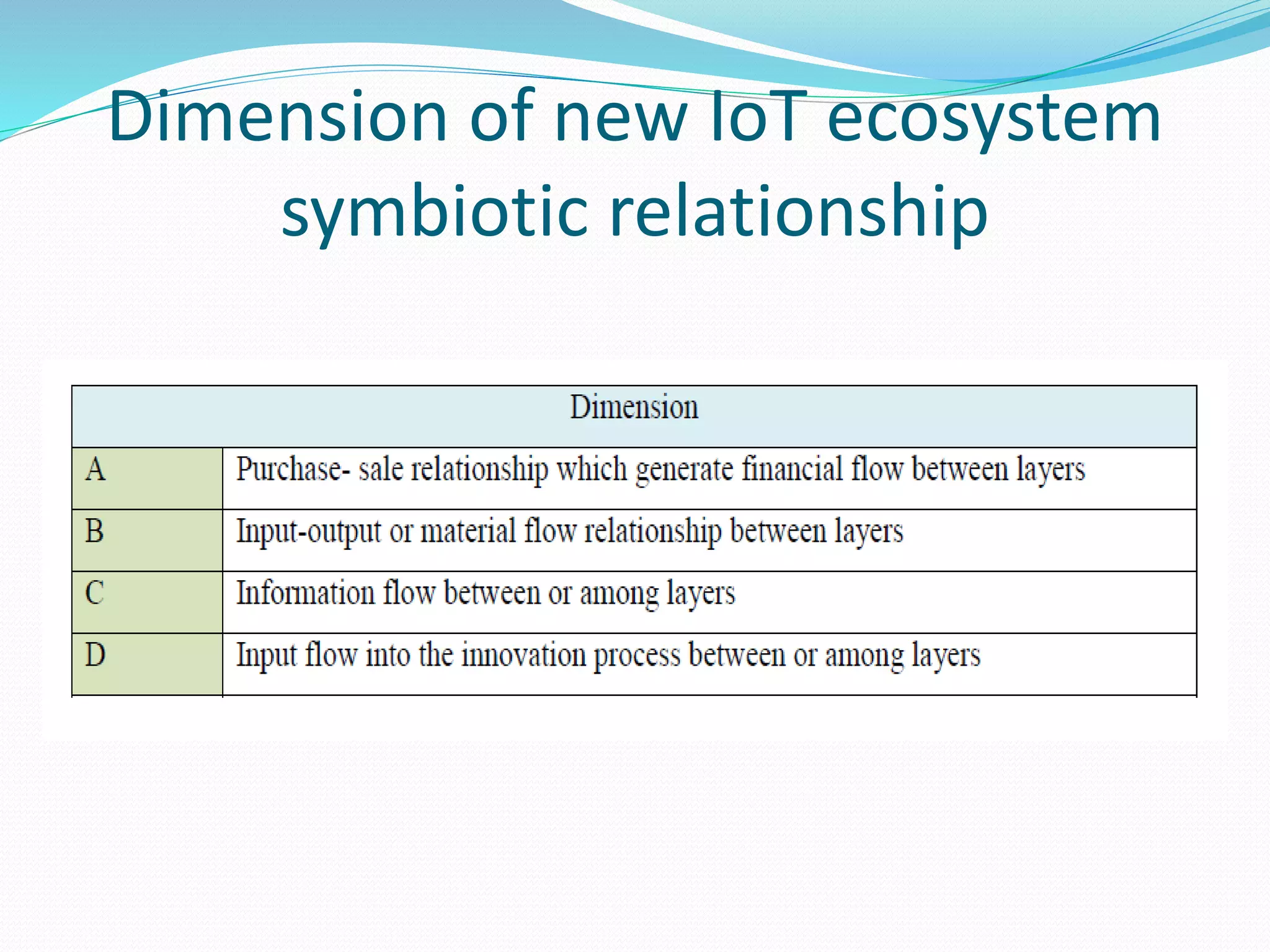
New Symbiotic Relationship
between Layers
Dimension of new IoT ecosystem
symbiotic relationship
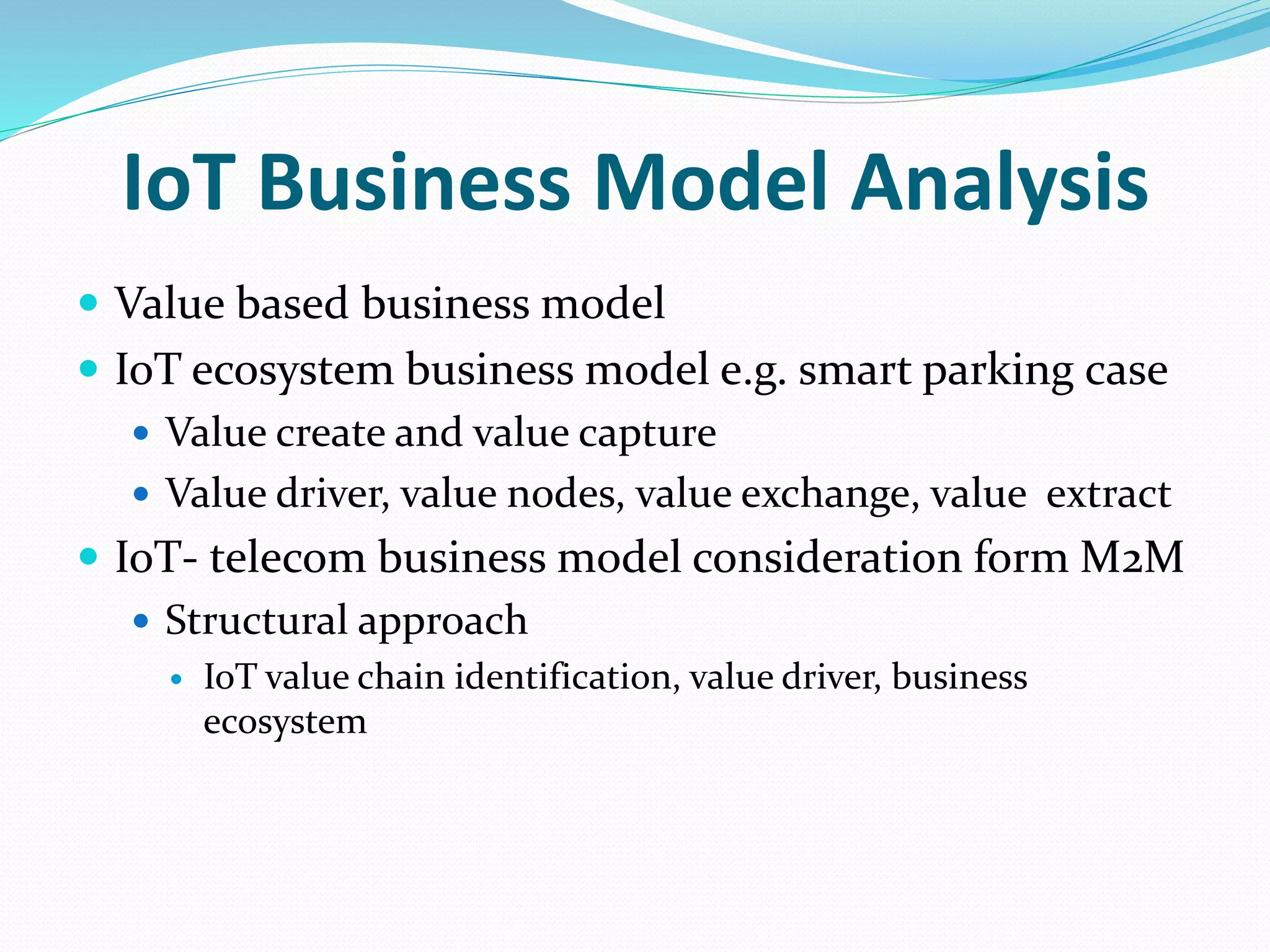
IoT Business Model Analysis
 Value based business model
 IoT ecosystem business model e.g. smart parking case
 Value create and value capture
 Value driver, value nodes, value exchange, value extract
 IoT- telecom business model consideration form M2M
 Structural approach
 IoT value chain identification, value driver, business
ecosystem
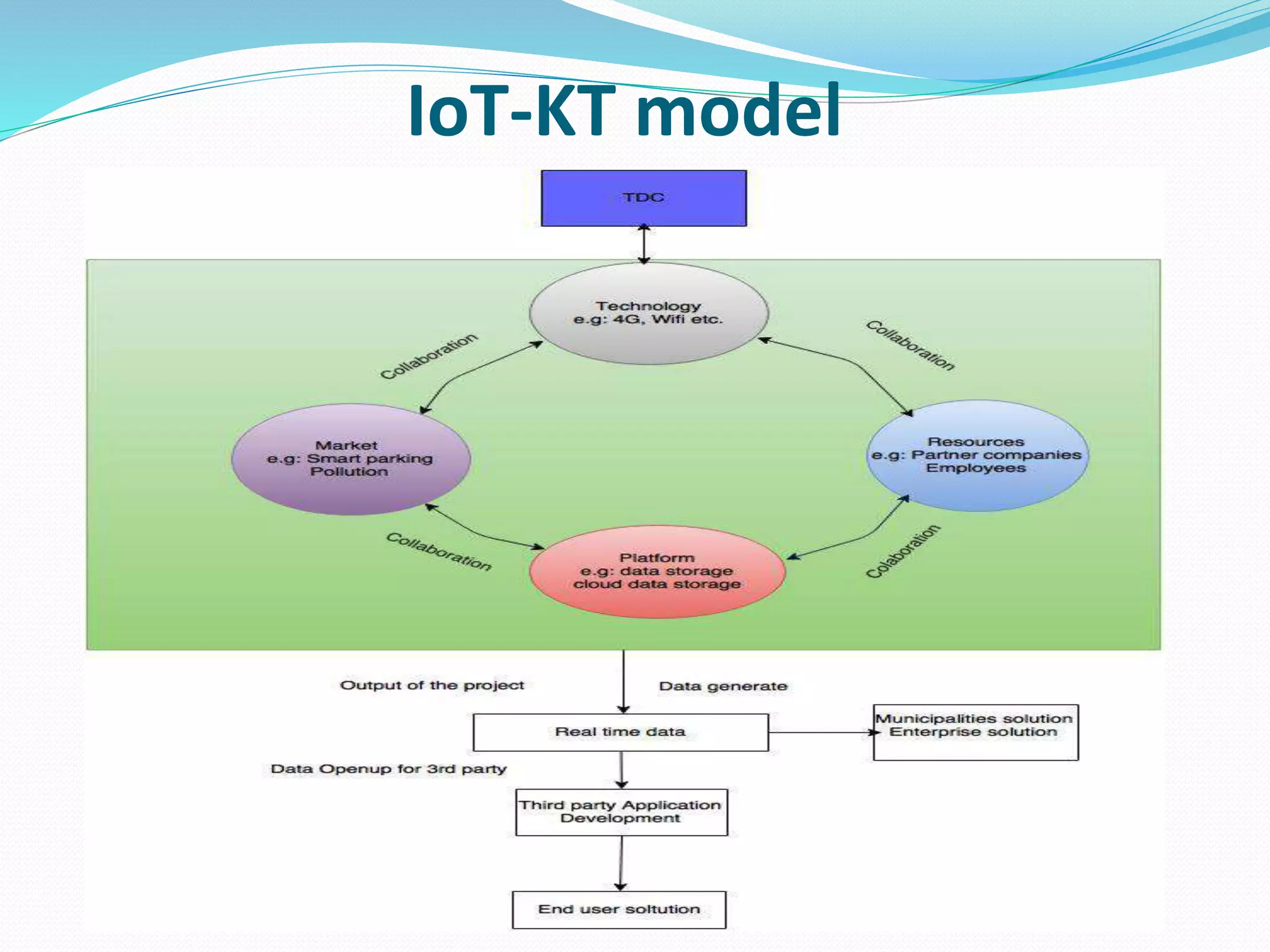
IoT-KT model
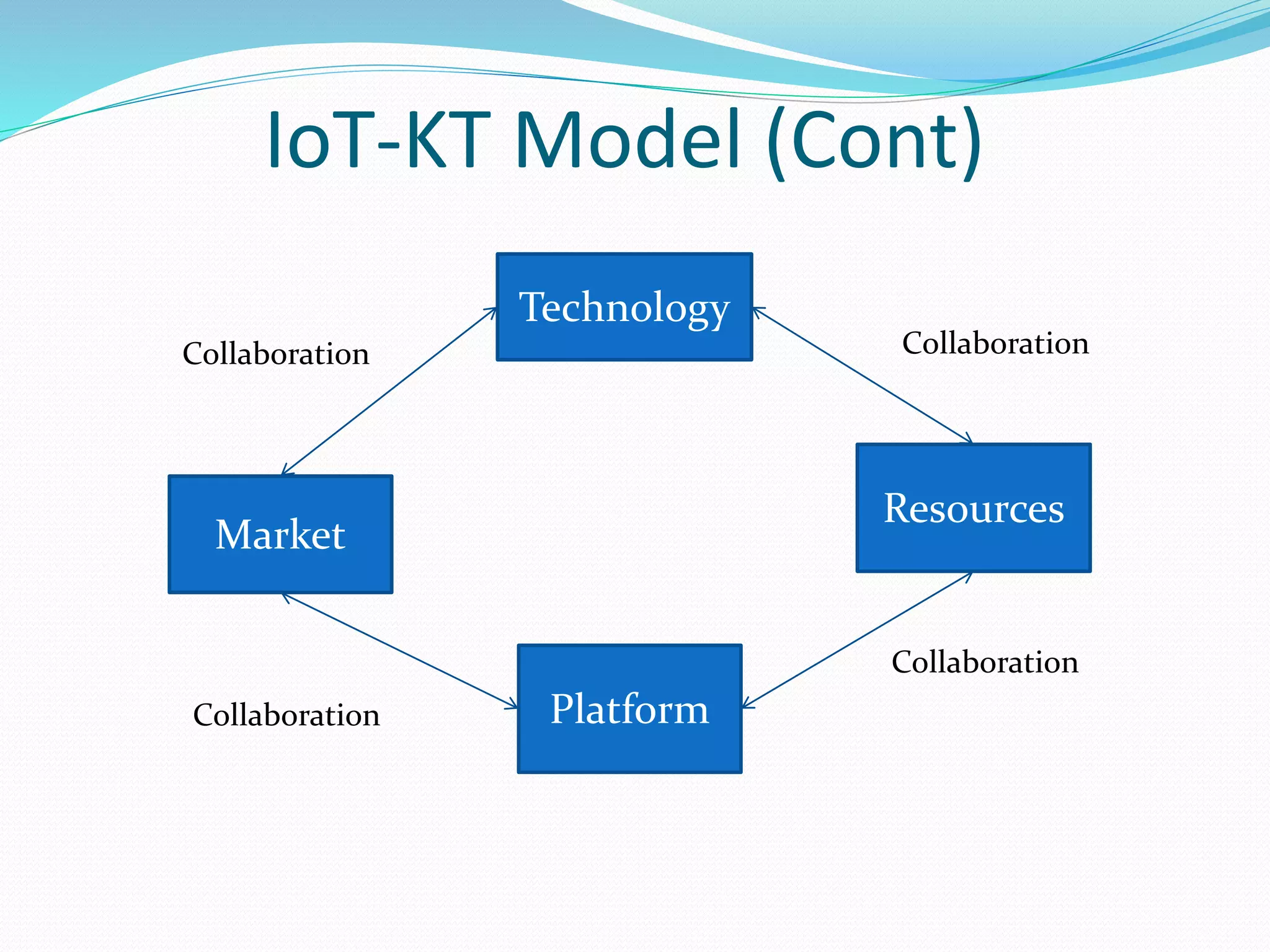
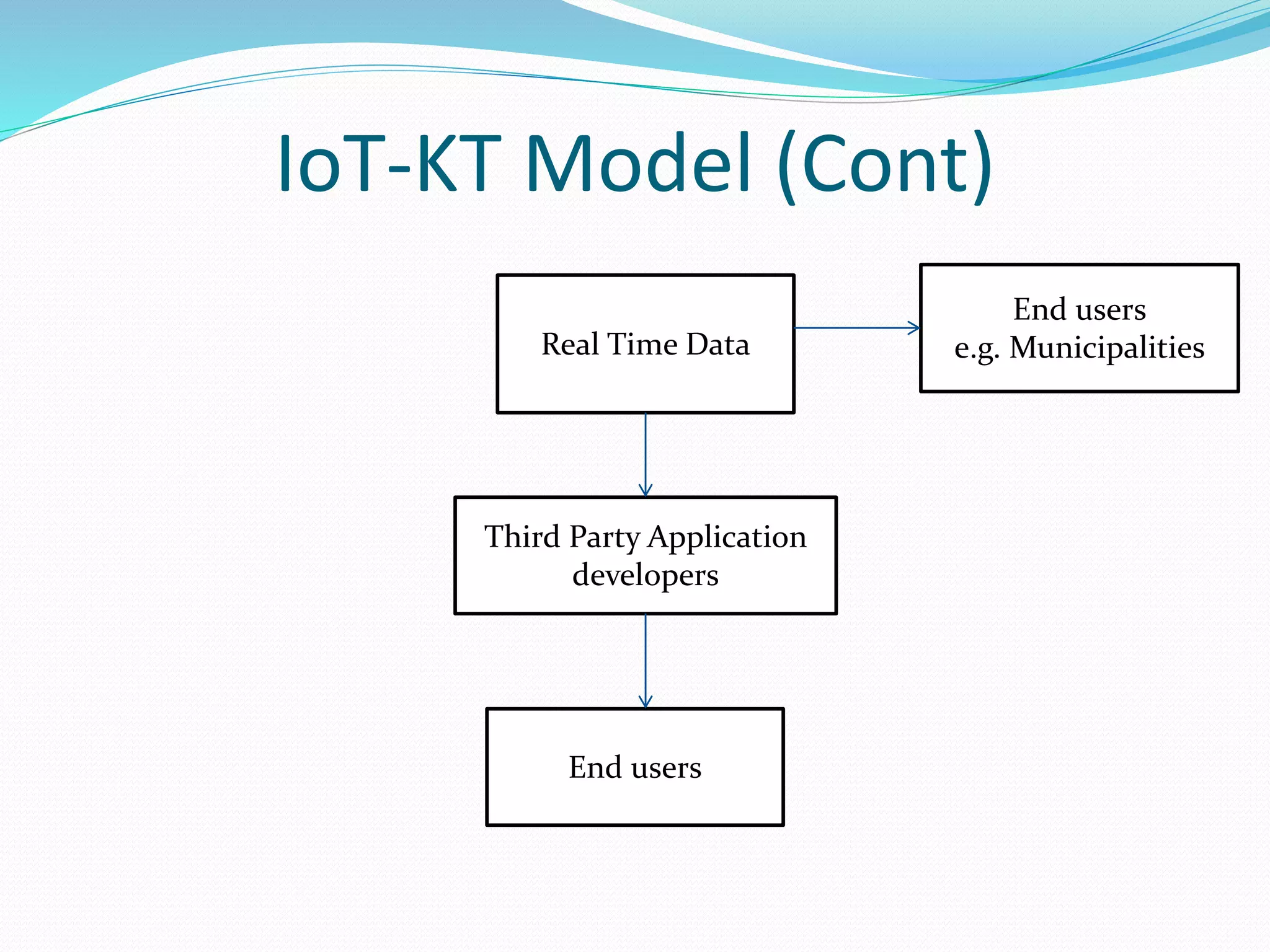
IoT-KT Model (Cont)
Market
Technology
Platform
Resources
Collaboration Collaboration
Collaboration
Collaboration
IoT-KT Model (Cont)
Real Time Data
End users
e.g. Municipalities
Third Party Application
developers
End users
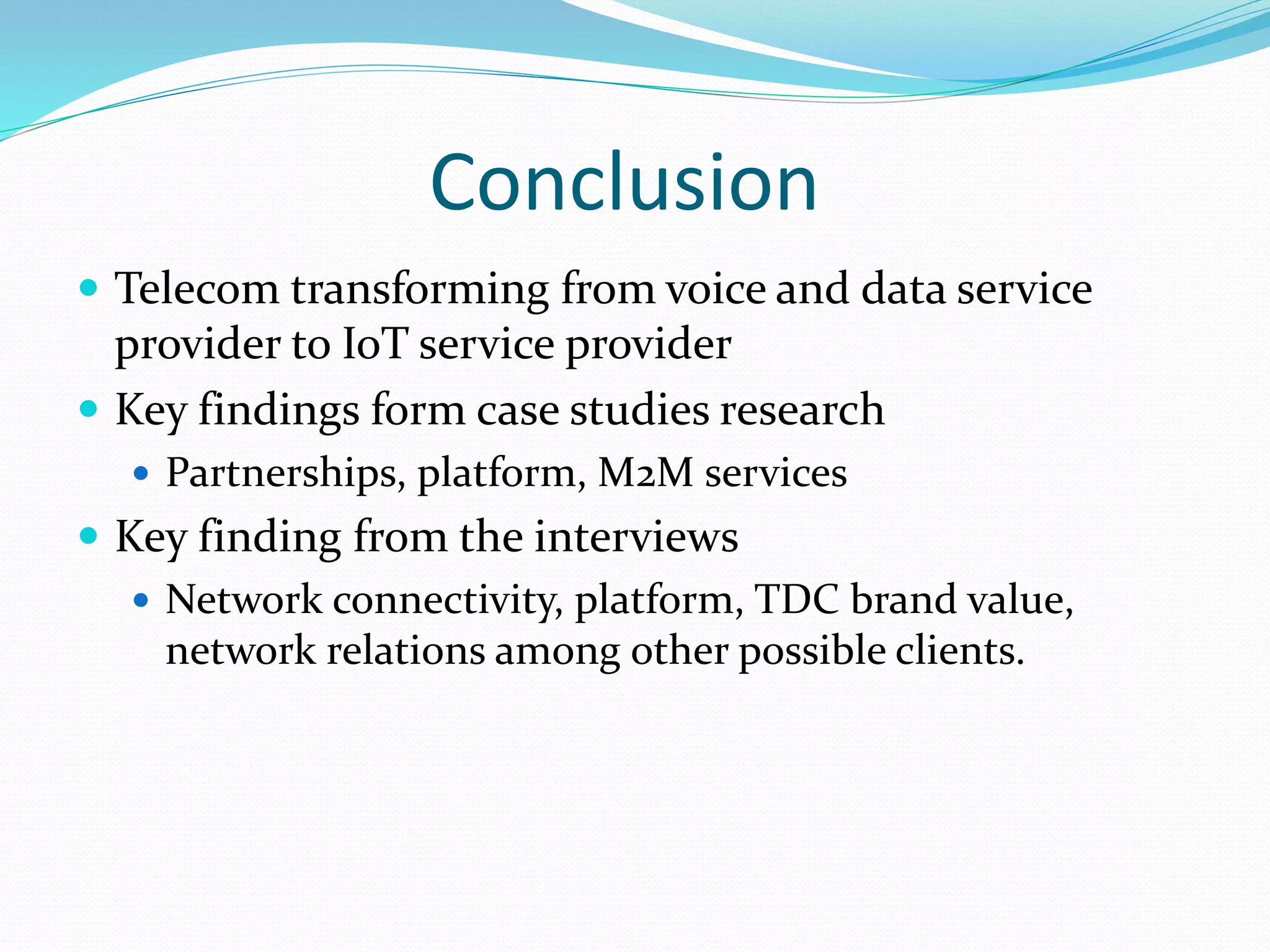
Conclusion
 Telecom transforming from voice and data service
provider to IoT service provider
 Key findings form case studies research
 Partnerships, platform, M2M services
 Key finding from the interviews
 Network connectivity, platform, TDC brand value,
network relations among other possible clients.
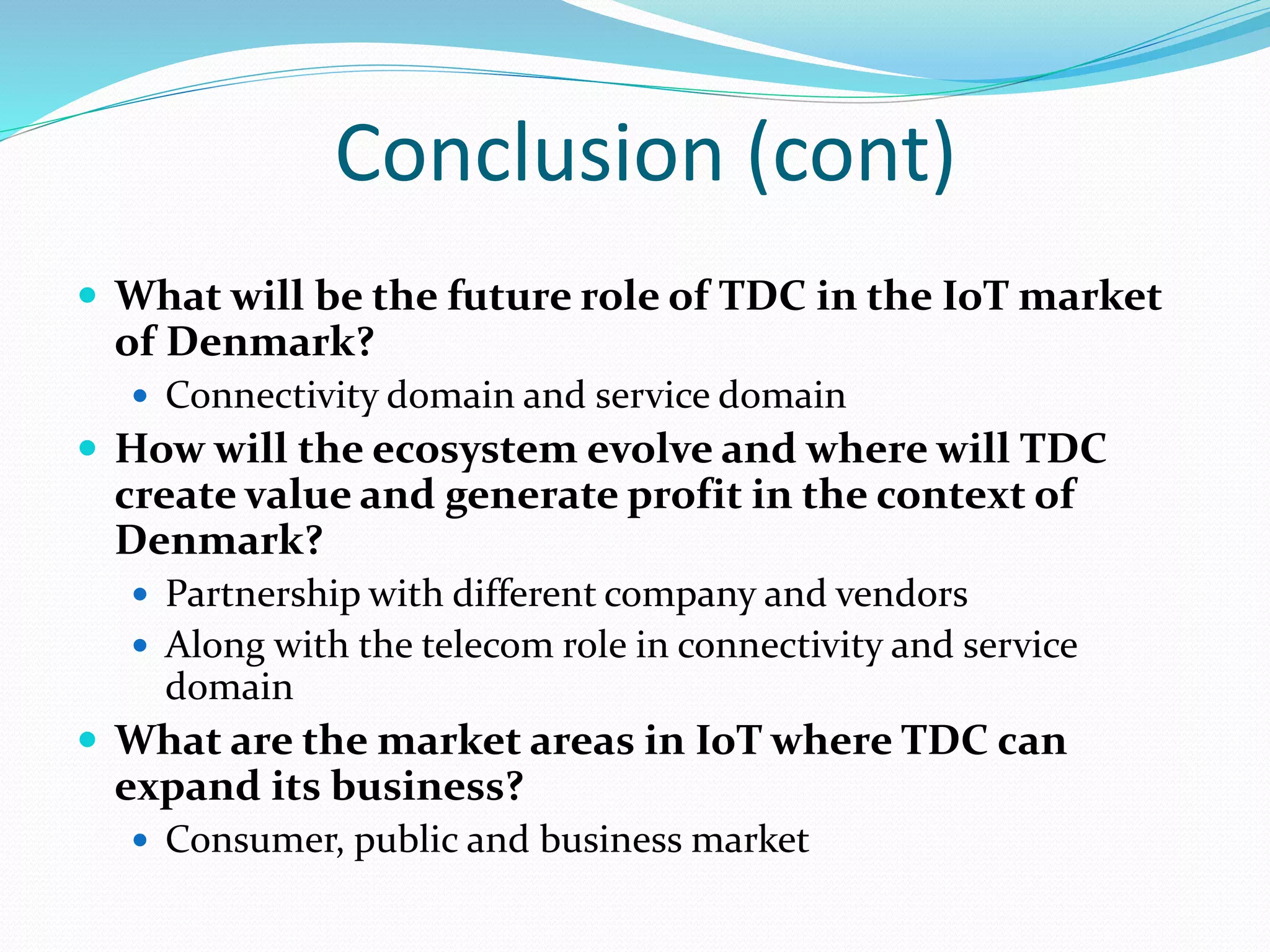
Conclusion (cont)
 What will be the future role of TDC in the IoT market
of Denmark?
 Connectivity domain and service domain
 How will the ecosystem evolve and where will TDC
create value and generate profit in the context of
Denmark?
 Partnership with different company and vendors
 Along with the telecom role in connectivity and service
domain
 What are the market areas in IoT where TDC can
expand its business?
 Consumer, public and business market
Than you for listening 

How telecom industry realte with IoT as a new area of business- TDC a case study

  • 1.
  • 2.
    Introduction  What isInternet of Things (IoT)?  Potentiality of IoT is enormous  4.9 billion connecting device by 2020 and 25 billion by 2025.  IoT business and revenue  IDC forecast 7 Trillion and Gartner forecast 3oo Billion USD by 2020  IoT economical impact worldwide  1,9 trillion by 2020 and 6.2 trillion by 2025.
  • 3.
    Impact on theworld economy
  • 4.
    Definition of IoT “Internet of Things (IoT) is an integrated part of Future Internet and could be defined as a dynamic global network infrastructure with self configuring capabilities based on standard and interoperable communication protocols where physical and virtual ‘things’ have identities, physical attributes, and virtual personalities and use intelligent interfaces, and are seamlessly integrated into the information network. In the IoT, ‘things’ are expected to become active participants in business, information and social processes where they are enabled to interact and communicate among themselves and with the environment by exchanging data and information ‘sensed’ about the environment, while reacting autonomously to the ‘real/physical world’ events and influencing it by running processes that trigger actions and create services with or without direct human intervention. Interfaces in the form of services facilitate interactions with these ‘smart things’ over the Internet, query and change their state and any information associated with them, taking into account security and privacy issues.”
  • 5.
    Problem Definition  MainResearch question  What will be the future role of TDC in the IoT market of Denmark?  Sub-questions:  How will the ecosystem evolve and where will TDC create value and generate profit in the context of Denmark?  What are the market areas in IoT where TDC can expand its business?
  • 6.
    Motivation  Working withDenmark largest telecom company, TDC  IoT is growing trend and higher potentiality  Academic research interest for future PhD endeavour
  • 7.
    Methodology  I wasfollowed deductive research methods  Qualitative  Case study based on Vodafone and SK telecom  Steps was followed-  Desktop research  Primary Research- Semi-structural Interview  Leapcraft  DOLL living Lab  TDC
  • 8.
  • 9.
    Delimitation  Focused onTelecom sectors  Avoid regulation  Avoid security and users privacy aspects  Macro and micro economics aspects.
  • 10.
    State of theArt of IoT  Overview of IoT
  • 11.
    Machine to machine(M2M) vs Internet of things (IoT)  IoT concepts evolved from M2M  M2M could communicate over GSM or other similar network without involvement of IP but IoT is IP based communication  M2M consist of hardware and embedded software and IoT consist of hardware, software, best customers experience (QoS)
  • 12.
    Evolution of internetof things from M2M
  • 13.
  • 14.
  • 15.
    WAN technology  3G Faster transmission speeds  Enhanced mobile broadband experience  50% spectral efficient as compare to 2G  Introducing 3G modem by companies  4G- LTE  IP connectivity  Better quality of service (QoS)  Much less latency  Multiple radio access technology support  LTE-M and NB LTE- M  Operate on shared LTE spectrum  Both are supplementary solution  Higher capacity, lower cost and better coverage
  • 16.
    WAN technology  Lowpower WAN (LPWA)  Two types 1) proprietary LPWAN 2) standard e.g cellular IoT  Requirements of LPWAN and LTE-M and NB LTE-M 1) Long battery life, 2) Low device cost, 3) Low deployment cost 4) Full coverage and 5) Support of massive number of device.
  • 17.
  • 18.
    Some of theWSN network  Zigbee Technology  Bluetooth technology  RFID technology
  • 19.
    IoT Ecosystem  Consistof four core  Connected device, connectivity, application service, supporting service  Company role consist of there big domain  Device domain, connectivity domain and service domain
  • 20.
    An Internet ofThings Ecosystem
  • 21.
    Business Model  1)Structural approach which is including identifying the value chain, value driver in the ubiquities computing environment.  2) Methodological approach which is including a business model development methodology in ubiquities computing environment and multipath utilization scenarios  3) Design approach which is including IoT business model canvas framework and networked business model itemization in the emerging technology based service in the ubiquities computing environment
  • 22.
    Designing Tools forEcosystem Business Model
  • 23.
    Key pillars ofa business model design tool for IoT ecosystems
  • 24.
    Theoretical Framework  Thereason to chose New ICT Ecosystem theory be  To form an ICT Ecosystem more than two companies are in needs to join and interact with each other to have a sustainable business case. Therefore, what are the criteria to chose the right company as a part of the ecosystem. Such criteria could be for example company brand value, financial strength etc.  ICT ecosystem is helping to understand the ecosystem evolvement, which and what kinds of company will be on board to consider for specific business context. For example, if it is smart city project what are the key service enabler company needs to consider as a part of ecosystem.  ICT Ecosystem is interacting between or among companies (layer) and end users, which will help to differentiate values, telecom company is generating from a particular business settings. Latterly, it has strong impact on the development of business model and revenue stream.
  • 25.
  • 26.
    Empirical Data  VodafoneCase  M2M services e.g. smart metering, intelligent home  Partnership for IoT business  SK telecom case  Thingplug platform  Partnership and network layer development  Interview  Leapcraft  DOLL  TDC
  • 27.
    Analysis  The telecommarket and IoT perspective  New hybrid IoT-ICT ecosystem
  • 28.
  • 29.
    Dimension of newIoT ecosystem symbiotic relationship
  • 30.
    IoT Business ModelAnalysis  Value based business model  IoT ecosystem business model e.g. smart parking case  Value create and value capture  Value driver, value nodes, value exchange, value extract  IoT- telecom business model consideration form M2M  Structural approach  IoT value chain identification, value driver, business ecosystem
  • 31.
  • 32.
  • 33.
    IoT-KT Model (Cont) RealTime Data End users e.g. Municipalities Third Party Application developers End users
  • 34.
    Conclusion  Telecom transformingfrom voice and data service provider to IoT service provider  Key findings form case studies research  Partnerships, platform, M2M services  Key finding from the interviews  Network connectivity, platform, TDC brand value, network relations among other possible clients.
  • 35.
    Conclusion (cont)  Whatwill be the future role of TDC in the IoT market of Denmark?  Connectivity domain and service domain  How will the ecosystem evolve and where will TDC create value and generate profit in the context of Denmark?  Partnership with different company and vendors  Along with the telecom role in connectivity and service domain  What are the market areas in IoT where TDC can expand its business?  Consumer, public and business market
  • 36.
    Than you forlistening 

Editor's Notes

  • #3 a proposed development of the Internet in which everyday objects have network connectivity, allowing them to send and receive data.
  • #31 The IoT business model ultimate results is to brings other companies into the TDC business model. And can only be possible if TDC provide service by themselves as TDC product.