Dimethyl Carbonate (DMC)
The New VOC Exempt Solvent
2
Product Introduction
• History
• Supply Picture
• Characteristics
EPA Statement
• Exact Verbiage
• Current VOC Exempt Map
Product Applications
• Applications
• Economics
• Sampling Process
• Other VOC Exempt Solvents
3
Dimethyl Carbonate (DMC) History
• 1997 - Manufacturing Process changes from Phosgenation
to Esterification greatly reducing costs
• 2002 – DMC is characterized as generally safe in Europe
and is named “Green Product” by Chinese equivalent to
EPA
• 2004 – Initial Application is made to EPA for VOC
Exemption
• 2009 – Jan. 13th - DMC and Propylene Carbonate are
characterized as VOC exempt
4
PRODUCT INTRODUCTION
Supply Picture
• Total US Volume of VOC exempt solvents market not
including acetone is estimated to be 30,000 MT / year
• PCBTF and TBAC are currently considered the two
largest volume VOC exempt solvents being used.
• Current Chinese production capacity exceeds 200,000
MT per year and has been growing at a rate of more
than 25% per year
• The core raw material for DMC and Propylene
Carbonate is Propylene Oxide.
5
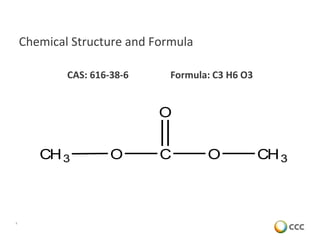
Chemical Structure and Formula
CH3 O C O CH3
O
CAS: 616-38-6 Formula: C3 H6 O3
6
Dimethyl Carbonate
Solvent Comparison Chart for Common Solvents
Chemical Properties Dimethyl
Carbonate
Acetone PCBTF
Tert
Butyl
Acetate
Toluene Xylene MEK MIBK
Isopropyl
Acetate
n-Butyl
Acetate
Total Hansen Solubility
Parameter
10.4 9.76 8.64 8.11 8.9 8.7 9.13 8.3 8.61 8.49
Relative Evaporation
rate
3.22 6.32 0.9 2.8 1.9 0.7 3.9 1.6 3 1
Flashpoint 'F 63 (-) 4 109 40 45 86 24 60 42 81
Specific Gravity @ 20'C 1.072 0.791 1.342 0.865 0.872 0.863 0.804 0.802 0.872 0.882
Boiling Point 'F 195'F 132'F 282 208 231 280 175 240 188 250
Lbs/gal 8.93 6.59 11.24 7.22 7.26 7.24 6.71 6.67 7.27 7.35
MIR value 0.06 0.43 0.11 0.22 3.97 7.37 1.49 4.31 1.12 0.89
VOC by EPA No No No No Yes yes yes yes yes yes
HAPS No No No No Yes yes no yes no no
7
PRODUCT CHARACTERISTICS
General Properties
• Under normal temperature, it is a colorless, fast evaporating, transparent
liquid with a molecular weight of 90.08.
• Has substantial polar nature, and moderate h-bonding strength effective in
replacing esters, glycol ethers and ketones in formulations.
• Can be mixed with organic solvents such as alcohol, ketones, esters, etc. at
any proportion and is slightly soluble in water (up to 13%)
• DMC has a melting point of 4℃ and a boiling point of 90.3℃, and flash point
of 17 ºC (63 ºF).
• Index of refraction (nd20), viscosity and latent heat of vaporization are
respectively 1.3697,0.664mpa.s and 8382KJ/Kmol.
• Has low toxicity, an unobjectionable methanol type odor and low skin
irritation
8
Other VOC Exempt Solvents
• In the United States today there are few VOC exempt solvents that are not
HAPS (or ODS) and even fewer that can be purchased for less than $2.00/lb
to allow formulators an option for low cost formulations for the coating,
cleaning & adhesive markets. DMC is consistently one of the least
expensive options:
VOC Exempt Solvents:
• Acetone
• Dimethyl Carbonate
• Methyl acetate
• P-Chlorobenzotrifluoride (PCBTF)
• Tertiary Butyl Acetate (tBAc)
9
PRODUCT CHARACTERISTICS
Relative Evaporation Rate for Common Solvents
Chemical Properties
Dimethyl
Carbonate
Acetone PCBTF
Tert
Butyl
Acetate
Toluene Xylene MEK MIBK
Isopropy
l
Acetate
n-Butyl
Acetate
Relative Evaporation
Rate 3.22 6.32 0.9 2.8 1.9 0.7 3.9 1.6 3 1
VOC by EPA No No No No Yes yes yes yes yes yes
HAPS No No No No Yes yes no yes no no
• Fast to moderate evaporation rate of 3.22 –3.4 with Butyl Acetate = 1.0.
• This makes it similar to TBAC at 2.8 and Isopropyl acetate at 3.0
• Much slower than Acetone at 7.2 it can be used as slightly slower
evaporating replacement for MEK at 3.8 or Ethyl Acetate at 4.1.
• It is not as slow as PCBTF at 0.9, IPA (1.7), MPK (2.3), Ethanol (1.8) and MIBK
(1.6)
• But is faster than IPA (1.7), MPK (2.3), Ethanol (1.8) and MIBK (1.6)
Evaporation Rate
10
DMC’s Odor Profile
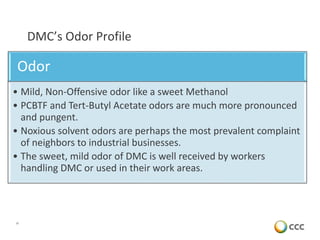
Odor
• Mild, Non-Offensive odor like a sweet Methanol
• PCBTF and Tert-Butyl Acetate odors are much more pronounced
and pungent.
• Noxious solvent odors are perhaps the most prevalent complaint
of neighbors to industrial businesses.
• The sweet, mild odor of DMC is well received by workers
handling DMC or used in their work areas.
11
PRODUCT CHARACTERISTICS
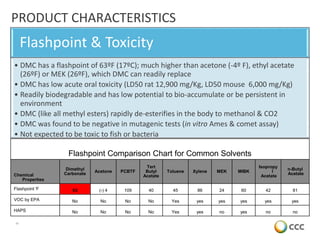
Flashpoint & Toxicity
• DMC has a flashpoint of 63ºF (17ºC); much higher than acetone (-4º F), ethyl acetate
(26ºF) or MEK (26ºF), which DMC can readily replace
• DMC has low acute oral toxicity (LD50 rat 12,900 mg/Kg, LD50 mouse 6,000 mg/Kg)
• Readily biodegradable and has low potential to bio-accumulate or be persistent in
environment
• DMC (like all methyl esters) rapidly de-esterifies in the body to methanol & CO2
• DMC was found to be negative in mutagenic tests (in vitro Ames & comet assay)
• Not expected to be toxic to fish or bacteria
Flashpoint Comparison Chart for Common Solvents
Chemical
Properties
Dimethyl
Carbonate
Acetone PCBTF
Tert
Butyl
Acetate
Toluene Xylene MEK MIBK
Isopropy
l
Acetate
n-Butyl
Acetate
Flashpoint 'F 63 (-) 4 109 40 45 86 24 60 42 81
VOC by EPA No No No No Yes yes yes yes yes yes
HAPS No No No No Yes yes no yes no no
12
California OEHHA Assessment
ASSESSMENT:
• In 2009, California's Office of Environmental Health Hazard Assessment
issued a toxicity assessment of DMC that used the toxicity of its primary
metabolite methanol and existing DMC studies to issue a toxicological
assessment of DMC
• They reported that there were no concerns that DMC (like methanol) would
be carcinogenic
CONCLUSION:
• The OEHHA report concluded that the levels of DMC that the general public
will likely be exposed to via the inhalation in the environment appears to
have “relatively minor” environmental health concerns
• The report established an interim acute and chronic REL, where the acute
REL is identical to MEK’s and the chronic REL similar to Isopropanol’s.
13
MIR Value
• DMC has the lowest MIR value of any liquid chemical in
commercial use based on studies conducted by Dr. William
Carter at Exxon Mobile.
• This ultra-low MIR value is leading to fast approval of DMC by
various states due to its very favorable ozone reduction
potential.
MIR Value Comparison for Common Solvents
Chemical
Properties
Dimethyl
Carbonate
Acetone PCBTF
Tert
Butyl
Acetate
Toluene Xylene MEK MIBK
Isopropyl
Acetate
n-Butyl
Acetate
MIR value 0.06 0.43 0.11 0.22 3.97 7.37 1.49 4.31 1.12 0.89
VOC by EPA No No No No Yes yes yes yes yes yes
HAPS No No No No Yes yes no yes no no
14
PRODUCT CHARACTERISTICS
Solubility
• Hildebrand solubility parameter 20.3 Mpa
• Hansen solubility parameters: Dispersion 15.5 polar 3.9 h-bond 9.7 molar
vol. 84.2
• DMC has been described as useful in acrylics, urethane and alkyd systems as a
co-solvent
• DMC is miscible with almost all organic solvents
• DMC would easily replace oxygenated solvents like esters and glycol ethers
• DMC should replace alcohols and ketones with appropriate co-solvents
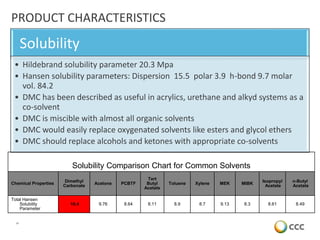
Solubility Comparison Chart for Common Solvents
Chemical Properties Dimethyl
Carbonate
Acetone PCBTF
Tert
Butyl
Acetate
Toluene Xylene MEK MIBK
Isopropyl
Acetate
n-Butyl
Acetate
Total Hansen
Solubility
Parameter
10.4 9.76 8.64 8.11 8.9 8.7 9.13 8.3 8.61 8.49
15
DMC in Waterborne Systems
• Being an ester, DMC can hydrolyze in acidic and basic conditions to
methanol and carbon dioxide and can be stable in neutral
conditions with suitable buffers (formulators may need to take
precautions to prevent CO2 accumulation)
• DMC’s primary use should be in solvent borne systems where
residual water does not normally cause any hydrolysis issues.
16
EPA Statement
According to the final ruling released January 13th of 2009, the EPA
will revise its definition of volatile organic compounds (VOC)
deleting DMC and Propylene Carbonate which the agency has said
contribute minimally to ground level ozone formation.
The final ruling, which appears in the subsequent edition of the
Federal Register after the January 13th ruling, will take effect 30
days after publication. The rule effectively and definitively
removes Dimethyl Carbonate and Propylene Carbonate from the
definitions of controlled volatile organic compounds at 40 C.F.R.
51.100(s).
17
DMC for Architectural, Aerosol & Automotive
Coatings
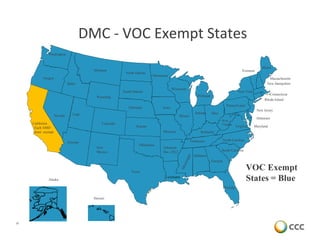
• Each state must still exempt DMC & PC for stationary source VOC rules.
• As of March 2011, 45 states have exempted DMC and by the end of 2011 all
states aside from California (which must have each district separately exempt
DMC) will have exempted DMC.
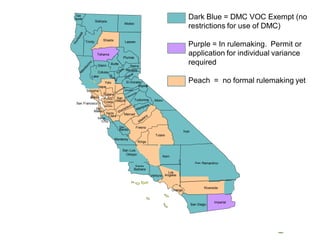
• California must have each of their Air Districts separately exempt DMC for
coatings, Inks and adhesives. This is currently happening (see California VOC
Exemption map)
• For Architectural Coatings, DMC is VOC exempt in all states today except parts
of California & Mass.
• Due to its ultra low MIR value, DMC can be used in aerosol coatings in
California and is soon to be approved in every state for us in aerosol coatings.
18
DMC - VOC Exempt States
Washington
Oregon
California
Each AMD
must exempt
Nevada
Idaho
Utah
Arizona
Montana
Texas
New
Mexico
Colorado
Wyoming
Nebraska
Oklahoma
Kansas
North Dakota
South Dakota
Wisconsin
Minnesota
Iowa
Missouri
Arkansas
Dec. 2012
Louisiana
Indiana
Illinois
Ohio
Kentucky
Alabama
Florida
Georgia
South Carolina
North Carolina
Virginia
West
Virginia
Maryland
Delaware
Pennsylvania
Maine
Vermont
Rhode Island
New York
New Jersey
Massachusetts
Connecticut
New Hampshire
Michigan
Alaska
Hawaii
Tennessee
VOC Exempt
States = Blue
19
DMC Exemption Status in Calif.
• Most county AMD’s plan to exempt or have no VOC rules (functionally
exempt)
• Shasta, Glenn & Tehema AMD’s may already exempt DMC depending
on application
• Santa Barbara users must file for a permit
• Bay Area AQMD (San Francisco area) looking at when they can begin
rulemaking for exempting DMC in 2011
• SCAQMD (L.A. area) has deferred rule making indefinitely.
• SCAQMD may need to look at certain coatings applications such as car
refinishing and in plant coatings to exempt first.
20
Sierra
Nevada
Colusa
Solano
Napa
Contra
CostaSan Francisco
San
Joaquin
Sonoma
Lake
San
Mateo
Santa
Cruz
Santa
Clara
Alameda
San
Benito
Monterey
Merced
Fresno
Mono
Kings
Butte
Inyo
Del
Norte
Santa
Barbara
Los
Angeles
LassenShasta
Siskiyou
San Bernardino
Imperial
San Diego
Modoc
Plumas
Glenn
El Dorado
Alpine
Amador
Marin
Kern
Riverside
Orange
Trinity
Yolo
Tuolumne
Tulare
San Luis
Obispo
Ventura
Tehama
Dark Blue = DMC VOC Exempt (no
restrictions for use of DMC)
Purple = In rulemaking. Permit or
application for individual variance
required
Peach = no formal rulemaking yet
21
California CARB Consumer items
• CARB regulates consumer product applications
– Coatings are covered by each AQMD separately
• Paint thinners are in their “multi-purpose solvent” classification
– Some local Calif. AMD’s debate that CARB can regulate paint thinners over them)
22
Product Applications
Paint & Coatings
HI&I Inks
Biodiesel
Additive
Resin
Manufacturing
23
Paint and Coatings
A carrier solvent or disperse medium for binders, pigments, and colorants.
Regulates viscosity and solubility of the various components in the paint
formula.
DMC will influence application properties such as flow, film build, and dry time
• DMC has shown promise in Auto refinish, with its favorable solubility, odor,
evaporation rate and economic profiles
• Industrial coatings for coating parts and architectural components at
factories have shown similar appeal.
• Also used in traffic paints, steel drum linings, floor coatings, concrete
sealers
• Can also be an effective paint thinner & multipurpose solvent, as is or as
co-solvent
24
Biodiesel Additive
With high oxygen content, a suitable boiling point;
it is soluble in diesel fuel
When diesel fuel is mixed with DMC, particulate
matter emissions can be reduced significantly.
Professional Engineering found in an experimental
study that diesel fuel blended with DMC had
improved combustion and emission performance
25
Household, Institutional & Industrial
DMC has rapid biodegradability for most
degreasing applications
DMC has “green” properties & low toxicity for
solvent degreasing formulations
DMC of 28.5 dynes offers unique lubricity and
de-foaming properties to HI&I compounders
26
Inks
DMC can replace the toluene and ethyl
acetate solvents in Gravure ink
applications
Gravure ink has been replaced in recent
years by a more “green” process known
as water-based Flexographic inks
27
Resin Manufacturing
DMC is a green alternative to alkylating
agents used in a variety of synthetic and
industrial applications under different
reaction conditions
As a low boiling (bp 90 C) compound; it can
be easily volatilized at lower temperatures
and is thermally stable
28
Benefits & Advantages
VOC Exemption
Low Odor
Lower Density
Competitive Pricing
29
DMC Cost & Supply
• DMC pricing is well below $ 1.00/lb, making it price competitive
with most oxygenated solvents except possibly acetone.
• Drums and bulk isotanks readily available from our factories in
China.
• DMC is used in very large volumes in China for coatings primarily
because of its low cost.
• Totes can be filled from isotanks or shipped from location.
• All packages come neatly labeled on new pallets, shrink-wrapped
with all necessary shipping documents and labels.
• Long term a bulk tank opportunities in USA is possible
30
Sampling Process
• Samples are readily available and have already been sent to over 350
prospective customers.
• To request a sample, please contact your CCC representative or visit us at
www.ccc-group.com
Propylene Carbonate
- Propylene Carbonate has a low viscocity 2.4 cps,
and a high flashpoint of 253ºF.
-PC is a very slow evaporating solvent
(evaporation rate <.005, BuAc =1) which restricts
its solvent use.
-Its Practically non-toxic by oral, dermal or
Inhalation, and is classified as a slight skin and eye
irritant.
-It’s manufactured by the same factories that
manufacture our Dimethyl Carbonate.
-PC has a very low toxicity profile which allows it’s
use in cosmetic products.
-Readily biodegradable
Other VOC Exempt
Products to Consider:

Dimethyl Carbonate (DMC), VOC Exempt

  • 1.
    Dimethyl Carbonate (DMC) TheNew VOC Exempt Solvent
  • 2.
    2 Product Introduction • History •Supply Picture • Characteristics EPA Statement • Exact Verbiage • Current VOC Exempt Map Product Applications • Applications • Economics • Sampling Process • Other VOC Exempt Solvents
  • 3.
    3 Dimethyl Carbonate (DMC)History • 1997 - Manufacturing Process changes from Phosgenation to Esterification greatly reducing costs • 2002 – DMC is characterized as generally safe in Europe and is named “Green Product” by Chinese equivalent to EPA • 2004 – Initial Application is made to EPA for VOC Exemption • 2009 – Jan. 13th - DMC and Propylene Carbonate are characterized as VOC exempt
  • 4.
    4 PRODUCT INTRODUCTION Supply Picture •Total US Volume of VOC exempt solvents market not including acetone is estimated to be 30,000 MT / year • PCBTF and TBAC are currently considered the two largest volume VOC exempt solvents being used. • Current Chinese production capacity exceeds 200,000 MT per year and has been growing at a rate of more than 25% per year • The core raw material for DMC and Propylene Carbonate is Propylene Oxide.
  • 5.
    5 Chemical Structure andFormula CH3 O C O CH3 O CAS: 616-38-6 Formula: C3 H6 O3
  • 6.
    6 Dimethyl Carbonate Solvent ComparisonChart for Common Solvents Chemical Properties Dimethyl Carbonate Acetone PCBTF Tert Butyl Acetate Toluene Xylene MEK MIBK Isopropyl Acetate n-Butyl Acetate Total Hansen Solubility Parameter 10.4 9.76 8.64 8.11 8.9 8.7 9.13 8.3 8.61 8.49 Relative Evaporation rate 3.22 6.32 0.9 2.8 1.9 0.7 3.9 1.6 3 1 Flashpoint 'F 63 (-) 4 109 40 45 86 24 60 42 81 Specific Gravity @ 20'C 1.072 0.791 1.342 0.865 0.872 0.863 0.804 0.802 0.872 0.882 Boiling Point 'F 195'F 132'F 282 208 231 280 175 240 188 250 Lbs/gal 8.93 6.59 11.24 7.22 7.26 7.24 6.71 6.67 7.27 7.35 MIR value 0.06 0.43 0.11 0.22 3.97 7.37 1.49 4.31 1.12 0.89 VOC by EPA No No No No Yes yes yes yes yes yes HAPS No No No No Yes yes no yes no no
  • 7.
    7 PRODUCT CHARACTERISTICS General Properties •Under normal temperature, it is a colorless, fast evaporating, transparent liquid with a molecular weight of 90.08. • Has substantial polar nature, and moderate h-bonding strength effective in replacing esters, glycol ethers and ketones in formulations. • Can be mixed with organic solvents such as alcohol, ketones, esters, etc. at any proportion and is slightly soluble in water (up to 13%) • DMC has a melting point of 4℃ and a boiling point of 90.3℃, and flash point of 17 ºC (63 ºF). • Index of refraction (nd20), viscosity and latent heat of vaporization are respectively 1.3697,0.664mpa.s and 8382KJ/Kmol. • Has low toxicity, an unobjectionable methanol type odor and low skin irritation
  • 8.
    8 Other VOC ExemptSolvents • In the United States today there are few VOC exempt solvents that are not HAPS (or ODS) and even fewer that can be purchased for less than $2.00/lb to allow formulators an option for low cost formulations for the coating, cleaning & adhesive markets. DMC is consistently one of the least expensive options: VOC Exempt Solvents: • Acetone • Dimethyl Carbonate • Methyl acetate • P-Chlorobenzotrifluoride (PCBTF) • Tertiary Butyl Acetate (tBAc)
  • 9.
    9 PRODUCT CHARACTERISTICS Relative EvaporationRate for Common Solvents Chemical Properties Dimethyl Carbonate Acetone PCBTF Tert Butyl Acetate Toluene Xylene MEK MIBK Isopropy l Acetate n-Butyl Acetate Relative Evaporation Rate 3.22 6.32 0.9 2.8 1.9 0.7 3.9 1.6 3 1 VOC by EPA No No No No Yes yes yes yes yes yes HAPS No No No No Yes yes no yes no no • Fast to moderate evaporation rate of 3.22 –3.4 with Butyl Acetate = 1.0. • This makes it similar to TBAC at 2.8 and Isopropyl acetate at 3.0 • Much slower than Acetone at 7.2 it can be used as slightly slower evaporating replacement for MEK at 3.8 or Ethyl Acetate at 4.1. • It is not as slow as PCBTF at 0.9, IPA (1.7), MPK (2.3), Ethanol (1.8) and MIBK (1.6) • But is faster than IPA (1.7), MPK (2.3), Ethanol (1.8) and MIBK (1.6) Evaporation Rate
  • 10.
    10 DMC’s Odor Profile Odor •Mild, Non-Offensive odor like a sweet Methanol • PCBTF and Tert-Butyl Acetate odors are much more pronounced and pungent. • Noxious solvent odors are perhaps the most prevalent complaint of neighbors to industrial businesses. • The sweet, mild odor of DMC is well received by workers handling DMC or used in their work areas.
  • 11.
    11 PRODUCT CHARACTERISTICS Flashpoint &Toxicity • DMC has a flashpoint of 63ºF (17ºC); much higher than acetone (-4º F), ethyl acetate (26ºF) or MEK (26ºF), which DMC can readily replace • DMC has low acute oral toxicity (LD50 rat 12,900 mg/Kg, LD50 mouse 6,000 mg/Kg) • Readily biodegradable and has low potential to bio-accumulate or be persistent in environment • DMC (like all methyl esters) rapidly de-esterifies in the body to methanol & CO2 • DMC was found to be negative in mutagenic tests (in vitro Ames & comet assay) • Not expected to be toxic to fish or bacteria Flashpoint Comparison Chart for Common Solvents Chemical Properties Dimethyl Carbonate Acetone PCBTF Tert Butyl Acetate Toluene Xylene MEK MIBK Isopropy l Acetate n-Butyl Acetate Flashpoint 'F 63 (-) 4 109 40 45 86 24 60 42 81 VOC by EPA No No No No Yes yes yes yes yes yes HAPS No No No No Yes yes no yes no no
  • 12.
    12 California OEHHA Assessment ASSESSMENT: •In 2009, California's Office of Environmental Health Hazard Assessment issued a toxicity assessment of DMC that used the toxicity of its primary metabolite methanol and existing DMC studies to issue a toxicological assessment of DMC • They reported that there were no concerns that DMC (like methanol) would be carcinogenic CONCLUSION: • The OEHHA report concluded that the levels of DMC that the general public will likely be exposed to via the inhalation in the environment appears to have “relatively minor” environmental health concerns • The report established an interim acute and chronic REL, where the acute REL is identical to MEK’s and the chronic REL similar to Isopropanol’s.
  • 13.
    13 MIR Value • DMChas the lowest MIR value of any liquid chemical in commercial use based on studies conducted by Dr. William Carter at Exxon Mobile. • This ultra-low MIR value is leading to fast approval of DMC by various states due to its very favorable ozone reduction potential. MIR Value Comparison for Common Solvents Chemical Properties Dimethyl Carbonate Acetone PCBTF Tert Butyl Acetate Toluene Xylene MEK MIBK Isopropyl Acetate n-Butyl Acetate MIR value 0.06 0.43 0.11 0.22 3.97 7.37 1.49 4.31 1.12 0.89 VOC by EPA No No No No Yes yes yes yes yes yes HAPS No No No No Yes yes no yes no no
  • 14.
    14 PRODUCT CHARACTERISTICS Solubility • Hildebrandsolubility parameter 20.3 Mpa • Hansen solubility parameters: Dispersion 15.5 polar 3.9 h-bond 9.7 molar vol. 84.2 • DMC has been described as useful in acrylics, urethane and alkyd systems as a co-solvent • DMC is miscible with almost all organic solvents • DMC would easily replace oxygenated solvents like esters and glycol ethers • DMC should replace alcohols and ketones with appropriate co-solvents Solubility Comparison Chart for Common Solvents Chemical Properties Dimethyl Carbonate Acetone PCBTF Tert Butyl Acetate Toluene Xylene MEK MIBK Isopropyl Acetate n-Butyl Acetate Total Hansen Solubility Parameter 10.4 9.76 8.64 8.11 8.9 8.7 9.13 8.3 8.61 8.49
  • 15.
    15 DMC in WaterborneSystems • Being an ester, DMC can hydrolyze in acidic and basic conditions to methanol and carbon dioxide and can be stable in neutral conditions with suitable buffers (formulators may need to take precautions to prevent CO2 accumulation) • DMC’s primary use should be in solvent borne systems where residual water does not normally cause any hydrolysis issues.
  • 16.
    16 EPA Statement According tothe final ruling released January 13th of 2009, the EPA will revise its definition of volatile organic compounds (VOC) deleting DMC and Propylene Carbonate which the agency has said contribute minimally to ground level ozone formation. The final ruling, which appears in the subsequent edition of the Federal Register after the January 13th ruling, will take effect 30 days after publication. The rule effectively and definitively removes Dimethyl Carbonate and Propylene Carbonate from the definitions of controlled volatile organic compounds at 40 C.F.R. 51.100(s).
  • 17.
    17 DMC for Architectural,Aerosol & Automotive Coatings • Each state must still exempt DMC & PC for stationary source VOC rules. • As of March 2011, 45 states have exempted DMC and by the end of 2011 all states aside from California (which must have each district separately exempt DMC) will have exempted DMC. • California must have each of their Air Districts separately exempt DMC for coatings, Inks and adhesives. This is currently happening (see California VOC Exemption map) • For Architectural Coatings, DMC is VOC exempt in all states today except parts of California & Mass. • Due to its ultra low MIR value, DMC can be used in aerosol coatings in California and is soon to be approved in every state for us in aerosol coatings.
  • 18.
    18 DMC - VOCExempt States Washington Oregon California Each AMD must exempt Nevada Idaho Utah Arizona Montana Texas New Mexico Colorado Wyoming Nebraska Oklahoma Kansas North Dakota South Dakota Wisconsin Minnesota Iowa Missouri Arkansas Dec. 2012 Louisiana Indiana Illinois Ohio Kentucky Alabama Florida Georgia South Carolina North Carolina Virginia West Virginia Maryland Delaware Pennsylvania Maine Vermont Rhode Island New York New Jersey Massachusetts Connecticut New Hampshire Michigan Alaska Hawaii Tennessee VOC Exempt States = Blue
  • 19.
    19 DMC Exemption Statusin Calif. • Most county AMD’s plan to exempt or have no VOC rules (functionally exempt) • Shasta, Glenn & Tehema AMD’s may already exempt DMC depending on application • Santa Barbara users must file for a permit • Bay Area AQMD (San Francisco area) looking at when they can begin rulemaking for exempting DMC in 2011 • SCAQMD (L.A. area) has deferred rule making indefinitely. • SCAQMD may need to look at certain coatings applications such as car refinishing and in plant coatings to exempt first.
  • 20.
    20 Sierra Nevada Colusa Solano Napa Contra CostaSan Francisco San Joaquin Sonoma Lake San Mateo Santa Cruz Santa Clara Alameda San Benito Monterey Merced Fresno Mono Kings Butte Inyo Del Norte Santa Barbara Los Angeles LassenShasta Siskiyou San Bernardino Imperial SanDiego Modoc Plumas Glenn El Dorado Alpine Amador Marin Kern Riverside Orange Trinity Yolo Tuolumne Tulare San Luis Obispo Ventura Tehama Dark Blue = DMC VOC Exempt (no restrictions for use of DMC) Purple = In rulemaking. Permit or application for individual variance required Peach = no formal rulemaking yet
  • 21.
    21 California CARB Consumeritems • CARB regulates consumer product applications – Coatings are covered by each AQMD separately • Paint thinners are in their “multi-purpose solvent” classification – Some local Calif. AMD’s debate that CARB can regulate paint thinners over them)
  • 22.
    22 Product Applications Paint &Coatings HI&I Inks Biodiesel Additive Resin Manufacturing
  • 23.
    23 Paint and Coatings Acarrier solvent or disperse medium for binders, pigments, and colorants. Regulates viscosity and solubility of the various components in the paint formula. DMC will influence application properties such as flow, film build, and dry time • DMC has shown promise in Auto refinish, with its favorable solubility, odor, evaporation rate and economic profiles • Industrial coatings for coating parts and architectural components at factories have shown similar appeal. • Also used in traffic paints, steel drum linings, floor coatings, concrete sealers • Can also be an effective paint thinner & multipurpose solvent, as is or as co-solvent
  • 24.
    24 Biodiesel Additive With highoxygen content, a suitable boiling point; it is soluble in diesel fuel When diesel fuel is mixed with DMC, particulate matter emissions can be reduced significantly. Professional Engineering found in an experimental study that diesel fuel blended with DMC had improved combustion and emission performance
  • 25.
    25 Household, Institutional &Industrial DMC has rapid biodegradability for most degreasing applications DMC has “green” properties & low toxicity for solvent degreasing formulations DMC of 28.5 dynes offers unique lubricity and de-foaming properties to HI&I compounders
  • 26.
    26 Inks DMC can replacethe toluene and ethyl acetate solvents in Gravure ink applications Gravure ink has been replaced in recent years by a more “green” process known as water-based Flexographic inks
  • 27.
    27 Resin Manufacturing DMC isa green alternative to alkylating agents used in a variety of synthetic and industrial applications under different reaction conditions As a low boiling (bp 90 C) compound; it can be easily volatilized at lower temperatures and is thermally stable
  • 28.
    28 Benefits & Advantages VOCExemption Low Odor Lower Density Competitive Pricing
  • 29.
    29 DMC Cost &Supply • DMC pricing is well below $ 1.00/lb, making it price competitive with most oxygenated solvents except possibly acetone. • Drums and bulk isotanks readily available from our factories in China. • DMC is used in very large volumes in China for coatings primarily because of its low cost. • Totes can be filled from isotanks or shipped from location. • All packages come neatly labeled on new pallets, shrink-wrapped with all necessary shipping documents and labels. • Long term a bulk tank opportunities in USA is possible
  • 30.
    30 Sampling Process • Samplesare readily available and have already been sent to over 350 prospective customers. • To request a sample, please contact your CCC representative or visit us at www.ccc-group.com
  • 31.
    Propylene Carbonate - PropyleneCarbonate has a low viscocity 2.4 cps, and a high flashpoint of 253ºF. -PC is a very slow evaporating solvent (evaporation rate <.005, BuAc =1) which restricts its solvent use. -Its Practically non-toxic by oral, dermal or Inhalation, and is classified as a slight skin and eye irritant. -It’s manufactured by the same factories that manufacture our Dimethyl Carbonate. -PC has a very low toxicity profile which allows it’s use in cosmetic products. -Readily biodegradable Other VOC Exempt Products to Consider: