 There have been over 28,000 preventable fatalities in UK alone since 2002. And in USA alone
over 10,000 reversals since 2008.
 Following overdose by heroin injection, death ‘usually’ occurs within 1 to 3 hours, limiting the
window of opportunity to intervene. Furthermore, most drug overdose deaths occur in the
company of others, with up to three-quarters of overdoses being witnessed by others, yet 80%
are found alone.
 In 2005, a change in the UK Medicines Act allowed prenoxad to be administered by anyone for the
purpose of saving life in an emergency.
 On October 1st 2015 the medicines act amendments allowed for prenoxad to be supplied without
prescription from any commissioned drug treatment service provider, or public health service
provider, police surgeons, pharmacists providing Nx or OST, MMS.
 Prenoxad Injection is the first presentation of naloxone licensed for emergency use in the home,
community, and other non-medical setting.
 Prenoxad Injection may be supplied to a person at risk of opioid overdose, their family, carers,
significant others,
 http:///www.prenoxadinjection.com
 On this website you will find further information on when and how Prenoxad Injection should be
used and a resource to train clients or their representatives on using Prenoxad Injection.
WHAT IS PRENOXAD?
* SIGNS OF OVERDOSE.
* HIGH RISK SUBSTANCES.
 WHEN AND HOW TO GIVE
PRENOXAD.
* FURTHER RESOURCES
* QUESTIONS AND ANSWERS.
 1961: Naloxone first cited.
 1971: Naloxone hydrochloride, received
FDA approval in 1971.
 1996: First pilots in 15 American sites.
 1998: European Naloxone Pilots began to
appear.
 2000: ACMD endorsed it as a life-saving
medication.
 2001: First program in UK, South London
Maudsley…..
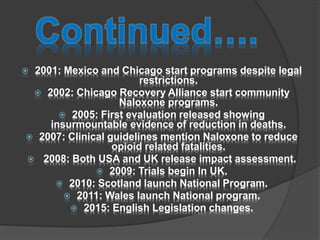
 2001: Mexico and Chicago start programs despite legal
restrictions.
 2002: Chicago Recovery Alliance start community
Naloxone programs.
 2005: First evaluation released showing
insurmountable evidence of reduction in deaths.
 2007: Clinical guidelines mention Naloxone to reduce
opioid related fatalities.
 2008: Both USA and UK release impact assessment.
 2009: Trials begin In UK.
 2010: Scotland launch National Program.
 2011: Wales launch National program.
 2015: English Legislation changes.
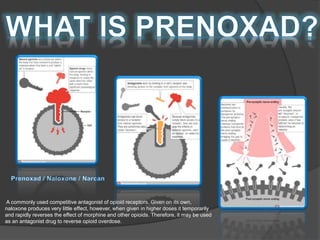
A commonly used competitive antagonist of opioid receptors. Given on its own,
naloxone produces very little effect, however, when given in higher doses it temporarily
and rapidly reverses the effect of morphine and other opioids. Therefore, it may be used
as an antagonist drug to reverse opioid overdose.
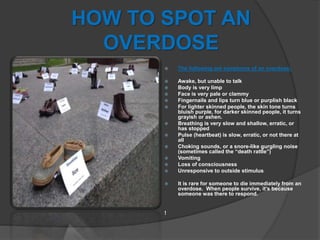
HOW TO SPOT AN
OVERDOSE
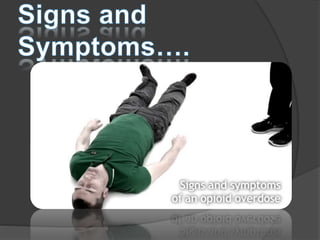
 The following are symptoms of an overdose:
 Awake, but unable to talk
 Body is very limp
 Face is very pale or clammy
 Fingernails and lips turn blue or purplish black
 For lighter skinned people, the skin tone turns
bluish purple, for darker skinned people, it turns
grayish or ashen.
 Breathing is very slow and shallow, erratic, or
has stopped
 Pulse (heartbeat) is slow, erratic, or not there at
all
 Choking sounds, or a snore-like gurgling noise
(sometimes called the “death rattle”)
 Vomiting
 Loss of consciousness
 Unresponsive to outside stimulus
 It is rare for someone to die immediately from an
overdose. When people survive, it’s because
someone was there to respond.
!
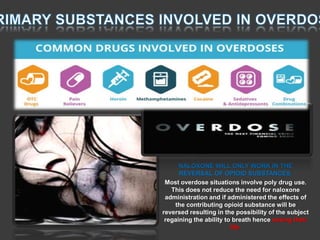
NALOXONE WILL ONLY WORK IN THE
REVERSAL OF OPIOID SUBSTANCES.
Most overdose situations involve poly drug use.
This does not reduce the need for naloxone
administration and if administered the effects of
the contributing opioid substance will be
reversed resulting in the possibility of the subject
regaining the ability to breath hence saving their
life.
MAIN SUBSTANCES....
• OPIOIDS
• ALCOHOL
•BENZOS
•METHADONE
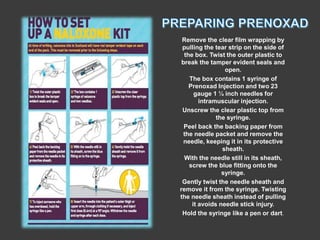
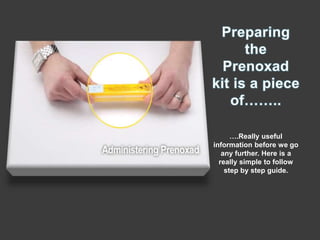
Remove the clear film wrapping by
pulling the tear strip on the side of
the box. Twist the outer plastic to
break the tamper evident seals and
open.
The box contains 1 syringe of
Prenoxad Injection and two 23
gauge 1 ¼ inch needles for
intramuscular injection.
Unscrew the clear plastic top from
the syringe.
Peel back the backing paper from
the needle packet and remove the
needle, keeping it in its protective
sheath.
With the needle still in its sheath,
screw the blue fitting onto the
syringe.
Gently twist the needle sheath and
remove it from the syringe. Twisting
the needle sheath instead of pulling
it avoids needle stick injury.
Hold the syringe like a pen or dart.
….Really useful
information before we go
any further. Here is a
really simple to follow
step by step guide.
IF THE PERSON IS
BREATHING
 If the casualty is breathing normally....
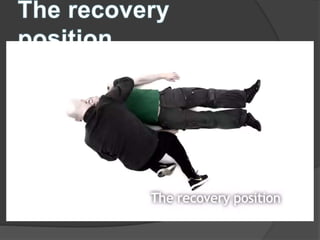
 Move the person into the recovery position,
 Give 0.4 ml Prenoxad Injection Call 999 and
ask for an ambulance explaining that you
have a casualty who is UNCONSCIOUS
BUT APPEARS TO BE BREATHING
 If the casualty does not wake up/regain
consciousness, keep them in the recovery
position and give further doses of Prenoxad
Injection every 2 to 3 minutes.. Repeat this
as many times as necessary until:
 The casualty regains consciousness
 The ambulance arrives
 Stay with the casualty and continue to
monitor their breathing. If there is a
decrease in breathing give 0.4 ml Prenoxad
Injection solution every 2 -3 minutes. If the
casualty’s breathing becomes less frequent
or stops, you may need to give basic life
support.
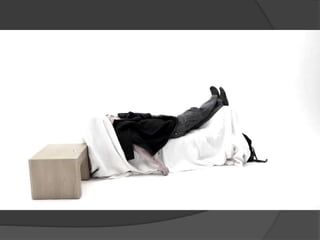
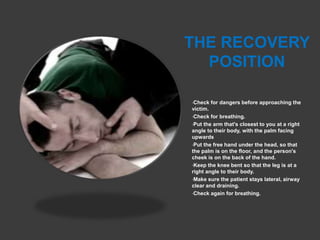
THE RECOVERY
POSITION
•Check for dangers before approaching the
victim.
•Check for breathing.
•Put the arm that's closest to you at a right
angle to their body, with the palm facing
upwards
•Put the free hand under the head, so that
the palm is on the floor, and the person's
cheek is on the back of the hand.
•Keep the knee bent so that the leg is at a
right angle to their body.
•Make sure the patient stays lateral, airway
clear and draining.
•Check again for breathing.
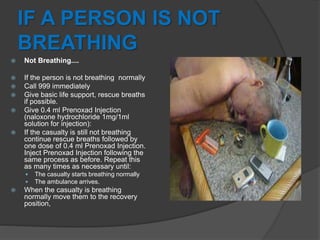
IF A PERSON IS NOT
BREATHING
 Not Breathing....
 If the person is not breathing normally
 Call 999 immediately
 Give basic life support, rescue breaths
if possible.
 Give 0.4 ml Prenoxad Injection
(naloxone hydrochloride 1mg/1ml
solution for injection):
 If the casualty is still not breathing
continue rescue breaths followed by
one dose of 0.4 ml Prenoxad Injection.
Inject Prenoxad Injection following the
same process as before. Repeat this
as many times as necessary until:
 The casualty starts breathing normally
 The ambulance arrives.
 When the casualty is breathing
normally move them to the recovery
position,
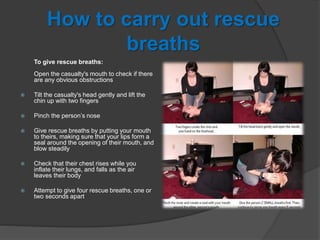
How to carry out rescue
breaths
To give rescue breaths:
Open the casualty's mouth to check if there
are any obvious obstructions
 Tilt the casualty's head gently and lift the
chin up with two fingers
 Pinch the person’s nose
 Give rescue breaths by putting your mouth
to theirs, making sure that your lips form a
seal around the opening of their mouth, and
blow steadily
 Check that their chest rises while you
inflate their lungs, and falls as the air
leaves their body
 Attempt to give four rescue breaths, one or
two seconds apart
Insert the needle at right angles (90
degrees) into the casualty’s outer thigh
or upper arm muscle, through clothing
if necessary.
Rotate the barrel so that the black
dosage line can be seen.
Inject the first dose of 0.4 ml Prenoxad
Injection by holding the syringe steady
and pushing the plunger to the first
black line.
Take out the syringe with the needle
attached and safely put it back into the
case.
Do not re-sheath the needle,
If you need to give another dose, insert
the syringe again and inject to the next
black line.
After using Prenoxad Injection, keep
the syringe in the box and hand it to
the ambulance crew so that they know
it has been administered,
For General Enquiries:
Building A2, Glory Park
Glory Park Avenue
Wooburn Green
Buckinghamshire
HP10 0DF
United Kingdom
t+44 (0) 1628551900
f+44 (0) 1628529848
econnect@martindalepharma.co.uk
For Ordering and Customer Services
You can use our free phone and fax
numbers, email or
register to order online
t 0800 137 627
f0800 360360
order@martindalepharma.co.uk

#IOM - Prenoxad Presentation and Training

  • 2.
     There havebeen over 28,000 preventable fatalities in UK alone since 2002. And in USA alone over 10,000 reversals since 2008.  Following overdose by heroin injection, death ‘usually’ occurs within 1 to 3 hours, limiting the window of opportunity to intervene. Furthermore, most drug overdose deaths occur in the company of others, with up to three-quarters of overdoses being witnessed by others, yet 80% are found alone.  In 2005, a change in the UK Medicines Act allowed prenoxad to be administered by anyone for the purpose of saving life in an emergency.  On October 1st 2015 the medicines act amendments allowed for prenoxad to be supplied without prescription from any commissioned drug treatment service provider, or public health service provider, police surgeons, pharmacists providing Nx or OST, MMS.  Prenoxad Injection is the first presentation of naloxone licensed for emergency use in the home, community, and other non-medical setting.  Prenoxad Injection may be supplied to a person at risk of opioid overdose, their family, carers, significant others,  http:///www.prenoxadinjection.com  On this website you will find further information on when and how Prenoxad Injection should be used and a resource to train clients or their representatives on using Prenoxad Injection.
  • 3.
    WHAT IS PRENOXAD? *SIGNS OF OVERDOSE. * HIGH RISK SUBSTANCES.  WHEN AND HOW TO GIVE PRENOXAD. * FURTHER RESOURCES * QUESTIONS AND ANSWERS.
  • 4.
     1961: Naloxonefirst cited.  1971: Naloxone hydrochloride, received FDA approval in 1971.  1996: First pilots in 15 American sites.  1998: European Naloxone Pilots began to appear.  2000: ACMD endorsed it as a life-saving medication.  2001: First program in UK, South London Maudsley…..
  • 5.
     2001: Mexicoand Chicago start programs despite legal restrictions.  2002: Chicago Recovery Alliance start community Naloxone programs.  2005: First evaluation released showing insurmountable evidence of reduction in deaths.  2007: Clinical guidelines mention Naloxone to reduce opioid related fatalities.  2008: Both USA and UK release impact assessment.  2009: Trials begin In UK.  2010: Scotland launch National Program.  2011: Wales launch National program.  2015: English Legislation changes.
  • 6.
    A commonly usedcompetitive antagonist of opioid receptors. Given on its own, naloxone produces very little effect, however, when given in higher doses it temporarily and rapidly reverses the effect of morphine and other opioids. Therefore, it may be used as an antagonist drug to reverse opioid overdose.
  • 9.
    HOW TO SPOTAN OVERDOSE  The following are symptoms of an overdose:  Awake, but unable to talk  Body is very limp  Face is very pale or clammy  Fingernails and lips turn blue or purplish black  For lighter skinned people, the skin tone turns bluish purple, for darker skinned people, it turns grayish or ashen.  Breathing is very slow and shallow, erratic, or has stopped  Pulse (heartbeat) is slow, erratic, or not there at all  Choking sounds, or a snore-like gurgling noise (sometimes called the “death rattle”)  Vomiting  Loss of consciousness  Unresponsive to outside stimulus  It is rare for someone to die immediately from an overdose. When people survive, it’s because someone was there to respond. !
  • 11.
    NALOXONE WILL ONLYWORK IN THE REVERSAL OF OPIOID SUBSTANCES. Most overdose situations involve poly drug use. This does not reduce the need for naloxone administration and if administered the effects of the contributing opioid substance will be reversed resulting in the possibility of the subject regaining the ability to breath hence saving their life. MAIN SUBSTANCES.... • OPIOIDS • ALCOHOL •BENZOS •METHADONE
  • 12.
    Remove the clearfilm wrapping by pulling the tear strip on the side of the box. Twist the outer plastic to break the tamper evident seals and open. The box contains 1 syringe of Prenoxad Injection and two 23 gauge 1 ¼ inch needles for intramuscular injection. Unscrew the clear plastic top from the syringe. Peel back the backing paper from the needle packet and remove the needle, keeping it in its protective sheath. With the needle still in its sheath, screw the blue fitting onto the syringe. Gently twist the needle sheath and remove it from the syringe. Twisting the needle sheath instead of pulling it avoids needle stick injury. Hold the syringe like a pen or dart.
  • 13.
    ….Really useful information beforewe go any further. Here is a really simple to follow step by step guide.
  • 16.
    IF THE PERSONIS BREATHING  If the casualty is breathing normally....  Move the person into the recovery position,  Give 0.4 ml Prenoxad Injection Call 999 and ask for an ambulance explaining that you have a casualty who is UNCONSCIOUS BUT APPEARS TO BE BREATHING  If the casualty does not wake up/regain consciousness, keep them in the recovery position and give further doses of Prenoxad Injection every 2 to 3 minutes.. Repeat this as many times as necessary until:  The casualty regains consciousness  The ambulance arrives  Stay with the casualty and continue to monitor their breathing. If there is a decrease in breathing give 0.4 ml Prenoxad Injection solution every 2 -3 minutes. If the casualty’s breathing becomes less frequent or stops, you may need to give basic life support.
  • 17.
    THE RECOVERY POSITION •Check fordangers before approaching the victim. •Check for breathing. •Put the arm that's closest to you at a right angle to their body, with the palm facing upwards •Put the free hand under the head, so that the palm is on the floor, and the person's cheek is on the back of the hand. •Keep the knee bent so that the leg is at a right angle to their body. •Make sure the patient stays lateral, airway clear and draining. •Check again for breathing.
  • 19.
    IF A PERSONIS NOT BREATHING  Not Breathing....  If the person is not breathing normally  Call 999 immediately  Give basic life support, rescue breaths if possible.  Give 0.4 ml Prenoxad Injection (naloxone hydrochloride 1mg/1ml solution for injection):  If the casualty is still not breathing continue rescue breaths followed by one dose of 0.4 ml Prenoxad Injection. Inject Prenoxad Injection following the same process as before. Repeat this as many times as necessary until:  The casualty starts breathing normally  The ambulance arrives.  When the casualty is breathing normally move them to the recovery position,
  • 20.
    How to carryout rescue breaths To give rescue breaths: Open the casualty's mouth to check if there are any obvious obstructions  Tilt the casualty's head gently and lift the chin up with two fingers  Pinch the person’s nose  Give rescue breaths by putting your mouth to theirs, making sure that your lips form a seal around the opening of their mouth, and blow steadily  Check that their chest rises while you inflate their lungs, and falls as the air leaves their body  Attempt to give four rescue breaths, one or two seconds apart
  • 22.
    Insert the needleat right angles (90 degrees) into the casualty’s outer thigh or upper arm muscle, through clothing if necessary. Rotate the barrel so that the black dosage line can be seen. Inject the first dose of 0.4 ml Prenoxad Injection by holding the syringe steady and pushing the plunger to the first black line. Take out the syringe with the needle attached and safely put it back into the case. Do not re-sheath the needle, If you need to give another dose, insert the syringe again and inject to the next black line. After using Prenoxad Injection, keep the syringe in the box and hand it to the ambulance crew so that they know it has been administered,
  • 23.
    For General Enquiries: BuildingA2, Glory Park Glory Park Avenue Wooburn Green Buckinghamshire HP10 0DF United Kingdom t+44 (0) 1628551900 f+44 (0) 1628529848 econnect@martindalepharma.co.uk For Ordering and Customer Services You can use our free phone and fax numbers, email or register to order online t 0800 137 627 f0800 360360 order@martindalepharma.co.uk

Editor's Notes

  • #2 . As from October the first new legislation makes Naloxone available from all drug and alcohol services, and pharmacies that provide supervised consumption. Police surgeons will also be able to supply all police officers on the force.
  • #7 Prenoxad Injection is currently the only Naloxone product licensed for community use. It is primarily used to partially reverse respiratory depression induced by natural and synthetic opioids in a ‘high mortality risk’ group within the community. It only works on opioids but can greatly reduce risk of fatality in poly drug use where opioids are present. Since 2002 there have been in excess of 26,000 preventable fatalities in the UK alone. Since 2009 there have been over 10,000 reversals in the USA alone.
  • #12 Naloxone will work only on opioid based substances, both natural and synthetic. Although it will work slower on synthetic opioids such as methadone and subutex. Even if there is polydrug use it is still of benefit in minimising the riskof fatal outcome.