Institute of Engineering, Tribhuvan University, Nepal
Stability Assessment and Review of Applied Support
at Headrace Tunnel of Khimti-2 Hydroelectric Project
TRIBHUVAN UNIVERSITY
INSTITUTE OF ENGINEERING
Pashchimanchal Campus
Thesis Proposal Presentation
Supervisor:
Sangit Lamichhane
Department of Civil Engineering,
Pashchimanchal Campus, IOE, TU
PAS078MSRTE016
Date: 28 May, 2023
2 Institute of Engineering, Tribhuvan University, Nepal
Contents
1. Introduction
2. Statement of Problem
3. Objectives
4. Methodology
5. Expected Outcomes
6. Limitations
7. Work Schedule
8. References
3 Institute of Engineering, Tribhuvan University, Nepal
1. Introduction
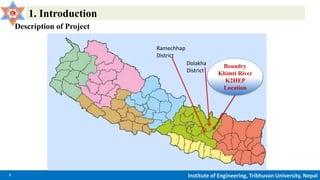
Description of Project
Boundry
Khimti River
K2HEP
Location
Ramechhap
District
Dolakha
District
4 Institute of Engineering, Tribhuvan University, Nepal
1. Introduction
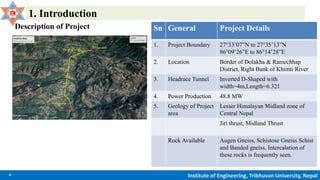
Description of Project Sn General Project Details
1. Project Boundary 27°33’07”N to 27°35’13”N
86°09’26”E to 86°14’28”E
2. Location Border of Dolakha & Ramechhap
District, Right Bank of Khimti River
3. Headrace Tunnel Inverted D-Shaped with
width=4m,Length=6.321
4. Power Production 48.8 MW
5. Geology of Project
area
Lesser Himalayan Midland zone of
Central Nepal
Jiri thrust, Midland Thrust
Rock Available Augen Gneiss, Schistose Gneiss Schist
and Banded gneiss. Intercalation of
these rocks is frequently seen.
5 Institute of Engineering, Tribhuvan University, Nepal
1. Introduction
Rock Mass Quality
 Detailed information regarding the strength qualities of the rock and in-situ stresses are
not available during initial stage of project.
 As a result, empirical techniques such as rock mass classification systems are used to
carry out the preliminary design of the tunnel support system.
 Depending upon the level of preconstruction phase engineering geological investigations,
the predicted and actual rockmass may vary accordingly on the site.
 If Supports are less then required, slowly advances into the tunnel without perceptible
volume increase.
 The underground structures are less susceptible to damage due to earthquakes than
surface structures due to various factors such as reduction in ground motion with depth
and consequent reduction in seismic coefficient but the impact of the seismic hazards
should be properly studied.
6 Institute of Engineering, Tribhuvan University, Nepal
2. Statement of Problem
 Limited field observation, testing result and not sufficient preconstruction
geological investigation
 Nepal has Complex geological setup while moving from south to north.
Preconstruction investigation conducted at one location of the tunnel alignment
may not be valid for other location, which may hamper overall construction cost
and time.
 Supports are given only based on support Chart of Q-system, which was
developed from the case histories in tunnels other than Nepal Himalaya.
 Nepal lies in one of the most seismically active regions in the world where
earthquakes of high magnitude occur at regular intervals causing significant
damages to structures.
7 Institute of Engineering, Tribhuvan University, Nepal
3.Objectives
General Objective
 Assess the stability condition of the headrace Tunnel
Specific Objective
 To study about the engineering geological parameters of the area around the tunnel
alignment.
 To carry out the rock mass classification survey at the surface as well as inside the
tunnel and compare the results.
 To determine the seismic impacts on tunnels through Numerical Approaches i.e Phase2
and review the current supports in the tunnel
8 Institute of Engineering, Tribhuvan University, Nepal
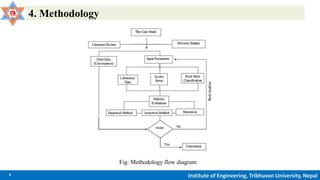
4. Methodology
Fig: Methodology flow diagram
9 Institute of Engineering, Tribhuvan University, Nepal
5.Expected Outcomes
The expected outcomes from this Research will be assessment of the
stability condition of headrace tunnel and suggestion of required
support considering seismic effect via numerical modeling.
10 Institute of Engineering, Tribhuvan University, Nepal
6.Limitations
 I would not be able to collect all the face map data myself and I will collect these from
the project
11 Institute of Engineering, Tribhuvan University, Nepal
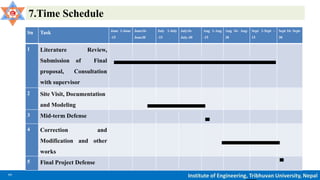
7.Time Schedule
Sn Task June 1-June
-15
June16-
June30
July 1-July
-15
July16-
July-30
Aug 1-Aug
-15
Aug 16- Aug-
30
Sept 1-Sept -
15
Sept 16- Sept-
30
1 Literature Review,
Submission of Final
proposal, Consultation
with supervisor
2 Site Visit, Documentation
and Modeling
3 Mid-term Defense
4 Correction and
Modification and other
works
5 Final Project Defense
12 Institute of Engineering, Tribhuvan University, Nepal
8.References
 Wyllie, D.C. and Mah, C., 2014. Rock slope engineering. CRC Press.
 Hoek & Marinos,2000, Predicting tunnel squeezing problems in weak heterogeneous rock masses
 K. K. Panthi and B. Nilsen, Comparison between predicted and actual rock mass conditions: a review based on tunnel projects in Nepal Himalaya
 Hoek, E., 2007. Practical Rock Engineering.
 Hudson, J. A. & Harrison, J. P., 1997. Engineering Rock Mechanics.
 Panthi, K. (2006). Analysis of engineering geological uncertainties related to tunneling in Himalayan rock mass conditions. NTNU, Norway.
 Tshering, K. (2012). Stability assessment of headrace tunnel for Punatsangchhu II Hydropower Project, Bhutan. NTNU Norway 150: MSc Thesis.
 D.U. Deere, R.B. Peck and H.W. Parker. Design of Tunnel Support Systems. University of Illinois.
 Shrestha, G. (2006). Stress induced problem in Himalayan Tunnels with Special reference to Squeezing. Trondheim, Norway: Doctoral Thesis, NTNU
 N. Dawadi & A.B Singh,2020, Prediction of Rock Burst, Squeezing and Support Design using Three-Dimensional and Conventional Methods along Headrace Tunnel in Balephi,
Nepal
 Santosh Subedi,2022 Rock Engineering Assessment along the Headrace Tunnel of Khimti2 Hydroelectric Project,MSc thesis
 Sivarajan T. K. Seismic load considerations in the design of underground structures for hydropower projects in the himalayan region. Recent Advances in Rock Engineering, 2016.
 Nepal Earthquake 25 April 2015: Hydro projects damaged, risks and lessons learned for design considerations, Subas Chandra Sunuwar,2018
13 Institute of Engineering, Tribhuvan University, Nepal
Thank YOU!!

ioe_engineering_thesis proposal roll16.pptx

  • 1.
    Institute of Engineering,Tribhuvan University, Nepal Stability Assessment and Review of Applied Support at Headrace Tunnel of Khimti-2 Hydroelectric Project TRIBHUVAN UNIVERSITY INSTITUTE OF ENGINEERING Pashchimanchal Campus Thesis Proposal Presentation Supervisor: Sangit Lamichhane Department of Civil Engineering, Pashchimanchal Campus, IOE, TU PAS078MSRTE016 Date: 28 May, 2023
  • 2.
    2 Institute ofEngineering, Tribhuvan University, Nepal Contents 1. Introduction 2. Statement of Problem 3. Objectives 4. Methodology 5. Expected Outcomes 6. Limitations 7. Work Schedule 8. References
  • 3.
    3 Institute ofEngineering, Tribhuvan University, Nepal 1. Introduction Description of Project Boundry Khimti River K2HEP Location Ramechhap District Dolakha District
  • 4.
    4 Institute ofEngineering, Tribhuvan University, Nepal 1. Introduction Description of Project Sn General Project Details 1. Project Boundary 27°33’07”N to 27°35’13”N 86°09’26”E to 86°14’28”E 2. Location Border of Dolakha & Ramechhap District, Right Bank of Khimti River 3. Headrace Tunnel Inverted D-Shaped with width=4m,Length=6.321 4. Power Production 48.8 MW 5. Geology of Project area Lesser Himalayan Midland zone of Central Nepal Jiri thrust, Midland Thrust Rock Available Augen Gneiss, Schistose Gneiss Schist and Banded gneiss. Intercalation of these rocks is frequently seen.
  • 5.
    5 Institute ofEngineering, Tribhuvan University, Nepal 1. Introduction Rock Mass Quality  Detailed information regarding the strength qualities of the rock and in-situ stresses are not available during initial stage of project.  As a result, empirical techniques such as rock mass classification systems are used to carry out the preliminary design of the tunnel support system.  Depending upon the level of preconstruction phase engineering geological investigations, the predicted and actual rockmass may vary accordingly on the site.  If Supports are less then required, slowly advances into the tunnel without perceptible volume increase.  The underground structures are less susceptible to damage due to earthquakes than surface structures due to various factors such as reduction in ground motion with depth and consequent reduction in seismic coefficient but the impact of the seismic hazards should be properly studied.
  • 6.
    6 Institute ofEngineering, Tribhuvan University, Nepal 2. Statement of Problem  Limited field observation, testing result and not sufficient preconstruction geological investigation  Nepal has Complex geological setup while moving from south to north. Preconstruction investigation conducted at one location of the tunnel alignment may not be valid for other location, which may hamper overall construction cost and time.  Supports are given only based on support Chart of Q-system, which was developed from the case histories in tunnels other than Nepal Himalaya.  Nepal lies in one of the most seismically active regions in the world where earthquakes of high magnitude occur at regular intervals causing significant damages to structures.
  • 7.
    7 Institute ofEngineering, Tribhuvan University, Nepal 3.Objectives General Objective  Assess the stability condition of the headrace Tunnel Specific Objective  To study about the engineering geological parameters of the area around the tunnel alignment.  To carry out the rock mass classification survey at the surface as well as inside the tunnel and compare the results.  To determine the seismic impacts on tunnels through Numerical Approaches i.e Phase2 and review the current supports in the tunnel
  • 8.
    8 Institute ofEngineering, Tribhuvan University, Nepal 4. Methodology Fig: Methodology flow diagram
  • 9.
    9 Institute ofEngineering, Tribhuvan University, Nepal 5.Expected Outcomes The expected outcomes from this Research will be assessment of the stability condition of headrace tunnel and suggestion of required support considering seismic effect via numerical modeling.
  • 10.
    10 Institute ofEngineering, Tribhuvan University, Nepal 6.Limitations  I would not be able to collect all the face map data myself and I will collect these from the project
  • 11.
    11 Institute ofEngineering, Tribhuvan University, Nepal 7.Time Schedule Sn Task June 1-June -15 June16- June30 July 1-July -15 July16- July-30 Aug 1-Aug -15 Aug 16- Aug- 30 Sept 1-Sept - 15 Sept 16- Sept- 30 1 Literature Review, Submission of Final proposal, Consultation with supervisor 2 Site Visit, Documentation and Modeling 3 Mid-term Defense 4 Correction and Modification and other works 5 Final Project Defense
  • 12.
    12 Institute ofEngineering, Tribhuvan University, Nepal 8.References  Wyllie, D.C. and Mah, C., 2014. Rock slope engineering. CRC Press.  Hoek & Marinos,2000, Predicting tunnel squeezing problems in weak heterogeneous rock masses  K. K. Panthi and B. Nilsen, Comparison between predicted and actual rock mass conditions: a review based on tunnel projects in Nepal Himalaya  Hoek, E., 2007. Practical Rock Engineering.  Hudson, J. A. & Harrison, J. P., 1997. Engineering Rock Mechanics.  Panthi, K. (2006). Analysis of engineering geological uncertainties related to tunneling in Himalayan rock mass conditions. NTNU, Norway.  Tshering, K. (2012). Stability assessment of headrace tunnel for Punatsangchhu II Hydropower Project, Bhutan. NTNU Norway 150: MSc Thesis.  D.U. Deere, R.B. Peck and H.W. Parker. Design of Tunnel Support Systems. University of Illinois.  Shrestha, G. (2006). Stress induced problem in Himalayan Tunnels with Special reference to Squeezing. Trondheim, Norway: Doctoral Thesis, NTNU  N. Dawadi & A.B Singh,2020, Prediction of Rock Burst, Squeezing and Support Design using Three-Dimensional and Conventional Methods along Headrace Tunnel in Balephi, Nepal  Santosh Subedi,2022 Rock Engineering Assessment along the Headrace Tunnel of Khimti2 Hydroelectric Project,MSc thesis  Sivarajan T. K. Seismic load considerations in the design of underground structures for hydropower projects in the himalayan region. Recent Advances in Rock Engineering, 2016.  Nepal Earthquake 25 April 2015: Hydro projects damaged, risks and lessons learned for design considerations, Subas Chandra Sunuwar,2018
  • 13.
    13 Institute ofEngineering, Tribhuvan University, Nepal Thank YOU!!

Editor's Notes

  • #4 Nepal lies in one of the most seismically active regions in the world. Small-scale earthquakes occur frequently in Nepal. The vulnerability of damage to the surface structure by an earthquake is very high and goes on decreasing with an increase in depth below the surface, as confinement from all directions increases. Most of the metro tunnels are shallow tunnels. At the portal of the mountain tunnel, it may act as a shallow tunnel till some chainage. The vulnerability to damage by the earthquake at those positions is very high. So, consideration of the seismic force during the design of the tunnel cannot be avoided
  • #5 Nepal lies in one of the most seismically active regions in the world. Small-scale earthquakes occur frequently in Nepal. The vulnerability of damage to the surface structure by an earthquake is very high and goes on decreasing with an increase in depth below the surface, as confinement from all directions increases. Most of the metro tunnels are shallow tunnels. At the portal of the mountain tunnel, it may act as a shallow tunnel till some chainage. The vulnerability to damage by the earthquake at those positions is very high. So, consideration of the seismic force during the design of the tunnel cannot be avoided
  • #6 Nepal lies in one of the most seismically active regions in the world. Small-scale earthquakes occur frequently in Nepal. The vulnerability of damage to the surface structure by an earthquake is very high and goes on decreasing with an increase in depth below the surface, as confinement from all directions increases. Most of the metro tunnels are shallow tunnels. At the portal of the mountain tunnel, it may act as a shallow tunnel till some chainage. The vulnerability to damage by the earthquake at those positions is very high. So, consideration of the seismic force during the design of the tunnel cannot be avoided