
Image data beyondradiology: newdevelopmentsDr. E. R. Ranschaert1Dr. F.H. Barneveld Binkhuysen2Jeroen Bosch Ziekenhuis, 's-Hertogenbosch, NL   Independent Hospital & Healthcare Professional, Soest, NL
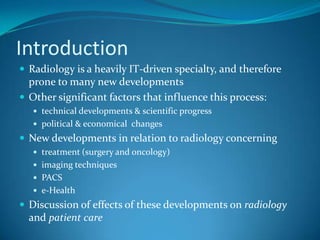
IntroductionRadiology is a heavily IT-driven specialty, and therefore prone to many new developmentsOther significant factors that influence this process:technical developments & scientific progresspolitical & economical  changesNew developments in relation to radiology concerningtreatment (surgery and oncology)imaging techniquesPACSe-HealthDiscussion of effects of these developments on radiology and patient care
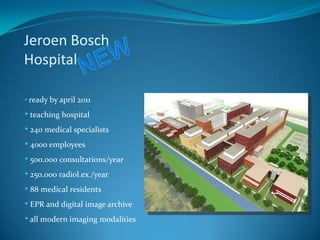
Jeroen Bosch HospitalNEWready by april 2011
 teaching hospital
 240 medical specialists
 4000 employees
 500.000 consultations/year
 250.000 radiol.ex./year
 88 medical residents
 EPR and digital image archive
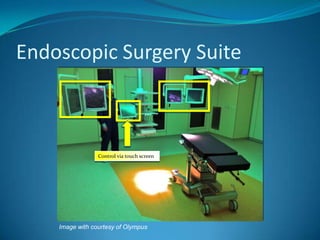
 all modern imaging modalitiesEndoscopic Surgery SuiteControl via touch screenImage with courtesy of Olympus
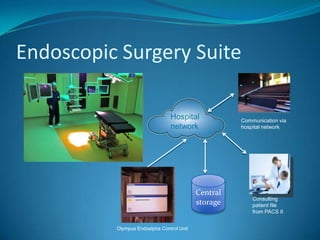
Endoscopic Surgery SuiteHospital networkCommunication via hospital networkCentral storageConsulting patient file from PACS IIOlympus Endoalpha Control Unit
Images beyondradiology: surgeryIntegration of images in surgical procedures forstrategic planningprocedure guidancepatient-specific treatment (custom-made implants)teaching (live)International trend: new surgical societiesISCASInternational Society for Computer Aided SurgeryISMICSInternational Society for Minimally Invasive Cardiothoracic SurgeryCAOS-international Society for Computer Assisted Orthopaedic and Spinal Surgery
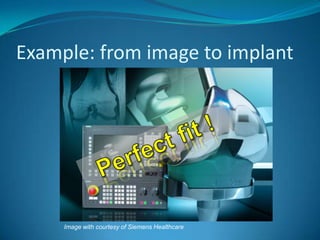
Example: from image to implantPerfect fit !Image with courtesy of Siemens Healthcare
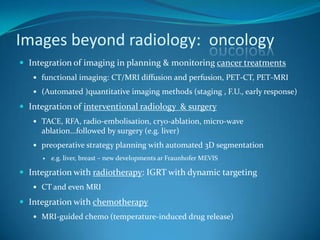
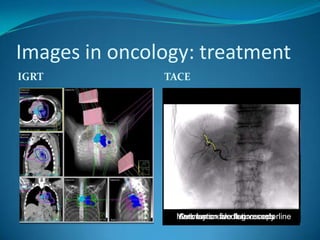
Images beyondradiology:  oncologyIntegration of imaging in planning & monitoring cancer treatmentsfunctional imaging: CT/MRI diffusion and perfusion, PET-CT, PET-MRI(Automated )quantitative imaging methods (staging , F.U., early response)Integration of interventional radiology  & surgeryTACE, RFA, radio-embolisation, cryo-ablation, micro-wave ablation...followed by surgery (e.g. liver)preoperative strategy planning with automated 3D segmentation e.g. liver, breast – new developments arFraunhofer MEVISIntegration with radiotherapy: IGRT with dynamic targetingCT and even MRIIntegration with chemotherapyMRI-guided chemo (temperature-induced drug release)
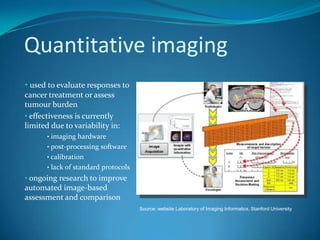
Quantitative imagingused to evaluate responses to cancer treatment or assess tumour burden
 effectiveness is currently limited due to variability in:
 imaging hardware
 post-processing software
 calibration
 lack of standard protocols
 ongoing research to improve automated image-based assessment and comparisonSource: website Laboratory of Imaging Informatics, Stanford University
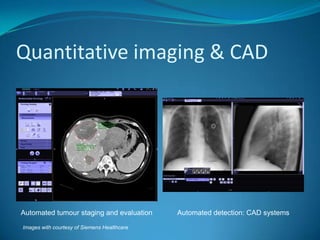
Quantitative imaging & CADAutomated tumour staging and evaluationAutomated detection: CAD systemsImages with courtesy of Siemens Healthcare
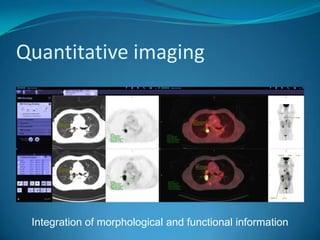
Quantitative imagingIntegration of morphological and functional information
Images in oncology: treatmentIGRTTACEMark tumor-feeding vesselsAutomatic calculation centerlineOverlay on live fluoroscopy
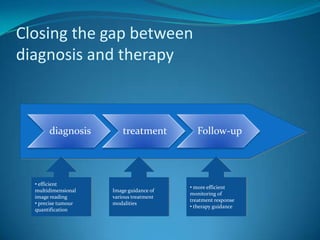
Closing the gap between diagnosis and therapy efficient multidimensional image reading
 precise tumour quantificationImage guidance of various treatment modalitiesmore efficient monitoring of treatment response
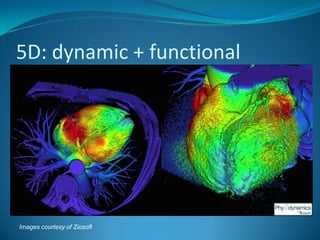
therapy guidanceDevelopments in techniques	Faster scanning protocols & post-processing  softwaremore data, greater volumes, better image quality 3Dsupercomputer technology : improved resolution, better dynamics4DFurther integration of imaging with additional information 5D?Various options for 5thdimensionfunction of organs/cells, biomarker information, (dual) energy...treatment: MRI guided chemotherapy and radiotherapy
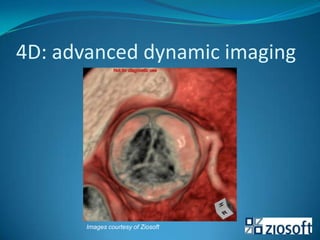
4D: advanced dynamic imagingImages courtesy of Ziosoft
5D: dynamic + functionalImages courtesy of Ziosoft
5D: MRI + functionalPET/MRI images, with courtesy of Siemens Healthcare
Developments in PACS (PACS II)Improved interoperability with other clinical IT-systems, HIS and EPR using IHE standardsEmbedding of clinical tools on 1 single workstation such as:documentation sharing (XDS/XMS), VoIP, integrated voice recognitionEasy access anywhere/anytime (web-based thin client, mobile)Further integration of :pathology images (interactive display of the microscopic fields), endoscopic images (video sequences, video capsule)  dermatological imagessurgical imaging: development of “surgical PACS” based upon DICOM and IHE, integration of therapy imaging and model-guided therapy (TIMMS)
Seamless integration and interconnectivityThe biggest gains will come from the seamless connectionof RIS/PACS and EPR with imagesIntegration of other applications should appear seamless to the radiologistThe longer term solution is to make transmural image transfer by DVDs and CDs unnecessary. This requires an interconnected, broadly based EPR system (“virtual cloud”)
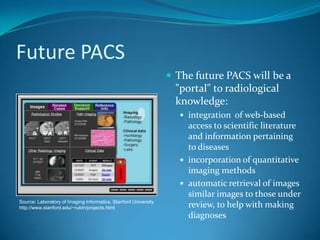
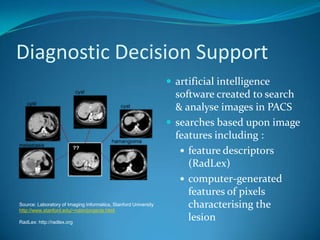
Future PACSThe future PACS will be a "portal" to radiological knowledge:integration  of web-based access to scientific literature  and information pertaining to diseases incorporation of quantitative imaging methodsautomatic retrieval of images similar images to those under review, to help with making diagnosesSource: Laboratory of Imaging Informatics, Stanford Universityhttp://www.stanford.edu/~rubin/projects.html
PACS-Web IntegrationThe (anonymised) data contained in a future connected web of EPR’s could be mined for medical knowledgeThis knowledge could then be put into a national or pan-European databasefor use in making diagnoses and choosing therapiesAbility to capture this information in a usable form depends on technologyphysicians' willingness to use software-rendered adviseprivacy regulations, financial & political support
Developments in e-HealthMany new developments in radiology are now driven by the consumerChanges that have increased the appetite for health information :wide-scale access to the Internetinexpensive PC’s mobile devices and servicesmerged functions of cell phone and PCPatients are empowered to research medical questions and have the means to own the results of imaging exams and lab testsSimultaneously political initiatives are taken to make healthcare more efficient through the widespread use of ITChanges are  often driven by cost-saving motives and intentions to allow patients to have better control of own health
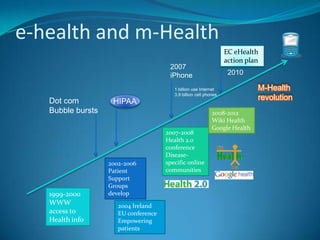
e-health and m-HealthEC eHealth action plan2007iPhone2010M-Healthrevolution1 billion use Internet3,9 billion cell phonesDot comBubble burstsHIPAA2008-2012Wiki Health Google Health2007-2008Health 2.0conferenceDisease-specific onlinecommunities2002-2006PatientSupportGroupsdevelop1999-2000WWW access toHealth info2004 IrelandEU conferenceEmpowering patients

Image data beyond radiology: new developments

  • 1.
    Image data beyondradiology:newdevelopmentsDr. E. R. Ranschaert1Dr. F.H. Barneveld Binkhuysen2Jeroen Bosch Ziekenhuis, 's-Hertogenbosch, NL Independent Hospital & Healthcare Professional, Soest, NL
  • 2.
    IntroductionRadiology is aheavily IT-driven specialty, and therefore prone to many new developmentsOther significant factors that influence this process:technical developments & scientific progresspolitical & economical changesNew developments in relation to radiology concerningtreatment (surgery and oncology)imaging techniquesPACSe-HealthDiscussion of effects of these developments on radiology and patient care
  • 3.
  • 4.
  • 5.
    240 medicalspecialists
  • 6.
  • 7.
  • 8.
  • 9.
    88 medicalresidents
  • 10.
    EPR anddigital image archive
  • 11.
    all modernimaging modalitiesEndoscopic Surgery SuiteControl via touch screenImage with courtesy of Olympus
  • 12.
    Endoscopic Surgery SuiteHospitalnetworkCommunication via hospital networkCentral storageConsulting patient file from PACS IIOlympus Endoalpha Control Unit
  • 13.
    Images beyondradiology: surgeryIntegrationof images in surgical procedures forstrategic planningprocedure guidancepatient-specific treatment (custom-made implants)teaching (live)International trend: new surgical societiesISCASInternational Society for Computer Aided SurgeryISMICSInternational Society for Minimally Invasive Cardiothoracic SurgeryCAOS-international Society for Computer Assisted Orthopaedic and Spinal Surgery
  • 14.
    Example: from imageto implantPerfect fit !Image with courtesy of Siemens Healthcare
  • 15.
    Images beyondradiology: oncologyIntegration of imaging in planning & monitoring cancer treatmentsfunctional imaging: CT/MRI diffusion and perfusion, PET-CT, PET-MRI(Automated )quantitative imaging methods (staging , F.U., early response)Integration of interventional radiology & surgeryTACE, RFA, radio-embolisation, cryo-ablation, micro-wave ablation...followed by surgery (e.g. liver)preoperative strategy planning with automated 3D segmentation e.g. liver, breast – new developments arFraunhofer MEVISIntegration with radiotherapy: IGRT with dynamic targetingCT and even MRIIntegration with chemotherapyMRI-guided chemo (temperature-induced drug release)
  • 16.
    Quantitative imagingused toevaluate responses to cancer treatment or assess tumour burden
  • 17.
    effectiveness iscurrently limited due to variability in:
  • 18.
  • 19.
  • 20.
  • 21.
    lack ofstandard protocols
  • 22.
    ongoing researchto improve automated image-based assessment and comparisonSource: website Laboratory of Imaging Informatics, Stanford University
  • 23.
    Quantitative imaging &CADAutomated tumour staging and evaluationAutomated detection: CAD systemsImages with courtesy of Siemens Healthcare
  • 24.
    Quantitative imagingIntegration ofmorphological and functional information
  • 25.
    Images in oncology:treatmentIGRTTACEMark tumor-feeding vesselsAutomatic calculation centerlineOverlay on live fluoroscopy
  • 26.
    Closing the gapbetween diagnosis and therapy efficient multidimensional image reading
  • 27.
    precise tumourquantificationImage guidance of various treatment modalitiesmore efficient monitoring of treatment response
  • 28.
    therapy guidanceDevelopments intechniques Faster scanning protocols & post-processing softwaremore data, greater volumes, better image quality 3Dsupercomputer technology : improved resolution, better dynamics4DFurther integration of imaging with additional information 5D?Various options for 5thdimensionfunction of organs/cells, biomarker information, (dual) energy...treatment: MRI guided chemotherapy and radiotherapy
  • 29.
    4D: advanced dynamicimagingImages courtesy of Ziosoft
  • 30.
    4D: advanced dynamicimagingImages courtesy of Ziosoft
  • 31.
    5D: dynamic +functionalImages courtesy of Ziosoft
  • 32.
    5D: MRI +functionalPET/MRI images, with courtesy of Siemens Healthcare
  • 33.
    Developments in PACS(PACS II)Improved interoperability with other clinical IT-systems, HIS and EPR using IHE standardsEmbedding of clinical tools on 1 single workstation such as:documentation sharing (XDS/XMS), VoIP, integrated voice recognitionEasy access anywhere/anytime (web-based thin client, mobile)Further integration of :pathology images (interactive display of the microscopic fields), endoscopic images (video sequences, video capsule) dermatological imagessurgical imaging: development of “surgical PACS” based upon DICOM and IHE, integration of therapy imaging and model-guided therapy (TIMMS)
  • 34.
    Seamless integration andinterconnectivityThe biggest gains will come from the seamless connectionof RIS/PACS and EPR with imagesIntegration of other applications should appear seamless to the radiologistThe longer term solution is to make transmural image transfer by DVDs and CDs unnecessary. This requires an interconnected, broadly based EPR system (“virtual cloud”)
  • 35.
    Future PACSThe futurePACS will be a "portal" to radiological knowledge:integration of web-based access to scientific literature and information pertaining to diseases incorporation of quantitative imaging methodsautomatic retrieval of images similar images to those under review, to help with making diagnosesSource: Laboratory of Imaging Informatics, Stanford Universityhttp://www.stanford.edu/~rubin/projects.html
  • 36.
    PACS-Web IntegrationThe (anonymised)data contained in a future connected web of EPR’s could be mined for medical knowledgeThis knowledge could then be put into a national or pan-European databasefor use in making diagnoses and choosing therapiesAbility to capture this information in a usable form depends on technologyphysicians' willingness to use software-rendered adviseprivacy regulations, financial & political support
  • 37.
    Developments in e-HealthManynew developments in radiology are now driven by the consumerChanges that have increased the appetite for health information :wide-scale access to the Internetinexpensive PC’s mobile devices and servicesmerged functions of cell phone and PCPatients are empowered to research medical questions and have the means to own the results of imaging exams and lab testsSimultaneously political initiatives are taken to make healthcare more efficient through the widespread use of ITChanges are often driven by cost-saving motives and intentions to allow patients to have better control of own health
  • 38.
    e-health and m-HealthECeHealth action plan2007iPhone2010M-Healthrevolution1 billion use Internet3,9 billion cell phonesDot comBubble burstsHIPAA2008-2012Wiki Health Google Health2007-2008Health 2.0conferenceDisease-specific onlinecommunities2002-2006PatientSupportGroupsdevelop1999-2000WWW access toHealth info2004 IrelandEU conferenceEmpowering patients