1
Teachers College
Columbia University
MA. RESEARCH PAPER
Some features of Invitations Performed by Highly Proficient Japanese
Speakers of English: More Evidence for the Pragmatic Transfer
Hypothesis ©
By
Roberto Criollo
© Roberto Criollo and Columbia University 1999. No further reproduction of this paper is authorized
without written permission from the copyright holders.
2
CHAPTER I: INTRODUCTION
1.1 Introduction to the Problem
Communicative competence (Hymes 1971, Canale and Swain 1980, Bachman
1992, Coulthard 1985) is the ability to use language for communication, to produce
correct and appropriate messages in a particular social context. According to Canale
and Swain (1980), for a person to be communicatively competent, four types of ability
are required: linguistic ability, sociolinguistic ability, discourse ability and strategic
ability. In other words, a person needs to be able to produce grammatically correct
sentences which are appropriate in a given social environment, that have a logical
structure, and are produced in the right moment. Traditionally, English-as-a-
second/foreign-language courses focus on the linguistic or grammatical component,
neglecting the remaining three others.
Pragmatic competence (Canale 1983, Canale and Swain 1980), which is the
ability to produce language appropriate in a social context, is of special interest for this
paper. In previous research on pragmatic competence of nonnative speakers of English,
Beebe, Takahashi and Uliss-Weltz (1990), found that highly proficient Japanese
speakers of English performed significantly differently from native speakers in the
performance of refusals. They concluded that their subjects’ pragmatic competence in
the second language (L2) was influenced by their mother tongue (L1). Unlike lexico-
grammatical transfer, which occurs in the first stages of learning, pragmatic transfer is
said to take place only when learners have reached a high level of proficiency. This
paper intends to provide evidence as to support or deny such statement.
1.2 Purpose of the Study
The purpose of this research is threefold. First of all, it intends to analyze and
describe pragmatic performance of highly proficient Japanese nonnative speakers of
3
English, in their performance of invitations. Secondly, it will compare and contrast
nonnative and native invitations, in order to find whether and to what extent they are
different. Finally, it will compare nonnative performance in their L1 and L2, in order to
find evidence of pragmatic transfer from Japanese into English.
1.3 Research Questions and Hypotheses
This paper addresses the following research questions:
1) What are some characteristics of invitations performed by Japanese nonnative
speakers of English?
2) What are some characteristics of invitations performed by native speakers of
English?
3) To what extent do nonnative invitations differ from native invitations?
4) What are some possible causes of the differences between nonnative and native
invitations?
5) Is there evidence of pragmatic transfer in nonnative invitations?
6) What are some characteristics of Japanese nonnative speakers of English’s
pragmatic competence?
7) What conclusions can be drawn about the existence of pragmatic transfer in
advanced learners?
8) What are the implications of this research for the ESL and EFL classroom?
Three important hypotheses found in previous studies of interlanguage
pragmatics were tested.
1) The existence of sociopragmatic and pragmalinguistic errors (Thomas 1983). This
hypotheses will be tested using a DCT and comparing the perceptions of face-work
4
required for different situations according to Japanese nonnative speakers of English
and English native speakers.
2) The three broad phases of development of pragmatic competence proposed by
Blum-Kulka (cited in Ellis 1994). According to their model, advanced students’
(phase 3) performance of speech acts can be described as ‘interculturally orientated
and potentially systematic’. By this they mean that learners approximate the native-
speaker performance, using the same range of politeness strategies as native
speakers, but they are also verbose and display some ‘residual’ pragmatic transfer
from their L1.
3) Finally, the politeness phenomenon was analyzed. Would both groups use the same
type of politeness? Pragmatic transfer, hence different concept of politeness might
be reflected in the subjects' performances of invitations.
1.4 Significance of the Study
This paper sets out to contribute with some empirical research into the pragmatic
aspects of interlanguage, in the belief that the ultimate goal of L2 learners is to be able
to communicate and successfully interact with native speakers of the target language. In
other words, having a thorough knowledge of grammar is not enough when it comes to
communicate and perform in different communicative situations and contexts (Hymes
1971, Canale and Swain 1980).
For that reason, we have engaged ourselves in the study of one particularly
interesting speech act: inviting. This language function was selected for the reasons
stated below and also because it has not been studied in real depth, except by Scarcella
and Brunak (1981). Their study is substantially different from ours in that it focused on
the differences between beginning and advanced learners. They found that some
5
politeness features are early acquired, while others are not, and that low level learners
showed much less variety of politeness strategies. Ours focuses on advanced learners
with native-like proficiency and long exposure to the language, and we used baseline
talk to refer to when accounting for the particularities in the learners’ performance of
this particular speech act. Also, whereas they used role-play to elicit data, we used a
discourse completion task (DCT).
1.5 Definition of terms
The following terms are essential for the theoretical framework of this research.
Communicative competence: The ability to use language for communication.
According to Canale and Swain (1980), communicative competence consists of
linguistic (or grammatical) competence, sociolinguistic competence, discourse
competence, and strategic competence.
Discourse Completion Test (DCT): A questionnaire containing descriptions of social
situations and blank spaces for respondents to fill in what they would do in each
particular situation. This instrument is extensively used for sociolinguistic and L2
pragmatic competence research (Ellis 1994, pp. 163-4).
Face: The positive image of oneself that a person shows or intends to show to other
participants in an interaction (Richards, Platt & Platt 1992, p. 135; Yule 1996, pp. 60-2).
Two types of face are distinguished, positive and negative. They are defined below in
detail.
Invitations: Speech acts in which the speaker attempts to have the hearer do
something. Unlike other speech acts, invitations threaten the speaker’s positive face.
Also, they may affect the hearer’s negative face (Scarcella & Brunak 1981, p.1; Criollo
& Maeda 1998)
6
Negative face: ‘The need to be independent, to have freedom of action, and not to be
imposed on by others’ (Yule 1996, p. 61).
Negative politeness: According to Yule (1996), negative politeness is ‘a face-saving
act which is oriented to the person’s negative face’, tends ‘to show deference,
emphasize the importance of the other’s time or concerns, and even include an apology
for the imposition or interruption.
Politeness: In an interaction, ‘the means employed to show awareness of other person’s
face’ which can be achieved in ‘situations of social distance or closeness’ (Yule 1996, p.
60).
Positive face: ‘The need to be accepted, , even liked, by others, to be treated as a
member of the same group, and to know that his or her wants are shared by others’
(Yule 1996, p. 62).
Positive politeness: Yule (1996) defines it as ‘a face-saving act which is concerned
with the person’s positive face’, tends ‘to show solidarity, emphasize that both speakers
want the same thing, and that they have a common goal’ (p. 62).
Pragmatic competence (also sociolinguistic competence): According to Ellis (1994),
it ‘consists or the knowledge that speaker-hearers use in order to engage in
communication, including how speech acts are successfully performed’ (p. 719).
Pragmalinguistic failure: A communicative problem that ‘occurs when a learner tries
to perform the right speech act, but chooses the wrong linguistic means’ (Thomas 1983,
cited in Ellis 1994, p. 165).
Pragmatic transfer: ‘Transfer of L1 sociocultural communicative competence in
performing L2 speech acts or any other aspects of L2 conversation, where the speaker is
trying to achieve a particular function of language’ (Beebe, Takahashi, & Uliss-Weltz
1990).
7
Sociopragmatic failure: The failure that occurs when an L2 learner ‘fails to perform
the illocutionary act required by the situation’ (Thomas 1983, cited in Ellis 1994, p.
165).
Speech acts (also known as ‘illocutionary acts’): According to Ellis (1994), they are
‘attempts by language users to perform specific actions, in particular interpersonal
functions such as compliments, apologies, requests or complaints’ (p. 159).
8
CHAPTER II: LITERATURE REVIEW
2.1 Face and Politeness
Invitations differ from other speech acts that have been studied more extensively
(i.e. apologies) in that they force the speaker (in this case the learner), to take the
initiative and use his knowledge of language to achieve a communicative goal. Here, as
different from an apology, for example, the learner has the first pair part of an adjacency
pair. In the same vein, invitations can be seen as belonging to a higher category of
pragmatic abilities. While an apology can be more of a ‘survival’ function, an invitation
implies more sophisticated pragmalinguistic behavior. A person who fails to apologize
or does it incorrectly will still be understood, whereas a person who fails to invite will
most likely be isolated from native speakers of English. Last but not least, this
language function is one of what Goffman (1976), and then Brown and Levinson (1978)
call a face threatening act. That is, it is a kind of speech act that imposes something on
the hearer.
To further clarify this concept we will use Goffman’s (1976) definition of face:
‘Something that is emotionally invested and that can be lost, maintained or enhanced’.
In the further definition by Brown and Levinson (1978), face is seen as consisting of
two aspects: positive face, the ‘positive, consistent self-image’ that every person has
and wants other people to appreciate; and negative face, basically defined as a claim for
‘freedom of action and freedom from imposition’. In this way, a speech act may
threaten positive face by belittling the hearer’s self-image or negative face by imposing
something on him/her.
As we can see, an invitation is a speech act that may threaten the hearer’s
negative face, as it imposes something on him. The hearer is forced to respond to this
by accepting or declining, but some face is invested in this process. For this language
9
function, as with some other face threatening acts, the speaker has a choice of
performing it on record (directly) or off record (indirectly). If he decides to perform it
on record, he has a choice of doing it ‘baldly on record’, that is to say, in a
straightforward manner, or of using some ‘face saving strategy’. By this Brown and
Levinson (1978) mean a strategy directed to mitigate some of the negative effects of a
face threatening act. In their ‘model of politeness’ (1978), they distinguish positive and
negative strategies. A face-saving strategy directed to positive face is an attempt of the
speaker to establish solidarity with the addressee by emphasizing commonality
(greeting, using ‘in group’ language: first names, inclusive pronouns, slang). This type
of strategy is common when there is minimal social distance between the interlocutors
and little power differences. A face-saving strategy directed to negative face is for the
speaker to perform the act in such a way that deference is shown to the hearer, to give
him/her a way of compliance with the act (hedging, indirectness, impersonalizing ‘it’,
using deferential terms of address). It is used when the power differences between the
participants is considerable (Brown and Levinson, 1978:6).
Another important characteristic of invitations is that while threatening the
hearer’s negative face, they also threaten the speaker’s positive face. In other words, if
a speaker invites, his/her interlocutor can either accept of decline the invitation. An
acceptance is a preferred response and a declination is a dispreferred one (Levinson
1983). Then, if the person does not accept, the person inviting will lose some positive
face. They also have the characteristic of enhancing the hearer’s positive face, as being
invited is something that, in most cases, makes one feel good.
As we can see, inviting requires mastery of pragmatic ability, to balance face-
saving activity because on the one hand, the speaker will not want to impose something
burdensome on his/her interlocutor and on the other hand, he/she will not want to
10
receive a negative. It takes then, careful linguistic planning. This is why this particular
speech act carries so much interest and needs to be further studied as we want our
students to be successful communicators in English. Our work will be based on the
particular features of invitations described below and drew from the speech act theory.
2.2 Invitations
Invitations are attempts on the part of the speaker to get the hearer to perform
some kind of action in the future (immediate or far). A number of general interactional,
illocutionary and sociolinguistic features of invitations can be identified.
1. They tend to serve an initiating of closing function in discourse.
2. They are performed in a single turn or, if they involve some kind of
preparatory act or pre-invitation and/or a closing act or post-invitation, over
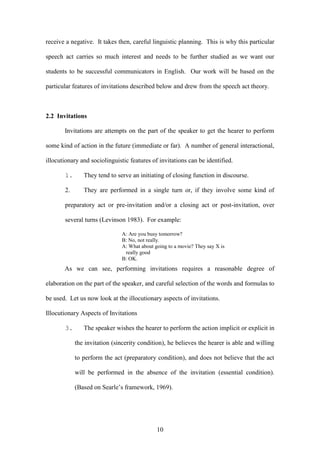
several turns (Levinson 1983). For example:
A: Are you busy tomorrow?
B: No, not really.
A: What about going to a movie? They say X is
really good
B: OK.
As we can see, performing invitations requires a reasonable degree of
elaboration on the part of the speaker, and careful selection of the words and formulas to
be used. Let us now look at the illocutionary aspects of invitations.
Illocutionary Aspects of Invitations
3. The speaker wishes the hearer to perform the action implicit or explicit in
the invitation (sincerity condition), he believes the hearer is able and willing
to perform the act (preparatory condition), and does not believe that the act
will be performed in the absence of the invitation (essential condition).
(Based on Searle’s framework, 1969).
11
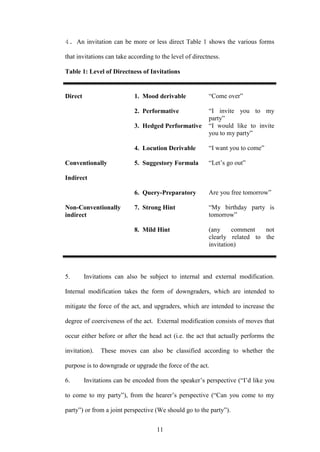
4. An invitation can be more or less direct Table 1 shows the various forms
that invitations can take according to the level of directness.
Table 1: Level of Directness of Invitations
Direct 1. Mood derivable “Come over”
2. Performative “I invite you to my
party”
3. Hedged Performative “I would like to invite
you to my party”
4. Locution Derivable “I want you to come”
Conventionally
Indirect
5. Suggestory Formula “Let’s go out”
6. Query-Preparatory Are you free tomorrow”
Non-Conventionally
indirect
7. Strong Hint “My birthday party is
tomorrow”
8. Mild Hint (any comment not
clearly related to the
invitation)
5. Invitations can also be subject to internal and external modification.
Internal modification takes the form of downgraders, which are intended to
mitigate the force of the act, and upgraders, which are intended to increase the
degree of coerciveness of the act. External modification consists of moves that
occur either before or after the head act (i.e. the act that actually performs the
invitation). These moves can also be classified according to whether the
purpose is to downgrade or upgrade the force of the act.
6. Invitations can be encoded from the speaker’s perspective (“I’d like you
to come to my party”), from the hearer’s perspective (“Can you come to my
party”) or from a joint perspective (We should go to the party”).
12
7. Invitations can be imposing, and call for face-work. The choice of
linguistic realization depends on a variety of social factors to do with the
relationship between the speaker and the addressee, and the perceived degree of
imposition which a particular invitation makes on the hearer.
8. Although the main sociopragmatic categories of invitations can be found
in different languages, there are pragmalinguistic differences relating to the
preferred form of an invitation that is used in a particular situation. This is what
our study will be focusing on. Also, cross-linguistic differences exist in the
choice of other linguistic features such as internal and external modification
devices.
13
CHAPTER III: METHOD
This study employed descriptive research, which involves collecting data in
order to test hypotheses and answer research questions. In terms of
pragmatic/sociolinguistic research, according to the classification proposed by Kasper
and Dahl (1991), our work belongs into the category of production, and as for the
degree of control, our data are the elicited type. On the other hand, our work fulfills the
three requirements proposed by Ellis (1994) as essential for an ideal study of
illocutionary acts in learner language, namely:
1) Samples of the illocutionary act performed in the target language (English)
by the L2 learners.
2) Samples performed by native speakers of the language.
3) Samples of the same illocutionary act performed by learners in their L1
(Japanese).
The process of data collection is described below.
3.1 Participants
We interviewed 10 advanced (native-like proficient) Japanese learners of L2
English (NNS) and 10 native speakers (NS) of English. Both groups were carefully
controlled. The members of both groups are graduate students, with ages ranging from
22 to 37 years old (NS), and 25 to 47 (NNS). As can be seen, the NNS group included
slightly older people than the NS group. In the NS group, there were 7 female and 3
male participants, whereas in the NNS group there were 6 females and 4 males. As can
be seen, we had more female than male subjects. Even if this may have some influence
in the results, this influence would be equal in both groups, thus ensuring reliability.
14
3.2 Instrument
For the purpose of our study, we collected data using a DCT, which contained a number
of situations with different addressees, for the subjects to complete with invitations. It
was designed to elicit a good range of politeness strategies and forms, as it included
situations in which the interlocutors had a higher, equal, and lower status than the
participants. This instrument can be seen in Appendix 1.
3.3 Task
The learners were first asked to complete the DCT in English, directed to native
speakers of this language, and secondly to perform the same speech act as they would in
their L1 when addressing a native speaker of that language. The situations are the same
and even though some of the tasks seem rather ‘strange’ (i.e. inviting their parents -
Japanese speakers- in English), the subjects were asked to put themselves in the
situation and write what they would say. We were interested in gathering all types of
data, in this case, analyze their performance in English when addressing a close relative
(eliminating the social distance that might affect their performance when addressing, let
us say, an English friend) so that we could have a good enough corpus of data that
allowed us to make some valid claims.
3.4 Procedures
To test the hypotheses, we compared the range of forms used by the learners to
the one performed by native speakers, and ranked them in order of occurrence, to see
how and to what extent their pragmalinguistic behavior differed from the native norms.
For verbosity, we estimated the average of words in the utterance actually performing
the invitation, and we compared the averages for both groups.
15
As for transfer, we also wanted to see if verbosity was a trace of their
performance in their L1, for which purpose we compared the data elicited in English to
the data collected in their L1 which was further translated into English. We also
expected some differing preferences in relation to the native speakers as to the way of
performing the act either on record or off record, and find out if this preference was an
aspect of development, was situation-contextually induced, or just transfer from their
L2. For this purpose, we compared the data elicited in English to the ones elicited in the
L1.
After the comparison, we looked at the different discourse structures of their
performance. That is to say, the use of pre-sequences and post-sequences
accompanying the actual invitation. We compared it to the native speakers performance
to find some differences and/or similarities. Finally, we determined the percentage of
positive and negative strategies for individual learners in both groups, and for the group
as a whole to determine whether they showed a marked preference in the use of either.
If they did, an ulterior analysis of particular situations and addressees would proceed.
3.5 Processing and Analyzing the Data
Once we got all the questionnaires back, we processed the data in a numerical
form, for easy viewing and reference that would allow a thorough analysis of the
phenomena under study (see Appendix 2).
16
CHAPTER IV: FINDINGS
The first part of the questionnaire had to do with the ‘level of difficulty’ for a
particular invitation in a particular context, and the interviewees had to assign a
numerical value to different situations according to the level of difficulty, ranking from
1 = ‘easy’ to 4 = ‘the most difficult’. The purpose of this was to determine whether
both native speakers of English (NS) and Japanese learners (NNS) had the same notion
as to what constitutes a face-threatening act.
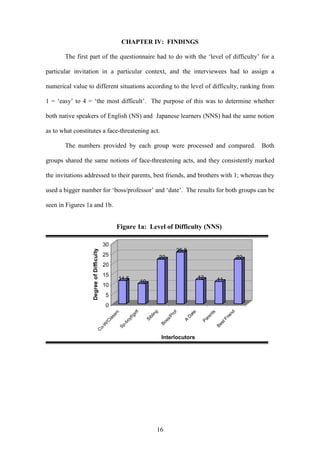
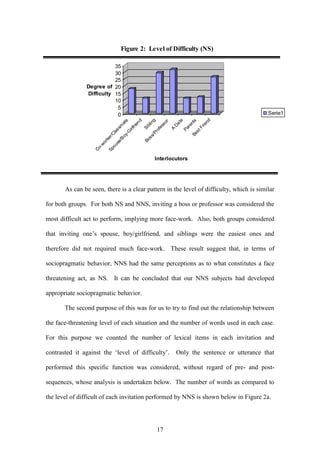
The numbers provided by each group were processed and compared. Both
groups shared the same notions of face-threatening acts, and they consistently marked
the invitations addressed to their parents, best friends, and brothers with 1; whereas they
used a bigger number for ‘boss/professor’ and ‘date’. The results for both groups can be
seen in Figures 1a and 1b.
11.5
10
22
25.5
12 11
22
0
5
10
15
20
25
30
Degree
of
Difficulty
C
o
-
W
/
C
l
a
s
s
m
S
p
-
b
o
y
f
/
g
i
r
l
f
S
i
b
l
i
n
g
B
o
s
s
/
P
r
o
f
A
D
a
t
e
P
a
r
e
n
t
s
B
e
s
t
F
r
i
e
n
d
Interlocutors
Figure 1a: Level of Difficulty (NNS)
17
0
5
10
15
20
25
30
35
Degree of
Difficulty
C
o
-
w
o
r
k
e
r
/
C
l
a
s
s
m
a
t
e
S
p
o
u
s
e
/
B
o
y
-
G
i
r
l
f
r
i
e
n
d
S
i
b
l
i
n
g
B
o
s
s
/
P
r
o
f
e
s
s
o
r
A
D
a
t
e
P
a
r
e
n
t
s
B
e
s
t
F
r
i
e
n
d
Interlocutors
Figure 2: Level of Difficulty (NS)
Serie1
As can be seen, there is a clear pattern in the level of difficulty, which is similar
for both groups. For both NS and NNS, inviting a boss or professor was considered the
most difficult act to perform, implying more face-work. Also, both groups considered
that inviting one’s spouse, boy/girlfriend, and siblings were the easiest ones and
therefore did not required much face-work. These result suggest that, in terms of
sociopragmatic behavior, NNS had the same perceptions as to what constitutes a face
threatening act, as NS. It can be concluded that our NNS subjects had developed
appropriate sociopragmatic behavior.
The second purpose of this was for us to try to find out the relationship between
the face-threatening level of each situation and the number of words used in each case.
For this purpose we counted the number of lexical items in each invitation and
contrasted it against the ‘level of difficulty’. Only the sentence or utterance that
performed this specific function was considered, without regard of pre- and post-
sequences, whose analysis is undertaken below. The number of words as compared to
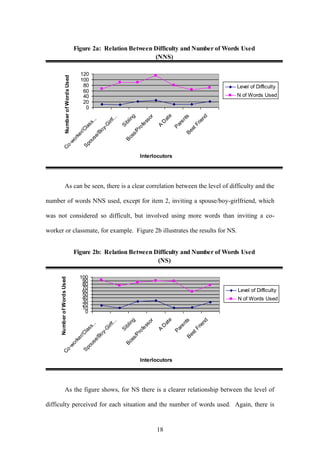
the level of difficult of each invitation performed by NNS is shown below in Figure 2a.
18
Figure 2a: Relation Between Difficulty and Number of Words Used
(NNS)
0
20
40
60
80
100
120
C
o
-
w
o
r
k
e
r
/
C
l
a
s
s
.
.
.
S
p
o
u
s
e
/
B
o
y
-
G
i
r
l
f
.
.
.
S
i
b
l
i
n
g
B
o
s
s
/
P
r
o
f
e
s
s
o
r
A
D
a
t
e
P
a
r
e
n
t
s
B
e
s
t
F
r
i
e
n
d
Interlocutors
Number
of
Words
Used
Level of Difficulty
N of Words Used
As can be seen, there is a clear correlation between the level of difficulty and the
number of words NNS used, except for item 2, inviting a spouse/boy-girlfriend, which
was not considered so difficult, but involved using more words than inviting a co-
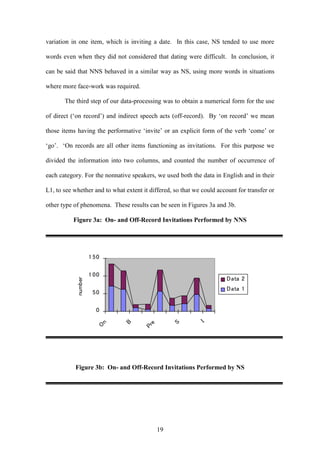
worker or classmate, for example. Figure 2b illustrates the results for NS.
Figure 2b: Relation Between Difficulty and Number of Words Used
(NS)
0
10
20
30
40
50
60
70
80
90
100
C
o
-
w
o
r
k
e
r
/
C
l
a
s
s
.
.
.
S
p
o
u
s
e
/
B
o
y
-
G
i
r
l
f
.
.
.
S
i
b
l
i
n
g
B
o
s
s
/
P
r
o
f
e
s
s
o
r
A
D
a
t
e
P
a
r
e
n
t
s
B
e
s
t
F
r
i
e
n
d
Interlocutors
Number
of
Words
Used
Level of Difficulty
N of Words Used
As the figure shows, for NS there is a clearer relationship between the level of
difficulty perceived for each situation and the number of words used. Again, there is
19
variation in one item, which is inviting a date. In this case, NS tended to use more
words even when they did not considered that dating were difficult. In conclusion, it
can be said that NNS behaved in a similar way as NS, using more words in situations
where more face-work was required.
The third step of our data-processing was to obtain a numerical form for the use
of direct (‘on record’) and indirect speech acts (off-record). By ‘on record’ we mean
those items having the performative ‘invite’ or an explicit form of the verb ‘come’ or
‘go’. ‘On records are all other items functioning as invitations. For this purpose we
divided the information into two columns, and counted the number of occurrence of
each category. For the nonnative speakers, we used both the data in English and in their
L1, to see whether and to what extent it differed, so that we could account for transfer or
other type of phenomena. These results can be seen in Figures 3a and 3b.
Figure 3a: On- and Off-Record Invitations Performed by NNS
0
50
1 00
1 50
O
n
B
P
r
e
S
I
number
Data 2
Data 1
Figure 3b: On- and Off-Record Invitations Performed by NS
20
0
1 0
20
30
40
50
60
70
80
O
n
B
P
r
e
S
I
Number
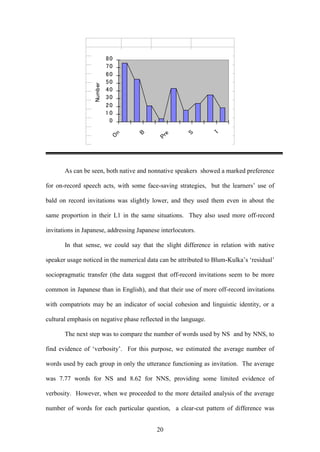
As can be seen, both native and nonnative speakers showed a marked preference
for on-record speech acts, with some face-saving strategies, but the learners’ use of
bald on record invitations was slightly lower, and they used them even in about the
same proportion in their L1 in the same situations. They also used more off-record
invitations in Japanese, addressing Japanese interlocutors.
In that sense, we could say that the slight difference in relation with native
speaker usage noticed in the numerical data can be attributed to Blum-Kulka’s ‘residual’
sociopragmatic transfer (the data suggest that off-record invitations seem to be more
common in Japanese than in English), and that their use of more off-record invitations
with compatriots may be an indicator of social cohesion and linguistic identity, or a
cultural emphasis on negative phase reflected in the language.
The next step was to compare the number of words used by NS and by NNS, to
find evidence of ‘verbosity’. For this purpose, we estimated the average number of
words used by each group in only the utterance functioning as invitation. The average
was 7.77 words for NS and 8.62 for NNS, providing some limited evidence of
verbosity. However, when we proceeded to the more detailed analysis of the average
number of words for each particular question, a clear-cut pattern of difference was
21
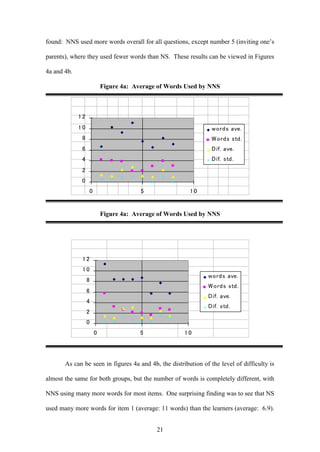
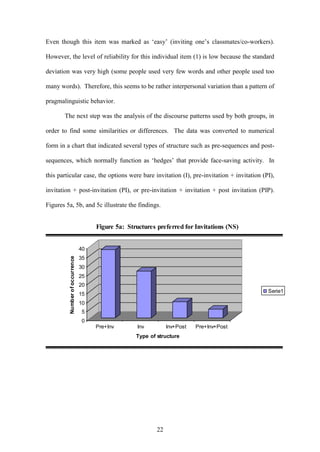
found: NNS used more words overall for all questions, except number 5 (inviting one’s
parents), where they used fewer words than NS. These results can be viewed in Figures
4a and 4b.
Figure 4a: Average of Words Used by NNS
0
2
4
6
8
1 0
1 2
0 5 1 0
words ave.
Words std.
Dif. ave.
Dif. std.
Figure 4a: Average of Words Used by NNS
0
2
4
6
8
1 0
1 2
0 5 1 0
words ave.
Words std.
Dif. ave.
Dif. std.
As can be seen in figures 4a and 4b, the distribution of the level of difficulty is
almost the same for both groups, but the number of words is completely different, with
NNS using many more words for most items. One surprising finding was to see that NS
used many more words for item 1 (average: 11 words) than the learners (average: 6.9).
22
Even though this item was marked as ‘easy’ (inviting one’s classmates/co-workers).
However, the level of reliability for this individual item (1) is low because the standard
deviation was very high (some people used very few words and other people used too
many words). Therefore, this seems to be rather interpersonal variation than a pattern of
pragmalinguistic behavior.
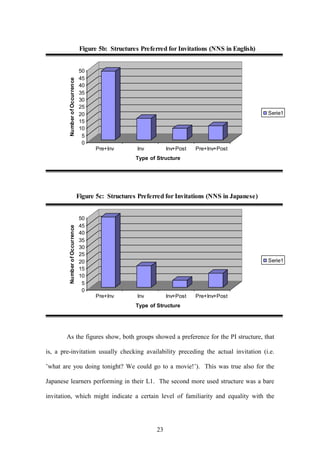
The next step was the analysis of the discourse patterns used by both groups, in
order to find some similarities or differences. The data was converted to numerical
form in a chart that indicated several types of structure such as pre-sequences and post-
sequences, which normally function as ‘hedges’ that provide face-saving activity. In
this particular case, the options were bare invitation (I), pre-invitation + invitation (PI),
invitation + post-invitation (PI), or pre-invitation + invitation + post invitation (PIP).
Figures 5a, 5b, and 5c illustrate the findings.
0
5
10
15
20
25
30
35
40
Number
of
occurrence
Pre+Inv Inv Inv+Post Pre+Inv+Post
Type of structure
Figure 5a: Structures preferred for Invitations (NS)
Serie1
23
0
5
10
15
20
25
30
35
40
45
50
Number
of
Occurrence
Pre+Inv Inv Inv+Post Pre+Inv+Post
Type of Structure
Figure 5b: Structures Preferred for Invitations (NNS in English)
Serie1
0
5
10
15
20
25
30
35
40
45
50
Number
of
Occurrence
Pre+Inv Inv Inv+Post Pre+Inv+Post
Type of Structure
Figure 5c: Structures Preferred for Invitations (NNS in Japanese)
Serie1
As the figures show, both groups showed a preference for the PI structure, that
is, a pre-invitation usually checking availability preceding the actual invitation (i.e.
’what are you doing tonight? We could go to a movie!’). This was true also for the
Japanese learners performing in their L1. The second more used structure was a bare
invitation, which might indicate a certain level of familiarity and equality with the
24
interlocutor that would make face-saving strategies superfluous (i.e. ‘Hey man, come
over’). This was true for both groups and for the learners performing in their L1.
However, as for the third most preferred structure, there were some differences. Native
speakers favored an IP structure, that is, the invitation followed by a post invitation,
usually indicating the favorable outcomes of accepting the invitation (i.e. “Wanna go to
the park? You need some fresh air!”). The PIP structure was the one they used the least.
As for the Japanese learners, they favored the use of a PIP structure, that is, a
pre-invitation asking for availability or indicating event, the actual invitation and finally
more face-saving activity describing the favorable outcomes of accepting the invitation
(i.e. ‘If you have time, would you like to come to my place and watch (show) together?
I’m sure it’ll be fun). This kind of structures with a high degree of elaboration were
especially used in situations that required face-saving strategies, but also in other
situations were they were not so necessary. That structure was preferred both in English
and in Japanese, providing some evidence of transfer at the discourse level. However,
the evidence is limited and we may conclude that there was no significant difference
between NNS and NS performance
We also analyzed the different forms both the learners and the native speakers
used to perform invitations. When performing an invitation, a speaker can either use a
question form, which is a more transparent or direct for this kind of speech act (as it
asks for the hearer’s confirmation: i.e. ‘Why don’t you come over to my place
tomorrow’). A statement can also be used, which is more indirect and expresses more
the feelings of the speaker than those of the hearer, and still gives the hearer a way out
(i.e. ‘I’d love it if you could come to my…’). Finally, the imperative form, which
implies a really close relationship with the interlocutor and the certainty of his
acceptance (‘Let’s go for a drink’). This type of structure takes it for granted that the
25
hearer wants to perform the perlocutionary act and that the invitation does not constitute
a threaten to his negative face (note the effect of ‘let’s’). It also implies that the
speaker’s positive face will not be threatened in the case of a refusal. This form is
mostly used with relatives and close friends.
NNS’ most used form was an interrogative construction, followed by statements
and finally, some imperative forms, which were not very used in comparison with the
other forms. Some interesting finding that might indicate transfer from their L2 is the
fact that they used almost the same amount of each form when addressing Japanese
speakers in Japanese. The native speakers, on the other hand, displayed a more balanced
use of all three different forms, the interrogative form being the most favored, though.
However, as the graphs show, they used statements and imperatives much more often
than the learners. These differences may be due in part to sociopragmatic differences
and social distance. Thus, the learners probably did not feel as confident to use an
imperative as native speakers did, for the reason that they were not performing in their
own language and also because the patterns of politeness in the different cultures may
vary substantially. In other words, whereas Americans emphasize positive face (i.e.
directness and familiarity) with equals, for Japanese people negative face (no
imposition, indirectness) is more valued and shows in the great number of honorific
terms found in that language, that make a great variety of forms possible.
Finally, we used a form-function analysis to determine the range of forms used
by both the learners and the native speakers to perform invitations. The finding was
striking: Whereas native speakers used 30 different formulas, the learners used 42
different formulas some of them quite sophisticated. A ranking from the most recurrent
to the least recurrent formulas also showed striking differences in use. The learners’
most used formula was ‘Why don’t you…? (8), followed by ‘Would you like to..?’ (6)
26
and ‘I’d be very X if you…’ (4), which happen to be translatable into Japanese. Their
equivalents were the ones most used in Japanese, too. The range of formulas used by
NS and NNS is shown in Tables 2a and 2b in Appendix 3.
The native speakers, on the other hand, tended to use ‘Let’s…’ (frequently pre-
or postmodified by some term of address of another device for positive face such as
‘yo’, ‘baby’ and the like) most often (12); followed by ‘wanna…(8) and ‘Would you
like to’ (6). This finding evidences striking differences in the conception of politeness
of each group. For the learners, politeness meant longer, complex, grammatically
correct utterances whereas for the native speakers, it meant showing social cohesion and
familiarity towards the interlocutor.
Additional support for this claim were the results found when we determined the
percentage of positive and negative strategies. Native speakers tended to use positive
strategies much more often, and to a greater extent. The percentage of positive and
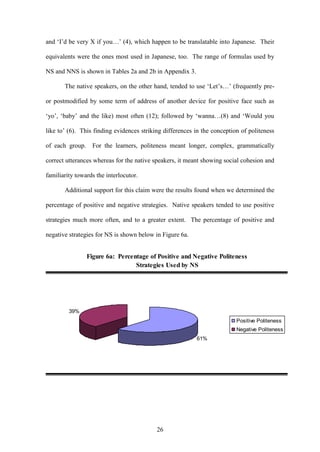
negative strategies for NS is shown below in Figure 6a.
Figure 6a: Percentage of Positive and Negative Politeness
Strategies Used by NS
61%
39%
Positive Politeness
Negative Politeness
27
As can be seen, NS tended to use positive politeness in their invitations. The
categories found included showing interest and noticing (greetings and similar
expressions: ‘hi’, ‘hey’), use of ‘in-group’ language (mention of first name, ‘man’,
‘guys’, ‘let’s…’, ‘we…’[inclusive], ‘yo’, ‘baby’, ‘ma’, and slang), and showing and
seeking agreement (‘what do you say we…?’, ‘wanna?’ you want to…?’). They used it
up to 61.25%, counting only their occurrence in each item in the DCT as one. On the
other hand, they only used negative strategies 38.75%, especially in items 4 (inviting
one’s boss or professor, they used it 100% of the times) and 7 (inviting one’s friend to
meet one’s parents), which required this kind of strategy, being consistent with Brown
and Levinson’s model. Seven people used positive strategies 62.5% and more, 2 people
used positive and negative strategies in the same proportion (50%), and only one person
used more negative strategies (62.5%) than positive strategies (37.5%). When looking
his the data, we found out that this person happens to be married to a Japanese woman.
The specific formulas used and the percentages for each individual participant can be
seen in Tables 2a and 2b in Appendix 3.
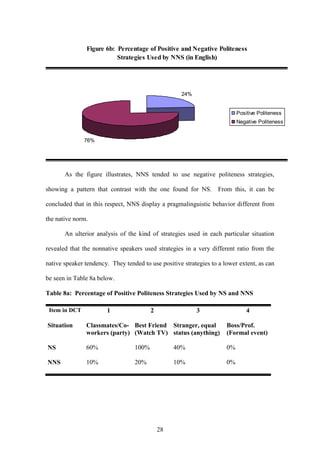
The NNS, on the other hand, used positive strategies only 23.75%, and tended to
use negative strategies on 76.25% of the times. None of them used positive strategies
more than 37.5%, being very consistent in that respect. The percentages are shown
below in Figure 6b.
28
Figure 6b: Percentage of Positive and Negative Politeness
Strategies Used by NNS (in English)
24%
76%
Positive Politeness
Negative Politeness
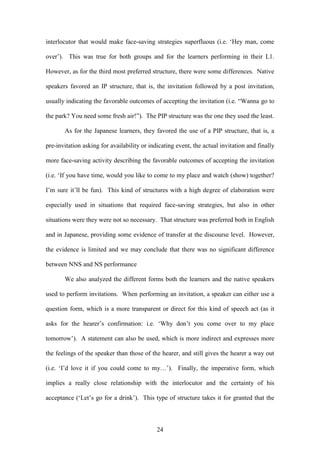
As the figure illustrates, NNS tended to use negative politeness strategies,
showing a pattern that contrast with the one found for NS. From this, it can be
concluded that in this respect, NNS display a pragmalinguistic behavior different from
the native norm.
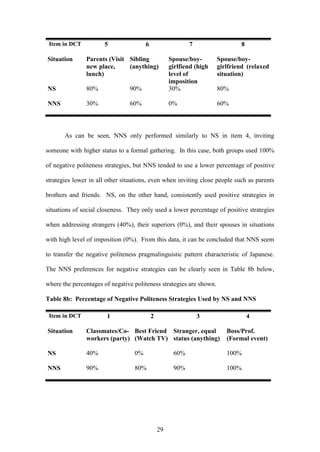
An ulterior analysis of the kind of strategies used in each particular situation
revealed that the nonnative speakers used strategies in a very different ratio from the
native speaker tendency. They tended to use positive strategies to a lower extent, as can
be seen in Table 8a below.
Table 8a: Percentage of Positive Politeness Strategies Used by NS and NNS
Item in DCT 1 2 3 4
Situation Classmates/Co-
workers (party)
Best Friend
(Watch TV)
Stranger, equal
status (anything)
Boss/Prof.
(Formal event)
NS 60% 100% 40% 0%
NNS 10% 20% 10% 0%
29
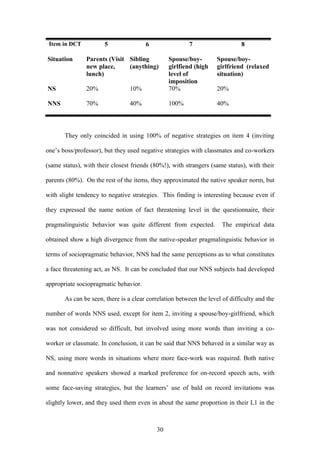
Item in DCT 5 6 7 8
Situation Parents (Visit
new place,
lunch)
Sibling
(anything)
Spouse/boy-
girlfiend (high
level of
imposition
Spouse/boy-
girlfriend (relaxed
situation)
NS 80% 90% 30% 80%
NNS 30% 60% 0% 60%
As can be seen, NNS only performed similarly to NS in item 4, inviting
someone with higher status to a formal gathering. In this case, both groups used 100%
of negative politeness strategies, but NNS tended to use a lower percentage of positive
strategies lower in all other situations, even when inviting close people such as parents
brothers and friends. NS, on the other hand, consistently used positive strategies in
situations of social closeness. They only used a lower percentage of positive strategies
when addressing strangers (40%), their superiors (0%), and their spouses in situations
with high level of imposition (0%). From this data, it can be concluded that NNS seem
to transfer the negative politeness pragmalinguistic pattern characteristic of Japanese.
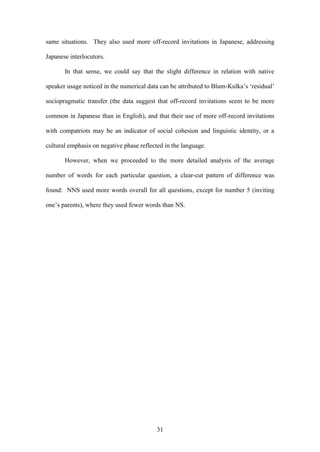
The NNS preferences for negative strategies can be clearly seen in Table 8b below,
where the percentages of negative politeness strategies are shown.
Table 8b: Percentage of Negative Politeness Strategies Used by NS and NNS
Item in DCT 1 2 3 4
Situation Classmates/Co-
workers (party)
Best Friend
(Watch TV)
Stranger, equal
status (anything)
Boss/Prof.
(Formal event)
NS 40% 0% 60% 100%
NNS 90% 80% 90% 100%
30
Item in DCT 5 6 7 8
Situation Parents (Visit
new place,
lunch)
Sibling
(anything)
Spouse/boy-
girlfiend (high
level of
imposition
Spouse/boy-
girlfriend (relaxed
situation)
NS 20% 10% 70% 20%
NNS 70% 40% 100% 40%
They only coincided in using 100% of negative strategies on item 4 (inviting
one’s boss/professor), but they used negative strategies with classmates and co-workers
(same status), with their closest friends (80%!), with strangers (same status), with their
parents (80%). On the rest of the items, they approximated the native speaker norm, but
with slight tendency to negative strategies. This finding is interesting because even if
they expressed the name notion of fact threatening level in the questionnaire, their
pragmalinguistic behavior was quite different from expected. The empirical data
obtained show a high divergence from the native-speaker pragmalinguistic behavior in
terms of sociopragmatic behavior, NNS had the same perceptions as to what constitutes
a face threatening act, as NS. It can be concluded that our NNS subjects had developed
appropriate sociopragmatic behavior.
As can be seen, there is a clear correlation between the level of difficulty and the
number of words NNS used, except for item 2, inviting a spouse/boy-girlfriend, which
was not considered so difficult, but involved using more words than inviting a co-
worker or classmate. In conclusion, it can be said that NNS behaved in a similar way as
NS, using more words in situations where more face-work was required. Both native
and nonnative speakers showed a marked preference for on-record speech acts, with
some face-saving strategies, but the learners’ use of bald on record invitations was
slightly lower, and they used them even in about the same proportion in their L1 in the
31
same situations. They also used more off-record invitations in Japanese, addressing
Japanese interlocutors.
In that sense, we could say that the slight difference in relation with native
speaker usage noticed in the numerical data can be attributed to Blum-Kulka’s ‘residual’
sociopragmatic transfer (the data suggest that off-record invitations seem to be more
common in Japanese than in English), and that their use of more off-record invitations
with compatriots may be an indicator of social cohesion and linguistic identity, or a
cultural emphasis on negative phase reflected in the language.
However, when we proceeded to the more detailed analysis of the average
number of words for each particular question, a clear-cut pattern of difference was
found: NNS used more words overall for all questions, except for number 5 (inviting
one’s parents), where they used fewer words than NS.
32
CHAPTER V: CONCLUSIONS
This study has been consistent with previous research in that it has positively
confirmed the hypothesis of verbosity as characteristic of the interlanguage of advanced
L2 learners, which is an effect of social and psychological distance that results in
pragmatic transfer. We have shown that verbosity can be found at the sentential and
discourse level. We have also found very strong empirical evidence to the existence of
pragmalinguistic errors, as showed by the larger number of formulas and the way they
are used. Finally, we have found strong evidence that differential concepts of politeness
in English and Japanese result in pragmalinguistic failure, as accounted by the use of
positive and negative strategies by native and nonnative speakers of English.
5.1 Methodological Problems
One of the methodological problems with this study may be the use of the DCT,
which, we are aware, is not the best way of collecting learner interlanguage samples; we
agree with Labov that the vernacular style is the one that can provide the most
systematic and valid data for linguistic study. However, the DCT was the most
appropriate tool given the time constraints and the nature of our research. On the other
hand, we think that our results will still be of great value since the subjects’
performance of invitations still carries two important features of naturally-occurring
invitations: they are planned but their outcomes are unexpected. They are planned
because our subjects, as in a real situation, where they would have had time to plan their
speech before actually performing the invitation, also had time to plan their responses
before actually completing the task. On the other hand, as in a real situation they would
have had no time to change their performance, in our task they had no time to think it
over and go back to it. They filled the questionnaires once and for all. In this sense, we
33
think that our data still carry some empirical value and are illustrative of the phenomena
that we are trying to bring under study. We were able to elicit a rich array of forms and
possibilities found in oral discourse, and the data were consistent altogether. As the
learners were first asked to perform in English, there is no possibility of transfer due to
nature of task. There might be the possibility of some transfer from English to
Japanese, though, when they were asked to perform in Japanese, but it is very unlikely.
5.2Implications
The results of our research suggest that the pragmatic aspects of a language are
very difficult to acquire, and that, as learners proficiency increases, pragmatic
competence seems to converge to the L1 norm. It implies that neither long formal
instruction (most of our learners have had formal instruction for more than 10 years) nor
long exposure to the language (one person has been living in the US for more than 18
years, and the rest of them also had over 5 years of exposure) seem to be enough to
acquire native-like use of pragmalinguistic skills.
The frequent use of ‘wanna’ on the part of native speakers and the use of more
correct types of question on the part of the nonnative speakers (although they did use
‘wanna’ although a little differently) may suggest that pragmalinguistic failure is partly
due to instruction, and especially, to focus only on form and meaning. In other words,
we teach students that ‘wanna’ is a reduced form of want to, and that is found in fast
speech or ‘informal’ situations. I have never seen a textbook or a teacher who says that
‘wanna’ is a formula used by native speakers to perform invitations with people they
like and are close to.
Language teaching has to turn direction to a focus on communication, but
communication in context that provides opportunities for students to grasp the
34
pragmatics of speaking in the target language. Grammar is important, but use overrides
grammar in actual communication situations. We need to look for ways to incorporate
all the language, and not separate parts of it. The challenge is a difficult one, but great
steps are being taken in that direction, and the findings of empirical study must soon be
applied to the classroom.
5.3 Further directions for research
The findings in this paper are not conclusive in that they do not cover
sociopragmatic behavior. Further study on this topic would include longitudinal design
and natural occurring invitations. On the other hand, using the same type of method to
study learners with different L1 would show if verbosity is more an effect of transfer or
of social distance. Finally, it would be interesting to test the different forms used by the
learners and the effect they produce in native speakers of the language, which is the
point where we are now turning to. More importantly, all the knowledge that we
language teachers now have about the pragmatics of interlanguage and about second
language acquisition in general should produce some innovative methodologies that
would empower the learners to jump from being fluent speakers to being effective
communicators.
Teachers College, Columbia University
35
BIBLIOGRAPHY
Beebe, L.M., Takahashi, T., and Uliss-Weltz, R. (1990). Pragmatic transfer in ESL
refusals. In R. Scarcella, G. Andersen, & S. Krashen (eds.), Developing
communicative competence in a second language. Rowley, MA: Newbury
House.
Brown, P. and S. Levinson (1978). Universals in language usage: Politeness
phenomena.In Goody, E. (ed.) Questions and politeness: Strategies in social
interaction. Cambridge: Cambridge University Press.
Canale, M. and M. Swain 1980. ‘Theoretical bases of communicative approaches to
second language teaching and testing’. Applied Linguistics 1: 1-47.
Canale, M. (1983). On some dimensions of language proficiency. In J. Oller (ed.),
Issues in language testing research (pp. 333-42). Rowley, MA: Newbury
House.
Ellis, R. (1994). The study of second language acquisition. Oxford: Oxford University
Press.
Goffman, E. (1976). Replies and responses. Language in society 5: 257-313.
Hymes, D.H. (1971). ‘On communicative competence’, in Brumfit and Johnson (eds.),
The communicative approach to language teaching. Oxford University Press.
Levinson, S. (1983). Pragmatics. New York: Cambridge University Press.
Richards, J. C., Platt, J., and Platt, H. (1992). Dictionary of language teaching and
applied linguistics. Harlow, Essex: Longman
Scarcella, R. and J. Brunak (1981). ‘On Speaking Politely in a Second Language’,
International Journal of the Sociology of Language 27:59-75.
Searle, J. R .1969. Speech acts. Cambridge: Cambridge University Press.
Thomas, J. (1983). Cross-cultural pragmatic failure. Applied Linguistics 4: 91-112
Yule, G. (1996). Pragmatics. Oxford: Oxford University Press.
36
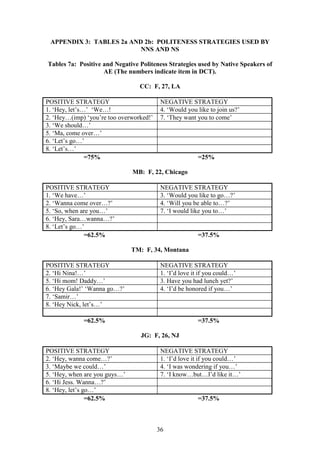
APPENDIX 3: TABLES 2a AND 2b: POLITENESS STRATEGIES USED BY
NNS AND NS
Tables 7a: Positive and Negative Politeness Strategies used by Native Speakers of
AE (The numbers indicate item in DCT).
CC: F, 27, LA
POSITIVE STRATEGY NEGATIVE STRATEGY
1. ‘Hey, let’s…’ ‘We…! 4. ‘Would you like to join us?’
2. ‘Hey…(imp) ‘you’re too overworked!’ 7. ‘They want you to come’
3. ‘We should…’
5. ‘Ma, come over…’
6. ‘Let’s go…’
8. ‘Let’s…’
=75% =25%
MB: F, 22, Chicago
POSITIVE STRATEGY NEGATIVE STRATEGY
1. ‘We have…’ 3. ‘Would you like to go…?’
2. ‘Wanna come over…?’ 4. ‘Will you be able to…?’
5. ‘So, when are you…’ 7. ‘I would like you to…’
6. ‘Hey, Sara…wanna…?’
8. ‘Let’s go…’
=62.5% =37.5%
TM: F, 34, Montana
POSITIVE STRATEGY NEGATIVE STRATEGY
2. ‘Hi Nina!…’ 1. ‘I’d love it if you could…’
5. ‘Hi mom! Daddy…’ 3. Have you had lunch yet?’
6. ‘Hey Gala!’ ‘Wanna go…?’ 4. ‘I’d be honored if you…’
7. ‘Samir…’
8. ‘Hey Nick, let’s…’
=62.5% =37.5%
JG: F, 26, NJ
POSITIVE STRATEGY NEGATIVE STRATEGY
2. ‘Hey, wanna come…?’ 1. ‘I’d love it if you could…’
3. ‘Maybe we could…’ 4. ‘I was wondering if you…’
5. ‘Hey, when are you guys…’ 7. ‘I know…but…I’d like it…’
6. ‘Hi Jess. Wanna…?’
8. ‘Hey, let’s go…’
=62.5% =37.5%
37
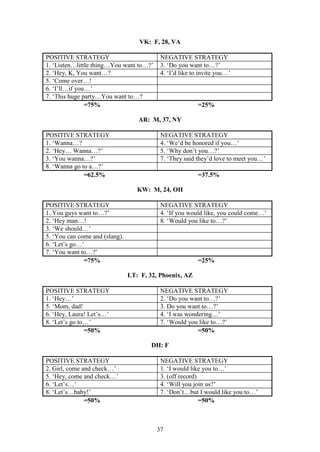
VK: F, 28, VA
POSITIVE STRATEGY NEGATIVE STRATEGY
1. ‘Listen…little thing…You want to…?’ 3. ‘Do you want to…?’
2. ‘Hey, K, You want…? 4. ‘I’d like to invite you…’
5. ‘Come over…!
6. ‘I’ll…if you…’
7. ‘This huge party…You want to…?
=75% =25%
AR: M, 37, NY
POSITIVE STRATEGY NEGATIVE STRATEGY
1. ‘Wanna…? 4. ‘We’d be honored if you…’
2. ‘Hey… Wanna…?’ 5. ‘Why don’t you…?’
3. ‘You wanna…?’ 7. ‘They said they’d love to meet you…’
8. ‘Wanna go to a…?’
=62.5% =37.5%
KW: M, 24, OH
POSITIVE STRATEGY NEGATIVE STRATEGY
1. You guys want to…?’ 4. ‘If you would like, you could come…’
2. ‘Hey man…! 8. ‘Would you like to…?’
3. ‘We should…’
5. ‘You can come and (slang).
6. ‘Let’s go…’
7. ‘You want to…?’
=75% =25%
LT: F, 32, Phoenix, AZ
POSITIVE STRATEGY NEGATIVE STRATEGY
1. ‘Hey…’ 2. ‘Do you want to…?’
5. ‘Mom, dad! 3. Do you want to…?’
6. ‘Hey, Laura! Let’s…’ 4. ‘I was wondering…’
8. ‘Let’s go to…’ 7. ‘Would you like to…?’
=50% =50%
DH: F
POSITIVE STRATEGY NEGATIVE STRATEGY
2. Girl, come and check…’ 1. ‘I would like you to…’
5. ‘Hey, come and check…’ 3. (off record)
6. ‘Let’s…’ 4. ‘Will you join us?’
8. ‘Let’s…baby!’ 7. ‘Don’t…but I would like you to…’
=50% =50%
38
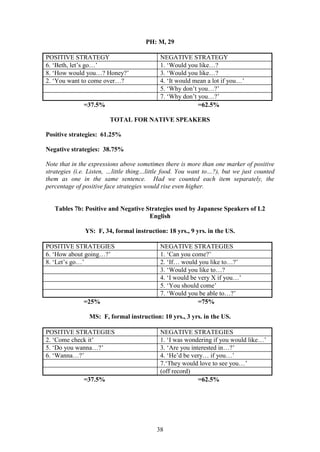
PH: M, 29
POSITIVE STRATEGY NEGATIVE STRATEGY
6. ‘Beth, let’s go…’ 1. ‘Would you like…?
8. ‘How would you…? Honey?’ 3. ‘Would you like…?
2. ‘You want to come over…? 4. ‘It would mean a lot if you…’
5. ‘Why don’t you…?’
7. ‘Why don’t you…?’
=37.5% =62.5%
TOTAL FOR NATIVE SPEAKERS
Positive strategies: 61.25%
Negative strategies: 38.75%
Note that in the expressions above sometimes there is more than one marker of positive
strategies (i.e. Listen, …little thing…little food. You want to…?), but we just counted
them as one in the same sentence. Had we counted each item separately, the
percentage of positive face strategies would rise even higher.
Tables 7b: Positive and Negative Strategies used by Japanese Speakers of L2
English
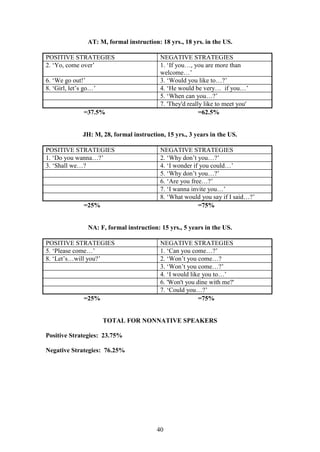
YS: F, 34, formal instruction: 18 yrs., 9 yrs. in the US.
POSITIVE STRATEGIES NEGATIVE STRATEGIES
6. ‘How about going…?’ 1. ‘Can you come?’
8. ‘Let’s go…’ 2. ‘If… would you like to…?’
3. ‘Would you like to…?
4. ‘I would be very X if you…’
5. ‘You should come’
7. ‘Would you be able to…?’
=25% =75%
MS: F, formal instruction: 10 yrs., 3 yrs. in the US.
POSITIVE STRATEGIES NEGATIVE STRATEGIES
2. ‘Come check it’ 1. ‘I was wondering if you would like…’
5. ‘Do you wanna…?’ 3. ‘Are you interested in…?’
6. ‘Wanna…?’ 4. ‘He’d be very… if you…’
7.‘They would love to see you…’
(off record)
=37.5% =62.5%
39
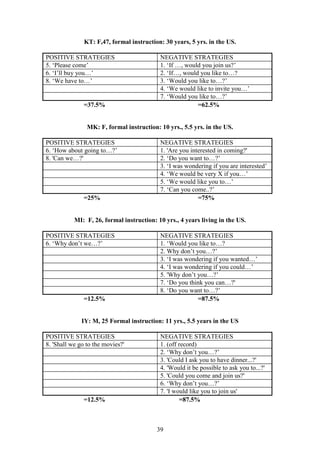
KT: F,47, formal instruction: 30 years, 5 yrs. in the US.
POSITIVE STRATEGIES NEGATIVE STRATEGIES
5. ‘Please come’ 1. ‘If …, would you join us?’
6. ‘I’ll buy you…’ 2. ‘If…, would you like to…?
8. ‘We have to…’ 3. ‘Would you like to…?’
4. ‘We would like to invite you…’
7. ‘Would you like to…?’
=37.5% =62.5%
MK: F, formal instruction: 10 yrs., 5.5 yrs. in the US.
POSITIVE STRATEGIES NEGATIVE STRATEGIES
6. ‘How about going to…?’ 1. 'Are you interested in coming?'
8. 'Can we…?' 2. ‘Do you want to…?’
3. ‘I was wondering if you are interested’
4. ‘We would be very X if you…’
5. ‘We would like you to…’
7. ‘Can you come..?’
=25% =75%
MI: F, 26, formal instruction: 10 yrs., 4 years living in the US.
POSITIVE STRATEGIES NEGATIVE STRATEGIES
6. ‘Why don’t we…?’ 1. ‘Would you like to…?
2. Why don’t you…?’
3. ‘I was wondering if you wanted…’
4. ‘I was wondering if you could…’
5. 'Why don’t you…?’
7. ‘Do you think you can…?'
8. ‘Do you want to…?’
=12.5% =87.5%
IY: M, 25 Formal instruction: 11 yrs., 5.5 years in the US
POSITIVE STRATEGIES NEGATIVE STRATEGIES
8. 'Shall we go to the movies?' 1. (off record)
2. ‘Why don’t you…?’
3. 'Could I ask you to have dinner...?'
4. 'Would it be possible to ask you to...?'
5. 'Could you come and join us?'
6. ‘Why don’t you…?’
7. 'I would like you to join us'
=12.5% =87.5%
40
AT: M, formal instruction: 18 yrs., 18 yrs. in the US.
POSITIVE STRATEGIES NEGATIVE STRATEGIES
2. ‘Yo, come over’ 1. ‘If you…, you are more than
welcome…’
6. ‘We go out!’ 3. ‘Would you like to…?’
8. ‘Girl, let’s go…’ 4. ‘He would be very… if you…’
5. ‘When can you…?’
7. 'They'd really like to meet you'
=37.5% =62.5%
JH: M, 28, formal instruction, 15 yrs., 3 years in the US.
POSITIVE STRATEGIES NEGATIVE STRATEGIES
1. ‘Do you wanna…?’ 2. ‘Why don’t you…?’
3. ‘Shall we…? 4. ‘I wonder if you could…’
5. ‘Why don’t you…?’
6. ‘Are you free…?’
7. ‘I wanna invite you…’
8. ‘What would you say if I said…?’
=25% =75%
NA: F, formal instruction: 15 yrs., 5 years in the US.
POSITIVE STRATEGIES NEGATIVE STRATEGIES
5. ‘Please come…’ 1. ‘Can you come…?’
8. ‘Let’s…will you?’ 2. ‘Won’t you come…?
3. ‘Won’t you come…?’
4. ‘I would like you to…’
6. 'Won't you dine with me?'
7. ‘Could you…?’
=25% =75%
TOTAL FOR NONNATIVE SPEAKERS
Positive Strategies: 23.75%
Negative Strategies: 76.25%

Invitations: Pragmatic Transfer

  • 1.
    1 Teachers College Columbia University MA.RESEARCH PAPER Some features of Invitations Performed by Highly Proficient Japanese Speakers of English: More Evidence for the Pragmatic Transfer Hypothesis © By Roberto Criollo © Roberto Criollo and Columbia University 1999. No further reproduction of this paper is authorized without written permission from the copyright holders.
  • 2.
    2 CHAPTER I: INTRODUCTION 1.1Introduction to the Problem Communicative competence (Hymes 1971, Canale and Swain 1980, Bachman 1992, Coulthard 1985) is the ability to use language for communication, to produce correct and appropriate messages in a particular social context. According to Canale and Swain (1980), for a person to be communicatively competent, four types of ability are required: linguistic ability, sociolinguistic ability, discourse ability and strategic ability. In other words, a person needs to be able to produce grammatically correct sentences which are appropriate in a given social environment, that have a logical structure, and are produced in the right moment. Traditionally, English-as-a- second/foreign-language courses focus on the linguistic or grammatical component, neglecting the remaining three others. Pragmatic competence (Canale 1983, Canale and Swain 1980), which is the ability to produce language appropriate in a social context, is of special interest for this paper. In previous research on pragmatic competence of nonnative speakers of English, Beebe, Takahashi and Uliss-Weltz (1990), found that highly proficient Japanese speakers of English performed significantly differently from native speakers in the performance of refusals. They concluded that their subjects’ pragmatic competence in the second language (L2) was influenced by their mother tongue (L1). Unlike lexico- grammatical transfer, which occurs in the first stages of learning, pragmatic transfer is said to take place only when learners have reached a high level of proficiency. This paper intends to provide evidence as to support or deny such statement. 1.2 Purpose of the Study The purpose of this research is threefold. First of all, it intends to analyze and describe pragmatic performance of highly proficient Japanese nonnative speakers of
  • 3.
    3 English, in theirperformance of invitations. Secondly, it will compare and contrast nonnative and native invitations, in order to find whether and to what extent they are different. Finally, it will compare nonnative performance in their L1 and L2, in order to find evidence of pragmatic transfer from Japanese into English. 1.3 Research Questions and Hypotheses This paper addresses the following research questions: 1) What are some characteristics of invitations performed by Japanese nonnative speakers of English? 2) What are some characteristics of invitations performed by native speakers of English? 3) To what extent do nonnative invitations differ from native invitations? 4) What are some possible causes of the differences between nonnative and native invitations? 5) Is there evidence of pragmatic transfer in nonnative invitations? 6) What are some characteristics of Japanese nonnative speakers of English’s pragmatic competence? 7) What conclusions can be drawn about the existence of pragmatic transfer in advanced learners? 8) What are the implications of this research for the ESL and EFL classroom? Three important hypotheses found in previous studies of interlanguage pragmatics were tested. 1) The existence of sociopragmatic and pragmalinguistic errors (Thomas 1983). This hypotheses will be tested using a DCT and comparing the perceptions of face-work
  • 4.
    4 required for differentsituations according to Japanese nonnative speakers of English and English native speakers. 2) The three broad phases of development of pragmatic competence proposed by Blum-Kulka (cited in Ellis 1994). According to their model, advanced students’ (phase 3) performance of speech acts can be described as ‘interculturally orientated and potentially systematic’. By this they mean that learners approximate the native- speaker performance, using the same range of politeness strategies as native speakers, but they are also verbose and display some ‘residual’ pragmatic transfer from their L1. 3) Finally, the politeness phenomenon was analyzed. Would both groups use the same type of politeness? Pragmatic transfer, hence different concept of politeness might be reflected in the subjects' performances of invitations. 1.4 Significance of the Study This paper sets out to contribute with some empirical research into the pragmatic aspects of interlanguage, in the belief that the ultimate goal of L2 learners is to be able to communicate and successfully interact with native speakers of the target language. In other words, having a thorough knowledge of grammar is not enough when it comes to communicate and perform in different communicative situations and contexts (Hymes 1971, Canale and Swain 1980). For that reason, we have engaged ourselves in the study of one particularly interesting speech act: inviting. This language function was selected for the reasons stated below and also because it has not been studied in real depth, except by Scarcella and Brunak (1981). Their study is substantially different from ours in that it focused on the differences between beginning and advanced learners. They found that some
  • 5.
    5 politeness features areearly acquired, while others are not, and that low level learners showed much less variety of politeness strategies. Ours focuses on advanced learners with native-like proficiency and long exposure to the language, and we used baseline talk to refer to when accounting for the particularities in the learners’ performance of this particular speech act. Also, whereas they used role-play to elicit data, we used a discourse completion task (DCT). 1.5 Definition of terms The following terms are essential for the theoretical framework of this research. Communicative competence: The ability to use language for communication. According to Canale and Swain (1980), communicative competence consists of linguistic (or grammatical) competence, sociolinguistic competence, discourse competence, and strategic competence. Discourse Completion Test (DCT): A questionnaire containing descriptions of social situations and blank spaces for respondents to fill in what they would do in each particular situation. This instrument is extensively used for sociolinguistic and L2 pragmatic competence research (Ellis 1994, pp. 163-4). Face: The positive image of oneself that a person shows or intends to show to other participants in an interaction (Richards, Platt & Platt 1992, p. 135; Yule 1996, pp. 60-2). Two types of face are distinguished, positive and negative. They are defined below in detail. Invitations: Speech acts in which the speaker attempts to have the hearer do something. Unlike other speech acts, invitations threaten the speaker’s positive face. Also, they may affect the hearer’s negative face (Scarcella & Brunak 1981, p.1; Criollo & Maeda 1998)
  • 6.
    6 Negative face: ‘Theneed to be independent, to have freedom of action, and not to be imposed on by others’ (Yule 1996, p. 61). Negative politeness: According to Yule (1996), negative politeness is ‘a face-saving act which is oriented to the person’s negative face’, tends ‘to show deference, emphasize the importance of the other’s time or concerns, and even include an apology for the imposition or interruption. Politeness: In an interaction, ‘the means employed to show awareness of other person’s face’ which can be achieved in ‘situations of social distance or closeness’ (Yule 1996, p. 60). Positive face: ‘The need to be accepted, , even liked, by others, to be treated as a member of the same group, and to know that his or her wants are shared by others’ (Yule 1996, p. 62). Positive politeness: Yule (1996) defines it as ‘a face-saving act which is concerned with the person’s positive face’, tends ‘to show solidarity, emphasize that both speakers want the same thing, and that they have a common goal’ (p. 62). Pragmatic competence (also sociolinguistic competence): According to Ellis (1994), it ‘consists or the knowledge that speaker-hearers use in order to engage in communication, including how speech acts are successfully performed’ (p. 719). Pragmalinguistic failure: A communicative problem that ‘occurs when a learner tries to perform the right speech act, but chooses the wrong linguistic means’ (Thomas 1983, cited in Ellis 1994, p. 165). Pragmatic transfer: ‘Transfer of L1 sociocultural communicative competence in performing L2 speech acts or any other aspects of L2 conversation, where the speaker is trying to achieve a particular function of language’ (Beebe, Takahashi, & Uliss-Weltz 1990).
  • 7.
    7 Sociopragmatic failure: Thefailure that occurs when an L2 learner ‘fails to perform the illocutionary act required by the situation’ (Thomas 1983, cited in Ellis 1994, p. 165). Speech acts (also known as ‘illocutionary acts’): According to Ellis (1994), they are ‘attempts by language users to perform specific actions, in particular interpersonal functions such as compliments, apologies, requests or complaints’ (p. 159).
  • 8.
    8 CHAPTER II: LITERATUREREVIEW 2.1 Face and Politeness Invitations differ from other speech acts that have been studied more extensively (i.e. apologies) in that they force the speaker (in this case the learner), to take the initiative and use his knowledge of language to achieve a communicative goal. Here, as different from an apology, for example, the learner has the first pair part of an adjacency pair. In the same vein, invitations can be seen as belonging to a higher category of pragmatic abilities. While an apology can be more of a ‘survival’ function, an invitation implies more sophisticated pragmalinguistic behavior. A person who fails to apologize or does it incorrectly will still be understood, whereas a person who fails to invite will most likely be isolated from native speakers of English. Last but not least, this language function is one of what Goffman (1976), and then Brown and Levinson (1978) call a face threatening act. That is, it is a kind of speech act that imposes something on the hearer. To further clarify this concept we will use Goffman’s (1976) definition of face: ‘Something that is emotionally invested and that can be lost, maintained or enhanced’. In the further definition by Brown and Levinson (1978), face is seen as consisting of two aspects: positive face, the ‘positive, consistent self-image’ that every person has and wants other people to appreciate; and negative face, basically defined as a claim for ‘freedom of action and freedom from imposition’. In this way, a speech act may threaten positive face by belittling the hearer’s self-image or negative face by imposing something on him/her. As we can see, an invitation is a speech act that may threaten the hearer’s negative face, as it imposes something on him. The hearer is forced to respond to this by accepting or declining, but some face is invested in this process. For this language
  • 9.
    9 function, as withsome other face threatening acts, the speaker has a choice of performing it on record (directly) or off record (indirectly). If he decides to perform it on record, he has a choice of doing it ‘baldly on record’, that is to say, in a straightforward manner, or of using some ‘face saving strategy’. By this Brown and Levinson (1978) mean a strategy directed to mitigate some of the negative effects of a face threatening act. In their ‘model of politeness’ (1978), they distinguish positive and negative strategies. A face-saving strategy directed to positive face is an attempt of the speaker to establish solidarity with the addressee by emphasizing commonality (greeting, using ‘in group’ language: first names, inclusive pronouns, slang). This type of strategy is common when there is minimal social distance between the interlocutors and little power differences. A face-saving strategy directed to negative face is for the speaker to perform the act in such a way that deference is shown to the hearer, to give him/her a way of compliance with the act (hedging, indirectness, impersonalizing ‘it’, using deferential terms of address). It is used when the power differences between the participants is considerable (Brown and Levinson, 1978:6). Another important characteristic of invitations is that while threatening the hearer’s negative face, they also threaten the speaker’s positive face. In other words, if a speaker invites, his/her interlocutor can either accept of decline the invitation. An acceptance is a preferred response and a declination is a dispreferred one (Levinson 1983). Then, if the person does not accept, the person inviting will lose some positive face. They also have the characteristic of enhancing the hearer’s positive face, as being invited is something that, in most cases, makes one feel good. As we can see, inviting requires mastery of pragmatic ability, to balance face- saving activity because on the one hand, the speaker will not want to impose something burdensome on his/her interlocutor and on the other hand, he/she will not want to
  • 10.
    10 receive a negative.It takes then, careful linguistic planning. This is why this particular speech act carries so much interest and needs to be further studied as we want our students to be successful communicators in English. Our work will be based on the particular features of invitations described below and drew from the speech act theory. 2.2 Invitations Invitations are attempts on the part of the speaker to get the hearer to perform some kind of action in the future (immediate or far). A number of general interactional, illocutionary and sociolinguistic features of invitations can be identified. 1. They tend to serve an initiating of closing function in discourse. 2. They are performed in a single turn or, if they involve some kind of preparatory act or pre-invitation and/or a closing act or post-invitation, over several turns (Levinson 1983). For example: A: Are you busy tomorrow? B: No, not really. A: What about going to a movie? They say X is really good B: OK. As we can see, performing invitations requires a reasonable degree of elaboration on the part of the speaker, and careful selection of the words and formulas to be used. Let us now look at the illocutionary aspects of invitations. Illocutionary Aspects of Invitations 3. The speaker wishes the hearer to perform the action implicit or explicit in the invitation (sincerity condition), he believes the hearer is able and willing to perform the act (preparatory condition), and does not believe that the act will be performed in the absence of the invitation (essential condition). (Based on Searle’s framework, 1969).
  • 11.
    11 4. An invitationcan be more or less direct Table 1 shows the various forms that invitations can take according to the level of directness. Table 1: Level of Directness of Invitations Direct 1. Mood derivable “Come over” 2. Performative “I invite you to my party” 3. Hedged Performative “I would like to invite you to my party” 4. Locution Derivable “I want you to come” Conventionally Indirect 5. Suggestory Formula “Let’s go out” 6. Query-Preparatory Are you free tomorrow” Non-Conventionally indirect 7. Strong Hint “My birthday party is tomorrow” 8. Mild Hint (any comment not clearly related to the invitation) 5. Invitations can also be subject to internal and external modification. Internal modification takes the form of downgraders, which are intended to mitigate the force of the act, and upgraders, which are intended to increase the degree of coerciveness of the act. External modification consists of moves that occur either before or after the head act (i.e. the act that actually performs the invitation). These moves can also be classified according to whether the purpose is to downgrade or upgrade the force of the act. 6. Invitations can be encoded from the speaker’s perspective (“I’d like you to come to my party”), from the hearer’s perspective (“Can you come to my party”) or from a joint perspective (We should go to the party”).
  • 12.
    12 7. Invitations canbe imposing, and call for face-work. The choice of linguistic realization depends on a variety of social factors to do with the relationship between the speaker and the addressee, and the perceived degree of imposition which a particular invitation makes on the hearer. 8. Although the main sociopragmatic categories of invitations can be found in different languages, there are pragmalinguistic differences relating to the preferred form of an invitation that is used in a particular situation. This is what our study will be focusing on. Also, cross-linguistic differences exist in the choice of other linguistic features such as internal and external modification devices.
  • 13.
    13 CHAPTER III: METHOD Thisstudy employed descriptive research, which involves collecting data in order to test hypotheses and answer research questions. In terms of pragmatic/sociolinguistic research, according to the classification proposed by Kasper and Dahl (1991), our work belongs into the category of production, and as for the degree of control, our data are the elicited type. On the other hand, our work fulfills the three requirements proposed by Ellis (1994) as essential for an ideal study of illocutionary acts in learner language, namely: 1) Samples of the illocutionary act performed in the target language (English) by the L2 learners. 2) Samples performed by native speakers of the language. 3) Samples of the same illocutionary act performed by learners in their L1 (Japanese). The process of data collection is described below. 3.1 Participants We interviewed 10 advanced (native-like proficient) Japanese learners of L2 English (NNS) and 10 native speakers (NS) of English. Both groups were carefully controlled. The members of both groups are graduate students, with ages ranging from 22 to 37 years old (NS), and 25 to 47 (NNS). As can be seen, the NNS group included slightly older people than the NS group. In the NS group, there were 7 female and 3 male participants, whereas in the NNS group there were 6 females and 4 males. As can be seen, we had more female than male subjects. Even if this may have some influence in the results, this influence would be equal in both groups, thus ensuring reliability.
  • 14.
    14 3.2 Instrument For thepurpose of our study, we collected data using a DCT, which contained a number of situations with different addressees, for the subjects to complete with invitations. It was designed to elicit a good range of politeness strategies and forms, as it included situations in which the interlocutors had a higher, equal, and lower status than the participants. This instrument can be seen in Appendix 1. 3.3 Task The learners were first asked to complete the DCT in English, directed to native speakers of this language, and secondly to perform the same speech act as they would in their L1 when addressing a native speaker of that language. The situations are the same and even though some of the tasks seem rather ‘strange’ (i.e. inviting their parents - Japanese speakers- in English), the subjects were asked to put themselves in the situation and write what they would say. We were interested in gathering all types of data, in this case, analyze their performance in English when addressing a close relative (eliminating the social distance that might affect their performance when addressing, let us say, an English friend) so that we could have a good enough corpus of data that allowed us to make some valid claims. 3.4 Procedures To test the hypotheses, we compared the range of forms used by the learners to the one performed by native speakers, and ranked them in order of occurrence, to see how and to what extent their pragmalinguistic behavior differed from the native norms. For verbosity, we estimated the average of words in the utterance actually performing the invitation, and we compared the averages for both groups.
  • 15.
    15 As for transfer,we also wanted to see if verbosity was a trace of their performance in their L1, for which purpose we compared the data elicited in English to the data collected in their L1 which was further translated into English. We also expected some differing preferences in relation to the native speakers as to the way of performing the act either on record or off record, and find out if this preference was an aspect of development, was situation-contextually induced, or just transfer from their L2. For this purpose, we compared the data elicited in English to the ones elicited in the L1. After the comparison, we looked at the different discourse structures of their performance. That is to say, the use of pre-sequences and post-sequences accompanying the actual invitation. We compared it to the native speakers performance to find some differences and/or similarities. Finally, we determined the percentage of positive and negative strategies for individual learners in both groups, and for the group as a whole to determine whether they showed a marked preference in the use of either. If they did, an ulterior analysis of particular situations and addressees would proceed. 3.5 Processing and Analyzing the Data Once we got all the questionnaires back, we processed the data in a numerical form, for easy viewing and reference that would allow a thorough analysis of the phenomena under study (see Appendix 2).
  • 16.
    16 CHAPTER IV: FINDINGS Thefirst part of the questionnaire had to do with the ‘level of difficulty’ for a particular invitation in a particular context, and the interviewees had to assign a numerical value to different situations according to the level of difficulty, ranking from 1 = ‘easy’ to 4 = ‘the most difficult’. The purpose of this was to determine whether both native speakers of English (NS) and Japanese learners (NNS) had the same notion as to what constitutes a face-threatening act. The numbers provided by each group were processed and compared. Both groups shared the same notions of face-threatening acts, and they consistently marked the invitations addressed to their parents, best friends, and brothers with 1; whereas they used a bigger number for ‘boss/professor’ and ‘date’. The results for both groups can be seen in Figures 1a and 1b. 11.5 10 22 25.5 12 11 22 0 5 10 15 20 25 30 Degree of Difficulty C o - W / C l a s s m S p - b o y f / g i r l f S i b l i n g B o s s / P r o f A D a t e P a r e n t s B e s t F r i e n d Interlocutors Figure 1a: Level of Difficulty (NNS)
  • 17.
    17 0 5 10 15 20 25 30 35 Degree of Difficulty C o - w o r k e r / C l a s s m a t e S p o u s e / B o y - G i r l f r i e n d S i b l i n g B o s s / P r o f e s s o r A D a t e P a r e n t s B e s t F r i e n d Interlocutors Figure 2:Level of Difficulty (NS) Serie1 As can be seen, there is a clear pattern in the level of difficulty, which is similar for both groups. For both NS and NNS, inviting a boss or professor was considered the most difficult act to perform, implying more face-work. Also, both groups considered that inviting one’s spouse, boy/girlfriend, and siblings were the easiest ones and therefore did not required much face-work. These result suggest that, in terms of sociopragmatic behavior, NNS had the same perceptions as to what constitutes a face threatening act, as NS. It can be concluded that our NNS subjects had developed appropriate sociopragmatic behavior. The second purpose of this was for us to try to find out the relationship between the face-threatening level of each situation and the number of words used in each case. For this purpose we counted the number of lexical items in each invitation and contrasted it against the ‘level of difficulty’. Only the sentence or utterance that performed this specific function was considered, without regard of pre- and post- sequences, whose analysis is undertaken below. The number of words as compared to the level of difficult of each invitation performed by NNS is shown below in Figure 2a.
  • 18.
    18 Figure 2a: RelationBetween Difficulty and Number of Words Used (NNS) 0 20 40 60 80 100 120 C o - w o r k e r / C l a s s . . . S p o u s e / B o y - G i r l f . . . S i b l i n g B o s s / P r o f e s s o r A D a t e P a r e n t s B e s t F r i e n d Interlocutors Number of Words Used Level of Difficulty N of Words Used As can be seen, there is a clear correlation between the level of difficulty and the number of words NNS used, except for item 2, inviting a spouse/boy-girlfriend, which was not considered so difficult, but involved using more words than inviting a co- worker or classmate, for example. Figure 2b illustrates the results for NS. Figure 2b: Relation Between Difficulty and Number of Words Used (NS) 0 10 20 30 40 50 60 70 80 90 100 C o - w o r k e r / C l a s s . . . S p o u s e / B o y - G i r l f . . . S i b l i n g B o s s / P r o f e s s o r A D a t e P a r e n t s B e s t F r i e n d Interlocutors Number of Words Used Level of Difficulty N of Words Used As the figure shows, for NS there is a clearer relationship between the level of difficulty perceived for each situation and the number of words used. Again, there is
  • 19.
    19 variation in oneitem, which is inviting a date. In this case, NS tended to use more words even when they did not considered that dating were difficult. In conclusion, it can be said that NNS behaved in a similar way as NS, using more words in situations where more face-work was required. The third step of our data-processing was to obtain a numerical form for the use of direct (‘on record’) and indirect speech acts (off-record). By ‘on record’ we mean those items having the performative ‘invite’ or an explicit form of the verb ‘come’ or ‘go’. ‘On records are all other items functioning as invitations. For this purpose we divided the information into two columns, and counted the number of occurrence of each category. For the nonnative speakers, we used both the data in English and in their L1, to see whether and to what extent it differed, so that we could account for transfer or other type of phenomena. These results can be seen in Figures 3a and 3b. Figure 3a: On- and Off-Record Invitations Performed by NNS 0 50 1 00 1 50 O n B P r e S I number Data 2 Data 1 Figure 3b: On- and Off-Record Invitations Performed by NS
  • 20.
    20 0 1 0 20 30 40 50 60 70 80 O n B P r e S I Number As canbe seen, both native and nonnative speakers showed a marked preference for on-record speech acts, with some face-saving strategies, but the learners’ use of bald on record invitations was slightly lower, and they used them even in about the same proportion in their L1 in the same situations. They also used more off-record invitations in Japanese, addressing Japanese interlocutors. In that sense, we could say that the slight difference in relation with native speaker usage noticed in the numerical data can be attributed to Blum-Kulka’s ‘residual’ sociopragmatic transfer (the data suggest that off-record invitations seem to be more common in Japanese than in English), and that their use of more off-record invitations with compatriots may be an indicator of social cohesion and linguistic identity, or a cultural emphasis on negative phase reflected in the language. The next step was to compare the number of words used by NS and by NNS, to find evidence of ‘verbosity’. For this purpose, we estimated the average number of words used by each group in only the utterance functioning as invitation. The average was 7.77 words for NS and 8.62 for NNS, providing some limited evidence of verbosity. However, when we proceeded to the more detailed analysis of the average number of words for each particular question, a clear-cut pattern of difference was
  • 21.
    21 found: NNS usedmore words overall for all questions, except number 5 (inviting one’s parents), where they used fewer words than NS. These results can be viewed in Figures 4a and 4b. Figure 4a: Average of Words Used by NNS 0 2 4 6 8 1 0 1 2 0 5 1 0 words ave. Words std. Dif. ave. Dif. std. Figure 4a: Average of Words Used by NNS 0 2 4 6 8 1 0 1 2 0 5 1 0 words ave. Words std. Dif. ave. Dif. std. As can be seen in figures 4a and 4b, the distribution of the level of difficulty is almost the same for both groups, but the number of words is completely different, with NNS using many more words for most items. One surprising finding was to see that NS used many more words for item 1 (average: 11 words) than the learners (average: 6.9).
  • 22.
    22 Even though thisitem was marked as ‘easy’ (inviting one’s classmates/co-workers). However, the level of reliability for this individual item (1) is low because the standard deviation was very high (some people used very few words and other people used too many words). Therefore, this seems to be rather interpersonal variation than a pattern of pragmalinguistic behavior. The next step was the analysis of the discourse patterns used by both groups, in order to find some similarities or differences. The data was converted to numerical form in a chart that indicated several types of structure such as pre-sequences and post- sequences, which normally function as ‘hedges’ that provide face-saving activity. In this particular case, the options were bare invitation (I), pre-invitation + invitation (PI), invitation + post-invitation (PI), or pre-invitation + invitation + post invitation (PIP). Figures 5a, 5b, and 5c illustrate the findings. 0 5 10 15 20 25 30 35 40 Number of occurrence Pre+Inv Inv Inv+Post Pre+Inv+Post Type of structure Figure 5a: Structures preferred for Invitations (NS) Serie1
  • 23.
    23 0 5 10 15 20 25 30 35 40 45 50 Number of Occurrence Pre+Inv Inv Inv+PostPre+Inv+Post Type of Structure Figure 5b: Structures Preferred for Invitations (NNS in English) Serie1 0 5 10 15 20 25 30 35 40 45 50 Number of Occurrence Pre+Inv Inv Inv+Post Pre+Inv+Post Type of Structure Figure 5c: Structures Preferred for Invitations (NNS in Japanese) Serie1 As the figures show, both groups showed a preference for the PI structure, that is, a pre-invitation usually checking availability preceding the actual invitation (i.e. ’what are you doing tonight? We could go to a movie!’). This was true also for the Japanese learners performing in their L1. The second more used structure was a bare invitation, which might indicate a certain level of familiarity and equality with the
  • 24.
    24 interlocutor that wouldmake face-saving strategies superfluous (i.e. ‘Hey man, come over’). This was true for both groups and for the learners performing in their L1. However, as for the third most preferred structure, there were some differences. Native speakers favored an IP structure, that is, the invitation followed by a post invitation, usually indicating the favorable outcomes of accepting the invitation (i.e. “Wanna go to the park? You need some fresh air!”). The PIP structure was the one they used the least. As for the Japanese learners, they favored the use of a PIP structure, that is, a pre-invitation asking for availability or indicating event, the actual invitation and finally more face-saving activity describing the favorable outcomes of accepting the invitation (i.e. ‘If you have time, would you like to come to my place and watch (show) together? I’m sure it’ll be fun). This kind of structures with a high degree of elaboration were especially used in situations that required face-saving strategies, but also in other situations were they were not so necessary. That structure was preferred both in English and in Japanese, providing some evidence of transfer at the discourse level. However, the evidence is limited and we may conclude that there was no significant difference between NNS and NS performance We also analyzed the different forms both the learners and the native speakers used to perform invitations. When performing an invitation, a speaker can either use a question form, which is a more transparent or direct for this kind of speech act (as it asks for the hearer’s confirmation: i.e. ‘Why don’t you come over to my place tomorrow’). A statement can also be used, which is more indirect and expresses more the feelings of the speaker than those of the hearer, and still gives the hearer a way out (i.e. ‘I’d love it if you could come to my…’). Finally, the imperative form, which implies a really close relationship with the interlocutor and the certainty of his acceptance (‘Let’s go for a drink’). This type of structure takes it for granted that the
  • 25.
    25 hearer wants toperform the perlocutionary act and that the invitation does not constitute a threaten to his negative face (note the effect of ‘let’s’). It also implies that the speaker’s positive face will not be threatened in the case of a refusal. This form is mostly used with relatives and close friends. NNS’ most used form was an interrogative construction, followed by statements and finally, some imperative forms, which were not very used in comparison with the other forms. Some interesting finding that might indicate transfer from their L2 is the fact that they used almost the same amount of each form when addressing Japanese speakers in Japanese. The native speakers, on the other hand, displayed a more balanced use of all three different forms, the interrogative form being the most favored, though. However, as the graphs show, they used statements and imperatives much more often than the learners. These differences may be due in part to sociopragmatic differences and social distance. Thus, the learners probably did not feel as confident to use an imperative as native speakers did, for the reason that they were not performing in their own language and also because the patterns of politeness in the different cultures may vary substantially. In other words, whereas Americans emphasize positive face (i.e. directness and familiarity) with equals, for Japanese people negative face (no imposition, indirectness) is more valued and shows in the great number of honorific terms found in that language, that make a great variety of forms possible. Finally, we used a form-function analysis to determine the range of forms used by both the learners and the native speakers to perform invitations. The finding was striking: Whereas native speakers used 30 different formulas, the learners used 42 different formulas some of them quite sophisticated. A ranking from the most recurrent to the least recurrent formulas also showed striking differences in use. The learners’ most used formula was ‘Why don’t you…? (8), followed by ‘Would you like to..?’ (6)
  • 26.
    26 and ‘I’d bevery X if you…’ (4), which happen to be translatable into Japanese. Their equivalents were the ones most used in Japanese, too. The range of formulas used by NS and NNS is shown in Tables 2a and 2b in Appendix 3. The native speakers, on the other hand, tended to use ‘Let’s…’ (frequently pre- or postmodified by some term of address of another device for positive face such as ‘yo’, ‘baby’ and the like) most often (12); followed by ‘wanna…(8) and ‘Would you like to’ (6). This finding evidences striking differences in the conception of politeness of each group. For the learners, politeness meant longer, complex, grammatically correct utterances whereas for the native speakers, it meant showing social cohesion and familiarity towards the interlocutor. Additional support for this claim were the results found when we determined the percentage of positive and negative strategies. Native speakers tended to use positive strategies much more often, and to a greater extent. The percentage of positive and negative strategies for NS is shown below in Figure 6a. Figure 6a: Percentage of Positive and Negative Politeness Strategies Used by NS 61% 39% Positive Politeness Negative Politeness
  • 27.
    27 As can beseen, NS tended to use positive politeness in their invitations. The categories found included showing interest and noticing (greetings and similar expressions: ‘hi’, ‘hey’), use of ‘in-group’ language (mention of first name, ‘man’, ‘guys’, ‘let’s…’, ‘we…’[inclusive], ‘yo’, ‘baby’, ‘ma’, and slang), and showing and seeking agreement (‘what do you say we…?’, ‘wanna?’ you want to…?’). They used it up to 61.25%, counting only their occurrence in each item in the DCT as one. On the other hand, they only used negative strategies 38.75%, especially in items 4 (inviting one’s boss or professor, they used it 100% of the times) and 7 (inviting one’s friend to meet one’s parents), which required this kind of strategy, being consistent with Brown and Levinson’s model. Seven people used positive strategies 62.5% and more, 2 people used positive and negative strategies in the same proportion (50%), and only one person used more negative strategies (62.5%) than positive strategies (37.5%). When looking his the data, we found out that this person happens to be married to a Japanese woman. The specific formulas used and the percentages for each individual participant can be seen in Tables 2a and 2b in Appendix 3. The NNS, on the other hand, used positive strategies only 23.75%, and tended to use negative strategies on 76.25% of the times. None of them used positive strategies more than 37.5%, being very consistent in that respect. The percentages are shown below in Figure 6b.
  • 28.
    28 Figure 6b: Percentageof Positive and Negative Politeness Strategies Used by NNS (in English) 24% 76% Positive Politeness Negative Politeness As the figure illustrates, NNS tended to use negative politeness strategies, showing a pattern that contrast with the one found for NS. From this, it can be concluded that in this respect, NNS display a pragmalinguistic behavior different from the native norm. An ulterior analysis of the kind of strategies used in each particular situation revealed that the nonnative speakers used strategies in a very different ratio from the native speaker tendency. They tended to use positive strategies to a lower extent, as can be seen in Table 8a below. Table 8a: Percentage of Positive Politeness Strategies Used by NS and NNS Item in DCT 1 2 3 4 Situation Classmates/Co- workers (party) Best Friend (Watch TV) Stranger, equal status (anything) Boss/Prof. (Formal event) NS 60% 100% 40% 0% NNS 10% 20% 10% 0%
  • 29.
    29 Item in DCT5 6 7 8 Situation Parents (Visit new place, lunch) Sibling (anything) Spouse/boy- girlfiend (high level of imposition Spouse/boy- girlfriend (relaxed situation) NS 80% 90% 30% 80% NNS 30% 60% 0% 60% As can be seen, NNS only performed similarly to NS in item 4, inviting someone with higher status to a formal gathering. In this case, both groups used 100% of negative politeness strategies, but NNS tended to use a lower percentage of positive strategies lower in all other situations, even when inviting close people such as parents brothers and friends. NS, on the other hand, consistently used positive strategies in situations of social closeness. They only used a lower percentage of positive strategies when addressing strangers (40%), their superiors (0%), and their spouses in situations with high level of imposition (0%). From this data, it can be concluded that NNS seem to transfer the negative politeness pragmalinguistic pattern characteristic of Japanese. The NNS preferences for negative strategies can be clearly seen in Table 8b below, where the percentages of negative politeness strategies are shown. Table 8b: Percentage of Negative Politeness Strategies Used by NS and NNS Item in DCT 1 2 3 4 Situation Classmates/Co- workers (party) Best Friend (Watch TV) Stranger, equal status (anything) Boss/Prof. (Formal event) NS 40% 0% 60% 100% NNS 90% 80% 90% 100%
  • 30.
    30 Item in DCT5 6 7 8 Situation Parents (Visit new place, lunch) Sibling (anything) Spouse/boy- girlfiend (high level of imposition Spouse/boy- girlfriend (relaxed situation) NS 20% 10% 70% 20% NNS 70% 40% 100% 40% They only coincided in using 100% of negative strategies on item 4 (inviting one’s boss/professor), but they used negative strategies with classmates and co-workers (same status), with their closest friends (80%!), with strangers (same status), with their parents (80%). On the rest of the items, they approximated the native speaker norm, but with slight tendency to negative strategies. This finding is interesting because even if they expressed the name notion of fact threatening level in the questionnaire, their pragmalinguistic behavior was quite different from expected. The empirical data obtained show a high divergence from the native-speaker pragmalinguistic behavior in terms of sociopragmatic behavior, NNS had the same perceptions as to what constitutes a face threatening act, as NS. It can be concluded that our NNS subjects had developed appropriate sociopragmatic behavior. As can be seen, there is a clear correlation between the level of difficulty and the number of words NNS used, except for item 2, inviting a spouse/boy-girlfriend, which was not considered so difficult, but involved using more words than inviting a co- worker or classmate. In conclusion, it can be said that NNS behaved in a similar way as NS, using more words in situations where more face-work was required. Both native and nonnative speakers showed a marked preference for on-record speech acts, with some face-saving strategies, but the learners’ use of bald on record invitations was slightly lower, and they used them even in about the same proportion in their L1 in the
  • 31.
    31 same situations. Theyalso used more off-record invitations in Japanese, addressing Japanese interlocutors. In that sense, we could say that the slight difference in relation with native speaker usage noticed in the numerical data can be attributed to Blum-Kulka’s ‘residual’ sociopragmatic transfer (the data suggest that off-record invitations seem to be more common in Japanese than in English), and that their use of more off-record invitations with compatriots may be an indicator of social cohesion and linguistic identity, or a cultural emphasis on negative phase reflected in the language. However, when we proceeded to the more detailed analysis of the average number of words for each particular question, a clear-cut pattern of difference was found: NNS used more words overall for all questions, except for number 5 (inviting one’s parents), where they used fewer words than NS.
  • 32.
    32 CHAPTER V: CONCLUSIONS Thisstudy has been consistent with previous research in that it has positively confirmed the hypothesis of verbosity as characteristic of the interlanguage of advanced L2 learners, which is an effect of social and psychological distance that results in pragmatic transfer. We have shown that verbosity can be found at the sentential and discourse level. We have also found very strong empirical evidence to the existence of pragmalinguistic errors, as showed by the larger number of formulas and the way they are used. Finally, we have found strong evidence that differential concepts of politeness in English and Japanese result in pragmalinguistic failure, as accounted by the use of positive and negative strategies by native and nonnative speakers of English. 5.1 Methodological Problems One of the methodological problems with this study may be the use of the DCT, which, we are aware, is not the best way of collecting learner interlanguage samples; we agree with Labov that the vernacular style is the one that can provide the most systematic and valid data for linguistic study. However, the DCT was the most appropriate tool given the time constraints and the nature of our research. On the other hand, we think that our results will still be of great value since the subjects’ performance of invitations still carries two important features of naturally-occurring invitations: they are planned but their outcomes are unexpected. They are planned because our subjects, as in a real situation, where they would have had time to plan their speech before actually performing the invitation, also had time to plan their responses before actually completing the task. On the other hand, as in a real situation they would have had no time to change their performance, in our task they had no time to think it over and go back to it. They filled the questionnaires once and for all. In this sense, we
  • 33.
    33 think that ourdata still carry some empirical value and are illustrative of the phenomena that we are trying to bring under study. We were able to elicit a rich array of forms and possibilities found in oral discourse, and the data were consistent altogether. As the learners were first asked to perform in English, there is no possibility of transfer due to nature of task. There might be the possibility of some transfer from English to Japanese, though, when they were asked to perform in Japanese, but it is very unlikely. 5.2Implications The results of our research suggest that the pragmatic aspects of a language are very difficult to acquire, and that, as learners proficiency increases, pragmatic competence seems to converge to the L1 norm. It implies that neither long formal instruction (most of our learners have had formal instruction for more than 10 years) nor long exposure to the language (one person has been living in the US for more than 18 years, and the rest of them also had over 5 years of exposure) seem to be enough to acquire native-like use of pragmalinguistic skills. The frequent use of ‘wanna’ on the part of native speakers and the use of more correct types of question on the part of the nonnative speakers (although they did use ‘wanna’ although a little differently) may suggest that pragmalinguistic failure is partly due to instruction, and especially, to focus only on form and meaning. In other words, we teach students that ‘wanna’ is a reduced form of want to, and that is found in fast speech or ‘informal’ situations. I have never seen a textbook or a teacher who says that ‘wanna’ is a formula used by native speakers to perform invitations with people they like and are close to. Language teaching has to turn direction to a focus on communication, but communication in context that provides opportunities for students to grasp the
  • 34.
    34 pragmatics of speakingin the target language. Grammar is important, but use overrides grammar in actual communication situations. We need to look for ways to incorporate all the language, and not separate parts of it. The challenge is a difficult one, but great steps are being taken in that direction, and the findings of empirical study must soon be applied to the classroom. 5.3 Further directions for research The findings in this paper are not conclusive in that they do not cover sociopragmatic behavior. Further study on this topic would include longitudinal design and natural occurring invitations. On the other hand, using the same type of method to study learners with different L1 would show if verbosity is more an effect of transfer or of social distance. Finally, it would be interesting to test the different forms used by the learners and the effect they produce in native speakers of the language, which is the point where we are now turning to. More importantly, all the knowledge that we language teachers now have about the pragmatics of interlanguage and about second language acquisition in general should produce some innovative methodologies that would empower the learners to jump from being fluent speakers to being effective communicators. Teachers College, Columbia University
  • 35.
    35 BIBLIOGRAPHY Beebe, L.M., Takahashi,T., and Uliss-Weltz, R. (1990). Pragmatic transfer in ESL refusals. In R. Scarcella, G. Andersen, & S. Krashen (eds.), Developing communicative competence in a second language. Rowley, MA: Newbury House. Brown, P. and S. Levinson (1978). Universals in language usage: Politeness phenomena.In Goody, E. (ed.) Questions and politeness: Strategies in social interaction. Cambridge: Cambridge University Press. Canale, M. and M. Swain 1980. ‘Theoretical bases of communicative approaches to second language teaching and testing’. Applied Linguistics 1: 1-47. Canale, M. (1983). On some dimensions of language proficiency. In J. Oller (ed.), Issues in language testing research (pp. 333-42). Rowley, MA: Newbury House. Ellis, R. (1994). The study of second language acquisition. Oxford: Oxford University Press. Goffman, E. (1976). Replies and responses. Language in society 5: 257-313. Hymes, D.H. (1971). ‘On communicative competence’, in Brumfit and Johnson (eds.), The communicative approach to language teaching. Oxford University Press. Levinson, S. (1983). Pragmatics. New York: Cambridge University Press. Richards, J. C., Platt, J., and Platt, H. (1992). Dictionary of language teaching and applied linguistics. Harlow, Essex: Longman Scarcella, R. and J. Brunak (1981). ‘On Speaking Politely in a Second Language’, International Journal of the Sociology of Language 27:59-75. Searle, J. R .1969. Speech acts. Cambridge: Cambridge University Press. Thomas, J. (1983). Cross-cultural pragmatic failure. Applied Linguistics 4: 91-112 Yule, G. (1996). Pragmatics. Oxford: Oxford University Press.
  • 36.
    36 APPENDIX 3: TABLES2a AND 2b: POLITENESS STRATEGIES USED BY NNS AND NS Tables 7a: Positive and Negative Politeness Strategies used by Native Speakers of AE (The numbers indicate item in DCT). CC: F, 27, LA POSITIVE STRATEGY NEGATIVE STRATEGY 1. ‘Hey, let’s…’ ‘We…! 4. ‘Would you like to join us?’ 2. ‘Hey…(imp) ‘you’re too overworked!’ 7. ‘They want you to come’ 3. ‘We should…’ 5. ‘Ma, come over…’ 6. ‘Let’s go…’ 8. ‘Let’s…’ =75% =25% MB: F, 22, Chicago POSITIVE STRATEGY NEGATIVE STRATEGY 1. ‘We have…’ 3. ‘Would you like to go…?’ 2. ‘Wanna come over…?’ 4. ‘Will you be able to…?’ 5. ‘So, when are you…’ 7. ‘I would like you to…’ 6. ‘Hey, Sara…wanna…?’ 8. ‘Let’s go…’ =62.5% =37.5% TM: F, 34, Montana POSITIVE STRATEGY NEGATIVE STRATEGY 2. ‘Hi Nina!…’ 1. ‘I’d love it if you could…’ 5. ‘Hi mom! Daddy…’ 3. Have you had lunch yet?’ 6. ‘Hey Gala!’ ‘Wanna go…?’ 4. ‘I’d be honored if you…’ 7. ‘Samir…’ 8. ‘Hey Nick, let’s…’ =62.5% =37.5% JG: F, 26, NJ POSITIVE STRATEGY NEGATIVE STRATEGY 2. ‘Hey, wanna come…?’ 1. ‘I’d love it if you could…’ 3. ‘Maybe we could…’ 4. ‘I was wondering if you…’ 5. ‘Hey, when are you guys…’ 7. ‘I know…but…I’d like it…’ 6. ‘Hi Jess. Wanna…?’ 8. ‘Hey, let’s go…’ =62.5% =37.5%
  • 37.
    37 VK: F, 28,VA POSITIVE STRATEGY NEGATIVE STRATEGY 1. ‘Listen…little thing…You want to…?’ 3. ‘Do you want to…?’ 2. ‘Hey, K, You want…? 4. ‘I’d like to invite you…’ 5. ‘Come over…! 6. ‘I’ll…if you…’ 7. ‘This huge party…You want to…? =75% =25% AR: M, 37, NY POSITIVE STRATEGY NEGATIVE STRATEGY 1. ‘Wanna…? 4. ‘We’d be honored if you…’ 2. ‘Hey… Wanna…?’ 5. ‘Why don’t you…?’ 3. ‘You wanna…?’ 7. ‘They said they’d love to meet you…’ 8. ‘Wanna go to a…?’ =62.5% =37.5% KW: M, 24, OH POSITIVE STRATEGY NEGATIVE STRATEGY 1. You guys want to…?’ 4. ‘If you would like, you could come…’ 2. ‘Hey man…! 8. ‘Would you like to…?’ 3. ‘We should…’ 5. ‘You can come and (slang). 6. ‘Let’s go…’ 7. ‘You want to…?’ =75% =25% LT: F, 32, Phoenix, AZ POSITIVE STRATEGY NEGATIVE STRATEGY 1. ‘Hey…’ 2. ‘Do you want to…?’ 5. ‘Mom, dad! 3. Do you want to…?’ 6. ‘Hey, Laura! Let’s…’ 4. ‘I was wondering…’ 8. ‘Let’s go to…’ 7. ‘Would you like to…?’ =50% =50% DH: F POSITIVE STRATEGY NEGATIVE STRATEGY 2. Girl, come and check…’ 1. ‘I would like you to…’ 5. ‘Hey, come and check…’ 3. (off record) 6. ‘Let’s…’ 4. ‘Will you join us?’ 8. ‘Let’s…baby!’ 7. ‘Don’t…but I would like you to…’ =50% =50%
  • 38.
    38 PH: M, 29 POSITIVESTRATEGY NEGATIVE STRATEGY 6. ‘Beth, let’s go…’ 1. ‘Would you like…? 8. ‘How would you…? Honey?’ 3. ‘Would you like…? 2. ‘You want to come over…? 4. ‘It would mean a lot if you…’ 5. ‘Why don’t you…?’ 7. ‘Why don’t you…?’ =37.5% =62.5% TOTAL FOR NATIVE SPEAKERS Positive strategies: 61.25% Negative strategies: 38.75% Note that in the expressions above sometimes there is more than one marker of positive strategies (i.e. Listen, …little thing…little food. You want to…?), but we just counted them as one in the same sentence. Had we counted each item separately, the percentage of positive face strategies would rise even higher. Tables 7b: Positive and Negative Strategies used by Japanese Speakers of L2 English YS: F, 34, formal instruction: 18 yrs., 9 yrs. in the US. POSITIVE STRATEGIES NEGATIVE STRATEGIES 6. ‘How about going…?’ 1. ‘Can you come?’ 8. ‘Let’s go…’ 2. ‘If… would you like to…?’ 3. ‘Would you like to…? 4. ‘I would be very X if you…’ 5. ‘You should come’ 7. ‘Would you be able to…?’ =25% =75% MS: F, formal instruction: 10 yrs., 3 yrs. in the US. POSITIVE STRATEGIES NEGATIVE STRATEGIES 2. ‘Come check it’ 1. ‘I was wondering if you would like…’ 5. ‘Do you wanna…?’ 3. ‘Are you interested in…?’ 6. ‘Wanna…?’ 4. ‘He’d be very… if you…’ 7.‘They would love to see you…’ (off record) =37.5% =62.5%
  • 39.
    39 KT: F,47, formalinstruction: 30 years, 5 yrs. in the US. POSITIVE STRATEGIES NEGATIVE STRATEGIES 5. ‘Please come’ 1. ‘If …, would you join us?’ 6. ‘I’ll buy you…’ 2. ‘If…, would you like to…? 8. ‘We have to…’ 3. ‘Would you like to…?’ 4. ‘We would like to invite you…’ 7. ‘Would you like to…?’ =37.5% =62.5% MK: F, formal instruction: 10 yrs., 5.5 yrs. in the US. POSITIVE STRATEGIES NEGATIVE STRATEGIES 6. ‘How about going to…?’ 1. 'Are you interested in coming?' 8. 'Can we…?' 2. ‘Do you want to…?’ 3. ‘I was wondering if you are interested’ 4. ‘We would be very X if you…’ 5. ‘We would like you to…’ 7. ‘Can you come..?’ =25% =75% MI: F, 26, formal instruction: 10 yrs., 4 years living in the US. POSITIVE STRATEGIES NEGATIVE STRATEGIES 6. ‘Why don’t we…?’ 1. ‘Would you like to…? 2. Why don’t you…?’ 3. ‘I was wondering if you wanted…’ 4. ‘I was wondering if you could…’ 5. 'Why don’t you…?’ 7. ‘Do you think you can…?' 8. ‘Do you want to…?’ =12.5% =87.5% IY: M, 25 Formal instruction: 11 yrs., 5.5 years in the US POSITIVE STRATEGIES NEGATIVE STRATEGIES 8. 'Shall we go to the movies?' 1. (off record) 2. ‘Why don’t you…?’ 3. 'Could I ask you to have dinner...?' 4. 'Would it be possible to ask you to...?' 5. 'Could you come and join us?' 6. ‘Why don’t you…?’ 7. 'I would like you to join us' =12.5% =87.5%
  • 40.
    40 AT: M, formalinstruction: 18 yrs., 18 yrs. in the US. POSITIVE STRATEGIES NEGATIVE STRATEGIES 2. ‘Yo, come over’ 1. ‘If you…, you are more than welcome…’ 6. ‘We go out!’ 3. ‘Would you like to…?’ 8. ‘Girl, let’s go…’ 4. ‘He would be very… if you…’ 5. ‘When can you…?’ 7. 'They'd really like to meet you' =37.5% =62.5% JH: M, 28, formal instruction, 15 yrs., 3 years in the US. POSITIVE STRATEGIES NEGATIVE STRATEGIES 1. ‘Do you wanna…?’ 2. ‘Why don’t you…?’ 3. ‘Shall we…? 4. ‘I wonder if you could…’ 5. ‘Why don’t you…?’ 6. ‘Are you free…?’ 7. ‘I wanna invite you…’ 8. ‘What would you say if I said…?’ =25% =75% NA: F, formal instruction: 15 yrs., 5 years in the US. POSITIVE STRATEGIES NEGATIVE STRATEGIES 5. ‘Please come…’ 1. ‘Can you come…?’ 8. ‘Let’s…will you?’ 2. ‘Won’t you come…? 3. ‘Won’t you come…?’ 4. ‘I would like you to…’ 6. 'Won't you dine with me?' 7. ‘Could you…?’ =25% =75% TOTAL FOR NONNATIVE SPEAKERS Positive Strategies: 23.75% Negative Strategies: 76.25%