Pragmatic Competence NaokoTaguchi Editor
download
https://ebookbell.com/product/pragmatic-competence-naoko-taguchi-
editor-51007428
Explore and download more ebooks at ebookbell.com
2.
Here are somerecommended products that we believe you will be
interested in. You can click the link to download.
Pragmatic Competence And Relevance Elly Ifantidou
https://ebookbell.com/product/pragmatic-competence-and-relevance-elly-
ifantidou-4705374
L2 Pragmatic Competence In Chinese Efl Routines Yuqi Wang
https://ebookbell.com/product/l2-pragmatic-competence-in-chinese-efl-
routines-yuqi-wang-46233080
Assessing Pragmatic Competence In The Japanese Efl Context Towards The
Learning Of Listener Responses 1st Edition Pino Cutrone
https://ebookbell.com/product/assessing-pragmatic-competence-in-the-
japanese-efl-context-towards-the-learning-of-listener-responses-1st-
edition-pino-cutrone-51309912
Language Learning Motivation And L2 Pragmatic Competence He Yang
https://ebookbell.com/product/language-learning-motivation-
and-l2-pragmatic-competence-he-yang-46322470
3.
Language Learning MotivationAnd L2 Pragmatic Competence 1st Edition
He Yang
https://ebookbell.com/product/language-learning-motivation-
and-l2-pragmatic-competence-1st-edition-he-yang-46358836
Context Individual Differences And Pragmatic Competence Naoko Taguchi
https://ebookbell.com/product/context-individual-differences-and-
pragmatic-competence-naoko-taguchi-51813472
Inductive Or Deductive The Impact Of Method Of Instruction On The
Acquisition Of Pragmatic Competence In Efl Unabridged Karen Glaser
https://ebookbell.com/product/inductive-or-deductive-the-impact-of-
method-of-instruction-on-the-acquisition-of-pragmatic-competence-in-
efl-unabridged-karen-glaser-38626034
A Pragmatic Guide To Competency Tools Frameworks And Assessment Jon
Holt
https://ebookbell.com/product/a-pragmatic-guide-to-competency-tools-
frameworks-and-assessment-jon-holt-5427128
Pragmatic Testdriven Development In C And Net Write Loosely Coupled
Documented And Highquality Code With Ddd Using Familiar Tools And
Libraries 1st Edition Adam Tibi
https://ebookbell.com/product/pragmatic-testdriven-development-in-c-
and-net-write-loosely-coupled-documented-and-highquality-code-with-
ddd-using-familiar-tools-and-libraries-1st-edition-adam-tibi-46473346
Mouton Series inPragmatics 5
Editor
Istvan Kecskes
Editorial Board
Reinhard Blutner Ferenc Kiefer
Universiteit van Amsterdam Hungarian Academy
The Netherlands of Sciences
Budapest
N. J. Enfield
Hungary
Max-Planck-Institute for
Psycholinguistics Lluı́s Payrató
Nijmegen University of Barcelona
The Netherlands Spain
Raymond W. Gibbs François Recanati
University of California Institut Jean-Nicod
Santa Cruz Paris
USA France
Laurence R. Horn John Searle
Yale University University of California
USA Berkeley
USA
Boaz Keysar
University of Chicago Deirdre Wilson
USA University College London
Great Britain
Mouton de Gruyter
Berlin · New York
Mouton de Gruyter(formerly Mouton, The Hague)
is a Division of Walter de Gruyter GmbH & Co. KG, Berlin.
앪
앝 Printed on acid-free paper which falls within the guidelines
of the ANSI to ensure permanence and durability.
Library of Congress Cataloging-in-Publication Data
Pragmatic competence / ed. by Naoko Taguchi.
p. cm. ⫺ (Mouton series in pragmatics ; 5)
Includes bibliographical references and index.
ISBN 978-3-11-021854-1 (hardcover : alk. paper)
1. Japanese language ⫺ Acquisition. 2. Japanese language ⫺
Study and teaching ⫺ Foreign speakers. 3. Pragmatics. 4. Com-
municative competence. I. Taguchi, Naoko, 1967⫺
PL524.85.P73 2009
495.615⫺dc22
2009026720
Bibliographic information published by the Deutsche Nationalbibliothek
The Deutsche Nationalbibliothek lists this publication in the Deutsche Nationalbibliografie;
detailed bibliographic data are available in the Internet at http://dnb.d-nb.de.
ISBN 978-3-11-021854-1
ISSN 1864-6409
쑔 Copyright 2009 by Walter de Gruyter GmbH & Co. KG, D-10785 Berlin.
All rights reserved, including those of translation into foreign languages. No part of this
book may be reproduced in any form or by any means, electronic or mechanical, including
photocopy, recording, or any information storage and retrieval system, without permission
in writing from the publisher.
Cover design: Martin Zech, Bremen.
Printed in Germany.
9.
Contents
(Instead of a)Foreword xiii
Gabriele Kasper
Pragmatic competence in Japanese as a second language:
An introduction 1
Naoko Taguchi
From a! to zo: Japanese pragmatics and its contribution
to JSL/JFL pedagogy 19
Dina R. Yoshimi
Indexing stance in interaction with the Japanese desu/masu and
plain forms 41
Kazuto Ishida
Advanced learners’ honorific styles in emails and telephone calls 69
Keiko Ikeda
Subjectivity and pragmatic choice in L2 Japanese:
Emulating and resisting pragmatic norms 101
Noriko Ishihara and Elaine Tarone
Requesting in Japanese: The effect of instruction on JFL
learners’ pragmatic competence 129
Yumiko Tateyama
Influence of learning context on L2 pragmatic realization:
A comparison between JSL and JFL learners’ compliment responses 167
Takafumi Shimizu
Refusals in Japanese telephone conversations 199
Megumi Kawate-Mierzejewska
Comprehending utterances in Japanese as a foreign language:
Formulaicity and literality 227
Akiko Hagiwara
10.
vi Contents
Comprehension ofindirect opinions and refusals in L2 Japanese 249
Naoko Taguchi
Blended learning for Japanese reactive tokens: Effects of
computer-led, instructor-led,and peer-based instruction 275
Takafumi Utashiro and Goh Kawai
Development of the use of Japanese sentence-final particles through
email correspondence 301
Tomomi Kakegawa
Commentary: The social turn in second language acquisition and
Japanese pragmatics research: Reflection on ideologies,
methodologies and instructional implications 335
Junko Mori
Index 359
11.
Contributors to thisvolume
Akiko Hagiwara is currently teaching English to life science majors at
Tokyo University of Pharmacy and Life Sciences. She has also taught
Japanese in China as well as in Hawaii. Her interests range from
pragmatics to corpus linguistics.
Keiko Ikeda obtained her Ph.D. in Japanese linguistics from University of
Hawai’i at Mānoa in 2007. Her main research areas are sociolinguistics and
discourse studies focusing on various dimensions of contemporary Japan.
She is currently an Associate Professor at Nagoya University.
Kazutoh Ishida is a doctoral student in the Department of East Asian
Languages and Literatures at the University of Hawai’i at Mānoa. His
research interests are in discourse analysis and pedagogy with a focus on
pragmatics. His publications include an article in the Journal of Pragmatics
and a chapter in Pragmatics in Language Learning, Theory, and Practice.
Noriko Ishihara received her Ph. D. in Curriculum and Instruction,
Second Languages/Cultures Education from the University of Minnesota,
and is currently Associate Professor at Hosei University, Japan. She has
taught ESL/EFL and teacher preparation courses in TESOL and
instructional pragmatics. Her research interests include pragmatics and
identity in language education, pragmatics-focused instruction/assessment,
and professional language teacher development.
Tomomi Kakegawa currently teaches Japanese at the University of
Wisconsin-Eau Claire. She received a Ph. D. in Linguistics from Michigan
State University, an MA in Comparative Literature from Pennsylvania
State University, and a BA in Teaching Japanese as a Foreign Language
from the International Christian University in Tokyo, Japan. Her research
interests include second language acquisition, Japanese pedagogy, and
syntax of noun phrases.
Gabriele Kasper is Professor of Second Language Studies at the
University of Hawai’i at Mānoa. Among her publications are Talk-in-
Interaction: Multilingual Perspectives (Nguyen and Kasper, 2009),
Misunderstanding in Social Life (House, Kasper, and Ross, 2003),
Pragmatic Development in a Second Language (Kasper and Rose, 2002),
12.
viii Contributors
and Pragmaticsin Language Teaching (Rose and Kasper, 2001). Her past
work centered on sociolinguistic, psycholinguistic, and methodological
aspects of interlanguage pragmatics. Currently her research focuses on
applying conversation analysis to the study of second language interaction
and learning and on qualitative research in second language studies.
Goh Kawai is an associate professor at Hokkaido University, Research
Faculty of Media and Communication. He holds a PhD in information and
communication engineering from the University of Tokyo. He integrates
language processing technology, linguistics, and pedagogy for the purpose
of nonnative language learning (e.g., automated pronunciation learning,
computer-mediated communication tools for instructor-led learning, and
peer-based asynchronous writing activities). His website is
http://www.kawai.com/goh/.
Megumi Kawate-Mierzejewska (Ed.D) currently teaches cross-cultural
pragmatics and other subjects at Temple University Japan Campus. She is
one of the founders of Japan Association for Language Teaching (JALT)
pragmatics Special Interest Group (SIG) and coordinator of the SIG
(2004.11-2009.11). She has published many articles. Her research interests
include interlanguage and cross-cultural pragmatics, neurolinguistics,
psycholinguistics, and language testing.
Junko Mori is Professor of Japanese Language and Linguistics at the
University of Wisconsin-Madison. Her research interests center on the
conversation analytic study of talk-in-interaction involving first and second
language speakers of Japanese. Her work has appeared in journals such as
Applied Linguistics, Journal of Pragmatics, Modern Language Journal,
Pragmatics, Research on Language and Social Interaction as well as a
number of edited volumes.
Takafumi Shimizu (Ph.D. in Applied Linguistics, University of London)
is an associate professor in the Faculty of Liberal Arts and the Graduate
School of Foreign Studies at Sophia University, Tokyo. His research
interests include cross-cultural and interlanguage pragmatics, second
language acquisition, and language pedagogy from the viewpoint of
teaching pragmatic and discourse aspects of language.
13.
Contributors ix
Elaine Taroneis Distinguished Teaching Professor in Second language
Studies, and Director of CARLA (Center for Advanced Research in
Language Acquisition) in the Office of International Programs at the
University of Minnesota. Her research interests include variation theory in
second language acquisition (SLA), the impact of literacy on SLA, and
language teacher education.
Yumiko Tateyama is an instructor at the Department of East Asian
Languages and Literatures at the University of Hawai’i at Mānoa where she
received her Ph.D. Her research interests include interlanguage pragmatics,
second language learning and teaching, conversation analysis, and
translation and interpretation. She has published studies on the
development of JFL learners’ pragmatic competence.
Naoko Taguchi is Assistant Professor of Japanese and Second Language
Acquisition at Carnegie Mellon University. Being a Fulbright recipient, she
completed her Ph.D. in Applied Linguistics at Northern Arizona
University. Her research interests include interlanguage pragmatics, second
language fluency, and classroom-based research.
Takafumi Utashiro is a PhD candidate in Department of Human System
Science, Graduate School of Decision Science and Technology at Tokyo
Institute of Technology. He taught Japanese in Taiwan. His research
interests include computer-assisted language learning, second-language
learning and teaching, pragmatics of language learning and teaching
specially in JFL/JSL contexts.
Dina Rudolph Yoshimi is Associate Professor of Japanese at the
University of Hawai’i- Mānoa. A commitment to increasing cross-cultural
communication between the United States and Asia guides her research on
professor-student interaction at the graduate level in the U.S. and Japan,
and her work on developing innovative approaches to classroom foreign
language instruction of everyday conversational interaction and pragmatic
awareness.
15.
Acknowledgements
A long-term projectlike this makes us appreciate the help we receive from
a large number of people without whose kindness, dedication, and support
it would be impossible to complete our work. First and foremost, I would
like to thank Istvan Kecskes, the editor of the Mouton Series in Pragmatics,
and the reviewers commissioned by Mouton de Gruyter, for their thorough
feedback and suggestions, which were invaluable in producing this book. I
would also like to thank all of the contributors to this volume for their
insightful work, cooperation, and their commitment as we worked our way
through revisions during internal and external reviews. Special thanks go to
Dina Yoshimi and Junko Mori whose sage advice at the initial phase helped
me clarify the vision of the volume, and to Gabrielle Kasper for her
detailed comments on the book proposal. The idea for this book arose when
I was participating in the 17th international conference on Pragmatics and
Language Learning in 2007. I thank the organizing committee at University
of Hawaii at Manoa for the inspiration. Finally, I wish to express my
sincere gratitude to the reviewers of individual manuscripts: Mariana
Achugar, Sono Takano Hynes, Yasufumi Iwasaki, Tadayoshi Kaya, Shuai
Li, Shoichi Matsumura, Masahiro Takimoto, Camilla Vasquez, Heidi
Vellenga, Ruth Wyle, and Dina Yoshimi. I would also like to thank Yan
Liu for her assistance with proof-editing. I feel privileged to be associated
with these many people whose efforts culminate in the publication of this
volume, and I am deeply indebted to all.
Naoko Taguchi
April 1, 2009
Pittsburgh
17.
(Instead of a)Foreword
Gabriele Kasper
In the history of interlanguage pragmatics (ILP), research on Japanese has
played a prominent role. Following the lead of English as the most
commonly studied target language in ILP, Japanese is next in line, and not
only because of the sheer volume of the L2 Japanese literature. From its
beginnings in the early 1990s, J-ILP has taken a broader and more inclusive
view of its objects of interest than the wider domain of ILP. The field at
large derived its agenda predominantly from speech act theory and
politeness theory, and consequently has been mostly interested in
describing how L2 speakers understand, produce, and acquire speech acts
in another language. By contrast, J-ILP put special emphasis on the
indexical resources that are critical to interaction in Japanese yet difficult to
learn and teach. Two categories of indexicals that have attracted sustained
attention are interactional particles and honorific speech styles. Aside from
its intrinsic value, the research on these objects is instructive from a
historical perspective because it generated several “firsts” in ILP. Sawyer’s
(1992) study on JSL learners’ use of the interactional particle ne
inaugurated a lively research tradition that has since examined how
Japanese L2 speakers use the marker, and change their use of it over time,
inside and outside of instructional settings. ILP classroom research explores
how learners can be helped to understand and produce ne and other
interactional particles effectively through instructional intervention.
Sawyer’s ne study was also one of the first to investigate L2 pragmatic
development longitudinally, preceded only by Schmidt’s seminal research
(Schmidt 1983; Schmidt and Frota 1986). In a series of studies, Ohta (1999,
2001a, b) showed how students’ use of ne-marked listener responses
evolved in peer interaction over time. These studies advanced our
understanding of L2 pragmatic development substantially by showing that
despite much individual variation, learners progress through discernible
phases as they become progressively interactionally competent in providing
third-turn responses. In a study on pragmatic transfer, one of the early key
topics in ILP, Yoshimi (1999) explained the learner’s use of ne in
conversation with an L1 Japanese speaking peer from the perspective of the
learner’s socialization into the discursive practices of L1 English speakers.
Most recently, M. Ishida traced the development of ne-marked assessments
in microgenetic perspective, over the course of a short peer activity (2006),
18.
xiv Gabriele Kasper
andontogenetically in diverse contexts over an observation period of
several months (2009). Complementing acquisitional records of ne-marked
assessments “in the wild” are planned pedagogical interventions for the
instructed learning of interactional markers over extended periods of time.
Yoshimi (2001) found that after explicit teaching of how to use the
interactional markers n desu, n desu kedo and n desu ne in extended
conversational tellings, students showed distinct improvement in the overall
organization of the activity through these markers, whereas the internal
structuring of the tellings remained less successful. Similarly, Kakegawa
(this volume) shows that in email exchanges between JFL students and
their L1 Japanese keypals, the students use the interactional particles ne,
no, yo, and yone more frequently and more accurately after two explicit
interventions. Beyond reassuring language educators that interactional
markers are teachable and offering models for effective pedagogical action,
the studies give us more nuanced insights into which of these objects and
their intricate usages are learned faster and more successfully, and where
learners continue to struggle despite carefully designed intervention. As all
good research, these interventional studies open up new trajectories for
more subtle and complex questions to be examined in the work ahead.
When Ken Rose and I prepared our edited volume on Pragmatics in
Language Teaching (2001), one reviewer complained that our proposal
included too many chapters on Japanese. Indeed, of eight chapters on
classroom research, four were on JFL (Cook 2001; Ohta 2001; Tateyama
2001; Yoshimi, 2001). We assured the publisher that we had tried very hard
to identify data-based studies on instruction in the pragmatics of other
target languages, but to no avail. At the end of the last millennium, J-ILP
was the Mount Fuji in the landscape of ILP classroom research. But J-ILP
also pioneered research on L2 pragmatic development in the environment
that is often seen as a counterpart to the language classroom, the in-country
sojourn during study abroad. Hashimoto (1993) and Marriott (1993, 1995)
found that after study abroad in Japan, Australian high-school students
strongly increased their use of plain style over desu/masu style, extending it
from interactions with peers to teachers and older adults. Learners’ shift
away from L2 sociolinguistic norms towards an overall more informal style
–a development not limited to Japanese (Regan 1995)–called into question
the popular belief that study abroad is a panacea for the shortcomings of
foreign language instruction. As subsequent studies highlighted, although
living and studying in-country – by design if not always in practice–offers
learners opportunities to participate in a wide range of socially
consequential activities, their participation may be constrained not only by
19.
(Instead of a)Foreword xv
limited L2 resources but also by identity-implicative pragmatic ideologies.
Poststructuralist identity theories, conceptualizing identity as relational,
mobile, and discursively co-constructed in social practices, afforded new
perspectives on the “indexical order” (Silverstein 2003) generated through
the selection and shift of speech styles. Siegal’s (1995, 1996) ethnographic
study on the development of sociolinguistic competencies during study
abroad in Japan drew attention to the socio-pragmatic ambivalences that
female L2 speakers of Japanese faced in ceremonial and asymmetrical
institutional speech activities. For these students, the normative
requirements for humble and honorific styles were incompatible with their
egalitarian ideologies. Two critical outcomes from Siegal’s studies have
since become salient topics in L2 pragmatic and discourse socialization
research, namely that learners may contest, resist, and on occasion
transform L2 pragmatic practices and ideologies, and that their own
pragmatic ideologies and discursive practices may undergo revision over
time. Together with research on the indexicalities of speech style in L1
socialization (e.g., Cook 1996, 1997), these studies prefigure Cook’s
(2008) recent investigation on shifts between plain and desu/masu style as
practices to index “modes of self” during dinner table conversations among
home-staying students and their host families (Cook 2008).
The complex interrelation of indexical orders, ideologies, and identities is a
key topic in discursively grounded research on intercultural pragmatics and
communication. In this arena, too, studies on interactions between speakers
of Japanese as a first and second language initiated new research directions.
In two seminal studies, Nishizaka (1995, 1999) examined a radio talk show
with non-Japanese students in Japan from the ethnomethodological
traditions of conversation analysis (CA) and membership categorization
analysis (MCA). Together with recent versions of interactional
sociolinguistics and ethnographic microanalysis, these analytical
perspectives fuel a research program on “intercultural communication” in
which participants’ membership in different cultures is seen as an
occasioned interactional accomplishment rather than as a permanent “trait”,
a stable identity category pre-existing its discursive co-production. Through
their talk, participants assemble such paired contrast categories as nihonjin-
gaijin, each reflexively associated with normatively expected and mutually
exclusive predicates. Several studies show how participants in
“intercultural” interaction discursively assign, assume, resist, deflect, and
subvert membership in cultural and other categories (cf. Cook 2006;
Fukuda 2006; Iino 1999, 2006; Mori 2003; Nishizaka 1995, 1999; Suzuki
20.
xvi Gabriele Kasper
2009,Zimmerman 2007). This research urges us to question entrenched
beliefs about “culture” and what exactly might be meant by “intercultural”.
As such, it has profound implications for JSL/JFL curricula, teaching
practices, and training programs for international cooperation and
exchange.
I have focused this brief discussion of J-ILP’s contribution to ILP on
socio-discursive research traditions because it is here, in my reading of the
literature, that J-ILP has made its most visible mark. But J-ILP has
advanced ILP research on classic SLA themes from psycholinguistic
perspectives as well, including pragmatic comprehension, the veteran of
ILP topics (Taguchi 2008c), pragmatic transfer (Ikoma and Shimura 1994;
Saito and Beecken 1997), negotiation of meaning (McMeekin 2006), and
the relative effectiveness of explicit and implicit teaching (Tateyama 2001;
Tateyama et al. 1997). While these studies have contributed to bringing ILP
research into the SLA mainstream, they also highlight the benefits of
incorporating psycholinguistic studies of L2 pragmatic use, learning, and
teaching for SLA. Taguchi’s extensive experimental research program on
L2 speech act comprehension and production (2002, 2005, 2007a, b, 2008a,
b, c) demonstrates in particular the need to systematically anchor tasks for
language learning and testing in theories of cognitive processing and
pragmatic theory and research.
Naoko Taguchi’s volume offers a panoramic view of the diverse topics
that emerged in two decades of Japanese interlanguage pragmatics:
interactional particles, honorific speech styles, understanding and
producing speech acts; identities and ideologies; resisting and adapting L2
pragmatic norms; pragmatic development over time, and the effect of
instruction and learning context on learning processes and outcomes. The
editor’s introduction effectively locates the volume in the context of
interlanguage pragmatics research and previews the following chapters.
Dina Yoshimi and Junko Mori frame the reports on empirical studies in the
contexts of two sets of relationships. Yoshimi lays out the connections
between Japanese pragmatics and L2 Japanese pedagogy in historical
perspective, critically scrutinizing the changing ways in which scholarship
on the pragmatics of Japanese has informed pedagogical vision and
practice. Mori locates J-ILP in current debates reconsidering from socially
grounded perspectives what it means to be a second language speaker and
learner, and the implications of socio-discursive approaches for researching
and teaching the pragmatics of Japanese.
Watching from the sidelines how J-ILP developed during the past
twenty years has been one of the intellectual pleasures of my academic life.
21.
(Instead of a)Foreword xvii
This volume documents the state-of-the-art in the field and advances an
enriched agenda for J-ILP as it enters its third decade. To the editor and
contributors, congratulations to an impressive accomplishment, and to J-
ILP, korekara mo gambatte kudasai.
References
Cook, Haruko
1996 Japanese language socialization: Indexing the modes of self.
Discourse Processes 22: 171-197.
1997 The role of the Japanese masu form in caregiver-child
conversation. Journal of Pragmatics 28: 695-718.
1999 Situational meanings of Japanese social deixis: The mixed use
of the masu and plain forms. Journal of Linguistic
Anthropology 8: 87-110.
2001 Why can’t learners of JFL distinguish polite from impolite
speech styles? In: Kenneth R. Rose and Gabriele Kasper
(eds.), Pragmatics in Language Teaching, 80-102. Cambridge:
Cambridge University Press.
2006 Joint construction of folk beliefs by JFL learners and Japanese
host families. In: Margaret A. DuFon and Eton Churchill
(eds.), Language Learners in Study Abroad Contexts, 120-150.
Clevedon, UK: Multilingual Matters.
2008 Socializing Identities Through Speech Style. Bristol:
Multilingual Matters.
Fukuda, Chie
2006 Resistance against being formulated as cultural other: The case
of a Chinese student in Japan. Pragmatics 16: 429-456.
Hashimoto, Hiroko
1993 Language acquisition of an exchange student within the
homestay environment. Journal of Asian Pacific
Communication 4: 209-224.
Iino, Masakazu
1999 Language use and identity in contact situations. In: Lawrence
F. Bouton (ed.), Pragmatics and Language Learning
Monograph Series, Vol. 9, 129-162. Urbana, IL.: University of
Illinois at Urbana-Champaign, Division of English as an
International Language.
22.
xviii Gabriele Kasper
2006Norms of interaction in a Japanese homestay setting: Toward
two-way flow of linguistic and cultural resources. In: Margaret
A. DuFon and Eton Churchill (eds.), Language Learners in
Study Abroad Contexts, 151-173. Clevedon, UK: Multilingual
Matters.
Ikoma, Tomoko and Akihiko Shimura
1993 Pragmatic transfer in the speech act of refusals in Japanese as
a second language. Journal of Asian Pacific Communication
5: 105-129.
Ishida, Midori
2006 Interactional competence and the use of modal expressions in
decision-making activities: CA for understanding
microgenesis of pragmatic competence. In: Kathleen Bardovi-
Harlig, César Félix-Brasdefer, and Alwiya S. Omar (eds.),
Pragmatics and Language Learning Volume 11, 55-79.
Honolulu, HI: University of Hawai’i at Manoa, National
Foreign Language Resource Center.
2009 Development of interactional competence: Changes in the use
of ne in L2 Japanese during study abroad. In: Hanh thi Nguyen
and Gabriele Kasper (eds.), Talk-in-interaction: Multilingual
Perspectives, 351-385. Honolulu, HI: University of Hawai’i at
Manoa, National Foreign Language Resource Center.
Marriott, Helen
1993 Acquiring sociolinguistic competence: Australian secondary
students in Japan. Journal of Asian Pacific Communication 4:
167-192.
1995 The acquisition of politeness patterns by exchange students in
Japan. In: Margaret A. DuFon and Eton Churchill (eds.),
Second Language Acquisition in a Study Abroad Context, 197-
224. Amsterdam: Benjamins.
McMeekin, Abby
2006 Negotiation in a Japanese study abroad setting. In: Margaret
A. DuFon and Eton Churchill (eds.), Language Learners in
Study Abroad Contexts, 31-58. Clevedon, UK: Multilingual
Matters.
Mori, Junko
2003 The construction of interculturality: A study of initial
encounters between Japanese and American students.
Research on Language and Social Interaction 36: 143-184.
Nishizaka, Aug
1995 The interactive constitution of interculturality: How to be a
Japanese with words. Human Studies 18: 301-326.
23.
(Instead of a)Foreword xix
1999 Doing interpreting within interaction: The interactive
accomplishments of a “Henna Gaijin” or “Strange Foreigner.”
Human Studies 22: 235-251.
Ohta, Amy Snyder
1999 Interactional routines and the socialization of interactional
style in adult learners of Japanese. Journal of Pragmatics
31(11): 1493–1512.
2001a A longitudinal study of the development of expression of
alignment in Japanese as a foreign language. In: Kenneth R.
Rose and Gabriele Kasper (eds.), Pragmatics in Language
Teaching, 103-120. Cambridge: Cambridge University Press.
2001b Second Language Acquisition Processes in the Classroom:
Learning Japanese. Mahwah, NJ: Lawrence Erlbaum.
Regan, Vera
1995 The acquisition of sociolinguistic native speech norms: Effects
of a year abroad on second language learners of French. In:
Barbara F. Freed (ed.), Second Language Acquisition in a
Study Abroad Context, 245-267. Amsterdam: Benjamins.
Saito, Hidetoshi and Masako Beecken
1997 An approach to instruction of pragmatic aspects: Implications
of pragmatic transfer by American learners of Japanese. The
Modern Language Journal 81: 363-377.
Sawyer, Mark
1992 The development of pragmatics in Japanese as a second
language: The sentence-final particle ne. In: Gabriele Kasper
(ed.), Pragmatics of Japanese as Native and Target Language,
83-125. Honolulu, HI: University of Hawai’i at Manoa,
Second Language Teaching and Curriculum Center.
Schmidt, Richard
1983 Interaction, acculturation, and the acquisition of
communicative competence: A case study of one adult. In:
Nessa Wolfson and Elliot Judd (eds.), Sociolinguistics and
Language Acquisition, 137-174. Rowley, MA: Newbury
House.
Schmidt, Richard and Sylvia Nagem Frota
1986 Developing basic conversational ability in a second language:
A case study of an adult learner of Portuguese. In: Richard
Day (ed.), Talking to Learn: Conversation in Second
Language Acquisition, 237-326. New York: Newbury House.
24.
xx Gabriele Kasper
Siegal,Meryl
1995 Individual differences and study abroad: Women learning
Japanese in Japan. In: Barbara F. Freed (ed.), Second
Language Acquisition in a Study Abroad Context, 225-244.
Amsterdam: Benjamins.
1996 The role of learner subjectivity in second language
sociolinguistic competency: Western women learning
Japanese. Applied Linguistics 17: 356-382.
Silverstein, Michael
2003 Indexical order and the dialectics of sociolinguistic life.
Language and Communication 23 (3-4): 193-229.
Suzuki, Asuka
2009 When “gaijin” matters: Theory-building in Japanese
multiparty conversation. In: Hanh thi Nguyen and Gabriele
Kasper (eds.), Talk-in-interaction: Multilingual Perspectives,
89-109. Honolulu, HI: University of Hawai’i, National
Foreign Language Resource Center.
Taguchi, Naoko
2002 An application of relevance theory to the analysis of L2
interpretation processes: The comprehension of indirect
replies. International Review of Applied Linguistics 40: 151-
176.
2005 Comprehending implied meaning in English as a second
language. Modern Language Journal 89: 543-562.
2007a Development of speed and accuracy in pragmatic
comprehension of English as a foreign language. TESOL
Quarterly 41: 313-338.
2007b Task difficulty in oral speech act production. Applied
Linguistics 28: 113-135.
2008a Cognition, language contact, and development of pragmatic
comprehension in a study-abroad context. Language Learning
58: 33-71.
2008b Pragmatic comprehension in Japanese as a foreign language.
The Modern Language Journal 92: 558-576.
2008c The role of learning environment in the development of
pragmatic comprehension: A comparison of gains between
EFL and ESL learners. Studies in Second Language
Acquisition 30: 423-452.
Tateyama, Yumiko
2001 Explicit and implicit teaching of pragmatic routines: Japanese
sumimasen. In: Kenneth R. Rose and Gabriele Kasper (eds.),
Pragmatics in Language Teaching, 200-222. Cambridge:
Cambridge University Press.
25.
(Instead of a)Foreword xxi
Tateyama, Yumiko, Gabriele Kasper, Lara P. Mui, Hui-Mian Tay and
Ong-on Thananart
1997 Explicit and implicit teaching of pragmatic routines. In:
Lawrence F. Bouton (ed.), Pragmatics and Language
Learning Monograph Series Vol. 8, 163-177. Urbana-
Champaign, IL: University of Illinois at Urbana-Champaign.
Yoshimi, Dina R.
1999 L1 language socialization as a variable in the use of ne by L2
learners of Japanese. Journal of Pragmatics 31(11): 1513-
1525.
2001 Explicit instruction and JFL learner’s use of interactional
discourse markers. In: Kenneth R. Rose and Gabriele Kasper
(eds.), Pragmatics in Language Teaching, 223-244.
Cambridge: Cambridge University Press.
Zimmerman, Erica
2007 Constructing Korean and Japanese interculturality in talk:
Ethnic membership categorization among users of Japanese.
Pragmatics 17: 71-94.
26.
Pragmatic competence inJapanese as a
second language: An introduction
Naoko Taguchi
1. Introduction
Pragmatic competence, broadly defined as the ability to use language
appropriately in a social context, has become an object of inquiry in a wide
range of disciplines including linguistics, applied linguistics, anthropology,
sociology, psychology, communication research, and cross-cultural studies.
In the disciplines of applied linguistics and second language acquisition
(SLA), the study of pragmatic competence has been driven by several
fundamental questions. Those questions include: What does it mean to
become pragmatically competent in a second language (L2)? How can we
examine pragmatic competence to make inferences of its development
among L2 learners? In what ways do research findings inform teaching and
assessment of pragmatic competence? These questions suggest that
construct definition, empirical methods, and application of research
findings to practice are at the centers of pragmatics research in SLA.
This book explores these key issues in Japanese as a second language.
Ten empirical studies in collection target select pragmatic features of
Japanese and investigate the learners’ use of them as an indicator of their
pragmatic competence. The target pragmatic features are wide-ranging,
among them honorifics, speech style, reactive tokens, sentence-final
particles, speech acts of various types, formulaic utterances, and indirect
expressions. Each study explicitly prompts the connection between
pragmalinguistics and sociopragmatics in the Japanese language.
Pragmalinguistics refers to the linguistic resources available to perform
pragmatic functions, while sociopragmatics refers to the appropriateness of
the linguistic resources in a given cultural context (Leech 1983; Thomas
1983). Being pragmatically competent requires both types of knowledge, as
well as processing skills that mobilize the knowledge in real time
communication. Learners need to have a range of linguistic forms (e.g.,
grammar and lexis) at their disposal to perform language functions (e.g.,
greeting). At the same time, they need to understand sociocultural norms
and rules that govern the usage of these forms (e.g., what to say to greet
27.
2 Naoko Taguchi
whom).By documenting the understanding and use of them among learners
of Japanese spanning multiple levels and time durations, this book offers
insight about the nature and development of pragmatic competence in L2
Japanese, as well as implications for the learning and teaching of Japanese
pragmatics.
This book has several broader purposes. First, it responds to the intense
interest that pragmatic competence has accumulated in the field,
corresponding with the recent advancement of internationalization and
multiculturalism. The 21st
century has brought a swift advance of
globalization in countless areas, among them technology, computer science,
and business. Responding to such changes, the development of L2
proficiency that could enhance mobility across the international community
has been a major goal in second language education. Such proficiency
inevitably involves a mastery of sociocultural usage of the language in its
communicative context. Because language is a tool to perform social
functions and develop interpersonal relationships, pragmatic competence –
the ability to convey and interpret meaning appropriately in a social
situation – is an important skill to develop in order to become a competent
speaker in the international community.
The importance of pragmatic competence has been articulated both in
theory and practice. On theoretical grounds, in the 1980s and 1990s,
drawing on Hymes’ (1972) notion of communicative competence,
theoretical models of L2 communicative competence emerged in the field
(Bachman 1990; Bachman and Palmer 1996; Canale and Swain 1980).
More recently, interactional competence (Young and He 1998; Young
2000) and “symbolic competence” (Kramsch and Whiteside 2008), which
focus on the dialogic aspect of communication, have been proposed as an
alternative notion to the models of communicative competence. These
theoretical models have advanced the field by situating pragmatic and
sociolinguistic competence as a distinct, indispensable component within
L2 proficiency. At the same time, the models have served as a guiding
framework for the empirical investigation of said competence. Ability to
perform language functions and knowledge of socially appropriate
language use had to be operationalized in some way as a measurable
construct, and specific tasks, instruments, and analytical methods were
explored to elicit and examine this construct. A bulk of L2 pragmatics
research produced in the last few decades exemplifies diverse
methodological options, ranging from ethnographic studies that involve
28.
Introduction 3
observation ofnaturalistic interaction to descriptive-quantitative studies
that use construct-eliciting instruments.
Correspondingly, these models of communicative competence have
been applied to practice in second language pedagogy and assessment.
Communicative Language Teaching, the Notional-Functional approach,
and task-based instruction all include pragmatic and sociocultural aspects
as important objectives of instruction (see Richards and Rodgers 2001 for
review). Standardized assessment measures such as ACTFL (American
Council of Teachers of Foreign Languages, 1999), the Common European
Framework (Council of Europe 2001), and the Canadian Language
Benchmarks (Pawlikowska-Smith 2002) have also designated pragmatic
competence as the target construct of measurement. These trends have
fortified the claim that pragmatic competence should be analyzed, taught,
and assessed in the course of L2 development.
In response to these theoretical, empirical, and practical interests, a
number of books and special issues on second language pragmatics have
been published over the last few decades. Some are research monographs
that document pragmatic performance of particular individuals and groups
(Barron 2002; Gass and Neu 1996). Others are edited volumes with specific
themes, including: cross-cultural pragmatics (Blum-Kulka, House, and
Kasper 1989; Gass and Houck 1999; Kasper and Blum-Kulka 1993;
Spencer-Oatey 2000), pragmatic development (Barron and Warga 2007;
Kasper and Rose 2002), pragmatics in instructional contexts (Bardovi-
Harlig and Mahan-Taylor 2003; Ishihara and Cohen 2008; LoCastro 2003;
Martínez Flor, et al. 2003; Rose and Kasper 2001; Yoshimi and Wang
2007), pragmatic testing, (Hudson, Detmer, and Brown 1994; Röver 2005;
Trosborg 1995; Yamashita 1996), and pragmatics in institutional discourse
(Bardovi-Harlig and Hartford 2005). Only a few volumes have focused on
pragmatics in an L2 other than English (Kasper 1992, 1995; Márquez-
Reiter and Placencia 2004), and among them, Kasper (1992) is the only
volume that has addressed pragmatics in L2 Japanese. Hence, there is a
need for an updated volume that compiles diverse empirical findings
among learners of Japanese, and this book intends to satisfy that need.
This book on Japanese pragmatics not only adds to the depth and scope
of pragmatics research, but also aims to facilitate the dialogue between the
universality and language-specific aspects of pragmatics. The universality
of pragmatics has been discussed widely across disciplines. In the field of
philosophy, early pragmatics theories–Speech Act Theory (Austin 1962),
Seale’s (1969) notion of direct and indirect speech acts, theories of
29.
4 Naoko Taguchi
politeness(Brown and Levinson 1987; Lakoff 1973; Leech 1983), Grice’s
(1975) Cooperative Principles and Sperber and Wilson’s (1995) Relevance
Theory – all served as a common framework for examining pragmatic
phenomena across languages. Although the universality of these theories is
not free from criticisms, because they have been applied to diverse
language communities, there is some commonality in the ways that people
conceptualize pragmatics.
In the fields of developmental psychology, communication pathology,
and language acquisition, on the other hand, it is uniformly understood that
pragmatic competence is part of human social cognition and develops
naturally as linguistic and cognitive abilities mature. Strong evidence
comes from neuroscience research that revealed that the right hemisphere is
responsible for pragmatic functions, specifically those that involve
inferential processing based on discoursal and contextual information (e.g.,
understanding irony, humor, and metaphors). Research shows that damage
to the right hemisphere results in communication disorders and social
handicaps (Paradis 1998). Research in linguistic anthropology and
language socialization, on the other hand, views acquisition of pragmatic
competence as part of the socialization process in which children are
enculturated into society and acquire specific manners of communication
that reflect beliefs and values in the given culture (Schieffelin and Ochs
1986). These literatures together suggest that pragmatic competence
involves both innate and learned capacities, and develops naturally as one
gains a full participation and membership in a society.
Drawing on Ochs’s (1996) notion of universal cultural principles,
Kasper and Rose (2002) provided a list of universal pragmatic principles
that comprise implicit knowledge and abilities people use to encode a
variety of linguistic and social conventions. Those principles include rituals
of conversation such as turn-taking and repair (Goffman 1976), inferencing
heuristics and presuppositions (Grice 1975; Holtgraves 2008), routine
formulae in recurrent communicative situations (Kecskes 2003; Schmitt
2004), and discursive construction of social identity (Bakhtin 1986). Such
knowledge and skills are shared cross-culturally and determine the
resources that competent adult speakers draw on while communicating.
These universal principles, in turn, serve as a framework applied to
examine cross-linguistic variation of pragmatic practice, because linguistic
and non-linguistic means to practice those principles, as well as norms and
conventions behind the practice, are often found language-specific.
Wierzbicka (1991, 1994) argued that characteristics of speaking in a given
30.
Introduction 5
community arethe manifestation of a tacit system of cultural rules that
reflect a society’s way of speaking. For instance, in North America the
speech act of apology presupposes a condition – “I did something bad” –
and is uttered when one is at fault. Unlike in North America, in Japan,
apology presupposes a condition – “I feel something bad”– and is uttered to
show sympathy or reconciliation even when one is not at fault (Wierzbicka
1994). Hence, beyond the linguistic level, there are qualitative differences
between Japanese and English apology owing to divergent cultural norms.
Consequently, these differences lead to variation in the behavior of apology
– when to apologize for what purposes. This is just one example that
variation in the way of communication is a portrayal of culture-specific
attitudes, assumptions, and norms.
For second language learners, it is this considerable cross-linguistic
variation in encoding and decoding pragmatic functions that makes
pragmatic competence difficult to acquire. Cross-linguistic variation in
pragmatic practice has been documented extensively over the last few
decades in the areas of contrastive pragmatics, cross-cultural
communication, and interlanguage pragmatics (e.g., Blum-Kulka, House,
and Kasper 1989; Boxer 2002; Gudykunst and Kim 2004). A myriad of
empirical data was collected on the linguistic and non-linguistic forms to
realize pragmatic acts, and variation across languages were found in their
realization patterns, often intertwined with norms and values in the given
culture. These empirical data reiterate that acquisition of pragmatic
competence entails gaining knowledge of language-specific linguistic and
non-linguistic behaviors, and sociocultural norms and conventions behind
the behaviors.
This book, dedicated to Japanese pragmatics, contributes to the
discussion of pragmatics-specific-to-languages. It presents a range of
pragmatic devices involved in the structure and discourse of Japanese
language, for instance, how people convey appropriate levels of politeness
in Japanese, or what linguistic resources they use to communicate meaning
indirectly. The ten empirical papers in this collection describe what
Japanese pragmatics entails, linguistically and culturally, and how it could
be applied to the analysis of L2 pragmatic competence. To this end, this
book will serve scholars who are interested in research in interlanguage
pragmatics and second language acquisition specific to languages.
With equal emphasis, we hope that this book serves as a resource for
teachers, program coordinators, and supervisors involved in Japanese
language education, as well as learners of Japanese who wish to gain
31.
6 Naoko Taguchi
advancedlevel proficiency. Pragmatic competence has become a keen
interest among practitioners involved in the teaching of Japanese,
corresponding to a steady increase in the population of Japanese learners
around the world and widespread Japanese language institutions serving for
the population. In the 1980s, Japanese language became one of the top
choices of foreign language education, largely due to Japan’s dramatic
economic development and contributions to the international community.
As of 2006, Japanese language education is underway in 133 countries
other than Japan, and approximately 2.98 million students study Japanese
(The Japan Foundation 2008). Compared to the 1979 data, the number of
Japanese language institutions increased by 12 times, the number of
teachers by 11 times, and the number of students by 23 times. The most
notable growth is found in higher education and non-academic institutions.
Currently 109 countries offer Japanese language courses as major/minor or
electives in universities and colleges. Over the last three years, the number
of institutions increased by about 30%, and the number of students and
teachers increased by 50%. Non-academic institutions showed even greater
increases.
The popularity of Japanese language education is largely attributed to
political and economic reasons (The Japan Foundation 2008). For instance,
in Indonesia, the number of Japanese language students grew 3.2 times over
the last three years because nation-wide educational reforms allowed
students to choose Japanese as an elective subject in secondary schools.
India, on the other hand, marked the second highest growth rate in the
number of Japanese language students because of its economic boom and
the expansion of Japanese corporations. The recent sharp increase in the
number of students in Southeast Asia (e.g., Thailand, Philippines, and Viet
Nam) also reflects their need and desire to strengthen economic ties with
Japan. Similarly, in China, learning Japanese is advantageous in job
placement due to the rapid expansion of Japanese corporations in the
country. Students study Japanese for university entrance exams or
qualification exams for the purpose of future employment or study abroad
in Japan.
The popularity of the Japanese language, however, is not limited to
utility-based, instrumental factors. Interest in Japanese culture and
communication has also contributed to the enthusiasm toward studying
Japanese. According to the Japan Foundation (2008), the top three reasons
for Japanese study were: to learn about Japanese culture, to be able to
communicate using Japanese, and interest in the Japanese language itself.
32.
Introduction 7
At thelevels of primary and secondary education, students expressed
genuine interest in communicating with Japanese people, developing cross-
cultural understanding, and engaging in exchange activities with Japan.
Recent expansion of Japanese pop culture and cultural borrowing
phenomena (e.g., anime, manga, video games, J-pop music, Japanese
cuisine) have no doubt contributed to the integrated motivation toward the
study of Japanese found among youth.
Long-term recognition of Japanese language and culture in the
international community, accompanied by the growing population of
Japanese language learners in the global society, suggests that this
scholarly volume on Japanese pragmatics is a timely addition to the field.
We hope that this volume encourages researchers of Japanese to explore
central characteristics of the construct of Japanese pragmatic competence,
both from language-universal and Japanese-specific standpoints, and to link
those to principled methods through which the nature and development of
pragmatic competence can be examined. We also hope that the empirical
findings presented in this volume are of use for practitioners, encouraging
them to explore creative ways to deal with pragmatic issues in their
classrooms. Finally, we hope that this volume invites researchers and
teachers in other language groups to imagine the uniqueness and
commonalities of pragmatic practice inherent to individual languages. An
exploration of pragmatic competence within and across language
communities will promote a more comprehensive understanding of
communicative abilities, and in turn help advance the practice of SLA
research and second language education.
2. Scope and content of this book
This book has three sections. The first section offers a general overview
and historical sketch of the study of Japanese pragmatics and its influence
on Japanese pedagogy and curriculum. The overview chapter is followed
by ten empirical findings, each dealing with phenomena that are significant
in Japanese pragmatics. The ten studies collectively develop a framework
of pragmalinguistics and sociopragmatics in Japanese, and reveal
challenges and opportunities that have to be considered for learners of
Japanese. The last section presents a critical reflection on the empirical
papers and prompts a discussion of the practice of Japanese pragmatics
research. Below I will introduce each contribution in the collection,
highlighting initial interconnections and differences.
33.
8 Naoko Taguchi
InChapter 2, Dina Yoshimi presents an overview of the literature on
Japanese pragmatics. The goal of this survey chapter is two-fold: (1) to
highlight the cultural, theoretical, and methodological factors that have
been central in shaping the current field of Japanese pragmatics, and (2) to
illustrate how Japanese language pedagogy and curriculum development
has come to be increasingly ordered by an empirically-grounded
understanding of those communicative practices and interactional routines
that organize the pragmatics of social interaction in Japanese. Yoshimi’s
chapter serves as an introduction to the ten chapters that offer empirical
investigations of pragmatic competence among learners of Japanese and
present implications of the research findings for pragmatic teaching.
The next ten chapters offer empirical investigations of pragmatic
competence among learners of Japanese. Chapters 3 through 5 focus on
traditional norms of politeness and stance in Japanese as indexed by
honorifics and speech styles, and learners’ intentions of emulating or
resisting those target pragmatic norms. In Chapter 3, Kazutoh Ishida reports
on a longitudinal development of Japanese pragmatic markers of stance,
with an instructional component added to the longitudinal design. He
investigated the development of six beginner-level learners’ use of
Japanese desu/masu and the plain forms that index one’s affective stance.
The participants received awareness-raising sessions of stance markers and
conversation sessions with Japanese native speakers over the period of two
semesters. Analysis of interactions between learners and native speakers
showed that some learners expanded the ways in which they expressed their
stances with the two forms. Analysis of the reflection sheets, which learners
filled out after each conversation session, revealed increased awareness of
the native speakers’ use of the forms and contextual features relevant to the
selection of the forms. The findings suggest that the pragmatic forms of
stance are learnable even at the beginning level through interaction with
native-speaker peers.
In Chapter 4, Keiko Ikeda examines the learners’ use of honorific
speech in emails and telephone conversations, particularly, how advanced
L2 learners of Japanese make decisions about using honorific styles in
specific contexts. The study involved 15 advanced-level learners of
Japanese and 15 native speakers of Japanese. The participants first wrote an
email to a native Japanese speaker of two different statuses: (1) an
employee at a company at which the participant sought an internship; or (2)
a professor in a department in which the participant desired to pursue
graduate study. A telephone conversation followed, in which they further
34.
Introduction 9
discussed theirinterests. The email and telephone conversation data were
transcribed and analyzed for the proportion of honorific speech (e.g.,
exalted and humble styles) employed by the learners in both tasks. The
findings revealed that the advanced learners did not make use of honorific
forms as much as the native speakers did in the same context. Qualitative
analyses revealed that the learners used a variety of linguistic resources in
order to project deference and demeanor expected in the task situations.
In Chapter 5, Noriko Ishihara and Elaine Tarone provide unique insight
by challenging the commonly-held notion of politeness as pragmatic target
and focusing on learner subjectivity in emulating and resisting the Japanese
norms of politeness. Using the interpretive case study approach, the authors
investigated the reason and meaning behind the pragmatic choices made by
seven advanced learners of Japanese in a US university. Retrospective
interviews and follow-up email correspondence identified instances where
learners intentionally either accommodated to or resisted perceived L2
pragmatic norms. The learners largely converged toward L2 norms to
emulate the target culture. However, on occasion they intentionally
diverged from L2 norms to resist pragmatic norms, particularly in the use
of higher-level honorifics and gendered language. Learners’ pragmatic
decisions were guided by a subjectivity that had been incorporated into
their life experiences and previous learning of Japanese in and outside the
classroom. The findings suggest a need for greater sensitivity toward
learner subjectivity in pragmatics-focused instruction: how pragmatics
might be more aptly taught and evaluated with learner subjectivity in mind.
The next three empirical papers feature speech acts of requests,
compliments, and refusals. While these speech acts have been widely
researched in the interlanguage pragmatics literature, each of the three
studies adds a unique angle to the examination of speech acts. Chapter 6 by
Yumiko Tateyama targets the speech act of request, focusing on the effect
of instruction on the acquisition of request realization patterns. Students in
four second-year Japanese classes in an American university participated in
the study. Two classes served as an experimental group and the other two
served as a control group. The control group received regular instruction
that closely followed the textbook lesson on making a request. The
experimental group received additional practice that involved
consciousness-raising activities, oral communicative practice with native
speakers of Japanese, and a video feedback session. Telephone message
and role-play tasks measured the effect of instruction. There was a
significant instructional effect in both measures. Although there was no
35.
10 Naoko Taguchi
significantgroup difference, the experimental group made greater gains
than the control group when the interlocutor was a teacher, which suggests
that the treatment was effective in raising their awareness about
pragmalinguistic forms that index politeness. The findings are suggestive of
the positive effect of explicit instruction combined with communicative
practice in the development of pragmatic competence.
In Chapter 7, Takafumi Shimizu explores the influence of learning
context on L2 pragmatic realizations of compliment responses. Participants
were 48 learners of Japanese in Japan (JSL) and in the United States (JFL).
Data collected employed an oral discourse completion test that consisted of
eight compliment situations. The data from the two learner groups, as well
as baseline data from 60 native speakers of Japanese (JJ) and American
English (AE), was analyzed specifically for the frequency of three
compliment response types: positive (acceptance), negative (rejection), and
avoidance (deflection), frequency and order of semantic formulas, and
characteristics of words/phrases used in the responses. Results revealed a
notable contextual influence on compliment responses: while JFL used
negative strategy (rejection) most often, JSL used avoidance strategy
(deflection) most frequently, approximating the native speaker norm.
Follow-up interviews revealed that JFL learners tended to reject
compliments based on what they had learned from Japanese textbooks. The
findings suggest that the acquisition of pragmatic knowledge is strongly
constrained by contextual factors of different sorts: exposure to the target
language input and instructional materials.
In Chapter 8, Megumi Kawate-Mierzejewska focuses on the
organization of refusal sequences in L2 Japanese. Different from the
majority of previous studies, the methodology in this study is unique in that
it examines naturally occurring request-refusal sequences in telephone
conversations. Participants were 20 native speakers of Japanese (JJ) and 20
American learners of Japanese (AJ) at the advanced proficiency level. Forty
separate telephone conversations (20 JJ-JJ and 20 JJ-AJ conversations; 10–
15 minutes each) were tape-recorded. In each conversation, the researcher
asked participants to tape-record their telephone conversation with friends.
When the participant refused the researcher’s request, their refusal
strategies were analyzed sequentially. Two important findings were gleaned
from the analysis. First, JJs used more formulaic refusal patterns than AJs.
Secondly, there were gender differences in refusal realization strategies in
both JJ-JJ and JJ-AJ interactions. For instance, more male than female
speakers tried to persuade the requester to abandon the request. The
36.
Introduction 11
findings suggestsome important areas of pragmatic instruction, including
typical refusal sequences in Japanese and gender differences in refusal
realizations.
While the previous six empirical papers investigate pragmatic
competence in production tasks (e.g., role plays, emails, telephone and
face-to-face conversation), Chapters 9 and 10 examine the competence in
comprehension tasks. In Chapter 9, Akiko Hagiwara investigates learners’
comprehension of non-literal meaning conveyed by conventionalized,
routine formulaic expressions. Two groups participated: 60 native speakers
of Japanese and 60 learners of intermediate Japanese in a U.S. university.
They completed a written multiple-choice questionnaire (k = 12) that asked
them to choose the most appropriate interpretation of the target literal and
non-literal, formulaic utterances. The greatest differences were found in the
interpretation of formulaic utterances, while the groups did not differ as
much in the comprehension of literal utterances. The findings suggest that
learners have difficulty in comprehending formulaic utterances that native
speakers frequently use in daily communication, potentially due to the
limited input and opportunities to observe native-speaker patterns in a
foreign language environment.
Naoko Taguchi’s cross-sectional study in Chapter 10 further explores
comprehension of non-literal, indirect meaning. Different from Hagiwara’s
study, Taguchi used a listening instrument to examine learners’ inferential
ability to comprehend indirect opinions and indirect refusals. Eighty-five
students of Japanese in the beginner–, intermediate–, and advanced–levels
completed a listening test that measured their ability to comprehend three
types of indirect meaning: indirect refusals and indirect opinions of two
types (conventional and non-conventional). The conventional indirect
opinion items included three pragmalinguistic devices of indirect
expressions: indirect sentence endings, adverbs of reservation, and
expressions of wondering. Each item had a short dialogue, followed by a
multiple-choice question that tested learners’ comprehension. Results
showed that indirect refusals were the easiest to comprehend for all levels.
Advanced and intermediate-level learners scored significantly higher than
the beginner-level learners. Follow-up interviews revealed sources of
comprehension difficulties in indirect communication that can be addressed
in a classroom.
The last two chapters in the empirical collection deal with discourse
features that have been commonly examined in the literature of Japanese
pragmatics. Using Computer Assisted Language Learning (CALL),
37.
12 Naoko Taguchi
TakafumiUtashiro and Goh Kawai’s Chapter 11 reports on the
effectiveness of instructional intervention in the learning of Receptive
Tasks (RTs). Participants were 24 learners of Japanese from intermediate to
advanced proficiency levels studying Japanese in Japan. They received
computer-delivered instruction on different RTs over a period of two
weeks. As part of the instruction, learners watched video clips of native
speaker conversations, practiced the RTs that appeared in the
conversations, and evaluated their use. The instruction was sequenced
according to three distinct stages: self-paced, instructor-led, and
interaction-based learning. Learning outcome was measured after each
stage using receptive and productive tasks, as well as awareness tasks.
Results showed that learners made significant gains in the receptive tasks at
all stages. They also demonstrated significant improvement in the
production tasks after the self-paced and teacher-led learning stages.
Awareness of RTs also improved after the instruction, and the gain was
retained at a delayed post-test given one week after the instruction. These
findings suggest the importance of explicit instruction in the use and
awareness of RTs and potential benefits of CALL for pragmatic learning.
Chapter 12 by Tomomi Kakegawa is the last chapter in the empirical
collection. It is an instructional intervention study that examines the effects
of direct teaching on the longitudinal development of sentence final
particles (i.e., SFPs). Innovative in this study is the use of computer
mediated communication (CMC) as an instructional medium. The
participants were 11 students enrolled in a third semester Japanese class in
a U.S. university and 17 native speakers of Japanese from a Japanese
college. Learners of Japanese exchanged emails with two native speakers
weekly for a period of 12 weeks. The learners received two instructional
interventions that focused on the use of SFPs, once in the sixth week and
the other in the eighth week. The first intervention aimed at raising the
learners’ awareness of Japanese native speakers’ use of the SFPs in their
emails. The second intervention involved drawing learners’ attention to
their own use and non-use of the SFPs. Comparisons of the data between
the first and second five-week periods showed learners’ increase in
frequency and range of the SFPs produced, and majority of them were used
in a productive manner. The findings suggest that CMC combined with
explicit instructions is effective in the development of the SFPs.
Each of the ten empirical chapters introduced – whether descriptive,
quasi-experimental, qualitative, or quantitative – focuses on different
features of Japanese pragmatics and examines the ways in which learners
38.
Introduction 13
use theirlinguistic capacities to achieve the pragmatic targets. What
learners can and cannot do and how they approximate more acceptable
patterns or fall short of the patterns revealed in each chapter help us
understand the nature of pragmatic competence at a given stage, and guide
us to foresee the challenges and opportunities that learners face in their
development toward the full pragmatic competence. Several instructional
studies included in the collection address whether or not instruction could
boost the learning in a short period of time by empirically testing the
effectiveness of direct teaching in pragmatic development. In Chapter 13,
the final chapter in the volume, Junko Mori reviews these empirical studies
and discusses their contributions to the understanding of L2 pragmatic
competence and its development, as well as to the implications of
pragmatic instruction and assessment. At the same time, the chapter
reconsiders commonly held assumptions behind many of these cross-
cultural or interlanguage pragmatic studies.
Pragmatics-Specific-to-Japanese, an overarching framework, organizes
empirical papers in this volume. However, such a framework begs the
question of whether Japanese pragmatics can be reduced to the sets of
linguistic systems of indexing social and interpersonal functions (e.g.,
honorifics, sentence-final particles), as well as other styles and behaviors
associated with indirectness or politeness. The mainstream practice of pre-
establishing a construct, eliciting and examining the construct through
measurable tasks, and making inferences on the construct by comparing it
to a group of native speakers or learners across levels often simplifies
individual and situational factors inherent to the individual’s pragmatic
performance. Mori’s chapter addresses these limitations of the reductionist
approach to pragmatic research and invites readers to explore new
possibilities in conceptualizing and studying pragmatic competence. To this
end, Mori presents intriguing prompts for the readers:
− What does it mean to become pragmatically competent in a second
language? What accounts for individual and situational variations
in behaviors of members of a speech community who are
pragmatically competent? Given the recent trends of
transnationalism, how can we distinguish ideological beliefs about
members of a particular culture from actual behaviors of the
members?
− How can we examine pragmatic competence to make inferences on
its development? Are there any important pragmatic norms and
39.
14 Naoko Taguchi
linguisticforms to be learned, which may not present themselves as
obviously as those items that have been investigated?
− In what ways do research findings inform teaching and assessment
of pragmatic competence? Should non-native speakers’
performance be taught and assessed at equal standards as those for
native speakers? Would non-native speakers’ mastery of pragmatic
norms guarantee their establishment of membership in the target
speech community?
By addressing these questions, the concluding chapter attempts to
identify remaining issues and the future directions of pragmatics
teaching and research in Japanese as a second language.
References
ACTFL
1999 Standards for Foreign Language Learning in the 21st
Century.
Lawrence, KS: Allen Press Inc.
Austin, John
1962 How To Do Things With Words. Cambridge: Harvard University
Press.
Bakhtin, Mikhail
1986 Speech Genres and Other Late Essays. Austin: University of
Texas Press.
Bardovi-Harlig, Kathleen and Beverly Hartford (eds.)
2005 Interlanguage Pragmatics: Exploring Institutional Talk.
Mahwah, NJ: Lawrence Erlbaum.
Bardovi-Harlig, Kathleen and Rebecca Mahan-Taylor (eds.)
2003 Teaching Pragmatics. Washington, DC: US Department of
State.
Barron, Anne
2002 Acquisition in Interlanguage Pragmatics: Learning How to Do
Things with Words in a Study Abroad Context. Amsterdam:
Benjamins.
Barron, Anne and Muriel Warga
2007 Acquisitional pragmatics: Focus on foreign language learners.
Special issue of Intercultural Pragmatics 4 (2).
Bachman, Lyle
1990 Fundamental Considerations in Language Testing. New York:
Oxford University Press.
40.
Introduction 15
Bachman, Lyleand Adrian Palmer
1996 Language Testing in Practice: Designing and Developing Useful
Language Tests. Oxford: Oxford University Press.
Blum-Kulka, Shoshana, Juliane House, and Gabriele Kasper (eds.)
1989 Cross-cultural Pragmatics: Requests and Apologies. Norwood,
NJ: Ablex.
Boxer, Diane
2002 Discourse issues in cross-cultural pragmatics. Annual Review of
Applied Linguistics 22: 150–167.
Brown, Penelope and Stephen Levinson
1987 Politeness: Some Universals in Language Usage. Cambridge:
Cambridge University Press.
Canale, Michael and Merril Swain
1980 Theoretical aspects of communicative approaches to second
language teaching and testing. Applied Linguistics 1: 1–47.
Council of Europe
2001 Common European Framework of Reference for Languages:
Learning, Teaching, Assessment. Cambridge: Cambridge
University Press.
Gass, Susan and Noel Houck
1999 Interlanguage Refusals. Berlin: Mouton de Gruyter.
Gass, Susan and Joyce Neu (eds.)
1996 Speech Acts Across Cultures. Berlin: Mouton de Gruyter.
Goffman, Erving
1976 Replies and responses. Language in Society 5: 254–313.
Grice, H. Paul
1975 Logic and conversation. In: Peter Cole and Jerry Morgan (eds.),
Syntax and Semantics, 41–58. New York: Academic Press.
Gudykunst, William and Young Yun Kim
2004 Communicating with Strangers: An Approach to Intercultural
Communication. 3rd
ed. CA, Thousand Oaks: Sage Publication.
Holtgraves, Thomas
2008 Automatic intention recognition in conversation processing.
Journal of Memory and Language 58: 627–645.
Hudson, Thom, Emily Detmer and James D. Brown
1995 Developing Prototypic Measures of Cross-Cultural Pragmatics
(Technical Report No.7). Honolulu, HI: University of Hawai’i at
Manoa, Second Language Teaching and Curriculum Center.
Hymes, Dell
1972 On communicative competence. In: Janet Pride and Janet
Holmes (eds.), Sociolinguistics: Selected readings, 269–293.
Middlesex, Harmondsworh: Penguin.
41.
16 Naoko Taguchi
Ishihara,Noriko and Andrew Cohen
2008 Teaching and Learning Pragmatics: Where Language and
Culture Meet.Harlow, England: Pearson Education.
Japan Foundation
2008 Survey Report on Japanese-Language Education Abroad 2006.
Tokyo: The Japan Foundation.
Kasper, Gabriele (ed.)
1992 Pragmatics of Japanese as Native and Target Language.
Honolulu, HI: University of Hawai’i at Manoa, Second
Language Teaching and Curriculum Center.
1995 Pragmatics of Chinese as Native and Target Language.
Honolulu, HI: University of Hawai’i at Manoa, Second
Language Teaching and Curriculum Center.
Kasper, Gabriele and Shoshana Blum-Kulka (eds.)
1993 Interlanguage Pragmatics. Oxford: Oxford University Press.
Kasper, Gabriele and Kenneth Rose
2002 Pragmatic Development in a Second Language. Oxford, UK:
Blackwell.
Kecskes, Istvan
2003 Situation-Bound Utterances in L1 and L2. Berlin: Mouton de
Gruyter.
Kramsch, Claire and Anne Whiteside
2008 Language ecology in multilingual settings: Towards a theory of
symbolic competence. Applied Linguistics 29: 645–671.
Lakoff, George
1973 The Logic of Politeness: or Minding Your P’s and Q’s. Chicago:
Chicago Linguistic Society.
Leech, Gregory
1983 Principles of Pragmatics. Harlow: Longman.
LoCastro, Vivian
2003 An Introduction to Pragmatics: Social Action for Language
Teachers. Ann Arbor, MI: The University of Michigan Press.
Márquez Reiter, Rosina and Maria Placencia (eds.)
2004 Current Trends in the Pragmatics of Spanish. Amsterdam:
Benjamins.
Martínez-Flor, Alicia, Ester Usó Juan and Fernández Guerra (eds.)
2003 Pragmatic Competence and Foreign Language Teaching.
Castelló de la Plana, Spain: Publications de la Universitat Jaume
I.
Ochs, Elinor
1996 Linguistic resources for socializing humanity. Rethinking
linguistic In: John Gumperz and Stephan Levinson (eds.),
Rethinking Linguistic Relativity, 407–437. New York:
Cambridge University Press.
42.
Introduction 17
Paradis, Michael
1998The other side of language: Pragmatic competence. Journal of
Neurolinguistics 1(2): 1–10.
Pawlikowska-Smith, Grazyna
2000 Canadian Language Benchmarks. Theoretical Framework.
Retrieved March, 2003.
www.language.ca/pdfs/final_theoreticalframeworks.pdf.
Richards, Jack and Theodore Rodgers
2001 Approaches and Methods in Language Teaching. 2d ed.
Cambridge: Cambridge University Press.
Röver, Carston
2005 Testing EFL Pragmatics. Frankfurt: Peter Lang.
Rose, Kenneth and Gabriele Kasper (eds.)
2001 Pragmatics in Language Teaching. Cambridge: Cambridge
University Press.
Schieffelin, Bambi and Elinor Ochs
1986 Language socialization. Annual Review of Anthropology 15:
163–191.
Schmitt, Norbert (eds.)
2004 Formulaic Sequences. Amsterdam: John Benjamins.
Searle, John
1969 Speech Acts: An Essay in the Philosophy of Language.
Cambridge: Cambridge University Press.
Spencer-Oatey, Helen (ed.)
2000 Culturally Speaking: Managing Rapport Across Cultures.
London: Continuum.
Sperber, Dan and Deirdre Wilson
1995 Relevance: Communication and Cognition. 2d ed. Cambridge:
Cambridge University Press.
Thomas, Jenny
1983 Cross-cultural pragmatic failure. Applied Linguistics 4: 91–112.
Trosborg, Anne
1995 Interlanguage Pragmatics: Requests, Complaints, and
Apologies. New York: Mouton de Gruyter.
Wierzbicka, Anna
1991 Cross-cultural Pragmatics: The semantics of Human Interaction.
Berlin: Mouton de Gruyter.
1994 “Cultural script”: A semantic approach to cultural analysis and
cross-cultural communication. In: Lawrence Bouton and Yamuna
Kachru (eds.), Pragmatics and Language Learning Monograph
Series Volume 5, 1–24. University of Illinois at Urbana-
Champagne.
43.
18 Naoko Taguchi
Yamashita,Sayoko
1996 Six Measures of JSL Pragmatics (Technical report #14).
Honolulu, HI: University of Hawai’i at Manoa, Second Language
Teaching and Curriculum Center.
Yong, Richard
2000 Interactional competence: challenges for validity. Paper
presented at the Language Testing Research Colloquium.
Vancouver, Canada, March.
Yong, Richard and Agnes He (eds.)
1998 Talking and Testing: Discourse Approaches of the Assessment of
Oral Proficiency. Amsterdam: John Benjamins.
Yoshimi, Dina and Haidan Wang (eds.)
2007 Selected Papers from Pragmatics in CJK Classrooms:
The State of the Art. University of Hawaii at Manoa, National
Foreign Language Resource Center
44.
From a! tozo: Japanese pragmatics and its
contribution to JSL/JFL pedagogy
Dina R. Yoshimi
Abstract
This chapter provides an overview of the literature on Japanese pragmatics
with the goal of a) highlighting the theoretical, and methodological factors
that have been central in shaping the current field of Japanese pragmatics,
and b) illustrating how research on pragmatics in Japanese language
pedagogy and curriculum development has come to be increasingly ordered
by an empirically-grounded understanding of those communicative
practices and interactional routines that organize the pragmatics of social
interaction in Japanese.
1. Introduction1
Although pragmatics may be the new kid on the block in the field of
Japanese foreign language (JFL) pedagogy, pragmatic phenomena are
hardly new to the JFL classroom.2
Years before pragmatics had even been
mentioned in conjunction with Japanese language pedagogy, the instruction
and explanation of the pragmatic aspects of Japanese were salient
components of JFL textbooks (e.g., Naganuma and Mori 1962; Jorden with
Chaplin 1963). Within the first ten chapters of Naganuma and Mori’s
(1962) introductory text, for example, there are discussions of polite
language use (use of prefix o-, of kudasai and [doozo]~~-te kudasai, and of
-san/sensei), resources for discourse cohesion (-te, ga), and variable
functions of sentence-final particle ne, to mention but a few of the
pragmatic aspects singled out for explanation. In sharp contrast to the
highly systematic presentation of the structural and lexical components of
the language that comprise the primary instructional focus of the grammar-
based “Main Texts,”3
the presentation of these points appears to be
opportunistic, and the explanations themselves are infused with an almost
commonsensical attitude toward usage. Thus, while complete and accurate
knowledge of lexis and grammar were clearly the primary goals of JFL
45.
20 Dina R.Yoshimi
instruction in the 1960s and 1970s, the importance of the pragmatic aspects
of the language were not overlooked, although their communicative
functions may not have been fully understood by practitioners in the field
of JFL pedagogy.
Notably, a similar treatment of Japanese pragmatic resources is evident
in many of the foundational scholarly works in Japanese linguistics from
the 1960s and 1970s. Working within the various approaches to linguistic
description and analysis of that era, scholars addressed such aspects of
Japanese pragmatics as stance marking and speaker perspective (Akatsuka
1978; Kuroda 1973, 1979), honorific morphology and its role in the
production of polite language (Martin 1975), discourse organization
(Kindaichi 1957/1978), and Japanese deictic phenomena (Kuno 1973;
Smith 1979), among others. As was consistent with the standard linguistic
research methods of the time, anecdotal observations, or constructed
examples with “imagined contexts of usage” derived from native speaker
intuitions were, effectively, the sole source of data. These sentence-level
examples were thought to be analyzable through introspection (often with
the assistance of a native speaker informant), and the phenomenon
identified through the research was then accounted for through the
economical elegance of a linguistic generalization.
Notably, the researcher’s orientation to the pragmatic features of a given
linguistic resource often stemmed from the inability of a syntactically-
grounded analysis to fully account for the functions and/or distributions of
the given resource(s) in the data. It was through such problem-solving
processes that many of the concepts commonly used to explicate Japanese
pragmatic phenomena today were first introduced: “(Speaker) empathy”
(Kuroda 1979; Lebra 1976; Smith 1979) and “speaker point of view“
(Kuno 1979), indirectness (Ueda 1974), obligatory attention to hierarchical
social ordering in linguistic use (Nakane 1970; Martin 1975), etc. A range
of pragmatic phenomena also caught the interest of researchers in the social
sciences, who discussed a number of social aspects of Japanese pragmatics:
The orientation to social hierarchy in everyday interaction (Nakane 1970),
the role of empathy (omoiyari) in listener response behaviors (Lebra 1976:
39) and the pervasiveness of obligation and reciprocal dependence in
Japanese interaction (Doi [1971]1973), among others (see especially the
works in Condon and Saito 1974). Although neither the linguistic research
nor the work in the social sciences was framed as research on pragmatics,
the diversity of these pragmatics-relevant studies highlights both the
ubiquity of these phenomena in Japanese language and social interaction, as
46.
From a! tozo: Japanese pragmatics 21
well as researchers’ orientation to them as having an important role in the
effective accomplishment of interpersonal communication in Japanese.
In the discussion that follows, I will outline the path by which the field
of Japanese pragmatics, and the closely aligned field of JFL pragmatics,
emerged from these early endeavors to account for dimensions of Japanese
language use that did not “fit” neatly into the dominant structuralist
paradigm (nor into the emerging transformationalist paradigm) of the time.
While initially, the very salience of these phenomena, and their tendency to
resist being shoehorned into strict syntactic and/or semantic analyses gave
rise to a number of ad hoc constructs – e.g., empathy, indirectness, speaker
perspective –, by the latter half of the 1980s, these pragmatic phenomena
and the ad-hoc constructs that had been proposed to account for them, had
become the object of regular and concerted linguistic inquiry. Studies of
strategic use of honorifics (Hori 1995; Tokunaga 1988) the marking of
epistemic stance (Akatsuka 1990; Aoki 1986; Kamio 1979), (in)direct
speech (Coulmas 1986), and the use of deictics (Kitagawa 1979; Tsutsui
1990), to name but a few, proliferated, and, increasingly, the term
“pragmatics” was used, either as a categorical label for the phenomenon, or
as a descriptor of the nature of it.
These studies provided the groundwork for JFL pedagogy professionals
who had long noticed that these same points posed challenges both for
teachers, who struggled to provide adequate explanations of them, as well
as for students, who struggled to make use of these linguistic resources in a
pragmatically appropriate manner. Several exploratory studies of pragmatic
interlanguage (Ishida 2006; Kamada 1990; Maynard 1985) formed a
foundation upon which researchers of JFL pragmatics established their
nascent field. Although the initial studies remained focused on sentence-
level phenomena, and analyses of these phenomena relied as much on
researcher intuition and anecdotal evidence as on examinations of
naturally-occurring conversational usage, the studies demonstrated that the
domain of JFL pragmatics constituted a rich and fruitful area for research
on learner language development (i.e., of pragmatic competence) and a
potentially fruitful site for research on effective JFL instruction.
2. The coming of age of Japanese discourse pragmatics research
Complementary to this growing line of JFL pragmatic research, a second
domain of JFL pragmatic inquiry has developed from an area of Japanese
47.
22 Dina R.Yoshimi
pragmatics research that is grounded in a significantly different theoretical
foundation and a distinct set of methodological practices. This second area,
the domain of discourse pragmatic research, was enabled by developments
in data collection capabilities in the 1970s and 1980s (i.e., technological
advances in audio and video recording and playback) that gave researchers
access to a more stable and complete record of everyday language use.
These technological advances, coupled with conceptual breakthroughs in
the analysis of pragmatic phenomena at the discourse level over the past
two and a half decades, have enabled the growth of a highly prolific and
now well-established field of Japanese (discourse) pragmatics.
The first studies of Japanese discourse organization based on naturally
occurring recorded mundane talk were conducted by John Hinds (Hinds
1976, 1978, 1979, 1982). Hinds, himself greatly influenced by the early
work of conversation analysis, was interested in the organizational
principles of extended speech, most specifically conversation.4
In his work,
he championed the exploration of stretches of talk and writing “beyond the
single sentence in isolation” (1979: 156) in an effort to identify patterns in
discourse that corresponded both to its linear organization (turn-taking) and
its hierarchical organization (as had been documented fairly clearly for
narrative by the mid-1970s). In addition to arguing (Hinds 1979, 1982) for
various aspects of Japanese conversational organization (i.e., the segment,
the paragraph, the triplet), he also undertook to study ellipsis as a discourse
level phenomenon in Japanese (Hinds 1980, 1981), a path that many other
researchers would soon follow. His paper on Japanese conversational
structures (1982) includes the first analyses of non-verbal concomitant
actions in Japanese conversational exchange (using videotaped data), and
the analysis of conversational overlap, which he found to occur in Japanese
conversation in ways that were considerably more prolonged than had been
argued to be possible by analysts of English (1982: 322–323). In discussing
this latter finding, Hinds took up a line of argumentation (1982: 324) that
would be repeated many times by other researchers throughout the 1980s
and beyond: He proposed an alternate linguistic account to replace the
privileging of Japanese cultural homogeneity as a basis for explicating
Japanese discourse phenomena that differed from those found in other
languages (most commonly English).
Building on the groundwork of Hinds’ pioneering endeavors,
pragmatics researchers of the 1980s expanded the boundaries of discourse
pragmatics in a number of directions, highlighting, with each new
discovery, the importance of a) examining naturally-occurring data beyond
the sentence-level, and b) recognizing the central role that speaker
48.
From a! tozo: Japanese pragmatics 23
subjectivity and speaker choice play in the variable use of linguistic
resources. Inoue (1984) uses a range of news reports and news features
(both spoken and written) to demonstrate that the two most commonly
occurring clause conjoining morphemes in her data set, -te and the
infinitival ending -i, are neither interchangeable, nor merely stylistic
variants, except in a highly restricted set of instances (1984: 85). Her
analysis reveals that the morpheme -te has an inherent dimension of
speaker subjectivity to it, reflecting the speaker’s perspective regarding the
dependence of the two clauses joined by -te. The infinitival ending, on the
other hand, does not share this feature. 5
Addressing a far more well-
established structuralist paradigm, Szatrowski (1987) takes up the question
of the function of the tense-aspect forms -ru and -ta in conversational
narratives. She frames her study with the following insightful comments:
“The question addressed is an ecological one: ‘How do mechanisms like
tense and aspect function in Japanese and why?’ By ‘ecological’ I mean the
function of forms and how they interact with other components in their
environment, i.e., the discourse” (Szatrowski 1987: 409–410). She finds
that the forms under study are “implemented variably” by the speakers,
with each form serving to enhance either ‘pastness’ or “narrative events,”
thereby demonstrating the inadequacy of “morphological distinctions like
non-past/past and noncomplete/complete” when the analysis of these
resources is directed beyond the sentence level. Szatrowski closes with an
observation that will be repeated by discourse pragmatics researchers in
subsequent decades; after acknowledging the limitations of her re-analysis,
she stands by her data, her methodology, and her analysis, stating, “…the
more important question to ask is what strategies do people use to create
and interpret their discourse.” In posing this question, she (and the
researchers who echo her stance) rejects wholesale the deterministic
approach to language use that characterized the dominant linguistic
paradigm of the 1960s and 1970s.
Even as this shift to naturally-occurring discourse as a more appropriate
database for exploring what “real people” do with language was becoming
the norm for many in the now-growing field of Japanese pragmatics, so too
was this viewpoint being taken up by researchers and practitioners of JFL
pedagogy as well. The drawbacks of the overemphasis on formal aspects of
sentential grammar that had characterized the linguistic research of the
preceding two decades were pointed out by a number of researchers
(Maynard 1985; Jorden and Walton 1987; Burt 1991), with Maynard
(1985: 217) noting that “the fundamental role of language, i.e., its function
49.
24 Dina R.Yoshimi
as a means for communicative interaction” had been overshadowed by
sentential grammar to the virtual exclusion of discourse structure, with the
result being that “students of a foreign language who have learned how to
construct individual grammatical sentences often encounter difficulties
when combining sentences to create a meanful [sic] cohesive discourse”
(1985: 218). Producing these comments in the context of her contrastive
analytic study of discourse organizational principles, Maynard went on to
propose that the findings of such a study and others like it (similarly
focused on contrastive analysis of discourse cohesion) could have
immediate relevance for JFL classroom learning, making it possible “to
incorporate the principles of text and discourse strategies into our daily
teaching” (1985: 228).
While Maynard (1985) does not make any explicit recommendations on
how this incorporation of findings from the literature on discourse
pragmatic research might best be accomplished, Jorden and Walton (1987)
in their bold proposal for the instruction of “truly foreign languages” (such
as Japanese and Chinese) outline a set of “best practices” for classroom
foreign language instruction that are designed specifically to address the
special instructional challenges that arise when the learners’ base language
and their target language of study are markedly different, including in the
domain of pragmatics. Decrying instructional materials that make use of
outdated linguistic explanations, direct translations of English that ignore
target language usage, and instructional dialogs that lack pragmatic and
sociolinguistic information, Jorden and Walton (1987) propose that the
basic unit of learning “must always be a sample discourse” if the student is
to learn how target-natives construct conversations in precisely defined
situations. There is no way for students to predict transition words,
intonations, deletions, and the like without a target-native model” (1987:
123). Yet they do not assume that providing the learner with such a model
will resolve all learning challenges. Rather, they propose the additional
pedagogical innovation of pairing a “linguistically sophisticated target-
native” who will be responsible for producing “truly authentic language
samples” with a “base-native linguist, who shares the students’ mind-set
and who knows through personal experience what it means to be a
foreigner in the target culture, [and who] plays a vital role in analyzing and
explaining, and in making decisions related to situations, pacing, ordering,
and levels of difficulty.” This proposal not only predates the now familiar
debate on the relative merits of implicit vs. explicit instruction of
pragmatics (opting instead for a combination of the two), but also
50.
From a! tozo: Japanese pragmatics 25
recognizes the inherently inter-linguistic nature of JFL pragmatics learning
well before “interlanguage pragmatics” had become an established topic in
the field of second language studies.
The first volume of Jorden with Noda’s (1987) textbook, Japanese: The
Spoken Language, which strictly adhered to the principles outlined in
Jorden and Walton (1987), was published in the same year, and the
publication of the three-volume set was complete by 1990. In a 44-page
review of the set, Quinn (1991: 264) praised the work for setting “new
standards for foreign language pedagogy“ with its breadth and depth of
attention to “modeled, guided use of the language, in culturally coherent
contexts” (1991: 249). Yet, at the same time, the pedagogical approach
proposed in conjunction with the work – an extensive and unalterable
regimen of drills and practice activities designed not only to preclude the
production of interlanguage errors, but also to provide learners with a
thorough grounding in the grammar, pragmatics, and culture of Japanese –
proved to be a breaking point, with many finding the time required for
complete and proper coverage of the materials to be too overburdening
(Quinn 1991: 263; Makino 1991: 223). Thus, while the book remained a
common fixture on the shelves of many linguists owing to its thorough
coverage and complete explanations of Japanese language structure and
pragmatic usage, its thoroughly inflexible and time-consuming approach to
JFL instruction ultimately undercut its potential for effecting precisely the
type of dramatic change in the instruction of JFL pragmatics that many JFL
researchers and practitioners had been calling for.
The 1980s were clearly the watershed decade for both Japanese
pragmatics and JFL pedagogy. The latter half of that decade produced both
the first book length treatment of the pragmatics of Japanese conversation
(Maynard 1989), and the first book length guide for daily language use for
JFL learners (Mizutani and Mizutani 1987). Maynard’s work, framed as a
study of “self-contextualization” (i.e., what strategies do people use to
create a discourse role and an interactional stance for themselves in
discourse) makes use of a wide range of data that includes both constructed
examples and transcriptions of recordings of naturally occurring talk.
Moreover, she continues to push into new domains of pragmatic
phenomena, here taking up, among other interactional practices, the now-
familiar topic of turn-taking in Japanese conversational interaction (cf.
Tanaka 1999 and elsewhere).
Like Maynard’s (1989) volume, Mizutani and Mizutani’s (1987) guide
– which contains explanations of everyday Japanese speaking practices
51.
26 Dina R.Yoshimi
associated with verbal politeness, as well as the underlying Japanese
cultural attitudes toward such politeness phenomena – may also be taken as
an important indicator of a new era in JFL pragmatics. First, manuals on
proper use of polite language had long been the domain of native speakers,
while foreigners, who, at least from an ideological perspective, were not
expected to demonstrate an equivalent level of pragmatic competence in the
Japanese social world (Kubota 2008), had not heretofore been burdened
with similar concerns. Indeed, a version of Japanese language (nihongo) for
the instruction of foreigners had been developed as part of national
language policy precisely because foreigners were not culturally obligated
to speak the language (kokugo) as native Japanese did (Tai 2003). Yet, in
the 1980s, as Japan’s economy boomed and the number of learners of
Japanese expanded exponentially, the perception of Japanese as an exotic
language spoken by a few academic types was overtaken by the expectation
that any foreigner might learn Japanese as a “practical skill with economic
utility” (Coulmas 1989: 129). It is within this cultural and historical context
that the publication of Mizutani and Mizutani’s (1987) manual on
politeness can be viewed as marking the beginning of an upward shift in
the expectations for pragmatic competence (especially polite use of
language) for JFL learners. At the same time, in introducing their volume,
the implicit nature of this shift is made explicit by the authors who state
that they “believe that foreigners can understand any subtle point whatever
in Japanese and can use it if they so desire; we [the authors] do not believe
in a “gaijin Japanese” different from the Japanese of native speakers”
(Mizutani and Mizutani 1987: 3).
3. A fork in the road: Japanese pragmatics and JFL pragmatics part
company
As Japanese pragmatics entered the 1990s, it remained a field energized by
the methodological and theoretical shifts that had taken place in the
preceding decade, and also ready to push forward into new domains of
inquiry. One notable trend was a shift away from a focus on the speaker
(e.g., speaker subjectivity, speaker perspective), and toward a broader
interest in the joint actions – such as “finishing each other’s sentences”
(Hayashi and Mori 1998; Ono and Yoshida 1996) –, and social activities
accomplished by two or more participants engaged in everyday social
interaction, such as floor management in multi-party interaction (Hayashi
52.
From a! tozo: Japanese pragmatics 27
1996) and negotiating (dis)agreement (Mori 1999). To the tradition of
research on discourse cohesion through the study of ellipsis and clause-
conjoining was added a new perspective: Research on the use of discourse
connectives such as datte and dakara, which were examined from a variety
of theoretical perspectives (e.g., Discourse Modality in Maynard 1993;
speech act theory in Kubo 1999; Conversation Analysis in Mori 1995).
Over the past ten years, research in Japanese pragmatics has broken new
ground by challenging the tenability of many longstanding analyses of
grammatical morphemes or syntactic patterns as having functions restricted
by sentence level grammar (cf. Ono, Thompson, and Suzuki [2000] for a
proposal that the distribution of the so-called grammatical morpheme ga,
long referred to as a subject marker, is actually conditioned by discourse-
pragmatic features of interaction; Takagi’s [2002] comprehensive study of
the “multilayered resources” available to conversational participants in
conjunction with the interpretation of unexpressed referents in spoken
discourse, i.e., ellipsis; and Lee and Yonezawa’s [2008] pragmatic account
of overt expression of subject pronouns in casual conversations and other
slightly formal conversational interactions).
In contrast, research in JFL pragmatics took a decidedly different
direction at this point in its history. While researchers and practitioners now
had a much clearer idea of what they needed to teach (cf. the increased
presence and elaboration of cultural notes and usage notes in the textbooks
of this decade such as Nakama and Yookoso!), there seemed to be
considerable uncertainty regarding how best to teach it. With the
communicative revolution sputtering, and the comprehensive approach to
“teaching all of it” (i.e., Jorden with Noda 1987) deemed too burdensome
for learners in most college-level programs to handle, it is perhaps not
surprising that much of JFL research focused on a search for effective
instructional approaches to pragmatics. Following work conducted by
House (1996), Tateyama et al. (1997) and Tateyama (2001, 2007, 2009)
demonstrated that the development of pragmatic competence may be
facilitated by explicit instruction of pragmatic routines combined with
communicative practice and feedback from the teacher. Similarly, Yoshimi
(2001) found that intermediate learners who received explicit instruction on
the effective use of discourse markers in the production of extended
tellings, showed considerable improvement in the appropriateness of their
use of discourse markers as well as in the effectiveness of organizing the
oral production of extended tellings.
53.
28 Dina R.Yoshimi
Yet, while these studies were able to demonstrate that learners who
received explicit instruction were able to outperform their implicitly
instructed and/or uninstructed peers under experimental conditions, a set of
studies conducted by researchers working within the paradigm of language
socialization produced evidence that a considerable amount of pragmatic
learning was occurring even in contexts where learners were not being
provided with explicit instruction. In a special issue of the Journal of
Pragmatics, several researchers applied the framework of language
socialization (Schieffelin and Ochs 1986) to their L2 data (Kanagy 1999;
Ohta 1999; Yoshimi 1999) in an effort to develop a clearer understanding
of the ways in which learner pragmatic development progresses. Across a
range of age groups and learning contexts, each demonstrated that
pragmatic development may proceed unassisted through learners’ direct
participation and/or peripheral participation in regular communicative
routines (Kanagy 1999, Ohta 1999), although there is no guarantee that this
development will not be negatively impacted by transfer of the learner’s L1
pragmatic preferences (Yoshimi 1999). In addition to providing the
opportunity for participation in pragmatic routines, JFL classrooms have
also been shown to be rich settings for the implicit socialization of
preferred practices and values of the target culture (Falsgraf and Majors
1995).
4. The coming of age of JFL pragmatics research and JFL pragmatics
focused pedagogy
More than twenty years after Maynard’s (1985) call for researchers to take
up the insights of discourse-level pragmatics research, and with a steady
chorus of researchers joining in since that time (Burt 1991; Hayashi 1996;
Mori 2005, 2006; Yoshimi 2007), it appears that the field of JFL
pragmatics has finally come of age: The enhanced understandings of
Japanese pragmatic phenomena that have accrued over the past four
decades have begun to inform, in significant ways, our understanding of the
relationship between the JFL classroom environment, the instructional
activities carried out and materials used therein, and the pragmatic
development of the JFL learner.
Taking a critical approach to the teaching of “Japanese culture,” Tai
(2003) proposes that teachers move away from fixed, ideological
representations of Japanese language and culture and strive to explore “the
54.
From a! tozo: Japanese pragmatics 29
dynamics and multiplicity of language phenomena,” starting with “their
own familiar speech habits” (2003: 22), and adding in other varieties
available from the media or the internet. Kubota (2003) also calls for a re-
examination of JFL classroom practices and instructional materials,
demonstrating the pernicious effects of instructional materials that present
culture as a “simplistic binary opposition of US vs. THEM” (2003: 85), and
proposing instructional strategies for avoiding the reinforcement of
Nihonjinron-based perspectives that make “a causal link between a cultural
practice and cultural perspectives appear logical and plausible” (2003: 83).
Still others take up critical stances toward the instruction of gendered
language and honorific expressions (Ohara, Saft, and Crookes 2001;
Matsumoto and Okamoto 2003; Okamoto and Siegal 2003). These studies
address areas of classroom language instruction that have been, and to a
considerable extent remain, mired in facile, stereotypical understandings of
the relationship between language use and social dimensions of language
users and/or communicative settings. From the perspective of Japanese
pragmatics, the power of these proposals is their thorough grounding in
microanalytic studies of naturally-occurring language from a broad range of
users and contexts of usage. Yet, from a JFL pedagogical/pragmatics
perspective, the strength of these proposals lies in their validation of the
communicative practices and everyday usage of all speakers of Japanese,
and the accessibility of this “expertise” through reflective pedagogical
activities.
More recently, there have been calls for the updating of instructional
materials in ways that reflect our state-of-the-art understanding of Japanese
language usage at the discourse level. Jones and Ono (2005) note the
increased naturalness in textbook dialogs over the past 30 years that has
been achieved through more authentic use of subject ellipsis, contracted
forms, and sentence-final particles, but bemoan the fact that these dialogues
still often fail to reflect “how Japanese is actually used” (2005: 242),
providing a list of features that are present in everyday language use, but
that are not yet represented in textbook dialogs, and focusing especially on
the highly collaborative nature of everyday talk. They conclude by
encouraging pedagogical practitioners to provide models of natural
discourse, either through the editing and/or development of model dialogs,
or through the incorporation of activities that give learners access to audio
or video recordings of such models.
The ready availability of two such resources – Colligan-Taylor’s (2007)
volume of unscripted interviews on topics pertaining to Japanese society
Ma io nonposso indugiarmi a discorrere su ogni scrittore che mi
avvenga di nominare in questa rapida corsa. Debbo limitarmi a
fuggevoli accenni, rimandando a miglior tempo uno studio compiuto
e un'antologia degli umoristi italiani, che qui, dato il mio compito,
sarebbe fuor di luogo. Basterà porre in vista alcuni pochi nomi; e
due ne abbiamo già citati di sommi, e un terzo di più modesto
scrittore, che fu di popolo e artigiano, uso, come disse egli stesso
«tutto il giorno a combattere con la forbice e con l'ago: cose che se
bene sono strumenti da donne, e le muse son donne, non si legge
però ch'elle fussino mai adoperate da loro»: Giambattista Gelli,
voglio dire, che nei giardini del Ruccellai si pascolò di filosofia e
diede fuori quella Circe e quei Capricci di Giusto Bottajo, che —
ripeto — chi sa che capolavori d'umorismo sembrerebbero, se scritti
in inglese, da scrittore inglese»
Ma sul serio, se son considerati umoristi in Inghilterra il Congreve, lo
Steele, il Prior, il Gay, non troveremo noi nella letteratura nostra da
contrapporre altri nomi di scrittori, che noi, per conto nostro, non ci
siamo mai sognati di chiamare umoristi, anche del settecento, e
anche di due e di tre secoli innanzi? Ma quanti bizzarri a gaj ingegni
tra quei bajoni nostri del Cinquecento! E il Cellini? Sul serio, se ci
vediamo porre innanzi The Dunciade del Pope, non abbiamo da
prendere a piene mani, per seppellirla, tutta una letteratura, di cui
sogliamo vergognarci, a cominciar dai Mattaccini del Caro?
Mancassero guerre d'inchiostro tra i letterati nostri d'ogni tempo, giù
giù dai sonetti di Cecco Angiolieri contro Dante, all'Atlantide di Mario
Rapisardi! Riso anche questo, sicuro, gajezza mala, umore, cioè fiele,
collera fredda e secca, come la chiama Brunetto Latini, o malinconia
nel senso originario della parola: la malinconia appunto dello Swift
libellista. Penso al Franco, all'Aretino e, più qua, a quel terribile
monsignor Lodovico Sergardi. A questi soltanto? Ma a ben più d'uno
è forza ch'io riguardi,
Il qual mi grida e di lontano accenna
E priega ch'io nol lasci nella penna,
57.
vedendo con quantalarghezza gli altri imbarchino scrittori su questo
Narrenschiff dell'umorismo! Ma sì, perchè no? anche tu, Ortensio
Lando, se pur volontariamente non pazzeggi come Bruto per aver
diritto di vivere e di parlare con libertà, come disse Carlo Tenca;
monta anche tu, autore dei Paradossi e del Commentario delle cose
mostruose d'Italia e d'altri luoghi, tu che, non foss'altro, avesti il
coraggio di dare ai tuoi dì dell'animalaccio ad Aristotile. Io, per me, ti
lascerei a terra con tutti gli altri, a terra col Doni, a terra col
Boccalini, Tacito proconsolo nell'isola di Lesbo, a terra col Dotti, a
terra con tanti prima e dopo di te, il Caporali e il Lippi e il Passeroni;
ma non vorrei essere io solo così rigoroso, massime quando vedo
dalla barca uno che ha il diritto di starvi, incontestabile, Lorenzo
Sterne, far cenni e invitar quell'ultimo dei nostri che ho nominati, a
montarvi.
E Alessandro Tassoni? si deve lasciare a terra anche lui? Nelle recenti
feste in suo onore, parecchi han voluto veder stoffa d'umorista vero
in questo acuto e acerbo derisore, anzi disprezzatore del suo tempo.
Se fosse inglese o tedesco, sarebbe già da un pezzo nella barca
anche lui e degno di starvi.
a giudizio de' savi universale.
Siamo sempre lì: in che senso si deve intendere l'umorismo?
L'Arcoleo, su la fine della sua seconda conferenza, dichiara di non
essere incline a quella critica che, rispetto a forme letterarie,
dispensa facilmente scomuniche e ostracismi; e dice che sono molto
complesse le ragioni per le quali in Italia ebbe poca vita la forma
umoristica, e che egli non vuol profanare quest'argomento che
merita studio speciale. Quali sieno queste ragioni molto complesse,
che al lume degli stessi esempii recati dall'Arcoleo appajono qua e là
contraddittorie, abbiamo già veduto: da noi non c'è spirito
d'osservazione nè intimità di stile, siamo pedanti e accademici, siamo
scettici e indifferenti, non aspiriamo a nulla. Contro queste accuse,
noi abbiamo citato parecchi nomi, che mai, neppure in un lampo,
sono sorti in mente all'Arcoleo. Una sola volta, parlando del Heine in
58.
fin di vita,che ride del suo dolore, pensa, per combinazione, al
Leopardi che si sentiva anche lui «un tronco che pena e vive» e al
Brighenti scriveva: «Io sto qui deriso, sputacchiato, preso a calci da
tutti, di maniera che se vi penso mi fa raccapricciare. Tuttavia mi
avvezzo a ridere e ci riesco». Sì, ma «restò lirico», osserva,
«l'educazione classica non gli permise di essere umorista!» Ma
scrisse anche certi dialoghi se non c'inganniamo, e certe altre
prosette... Restò lirico anche lì? L'educazione classica... Ma almeno la
tendenza romantica avrà permesso al Manzoni di essere umorista?
Che! Il suo don Abbondio «non aspira a nulla, litiga tra il dovere e la
paura; è ridicolo senz'altro». Non è questo un modo abbastanza
spiccio di giudicare e mandare? Ma questo modo, veramente, tiene
l'Arcoleo dal principio alla fine delle due conferenze: l'argomento è
trattato così, a sprazzi, per sentenze inappellabili. Umorismo: fuoco
d'artifizio di scoppiettanti definizioni; poi, prima fase: dubbio e
scetticismo — «ridere del proprio pensiero» — Amleto; seconda fase,
lotta e adattamento — «ridere del proprio dolore» — Don Giovanni.
E tra gli umoristi della prima fase son citati due francesi, Rabelais e
Montaigne, e due inglesi, Swift e Sterne; tra gli umoristi della
seconda, due tedeschi, Richter e Heine, tre inglesi, Carlyle, Dickens,
Thackeray e poi... Marco Twain. Come si vede, nessun italiano. E
dire che arriviamo fino a Marco Twain!
L'Arcoleo conclude così: «Lo spirito comico rimase avviluppato
nell'embrione della commedia dell'arte o nella poesia dialettale; e
molto e ricco sviluppo ebbero invece e in poesia e in prosa, in poemi,
novelle, romanzi e saggi, l'ironia e la satira. Basta confondere con
queste forme l'humour, perchè n'esca giudizio opposto al mio, o
perchè io sembri esagerato e ingiusto. Non intendo parlare di
tentativi o abbozzi; si trovano facilmente in ogni storia artistica e di
ogni forma: ma io non so vedere fra noi una letteratura umoristica e
all'uopo non avrei che a fare un paragone tra l'Ariosto e Cervantes».
Questo paragone l'abbiamo fatto noi, e con un giudizio non opposto
a quello ch'egli avrebbe dato, se avesse fatto il paragone. Tra
parentesi però, Cervantes — come Rabelais, come Montaigne — è
un latino; e non crediamo che la Riforma propriamente in Spagna...
59.
Lasciamo andare! Veniamoin Italia. Noi non vogliamo affatto
confondere lo spirito comico, l'ironia, la satira con l'umorismo:
tutt'altro! Ma non si deve neanche confondere l'umorismo vero e
proprio con l'humour inglese, cioè con quel tipico modo di ridere o
umore che, come tutti gli altri popoli, hanno anche gl'Inglesi. Non si
pretenderà, che gl'italiani o i Francesi abbiano l'humour inglese;
come non si può pretendere che gl'Inglesi ridano a modo nostro o
facciano dello spirito come i Francesi. L'avranno magari fatto,
qualche volta; ma ciò non vuol dire. L'umorismo vero e proprio è
un'altra cosa, ed è anche per gl'inglesi un'eccentricità di stile. Basta
confondere l'una cosa e l'altra — diciamo anche noi a nostra volta —
perchè si venga a riconoscere una letteratura umoristica a un popolo
e a negarla a un altro. Ma una letteratura umoristica si può avere a
questo solo patto, cioè di far questa confusione; e allora ogni popolo
avrà la sua, assommando tutte le opere in cui questo tipico umore si
esprime nei più bizzarri modi; e noi potremmo cominciar la nostra,
ad esempio, con Cecco Angiolieri, come gl'Inglesi la cominciano col
Chaucer, e non direi che la comincino bene, non per il valore del
poeta, ma perchè egli mostra di aver mescolato alla bevanda
nazionale un po' del vino che si vendemmia nel paese del sole.
Altrimenti, una letteratura umoristica vera e propria non è possibile,
presso nessun popolo: si possono avere umoristi, cioè pochi e rari
scrittori in cui per natural disposizione avviene quel complicato e
speciosissimo processo psicologico che si chiama umorismo. Quanti
ne cita l'Arcoleo?
Certamente, l'umorismo nasce da uno speciale stato d'animo, che
può, più o meno, diffondersi. Quando un'espressione d'arte riesce a
conquistare l'attenzione del pubblico, questo si dà subito a pensare e
a parlare e a scrivere secondo le impressioni che ne ha ricevuto; di
modo che quella espressione, sorta dapprima dalla particolare
intuizione d'uno scrittore, penetrata rapidamente nel pubblico, è poi
da questo variamente trasformata e diretta. Così avvenne per il
romanticismo, così per il naturalismo: diventarono le idee del tempo,
quasi un'atmosfera ideale; e molti fecero per moda i romantici o i
naturalisti, come molti per moda fecero gli umoristi in Inghilterra nel
60.
sec. XVIII, emolti furon degli umidi nel Cinquecento in Italia, e degli
arcadi nel settecento. Uno stato d'animo si può creare in noi e
divenir coerente o rimaner fittizio, secondo che risponda o no alla
speciale fisionomia dell'organismo psichico. Ma poi le idee del tempo
mutano, cangia la moda, i pòmpili seguaci si mettono appresso ad
altre navi. Chi resta? Restano quei pochi, da contar su le dita, quei
pochi che ebbero, primi, l'intuizione straordinaria, o in cui quello
speciale stato d'animo divenne così coerente, che poteron creare
un'opera organica, resistente al tempo e alla moda.
Sul serio poi l'Arcoleo crede che nella nostra letteratura dialettale
non ci sia altro che spirito comico? Egli è siciliano, e certamente ha
letto il Meli, e sa quanto sia ingiusto il giudizio di arcadia superiore
dato della poesia di lui, che non fu sonata soltanto su la zampogna
pastorale, ma ebbe anche tutte le corde della lira e si espresse in
tutte le forme. Non c'è vero e proprio umorismo in tanta parte della
poesia del Meli? Ma basterebbe citar soltanto La cutuliata per
dimostrarlo!
Tic tic... chi fu? Cutuliata.
E non c'è umorismo, vero e proprio umorismo, in tanti e tanti sonetti
del Belli? E senza parlare delle figure del Maggi, il Giovannin Bongè,
il Marchionn di gamb avert di Carlo Porta non son due capolavori
d'umorismo? E, poichè si parla di tipi rimasti imperituri, il Monsù
Travet del Bersezio, il Nobilomo Vidal del Gallina? E un altro scrittore
dialettale abbiamo, finora quasi del tutto ignoto, grandissimo:
umorista vero, se mai ce ne fu, e — a farlo apposta —
meridionalissimo, di Reggio Calabria: Giovanni Merlino, rivelato or
son parecchi anni, in una conferenza[47] da Giuseppe Mantica, suo
conterraneo, che sarebbe stato anche lui un forte scrittore umorista
se, nel breve corso della sua esistenza, la politica non lo avesse
troppo presto distratto dalle lettere. Scrisse il Merlino i suoi libri per
55 lettori, che nomina uno per uno e divide in quattro categorie,
imponendo a ciascuna di esse alcuni speciali obblighi in ricompensa
del piacere loro procurato. Uno de' suoi volumi, ancora tutti inediti, è
61.
detto: Miscellanea divarie cose sconnesse e piacevoli, «fatta per
coloro che, avendo poco cervello, vogliono istruirsi sul modo più
acconcio per perderlo interamente»; gli altri sono Memorie utili ed
inutili ai posteri, ossia la vita di Giovanni Merlino del quondam
Antonio di Reggio, principiata a 27 decembre 1789 e proseguita fino
al 1850, composta di sette volumi. Vorrei poter citare per disteso il
lungo Dialogo alla calabrese tra Domine Dio e Giovanni Merlino o il
Conto con Domine Dio per dimostrare che umorista fosse il Merlino.
Nell'attesa che gli eredi lo rendano a tutti noto pubblicando i volumi,
rimando alla pubblicazione che il Mantica fece di questi due
impareggiabili Dialoghi, con la traduzione a fronte.
Questo, per la letteratura dialettale. Non scopre poi sul serio altro
che ironia e satira l'Arcoleo negli scrittori italiani? Io penso a un certo
Socrate immaginario d'un certo abbate del settecento; penso al
Didimo chierico del Foscolo: ad alcune volate in prosa del Baretti;
penso ai Promessi Sposi del Manzoni, tutto infuso di genuino
umorismo;[48] penso al Sant'Ambrogio del Giusti, vera poesia
umoristica, unica forse tra le tante satiriche o sentimentali; penso a
quei certi dialoghi e a quelle certe prosette del Leopardi; penso
all'Asino e al Buco nel muro del Guerrazzi; penso al Fanfulla del
D'Azeglio; penso a Carlo Bini; penso a quella tal cucina nel castello di
Fratta delle Confessioni d'un ottuagenario del Nievo; penso a Camillo
De Meis, al Revere; e, poichè l'Arcoleo arriva fino a Marco Twain,
penso al Re umorista, al Demonio dello stile, all'Altalena delle
antipatie, al Pietro e Paola, a Scaricalasino, all'Illustrissimo del
Cantoni; al Demetrio Pianelli del De Marchi; penso ai poeti della
scapigliatura lombarda e a tante note di schietto e profondo
umorismo nelle liriche del Carducci e del Graf; penso ai tanti
personaggi umoristici che popolano i romanzi e le novelle del
Fogazzaro, del Farina, del Capuana, del Fucini, e anche ad alcune
opere di più giovani scrittori, da Luigi Antonio Villari all'Albertazzi, al
Panzini... ed ecco, la Lanterna di Diogene di quest'ultimo vorrei porre
in una mano all'Arcoleo e nell'altra la candela del Candelaio del
Bruno: son sicuro che parecchi scrittori umoristi scoprirebbe nella
letteratura italiana antica e nuova.
Essenza, caratteri emateria dell'umorismo
I
Che cosa è l'umorismo?
Se volessimo tener conto di tutte le risposte che si son date a questa
domanda, di tutte le definizioni che autori e critici han tentato,
potremmo riempire parecchie e parecchie pagine, e probabilmente
alla fine, confusi tra tanti pareri e dispareri, non riusciremmo ad altro
che a ripetere la domanda: — Ma, in somma, che cos'è l'umorismo?
Abbiamo già detto che tutti coloro, i quali, o di proposito o per
incidenza, ne han parlato, in una cosa sola si accordano, nel
dichiarare che è difficilissimo dire che cosa sia veramente, perchè
esso ha infinite varietà e tante caratteristiche che, a volerlo
descrivere in generale, si rischia sempre di dimenticarne qualcuna.
Questo è vero; ma è vero altresì che da un pezzo ormai avrebbe
dovuto capirsi che partire da queste caratteristiche non è la via
migliore per arrivare a intendere la vera essenza dell'umorismo,
poichè sempre avviene che una se ne assuma per fondamentale,
quella che si è riscontrata comune a parecchie opere o a parecchi
scrittori studiati con predilezione; di modo che tante definizioni si
vengono infine ad avere dell'umorismo, quante sono le
caratteristiche riscontrate, e tutte naturalmente hanno una parte di
vero, e nessuna è la vera.
Certamente, dalla somma di tutte queste varie caratteristiche e delle
conseguenti definizioni si può arrivare a comprendere, così, in
generale, che cosa sia l'umorismo; ma se ne avrà sempre una
64.
conoscenza sommaria edesteriore, appunto perchè fondata su
queste sommarie ed esteriori determinazioni.
La caratteristica, ad esempio, di quella tale peculiar bonarietà o
benevola indulgenza che scoprono alcuni nell'umorismo, già definito
del Richter «malinconia d'un animo superiore che giunge a divertirsi
finanche di ciò che lo rattrista»,[49] quel «tranquillo, giocondo e
riflesso sguardo su le cose», quel «modo d'accogliere gli spettacoli
divertenti, che sembra, nella sua moderazione, soddisfare il senso
del ridicolo e domandar perdono di ciò che v'è di poco delicato in tal
compiacimento», quella tale «espansione degli spiriti dall'interno
all'esterno incontrata e ritardata dalla corrente contraria d'una specie
di benevolenza pensosa», di cui parla il Sully nel suo Essai sur le rire,
[50] non si trovano in tutti gli umoristi. Alcuni di questi tratti, che al
critico francese, e non a lui soltanto, pajono principali dell'umorismo,
si troveranno in alcuni, in altri no; e in certuni anzi si troverà il
contrario, come ad esempio nello Swift, che è malinconico nel senso
originario della parola, cioè pieno di fiele; e del resto noi vedremo un
po' più innanzi, parlando del don Abbondio del Manzoni, a che cosa
in fondo si riduca quella peculiar bonarietà o simpatica indulgenza.
Al contrario, quella «acre disposizione a scoprire ed esprimere il
ridicolo del serio e il serio del ridicolo umano», di cui parla il Bonghi,
calzerà allo Swift e a umoristi al pari di lui beffardi e mordaci; non
calzerà ad altri; nè del resto, come osserva il Lipps, opponendosi alla
teoria del Lazzarus, che considera anch'esso l'umorismo soltanto
come una disposizione d'animo, questo modo di considerarlo è
compiuto. Nè compiuto sarà quello del Hegel che lo dice «attitudine
speciale d'intelletto e di animo onde l'artista si pone lui stesso al
posto delle cose», definizione che, a non porsi bene a guardare da
quel solo lato da cui l'Hegel lo guarda, ha tutta l'aria d'un rebus.
Caratteristiche più comuni, e però più generalmente osservate, sono
la «contradizione» fondamentale, a cui si suol dare per causa
principale il disaccordo che il sentimento e la meditazione scoprono o
fra la vita reale e l'ideale umano o fra le nostre aspirazioni e le
nostre debolezze e miserie, e per principale effetto quella tal
65.
perplessità tra ilpianto e il riso; poi lo scetticismo, di cui si colora
ogni osservazione, ogni pittura umoristica, e in fine il suo procedere
minuziosamente e anche maliziosamente analitico.
Dalla somma, ripeto, di tutte queste caratteristiche e conseguenti
definizioni si può arrivare a comprendere, così, in generale, che cosa
sia l'umorismo, ma nessuno negherà che non ne risulti una
conoscenza troppo sommaria. Che se accanto ad alcune
determinazioni affatto incompiute, come abbiamo veduto, altre ve ne
sono indubbiamente più comuni, l'intima ragione di esse non è poi
veduta affatto con precisione nè spiegata.
Rinunzieremo noi a vederla con precisione e a spiegarla, accettando
l'opinione di Benedetto Croce che nel Journal of comparative
Literature (fasc. III, 1903) dichiarò indefinibile l'umorismo come tutti
gli stati psicologici, e nel libro dell'Estetica lo annoverò tra i tanti
concetti dell'estetica del simpatico? «L'indagine dei filosofi — egli
dice — si è a lungo travagliata intorno a questi fatti, e specialmente
intorno ad alcuni di essi, come, in prima linea, il comico, e poi il
sublime, il tragico, l'umoristico e il grazioso. Ma bisogna evitar
l'errore di considerarli come sentimenti speciali, note del sentimento,
ammettendo così delle distinzioni e classi di sentimenti, laddove il
sentimento organico per sè stesso non può dar luogo a classi; e
bisogna chiarire in che senso possano dirsi fatti misti. Essi dan luogo
a concetti complessi, ossia di complessi di fatti, nei quali entrano
sentimenti organici di piacere e dispiacere (o anche sentimenti
spirituali-organici), e date circostanze esterne che forniscono a quei
sentimenti meramente organici o spirituali-organici un determinato
contenuto. Il modo di definizione di questi concetti è il genetico:
Posto l'organismo nella situazione a, sopravvenendo la circostanza b,
si ha il fatto c. Questo e simili processi non hanno col fatto estetico
nessun contatto: salvo quello generale che tutti essi, in quanto
costituiscono la materia o la realtà, possono essere rappresentati
dall'arte; e l'altro, accidentale, che in questi processi entrino talvolta
dei fatti estetici, come nel caso dell'impressione di sublime che può
produrre l'opera di un artista titano, di un Dante o di uno
Shakespeare, o di quella comica del conato di un imbrattatele o di
66.
un imbrattacarte. Anchein questi casi il processo è estrinseco al
fatto estetico: al quale non si lega se non il sentimento del piacere e
dispiacere, del valore e disvalore estetico, del bello e del brutto».
Innanzi tutto, perchè sono indefinibili gli stati psicologici? Saranno
forse indefinibili per un filosofo, ma l'artista, in fondo, non fa altro
che definire e rappresentare stati psicologici. E poi se l'umorismo è
un processo o un fatto che dà luogo a concetti complessi, ossia di
complessi di fatti, come diventa poi esso un concetto? Concetto sarà
quello a cui l'umorismo dà luogo, non l'umorismo. Certamente se per
fatto estetico deve intendersi quel che intende il Croce, tutto diviene
estrinseco ad esso, non che questo processo. Ma noi abbiamo
dimostrato altrove e anche nel corso di questo lavoro, che il fatto
estetico non è nè può essere quel che il Croce intende. E, del resto,
che significa la concessione che «questo e simili processi non hanno
col fatto estetico nessun contatto, salvo quello generale che tutti
essi, in quanto costituiscono la materia o la realtà possono essere
rappresentati dall'arte?». L'arte può rappresentare questo processo
che dà luogo al concetto di umorismo. Ora, come potrò io, critico,
rendermi conto di questa rappresentazione artistica, se non mi rendo
conto del processo da cui risulta? E in che consisterebbe allora la
critica estetica? «Se un'opera d'arte, — osserva il Cesareo nel suo
saggio su La critica estetica appunto, — ha da provocare uno stato
d'animo, appar manifesto che tanto più pieno sarà l'effetto finale,
quanto più intense e concordi vi coopereranno tutte le singole
determinazioni. Anche in estetica la somma è in ragion delle poste.
L'esame di tutte a una a una le particolari espressioni ci darà la
misura dell'espressione totale. Or come la perfetta riproduzione
d'uno stato d'animo, in cui per l'appunto consiste la bellezza estetica,
è un fatto emozionale che può risultare soltanto dalla somma
d'alcune rappresentazioni sentimentali, così l'analisi psicologica
d'un'opera di poesia è il necessario fondamento di qualsiasi
valutazione estetica».
Parlando di questo mio saggio sulla sua rivista La Critica (vol. VII, a.
1909, pagg. 219-23), il Croce, a proposito dello studio del
Baldensperger Les définitions de l'humour (in Études d'histoire
67.
littéraire, Paris, Hachette,1907), si compiace di dire che il
Baldensperger ricorda anche le ricerche del Cazamian, edite nella
Revue germanique del 1906: Pourquoi nous ne pouvons définir
l'humour, in cui l'autore, seguace del Bergson, sostiene che
l'umorismo sfugge alla scienza, perchè gli elementi caratteristici e
costanti di esso sono in piccolo numero e sopratutto negativi,
laddove gli elementi variabili sono in numero indeterminato. Per cui,
il compito della critica è di studiare il contenuto e il tono di ogni
umore e, cioè, la personalità di ciascun umorista.
— Il n'y a pas d'humour, il n'y a que des humouristes, — dice il
signor Baldensperger.
E il Croce s'affretta a concludere:
— La questione è così esaurita.
Esaurita? Torniamo e torneremo sempre a domandare come mai, se
l'umorismo non c'è, nè si sa, nè si può dire che cosa sia, ci sieno poi
scrittori, di cui si possa sapere e dire che sono umoristi. In base a
che cosa si saprà e si potrà dire?
L'umorismo non c'è; ci sono scrittori umoristi. Il comico non c'è; ci
sono scrittori comici.
Benissimo! E se un tale, sbagliando, afferma che un tale scrittore
umorista è un comico, come farò io a chiarirgli lo sbaglio, a
dimostrargli che è un umorista e non un comico?
Il Croce pone innanzi la pregiudiziale metodica circa la possibilità di
definire un concetto. Io gli pongo innanzi questo caso, e gli domando
come potrebbe egli dimostrare, per esempio, all'Arcoleo, il quale
afferma che il personaggio di don Abbondio è comico, che invece no,
quel personaggio è umoristico, se non avesse ben chiaro in mente
che cosa sia e che debba intendersi per umorismo.
Ma egli dice, in fondo, di non muover guerra alle definizioni, e che
anzi il suo modo di rifiutarle tutte, filosocamente, è l'accettarle tutte,
empiricamente. Anche la mia; che del resto non è, nè vuol essere
una definizione, ma piuttosto la spiegazione di quell'intimo processo
68.
che avviene, eche non può non avvenire, in tutti quegli scrittori che
si dicono umoristi.
L'Estetica del Croce è così astratta e negativa, che applicarla alla
critica non è assolutamente possibile, se non a patto di negarla di
continuo, com'egli stesso fa, accettando questi così detti concetti
empirici che, cacciati dalla porta, gli rientrano dalla finestra.
Ah, una bella soddisfazione, la filosofia!
II
Vediamo dunque, senz'altro, qual è il processo da cui risulta quella
particolar rappresentazione che si suol chiamare umoristica; se
questa ha peculiari caratteri che la distinguono, e da che derivano:
se vi è un particolar modo di considerare il mondo, che costituisce
appunto la materia e la ragione dell'umorismo.
Ordinariamente, — ho già detto altrove,[51] e qui m'è forza ripetere
— l'opera d'arte è creata dal libero movimento della vita interiore
che organa le idee e le imagini in una forma armoniosa, di cui tutti
gli elementi han corrispondenza tra loro e con l'idea-madre che le
coordina. La riflessione, durante la concezione, come durante
l'esecuzione dell'opera d'arte, non resta certamente inattiva: assiste
al nascere e al crescere dell'opera, ne segue le fasi progressive e ne
gode, raccosta i varii elementi, li coordina, li compara. La coscienza
non rischiara tutto lo spirito; segnatamente per l'artista, essa non è
un lume distinto dal pensiero, che permetta alla volontà di attingere
in lei come in un tesoro d'immagini e d'idee. La coscienza, in somma,
non è una potenza creatrice; ma lo specchio interiore in cui il
pensiero si rimira; si può dire anzi ch'essa sia il pensiero che vede sè
stesso, assistendo a quello che esso fa spontaneamente. E,
d'ordinario, nell'artista, nel momento della concezione, la riflessione
si nasconde, resta, per così dire, invisibile: è, quasi, per l'artista una
forma del sentimento. Man mano che l'opera si fa, essa la critica,
69.
non freddamente, comefarebbe un giudice spassionato,
analizzandola; ma d'un tratto, mercè l'impressione che ne riceve.
Questo, ordinariamente. Vediamo adesso se, per la natural
disposizione d'animo di quegli scrittori che si chiamano umoristi e
per il particolar modo che essi hanno di intuire e di considerar gli
uomini e la vita, questo stesso procedimento avviene nella
concezione delle loro opere; se cioè la riflessione vi tenga la parte
che abbiamo or ora descritto, o non vi assuma piuttosto una speciale
attività.
Ebbene, noi vedremo che nella concezione di ogni opera umoristica,
la riflessione non si nasconde, non resta invisibile, non resta cioè
quasi una forma del sentimento, quasi uno specchio in cui il
sentimento si rimira; ma gli si pone innanzi; lo analizza,
spassionandosene; ne scompone l'imagine; da questa analisi però,
da questa scomposizione, un altro sentimento sorge o spira: quello
che potrebbe chiamarsi, e che io difatti chiamo il sentimento del
contrario.
Vedo una vecchia signora, coi capelli ritinti, tutti unti non si sa di
quale orribile manteca, e poi tutta goffamente imbellettata, e parata
d'abiti giovanili. Mi metto a ridere. Avverto che quella vecchia signora
è il contrario di ciò che una vecchia rispettabile signora dovrebbe
essere. Posso così, a prima, giunta e superficialmente, arrestarmi a
questa impressione comica. Il comico è appunto un avvertimento del
contrario. Ma se ora interviene in me la riflessione, e mi suggerisce
che quella vecchia signora non prova forse nessun piacere a pararsi
così come un pappagallo, ma che forse ne soffre e lo fa soltanto
perchè pietosamente s'inganna che, parata così, nascondendo così le
rughe e le canizie, riesca a trattenere a sè l'amore del marito molto
più giovine di lei, ecco che io non posso più riderne come prima,
perchè appunto la riflessione, lavorando in me, mi ha fatto andar
oltre a quel primo avvertimento, o piuttosto, più addentro: da quel
primo avvertimento del contrario mi ha fatto passare a questo
sentimento del contrario. Ed è tutta qui la differenza, tra il comico e
l'umoristico.
70.
— «Signore, signore!oh! signore, forse, come gli altri, voi stimate
ridicolo tutto questo; forse vi annojo raccontandovi questi stupidi e
miserabili particolari della mia vita domestica; ma per me non è
ridicolo, perchè io sento tutto ciò...» — Così grida Marmeladoff
nell'osteria, in Delitto e Castigo del Dostojevski, a Raskolnikoff tra le
risate degli avventori ubriachi. E questo grido è appunto la protesta
dolorosa ed esasperata d'un personaggio umoristico contro chi, di
fronte a lui, si ferma a un primo avvertimento superficiale e non
riesce a vederne altro che la comicità.
Ed ecco qua un terzo esempio, che per la sua lampante chiarezza, si
potrebbe dir tipico. Un poeta, il Giusti, entra un giorno nella chiesa di
Sant'Ambrogio a Milano, e vi trova un pieno di soldati,
Di que' soldati settentrionali,
Come sarebbe boemi e croati,
Messi qui nella vigna a far da pali....
Il suo primo sentimento è d'odio: quei soldatacci ispidi e duri son lì a
ricordargli la patria schiava. Ma ecco levarsi nel tempio il suono
dell'organo: poi quel cantico tedesco lento lento,
D'un suono grave, flebile, solenne
che è preghiera e pare lamento. Ebbene, questo suono determina a
un tratto una disposizione insolita nel poeta, avvezzo a usare il
flagello della satira politica e civile: determina in lui la disposizione
propriamente umoristica: cioè, lo dispone a quella particolar
riflessione che, spassionandosi del primo sentimento, dell'odio
suscitato dalla vista di quei soldati, genera appunto il sentimento del
contrario. Il poeta ha sentito nell'inno
la dolcezza amara
Dei canti uditi da fanciullo: il core
Che da voce domestica gl'impara,
Ce li ripete i giorni del dolore.
Un pensier mesto della madre cara,
71.
Un desiderio dipace e d'amore,
Uno sgomento di lontano esilio...
E riflette che quei soldati, strappati ai loro tetti da un re pauroso,
A dura vita, a dura disciplina
Muti, derisi, solitari stanno,
Strumenti ciechi d'occhiuta rapina
Che lor non tocca e che forse non sanno.
Ed ecco il contrario dell'odio di prima:
Povera gente! lontana da' suoi
In un paese qui che le vuol male...
Il poeta è costretto a fuggir dalla chiesa perchè
Qui, se non fuggo, abbraccio un caporale,
Colla su' brava mazza di nocciuolo
Duro e piantato lì come un piuolo.
Notando questo, avvertendo cioè questo sentimento del contrario
che nasce da una speciale attività della riflessione, io non esco
affatto dal campo della critica estetica e psicologica. L'analisi
psicologica di questa poesia è il necessario fondamento della
valutazione estetica di essa. Io non posso intenderne la bellezza, se
non intendo il processo psicologico da cui risulta la perfetta
riproduzione di quello stato d'animo che il poeta voleva suscitare,
nella quale consiste appunto la bellezza estetica.
Vediamo ora un esempio più complesso, nel quale la speciale attività
della riflessione non si scopre così a prima giunta; prendiamo un
libro di cui abbiamo già discorso: il Don Quijote del Cervantes.
Vogliamo giudicarne il valore estetico. Che faremo? Dopo la prima
lettura e la prima impressione che ne avremo ricevuto, terremo
conto anche qui dello stato d'animo che l'autore ha voluto suscitare.
Qual'è questo stato d'animo? Noi vorremmo ridere di tutto quanto
72.
c'è di comiconella rappresentazione di questo povero alienato che
maschera della sua follia sè stesso e gli altri e tutte le cose;
vorremmo ridere, ma il riso non ci viene alle labbra schietto e facile;
sentiamo che qualcosa ce lo turba e ce l'ostacola; è un senso di
commiserazione, di pena e anche d'ammirazione, sì, perchè se le
eroiche avventure di questo povero hidalgo sono ridicolissime, pur
non v'ha dubbio che egli nella sua ridicolaggine è veramente eroico.
Noi abbiamo una rappresentazione comica, ma spira da questa un
sentimento che ci impedisce di ridere o ci turba il riso della comicità
rappresentata; ce lo rende amaro. Attraverso il comico stesso,
abbiamo anche qui il sentimento del contrario. L'autore l'ha destato
in noi perchè s'è destato in lui, e noi ne abbiamo già veduto le
ragioni. Ebbene, perchè non si scopre qui la speciale attività della
riflessione? Ma perchè essa — frutto della tristissima esperienza della
vita, esperienza che ha determinato la disposizione umoristica nel
poeta — si era già esercitata sul sentimento di lui, su quel
sentimento che lo aveva armato cavaliere della fede a Lepanto.
Spassionandosi di questo sentimento e ponendovisi contro, da
giudice, nella oscura carcere della Mancha, ed analizzandolo con
amara freddezza, la riflessione aveva già destato nel poeta il
sentimento del contrario, e frutto di esso è appunto il Don Quijote: è
questo sentimento del contrario oggettivato. Il poeta non ha
rappresentato la causa del processo — come il Giusti nella sua
poesia — ne ha rappresentato soltanto l'effetto, e però il sentimento
del contrario spira attraverso la comicità della rappresentazione;
questa comicità è frutto del sentimento del contrario generato nel
poeta dalla speciale attività della riflessione sul primo sentimento
tenuto nascosto.
Ora, che bisogno ho io d'assegnare un qualsiasi valore etico a questo
sentimento del contrario, come fa Theodor Lipps nel suo libro Komik
und Humor?
Cioè — intendiamoci bene — al Lipps veramente non si affaccia mai
questo sentimento del contrario. Egli, da un canto, non vede che una
specie di meccanismo così del comico come dell'umore: quello stesso
che il Croce nella sua Estetica cita come un esempio di spiegazione
73.
accettabile di siffatti«concetti»: — «Posto l'organismo nella
situazione a, sopravvenendo la circostanza b, si ha il fatto c.» — E,
dall'altro canto, s'impaccia di continuo di valori etici, poichè per lui
ogni godimento artistico ed estetico in genere è godimento di
qualcosa che ha valore etico: non già come elemento di un
complesso, ma come oggetto dell'intuizione estetica. E tira
continuamente in ballo il valore etico della personalità umana, e
parla di positivo umano e di negazione di esso. Egli dice: «Dass
durch die Negation, die am positiv Menschlichen geschieht, dies
positiv Menschliche uns näher gebracht, in seinen Wert offenbarer
und fühlbarer gemacht wird, darin besteht, wie wir sahen, das
allgemeinste Wesen der Tragik. Ebendarin besteht auch das
allgemeinste Wesen des Humors. Nur dass hier die Negation anderer
Art ist als dort, nämlich komische Negation. Ich sagte vom
Naivkomischen, dass es auf dem Wege liege von der Komik zum
Humor. Dies heisst nicht: die naive Komik ist Humor. Vielmehr ist
auch hier die Komik als solche das Gegenteil des Humors. Die naive
Komik entsteht aus Berechtigte, Gute, Kluge, von unserem
Standpunkte aus in gegenteiligen Lichte erscheint. Der Humor
entseht umgekhert, indem jenes relativ Berechtigte, Gute, Kluge aus
dem Prozess der komischen Vernichtung wiederum emportaucht,
und nun erst recht in seinem Werte einleuchtet und genossen wird».
E poco più oltre: «Der eigentliche Grund und Kern des Humors ist
überall und jederzeit das relativ Gute, Schöne, Vernünftige, das auch
da sich findet, wo es nach unserem gewönlichen Begriffen nicht
vorhanden, ja geflissentlich negiert erscheint». Dice anche: «in der
Komik nicht nur das Komische in nichts zergeht, sondern auch wir in
gewisser Weise, mit unserer Erwartung, unserem Glauben an eine
Erhabenheit oder Grösse, den Regeln oder Gewohnheiten unseres
Denkens u. s. w. «zu nichte» werden. Über dieses eigene
Zunichtewerden erhebt sich der Humor. Dieser Humor, der Humor,
den wir angesichts des Komischen haben, besteht schliesslich
ebenso wie derjenige, den der Träger des bewusst humoristischen
Geschehens hat, in der Geistesfreiheit, der Gewissheit des eigenen
Selbst und des Vernünftigen, Guten und Erhabenen in der Welt, die
bei aller objektiven und eigenen Nichtigkeit bestehen bleit, oder
74.
eben darin zurGeltung kommt». Ma è poi costretto a riconoscere
egli stesso che «nicht jeder Humor diese höchste Stufe erreicht» e
che vi ha «neben dem versöhnten, einen entzweiten Humor».
Ma che bisogno ho io, ripeto, di dare un qualsiasi valore etico a
quello che ho chiamato il sentimento del contrario, o di determinarlo
a priori in alcun modo? Esso si determinerà da sè, volta per volta,
secondo la personalità del poeta o l'oggetto della rappresentazione.
Che importa a me, critico estetico, di sapere in chi o dove stia la
ragion relativa e il giusto e il bene? Io non voglio nè debbo uscire dal
campo della fantasia pura. Io mi pongo dinanzi qualunque
rappresentazione artistica, e mi propongo soltanto di giudicarne il
valore estetico. Per questo giudizio, ho bisogno innanzi tutto di
sapere lo stato d'animo che quella rappresentazione artistica vuol
suscitare: lo saprò dall'impressione che ne ho ricevuto. Questo stato
d'animo, ogni qual volta mi trovo innanzi a una rappresentazione
veramente umoristica, è di perplessità: io mi sento come tenuto tra
due: vorrei ridere, rido, ma il riso mi è turbato e ostacolato da
qualcosa che spira dalla rappresentazione stessa. Ne cerco la
ragione. Per trovarla, non ho affatto bisogno di sciogliere
l'espressione fantastica in un rapporto etico, di tirare in ballo il valore
etico della personalità umana e via dicendo.
Trovo questo sentimento del contrario, qualunque esso sia, che spira
in tanti modi dalla rappresentazione stessa, costantemente in tutte le
rappresentazioni che soglio chiamare umoristiche. Perchè limitarne
eticamente la causa, oppure astrattamente, attribuendola, ad
esempio, al disaccordo che il sentimento e la meditazione scoprono
fra la vita reale e l'ideale umano o fra le nostre aspirazioni e le
nostre debolezze e miserie? Nascerà anche da questo, come da
tantissime altre cause indeterminabili a priori. A noi preme soltanto
accertare che questo sentimento del contrario nasce, e che nasce da
una speciale attività che assume nella concezione di siffatte opere
d'arte la riflessione.
III
75.
Teniamoci a questo;seguiamo questa attività speciale della
riflessione, e vediamo se essa non ci spiega, a una a una le varie
caratteristiche, che si possono riscontrare in ogni opera umoristica.
Abbiamo detto che, ordinariamente, nella concezione d'un'opera
d'arte, la riflessione è quasi una forma del sentimento, quasi uno
specchio in cui il sentimento si rimira. Volendo seguitar
quest'imagine, si potrebbe dire che, nella concezione umoristica, la
riflessione è, sì, come uno specchio, ma d'acqua diaccia, in cui la
fiamma del sentimento non si rimira soltanto, ma si tuffa e si
smorza: il friggere dell'acqua è il riso che suscita l'umorista; il vapore
che n'esala è la fantasia spesso un po' fumosa dell'opera umoristica.
— A questo mondo c'è giustizia finalmente! — grida Renzo, il
promesso sposo, appassionato e rivoltato.
— Tant'è vero che un uomo sopraffatto dal dolore non sa più quel
che si dica, — commenta il Manzoni.
Ecco la fiamma là del sentimento, che si tuffa qua e si smorza
nell'acqua diaccia della riflessione.
La riflessione, assumendo quella sua speciale attività, viene a
turbare, a interrompere il movimento spontaneo che organa le idee
e le immagini in una forma armoniosa. È stato tante volte notato che
le opere umoristiche sono scomposte, interrotte, intramezzate di
continue digressioni. Anche in un'opera così armonica nel suo
complesso come I Promessi Sposi, è stato notato qualche difetto di
composizione, una soverchia minuzia qua e là e il frequente
interrompersi della rappresentazione o per richiami al famoso
Anonimo o per l'arguta intrusione dell'autore stesso. Questo, che ai
critici nostri è sembrato un eccesso per un verso, un difetto per
l'altro, è poi la caratteristica più evidente di tutti i libri umoristici.
Basta citare il Tristram Shandy dello Sterne, che è tutto quanto un
viluppo di variazioni e digressioni, non ostante che l'autobiografo si
proponga di narrar tutto ab ovo, punto per punto, e cominci dall'alvo
di sua madre e dalla pendola che il signor Shandy padre soleva
puntualmente caricare.
76.
Ma se questacaratteristica è stata notata, non se ne son vedute
chiaramente le ragioni. Questa scompostezza, queste digressioni,
queste variazioni non derivano già dal bizzarro arbitrio o dal capriccio
degli scrittori, ma sono appunto necessaria e inovviabile
conseguenza del turbamento e delle interruzioni del movimento
organatore delle immagini per opera della riflessione attiva, la quale
suscita un'associazione per contrarii: le immagini cioè, anzichè
associate per similazione o per contiguità, si presentano in contrasto:
ogni immagine, ogni gruppo d'immagini desta e richiama le
contrarie, che naturalmente dividono lo spirito, il quale, irrequieto,
s'ostina a trovare o a stabilir tra loro le relazioni più impensate.
Ogni vero umorista non è soltanto poeta, è anche critico, ma — si
badi — un critico sui generis, un critico fantastico: e dico fantastico
non solamente nel senso di bizzarro o di capriccioso, ma anche nel
senso estetico della parola, quantunque possa sembrare a prima
giunta una contraddizione in termini. Ma è proprio così; e però ho
sempre parlato di una speciale attività della riflessione.
Questo apparirà chiaro quando si pensi che se, indubbiamente, una
innata o ereditata malinconia, le tristi vicende, un'amara esperienza
della vita, o anche un pessimismo o uno scetticismo acquisito con lo
studio e con la considerazione su le sorti dell'umana esistenza, sul
destino degli uomini, ecc. possono determinare quella particolar
disposizione d'animo che si suol chiamare umoristica, questa
disposizione poi, da sola, non basta a creare un'opera d'arte. Essa
non è altro che il terreno preparato: l'opera d'arte è il germe che
cadrà in questo terreno, e sorgerà, e si svilupperà nutrendosi
dell'umore di esso, togliendo cioè da esso condizione e qualità. Ma la
nascita e lo sviluppo di questa pianta debbono essere spontanei.
Apposta il germe non cade se non nel terreno preparato a riceverlo,
ove meglio cioè può germogliare. La creazione dell'arte è spontanea:
non è composizione esteriore, per addizione d'elementi di cui si siano
studiati i rapporti: di membra sparse non si compone un corpo vivo,
innestando, combinando. Un'opera d'arte, in somma, è, in quanto è
«ingenua»; non può essere il risultato della riflessione cosciente.
77.
La riflessione, dunque,di cui io parlo, non è un'opposizione del
cosciente verso lo spontaneo; è una specie di proiezione della stessa
attività fantastica: nasce dal fantasma, come l'ombra dal corpo; ha
tutti i caratteri della «ingenuità» o natività spontanea; è nel germe
stesso della creazione, e spira in fatti da essa ciò che ho chiamato il
sentimento del contrario.
Ben per questo ho soggiunto che l'umorismo potrebbe dirsi un
fenomeno di sdoppiamento nell'atto della concezione. La concezione
dell'opera d'arte non è altro, in fondo, che una forma
dell'organamento delle immagini. L'idea dell'artista non è un'idea
astratta; è un sentimento, che divien centro della vita interiore, si
impadronisce dello spirito, l'agita e, agitandolo, tende a crearsi un
corpo d'immagini. Quando un sentimento scuote violentemente lo
spirito, d'ordinario, si svegliano tutte le idee, tutte le immagini che
son con esso in accordo: qui, invece, per la riflessione inserta nel
germe del sentimento, come un vischio maligno, si sveglian le idee e
le immagini in contrasto. E la condizione, è la qualità che prende il
germe, cadendo nel terreno che abbiamo più su descritto: gli
s'inserisce il vischio della riflessione; e la pianta sorge e si veste d'un
verde estraneo e pur con essa connaturato.
A questo punto si fa avanti il Croce con tutta la forza della sua logica
raccolta in un cosicchè, per inferire da quanto ho detto più su, ch'io
contrappongo arte e umorismo. E si domanda: — «Vuol egli dire che
l'umorismo non è arte, o che esso è più che arte? E, in questo caso,
che cosa è mai? Riflessione su l'arte, e cioè critica d'arte? Riflessione
sulla vita, e cioè filosofia della vita? O una forma sui generis dello
spirito, che i filosofi, finora, non hanno conosciuta? Il P., se l'ha
scoperta lui, avrebbe dovuto, a ogni modo, dimostrarla, assegnarle
un posto, dedurla e farne intendere la connessione con le altre
forme dello spirito. Il che non ha fatto, limitandosi ad affermare che
l'umorismo è l'opposto dell'arte».
Io mi guardo attorno sbalordito. Ma dove, ma quando mai ho
affermato questo? Qui sta tra due: o io non so scrivere, o il Croce
non sa leggere. Come c'entra la riflessione sull'arte che è critica
78.
d'arte, e lariflessione sulla vita che è filosofia della vita? Io ho detto
che ordinariamente, in generale, nella concezione d'un'opera d'arte,
cioè mentre uno scrittore la concepisce, la riflessione ha un ufficio
che ho cercato di determinare, per poi venire a determinare quale
speciale attività essa assuma, non già sull'opera d'arte, ma in quella
speciale opera d'arte che si chiama umoristica. Ebbene, perciò
l'umorismo non è arte, o è più che alte? Chi lo dice? Lo dice lui, il
Croce, perchè vuol dirlo, non perchè io non mi sia espresso
chiaramente, dimostrando che è arte con questo particolar carattere,
e chiarendo da che cosa le provenga, cioè da questa speciale attività
della riflessione, la quale scompone l'immagine creata da un primo
sentimento per far sorgere da questa scomposizione e presentarne
un altro contrario, come appunto s'è veduto dagli esempii recati e da
tutti gli altri che avrei potuto recare, esaminando a una a una le più
celebrate opere umoristiche.
Non vorrei ammettere un'ipotesi quanto mai ingiuriosa per il Croce,
che cioè egli creda che un'opera d'arte si componga come un
qualunque pasticcio con tanto d'uova, tanto di farina, tanto di questo
o di quell'altro ingrediente, che si potrebbe anche mettere o lasciar
fuori. Ma purtroppo mi vedo costretto da lui stesso ad ammettere
una siffatta ipotesi, quand'egli «per farmi toccare con mano che
l'umorismo come arte non si può distinguere dalla restante arte»
pone questi due casi circa alla riflessione, di cui io — secondo lui —
vorrei fare carattere distintivo dell'arte umoristica, quasi che fosse lo
stesso dire così, in generale, la riflessione e parlare com'io faccio,
d'una speciale attività della riflessione, più come processo intimo,
immancabile nell'atto della concezione o della creazione di tali opere,
che come carattere distintivo che per forza debba mostrarsi. Ma
lasciamo andare. Pone, dicevo, questi due casi: che cioè, la
riflessione «o entra, come componente nella materia dell'opera
dell'arte e, in questo caso, tra l'umorismo e la commedia (o la
tragedia o la lirica, e via dicendo), non vi ha differenza alcuna,
giacchè in tutte le opere d'arte entra, o può entrare, il pensiero e la
riflessione; ovvero rimane estrinseca, all'opera d'arte, e allora si avrà
critica e non mai arte, e neppure arte umoristica».
È
79.
È chiaro. Ilpasticcio! Recipe: tanto di fantasia, tanto di sentimento,
tanto di riflessione; impasta e avrai una qualunque opera d'arte,
perchè nella composizione di una qualunque opera d'arte possono
entrare tutti quegli ingredienti, e anche altri.
Ma domando io: come c'entra questo pasticcio, questa composizione
d'elementi come materia dell'opera d'arte, qualunque e comunque
sia, con quello che io ho detto più su e che ho fatto vedere, punto
per punto, parlando per esempio del Sant'Ambrogio del Giusti,
quando ho mostrato come la riflessione, inserendosi come un vischio
nel primo sentimento del poeta, che è d'odio verso quei soldatacci
stranieri, generò a poco a poco il contrario del sentimento di prima?
E forse perchè questa riflessione, sempre vigile e specchiante in ogni
artista durante la creazione, non segue qua il primo sentimento, ma
a un certo punto gli s'oppone, diventa perciò estrinseca all'opera
d'arte, diventa perciò critica? Io parlo d'una attività intrinseca della
riflessione, e non della riflessione come materia componente
dell'opera d'arte. È chiaro! E non è credibile che il Croce non
l'intenda. Non vuole intenderlo. E ne è prova quel suo voler far
credere che siano imprecise le mie distinzioni e che io le ripeta e le
modifichi e le temperi di continuo e che, quando altro non sappia,
ricorra alle immagini; mentre invece negli esempii ch'egli cita di
queste mie pretese ripetizioni e modificazioni e soccorrevoli
immagini, sfido chiunque a scoprire il minimo disaccordo, la minima
modificazione, il minimo temperamento della prima asserzione, e
non piuttosto una più chiara spiegazione, una più precisa immagine;
sfido chiunque a riconoscere con lui il mio imbarazzo, poichè i
concetti, a suo dire, mi si sformano tra mano quando li prendo per
porgerli altrui.
Tutto questo è veramente pietoso. Ma tanto può sul Croce ciò che
una volta egli s'è lasciato dire: che cioè dell'umorismo non si debba,
nè si possa parlare.
Andiamo avanti.
80.
IV
Per spiegarci laragione del contrasto tra la riflessione e il
sentimento, dobbiamo penetrar nel terreno in cui il germe cade,
voglio dire nello spirito dello scrittore umorista. Che se la
disposizione umoristica per sè sola non basta, perchè ci vuole il
germe della creazione, questo germe poi si nutre dell'umore che
trova. Lo stesso Lipps che vede tre modi d'essere dell'umore, cioè:
a) l'umore, come disposizione, o modo di considerar le cose;
b) l'umore, come rappresentazione;
c) l'umore obiettivo; conclude poi che in verità l'umore è soltanto in
chi lo ha: soggettivismo e oggettivismo non sono altro che un
diverso atteggiamento dello spirito nell'atto della rappresentazione.
La rappresentazione cioè dell'umore, che è sempre in chi lo ha, può
essere atteggiata in due modi: subiettivamente od obiettivamente.
Quei tre modi d'essere si presentano al Lipps perchè egli limita e
determina eticamente la ragione dell'umorismo, il quale è per lui,
come abbiamo già veduto, superamento del comico attraverso il
comico stesso. Sappiamo che cosa egli intenda per superamento. Io,
secondo lui, ho umore, quando: «ich selbst bin der Erhabene, der
sich Behauptende, der Träger des Vernünftigen Oder Sittlichen. Als
dieser Erhabene, oder im Lichte dieses Erhabenen betrachte ich die
Welt. Ich finde in ihr Komisches und gehe betrachtend in die Komick
ein. Ich gewinne aber schliesslich mich selbst, oder des Erhabene in
mir, erhöht, befestigt, gesteigert wieder».
Ora questa per noi è una considerazione assolutamente estranea,
prima di tutto, e poi anche unilaterale. Togliendo alla formula il
valore etico, l'umorismo poi con essa riman considerato, se mai, nel
suo effetto, non nella causa.
Per noi tanto il comico quanto il suo contrario sono nella disposizione
d'animo stessa ed insiti nel processo che ne risulta. Nella sua
anormalità, non può esser che amaramente comica la condizione
81.
d'un uomo chesi trova ad esser sempre quasi fuori di chiave, ad
essere a un tempo violino e contrabbasso; d'un uomo a cui un
pensiero non può nascere, che subito non gliene nasca un altro
opposto, contrario; a cui per una ragione ch'egli abbia di dir sì,
subito un'altra e due e tre non ne sorgano che lo costringono a dir
no; e tra il sì e il no lo tengan sospeso, perplesso, per tutta la vita;
d'un uomo che non può abbandonarsi a un sentimento, senza
avvertir subito qualcosa dentro che gli fa una smorfia e lo turba e lo
sconcerta e lo indispettisce.
Questo stesso contrasto, che è nella disposizione dell'animo, si
scorge nelle cose e passa nella rappresentazione.
È una speciale fisionomia psichica, a cui è assolutamente arbitrario
attribuire una causa determinante; può esser frutto d'una esperienza
amara della vita e degli uomini, d'una esperienza che se, da un
canto, non permette più al sentimento ingenuo di metter le ali e di
levarsi come un'allodola perchè lanci un trillo nel sole, senza ch'essa
la trattenga per la coda nell'atto di spiccare il volo; dall'altro induce a
riflettere che la tristizia degli uomini si deve spesso alla tristezza
della vita, ai mali di cui essa è piena e che non tutti sanno o possono
sopportare; induce a riflettere che la vita, non avendo fatalmente
per la ragione umana un fine chiaro e determinato, bisogna che, per
non brancolar nel vuoto, ne abbia uno particolare, fittizio, illusorio,
per ciascun uomo, o basso o alto; poco importa, giacchè non è, nè
può essere il fine vero, che tutti cercano affannosamente e nessuno
trova, forse perchè non esiste. Quel che importa è che si dia
importanza a qualche cosa, e sia pur vana: varrà quanto un'altra
stimata seria, perchè in fondo nè l'una nè l'altra daranno
soddisfazione: tanto è vero che durerà sempre ardentissima la sete
di sapere, non si estinguerà mai la facoltà di desiderare, e non è
detto pur troppo che nel progresso consista la felicità degli uomini.
Tutte le finzioni dell'anima, tutte le creazioni del sentimento vedremo
esser materia dell'umorismo, vedremo cioè la riflessione diventar
come un demonietto che smonta il congegno d'ogni immagine,
d'ogni fantasma messo su dal sentimento; smontarlo per veder
82.
Welcome to ourwebsite – the perfect destination for book lovers and
knowledge seekers. We believe that every book holds a new world,
offering opportunities for learning, discovery, and personal growth.
That’s why we are dedicated to bringing you a diverse collection of
books, ranging from classic literature and specialized publications to
self-development guides and children's books.
More than just a book-buying platform, we strive to be a bridge
connecting you with timeless cultural and intellectual values. With an
elegant, user-friendly interface and a smart search system, you can
quickly find the books that best suit your interests. Additionally,
our special promotions and home delivery services help you save time
and fully enjoy the joy of reading.
Join us on a journey of knowledge exploration, passion nurturing, and
personal growth every day!
ebookbell.com

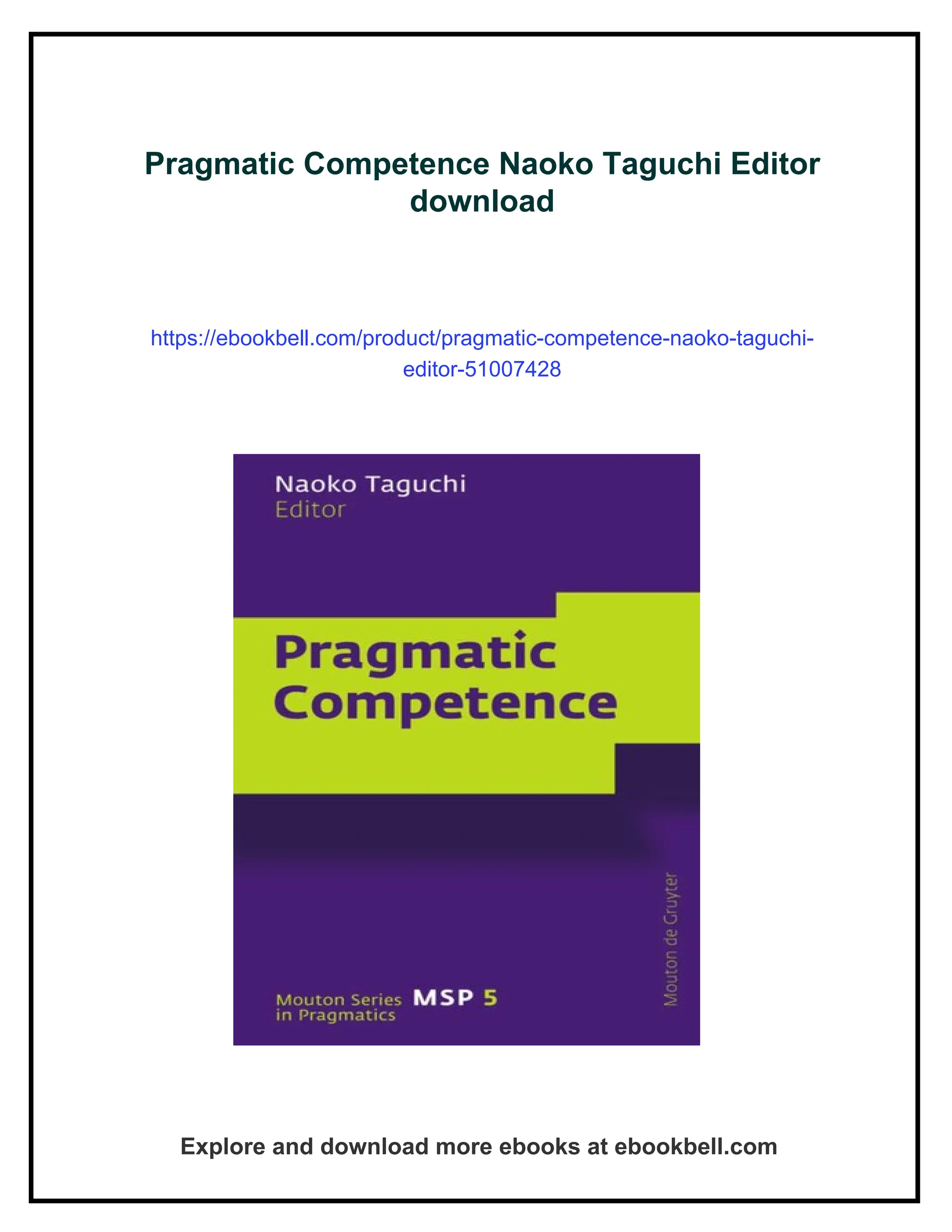


![From a! to zo: Japanese pragmatics and its
contribution to JSL/JFL pedagogy
Dina R. Yoshimi
Abstract
This chapter provides an overview of the literature on Japanese pragmatics
with the goal of a) highlighting the theoretical, and methodological factors
that have been central in shaping the current field of Japanese pragmatics,
and b) illustrating how research on pragmatics in Japanese language
pedagogy and curriculum development has come to be increasingly ordered
by an empirically-grounded understanding of those communicative
practices and interactional routines that organize the pragmatics of social
interaction in Japanese.
1. Introduction1
Although pragmatics may be the new kid on the block in the field of
Japanese foreign language (JFL) pedagogy, pragmatic phenomena are
hardly new to the JFL classroom.2
Years before pragmatics had even been
mentioned in conjunction with Japanese language pedagogy, the instruction
and explanation of the pragmatic aspects of Japanese were salient
components of JFL textbooks (e.g., Naganuma and Mori 1962; Jorden with
Chaplin 1963). Within the first ten chapters of Naganuma and Mori’s
(1962) introductory text, for example, there are discussions of polite
language use (use of prefix o-, of kudasai and [doozo]~~-te kudasai, and of
-san/sensei), resources for discourse cohesion (-te, ga), and variable
functions of sentence-final particle ne, to mention but a few of the
pragmatic aspects singled out for explanation. In sharp contrast to the
highly systematic presentation of the structural and lexical components of
the language that comprise the primary instructional focus of the grammar-
based “Main Texts,”3
the presentation of these points appears to be
opportunistic, and the explanations themselves are infused with an almost
commonsensical attitude toward usage. Thus, while complete and accurate
knowledge of lexis and grammar were clearly the primary goals of JFL](https://image.slidesharecdn.com/25503714-250511121956-186e11cd/85/Pragmatic-Competence-Naoko-Taguchi-Editor-44-320.jpg)
![20 Dina R. Yoshimi
instruction in the 1960s and 1970s, the importance of the pragmatic aspects
of the language were not overlooked, although their communicative
functions may not have been fully understood by practitioners in the field
of JFL pedagogy.
Notably, a similar treatment of Japanese pragmatic resources is evident
in many of the foundational scholarly works in Japanese linguistics from
the 1960s and 1970s. Working within the various approaches to linguistic
description and analysis of that era, scholars addressed such aspects of
Japanese pragmatics as stance marking and speaker perspective (Akatsuka
1978; Kuroda 1973, 1979), honorific morphology and its role in the
production of polite language (Martin 1975), discourse organization
(Kindaichi 1957/1978), and Japanese deictic phenomena (Kuno 1973;
Smith 1979), among others. As was consistent with the standard linguistic
research methods of the time, anecdotal observations, or constructed
examples with “imagined contexts of usage” derived from native speaker
intuitions were, effectively, the sole source of data. These sentence-level
examples were thought to be analyzable through introspection (often with
the assistance of a native speaker informant), and the phenomenon
identified through the research was then accounted for through the
economical elegance of a linguistic generalization.
Notably, the researcher’s orientation to the pragmatic features of a given
linguistic resource often stemmed from the inability of a syntactically-
grounded analysis to fully account for the functions and/or distributions of
the given resource(s) in the data. It was through such problem-solving
processes that many of the concepts commonly used to explicate Japanese
pragmatic phenomena today were first introduced: “(Speaker) empathy”
(Kuroda 1979; Lebra 1976; Smith 1979) and “speaker point of view“
(Kuno 1979), indirectness (Ueda 1974), obligatory attention to hierarchical
social ordering in linguistic use (Nakane 1970; Martin 1975), etc. A range
of pragmatic phenomena also caught the interest of researchers in the social
sciences, who discussed a number of social aspects of Japanese pragmatics:
The orientation to social hierarchy in everyday interaction (Nakane 1970),
the role of empathy (omoiyari) in listener response behaviors (Lebra 1976:
39) and the pervasiveness of obligation and reciprocal dependence in
Japanese interaction (Doi [1971]1973), among others (see especially the
works in Condon and Saito 1974). Although neither the linguistic research
nor the work in the social sciences was framed as research on pragmatics,
the diversity of these pragmatics-relevant studies highlights both the
ubiquity of these phenomena in Japanese language and social interaction, as](https://image.slidesharecdn.com/25503714-250511121956-186e11cd/85/Pragmatic-Competence-Naoko-Taguchi-Editor-45-320.jpg)
![24 Dina R. Yoshimi
as a means for communicative interaction” had been overshadowed by
sentential grammar to the virtual exclusion of discourse structure, with the
result being that “students of a foreign language who have learned how to
construct individual grammatical sentences often encounter difficulties
when combining sentences to create a meanful [sic] cohesive discourse”
(1985: 218). Producing these comments in the context of her contrastive
analytic study of discourse organizational principles, Maynard went on to
propose that the findings of such a study and others like it (similarly
focused on contrastive analysis of discourse cohesion) could have
immediate relevance for JFL classroom learning, making it possible “to
incorporate the principles of text and discourse strategies into our daily
teaching” (1985: 228).
While Maynard (1985) does not make any explicit recommendations on
how this incorporation of findings from the literature on discourse
pragmatic research might best be accomplished, Jorden and Walton (1987)
in their bold proposal for the instruction of “truly foreign languages” (such
as Japanese and Chinese) outline a set of “best practices” for classroom
foreign language instruction that are designed specifically to address the
special instructional challenges that arise when the learners’ base language
and their target language of study are markedly different, including in the
domain of pragmatics. Decrying instructional materials that make use of
outdated linguistic explanations, direct translations of English that ignore
target language usage, and instructional dialogs that lack pragmatic and
sociolinguistic information, Jorden and Walton (1987) propose that the
basic unit of learning “must always be a sample discourse” if the student is
to learn how target-natives construct conversations in precisely defined
situations. There is no way for students to predict transition words,
intonations, deletions, and the like without a target-native model” (1987:
123). Yet they do not assume that providing the learner with such a model
will resolve all learning challenges. Rather, they propose the additional
pedagogical innovation of pairing a “linguistically sophisticated target-
native” who will be responsible for producing “truly authentic language
samples” with a “base-native linguist, who shares the students’ mind-set
and who knows through personal experience what it means to be a
foreigner in the target culture, [and who] plays a vital role in analyzing and
explaining, and in making decisions related to situations, pacing, ordering,
and levels of difficulty.” This proposal not only predates the now familiar
debate on the relative merits of implicit vs. explicit instruction of
pragmatics (opting instead for a combination of the two), but also](https://image.slidesharecdn.com/25503714-250511121956-186e11cd/85/Pragmatic-Competence-Naoko-Taguchi-Editor-49-320.jpg)
![26 Dina R. Yoshimi
associated with verbal politeness, as well as the underlying Japanese
cultural attitudes toward such politeness phenomena – may also be taken as
an important indicator of a new era in JFL pragmatics. First, manuals on
proper use of polite language had long been the domain of native speakers,
while foreigners, who, at least from an ideological perspective, were not
expected to demonstrate an equivalent level of pragmatic competence in the
Japanese social world (Kubota 2008), had not heretofore been burdened
with similar concerns. Indeed, a version of Japanese language (nihongo) for
the instruction of foreigners had been developed as part of national
language policy precisely because foreigners were not culturally obligated
to speak the language (kokugo) as native Japanese did (Tai 2003). Yet, in
the 1980s, as Japan’s economy boomed and the number of learners of
Japanese expanded exponentially, the perception of Japanese as an exotic
language spoken by a few academic types was overtaken by the expectation
that any foreigner might learn Japanese as a “practical skill with economic
utility” (Coulmas 1989: 129). It is within this cultural and historical context
that the publication of Mizutani and Mizutani’s (1987) manual on
politeness can be viewed as marking the beginning of an upward shift in
the expectations for pragmatic competence (especially polite use of
language) for JFL learners. At the same time, in introducing their volume,
the implicit nature of this shift is made explicit by the authors who state
that they “believe that foreigners can understand any subtle point whatever
in Japanese and can use it if they so desire; we [the authors] do not believe
in a “gaijin Japanese” different from the Japanese of native speakers”
(Mizutani and Mizutani 1987: 3).
3. A fork in the road: Japanese pragmatics and JFL pragmatics part
company
As Japanese pragmatics entered the 1990s, it remained a field energized by
the methodological and theoretical shifts that had taken place in the
preceding decade, and also ready to push forward into new domains of
inquiry. One notable trend was a shift away from a focus on the speaker
(e.g., speaker subjectivity, speaker perspective), and toward a broader
interest in the joint actions – such as “finishing each other’s sentences”
(Hayashi and Mori 1998; Ono and Yoshida 1996) –, and social activities
accomplished by two or more participants engaged in everyday social
interaction, such as floor management in multi-party interaction (Hayashi](https://image.slidesharecdn.com/25503714-250511121956-186e11cd/85/Pragmatic-Competence-Naoko-Taguchi-Editor-51-320.jpg)
![From a! to zo: Japanese pragmatics 27
1996) and negotiating (dis)agreement (Mori 1999). To the tradition of
research on discourse cohesion through the study of ellipsis and clause-
conjoining was added a new perspective: Research on the use of discourse
connectives such as datte and dakara, which were examined from a variety
of theoretical perspectives (e.g., Discourse Modality in Maynard 1993;
speech act theory in Kubo 1999; Conversation Analysis in Mori 1995).
Over the past ten years, research in Japanese pragmatics has broken new
ground by challenging the tenability of many longstanding analyses of
grammatical morphemes or syntactic patterns as having functions restricted
by sentence level grammar (cf. Ono, Thompson, and Suzuki [2000] for a
proposal that the distribution of the so-called grammatical morpheme ga,
long referred to as a subject marker, is actually conditioned by discourse-
pragmatic features of interaction; Takagi’s [2002] comprehensive study of
the “multilayered resources” available to conversational participants in
conjunction with the interpretation of unexpressed referents in spoken
discourse, i.e., ellipsis; and Lee and Yonezawa’s [2008] pragmatic account
of overt expression of subject pronouns in casual conversations and other
slightly formal conversational interactions).
In contrast, research in JFL pragmatics took a decidedly different
direction at this point in its history. While researchers and practitioners now
had a much clearer idea of what they needed to teach (cf. the increased
presence and elaboration of cultural notes and usage notes in the textbooks
of this decade such as Nakama and Yookoso!), there seemed to be
considerable uncertainty regarding how best to teach it. With the
communicative revolution sputtering, and the comprehensive approach to
“teaching all of it” (i.e., Jorden with Noda 1987) deemed too burdensome
for learners in most college-level programs to handle, it is perhaps not
surprising that much of JFL research focused on a search for effective
instructional approaches to pragmatics. Following work conducted by
House (1996), Tateyama et al. (1997) and Tateyama (2001, 2007, 2009)
demonstrated that the development of pragmatic competence may be
facilitated by explicit instruction of pragmatic routines combined with
communicative practice and feedback from the teacher. Similarly, Yoshimi
(2001) found that intermediate learners who received explicit instruction on
the effective use of discourse markers in the production of extended
tellings, showed considerable improvement in the appropriateness of their
use of discourse markers as well as in the effectiveness of organizing the
oral production of extended tellings.](https://image.slidesharecdn.com/25503714-250511121956-186e11cd/85/Pragmatic-Competence-Naoko-Taguchi-Editor-52-320.jpg)

![sec. XVIII, e molti furon degli umidi nel Cinquecento in Italia, e degli
arcadi nel settecento. Uno stato d'animo si può creare in noi e
divenir coerente o rimaner fittizio, secondo che risponda o no alla
speciale fisionomia dell'organismo psichico. Ma poi le idee del tempo
mutano, cangia la moda, i pòmpili seguaci si mettono appresso ad
altre navi. Chi resta? Restano quei pochi, da contar su le dita, quei
pochi che ebbero, primi, l'intuizione straordinaria, o in cui quello
speciale stato d'animo divenne così coerente, che poteron creare
un'opera organica, resistente al tempo e alla moda.
Sul serio poi l'Arcoleo crede che nella nostra letteratura dialettale
non ci sia altro che spirito comico? Egli è siciliano, e certamente ha
letto il Meli, e sa quanto sia ingiusto il giudizio di arcadia superiore
dato della poesia di lui, che non fu sonata soltanto su la zampogna
pastorale, ma ebbe anche tutte le corde della lira e si espresse in
tutte le forme. Non c'è vero e proprio umorismo in tanta parte della
poesia del Meli? Ma basterebbe citar soltanto La cutuliata per
dimostrarlo!
Tic tic... chi fu? Cutuliata.
E non c'è umorismo, vero e proprio umorismo, in tanti e tanti sonetti
del Belli? E senza parlare delle figure del Maggi, il Giovannin Bongè,
il Marchionn di gamb avert di Carlo Porta non son due capolavori
d'umorismo? E, poichè si parla di tipi rimasti imperituri, il Monsù
Travet del Bersezio, il Nobilomo Vidal del Gallina? E un altro scrittore
dialettale abbiamo, finora quasi del tutto ignoto, grandissimo:
umorista vero, se mai ce ne fu, e — a farlo apposta —
meridionalissimo, di Reggio Calabria: Giovanni Merlino, rivelato or
son parecchi anni, in una conferenza[47] da Giuseppe Mantica, suo
conterraneo, che sarebbe stato anche lui un forte scrittore umorista
se, nel breve corso della sua esistenza, la politica non lo avesse
troppo presto distratto dalle lettere. Scrisse il Merlino i suoi libri per
55 lettori, che nomina uno per uno e divide in quattro categorie,
imponendo a ciascuna di esse alcuni speciali obblighi in ricompensa
del piacere loro procurato. Uno de' suoi volumi, ancora tutti inediti, è](https://image.slidesharecdn.com/25503714-250511121956-186e11cd/85/Pragmatic-Competence-Naoko-Taguchi-Editor-60-320.jpg)
![detto: Miscellanea di varie cose sconnesse e piacevoli, «fatta per
coloro che, avendo poco cervello, vogliono istruirsi sul modo più
acconcio per perderlo interamente»; gli altri sono Memorie utili ed
inutili ai posteri, ossia la vita di Giovanni Merlino del quondam
Antonio di Reggio, principiata a 27 decembre 1789 e proseguita fino
al 1850, composta di sette volumi. Vorrei poter citare per disteso il
lungo Dialogo alla calabrese tra Domine Dio e Giovanni Merlino o il
Conto con Domine Dio per dimostrare che umorista fosse il Merlino.
Nell'attesa che gli eredi lo rendano a tutti noto pubblicando i volumi,
rimando alla pubblicazione che il Mantica fece di questi due
impareggiabili Dialoghi, con la traduzione a fronte.
Questo, per la letteratura dialettale. Non scopre poi sul serio altro
che ironia e satira l'Arcoleo negli scrittori italiani? Io penso a un certo
Socrate immaginario d'un certo abbate del settecento; penso al
Didimo chierico del Foscolo: ad alcune volate in prosa del Baretti;
penso ai Promessi Sposi del Manzoni, tutto infuso di genuino
umorismo;[48] penso al Sant'Ambrogio del Giusti, vera poesia
umoristica, unica forse tra le tante satiriche o sentimentali; penso a
quei certi dialoghi e a quelle certe prosette del Leopardi; penso
all'Asino e al Buco nel muro del Guerrazzi; penso al Fanfulla del
D'Azeglio; penso a Carlo Bini; penso a quella tal cucina nel castello di
Fratta delle Confessioni d'un ottuagenario del Nievo; penso a Camillo
De Meis, al Revere; e, poichè l'Arcoleo arriva fino a Marco Twain,
penso al Re umorista, al Demonio dello stile, all'Altalena delle
antipatie, al Pietro e Paola, a Scaricalasino, all'Illustrissimo del
Cantoni; al Demetrio Pianelli del De Marchi; penso ai poeti della
scapigliatura lombarda e a tante note di schietto e profondo
umorismo nelle liriche del Carducci e del Graf; penso ai tanti
personaggi umoristici che popolano i romanzi e le novelle del
Fogazzaro, del Farina, del Capuana, del Fucini, e anche ad alcune
opere di più giovani scrittori, da Luigi Antonio Villari all'Albertazzi, al
Panzini... ed ecco, la Lanterna di Diogene di quest'ultimo vorrei porre
in una mano all'Arcoleo e nell'altra la candela del Candelaio del
Bruno: son sicuro che parecchi scrittori umoristi scoprirebbe nella
letteratura italiana antica e nuova.](https://image.slidesharecdn.com/25503714-250511121956-186e11cd/85/Pragmatic-Competence-Naoko-Taguchi-Editor-61-320.jpg)
![conoscenza sommaria ed esteriore, appunto perchè fondata su
queste sommarie ed esteriori determinazioni.
La caratteristica, ad esempio, di quella tale peculiar bonarietà o
benevola indulgenza che scoprono alcuni nell'umorismo, già definito
del Richter «malinconia d'un animo superiore che giunge a divertirsi
finanche di ciò che lo rattrista»,[49] quel «tranquillo, giocondo e
riflesso sguardo su le cose», quel «modo d'accogliere gli spettacoli
divertenti, che sembra, nella sua moderazione, soddisfare il senso
del ridicolo e domandar perdono di ciò che v'è di poco delicato in tal
compiacimento», quella tale «espansione degli spiriti dall'interno
all'esterno incontrata e ritardata dalla corrente contraria d'una specie
di benevolenza pensosa», di cui parla il Sully nel suo Essai sur le rire,
[50] non si trovano in tutti gli umoristi. Alcuni di questi tratti, che al
critico francese, e non a lui soltanto, pajono principali dell'umorismo,
si troveranno in alcuni, in altri no; e in certuni anzi si troverà il
contrario, come ad esempio nello Swift, che è malinconico nel senso
originario della parola, cioè pieno di fiele; e del resto noi vedremo un
po' più innanzi, parlando del don Abbondio del Manzoni, a che cosa
in fondo si riduca quella peculiar bonarietà o simpatica indulgenza.
Al contrario, quella «acre disposizione a scoprire ed esprimere il
ridicolo del serio e il serio del ridicolo umano», di cui parla il Bonghi,
calzerà allo Swift e a umoristi al pari di lui beffardi e mordaci; non
calzerà ad altri; nè del resto, come osserva il Lipps, opponendosi alla
teoria del Lazzarus, che considera anch'esso l'umorismo soltanto
come una disposizione d'animo, questo modo di considerarlo è
compiuto. Nè compiuto sarà quello del Hegel che lo dice «attitudine
speciale d'intelletto e di animo onde l'artista si pone lui stesso al
posto delle cose», definizione che, a non porsi bene a guardare da
quel solo lato da cui l'Hegel lo guarda, ha tutta l'aria d'un rebus.
Caratteristiche più comuni, e però più generalmente osservate, sono
la «contradizione» fondamentale, a cui si suol dare per causa
principale il disaccordo che il sentimento e la meditazione scoprono o
fra la vita reale e l'ideale umano o fra le nostre aspirazioni e le
nostre debolezze e miserie, e per principale effetto quella tal](https://image.slidesharecdn.com/25503714-250511121956-186e11cd/85/Pragmatic-Competence-Naoko-Taguchi-Editor-64-320.jpg)
![che avviene, e che non può non avvenire, in tutti quegli scrittori che
si dicono umoristi.
L'Estetica del Croce è così astratta e negativa, che applicarla alla
critica non è assolutamente possibile, se non a patto di negarla di
continuo, com'egli stesso fa, accettando questi così detti concetti
empirici che, cacciati dalla porta, gli rientrano dalla finestra.
Ah, una bella soddisfazione, la filosofia!
II
Vediamo dunque, senz'altro, qual è il processo da cui risulta quella
particolar rappresentazione che si suol chiamare umoristica; se
questa ha peculiari caratteri che la distinguono, e da che derivano:
se vi è un particolar modo di considerare il mondo, che costituisce
appunto la materia e la ragione dell'umorismo.
Ordinariamente, — ho già detto altrove,[51] e qui m'è forza ripetere
— l'opera d'arte è creata dal libero movimento della vita interiore
che organa le idee e le imagini in una forma armoniosa, di cui tutti
gli elementi han corrispondenza tra loro e con l'idea-madre che le
coordina. La riflessione, durante la concezione, come durante
l'esecuzione dell'opera d'arte, non resta certamente inattiva: assiste
al nascere e al crescere dell'opera, ne segue le fasi progressive e ne
gode, raccosta i varii elementi, li coordina, li compara. La coscienza
non rischiara tutto lo spirito; segnatamente per l'artista, essa non è
un lume distinto dal pensiero, che permetta alla volontà di attingere
in lei come in un tesoro d'immagini e d'idee. La coscienza, in somma,
non è una potenza creatrice; ma lo specchio interiore in cui il
pensiero si rimira; si può dire anzi ch'essa sia il pensiero che vede sè
stesso, assistendo a quello che esso fa spontaneamente. E,
d'ordinario, nell'artista, nel momento della concezione, la riflessione
si nasconde, resta, per così dire, invisibile: è, quasi, per l'artista una
forma del sentimento. Man mano che l'opera si fa, essa la critica,](https://image.slidesharecdn.com/25503714-250511121956-186e11cd/85/Pragmatic-Competence-Naoko-Taguchi-Editor-68-320.jpg)