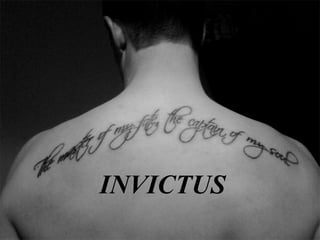
INVICTUS
William Ernest Henley
• At the age of 12, Henley contracted
  tuberculosis of the bone. A few years later, the
  disease progressed to his foot, and physicians
  announced that the only way to save his life
  was to amputate directly below the knee. It
  was amputated when he was 17. inspired him
  to write this poem. Despite his disability, he
  survived with one foot intact and led an active
  life until his death at the age of 53.
Invictus

   Out of the night that covers me,
    Black as the Pit from pole to pole,
      I thank whatever gods may be
        For my unconquerable soul.

    In the fell clutch of circumstance
   I have not winced nor cried aloud.
    Under the bludgeoning of chance
    My head is bloody, but unbowed.

  Beyond this place of wrath and tears
  Looms but the Horror of the shade,
    And yet the menace of the years
   Finds, and shall find, me unafraid.

   It matters not how strait the gate,
How charged with punishments the scroll.
       I am the master of my fate:
      I am the captain of my soul.
• Invictus, meaning "unconquerable" or
           "undefeated" in Latin
• Out of the night that covers me,
  Black as the Pit from pole to pole,
  I thank whatever gods may be
  For my unconquerable soul.

• In the first stanza the persona prays in the dark to "whatever
  gods may be" a prayer of thanks for his "unconquerable soul.”

• Several things are apparent from the outset: First, the
  speaker is in some sort of metaphorical darkness, perhaps the
  darkness of despair. Second, he does not pray for strength,
  but gives thanks for the strength that he already has.
• In the fell clutch of circumstance
  I have not winced nor cried aloud.
  Under the bludgeoning of chance
  My head is bloody, but unbowed.

• The seeming agnosticism (denial about god’s will) of the first
  stanza continues in the second.
• He does not talk about God's will or even fate; instead he
  speaks of "the fell clutch of circumstance" and "the
  bludgeoning of chance," and asserts that he has overcome
  these bravely and without complaint or giving up.
• Beyond this place of wrath and tears
  Looms but the Horror of the shade,
  And yet the menace of the years
  Finds, and shall find, me unafraid.

• The third stanza is about death and what a trifle it seems to
  the persona. This "place of wrath and tears", this life, it
  seems, is not full enough of pain and horror to frighten the
  persona. And death, "the Horror of the shade," could not
  possibly worry him, being an end to "wrath and tears".
• Notice here that he is not concerned in any way about an
  afterlife. Death is merely an end to suffering for him.
• Not even death or the afterlife may scare him
• It matters not how strait the gate,
  How charged with punishments the scroll.
  I am the master of my fate:
  I am the captain of my soul.

• strait means narrow, restricted. To escape, the persona must
  pass through a narrow gate. He believes he can do so in spite
  of the punishments that fate has allotted him

• He accepts no master but himself. He bows to no authority.
  He is his own god, guide and judge. He is the Captain.
Unconquerable
    spirit


   Subject
   Matter


Will to survive
Theme
• the will to survive in the face of a severe test.

• Exp:
• My head is bloody, but unbowed.
• This line shows how the persona is probably
  injured or severely damaged (bloody), but
  unbowed meaning that he is still not giving
  up.
• The believe and confidence in oneself that he
  or she can go through any challenges in life
• Exp:
• I am the master of my fate:
  I am the captain of my soul.

• These two lines clearly shows how the persona confidently
  despise any obstacles or challenges and says that he controls
  his life, his fate and his soul.
Strong lines


I am the master of my fate:
 I am the captain of my soul.
• Signifies that the persona is very well in
  controlled of his life even though in the
  hardships that may have killed or damaged
  him.

Invictus

  • 1.
  • 2.
    William Ernest Henley •At the age of 12, Henley contracted tuberculosis of the bone. A few years later, the disease progressed to his foot, and physicians announced that the only way to save his life was to amputate directly below the knee. It was amputated when he was 17. inspired him to write this poem. Despite his disability, he survived with one foot intact and led an active life until his death at the age of 53.
  • 3.
    Invictus Out of the night that covers me, Black as the Pit from pole to pole, I thank whatever gods may be For my unconquerable soul. In the fell clutch of circumstance I have not winced nor cried aloud. Under the bludgeoning of chance My head is bloody, but unbowed. Beyond this place of wrath and tears Looms but the Horror of the shade, And yet the menace of the years Finds, and shall find, me unafraid. It matters not how strait the gate, How charged with punishments the scroll. I am the master of my fate: I am the captain of my soul.
  • 4.
    • Invictus, meaning"unconquerable" or "undefeated" in Latin
  • 5.
    • Out ofthe night that covers me, Black as the Pit from pole to pole, I thank whatever gods may be For my unconquerable soul. • In the first stanza the persona prays in the dark to "whatever gods may be" a prayer of thanks for his "unconquerable soul.” • Several things are apparent from the outset: First, the speaker is in some sort of metaphorical darkness, perhaps the darkness of despair. Second, he does not pray for strength, but gives thanks for the strength that he already has.
  • 6.
    • In thefell clutch of circumstance I have not winced nor cried aloud. Under the bludgeoning of chance My head is bloody, but unbowed. • The seeming agnosticism (denial about god’s will) of the first stanza continues in the second. • He does not talk about God's will or even fate; instead he speaks of "the fell clutch of circumstance" and "the bludgeoning of chance," and asserts that he has overcome these bravely and without complaint or giving up.
  • 7.
    • Beyond thisplace of wrath and tears Looms but the Horror of the shade, And yet the menace of the years Finds, and shall find, me unafraid. • The third stanza is about death and what a trifle it seems to the persona. This "place of wrath and tears", this life, it seems, is not full enough of pain and horror to frighten the persona. And death, "the Horror of the shade," could not possibly worry him, being an end to "wrath and tears". • Notice here that he is not concerned in any way about an afterlife. Death is merely an end to suffering for him. • Not even death or the afterlife may scare him
  • 8.
    • It mattersnot how strait the gate, How charged with punishments the scroll. I am the master of my fate: I am the captain of my soul. • strait means narrow, restricted. To escape, the persona must pass through a narrow gate. He believes he can do so in spite of the punishments that fate has allotted him • He accepts no master but himself. He bows to no authority. He is his own god, guide and judge. He is the Captain.
  • 9.
    Unconquerable spirit Subject Matter Will to survive
  • 10.
    Theme • the willto survive in the face of a severe test. • Exp: • My head is bloody, but unbowed. • This line shows how the persona is probably injured or severely damaged (bloody), but unbowed meaning that he is still not giving up.
  • 11.
    • The believeand confidence in oneself that he or she can go through any challenges in life • Exp: • I am the master of my fate: I am the captain of my soul. • These two lines clearly shows how the persona confidently despise any obstacles or challenges and says that he controls his life, his fate and his soul.
  • 12.
    Strong lines I amthe master of my fate: I am the captain of my soul.
  • 13.
    • Signifies thatthe persona is very well in controlled of his life even though in the hardships that may have killed or damaged him.