Process of Portfolio
Construction.
1
Shirisha T (157)
Harshitha K (190)
Sushmna P (191)
Contents
❖What is Portfolio ?
❖ Process of Portfolio
Construction.
❖ Example of Portfolio
Construction.
❖ Tabular representation and
summary of example scenario.
2
What is Portfolio ?
 Portfolio is a combination of securities such as stocks,
bonds, and money market instruments.
 The process of blending together the broad classes so
as to obtain return with minimum risk is called
PORTFOLIO CONSTRUCTION.
 Diversification of investments helps to spread risk
over many assets and thus reduces unsystematic risk.
 Effective portfolio construction requires a systematic
approach to balancing risk and return while
considering an investor's specific objectives
3
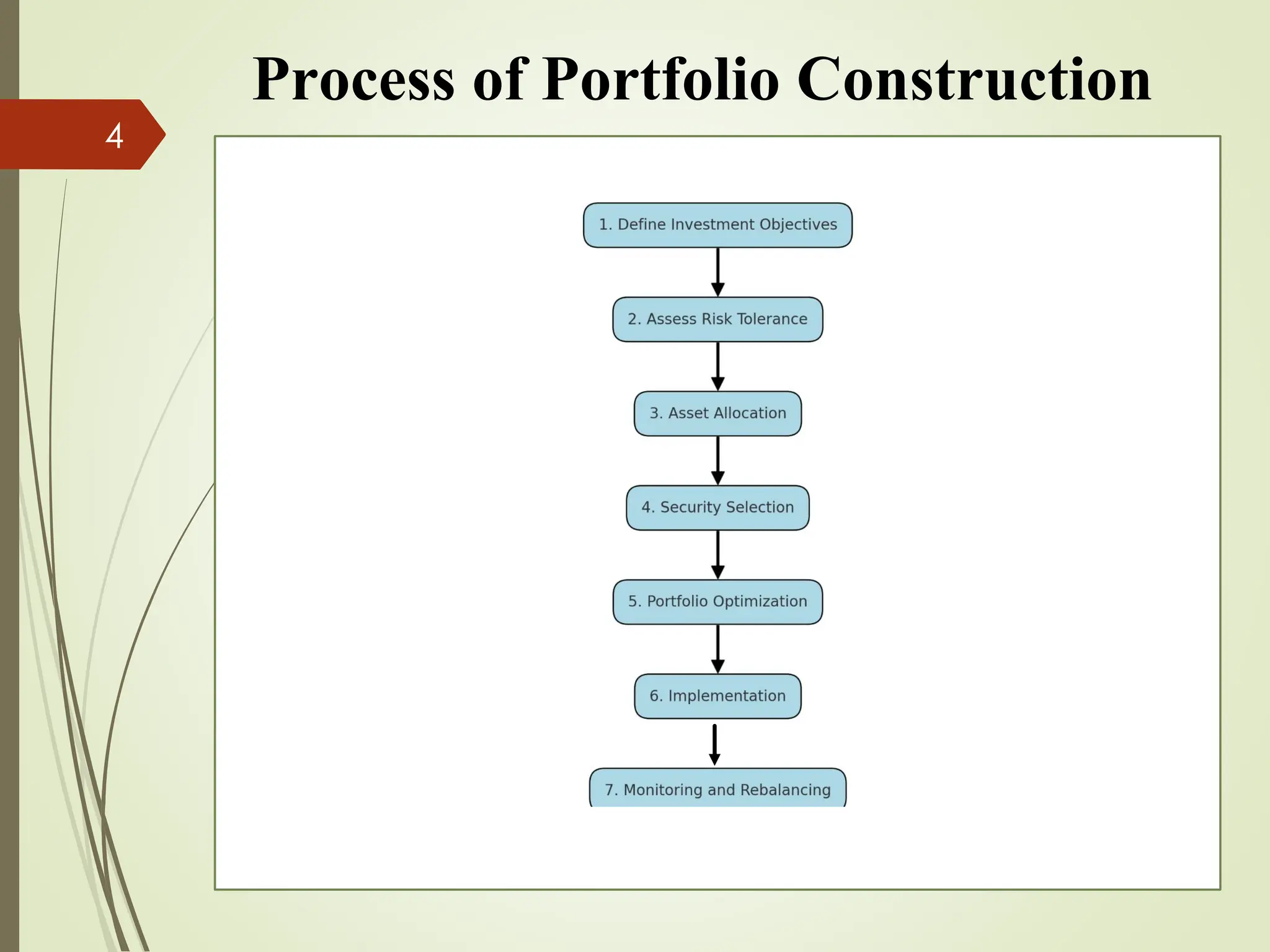
Process of Portfolio Construction
4
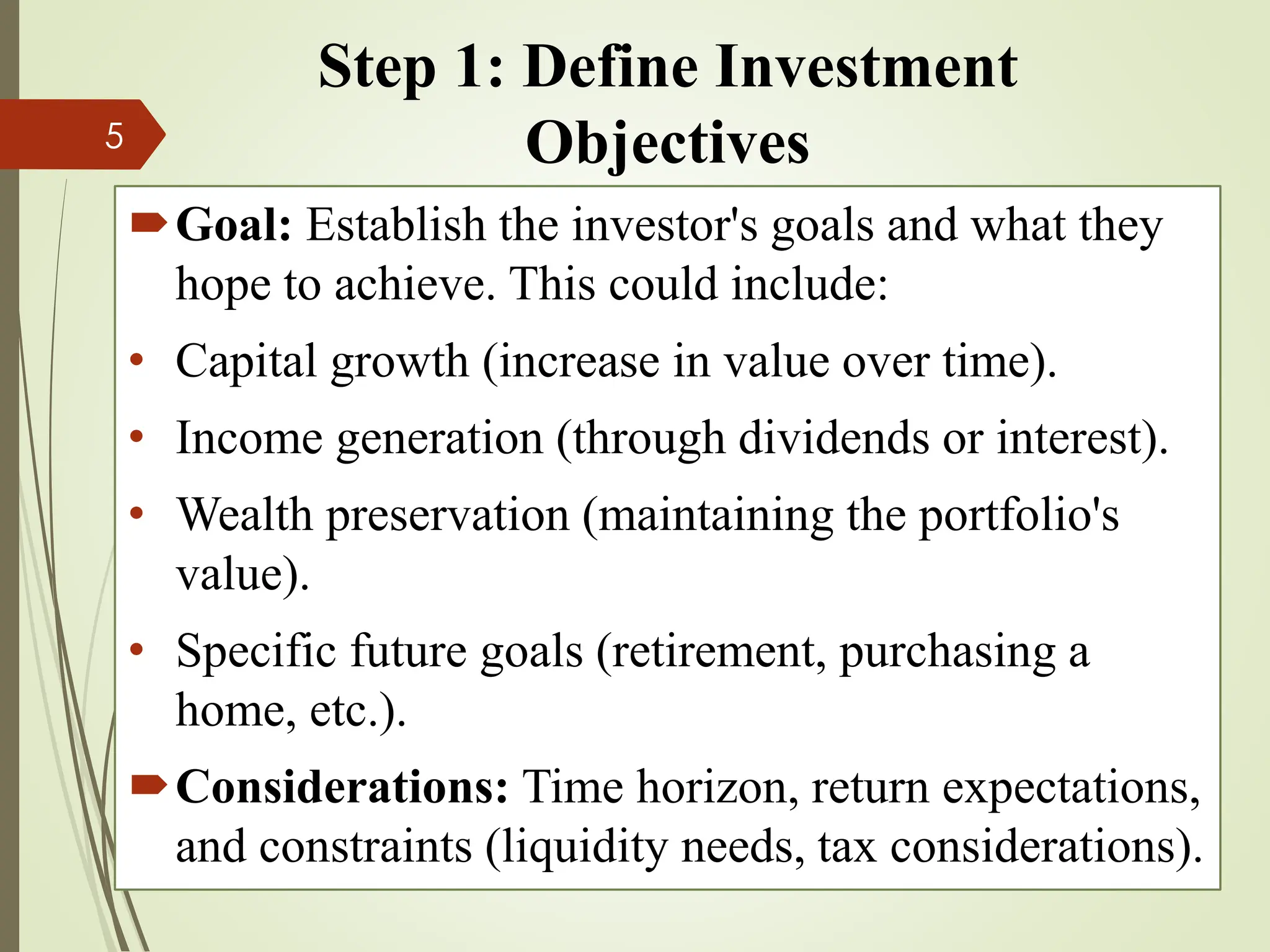
Step 1: Define Investment
Objectives
Goal: Establish the investor's goals and what they
hope to achieve. This could include:
• Capital growth (increase in value over time).
• Income generation (through dividends or interest).
• Wealth preservation (maintaining the portfolio's
value).
• Specific future goals (retirement, purchasing a
home, etc.).
Considerations: Time horizon, return expectations,
and constraints (liquidity needs, tax considerations).
5
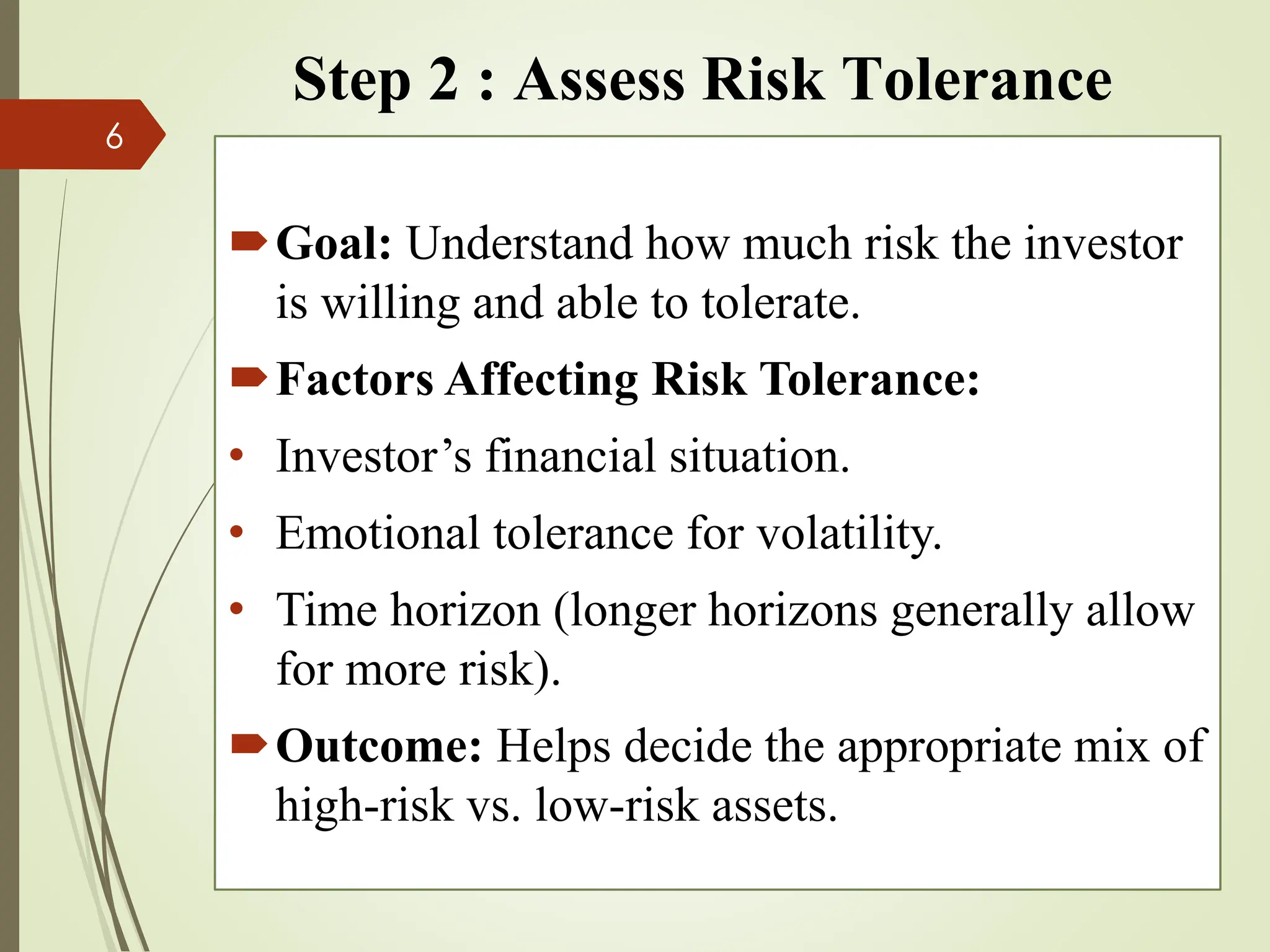
Step 2 : Assess Risk Tolerance
Goal: Understand how much risk the investor
is willing and able to tolerate.
Factors Affecting Risk Tolerance:
• Investor’s financial situation.
• Emotional tolerance for volatility.
• Time horizon (longer horizons generally allow
for more risk).
Outcome: Helps decide the appropriate mix of
high-risk vs. low-risk assets.
6
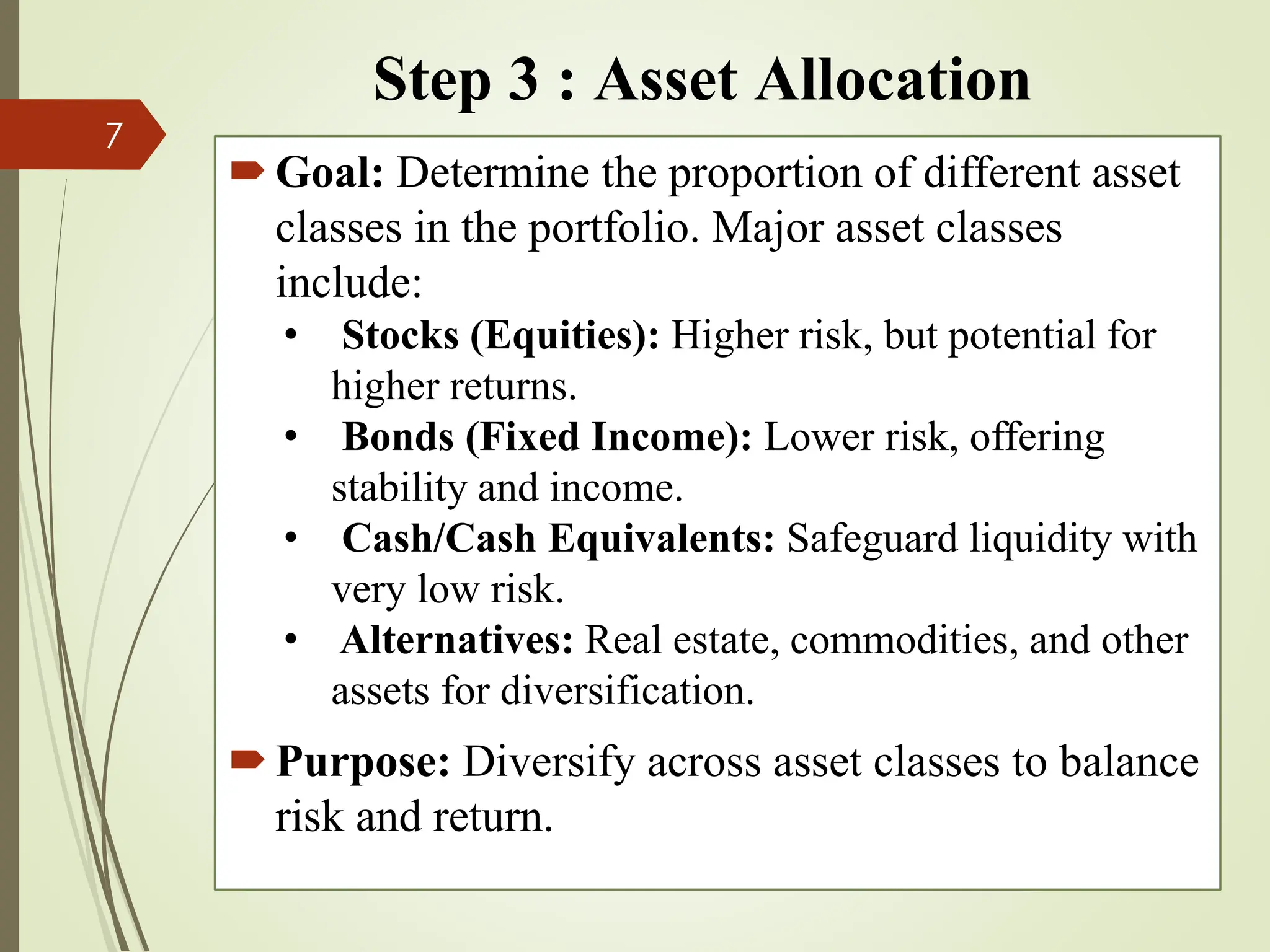
Step 3 : Asset Allocation
Goal: Determine the proportion of different asset
classes in the portfolio. Major asset classes
include:
• Stocks (Equities): Higher risk, but potential for
higher returns.
• Bonds (Fixed Income): Lower risk, offering
stability and income.
• Cash/Cash Equivalents: Safeguard liquidity with
very low risk.
• Alternatives: Real estate, commodities, and other
assets for diversification.
Purpose: Diversify across asset classes to balance
risk and return.
7
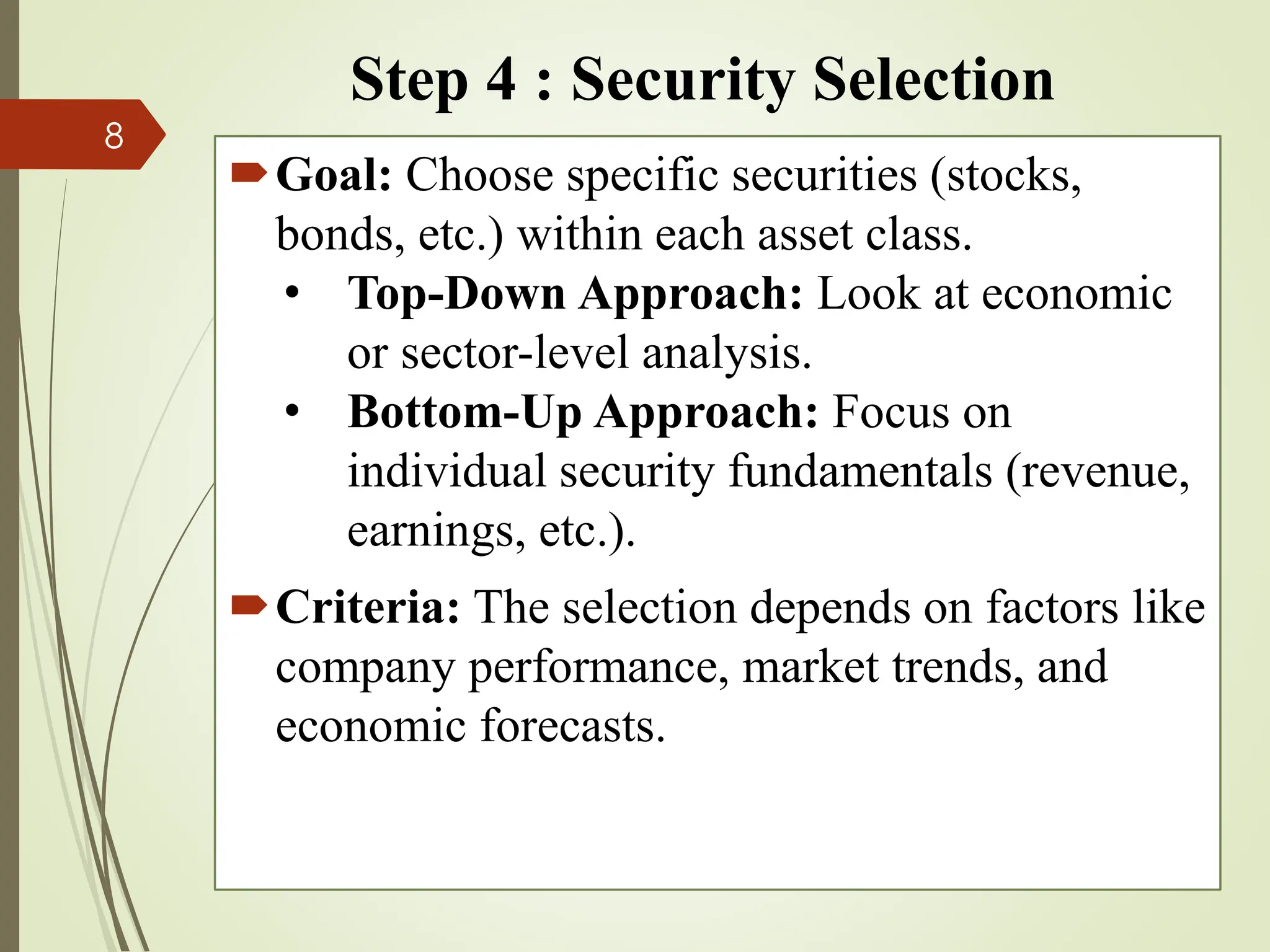
Step 4 : Security Selection
Goal: Choose specific securities (stocks,
bonds, etc.) within each asset class.
• Top-Down Approach: Look at economic
or sector-level analysis.
• Bottom-Up Approach: Focus on
individual security fundamentals (revenue,
earnings, etc.).
Criteria: The selection depends on factors like
company performance, market trends, and
economic forecasts.
8
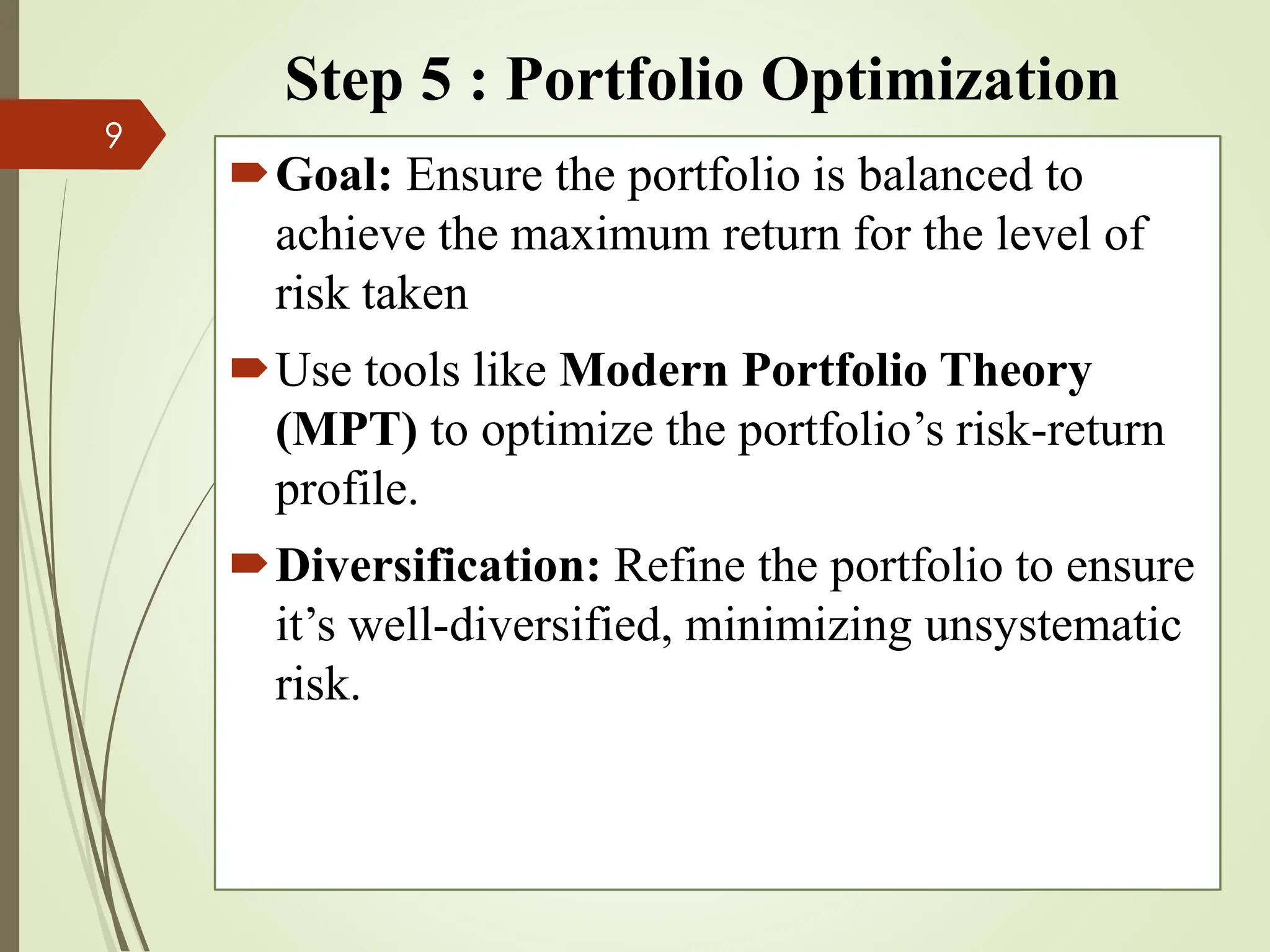
Step 5 : Portfolio Optimization
Goal: Ensure the portfolio is balanced to
achieve the maximum return for the level of
risk taken
Use tools like Modern Portfolio Theory
(MPT) to optimize the portfolio’s risk-return
profile.
Diversification: Refine the portfolio to ensure
it’s well-diversified, minimizing unsystematic
risk.
9
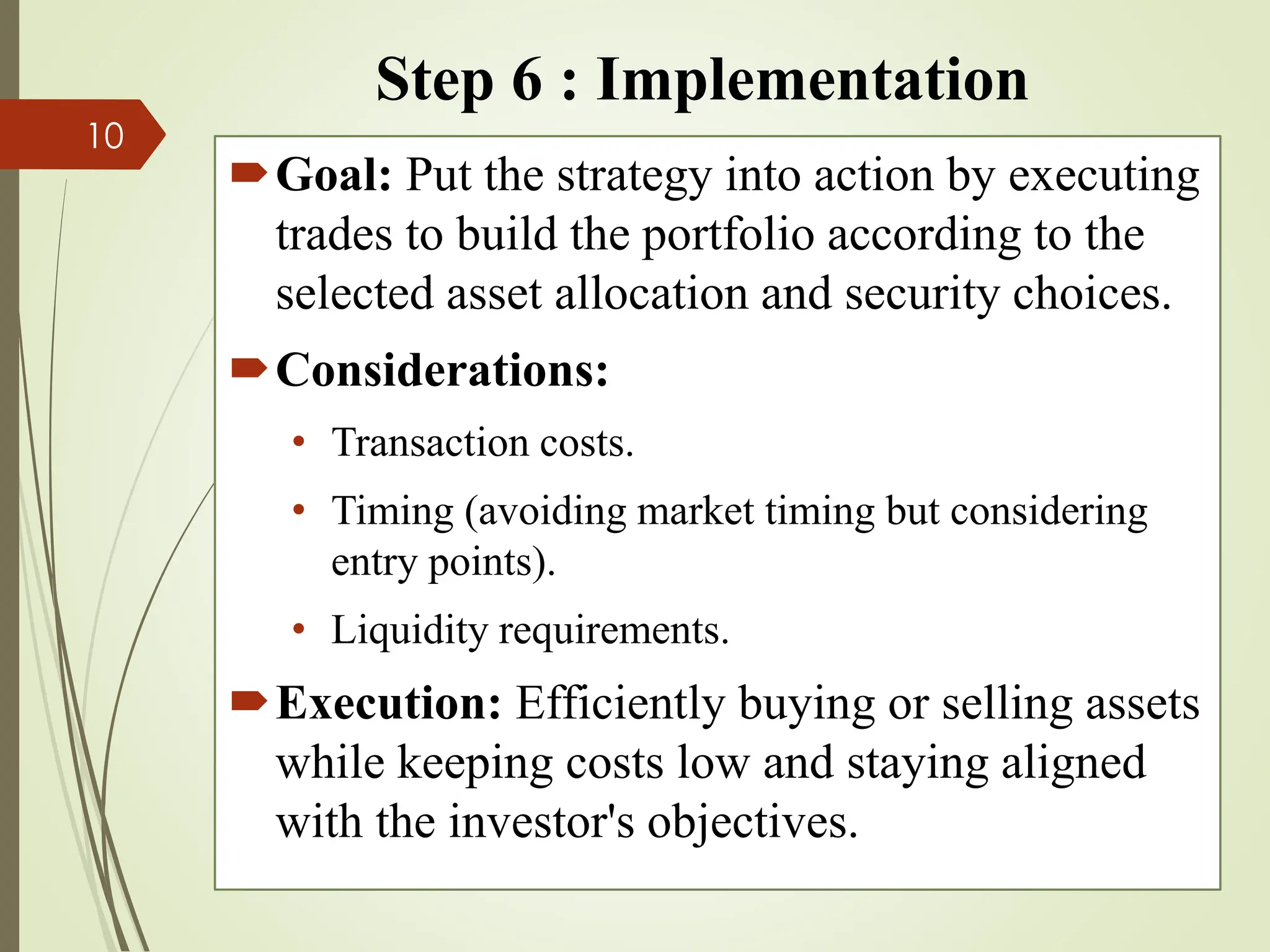
Step 6 : Implementation
Goal: Put the strategy into action by executing
trades to build the portfolio according to the
selected asset allocation and security choices.
Considerations:
• Transaction costs.
• Timing (avoiding market timing but considering
entry points).
• Liquidity requirements.
Execution: Efficiently buying or selling assets
while keeping costs low and staying aligned
with the investor's objectives.
10
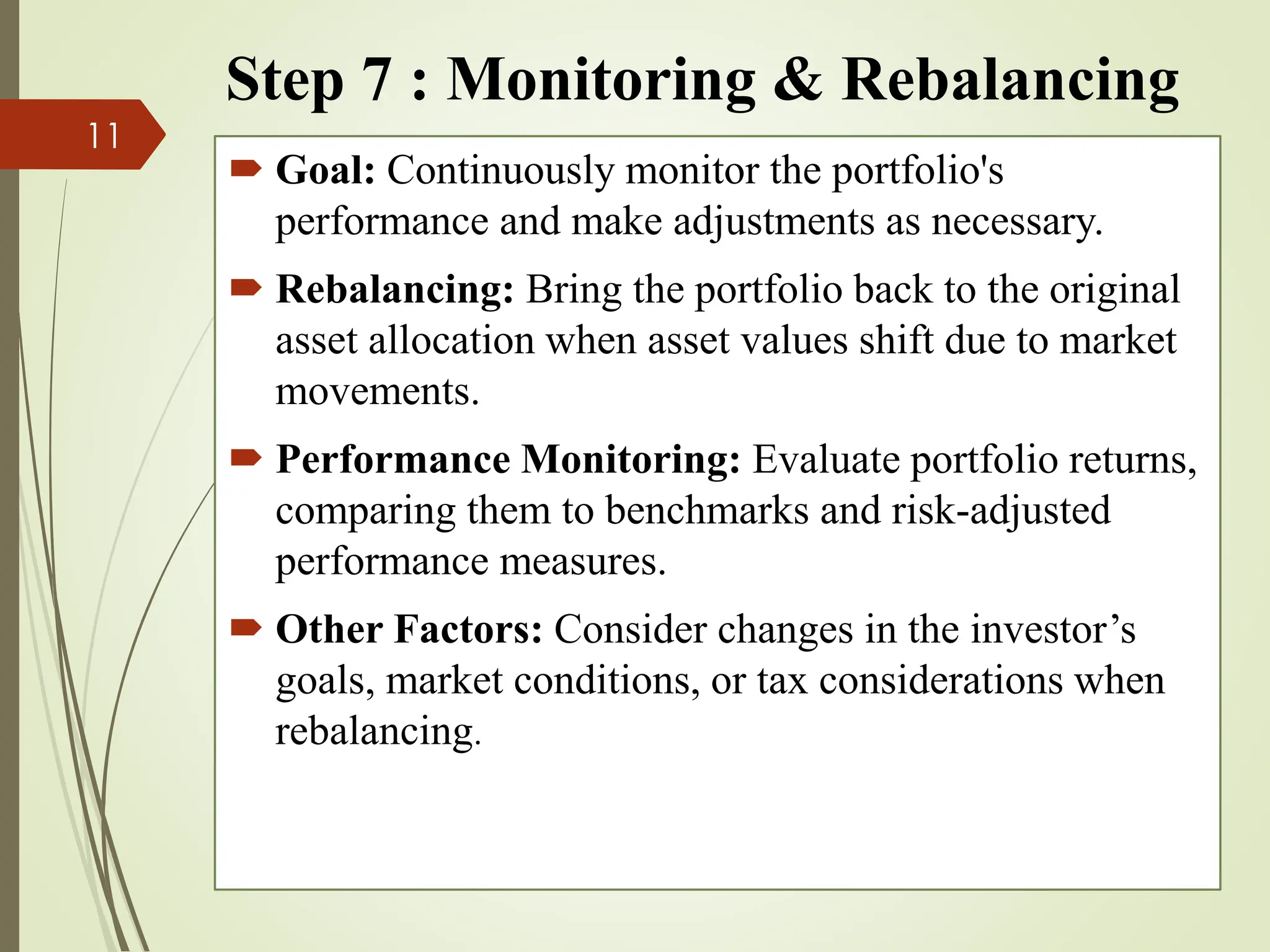
Step 7 : Monitoring & Rebalancing
 Goal: Continuously monitor the portfolio's
performance and make adjustments as necessary.
 Rebalancing: Bring the portfolio back to the original
asset allocation when asset values shift due to market
movements.
 Performance Monitoring: Evaluate portfolio returns,
comparing them to benchmarks and risk-adjusted
performance measures.
 Other Factors: Consider changes in the investor’s
goals, market conditions, or tax considerations when
rebalancing.
11
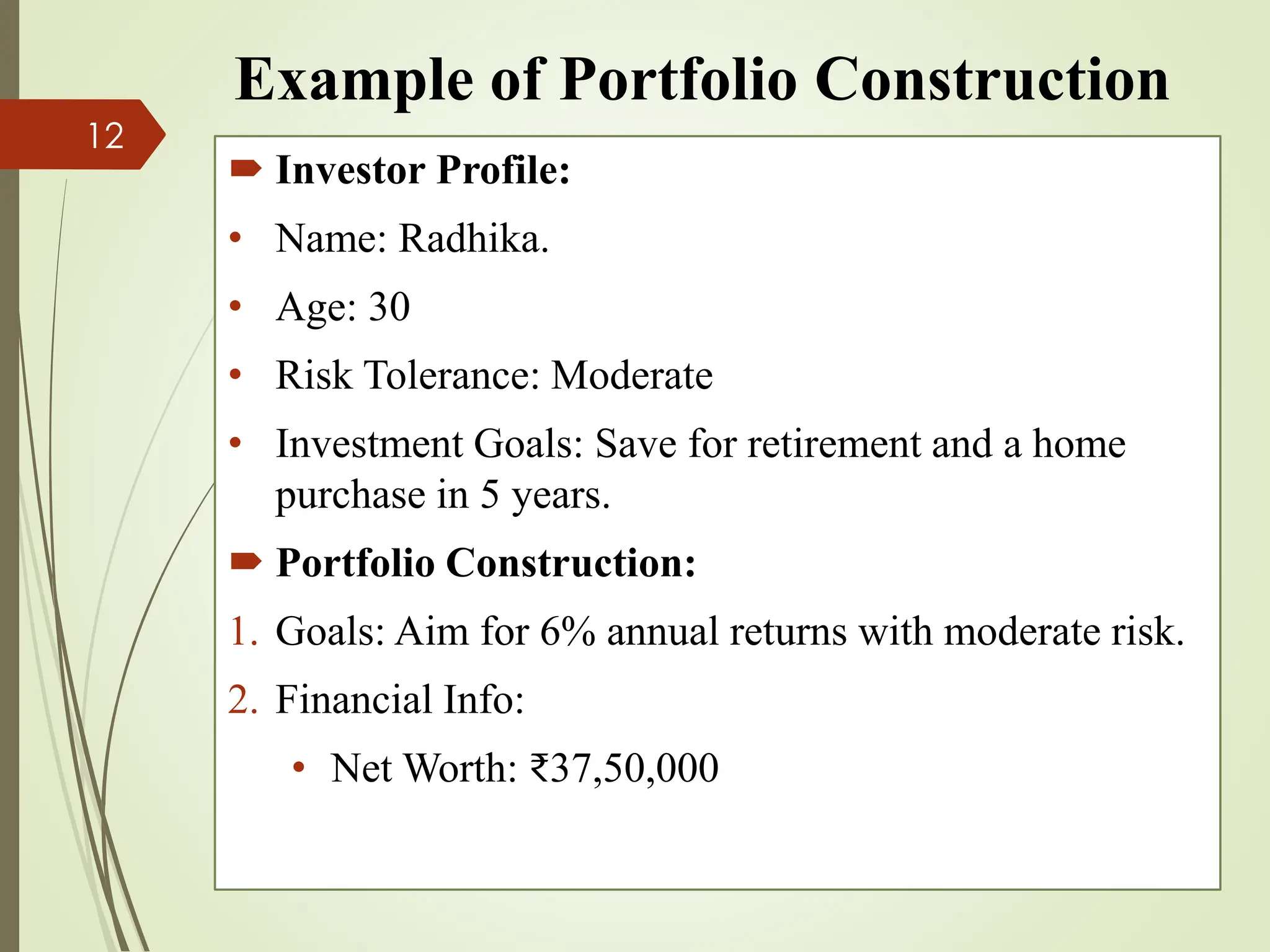
Example of Portfolio Construction
 Investor Profile:
• Name: Radhika.
• Age: 30
• Risk Tolerance: Moderate
• Investment Goals: Save for retirement and a home
purchase in 5 years.
 Portfolio Construction:
1. Goals: Aim for 6% annual returns with moderate risk.
2. Financial Info:
• Net Worth: ₹37,50,000
12
Example of Portfolio Construction
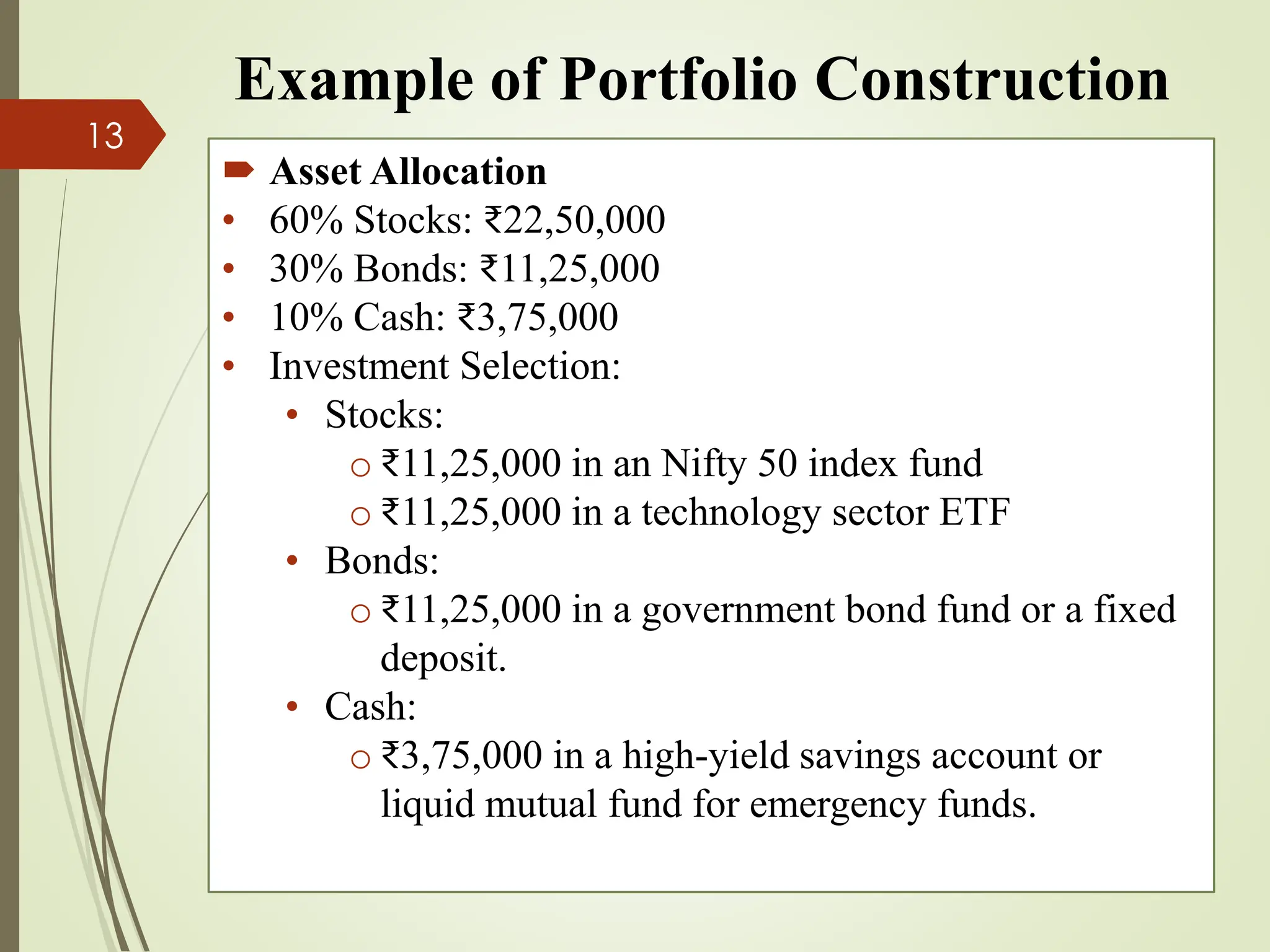
 Asset Allocation
• 60% Stocks: ₹22,50,000
• 30% Bonds: ₹11,25,000
• 10% Cash: ₹3,75,000
• Investment Selection:
• Stocks:
o ₹11,25,000 in an Nifty 50 index fund
o ₹11,25,000 in a technology sector ETF
• Bonds:
o ₹11,25,000 in a government bond fund or a fixed
deposit.
• Cash:
o ₹3,75,000 in a high-yield savings account or
liquid mutual fund for emergency funds.
13
Example of Portfolio Construction
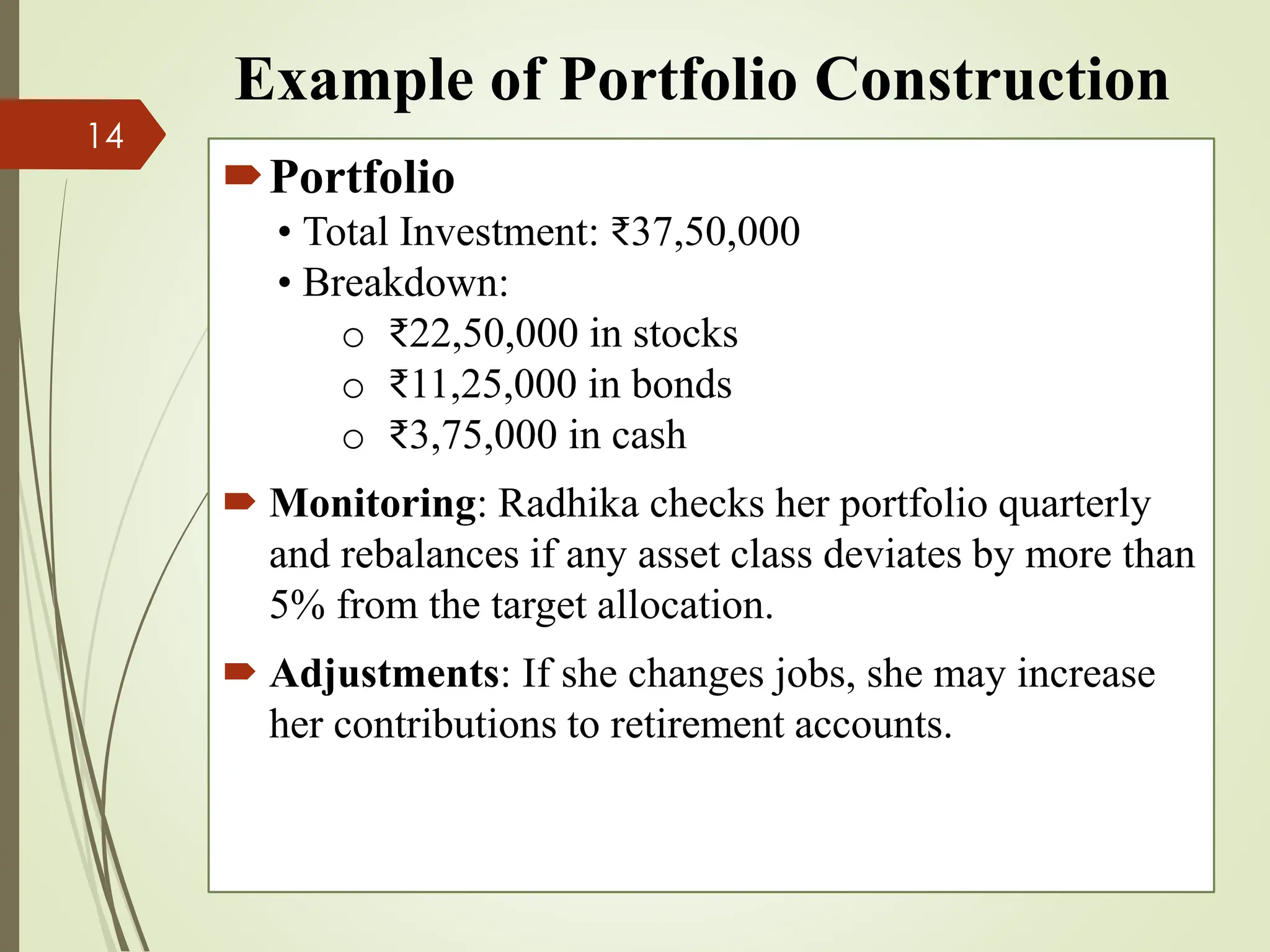
Portfolio
• Total Investment: ₹37,50,000
• Breakdown:
o ₹22,50,000 in stocks
o ₹11,25,000 in bonds
o ₹3,75,000 in cash
 Monitoring: Radhika checks her portfolio quarterly
and rebalances if any asset class deviates by more than
5% from the target allocation.
 Adjustments: If she changes jobs, she may increase
her contributions to retirement accounts.
14
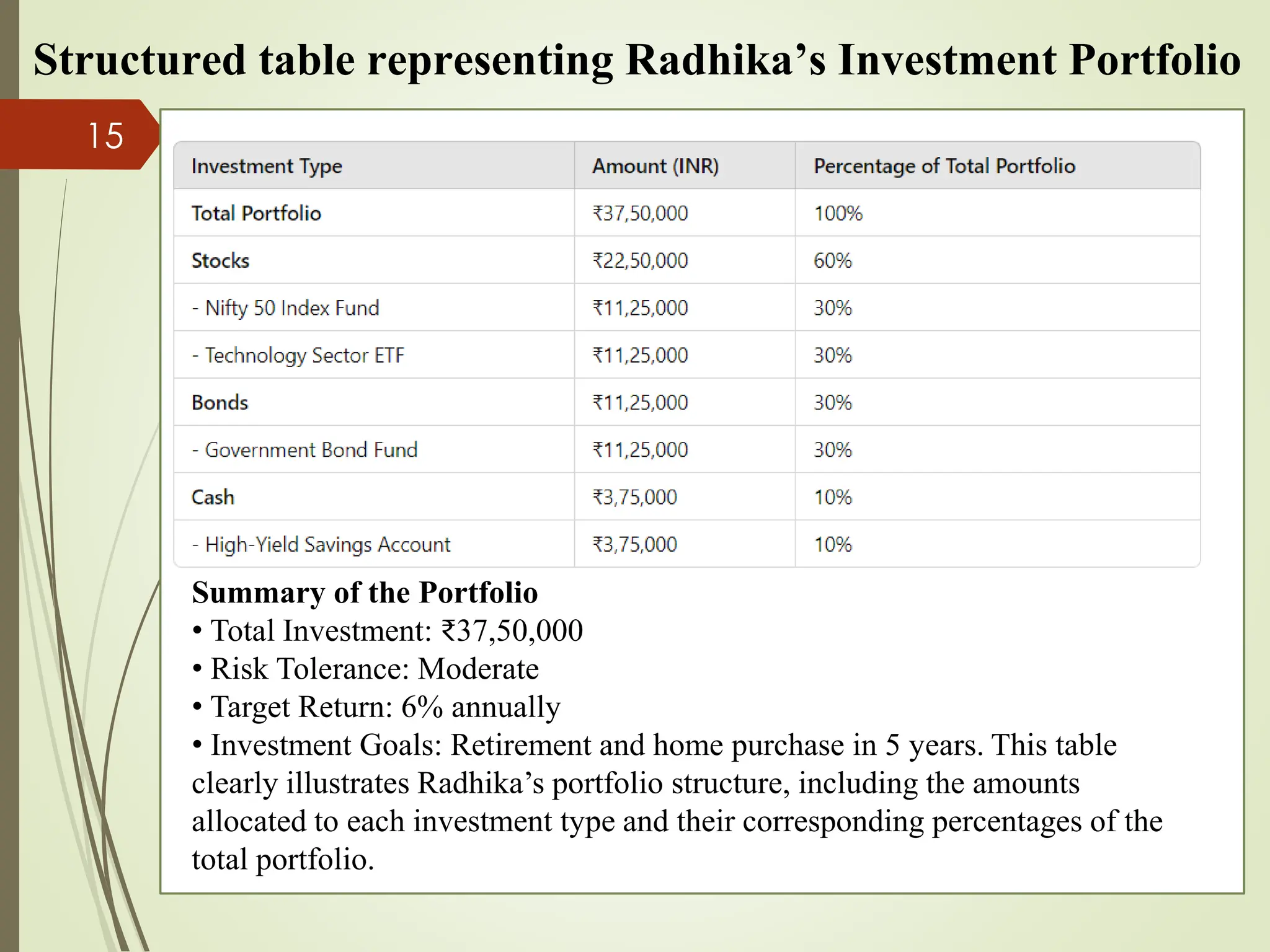
Structured table representing Radhika’s Investment Portfolio
15
Summary of the Portfolio
• Total Investment: ₹37,50,000
• Risk Tolerance: Moderate
• Target Return: 6% annually
• Investment Goals: Retirement and home purchase in 5 years. This table
clearly illustrates Radhika’s portfolio structure, including the amounts
allocated to each investment type and their corresponding percentages of the
total portfolio.
16

PRESENTATION - PPT.pdfffffffffffffffffff

  • 1.
    Process of Portfolio Construction. 1 ShirishaT (157) Harshitha K (190) Sushmna P (191)
  • 2.
    Contents ❖What is Portfolio? ❖ Process of Portfolio Construction. ❖ Example of Portfolio Construction. ❖ Tabular representation and summary of example scenario. 2
  • 3.
    What is Portfolio?  Portfolio is a combination of securities such as stocks, bonds, and money market instruments.  The process of blending together the broad classes so as to obtain return with minimum risk is called PORTFOLIO CONSTRUCTION.  Diversification of investments helps to spread risk over many assets and thus reduces unsystematic risk.  Effective portfolio construction requires a systematic approach to balancing risk and return while considering an investor's specific objectives 3
  • 4.
    Process of PortfolioConstruction 4
  • 5.
    Step 1: DefineInvestment Objectives Goal: Establish the investor's goals and what they hope to achieve. This could include: • Capital growth (increase in value over time). • Income generation (through dividends or interest). • Wealth preservation (maintaining the portfolio's value). • Specific future goals (retirement, purchasing a home, etc.). Considerations: Time horizon, return expectations, and constraints (liquidity needs, tax considerations). 5
  • 6.
    Step 2 :Assess Risk Tolerance Goal: Understand how much risk the investor is willing and able to tolerate. Factors Affecting Risk Tolerance: • Investor’s financial situation. • Emotional tolerance for volatility. • Time horizon (longer horizons generally allow for more risk). Outcome: Helps decide the appropriate mix of high-risk vs. low-risk assets. 6
  • 7.
    Step 3 :Asset Allocation Goal: Determine the proportion of different asset classes in the portfolio. Major asset classes include: • Stocks (Equities): Higher risk, but potential for higher returns. • Bonds (Fixed Income): Lower risk, offering stability and income. • Cash/Cash Equivalents: Safeguard liquidity with very low risk. • Alternatives: Real estate, commodities, and other assets for diversification. Purpose: Diversify across asset classes to balance risk and return. 7
  • 8.
    Step 4 :Security Selection Goal: Choose specific securities (stocks, bonds, etc.) within each asset class. • Top-Down Approach: Look at economic or sector-level analysis. • Bottom-Up Approach: Focus on individual security fundamentals (revenue, earnings, etc.). Criteria: The selection depends on factors like company performance, market trends, and economic forecasts. 8
  • 9.
    Step 5 :Portfolio Optimization Goal: Ensure the portfolio is balanced to achieve the maximum return for the level of risk taken Use tools like Modern Portfolio Theory (MPT) to optimize the portfolio’s risk-return profile. Diversification: Refine the portfolio to ensure it’s well-diversified, minimizing unsystematic risk. 9
  • 10.
    Step 6 :Implementation Goal: Put the strategy into action by executing trades to build the portfolio according to the selected asset allocation and security choices. Considerations: • Transaction costs. • Timing (avoiding market timing but considering entry points). • Liquidity requirements. Execution: Efficiently buying or selling assets while keeping costs low and staying aligned with the investor's objectives. 10
  • 11.
    Step 7 :Monitoring & Rebalancing  Goal: Continuously monitor the portfolio's performance and make adjustments as necessary.  Rebalancing: Bring the portfolio back to the original asset allocation when asset values shift due to market movements.  Performance Monitoring: Evaluate portfolio returns, comparing them to benchmarks and risk-adjusted performance measures.  Other Factors: Consider changes in the investor’s goals, market conditions, or tax considerations when rebalancing. 11
  • 12.
    Example of PortfolioConstruction  Investor Profile: • Name: Radhika. • Age: 30 • Risk Tolerance: Moderate • Investment Goals: Save for retirement and a home purchase in 5 years.  Portfolio Construction: 1. Goals: Aim for 6% annual returns with moderate risk. 2. Financial Info: • Net Worth: ₹37,50,000 12
  • 13.
    Example of PortfolioConstruction  Asset Allocation • 60% Stocks: ₹22,50,000 • 30% Bonds: ₹11,25,000 • 10% Cash: ₹3,75,000 • Investment Selection: • Stocks: o ₹11,25,000 in an Nifty 50 index fund o ₹11,25,000 in a technology sector ETF • Bonds: o ₹11,25,000 in a government bond fund or a fixed deposit. • Cash: o ₹3,75,000 in a high-yield savings account or liquid mutual fund for emergency funds. 13
  • 14.
    Example of PortfolioConstruction Portfolio • Total Investment: ₹37,50,000 • Breakdown: o ₹22,50,000 in stocks o ₹11,25,000 in bonds o ₹3,75,000 in cash  Monitoring: Radhika checks her portfolio quarterly and rebalances if any asset class deviates by more than 5% from the target allocation.  Adjustments: If she changes jobs, she may increase her contributions to retirement accounts. 14
  • 15.
    Structured table representingRadhika’s Investment Portfolio 15 Summary of the Portfolio • Total Investment: ₹37,50,000 • Risk Tolerance: Moderate • Target Return: 6% annually • Investment Goals: Retirement and home purchase in 5 years. This table clearly illustrates Radhika’s portfolio structure, including the amounts allocated to each investment type and their corresponding percentages of the total portfolio.
  • 16.