1
SYSTEMATIC INVESTMENT PLAN
Presented By :
Frontline Securities Limited
Date :23.02.2009
Disclaimer :
This document has been prepared by FRONTILNE SECURITIES LIMITED for the use of
recipient only and not for circulation. The information and opinions contained in the document
have been compiled from sources believed to be reliable. Frontline does not warrant its
accuracy, completeness and correctness. This document is not , and should not be construed
as , an offer to sell or solicitation to buy any securities. This document may not be reproduced,
distributed or published, in whole or a part ,by any recipient hereof for any purpose without
prior permission from us .
2
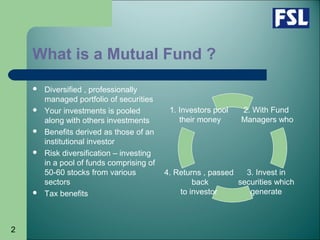
What is a Mutual Fund ?
 Diversified , professionally
managed portfolio of securities
 Your investments is pooled
along with others investments
 Benefits derived as those of an
institutional investor
 Risk diversification – investing
in a pool of funds comprising of
50-60 stocks from various
sectors
 Tax benefits
2. With Fund
Managers who
3. Invest in
securities which
generate
4. Returns , passed
back
to investor
1. Investors pool
their money
3
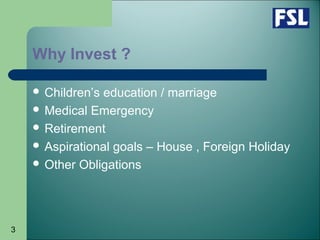
Why Invest ?
 Children’s education / marriage
 Medical Emergency
 Retirement
 Aspirational goals – House , Foreign Holiday
 Other Obligations
4
TIME VALUE OF MONEY
Patience and discipline are required not to make the
wrong move at the wrong time – the results can be
dramatic – it is far more common to do the wrong thing
than to not do the right thing.
Considering inflation @ 5 %
5
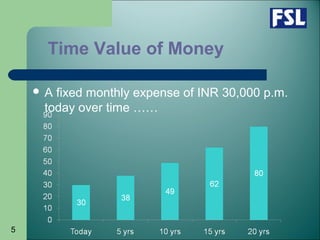
Time Value of Money
 A fixed monthly expense of INR 30,000 p.m.
today over time ……
6
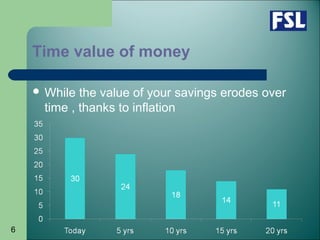
Time value of money
 While the value of your savings erodes over
time , thanks to inflation
7
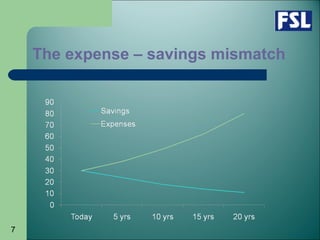
The expense – savings mismatch
8
LET’S PLAN TO GET RICH
TOGETHER
INVESTORS NEED TO SAVE REGULARLY
INTO ASSETS THAT CAN BEAT
INFLATION TO MEET THEIR FINANCIAL
GOALS.
9
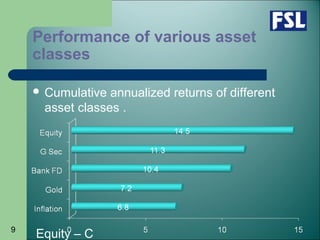
Performance of various asset
classes
 Cumulative annualized returns of different
asset classes .
Equity – C
10
MARKET TIMING –
DOES IT MATTER ?
11
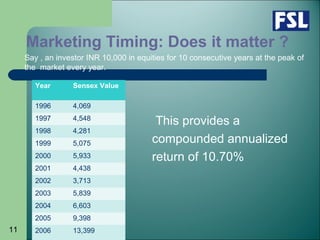
Marketing Timing: Does it matter ?
This provides a
compounded annualized
return of 10.70%
Year Sensex Value
1996 4,069
1997 4,548
1998 4,281
1999 5,075
2000 5,933
2001 4,438
2002 3,713
2003 5,839
2004 6,603
2005 9,398
2006 13,399
Say , an investor INR 10,000 in equities for 10 consecutive years at the peak of
the market every year.
12
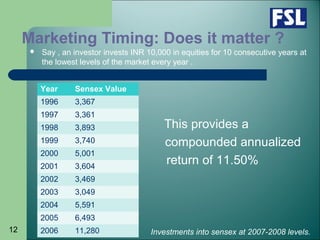
Marketing Timing: Does it matter ?
Year Sensex Value
1996 3,367
1997 3,361
1998 3,893
1999 3,740
2000 5,001
2001 3,604
2002 3,469
2003 3,049
2004 5,591
2005 6,493
2006 11,280
 Say , an investor invests INR 10,000 in equities for 10 consecutive years at
the lowest levels of the market every year .
This provides a
compounded annualized
return of 11.50%
Investments into sensex at 2007-2008 levels.
13
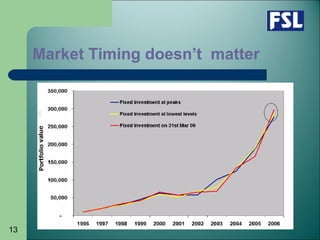
Market Timing doesn’t matter
14
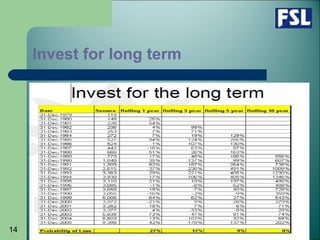
Invest for long term
15
MORAL
Market timing doesn’t help !!!
…………….. It is the time in
the markets that matters
16
Case Study – Systematic Investing
Little Drops of Water Make the Mighty Ocean
17
Systematic Investment Plan
 Let’s take an example ……
 Anil is a businessman. He is married to Tina who is a
housewife. He has a son and daughter , both are in
school.
 Over next couple of years, he desires to follow a
savings plan to build wealth for his children’s
education/marriage and buy a bigger house.
 In order to hedge against uncertainties of business ,
he has been regularly investing in fixed income
instruments.
18
 The lower interest rates over the years have been worrying
him.
 He decides to take the help of Sreeni , financial advisor.
 After carefully evaluating his financial goals and time required
to achieve his financial goals , he advises him to invest in
equity mutual funds for following reasons
— Portfolio diversification
— Superior returns ( refer slide on cumulative annualized returns
for different asset classes for details )
Systematic Investment Plan
19
 However, Anil is not comfortable investing into equity
mutual funds as they are volatile and therefore risky
and avoidable.
 Sreeni advises Mahesh to register for Systematic
Investment Plan (SIP) and make use of volatility in
the market rather than get worried and avoid
investing in equity mutual funds.
 Anil is not clear as to how SIP will work to his
advantage and requests for more details
 Sreeni explains as follows :
Systematic Investment Plan
20
Systematic Investment, An
example
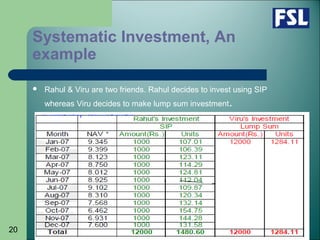
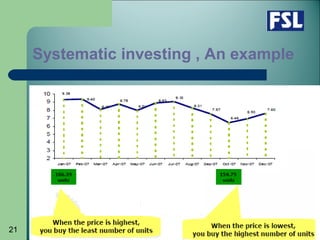
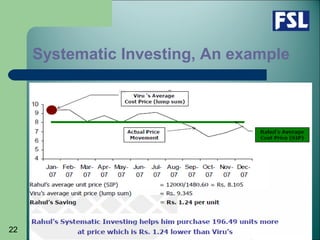
 Rahul & Viru are two friends. Rahul decides to invest using SIP
whereas Viru decides to make lump sum investment.
21
Systematic investing , An example
22
Systematic Investing, An example
23
Why Systematic Investing?
 The Goal of most investors is to buy when the
prices are low, and sell when the prices are
high.
 Sounds simple, but trying to time the market
like this is :
1. Time Consuming
2. Risky
3. And almost Impossible
 A more successful strategy is to adopt
Rupee Cost Averaging.
24
What is Rupee Cost Averaging ?
 The markets are volatile : they move up and down in an
unpredictable manner.
 Invest a fixed amount, at regular, predetermined
intervals and use the market fluctuations to your benefit.
 How does it help you :
1. You buy less when the market is up. You buy more
when the market is down
2. Overtime the market fluctuations are averaged
3. Most likely you will realize a saving on the cost per unit
4. This may lead to HIGHER RETURNS
25
Three common reasons for not
investing
 I don’t have enough money to invest
 I am too busy making money to worry about managing
it
 I don’t have the time or expertise to follow the market
movements and make investments at the right time.
SYSTEMATIC INVESTMENT PLAN
is the only answer to all reasons.
26
Investment made easy – SIP
SIP is an investment program that
allows you to contribute a fixed amount
(as low as Rs.1000 )in mutual funds at
regular intervals.
27
Systematic Investment Plan
The Smart Law of Averages
 Invest regularly and periodically instead of Lumpsum / 1
time investment.
 For example , if you have Rs. 60000 to invest – you can
either do a one time investment or alternatively you can
spread the investment amount over a period of time say
Rs. 5000 every month for 12 months or Rs.10,000 every
month for 6 months.
28
How to make Sip work for you ?
Set your financial goals
Identify the scheme
Decide the SIP amount
Look for a long term commitment
Aim for the big picture
Start investing.
29
Thank You

Sip presentation

  • 1.
    1 SYSTEMATIC INVESTMENT PLAN PresentedBy : Frontline Securities Limited Date :23.02.2009 Disclaimer : This document has been prepared by FRONTILNE SECURITIES LIMITED for the use of recipient only and not for circulation. The information and opinions contained in the document have been compiled from sources believed to be reliable. Frontline does not warrant its accuracy, completeness and correctness. This document is not , and should not be construed as , an offer to sell or solicitation to buy any securities. This document may not be reproduced, distributed or published, in whole or a part ,by any recipient hereof for any purpose without prior permission from us .
  • 2.
    2 What is aMutual Fund ?  Diversified , professionally managed portfolio of securities  Your investments is pooled along with others investments  Benefits derived as those of an institutional investor  Risk diversification – investing in a pool of funds comprising of 50-60 stocks from various sectors  Tax benefits 2. With Fund Managers who 3. Invest in securities which generate 4. Returns , passed back to investor 1. Investors pool their money
  • 3.
    3 Why Invest ? Children’s education / marriage  Medical Emergency  Retirement  Aspirational goals – House , Foreign Holiday  Other Obligations
  • 4.
    4 TIME VALUE OFMONEY Patience and discipline are required not to make the wrong move at the wrong time – the results can be dramatic – it is far more common to do the wrong thing than to not do the right thing. Considering inflation @ 5 %
  • 5.
    5 Time Value ofMoney  A fixed monthly expense of INR 30,000 p.m. today over time ……
  • 6.
    6 Time value ofmoney  While the value of your savings erodes over time , thanks to inflation
  • 7.
    7 The expense –savings mismatch
  • 8.
    8 LET’S PLAN TOGET RICH TOGETHER INVESTORS NEED TO SAVE REGULARLY INTO ASSETS THAT CAN BEAT INFLATION TO MEET THEIR FINANCIAL GOALS.
  • 9.
    9 Performance of variousasset classes  Cumulative annualized returns of different asset classes . Equity – C
  • 10.
  • 11.
    11 Marketing Timing: Doesit matter ? This provides a compounded annualized return of 10.70% Year Sensex Value 1996 4,069 1997 4,548 1998 4,281 1999 5,075 2000 5,933 2001 4,438 2002 3,713 2003 5,839 2004 6,603 2005 9,398 2006 13,399 Say , an investor INR 10,000 in equities for 10 consecutive years at the peak of the market every year.
  • 12.
    12 Marketing Timing: Doesit matter ? Year Sensex Value 1996 3,367 1997 3,361 1998 3,893 1999 3,740 2000 5,001 2001 3,604 2002 3,469 2003 3,049 2004 5,591 2005 6,493 2006 11,280  Say , an investor invests INR 10,000 in equities for 10 consecutive years at the lowest levels of the market every year . This provides a compounded annualized return of 11.50% Investments into sensex at 2007-2008 levels.
  • 13.
  • 14.
  • 15.
    15 MORAL Market timing doesn’thelp !!! …………….. It is the time in the markets that matters
  • 16.
    16 Case Study –Systematic Investing Little Drops of Water Make the Mighty Ocean
  • 17.
    17 Systematic Investment Plan Let’s take an example ……  Anil is a businessman. He is married to Tina who is a housewife. He has a son and daughter , both are in school.  Over next couple of years, he desires to follow a savings plan to build wealth for his children’s education/marriage and buy a bigger house.  In order to hedge against uncertainties of business , he has been regularly investing in fixed income instruments.
  • 18.
    18  The lowerinterest rates over the years have been worrying him.  He decides to take the help of Sreeni , financial advisor.  After carefully evaluating his financial goals and time required to achieve his financial goals , he advises him to invest in equity mutual funds for following reasons — Portfolio diversification — Superior returns ( refer slide on cumulative annualized returns for different asset classes for details ) Systematic Investment Plan
  • 19.
    19  However, Anilis not comfortable investing into equity mutual funds as they are volatile and therefore risky and avoidable.  Sreeni advises Mahesh to register for Systematic Investment Plan (SIP) and make use of volatility in the market rather than get worried and avoid investing in equity mutual funds.  Anil is not clear as to how SIP will work to his advantage and requests for more details  Sreeni explains as follows : Systematic Investment Plan
  • 20.
    20 Systematic Investment, An example Rahul & Viru are two friends. Rahul decides to invest using SIP whereas Viru decides to make lump sum investment.
  • 21.
  • 22.
  • 23.
    23 Why Systematic Investing? The Goal of most investors is to buy when the prices are low, and sell when the prices are high.  Sounds simple, but trying to time the market like this is : 1. Time Consuming 2. Risky 3. And almost Impossible  A more successful strategy is to adopt Rupee Cost Averaging.
  • 24.
    24 What is RupeeCost Averaging ?  The markets are volatile : they move up and down in an unpredictable manner.  Invest a fixed amount, at regular, predetermined intervals and use the market fluctuations to your benefit.  How does it help you : 1. You buy less when the market is up. You buy more when the market is down 2. Overtime the market fluctuations are averaged 3. Most likely you will realize a saving on the cost per unit 4. This may lead to HIGHER RETURNS
  • 25.
    25 Three common reasonsfor not investing  I don’t have enough money to invest  I am too busy making money to worry about managing it  I don’t have the time or expertise to follow the market movements and make investments at the right time. SYSTEMATIC INVESTMENT PLAN is the only answer to all reasons.
  • 26.
    26 Investment made easy– SIP SIP is an investment program that allows you to contribute a fixed amount (as low as Rs.1000 )in mutual funds at regular intervals.
  • 27.
    27 Systematic Investment Plan TheSmart Law of Averages  Invest regularly and periodically instead of Lumpsum / 1 time investment.  For example , if you have Rs. 60000 to invest – you can either do a one time investment or alternatively you can spread the investment amount over a period of time say Rs. 5000 every month for 12 months or Rs.10,000 every month for 6 months.
  • 28.
    28 How to makeSip work for you ? Set your financial goals Identify the scheme Decide the SIP amount Look for a long term commitment Aim for the big picture Start investing.
  • 29.