IJRET: International Journal of Research in Engineering and Technology eISSN: 2319-1163 | pISSN: 2321-7308
__________________________________________________________________________________________
Volume: 03 Special Issue: 07 | May-2014, Available @ http://www.ijret.org 129
INVALIDATING VULNERABLE BROADCASTER NODES USING
MAXIMUM LIKELIHOOD EXPECTATION
Jeril Kuriakose1
, Amruth V2
, Swathy Nandhini N3
, Iyer Snehal Gopalakrishnan4
, Cyril Kuriakose5
1
Research Scholar, School of Computing and Information Technology (SCIT), Manipal University Jaipur, Jaipur, India
2
Assistant Professor, Department of Information Science and Engineering, Bearys Institute of Technology, Mangalore,
India
3
Assistant Professor, Department of Information Technology, Jayam College of Engineering and Technology,
Dharmapuri, India
4
M Tech student, SCIT, Manipal University Jaipur, Jaipur, India
5
Senior Support Executive, Allsec Technology Ltd., Chennai, India
Abstract
Discovering the cheating or vulnerable anchor node (or broadcaster node) is an essential problem in wireless sensor networks
(WSNs). In wireless sensor networks, anchor nodes are the nodes that know its current location. Neighboring nodes or non-anchor
nodes calculate its location (or its location reference) with the help of anchor nodes. Ingenuous localization is not possible in the
presence of a cheating anchor node or a cheating node. Nowadays, it’s a challenging task to identify the cheating anchor node or
cheating node in a network. Even after finding out the location of the cheating anchor node, there is no assurance, that the identified
node is legitimate or not. This paper aims to localize the cheating anchor nodes using trilateration algorithm and later associate it
with maximum likelihood expectation technique (MLE) to obtain maximum accuracy in localization. We were able to attain a
considerable reduction in the error achieved during localization. For implementation purpose we simulated our scheme using ns-3
network simulator.
Keywords: Maximum likelihood expectation; trilateration; anchor node; security; distance-based localization; wireless
sensor networks;
-----------------------------------------------------------------------***----------------------------------------------------------------------
1. INTRODUCTION
Wireless ad hoc and sensor networks are on a steady rise in
the recent decade. This is because of their reduced cost in
deployment and maintenance. Advancements in radio
frequency spectrum also carved way for the improvement in
the data rate for communication. Many devices belong to
wireless ad hoc and sensor networks; one among them is
anchor node [1 - 8]. Anchor nodes are the nodes that know its
current location. Neighboring nodes or non-anchor nodes
calculate its location (or location reference) with the help of
anchor nodes, and its working is quite referable to Light
House.
The location of the nodes plays a significant role in many
areas as routing, surveillance and monitoring, military etc. The
sensor nodes must know their location reference to carryout
Location-based routing (LR) [9 - 12]. To find out the shortest
route, the Location Aided Routing (LAR) [13 - 15] makes use
of the locality reference of the sensor nodes. In some
industries the sensor nodes are used to identify minute changes
as pressure, temperature and gas leak, and in military, robots
are used to detect landmines where in both the cases location
information plays a key part.
Anchor nodes can also be used to find the current location of
any device (mobile phones, objects and people). It does that
by transmitting anchor frames periodically or at regular
intervals. Usually anchor frames are used to advertise the
occurrence of a wireless modem or an Access Point (AP).
Each anchor frame carries some details about the
configuration of AP and a little security information for the
clients.
When the technologies are on a massive upswing, the need for
security of the relevant technologies arises. There can be
several occasion where the anchor nodes can be vulnerable to
security breach. Because of the security breach the anchor
node starts to cheat by giving false information. In the
presence of cheating anchor nodes the chances of localization
drastically decreases. Many papers [16 - 19] discuss about the
localization of cheating anchor nodes, but with inconsistent
accuracy. So, to overcome this, we localize the cheating or
vulnerable anchor node using trilateration technique and
IJRET: International Journal of Research in Engineering and Technology eISSN: 2319-1163 | pISSN: 2321-7308
__________________________________________________________________________________________
Volume: 03 Special Issue: 07 | May-2014, Available @ http://www.ijret.org 130
associate the results with maximum likelihood expectation
technique [20].
Organization of the paper - Section 2 provides the
localization using trilateration algorithm and section 3 studies
the maximum likelihood expectation. Simulation and results
are covered in section 4 and section 5 concludes the paper.
2. LOCALIZATION USING TRILATERATION
ALGORITHM
Anchor nodes are widely used for tacking and localization;
whereas nowadays it is also used for navigation and route-
identification. With the help of anchor nodes, a user can find
out his current location. Consider a scenario like a hotel or
museum, there may be many occasions where people go out of
track. Thiscan be flabbergasted by installing anchor nodes
installed in various locations, so that people can trace out there
location very easily and it ispossible only when the anchor
nodes are authentic. Nowadays hackers are on a rise; anybody
can easily get into any system and change its settings.
Similarly, they can hack any anchor nodes and change its
location reference to some other false location reference,
making people lose their track; thus leading to a bad imprint
about the system (i.e., hotel, museum).
An attack is exemplified in fig. 1 and fig. 2. Fig. 1 shows the
initial deployment of anchor nodes A1, A2, A3; with location
reference (x1, y1), (x2, y2), (x3, y3); and distance L1, L2, L3;
respectively, from the trilateration point T, having location
reference (xt, yt). Fig. 2 demonstrates the logical deployment
of anchor nodes after the attack i.e., multiple changes in
location reference of anchor node A2.
The three dimensional location coordinate of any device or
node can be estimated using trilateration calculations.
Trilateration technique uses distance measurements rather than
angular measurements; latter technique is also used in many
localization techniques [21 -23, 32]. Using some iterative
schemes like least square, least median square [17], least
trimmed square [24] and gradient descent [25], can equitably
increase the accuracy of trilateration technique.
Fig. 1. Initial setup of anchor nodes
Fig. 2. Anchor nodes after attack
Trilateration techniques use the distance measurement
between the nodes to calculate the location reference. The
distances between the nodes are identified using Received
Signal Strength (RSSI) [26, 32] or Time of Arrival (ToA) [27,
28, 32] or Time Difference of Arrival (TDoA) [29, 30, 32].
When a node (requesting node) wants to identify its location
information using trilateration technique, it does with the help
of three or more neighboring anchor nodes. The
exemplification of trilateration techniques is as follows:
a) A node that wants to find its location reference (or
location coordinate) sends a localization request to any
IJRET: International Journal of Research in Engineering and Technology eISSN: 2319-1163 | pISSN: 2321-7308
__________________________________________________________________________________________
Volume: 03 Special Issue: 07 | May-2014, Available @ http://www.ijret.org 131
of its neighboring anchor nodes. The anchor node sends
a reply with its current location reference and its RSSI
measurement with respect to the node that wants to
localize. Based on this information, we put up a virtual
wireless ring (VWR) (or logical ring) [31] as shown in
fig. 3. The assumption of the logical ring is made with
the anchor node as center. The requesting node can be
located anywhere on the circumference of the logical
ring, and thus making it difficult to guess its exact
location.
Fig. 3. Virtual wireless ring with one anchor node
b) Next the same requesting node sends another
localization request to a different neighboring anchor
node. The anchor node follows the same process as
discussed in the previous step. Again another logical
ring is updated to the previous one, shown in fig. 4.
From the logical observation we can analyze that the
location of the requesting node could be present in any
one of the intersecting point of the two logical rings.
Fig. 4. Virtual wireless ring with two anchor nodes
c) Finally to ease the muddle, the same requesting node
sends another localization request to a different
neighboring anchor node other than the previous two
anchor nodes. The same process is repeated with the
new neighboring anchor node. When the final virtual
wireless ring is drawn, we would be able to extract the
exact location of the requesting node. Fig. 5 shows the
localization of a node using trilateration technique.
Fig. 5. Virtual wireless ring with three anchor node
The mathematical computation of trilateration is as follows:
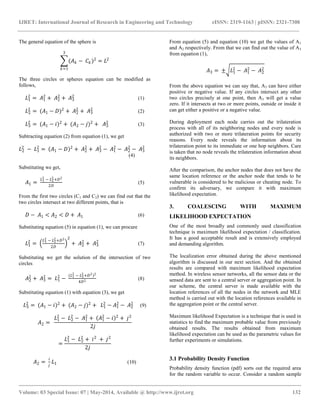
Consider three circles or spheres with center C1, C2 and C3,
radius L1, L2 and L3 from points A1, A2 and A3 (anchor node
location), refer fig. 6.
Fig.6. Trilateration measurements
IJRET: International Journal of Research in Engineering and Technology eISSN: 2319-1163 | pISSN: 2321-7308
__________________________________________________________________________________________
Volume: 03 Special Issue: 07 | May-2014, Available @ http://www.ijret.org 132
The general equation of the sphere is
(𝐴 𝑘 − 𝐶 𝑘)2
= 𝐿2
3
𝑘=1
The three circles or spheres equation can be modified as
follows,
𝐿1
2
= 𝐴1
2
+ 𝐴2
2
+ 𝐴3
2
(1)
𝐿2
2
= (𝐴1 − 𝐷)2
+ 𝐴2
2
+ 𝐴3
2
(2)
𝐿3
2
= (𝐴1 − 𝑖)2
+ (𝐴2 − 𝑗)2
+ 𝐴3
2
(3)
Subtracting equation (2) from equation (1), we get
𝐿2
2
− 𝐿1
2
= 𝐴1 − 𝐷 2
+ 𝐴2
2
+ 𝐴3
2
− 𝐴1
2
− 𝐴2
2
− 𝐴3
2
(4)
Substituting we get,
𝐴1 =
𝐿1
2 − 𝐿2
2 +𝐷2
2𝐷
(5)
From the first two circles (C1 and C2) we can find out that the
two circles intersect at two different points, that is
𝐷 − 𝐴1 < 𝐴2 < 𝐷 + 𝐴1 (6)
Substituting equation (5) in equation (1), we can procure
𝐿1
2
=
𝐿1
2
− 𝐿2
2
+𝐷2
2𝐷
2
+ 𝐴2
2
+ 𝐴3
2
(7)
Substituting we get the solution of the intersection of two
circles
𝐴2
2
+ 𝐴3
2
= 𝐿1
2
−
(𝐿1
2
− 𝐿2
2
+𝐷2)2
4𝐷2 (8)
Substituting equation (1) with equation (3), we get
𝐿3
2
= (𝐴1 − 𝑖)2
+ (𝐴2 − 𝑗)2
+ 𝐿1
2
− 𝐴1
2
− 𝐴2
2
(9)
𝐴2 =
𝐿1
2
− 𝐿2
2
− 𝐴1
2
+ 𝐴1
2
− 𝑖 2
+ 𝑗2
2𝑗
=
𝐿1
2
− 𝐿2
2
+ 𝑖2
+ 𝑗2
2𝑗
𝐴2 =
𝑖
𝑗
𝐿1 (10)
From equation (5) and equation (10) we get the values of A1
and A2 respectively. From that we can find out the value of A3
from equation (1),
𝐴3 = ± 𝐿1
2
− 𝐴1
2
− 𝐴2
2
From the above equation we can say that, A3 can have either
positive or negative value. If any circles intersect any other
two circles precisely at one point, then A3 will get a value
zero. If it intersects at two or more points, outside or inside it
can get either a positive or a negative value.
During deployment each node carries out the trilateration
process with all of its neighboring nodes and every node is
authorized with two or more trilateration points for security
reasons. Every node reveals the information about its
trilateration point to its immediate or one hop neighbors. Care
is taken that no node reveals the trilateration information about
its neighbors.
After the comparison, the anchor nodes that does not have the
same location reference or the anchor node that tends to be
vulnerable is considered to be malicious or cheating node. To
confirm its adversary, we compare it with maximum
likelihood expectation.
3. COALESCING WITH MAXIMUM
LIKELIHOOD EXPECTATION
One of the most broadly and commonly used classification
technique is maximum likelihood expectation / classification.
It has a good acceptable result and is extensively employed
and demanding algorithm.
The localization error obtained during the above mentioned
algorithm is discussed in our next section. And the obtained
results are compared with maximum likelihood expectation
method. In wireless sensor networks, all the sensor data or the
sensed data are sent to a central server or aggregation point. In
our scheme, the central server is made available with the
location references of all the nodes in the network and MLE
method is carried out with the location references available in
the aggregation point or the central server.
Maximum likelihood Expectation is a technique that is used in
statistics to find the maximum probable value from previously
obtained results. The results obtained from maximum
likelihood expectation can be used as the parametric values for
further experiments or simulations.
3.1 Probability Density Function
Probability density function (pdf) sorts out the required area
for the random variable to occur. Consider a random sample
IJRET: International Journal of Research in Engineering and Technology eISSN: 2319-1163 | pISSN: 2321-7308
__________________________________________________________________________________________
Volume: 03 Special Issue: 07 | May-2014, Available @ http://www.ijret.org 133
(x1, x2, …,xn) from an unknown population has data vector x =
(x1, x2, …, xn). The probability density function f(x|w) is
𝑓 𝑥 = 𝑥1, 𝑥2, … , 𝑥 𝑛 𝑤
= 𝑓1 𝑥1 𝑤 ∗ 𝑓2 𝑥2 𝑤 ∗ … ∗ 𝑓𝑛(𝑥 𝑛|𝑤)
Where:
x is a random sample,
w is the parameter value.
Consider a scenario where n (number of trials) = 10, w = 0.4
and x = (0, 1, …, 10), then the probability density function
will be
𝑓 𝑥 𝑛 = 10, 𝑤 = 0.4 )
=
10!
𝑥! (10 − 𝑥!)
(0.4) 𝑥
(0.6)10−𝑥
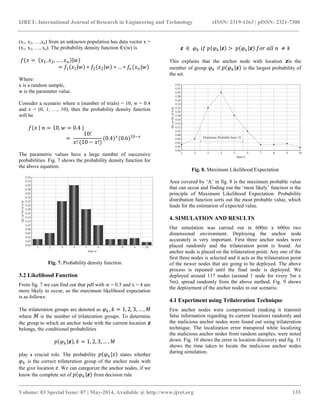
The parametric values have a large number of successive
probabilities. Fig. 7 shows the probability density function for
the above equation.
Fig. 7. Probability density function
3.2 Likelihood Function
From fig. 7 we can find out that pdf with w = 0.5 and x = 4 are
more likely to occur, so the maximum likelihood expectation
is as follows:
The trilateration groups are denoted as 𝜑 𝑘, 𝑘 = 1, 2, 3, … , 𝑀
where 𝑀 is the number of trilateration groups. To determine
the group to which an anchor node with the current location 𝒛
belongs, the conditional probabilities
𝑝 𝜑 𝑘 𝒛 , 𝑘 = 1, 2, 3, … , 𝑀
play a crucial role. The probability 𝑝 𝜑 𝑘 𝑧 states whether
𝜑 𝑘 is the correct trilateration group of the anchor node with
the give location 𝑧. We can categorize the anchor nodes, if we
know the complete set of 𝑝 𝜑 𝑘 𝒛 from decision rule
𝒛 ∈ 𝜑 𝑘 𝑖𝑓 𝑝 𝜑 𝑘 𝒛 > 𝑝 𝜑 𝑛 𝒛 𝑓𝑜𝑟 𝑎𝑙𝑙 𝑛 ≠ 𝑘
This explains that the anchor node with location 𝒛is the
member of group 𝜑 𝑘 if 𝑝 𝜑 𝑘 𝒛 is the largest probability of
the set.
Fig. 8. Maximum Likelihood Expectation
Area covered by „A‟ in fig. 8 is the maximum probable value
that can occur and finding out the „most likely‟ function is the
principle of Maximum Likelihood Expectation. Probability
distribution function sorts out the most probable value, which
leads for the estimation of expected value.
4. SIMULATION AND RESULTS
Our simulation was carried out in 600m x 600m two
dimensional environment. Deploying the anchor node
accurately is very important. First three anchor nodes were
placed randomly and the trilateration point is found. An
anchor node is placed on the trilateration point. Any one of the
first three nodes is selected and it acts as the trilateration point
of the newer nodes that are going to be deployed. The above
process is repeated until the final node is deployed. We
deployed around 117 nodes (around 1 node for every 5m x
5m), spread randomly from the above method. Fig. 9 shows
the deployment of the anchor nodes in our scenario.
4.1 Experiment using Trilateration Technique
Few anchor nodes were compromised (making it transmit
false information regarding its current location) randomly and
the malicious anchor nodes were found out using trilateration
technique. The localization error transpired while localizing
the malicious anchor nodes from random samples, were noted
down. Fig. 10 shows the error in location discovery and fig. 11
shows the time taken to locate the malicious anchor nodes
during simulation.
IJRET: International Journal of Research in Engineering and Technology eISSN: 2319-1163 | pISSN: 2321-7308
__________________________________________________________________________________________
Volume: 03 Special Issue: 07 | May-2014, Available @ http://www.ijret.org 134
Fig. 9. Deployment of anchor nodes
Fig. 10. Mean error in location discovery
4.2 Comparing with Maximum Likelihood
Expectation
Maximum likelihood function has a list of initial location
references of the anchor nodes. The false location of the
malicious anchor nodes obtained, were compared with the
results obtained from maximum likelihood function.
Comparing the results obtained, reduced the error in location
discovery. Fig. 12 shows the mean error in locating malicious
anchor nodes. Fig. 13 shows the comparison of the two results,
trilateration and trilateration with MLE.
Fig. 11. Average time for simulation
Fig. 12. Mean error after comparing with maximum likelihood
function
Fig. 13. Result comparison
5. CONCLUSIONS
We have discussed about locating malicious anchor nodes
using trilateration technique and compared the results obtained
with Maximum Likelihood Expectation. This way we were
able to reduce the error attained during localization. While
IJRET: International Journal of Research in Engineering and Technology eISSN: 2319-1163 | pISSN: 2321-7308
__________________________________________________________________________________________
Volume: 03 Special Issue: 07 | May-2014, Available @ http://www.ijret.org 135
using Maximum Likelihood Expectation we can obtain
consistent and efficient results. Our results show that as the
malicious anchor nodes increases, the simulation time and
error obtained during location discovery slightly increases.
The accuracy obtained in our work can be used as assistance
in some wireless applications.
REFERENCES
[1] R. Want, A. Hopper, V. Falcao, and J. Gibbons, “The
Active Badge Location System,” ACM Trans.
Information Systems, vol. 10, pp. 91 - 102, 1992.
[2] J. Liu, Y. Zhang, and F. Zhao, “Robust Distributed
Node Localization with Error Management,”
Proceedings ACM MobiHoc, 2006
[3] M.W. Carter, H.H. Jin, M.A. Saunders, and Y. Ye,
“SpaseLoc: An Adaptive Subproblem Algorithm for
Scalable Wireless Sensor Network Localization,” SIAM
J. Optimization, 2006.
[4] P. Bahl and V.N. Padmanabhan, “RADAR: An In-
Building RFBased User Location and Tracking
System,” Proc. IEEE INFOCOM, 2000.
[5] D. Niculescu and B. Nath, “DV Based Positioning in
Ad Hoc Networks,” J. Telecomm. Systems, vol. 22, pp.
267-280, 2003.
[6] N. Priyantha, A. Chakraborty, and H. Balakrishnan,
“The Cricket Location-Support System,” Proc. ACM
MobiCom, 2000.
[7] R. Stoleru and J.A. Stankovic, “Probability Grid: A
Location Estimation Scheme for Wireless Sensor
Networks,” Proc. First IEEE Conf. Sensor and Ad Hoc
Comm. and Networks (SECON ’04), 2004.
[8] N. Bulusu, J. Heidemann, and D. Estrin, “GPS-Less
Low Cost Outdoor Localization for Very Small
Devices,” IEEE Personal Comm. Magazine, vol. 7, no.
5, pp. 28-34, Oct. 2000.
[9] Tracy Camp, Jeff Boleng, Brad Williams, Lucas
Wilcox and William Navidi, “Performance Comparison
of Two Location Based Routing Protocols for Ad Hoc
Networks,” IEEE Infocom, 2002.
[10] LjubicaBlazevic, Jean-Yves Le Boudec and Silvia
Giordano, “A Location-Based Routing Method for
Mobile Ad Hoc Networks,” IEEE Transactions on
Mobile Computing, 2005.
[11] HolgerFußler, Martin Mauve, et al., “Location Based
Routing for Vehicular AdHoc Networks,” Proceedings
of ACM MOBICOM, 2002.
[12] H. Qu, S. B. Wicke, “Co-designed anchor-free
localization and location-based routing algorithm for
rapidly-deployed wireless sensor networks,”
Information Fusion, 2008.
[13] F. Kuhn, R. Wattenhofer, A. Zollinger, “Worst-case
optimal and average-case efficient geometric ad-hoc
routing,” Proceedings of the 4th ACM International
Symposium on Mobile Ad Hoc Networking &
Computing, 2003.
[14] Karim El Defrawy, Gene Tsudik, “ALARM:
Anonymous Location-Aided Routing in Suspicious
MANETs,”
[15] Young-BaeKo and Nitin H. Vaidya, “Location-Aided
Routing (LAR) in mobile ad hoc networks,” Wireless
Networks, 2000
[16] MurtuzaJadliwala, Sheng Zhong, ShambhuUpadhyaya,
ChunmingQiao and Jean-Pierre Hubaux, “Secure
Distance-Based Localization in the Presence of
Cheating Anchor Nodes,” IEEE Transactions on
Mobile Computing, 2010.
[17] Z. Li, W. Trappe, Y. Zhang, and B. Nath, “Robust
Statistical Methods for Securing Wireless Localization
in Sensor Networks,” Proceedings of Fourth
International Symposium on Information Processing in
Sensor Networks (IPSN ’05), 2005.
[18] D. Liu, P. Ning, and W. Du, “Attack-Resistant
Location Estimation in Sensor Networks,” Proceedings
of Fourth International Symposium on Information
Processing in Sensor Networks (IPSN ’05), 2005.
[19] D. Liu, P. Ning, and W. Du, “Detecting Malicious
Beacon Nodes for Secure Location Discovery in
Wireless Sensor Networks,” Proceedings of 25th
International Conference Distributed Computing
Systems (ICDCS ’05), 2005.
[20] In Jae Myung, “Tutorial on maximum likelihood
estimation,” Journal of Mathematical Psychology,
2003.
[21] R. Peng, M. L. Sichitiu, “Angle of Arrival Localization
for Wireless Sensor Networks,” Third Annual IEEE
Communications Society Conference on Sensor and Ad
Hoc Communications and Networks, 2006.
[22] D. Niculescu and B. Nath, “Ad hoc positioning system
(APS) using AOA,” IEEE INFOCOM, 2003.
[23] A. Nasipuri and K. Li, “A directionality based location
discovery scheme for wireless sensor networks,” ACM
International Workshop on Wireless Sensor Networks
and Applications, 2002.
[24] P. Rousseeuw and K. Driessen, “Computing LTS
regression for large data sets,” Data Mining Knowledge
Discovery, vol. 12, no. 1, pp. 29–45, 2006.
[25] Ravi Garg, Avinash L. Varna and Min Wu, “An
Efficient Gradient Descent Approach to Secure
Localization in Resource Constrained Wireless Sensor
Networks,” IEEE Transactions on Information
Forensics and Security, Vol. 7, No. 2, April 2012.
[26] G. Mao, B.D.O. Anderson, and B. Fidan, “Path Loss
Exponent Estimation for Wireless Sensor Network
Localization,” Computer Networks, vol. 51, pp. 2467-
2483, 2007.
[27] R. Moses, D. Krishnamurthy, and R. Patterson, “A
Self-Localization Method for Wireless Sensor
Networks,” Eurasip J. Applied Signal Processing,
special issue on sensor networks, vol. 2003, pp. 348-
358, 2003.
IJRET: International Journal of Research in Engineering and Technology eISSN: 2319-1163 | pISSN: 2321-7308
__________________________________________________________________________________________
Volume: 03 Special Issue: 07 | May-2014, Available @ http://www.ijret.org 136
[28] G. Sarigiannidis, “Localization for Ad Hoc Wireless
Sensor Networks,” M.S. thesis, Technical University
Delft, The Netherlands, August 2006.
[29] J. Xiao, L. Ren, and J. Tan, “Research of TDOA Based
Self-Localization Approach in Wireless Sensor
Network,” Proceedings IEEE/RSJ International
Conference on Intelligent Robots and Systems, 2006.
[30] N. Priyantha, A. Chakraborty, and H. Balakrishnan,
“The Cricket Location-Support System,” Proceedings
ACM MobiCom, 2000.
[31] George Aggelou, Mobile Ad Hoc Networks from
Wireless LANs to 4G Network, India: Tata McGraw
Hill Education, 2009, Print.
[32] Jeril Kuriakose, Sandeep Joshi, VikramRaju R, and
AravindKilaru, "A Review on Localization in Wireless
Sensor Networks," Advances in Signal Processing and
Intelligent Recognition Systems. Springer International
Publishing, 2014. 599-610.
[33] http://en.wikipedia.org/wiki/3-sphere
[34] http://en.wikipedia.org/wiki/Trilateration
BIOGRAPHIES
Jeril Kuriakose received the B Tech degree
from Jeppiaar Engineering College, India,
in 2010, and M Tech degree from
University of Mysore, India, in 2012, all in
information technology. He is currently
pursuing PhD in Manipal University Jaipur,
India. His research interests include mobile computing, mobile
ad hoc network, network and information security, and
scientific computing
Amruth V received B Tech Degree from
Coorg Institute of Technology, India, and M
Tech Degree from University of Mysore,
India, in 2009 and 2012, respectively, all in
information technology. At present he is
working as assistant professor in Bearys
Institute of Technology, Mangalore, India, in the department
of information science and engineering. His research areas
include remote sensing, algorithms, network and information
security, and wireless networking.
Swathy Nandhini N completed UG degree
in KSR College of Engineering and PG
degree in VaruvanVadivelan Institute of
Technology, Anna University, in India, in
2010 and 2012, respectively.At present she
is working as assistant professor in Jayam
College of Engineering and Technology. Herarea of interest
includes Cryptography and Network Security, Computer
Networks, Operating Systems, and Web Technology.
Iyer Snehal Gopalakrishnan is a M
Tech student in Manipal University
Jaipur, India. He completed his B Tech
in Computer Science from Coorg
Institute of Technology, in India, in
2012. His research interests include
mobile ad hoc network, number theory and crytography, and
wireless sensor network.
Cyril Kuriakose is a senior support
executive at Allsec Technologies Ltd.
He received the B.Sc. degree from St.
Joseph‟s College, Trichy, India, in 2007,
and M.Sc. degree from Kongu
Engineering College, India, in 2012, in
computer science and information technology, respectively.
He is a Governor and President Award winner in scout, in
2001 and 2002, respectively. His research areas include
wireless sensor network, ad hoc network, cryptography, and
network security.

Invalidating vulnerable broadcaster nodes using

  • 1.
    IJRET: International Journalof Research in Engineering and Technology eISSN: 2319-1163 | pISSN: 2321-7308 __________________________________________________________________________________________ Volume: 03 Special Issue: 07 | May-2014, Available @ http://www.ijret.org 129 INVALIDATING VULNERABLE BROADCASTER NODES USING MAXIMUM LIKELIHOOD EXPECTATION Jeril Kuriakose1 , Amruth V2 , Swathy Nandhini N3 , Iyer Snehal Gopalakrishnan4 , Cyril Kuriakose5 1 Research Scholar, School of Computing and Information Technology (SCIT), Manipal University Jaipur, Jaipur, India 2 Assistant Professor, Department of Information Science and Engineering, Bearys Institute of Technology, Mangalore, India 3 Assistant Professor, Department of Information Technology, Jayam College of Engineering and Technology, Dharmapuri, India 4 M Tech student, SCIT, Manipal University Jaipur, Jaipur, India 5 Senior Support Executive, Allsec Technology Ltd., Chennai, India Abstract Discovering the cheating or vulnerable anchor node (or broadcaster node) is an essential problem in wireless sensor networks (WSNs). In wireless sensor networks, anchor nodes are the nodes that know its current location. Neighboring nodes or non-anchor nodes calculate its location (or its location reference) with the help of anchor nodes. Ingenuous localization is not possible in the presence of a cheating anchor node or a cheating node. Nowadays, it’s a challenging task to identify the cheating anchor node or cheating node in a network. Even after finding out the location of the cheating anchor node, there is no assurance, that the identified node is legitimate or not. This paper aims to localize the cheating anchor nodes using trilateration algorithm and later associate it with maximum likelihood expectation technique (MLE) to obtain maximum accuracy in localization. We were able to attain a considerable reduction in the error achieved during localization. For implementation purpose we simulated our scheme using ns-3 network simulator. Keywords: Maximum likelihood expectation; trilateration; anchor node; security; distance-based localization; wireless sensor networks; -----------------------------------------------------------------------***---------------------------------------------------------------------- 1. INTRODUCTION Wireless ad hoc and sensor networks are on a steady rise in the recent decade. This is because of their reduced cost in deployment and maintenance. Advancements in radio frequency spectrum also carved way for the improvement in the data rate for communication. Many devices belong to wireless ad hoc and sensor networks; one among them is anchor node [1 - 8]. Anchor nodes are the nodes that know its current location. Neighboring nodes or non-anchor nodes calculate its location (or location reference) with the help of anchor nodes, and its working is quite referable to Light House. The location of the nodes plays a significant role in many areas as routing, surveillance and monitoring, military etc. The sensor nodes must know their location reference to carryout Location-based routing (LR) [9 - 12]. To find out the shortest route, the Location Aided Routing (LAR) [13 - 15] makes use of the locality reference of the sensor nodes. In some industries the sensor nodes are used to identify minute changes as pressure, temperature and gas leak, and in military, robots are used to detect landmines where in both the cases location information plays a key part. Anchor nodes can also be used to find the current location of any device (mobile phones, objects and people). It does that by transmitting anchor frames periodically or at regular intervals. Usually anchor frames are used to advertise the occurrence of a wireless modem or an Access Point (AP). Each anchor frame carries some details about the configuration of AP and a little security information for the clients. When the technologies are on a massive upswing, the need for security of the relevant technologies arises. There can be several occasion where the anchor nodes can be vulnerable to security breach. Because of the security breach the anchor node starts to cheat by giving false information. In the presence of cheating anchor nodes the chances of localization drastically decreases. Many papers [16 - 19] discuss about the localization of cheating anchor nodes, but with inconsistent accuracy. So, to overcome this, we localize the cheating or vulnerable anchor node using trilateration technique and
  • 2.
    IJRET: International Journalof Research in Engineering and Technology eISSN: 2319-1163 | pISSN: 2321-7308 __________________________________________________________________________________________ Volume: 03 Special Issue: 07 | May-2014, Available @ http://www.ijret.org 130 associate the results with maximum likelihood expectation technique [20]. Organization of the paper - Section 2 provides the localization using trilateration algorithm and section 3 studies the maximum likelihood expectation. Simulation and results are covered in section 4 and section 5 concludes the paper. 2. LOCALIZATION USING TRILATERATION ALGORITHM Anchor nodes are widely used for tacking and localization; whereas nowadays it is also used for navigation and route- identification. With the help of anchor nodes, a user can find out his current location. Consider a scenario like a hotel or museum, there may be many occasions where people go out of track. Thiscan be flabbergasted by installing anchor nodes installed in various locations, so that people can trace out there location very easily and it ispossible only when the anchor nodes are authentic. Nowadays hackers are on a rise; anybody can easily get into any system and change its settings. Similarly, they can hack any anchor nodes and change its location reference to some other false location reference, making people lose their track; thus leading to a bad imprint about the system (i.e., hotel, museum). An attack is exemplified in fig. 1 and fig. 2. Fig. 1 shows the initial deployment of anchor nodes A1, A2, A3; with location reference (x1, y1), (x2, y2), (x3, y3); and distance L1, L2, L3; respectively, from the trilateration point T, having location reference (xt, yt). Fig. 2 demonstrates the logical deployment of anchor nodes after the attack i.e., multiple changes in location reference of anchor node A2. The three dimensional location coordinate of any device or node can be estimated using trilateration calculations. Trilateration technique uses distance measurements rather than angular measurements; latter technique is also used in many localization techniques [21 -23, 32]. Using some iterative schemes like least square, least median square [17], least trimmed square [24] and gradient descent [25], can equitably increase the accuracy of trilateration technique. Fig. 1. Initial setup of anchor nodes Fig. 2. Anchor nodes after attack Trilateration techniques use the distance measurement between the nodes to calculate the location reference. The distances between the nodes are identified using Received Signal Strength (RSSI) [26, 32] or Time of Arrival (ToA) [27, 28, 32] or Time Difference of Arrival (TDoA) [29, 30, 32]. When a node (requesting node) wants to identify its location information using trilateration technique, it does with the help of three or more neighboring anchor nodes. The exemplification of trilateration techniques is as follows: a) A node that wants to find its location reference (or location coordinate) sends a localization request to any
  • 3.
    IJRET: International Journalof Research in Engineering and Technology eISSN: 2319-1163 | pISSN: 2321-7308 __________________________________________________________________________________________ Volume: 03 Special Issue: 07 | May-2014, Available @ http://www.ijret.org 131 of its neighboring anchor nodes. The anchor node sends a reply with its current location reference and its RSSI measurement with respect to the node that wants to localize. Based on this information, we put up a virtual wireless ring (VWR) (or logical ring) [31] as shown in fig. 3. The assumption of the logical ring is made with the anchor node as center. The requesting node can be located anywhere on the circumference of the logical ring, and thus making it difficult to guess its exact location. Fig. 3. Virtual wireless ring with one anchor node b) Next the same requesting node sends another localization request to a different neighboring anchor node. The anchor node follows the same process as discussed in the previous step. Again another logical ring is updated to the previous one, shown in fig. 4. From the logical observation we can analyze that the location of the requesting node could be present in any one of the intersecting point of the two logical rings. Fig. 4. Virtual wireless ring with two anchor nodes c) Finally to ease the muddle, the same requesting node sends another localization request to a different neighboring anchor node other than the previous two anchor nodes. The same process is repeated with the new neighboring anchor node. When the final virtual wireless ring is drawn, we would be able to extract the exact location of the requesting node. Fig. 5 shows the localization of a node using trilateration technique. Fig. 5. Virtual wireless ring with three anchor node The mathematical computation of trilateration is as follows: Consider three circles or spheres with center C1, C2 and C3, radius L1, L2 and L3 from points A1, A2 and A3 (anchor node location), refer fig. 6. Fig.6. Trilateration measurements
  • 4.
    IJRET: International Journalof Research in Engineering and Technology eISSN: 2319-1163 | pISSN: 2321-7308 __________________________________________________________________________________________ Volume: 03 Special Issue: 07 | May-2014, Available @ http://www.ijret.org 132 The general equation of the sphere is (𝐴 𝑘 − 𝐶 𝑘)2 = 𝐿2 3 𝑘=1 The three circles or spheres equation can be modified as follows, 𝐿1 2 = 𝐴1 2 + 𝐴2 2 + 𝐴3 2 (1) 𝐿2 2 = (𝐴1 − 𝐷)2 + 𝐴2 2 + 𝐴3 2 (2) 𝐿3 2 = (𝐴1 − 𝑖)2 + (𝐴2 − 𝑗)2 + 𝐴3 2 (3) Subtracting equation (2) from equation (1), we get 𝐿2 2 − 𝐿1 2 = 𝐴1 − 𝐷 2 + 𝐴2 2 + 𝐴3 2 − 𝐴1 2 − 𝐴2 2 − 𝐴3 2 (4) Substituting we get, 𝐴1 = 𝐿1 2 − 𝐿2 2 +𝐷2 2𝐷 (5) From the first two circles (C1 and C2) we can find out that the two circles intersect at two different points, that is 𝐷 − 𝐴1 < 𝐴2 < 𝐷 + 𝐴1 (6) Substituting equation (5) in equation (1), we can procure 𝐿1 2 = 𝐿1 2 − 𝐿2 2 +𝐷2 2𝐷 2 + 𝐴2 2 + 𝐴3 2 (7) Substituting we get the solution of the intersection of two circles 𝐴2 2 + 𝐴3 2 = 𝐿1 2 − (𝐿1 2 − 𝐿2 2 +𝐷2)2 4𝐷2 (8) Substituting equation (1) with equation (3), we get 𝐿3 2 = (𝐴1 − 𝑖)2 + (𝐴2 − 𝑗)2 + 𝐿1 2 − 𝐴1 2 − 𝐴2 2 (9) 𝐴2 = 𝐿1 2 − 𝐿2 2 − 𝐴1 2 + 𝐴1 2 − 𝑖 2 + 𝑗2 2𝑗 = 𝐿1 2 − 𝐿2 2 + 𝑖2 + 𝑗2 2𝑗 𝐴2 = 𝑖 𝑗 𝐿1 (10) From equation (5) and equation (10) we get the values of A1 and A2 respectively. From that we can find out the value of A3 from equation (1), 𝐴3 = ± 𝐿1 2 − 𝐴1 2 − 𝐴2 2 From the above equation we can say that, A3 can have either positive or negative value. If any circles intersect any other two circles precisely at one point, then A3 will get a value zero. If it intersects at two or more points, outside or inside it can get either a positive or a negative value. During deployment each node carries out the trilateration process with all of its neighboring nodes and every node is authorized with two or more trilateration points for security reasons. Every node reveals the information about its trilateration point to its immediate or one hop neighbors. Care is taken that no node reveals the trilateration information about its neighbors. After the comparison, the anchor nodes that does not have the same location reference or the anchor node that tends to be vulnerable is considered to be malicious or cheating node. To confirm its adversary, we compare it with maximum likelihood expectation. 3. COALESCING WITH MAXIMUM LIKELIHOOD EXPECTATION One of the most broadly and commonly used classification technique is maximum likelihood expectation / classification. It has a good acceptable result and is extensively employed and demanding algorithm. The localization error obtained during the above mentioned algorithm is discussed in our next section. And the obtained results are compared with maximum likelihood expectation method. In wireless sensor networks, all the sensor data or the sensed data are sent to a central server or aggregation point. In our scheme, the central server is made available with the location references of all the nodes in the network and MLE method is carried out with the location references available in the aggregation point or the central server. Maximum likelihood Expectation is a technique that is used in statistics to find the maximum probable value from previously obtained results. The results obtained from maximum likelihood expectation can be used as the parametric values for further experiments or simulations. 3.1 Probability Density Function Probability density function (pdf) sorts out the required area for the random variable to occur. Consider a random sample
  • 5.
    IJRET: International Journalof Research in Engineering and Technology eISSN: 2319-1163 | pISSN: 2321-7308 __________________________________________________________________________________________ Volume: 03 Special Issue: 07 | May-2014, Available @ http://www.ijret.org 133 (x1, x2, …,xn) from an unknown population has data vector x = (x1, x2, …, xn). The probability density function f(x|w) is 𝑓 𝑥 = 𝑥1, 𝑥2, … , 𝑥 𝑛 𝑤 = 𝑓1 𝑥1 𝑤 ∗ 𝑓2 𝑥2 𝑤 ∗ … ∗ 𝑓𝑛(𝑥 𝑛|𝑤) Where: x is a random sample, w is the parameter value. Consider a scenario where n (number of trials) = 10, w = 0.4 and x = (0, 1, …, 10), then the probability density function will be 𝑓 𝑥 𝑛 = 10, 𝑤 = 0.4 ) = 10! 𝑥! (10 − 𝑥!) (0.4) 𝑥 (0.6)10−𝑥 The parametric values have a large number of successive probabilities. Fig. 7 shows the probability density function for the above equation. Fig. 7. Probability density function 3.2 Likelihood Function From fig. 7 we can find out that pdf with w = 0.5 and x = 4 are more likely to occur, so the maximum likelihood expectation is as follows: The trilateration groups are denoted as 𝜑 𝑘, 𝑘 = 1, 2, 3, … , 𝑀 where 𝑀 is the number of trilateration groups. To determine the group to which an anchor node with the current location 𝒛 belongs, the conditional probabilities 𝑝 𝜑 𝑘 𝒛 , 𝑘 = 1, 2, 3, … , 𝑀 play a crucial role. The probability 𝑝 𝜑 𝑘 𝑧 states whether 𝜑 𝑘 is the correct trilateration group of the anchor node with the give location 𝑧. We can categorize the anchor nodes, if we know the complete set of 𝑝 𝜑 𝑘 𝒛 from decision rule 𝒛 ∈ 𝜑 𝑘 𝑖𝑓 𝑝 𝜑 𝑘 𝒛 > 𝑝 𝜑 𝑛 𝒛 𝑓𝑜𝑟 𝑎𝑙𝑙 𝑛 ≠ 𝑘 This explains that the anchor node with location 𝒛is the member of group 𝜑 𝑘 if 𝑝 𝜑 𝑘 𝒛 is the largest probability of the set. Fig. 8. Maximum Likelihood Expectation Area covered by „A‟ in fig. 8 is the maximum probable value that can occur and finding out the „most likely‟ function is the principle of Maximum Likelihood Expectation. Probability distribution function sorts out the most probable value, which leads for the estimation of expected value. 4. SIMULATION AND RESULTS Our simulation was carried out in 600m x 600m two dimensional environment. Deploying the anchor node accurately is very important. First three anchor nodes were placed randomly and the trilateration point is found. An anchor node is placed on the trilateration point. Any one of the first three nodes is selected and it acts as the trilateration point of the newer nodes that are going to be deployed. The above process is repeated until the final node is deployed. We deployed around 117 nodes (around 1 node for every 5m x 5m), spread randomly from the above method. Fig. 9 shows the deployment of the anchor nodes in our scenario. 4.1 Experiment using Trilateration Technique Few anchor nodes were compromised (making it transmit false information regarding its current location) randomly and the malicious anchor nodes were found out using trilateration technique. The localization error transpired while localizing the malicious anchor nodes from random samples, were noted down. Fig. 10 shows the error in location discovery and fig. 11 shows the time taken to locate the malicious anchor nodes during simulation.
  • 6.
    IJRET: International Journalof Research in Engineering and Technology eISSN: 2319-1163 | pISSN: 2321-7308 __________________________________________________________________________________________ Volume: 03 Special Issue: 07 | May-2014, Available @ http://www.ijret.org 134 Fig. 9. Deployment of anchor nodes Fig. 10. Mean error in location discovery 4.2 Comparing with Maximum Likelihood Expectation Maximum likelihood function has a list of initial location references of the anchor nodes. The false location of the malicious anchor nodes obtained, were compared with the results obtained from maximum likelihood function. Comparing the results obtained, reduced the error in location discovery. Fig. 12 shows the mean error in locating malicious anchor nodes. Fig. 13 shows the comparison of the two results, trilateration and trilateration with MLE. Fig. 11. Average time for simulation Fig. 12. Mean error after comparing with maximum likelihood function Fig. 13. Result comparison 5. CONCLUSIONS We have discussed about locating malicious anchor nodes using trilateration technique and compared the results obtained with Maximum Likelihood Expectation. This way we were able to reduce the error attained during localization. While
  • 7.
    IJRET: International Journalof Research in Engineering and Technology eISSN: 2319-1163 | pISSN: 2321-7308 __________________________________________________________________________________________ Volume: 03 Special Issue: 07 | May-2014, Available @ http://www.ijret.org 135 using Maximum Likelihood Expectation we can obtain consistent and efficient results. Our results show that as the malicious anchor nodes increases, the simulation time and error obtained during location discovery slightly increases. The accuracy obtained in our work can be used as assistance in some wireless applications. REFERENCES [1] R. Want, A. Hopper, V. Falcao, and J. Gibbons, “The Active Badge Location System,” ACM Trans. Information Systems, vol. 10, pp. 91 - 102, 1992. [2] J. Liu, Y. Zhang, and F. Zhao, “Robust Distributed Node Localization with Error Management,” Proceedings ACM MobiHoc, 2006 [3] M.W. Carter, H.H. Jin, M.A. Saunders, and Y. Ye, “SpaseLoc: An Adaptive Subproblem Algorithm for Scalable Wireless Sensor Network Localization,” SIAM J. Optimization, 2006. [4] P. Bahl and V.N. Padmanabhan, “RADAR: An In- Building RFBased User Location and Tracking System,” Proc. IEEE INFOCOM, 2000. [5] D. Niculescu and B. Nath, “DV Based Positioning in Ad Hoc Networks,” J. Telecomm. Systems, vol. 22, pp. 267-280, 2003. [6] N. Priyantha, A. Chakraborty, and H. Balakrishnan, “The Cricket Location-Support System,” Proc. ACM MobiCom, 2000. [7] R. Stoleru and J.A. Stankovic, “Probability Grid: A Location Estimation Scheme for Wireless Sensor Networks,” Proc. First IEEE Conf. Sensor and Ad Hoc Comm. and Networks (SECON ’04), 2004. [8] N. Bulusu, J. Heidemann, and D. Estrin, “GPS-Less Low Cost Outdoor Localization for Very Small Devices,” IEEE Personal Comm. Magazine, vol. 7, no. 5, pp. 28-34, Oct. 2000. [9] Tracy Camp, Jeff Boleng, Brad Williams, Lucas Wilcox and William Navidi, “Performance Comparison of Two Location Based Routing Protocols for Ad Hoc Networks,” IEEE Infocom, 2002. [10] LjubicaBlazevic, Jean-Yves Le Boudec and Silvia Giordano, “A Location-Based Routing Method for Mobile Ad Hoc Networks,” IEEE Transactions on Mobile Computing, 2005. [11] HolgerFußler, Martin Mauve, et al., “Location Based Routing for Vehicular AdHoc Networks,” Proceedings of ACM MOBICOM, 2002. [12] H. Qu, S. B. Wicke, “Co-designed anchor-free localization and location-based routing algorithm for rapidly-deployed wireless sensor networks,” Information Fusion, 2008. [13] F. Kuhn, R. Wattenhofer, A. Zollinger, “Worst-case optimal and average-case efficient geometric ad-hoc routing,” Proceedings of the 4th ACM International Symposium on Mobile Ad Hoc Networking & Computing, 2003. [14] Karim El Defrawy, Gene Tsudik, “ALARM: Anonymous Location-Aided Routing in Suspicious MANETs,” [15] Young-BaeKo and Nitin H. Vaidya, “Location-Aided Routing (LAR) in mobile ad hoc networks,” Wireless Networks, 2000 [16] MurtuzaJadliwala, Sheng Zhong, ShambhuUpadhyaya, ChunmingQiao and Jean-Pierre Hubaux, “Secure Distance-Based Localization in the Presence of Cheating Anchor Nodes,” IEEE Transactions on Mobile Computing, 2010. [17] Z. Li, W. Trappe, Y. Zhang, and B. Nath, “Robust Statistical Methods for Securing Wireless Localization in Sensor Networks,” Proceedings of Fourth International Symposium on Information Processing in Sensor Networks (IPSN ’05), 2005. [18] D. Liu, P. Ning, and W. Du, “Attack-Resistant Location Estimation in Sensor Networks,” Proceedings of Fourth International Symposium on Information Processing in Sensor Networks (IPSN ’05), 2005. [19] D. Liu, P. Ning, and W. Du, “Detecting Malicious Beacon Nodes for Secure Location Discovery in Wireless Sensor Networks,” Proceedings of 25th International Conference Distributed Computing Systems (ICDCS ’05), 2005. [20] In Jae Myung, “Tutorial on maximum likelihood estimation,” Journal of Mathematical Psychology, 2003. [21] R. Peng, M. L. Sichitiu, “Angle of Arrival Localization for Wireless Sensor Networks,” Third Annual IEEE Communications Society Conference on Sensor and Ad Hoc Communications and Networks, 2006. [22] D. Niculescu and B. Nath, “Ad hoc positioning system (APS) using AOA,” IEEE INFOCOM, 2003. [23] A. Nasipuri and K. Li, “A directionality based location discovery scheme for wireless sensor networks,” ACM International Workshop on Wireless Sensor Networks and Applications, 2002. [24] P. Rousseeuw and K. Driessen, “Computing LTS regression for large data sets,” Data Mining Knowledge Discovery, vol. 12, no. 1, pp. 29–45, 2006. [25] Ravi Garg, Avinash L. Varna and Min Wu, “An Efficient Gradient Descent Approach to Secure Localization in Resource Constrained Wireless Sensor Networks,” IEEE Transactions on Information Forensics and Security, Vol. 7, No. 2, April 2012. [26] G. Mao, B.D.O. Anderson, and B. Fidan, “Path Loss Exponent Estimation for Wireless Sensor Network Localization,” Computer Networks, vol. 51, pp. 2467- 2483, 2007. [27] R. Moses, D. Krishnamurthy, and R. Patterson, “A Self-Localization Method for Wireless Sensor Networks,” Eurasip J. Applied Signal Processing, special issue on sensor networks, vol. 2003, pp. 348- 358, 2003.
  • 8.
    IJRET: International Journalof Research in Engineering and Technology eISSN: 2319-1163 | pISSN: 2321-7308 __________________________________________________________________________________________ Volume: 03 Special Issue: 07 | May-2014, Available @ http://www.ijret.org 136 [28] G. Sarigiannidis, “Localization for Ad Hoc Wireless Sensor Networks,” M.S. thesis, Technical University Delft, The Netherlands, August 2006. [29] J. Xiao, L. Ren, and J. Tan, “Research of TDOA Based Self-Localization Approach in Wireless Sensor Network,” Proceedings IEEE/RSJ International Conference on Intelligent Robots and Systems, 2006. [30] N. Priyantha, A. Chakraborty, and H. Balakrishnan, “The Cricket Location-Support System,” Proceedings ACM MobiCom, 2000. [31] George Aggelou, Mobile Ad Hoc Networks from Wireless LANs to 4G Network, India: Tata McGraw Hill Education, 2009, Print. [32] Jeril Kuriakose, Sandeep Joshi, VikramRaju R, and AravindKilaru, "A Review on Localization in Wireless Sensor Networks," Advances in Signal Processing and Intelligent Recognition Systems. Springer International Publishing, 2014. 599-610. [33] http://en.wikipedia.org/wiki/3-sphere [34] http://en.wikipedia.org/wiki/Trilateration BIOGRAPHIES Jeril Kuriakose received the B Tech degree from Jeppiaar Engineering College, India, in 2010, and M Tech degree from University of Mysore, India, in 2012, all in information technology. He is currently pursuing PhD in Manipal University Jaipur, India. His research interests include mobile computing, mobile ad hoc network, network and information security, and scientific computing Amruth V received B Tech Degree from Coorg Institute of Technology, India, and M Tech Degree from University of Mysore, India, in 2009 and 2012, respectively, all in information technology. At present he is working as assistant professor in Bearys Institute of Technology, Mangalore, India, in the department of information science and engineering. His research areas include remote sensing, algorithms, network and information security, and wireless networking. Swathy Nandhini N completed UG degree in KSR College of Engineering and PG degree in VaruvanVadivelan Institute of Technology, Anna University, in India, in 2010 and 2012, respectively.At present she is working as assistant professor in Jayam College of Engineering and Technology. Herarea of interest includes Cryptography and Network Security, Computer Networks, Operating Systems, and Web Technology. Iyer Snehal Gopalakrishnan is a M Tech student in Manipal University Jaipur, India. He completed his B Tech in Computer Science from Coorg Institute of Technology, in India, in 2012. His research interests include mobile ad hoc network, number theory and crytography, and wireless sensor network. Cyril Kuriakose is a senior support executive at Allsec Technologies Ltd. He received the B.Sc. degree from St. Joseph‟s College, Trichy, India, in 2007, and M.Sc. degree from Kongu Engineering College, India, in 2012, in computer science and information technology, respectively. He is a Governor and President Award winner in scout, in 2001 and 2002, respectively. His research areas include wireless sensor network, ad hoc network, cryptography, and network security.