EEL 5245 POWER ELECTRONICS I
Lecture #2: Chapter 1
Introduction to Power Electronics
Discussion Topics
!
• Definition of Power Electronics
• Industry Overview/Market Share Analysis
• Multidisciplinary Nature of Power Electronics
• The Need for Power Electronics
• Types of Power Conversion
• Figures of Merit for Power Electronics Converters
• Applications for Power Electronic Converters
• Future Trends
What is Power Electronics?
• Electronics: Solid State Electronics Devices and their
Driving Circuits.
• Power: Static and Dynamic Requirements for Generation,
Conversion and Transmission of Power.
• Control: The Steady State and Dynamic Stability of the
Closed Loop system.
POWER ELECTRONICS may be defined as
the application of Solid State Electronics for
the Control and conversion of Power.
The Worldwide Electronics
Market Overview
Power
Electronics
is an Enabling
Technology
Equipment Sales: $30B
Hardware Electronics
$570B
Total Electronics Market $1,000B
Source: Microtech
National Critical Technology Areas
Source: President’s Committee of Advisors on Science and Technology
Energy
Environmental
Quality
Information and
Communication
Living Systems
Manufacturing
Materials
Transportation
Technology Category
Energy Efficiency
Energy Storage
Power Conditioning
Power Distribution
Distributed Power Supplies
Process Control Automation
Avionics and Controls
Power System Integration
Propulsion for Mass Transit
Hybrid Electric Vehicles
Technology Area
Historical Perspective
!
• Traditional power conversion
– Linear Electronics- Transistors in active mode (linear
region)
• Transistor acts as variable resistor for control
• Terrible efficiency (50% not uncommon)
• Low conversion range (greater Vd smaller efficiency)
• Low power applications
– Motor-Generator Sets (AC-DC or AC-AC)
• Can still be found in use
• Large physical size
• Maintenance intensive
• Low efficiency
• Poor Load regulation
Modern Power Electronics
!
• Can have efficiencies approaching 100%
– Uses switches in saturation mode (On of Off)
– On state-resistance can be down in tenths of Ohms
• Are much smaller than predecessors
– High switching frequency means smaller magnetic
components.
– Reduced losses means smaller package size
• Net effect is better efficiency, greater power density (5W/
in^3 attainable)
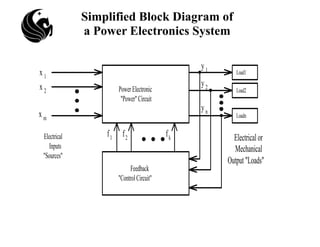
Simplified Block Diagram of
a Power Electronics System
Power Electronic
"Power" Circuit
Feedback
"Control Circuit"
Load1
Load2
Loadn
Electrical
Inputs
"Sources"
Electrical or
Mechanical
Output "Loads"
x 1
x 2
x m
y 1
y 2
y n
f1 f2 fk
Detailed Block Diagram of
Power Electronics System
Filter
&
Rectify
PE Circuit Load
Filter
&
Rectify
Control
Circuit
Mechanical Variable
Feedback
Electrical Variable
Feedback
Input
Form of
electrical
energy
Electrical
Mechanical
Pre-stage
Power proc. stage Post stage
Output
Form of elec. or
mechan. energy
Switch
Drives
Process feedback
signals and decide
on control
Could generate
undesirable
waveforms
Mostly ac line
voltage (single
or three phase)
Mostly
unregulate
d dc
voltage
Interface between
control and power
circuits
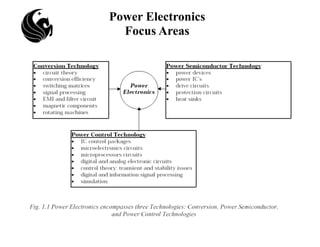
Multidisciplinary Nature
of Power Electronics
• Power electronics is comprised of:
– Semiconductor Devices
– Analog Circuits
– Control Design
– Magnetics
– Electric Machines
– Power Systems Engineering
– Circuit Simulation
Power Electronics
Focus Areas
Growth In Power Electronics
!
• The technology boom of the semiconductor market creates power
devices with significant power handling and switch speed
capability (ICs for control as well)
• The expanding market demand for new power electronic
applications that require the use variable-speed motor drives,
regulated power supplies, robotics, uninterruptible power
supplies.
• The ever increasing demand for smaller size and lighter weight
power electronic systems.
• A result of this increasing reliance on power electronic systems
made it mandatory that all such systems have radiated and
conducted electromagnetic interference (EMI) be limited within
regulated ranges.
The Drivers for Power Electronics
!
• Primary Factors Locally (KSC/Florida)
– Microprocessor-based technology has been producing devices
that often require tight regulation and uninterruptible power
– Increased sensitivity to power system harmonics
– Energy Conservation and Environmental Management are
now grouped within US Domestic Policy and are receiving
significant focus from Bush Administration
• New Legislation from Bush on Energy Conservation
Requirements
• New Florida Building Code will Require Variable Speed Air
Handlers
– Industrial Process Control and Automation is BOOMING with
new/refined motor drive applications
• HVAC (VAV, Chilled Water Flow, Chiller)
• Elevator Drives (DC Drives)
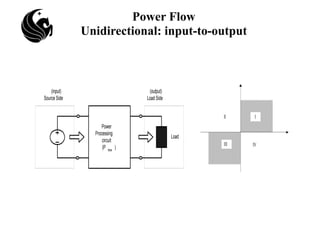
Power Flow
Unidirectional: input-to-output
Power
Processing
circuit
(P loss
)
(input)
Source Side
(output)
Load Side
Load
I
III IV
II
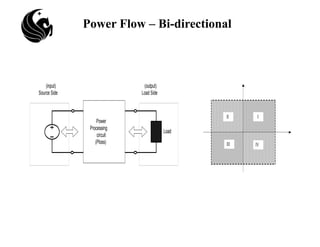
Power Flow – Bi-directional
Power
Processing
circuit
(Ploss)
(input)
Source Side
(output)
Load Side
Load
I
III IV
II
Power Conversion Dictates
Change in Current and/or Voltage:
• Voltage/Current form ac or dc
• Voltage/Current level (magnitude)
• Voltage frequency (line or otherwise)
• Voltage/Current waveshape (sinusoidal or
nonsinusoidal such as square, triangle,
sawtooth, etc.)
• Voltage phase(single or three-phase).
Conversion Type Description
• Power Electronic systems perform one or more of the
following conversion functions:
!
a)Rectification (ac-to-dc)
b) Inversion (dc-to-ac)
c) Cycloconversion
(ac-to-ac different frequencies) or
(ac-to-ac same frequency)
d) Conversion (dc-to-dc)
Types Of Power Conversion
Figures of Merit
for Power Electronic Converters
• What is the objective?
– Overall goal: To produce a converter that performs
well in these areas:
• Efficiency
• Transient Response
• Load and Line Regulation
• Power Density
• Input/Output Distortion (Input Power Factor)
• Reliability (MTBF)
• Cost
– In the final analysis, the job is to process and control
the flow of electric energy by supplying currents/
voltages in a form most suited to both the load and
energy source
Industrial Applications
!
• SMPS
– PFC
– Universal Input
– Soft-Switching
• Uninterruptible Power Supplies
– Hot-Sync Paralleling
• Process Control
– Motor Drives (DC Drives-VSDs, VFD)
Motor Drive
Typical PC Power Supply
Classic Inverter Scheme
Typical Commercial
Power Supply-Univ. PFC 600W
Typical Commercial
Power Supply-Universal PFC 150W
Future Trends
!
• Continue in the technological improvement of high power and
high frequency semiconductor devices.
• Attempts to improve energy density with increased efficiency
and performance
• Improvement in the design of driver circuits for switching
devices (DSP)
• Improvement in control techniques including optimal and
adaptive control.
• Integration of power and control circuitry on a single IC
• Distributed Power Systems (DPS).
• Power factor correction techniques and EMI reduction.
• New Power Transmission Concepts
UCF Power Electronics
FloridaPEC
Florida Power Electronics Center
Director: Dr. Batarseh
http://apec.engr.ucf.edu
!
• Power Factor Correction (PFC) circuits
• Soft-Switching DC-DC Converters
• Low Voltage AC-DC and DC-DC converters
• Low Voltage high-current fast-transient VRMs
• Dynamic Modeling and Control
• Electromagnetic Interference and Compatibility (EMI/
EMC)
• Modeling of Power Devices
• Solar/Wind Source Converters

Intro_PowerElectronics.pdf

  • 1.
    EEL 5245 POWERELECTRONICS I Lecture #2: Chapter 1 Introduction to Power Electronics
  • 2.
    Discussion Topics ! • Definitionof Power Electronics • Industry Overview/Market Share Analysis • Multidisciplinary Nature of Power Electronics • The Need for Power Electronics • Types of Power Conversion • Figures of Merit for Power Electronics Converters • Applications for Power Electronic Converters • Future Trends
  • 3.
    What is PowerElectronics? • Electronics: Solid State Electronics Devices and their Driving Circuits. • Power: Static and Dynamic Requirements for Generation, Conversion and Transmission of Power. • Control: The Steady State and Dynamic Stability of the Closed Loop system. POWER ELECTRONICS may be defined as the application of Solid State Electronics for the Control and conversion of Power.
  • 4.
    The Worldwide Electronics MarketOverview Power Electronics is an Enabling Technology Equipment Sales: $30B Hardware Electronics $570B Total Electronics Market $1,000B Source: Microtech
  • 5.
    National Critical TechnologyAreas Source: President’s Committee of Advisors on Science and Technology Energy Environmental Quality Information and Communication Living Systems Manufacturing Materials Transportation Technology Category Energy Efficiency Energy Storage Power Conditioning Power Distribution Distributed Power Supplies Process Control Automation Avionics and Controls Power System Integration Propulsion for Mass Transit Hybrid Electric Vehicles Technology Area
  • 6.
    Historical Perspective ! • Traditionalpower conversion – Linear Electronics- Transistors in active mode (linear region) • Transistor acts as variable resistor for control • Terrible efficiency (50% not uncommon) • Low conversion range (greater Vd smaller efficiency) • Low power applications – Motor-Generator Sets (AC-DC or AC-AC) • Can still be found in use • Large physical size • Maintenance intensive • Low efficiency • Poor Load regulation
  • 7.
    Modern Power Electronics ! •Can have efficiencies approaching 100% – Uses switches in saturation mode (On of Off) – On state-resistance can be down in tenths of Ohms • Are much smaller than predecessors – High switching frequency means smaller magnetic components. – Reduced losses means smaller package size • Net effect is better efficiency, greater power density (5W/ in^3 attainable)
  • 8.
    Simplified Block Diagramof a Power Electronics System Power Electronic "Power" Circuit Feedback "Control Circuit" Load1 Load2 Loadn Electrical Inputs "Sources" Electrical or Mechanical Output "Loads" x 1 x 2 x m y 1 y 2 y n f1 f2 fk
  • 9.
    Detailed Block Diagramof Power Electronics System Filter & Rectify PE Circuit Load Filter & Rectify Control Circuit Mechanical Variable Feedback Electrical Variable Feedback Input Form of electrical energy Electrical Mechanical Pre-stage Power proc. stage Post stage Output Form of elec. or mechan. energy Switch Drives Process feedback signals and decide on control Could generate undesirable waveforms Mostly ac line voltage (single or three phase) Mostly unregulate d dc voltage Interface between control and power circuits
  • 10.
    Multidisciplinary Nature of PowerElectronics • Power electronics is comprised of: – Semiconductor Devices – Analog Circuits – Control Design – Magnetics – Electric Machines – Power Systems Engineering – Circuit Simulation
  • 11.
  • 12.
    Growth In PowerElectronics ! • The technology boom of the semiconductor market creates power devices with significant power handling and switch speed capability (ICs for control as well) • The expanding market demand for new power electronic applications that require the use variable-speed motor drives, regulated power supplies, robotics, uninterruptible power supplies. • The ever increasing demand for smaller size and lighter weight power electronic systems. • A result of this increasing reliance on power electronic systems made it mandatory that all such systems have radiated and conducted electromagnetic interference (EMI) be limited within regulated ranges.
  • 13.
    The Drivers forPower Electronics ! • Primary Factors Locally (KSC/Florida) – Microprocessor-based technology has been producing devices that often require tight regulation and uninterruptible power – Increased sensitivity to power system harmonics – Energy Conservation and Environmental Management are now grouped within US Domestic Policy and are receiving significant focus from Bush Administration • New Legislation from Bush on Energy Conservation Requirements • New Florida Building Code will Require Variable Speed Air Handlers – Industrial Process Control and Automation is BOOMING with new/refined motor drive applications • HVAC (VAV, Chilled Water Flow, Chiller) • Elevator Drives (DC Drives)
  • 14.
    Power Flow Unidirectional: input-to-output Power Processing circuit (Ploss ) (input) Source Side (output) Load Side Load I III IV II
  • 15.
    Power Flow –Bi-directional Power Processing circuit (Ploss) (input) Source Side (output) Load Side Load I III IV II
  • 16.
    Power Conversion Dictates Changein Current and/or Voltage: • Voltage/Current form ac or dc • Voltage/Current level (magnitude) • Voltage frequency (line or otherwise) • Voltage/Current waveshape (sinusoidal or nonsinusoidal such as square, triangle, sawtooth, etc.) • Voltage phase(single or three-phase).
  • 17.
    Conversion Type Description •Power Electronic systems perform one or more of the following conversion functions: ! a)Rectification (ac-to-dc) b) Inversion (dc-to-ac) c) Cycloconversion (ac-to-ac different frequencies) or (ac-to-ac same frequency) d) Conversion (dc-to-dc)
  • 18.
    Types Of PowerConversion
  • 19.
    Figures of Merit forPower Electronic Converters • What is the objective? – Overall goal: To produce a converter that performs well in these areas: • Efficiency • Transient Response • Load and Line Regulation • Power Density • Input/Output Distortion (Input Power Factor) • Reliability (MTBF) • Cost – In the final analysis, the job is to process and control the flow of electric energy by supplying currents/ voltages in a form most suited to both the load and energy source
  • 20.
    Industrial Applications ! • SMPS –PFC – Universal Input – Soft-Switching • Uninterruptible Power Supplies – Hot-Sync Paralleling • Process Control – Motor Drives (DC Drives-VSDs, VFD)
  • 21.
  • 22.
  • 23.
  • 24.
  • 25.
  • 26.
    Future Trends ! • Continuein the technological improvement of high power and high frequency semiconductor devices. • Attempts to improve energy density with increased efficiency and performance • Improvement in the design of driver circuits for switching devices (DSP) • Improvement in control techniques including optimal and adaptive control. • Integration of power and control circuitry on a single IC • Distributed Power Systems (DPS). • Power factor correction techniques and EMI reduction. • New Power Transmission Concepts
  • 27.
    UCF Power Electronics FloridaPEC FloridaPower Electronics Center Director: Dr. Batarseh http://apec.engr.ucf.edu ! • Power Factor Correction (PFC) circuits • Soft-Switching DC-DC Converters • Low Voltage AC-DC and DC-DC converters • Low Voltage high-current fast-transient VRMs • Dynamic Modeling and Control • Electromagnetic Interference and Compatibility (EMI/ EMC) • Modeling of Power Devices • Solar/Wind Source Converters