1
u Open Badges for Learning Environments
S C I E N C E  P A S S I O N  T E C H N O L O G Y
u www.tugraz.at
Open Badges for Learning
Environments
Mario Wüster
Supervisor: Assoc.Prof.Dipl.-Ing.Dr.techn. Martin Ebner
October 22, 2015
2
u Open Badges for Learning Environments
2
u
1. Research Question
2. Learning Environments
3. Open Badge (Infrastructure)
4. Motivation
5. General Approaches for Integration
6. Prototype
7. Evaluation
8. Conclusion
Contents
3
u Open Badges for Learning Environments
3
u
Research Question
How to integrate Open Badges in Learning
Environments [and to enable automatic badge issuing
based on defined criteria] ?
4
u Open Badges for Learning Environments
4
u
Learning Environments
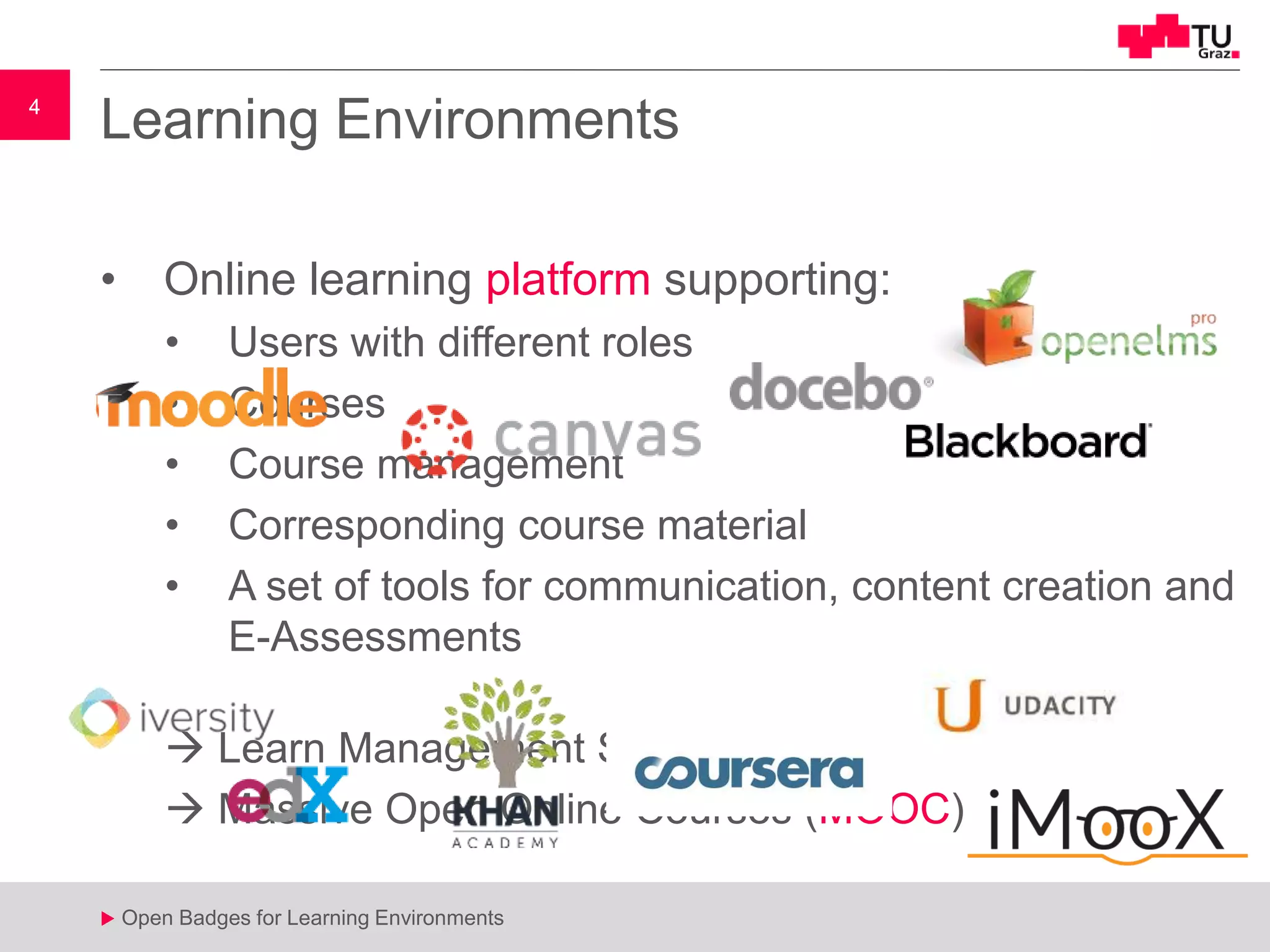
• Online learning platform supporting:
• Users with different roles
• Courses
• Course management
• Corresponding course material
• A set of tools for communication, content creation and
E-Assessments
 Learn Management Systems (LMS)
 Massive Open Online Courses (MOOC)
5
u Open Badges for Learning Environments
5
u
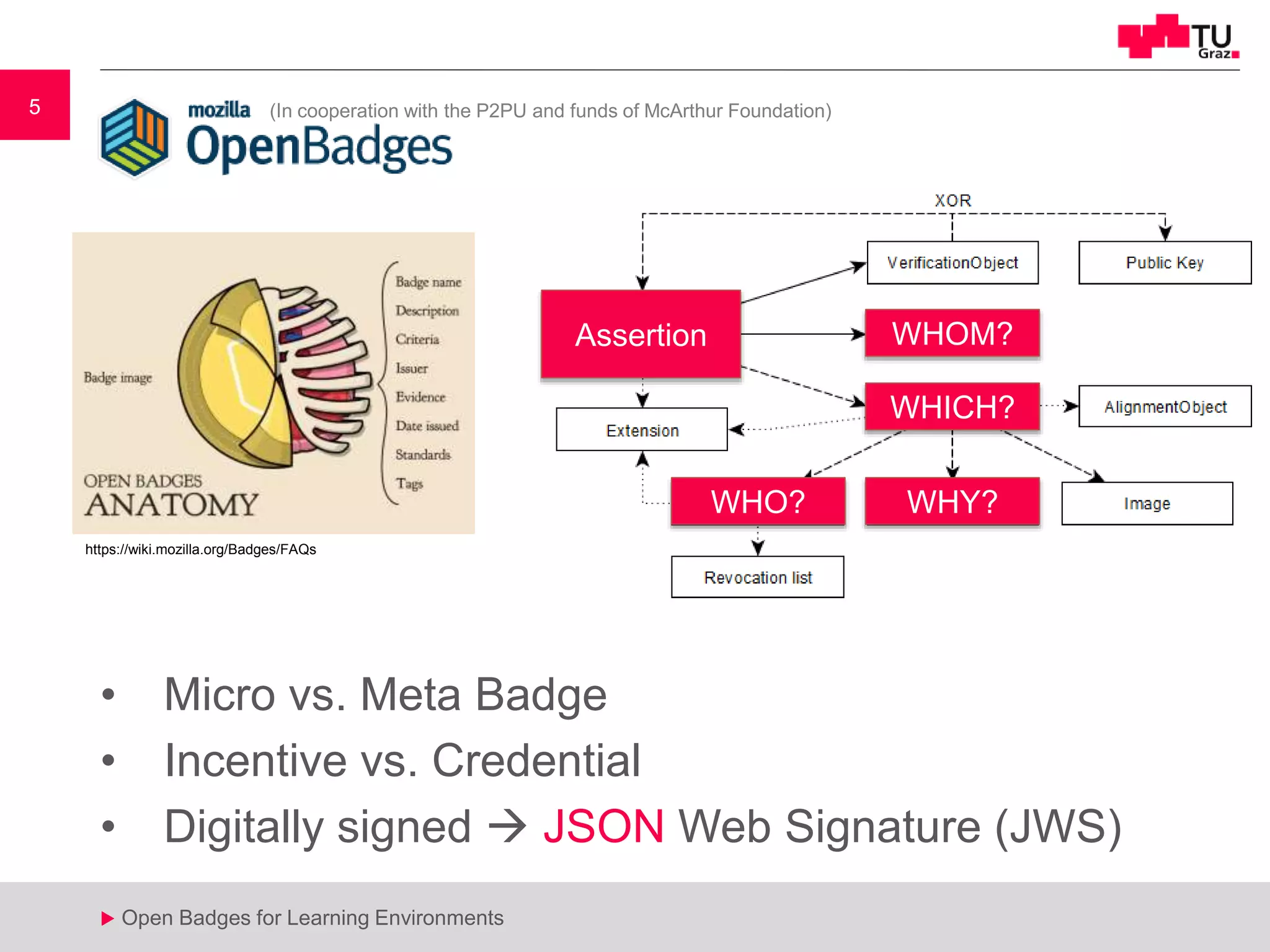
• Micro vs. Meta Badge
• Incentive vs. Credential
• Digitally signed  JSON Web Signature (JWS)
WHOM?
WHICH?
WHY?WHO?
Assertion
https://wiki.mozilla.org/Badges/FAQs
(In cooperation with the P2PU and funds of McArthur Foundation)
6
u Open Badges for Learning Environments
6
u
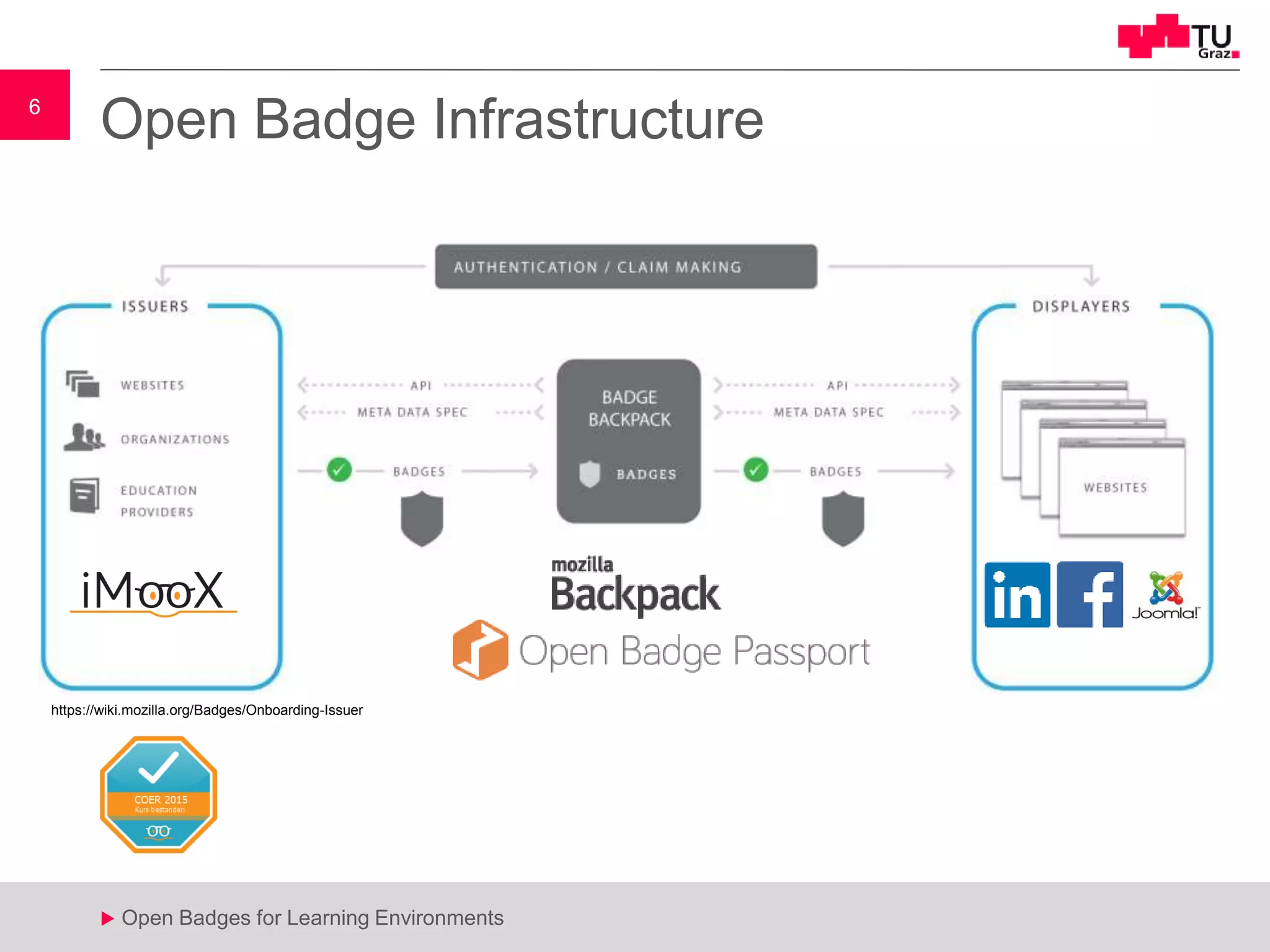
Open Badge Infrastructure
https://wiki.mozilla.org/Badges/Onboarding-Issuer
7
u Open Badges for Learning Environments
7
u
Motivation
• Hard to motivate learners to actively participate in
non-formal and informal educational systems if they
do not get any recognition for their achievements
• Mostly no recognition at all for gained skills if a
course has not been completed
• Just summative feedback
• No common standard for acknowledgements
• Certificates are not digitially signed
 Open Badges could help to diminish or even resolve
those issues
• Formal: organized, structured, supported, intentional & certified
• Non-formal: formal, but not in edu. institutions & w/o certification
• Informal: through made experiences, independent of the context
8
u Open Badges for Learning Environments
8
u
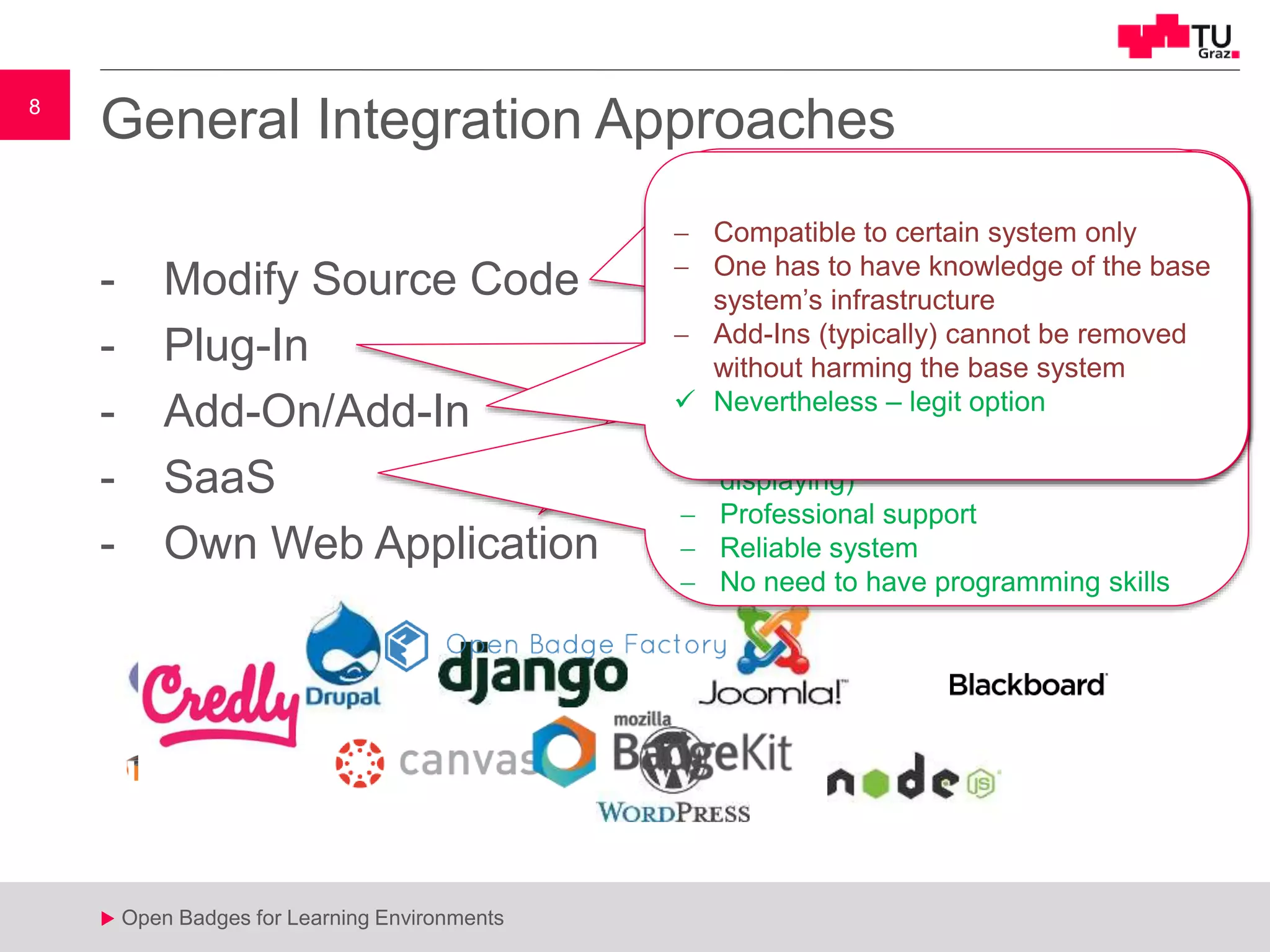
- Modify Source Code
- Plug-In
- Add-On/Add-In
- SaaS
- Own Web Application
General Integration Approaches
 Source code has to be known
 High risk on introducing errors in the
base system
 Base system updates could harm the
badging system
 No community that maintains code
 Fast
 Highly customizable
 Time (=Money)
 Programmer
 Support
 API needed
 High customization
 Fast bug fixing & integration of new
features
 Full control over student & badge data
 Typically not free of charge
 Data has to be transmitted to an
foreign server
 Limited customization
 What happens if subscription gets
cancelled sometimes? How to
backup/transfer data ?
 Most simplest way to use OpenBadges
 Complete solutions (issuing, managing,
displaying)
 Professional support
 Reliable system
 No need to have programming skills
 Base system has to provide API.
 Limited customization
 Dynamically loaded
 Does not influence core system
 Huge community
 Mostly compatible to multiple base
systems
 Compatible to certain system only
 One has to have knowledge of the base
system’s infrastructure
 Add-Ins (typically) cannot be removed
without harming the base system
 Nevertheless – legit option
9
u Open Badges for Learning Environments
9
u
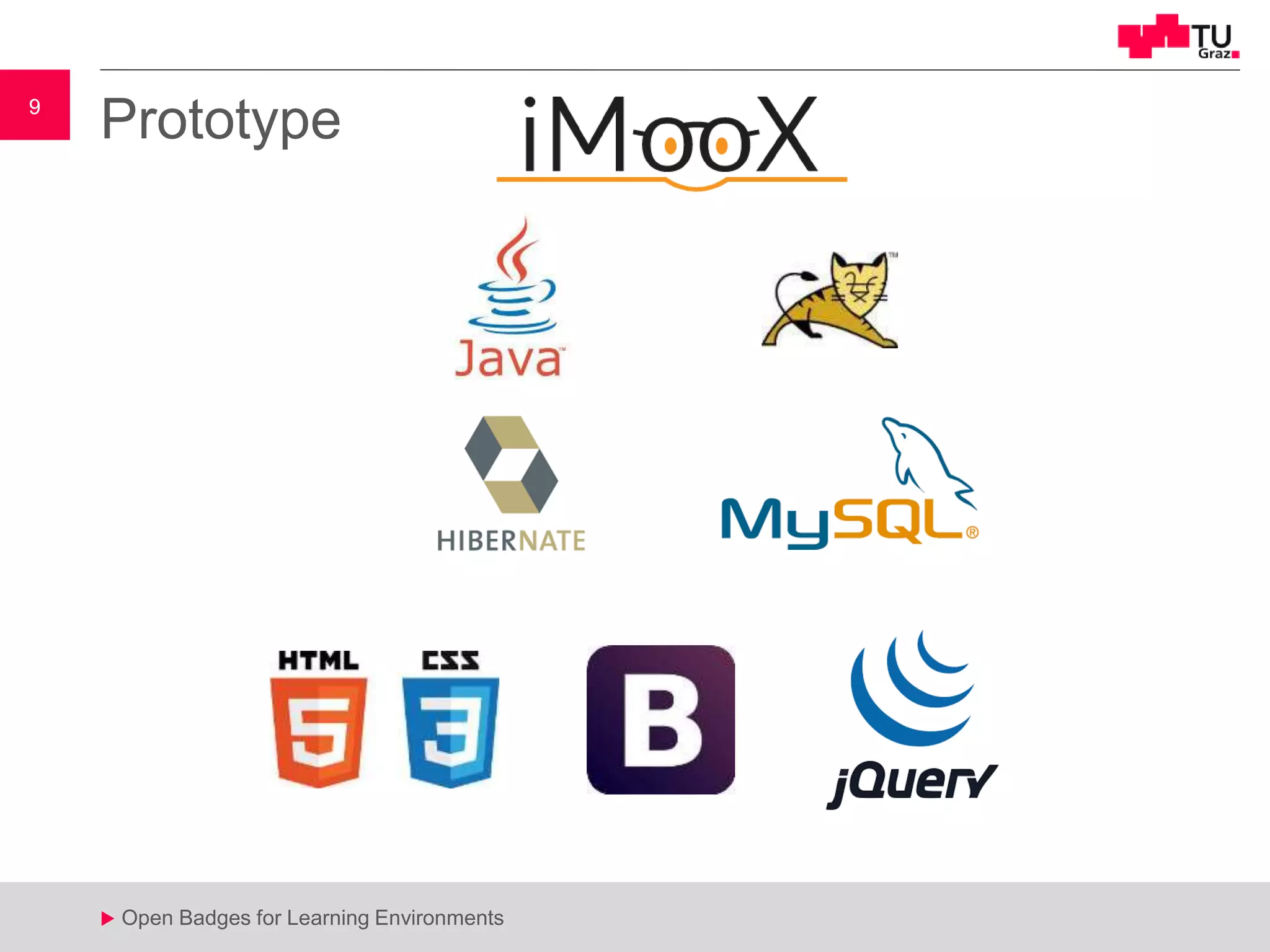
Prototype
10
u Open Badges for Learning Environments
10
u
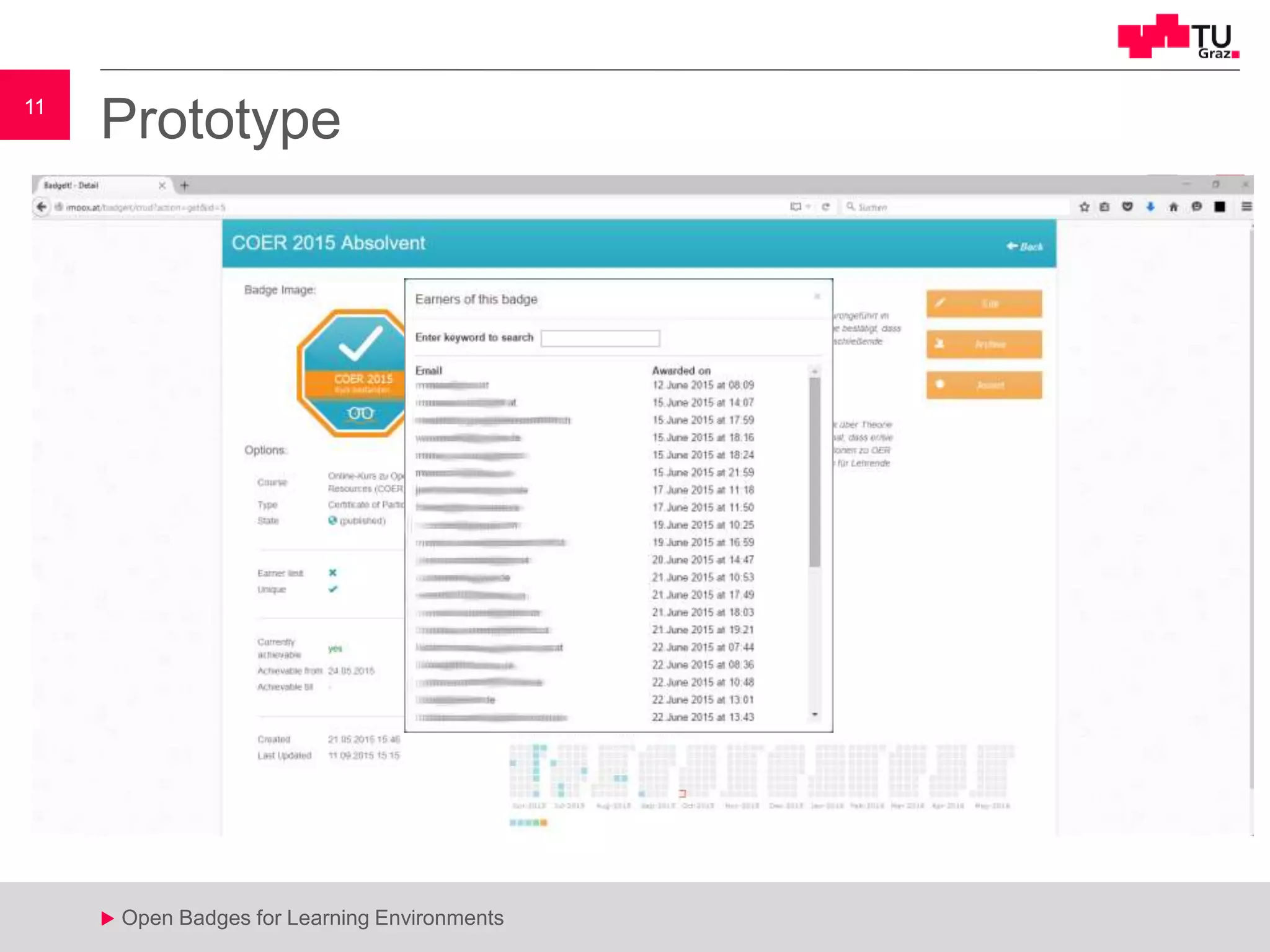
Prototype - Features
1. Badge management (CRUD + control availability)
via backend (pw protected .htaccess)
2. Assert badges manually
3. Assert badges automatically - triggered by the
iMooX user
4. Display rudimentary awarding statistics
5. Currently, supporting 2 different types of badges
i. Quiz-Level Badge
ii. Course-Level Badge
11
u Open Badges for Learning Environments
11
u
Prototype
12
u Open Badges for Learning Environments
12
u
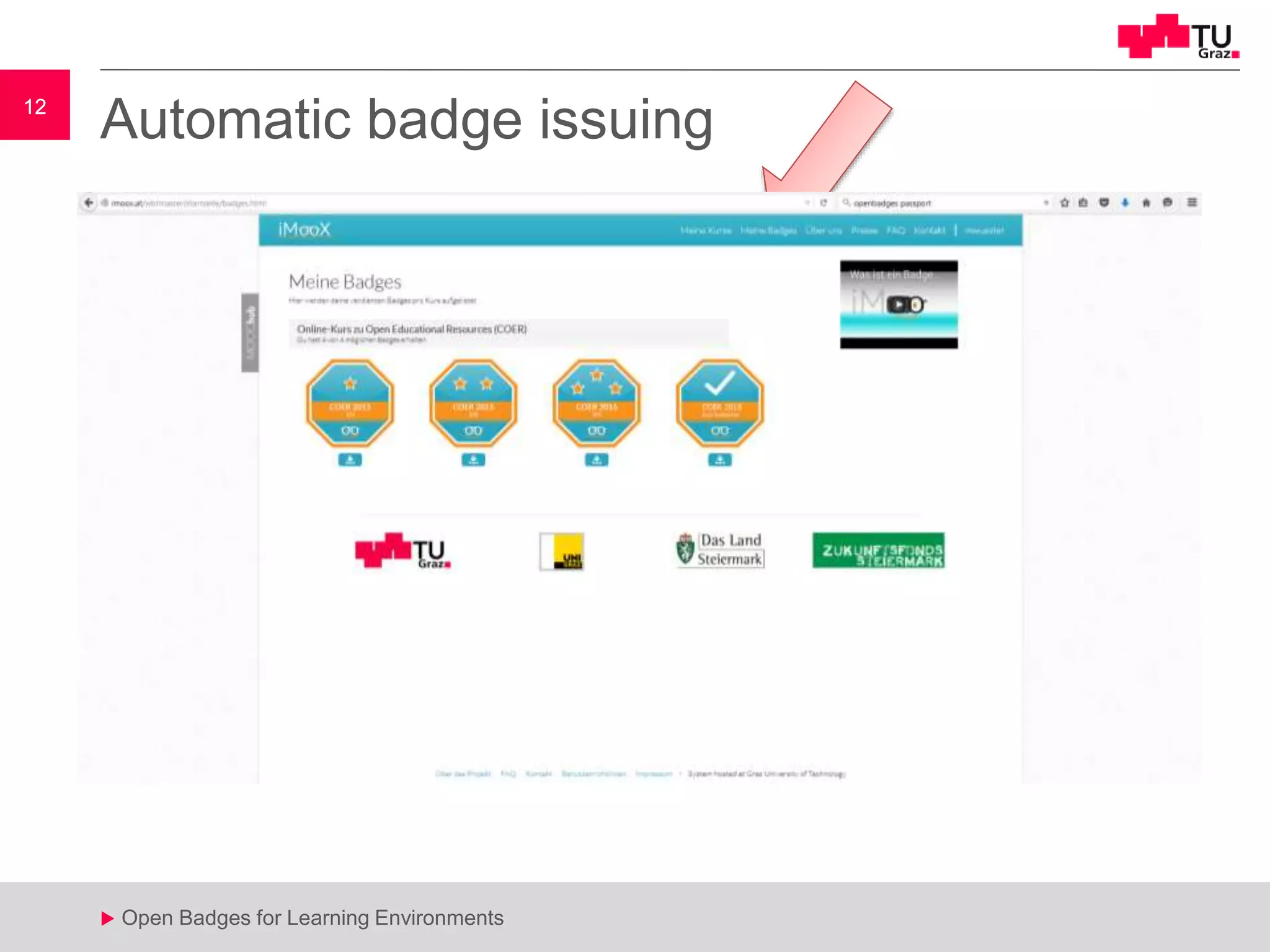
Automatic badge issuing
13
u Open Badges for Learning Environments
13
u
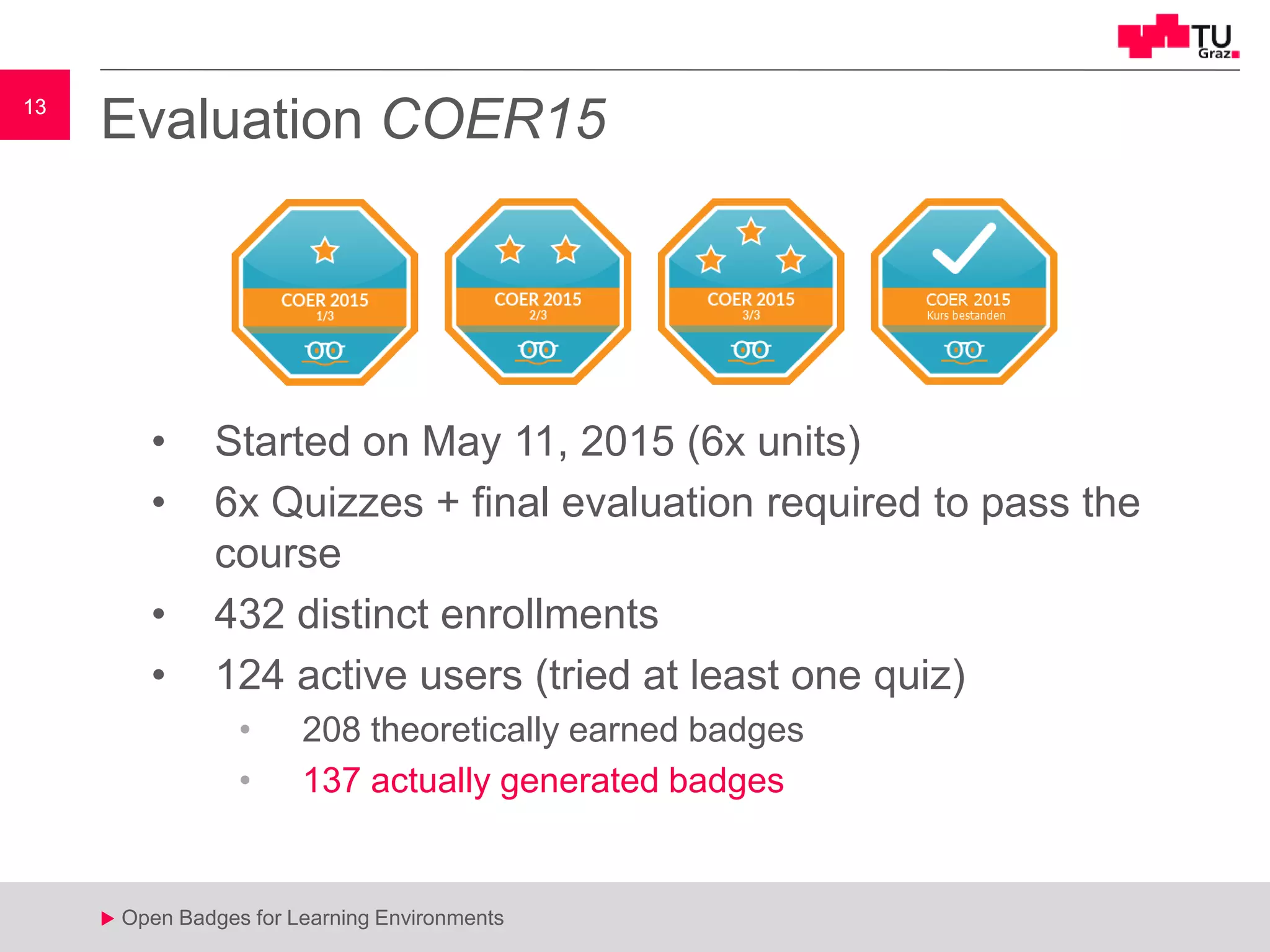
Evaluation COER15
• Started on May 11, 2015 (6x units)
• 6x Quizzes + final evaluation required to pass the
course
• 432 distinct enrollments
• 124 active users (tried at least one quiz)
• 208 theoretically earned badges
• 137 actually generated badges
14
u Open Badges for Learning Environments
14
u
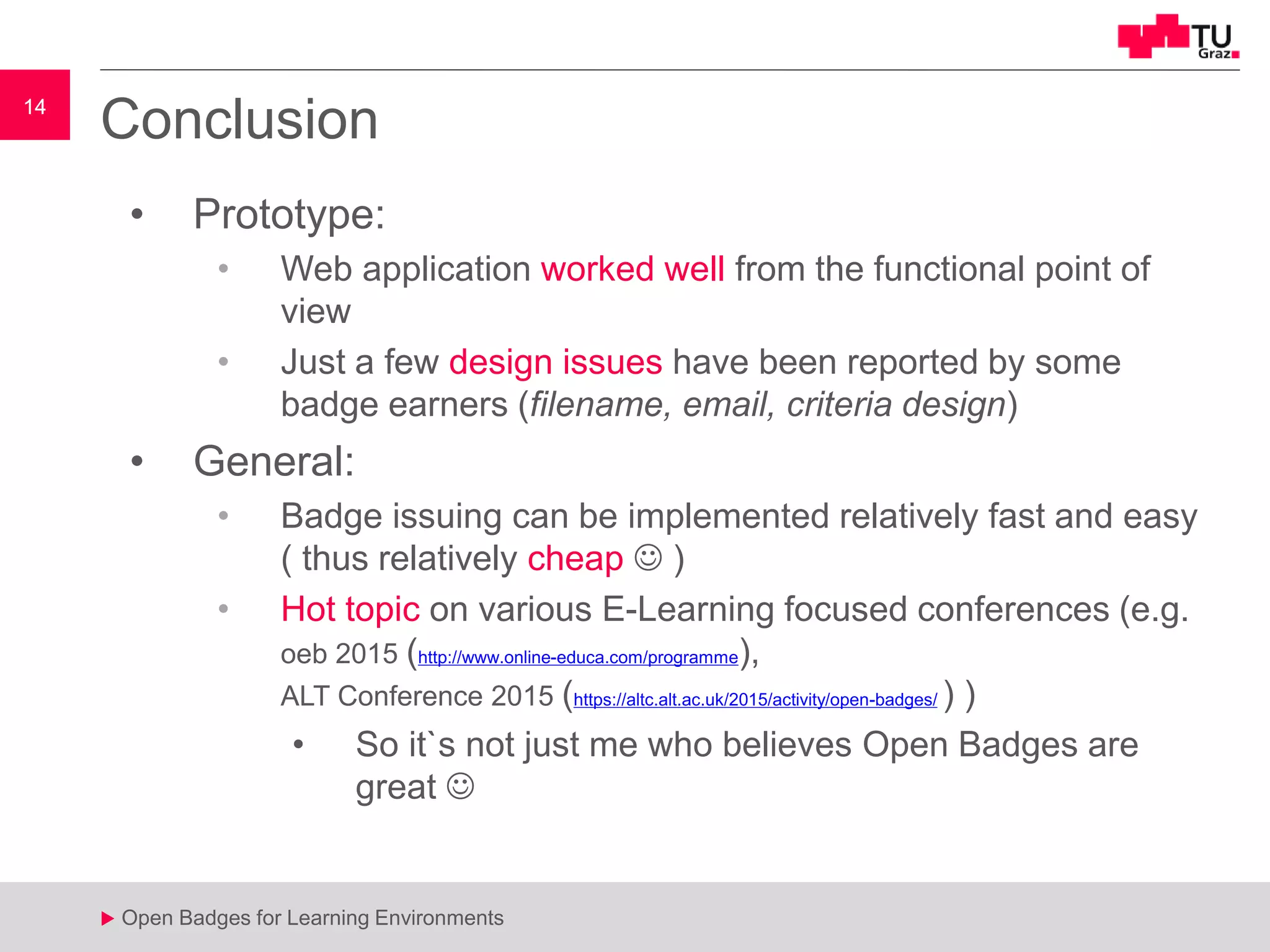
Conclusion
• Prototype:
• Web application worked well from the functional point of
view
• Just a few design issues have been reported by some
badge earners (filename, email, criteria design)
• General:
• Badge issuing can be implemented relatively fast and easy
( thus relatively cheap  )
• Hot topic on various E-Learning focused conferences (e.g.
oeb 2015 (http://www.online-educa.com/programme),
ALT Conference 2015 (https://altc.alt.ac.uk/2015/activity/open-badges/ ) )
• So it`s not just me who believes Open Badges are
great 
15
u Open Badges for Learning Environments
15
u
Thanks for
your attention !
16
u Open Badges for Learning Environments
16
u
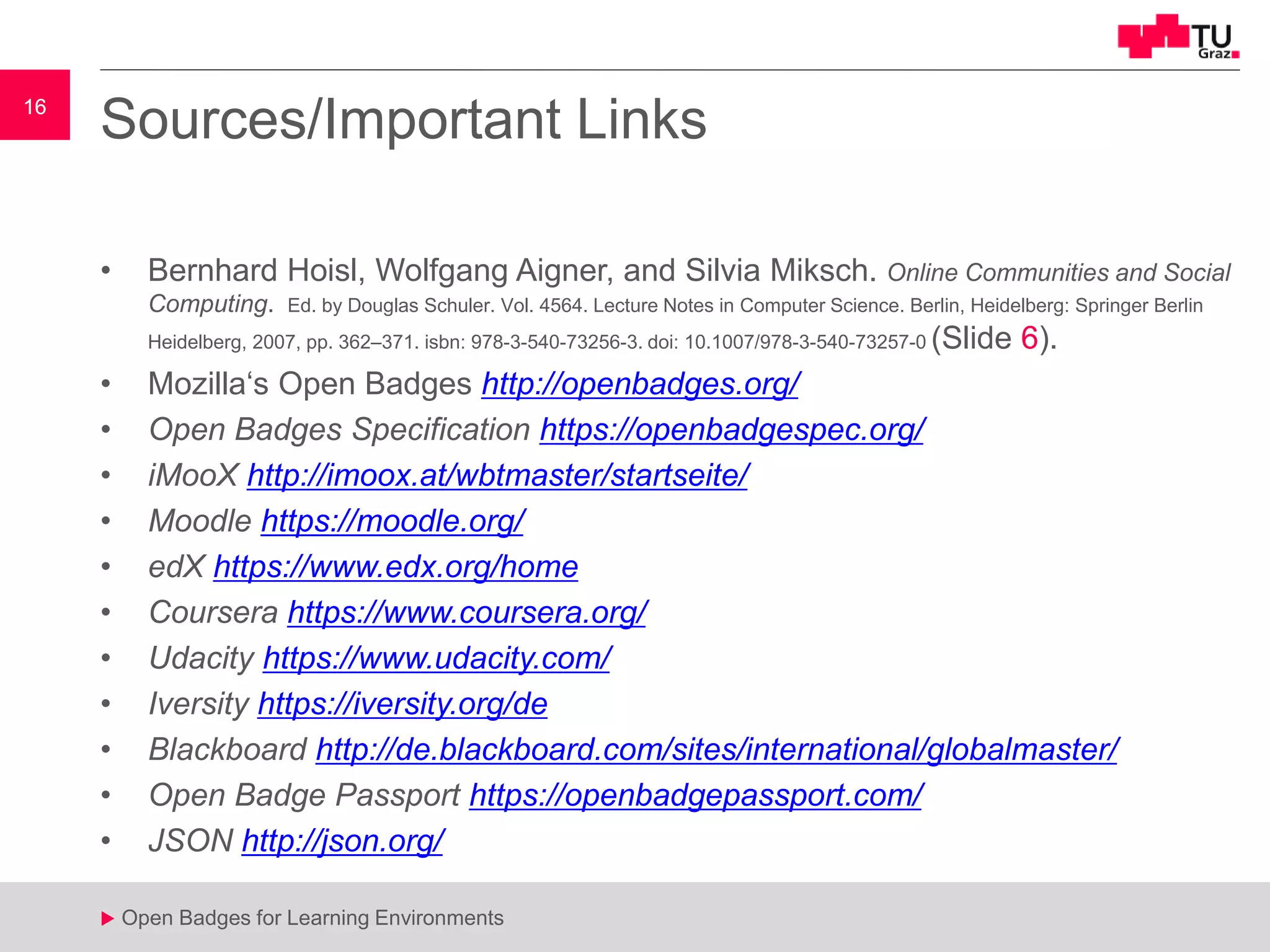
Sources/Important Links
• Bernhard Hoisl, Wolfgang Aigner, and Silvia Miksch. Online Communities and Social
Computing. Ed. by Douglas Schuler. Vol. 4564. Lecture Notes in Computer Science. Berlin, Heidelberg: Springer Berlin
Heidelberg, 2007, pp. 362–371. isbn: 978-3-540-73256-3. doi: 10.1007/978-3-540-73257-0 (Slide 6).
• Mozilla‘s Open Badges http://openbadges.org/
• Open Badges Specification https://openbadgespec.org/
• iMooX http://imoox.at/wbtmaster/startseite/
• Moodle https://moodle.org/
• edX https://www.edx.org/home
• Coursera https://www.coursera.org/
• Udacity https://www.udacity.com/
• Iversity https://iversity.org/de
• Blackboard http://de.blackboard.com/sites/international/globalmaster/
• Open Badge Passport https://openbadgepassport.com/
• JSON http://json.org/
17
u Open Badges for Learning Environments
17
u
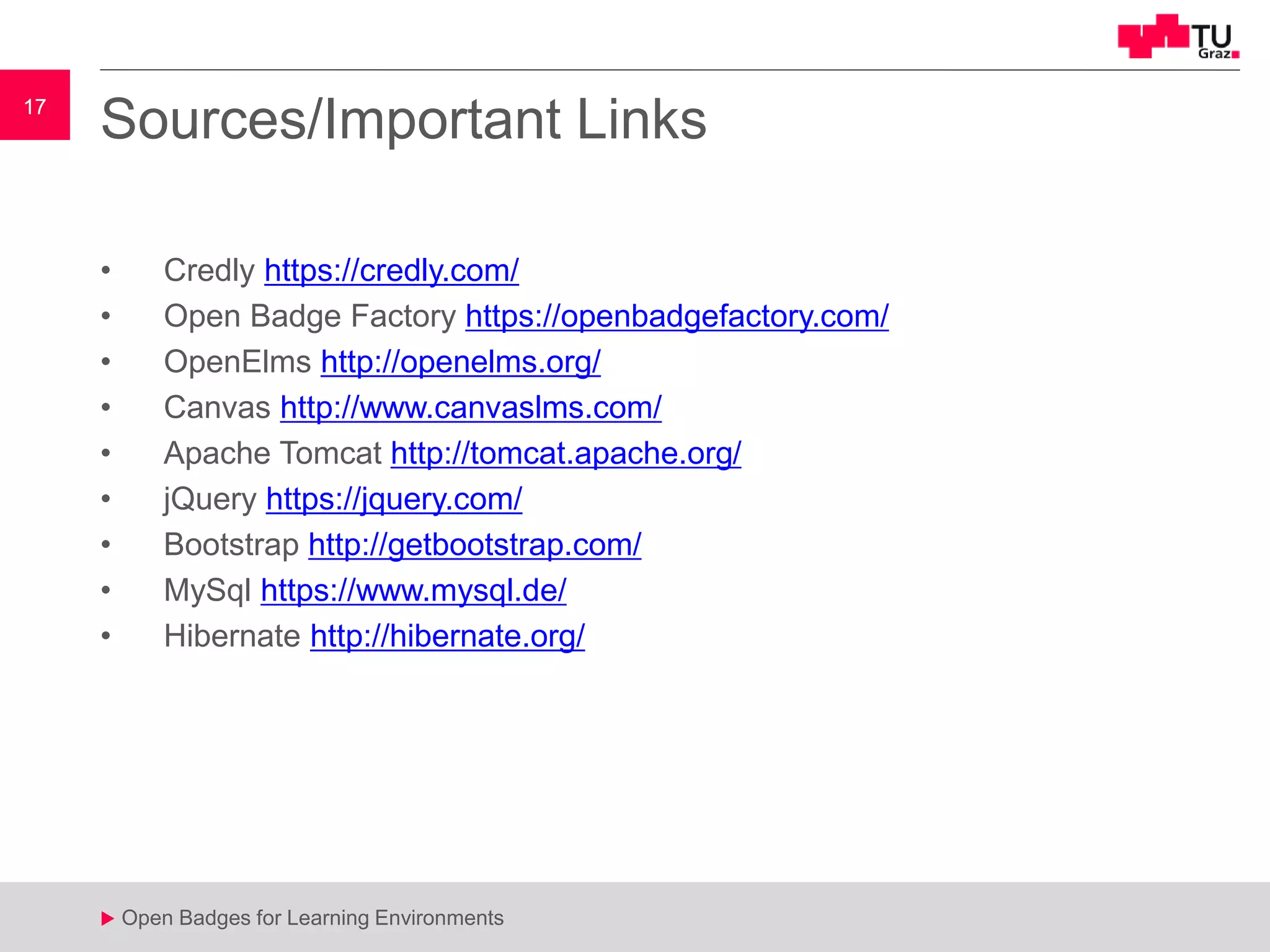
Sources/Important Links
• Credly https://credly.com/
• Open Badge Factory https://openbadgefactory.com/
• OpenElms http://openelms.org/
• Canvas http://www.canvaslms.com/
• Apache Tomcat http://tomcat.apache.org/
• jQuery https://jquery.com/
• Bootstrap http://getbootstrap.com/
• MySql https://www.mysql.de/
• Hibernate http://hibernate.org/
18
u Open Badges for Learning Environments
18
u
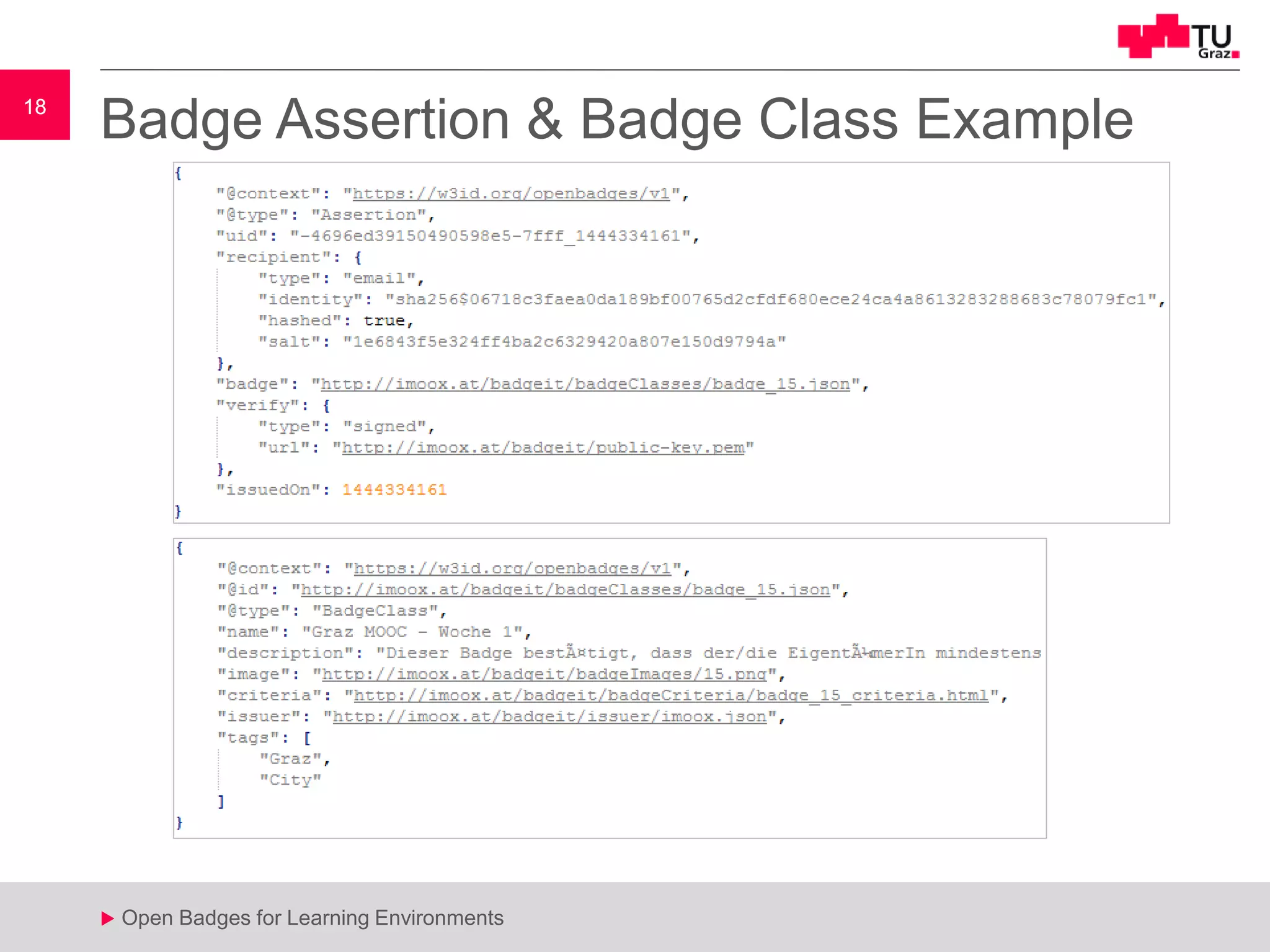
Badge Assertion & Badge Class Example
19
u Open Badges for Learning Environments
19
u
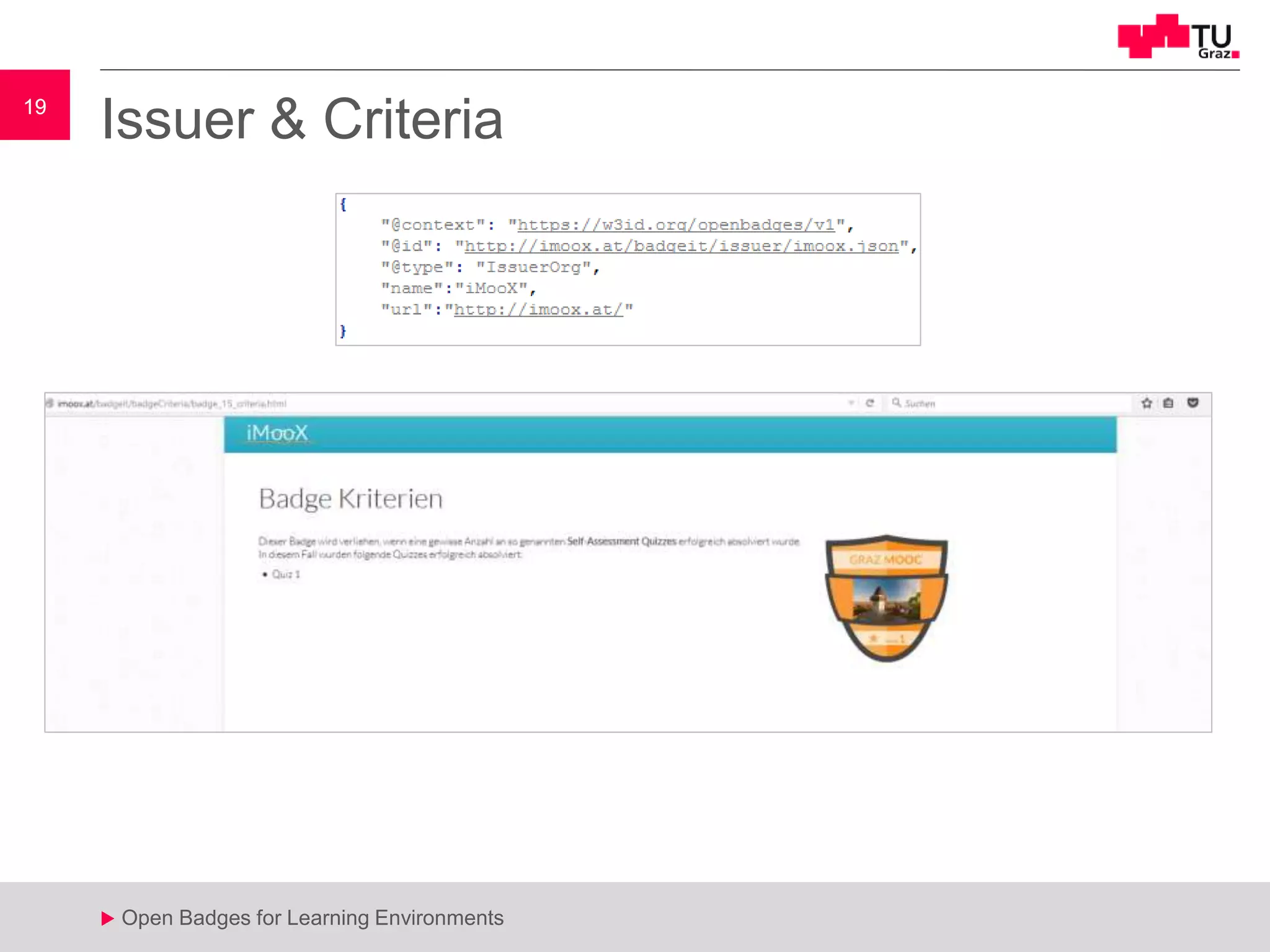
Issuer & Criteria
20
u Open Badges for Learning Environments
20
u
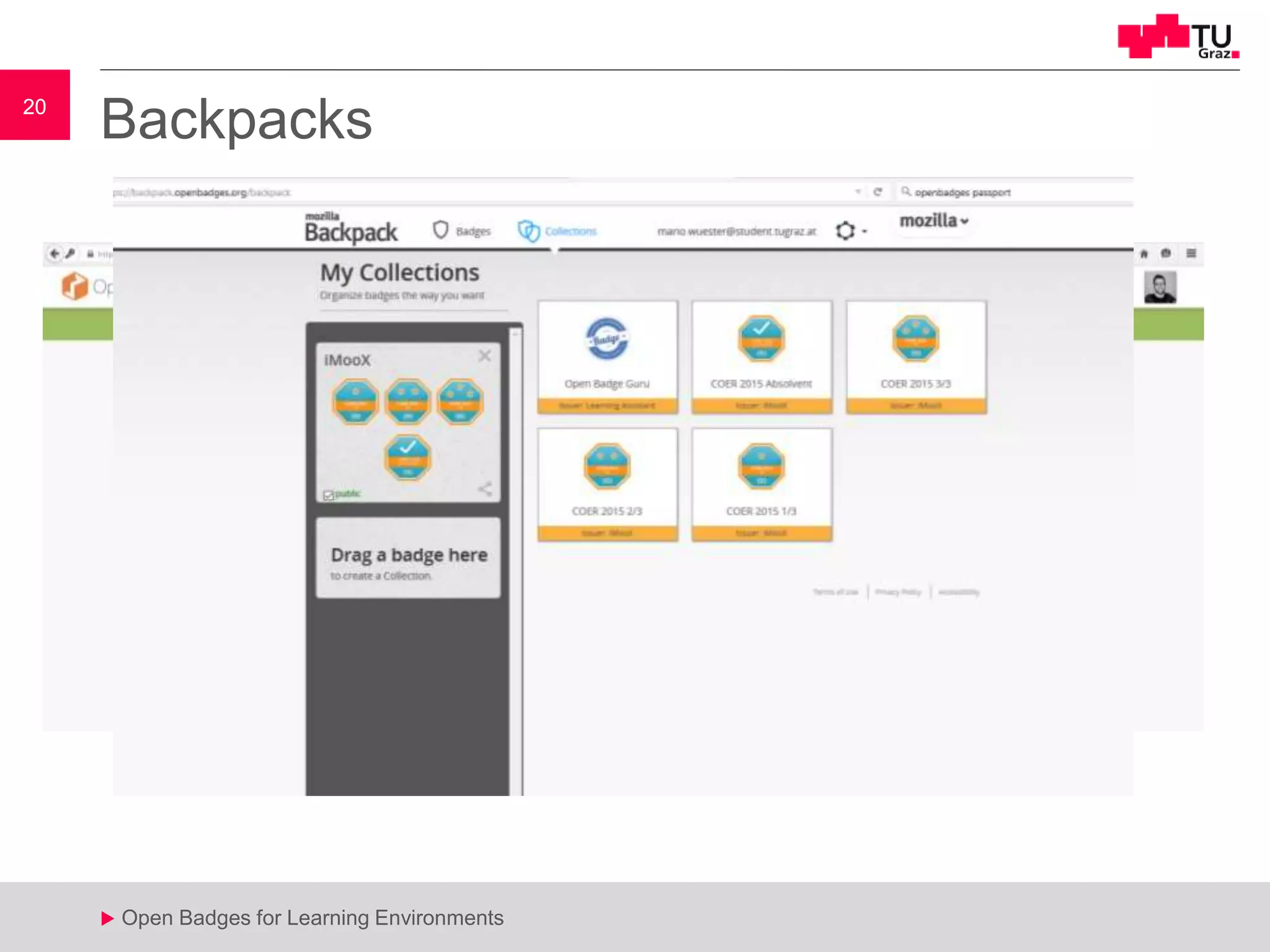
Backpacks
21
u Open Badges for Learning Environments
21
u
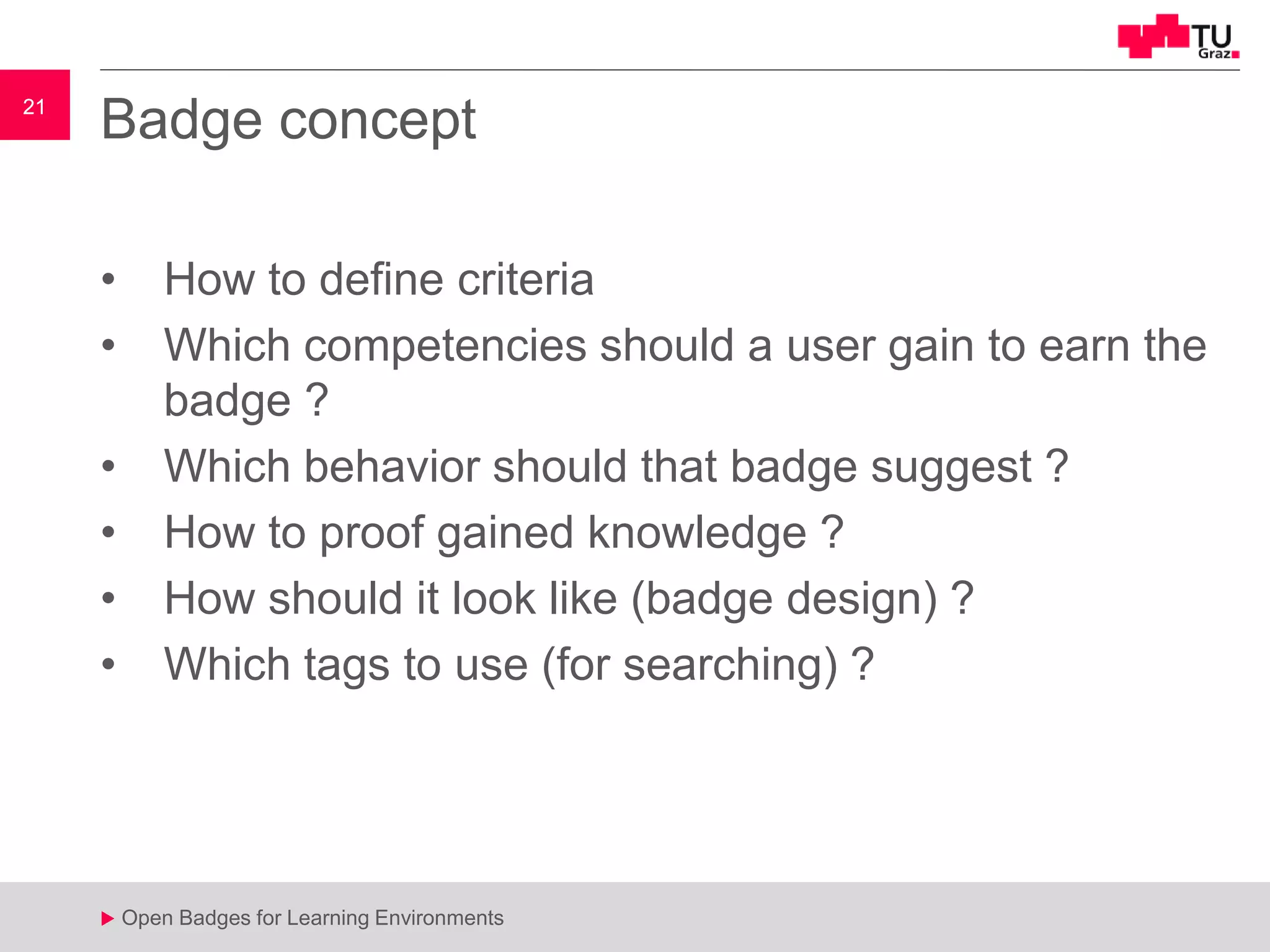
Badge concept
• How to define criteria
• Which competencies should a user gain to earn the
badge ?
• Which behavior should that badge suggest ?
• How to proof gained knowledge ?
• How should it look like (badge design) ?
• Which tags to use (for searching) ?
22
u Open Badges for Learning Environments
22
u
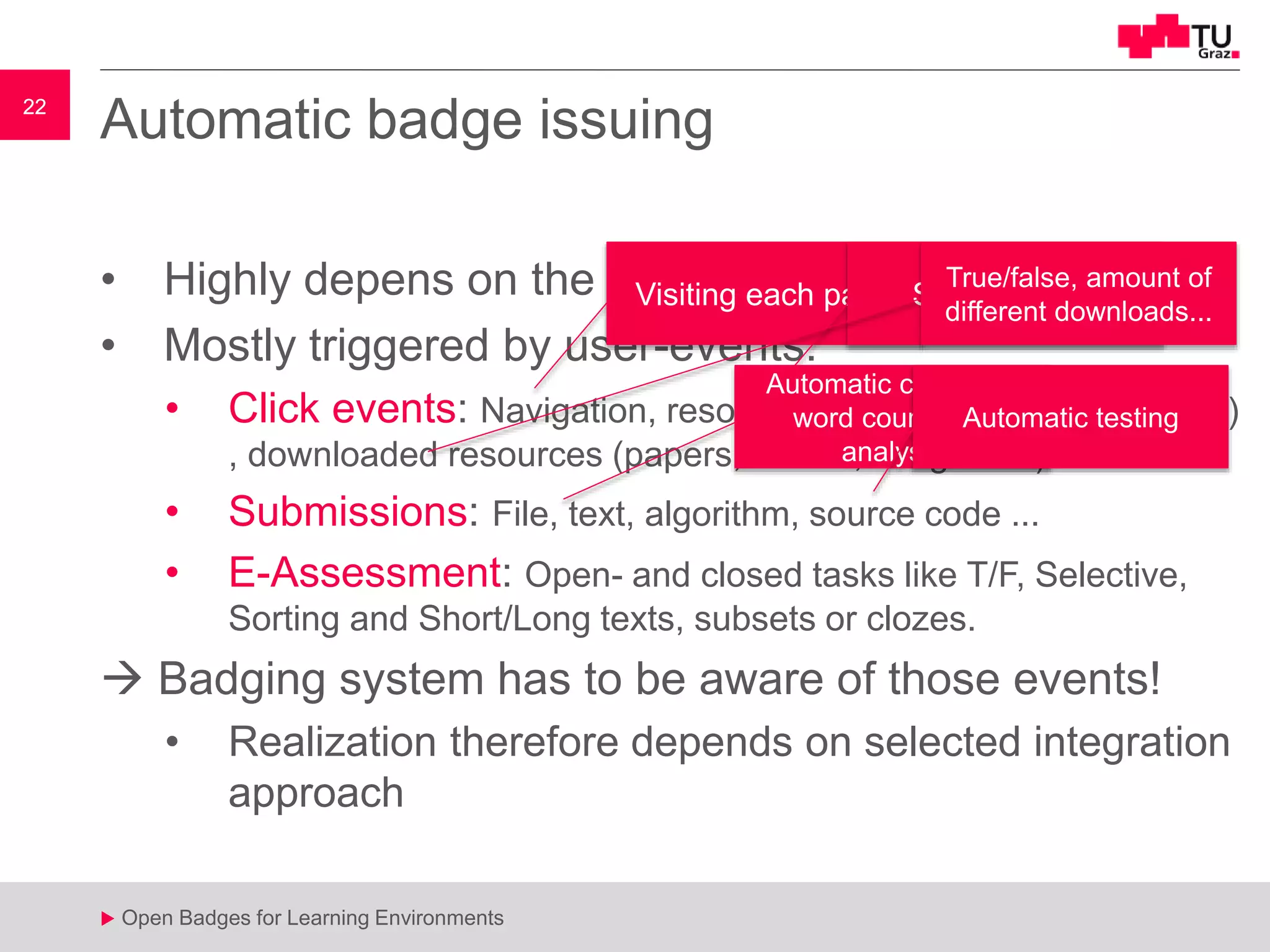
Automatic badge issuing
• Highly depens on the context
• Mostly triggered by user-events:
• Click events: Navigation, resource watching (video, e-paper...)
, downloaded resources (papers, videos, images ... )
• Submissions: File, text, algorithm, source code ...
• E-Assessment: Open- and closed tasks like T/F, Selective,
Sorting and Short/Long texts, subsets or clozes.
 Badging system has to be aware of those events!
• Realization therefore depends on selected integration
approach
Visiting each page Starting, time
True/false, amount of
different downloads...
Automatic checking,
word count, text
analysis
Automatic testing

Open Badges for Learning Environments

  • 1.
    1 u Open Badgesfor Learning Environments S C I E N C E  P A S S I O N  T E C H N O L O G Y u www.tugraz.at Open Badges for Learning Environments Mario Wüster Supervisor: Assoc.Prof.Dipl.-Ing.Dr.techn. Martin Ebner October 22, 2015
  • 2.
    2 u Open Badgesfor Learning Environments 2 u 1. Research Question 2. Learning Environments 3. Open Badge (Infrastructure) 4. Motivation 5. General Approaches for Integration 6. Prototype 7. Evaluation 8. Conclusion Contents
  • 3.
    3 u Open Badgesfor Learning Environments 3 u Research Question How to integrate Open Badges in Learning Environments [and to enable automatic badge issuing based on defined criteria] ?
  • 4.
    4 u Open Badgesfor Learning Environments 4 u Learning Environments • Online learning platform supporting: • Users with different roles • Courses • Course management • Corresponding course material • A set of tools for communication, content creation and E-Assessments  Learn Management Systems (LMS)  Massive Open Online Courses (MOOC)
  • 5.
    5 u Open Badgesfor Learning Environments 5 u • Micro vs. Meta Badge • Incentive vs. Credential • Digitally signed  JSON Web Signature (JWS) WHOM? WHICH? WHY?WHO? Assertion https://wiki.mozilla.org/Badges/FAQs (In cooperation with the P2PU and funds of McArthur Foundation)
  • 6.
    6 u Open Badgesfor Learning Environments 6 u Open Badge Infrastructure https://wiki.mozilla.org/Badges/Onboarding-Issuer
  • 7.
    7 u Open Badgesfor Learning Environments 7 u Motivation • Hard to motivate learners to actively participate in non-formal and informal educational systems if they do not get any recognition for their achievements • Mostly no recognition at all for gained skills if a course has not been completed • Just summative feedback • No common standard for acknowledgements • Certificates are not digitially signed  Open Badges could help to diminish or even resolve those issues • Formal: organized, structured, supported, intentional & certified • Non-formal: formal, but not in edu. institutions & w/o certification • Informal: through made experiences, independent of the context
  • 8.
    8 u Open Badgesfor Learning Environments 8 u - Modify Source Code - Plug-In - Add-On/Add-In - SaaS - Own Web Application General Integration Approaches  Source code has to be known  High risk on introducing errors in the base system  Base system updates could harm the badging system  No community that maintains code  Fast  Highly customizable  Time (=Money)  Programmer  Support  API needed  High customization  Fast bug fixing & integration of new features  Full control over student & badge data  Typically not free of charge  Data has to be transmitted to an foreign server  Limited customization  What happens if subscription gets cancelled sometimes? How to backup/transfer data ?  Most simplest way to use OpenBadges  Complete solutions (issuing, managing, displaying)  Professional support  Reliable system  No need to have programming skills  Base system has to provide API.  Limited customization  Dynamically loaded  Does not influence core system  Huge community  Mostly compatible to multiple base systems  Compatible to certain system only  One has to have knowledge of the base system’s infrastructure  Add-Ins (typically) cannot be removed without harming the base system  Nevertheless – legit option
  • 9.
    9 u Open Badgesfor Learning Environments 9 u Prototype
  • 10.
    10 u Open Badgesfor Learning Environments 10 u Prototype - Features 1. Badge management (CRUD + control availability) via backend (pw protected .htaccess) 2. Assert badges manually 3. Assert badges automatically - triggered by the iMooX user 4. Display rudimentary awarding statistics 5. Currently, supporting 2 different types of badges i. Quiz-Level Badge ii. Course-Level Badge
  • 11.
    11 u Open Badgesfor Learning Environments 11 u Prototype
  • 12.
    12 u Open Badgesfor Learning Environments 12 u Automatic badge issuing
  • 13.
    13 u Open Badgesfor Learning Environments 13 u Evaluation COER15 • Started on May 11, 2015 (6x units) • 6x Quizzes + final evaluation required to pass the course • 432 distinct enrollments • 124 active users (tried at least one quiz) • 208 theoretically earned badges • 137 actually generated badges
  • 14.
    14 u Open Badgesfor Learning Environments 14 u Conclusion • Prototype: • Web application worked well from the functional point of view • Just a few design issues have been reported by some badge earners (filename, email, criteria design) • General: • Badge issuing can be implemented relatively fast and easy ( thus relatively cheap  ) • Hot topic on various E-Learning focused conferences (e.g. oeb 2015 (http://www.online-educa.com/programme), ALT Conference 2015 (https://altc.alt.ac.uk/2015/activity/open-badges/ ) ) • So it`s not just me who believes Open Badges are great 
  • 15.
    15 u Open Badgesfor Learning Environments 15 u Thanks for your attention !
  • 16.
    16 u Open Badgesfor Learning Environments 16 u Sources/Important Links • Bernhard Hoisl, Wolfgang Aigner, and Silvia Miksch. Online Communities and Social Computing. Ed. by Douglas Schuler. Vol. 4564. Lecture Notes in Computer Science. Berlin, Heidelberg: Springer Berlin Heidelberg, 2007, pp. 362–371. isbn: 978-3-540-73256-3. doi: 10.1007/978-3-540-73257-0 (Slide 6). • Mozilla‘s Open Badges http://openbadges.org/ • Open Badges Specification https://openbadgespec.org/ • iMooX http://imoox.at/wbtmaster/startseite/ • Moodle https://moodle.org/ • edX https://www.edx.org/home • Coursera https://www.coursera.org/ • Udacity https://www.udacity.com/ • Iversity https://iversity.org/de • Blackboard http://de.blackboard.com/sites/international/globalmaster/ • Open Badge Passport https://openbadgepassport.com/ • JSON http://json.org/
  • 17.
    17 u Open Badgesfor Learning Environments 17 u Sources/Important Links • Credly https://credly.com/ • Open Badge Factory https://openbadgefactory.com/ • OpenElms http://openelms.org/ • Canvas http://www.canvaslms.com/ • Apache Tomcat http://tomcat.apache.org/ • jQuery https://jquery.com/ • Bootstrap http://getbootstrap.com/ • MySql https://www.mysql.de/ • Hibernate http://hibernate.org/
  • 18.
    18 u Open Badgesfor Learning Environments 18 u Badge Assertion & Badge Class Example
  • 19.
    19 u Open Badgesfor Learning Environments 19 u Issuer & Criteria
  • 20.
    20 u Open Badgesfor Learning Environments 20 u Backpacks
  • 21.
    21 u Open Badgesfor Learning Environments 21 u Badge concept • How to define criteria • Which competencies should a user gain to earn the badge ? • Which behavior should that badge suggest ? • How to proof gained knowledge ? • How should it look like (badge design) ? • Which tags to use (for searching) ?
  • 22.
    22 u Open Badgesfor Learning Environments 22 u Automatic badge issuing • Highly depens on the context • Mostly triggered by user-events: • Click events: Navigation, resource watching (video, e-paper...) , downloaded resources (papers, videos, images ... ) • Submissions: File, text, algorithm, source code ... • E-Assessment: Open- and closed tasks like T/F, Selective, Sorting and Short/Long texts, subsets or clozes.  Badging system has to be aware of those events! • Realization therefore depends on selected integration approach Visiting each page Starting, time True/false, amount of different downloads... Automatic checking, word count, text analysis Automatic testing

Editor's Notes

  • #9 Moodle since 2.5 (May 2013) release (current 2.9) integrated badge support. Blackboard too since End of 2014. Open Badges Issuer Add-On (https://wordpress.org/plugins/badgeos-open-badges-issuer-add-on/) for the WordPress Plug-In BadgeOS (https://github.com/opencredit/badgeos)
  • #15 Oeb: the global, cross-sector conference on technology supported learning and training (Berlin, Dec. 2-4, 2015) ALT: Association for Learning Technology ( Annual Conference ) – use BadgeOS and OpenBadgeIssuer Plugin for Wordpress – Badges for Speakers, Programme Committee and Participants. ( 8-10 September 2015)