Introduction to
Quantum Computing
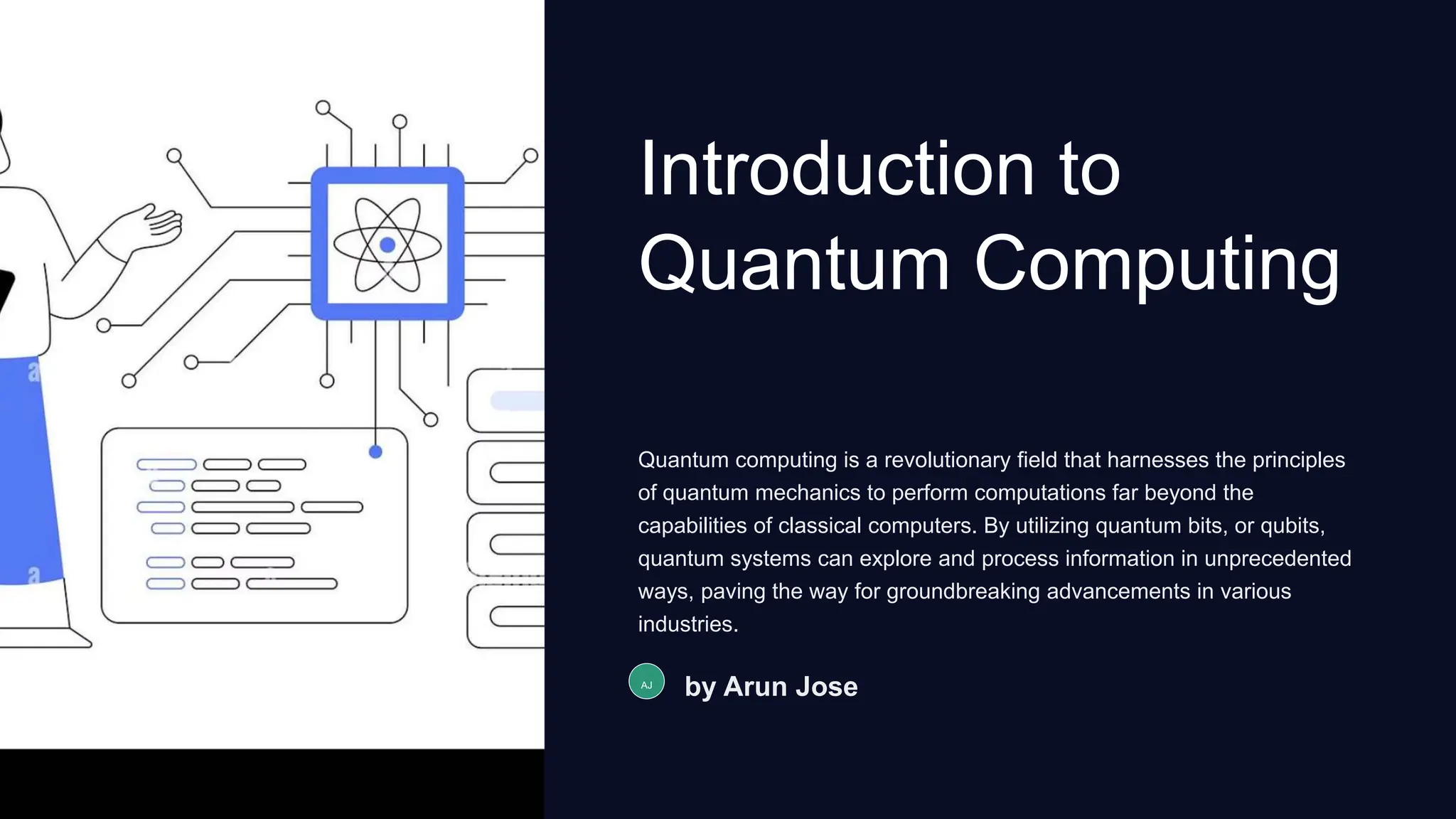
Quantum computing is a revolutionary field that harnesses the principles
of quantum mechanics to perform computations far beyond the
capabilities of classical computers. By utilizing quantum bits, or qubits,
quantum systems can explore and process information in unprecedented
ways, paving the way for groundbreaking advancements in various
industries.
AJ
by Arun Jose
Quantum Computing 0
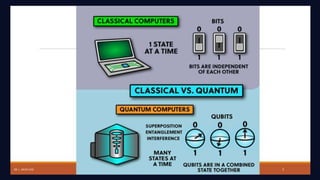
Bit vs Qubit
Quantum Computing 1
Bit vs Qubit
Simulating Quantum Entanglement
Demonstrate a simple quantum experiment or
simulation, such as visualizing the behavior of
entangled qubits, to provide a tangible
understanding of quantum principles.
Interactive Quantum Exploration
Utilize online quantum computing simulators or
interactive tools to allow participants to explore
and experiment with basic quantum
computations.
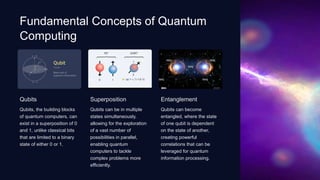
Fundamental Concepts of Quantum
Computing
Qubits
Qubits, the building blocks
of quantum computers, can
exist in a superposition of 0
and 1, unlike classical bits
that are limited to a binary
state of either 0 or 1.
Superposition
Qubits can be in multiple
states simultaneously,
allowing for the exploration
of a vast number of
possibilities in parallel,
enabling quantum
computers to tackle
complex problems more
efficiently.
Entanglement
Qubits can become
entangled, where the state
of one qubit is dependent
on the state of another,
creating powerful
correlations that can be
leveraged for quantum
information processing.
How Quantum Computing Works
Quantum Gates
Quantum gates are the
fundamental building blocks of
quantum circuits, performing
operations on one or more
qubits, similar to how classical
logic gates manipulate bits.
Quantum Circuits
Quantum circuits, sequences
of quantum gates, are used to
represent and execute
quantum algorithms,
harnessing the unique
properties of qubits to solve
complex problems.
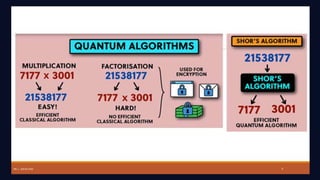
Quantum Algorithms
Key quantum algorithms, such
as Shor's Algorithm for efficient
factorization and Grover's
Algorithm for unstructured
search, demonstrate the
remarkable potential of
quantum computing.
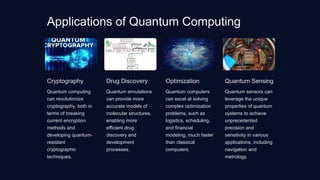
Applications of Quantum Computing
Cryptography
Quantum computing
can revolutionize
cryptography, both in
terms of breaking
current encryption
methods and
developing quantum-
resistant
cryptographic
techniques.
Drug Discovery
Quantum simulations
can provide more
accurate models of
molecular structures,
enabling more
efficient drug
discovery and
development
processes.
Optimization
Quantum computers
can excel at solving
complex optimization
problems, such as
logistics, scheduling,
and financial
modeling, much faster
than classical
computers.
Quantum Sensing
Quantum sensors can
leverage the unique
properties of quantum
systems to achieve
unprecedented
precision and
sensitivity in various
applications, including
navigation and
metrology.
Interaction and Discussion
Questions
Encourage participants to ask questions about
the impact of quantum computing on
cybersecurity, potential applications in their fields,
and other areas of interest.
Discussion
Facilitate an engaging discussion where
participants can share their thoughts on the future
of quantum computing and explore practical use
cases that resonate with them.
Interaction and Discussion
Questions
Encourage participants to ask questions about
the impact of quantum computing on
cybersecurity, potential applications in their fields,
and other areas of interest.
Discussion
Facilitate an engaging discussion where
participants can share their thoughts on the future
of quantum computing and explore practical use
cases that resonate with them.
Discussion
Interaction and Discussion
Questions
Encourage participants to ask questions about
the impact of quantum computing on
cybersecurity, potential applications in their fields,
and other areas of interest.
Discussion
Facilitate an engaging discussion where
participants can share their thoughts on the future
of quantum computing and explore practical use
cases that resonate with them.
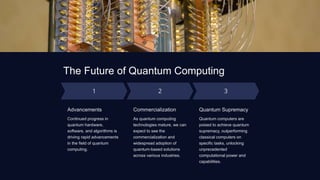
The Future of Quantum Computing
Advancements
Continued progress in
quantum hardware,
software, and algorithms is
driving rapid advancements
in the field of quantum
computing.
Commercialization
As quantum computing
technologies mature, we can
expect to see the
commercialization and
widespread adoption of
quantum-based solutions
across various industries.
Quantum Supremacy
Quantum computers are
poised to achieve quantum
supremacy, outperforming
classical computers on
specific tasks, unlocking
unprecedented
computational power and
capabilities.
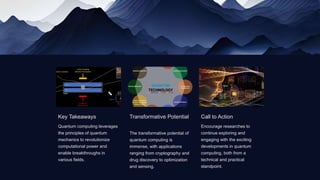
Key Takeaways
Quantum computing leverages
the principles of quantum
mechanics to revolutionize
computational power and
enable breakthroughs in
various fields.
Transformative Potential
The transformative potential of
quantum computing is
immense, with applications
ranging from cryptography and
drug discovery to optimization
and sensing.
Call to Action
Encourage researches to
continue exploring and
engaging with the exciting
developments in quantum
computing, both from a
technical and practical
standpoint.
CREDIT
GRAPHICS DOMINIC WALLIMAN
https://www.psu.edu/news/materials-research-institute/story/new-material-
may-offer-key-solving-quantum-computing-issue/
https://www.youtube.com/watch?v=F_Riqjdh2oM
https://www.youtube.com/watch?v=6qD9XElTpCE
https://www.youtube.com/watch?v=v7iAqcFCTQQ
https://www.youtube.com/watch?v=xjlGL4Mvq7A

Introduction to Quantum Computing and Classical Computing

  • 1.
    Introduction to Quantum Computing Quantumcomputing is a revolutionary field that harnesses the principles of quantum mechanics to perform computations far beyond the capabilities of classical computers. By utilizing quantum bits, or qubits, quantum systems can explore and process information in unprecedented ways, paving the way for groundbreaking advancements in various industries. AJ by Arun Jose
  • 2.
  • 3.
  • 4.
    Simulating Quantum Entanglement Demonstratea simple quantum experiment or simulation, such as visualizing the behavior of entangled qubits, to provide a tangible understanding of quantum principles. Interactive Quantum Exploration Utilize online quantum computing simulators or interactive tools to allow participants to explore and experiment with basic quantum computations.
  • 5.
    Fundamental Concepts ofQuantum Computing Qubits Qubits, the building blocks of quantum computers, can exist in a superposition of 0 and 1, unlike classical bits that are limited to a binary state of either 0 or 1. Superposition Qubits can be in multiple states simultaneously, allowing for the exploration of a vast number of possibilities in parallel, enabling quantum computers to tackle complex problems more efficiently. Entanglement Qubits can become entangled, where the state of one qubit is dependent on the state of another, creating powerful correlations that can be leveraged for quantum information processing.
  • 6.
    How Quantum ComputingWorks Quantum Gates Quantum gates are the fundamental building blocks of quantum circuits, performing operations on one or more qubits, similar to how classical logic gates manipulate bits. Quantum Circuits Quantum circuits, sequences of quantum gates, are used to represent and execute quantum algorithms, harnessing the unique properties of qubits to solve complex problems. Quantum Algorithms Key quantum algorithms, such as Shor's Algorithm for efficient factorization and Grover's Algorithm for unstructured search, demonstrate the remarkable potential of quantum computing.
  • 7.
    Applications of QuantumComputing Cryptography Quantum computing can revolutionize cryptography, both in terms of breaking current encryption methods and developing quantum- resistant cryptographic techniques. Drug Discovery Quantum simulations can provide more accurate models of molecular structures, enabling more efficient drug discovery and development processes. Optimization Quantum computers can excel at solving complex optimization problems, such as logistics, scheduling, and financial modeling, much faster than classical computers. Quantum Sensing Quantum sensors can leverage the unique properties of quantum systems to achieve unprecedented precision and sensitivity in various applications, including navigation and metrology.
  • 8.
    Interaction and Discussion Questions Encourageparticipants to ask questions about the impact of quantum computing on cybersecurity, potential applications in their fields, and other areas of interest. Discussion Facilitate an engaging discussion where participants can share their thoughts on the future of quantum computing and explore practical use cases that resonate with them.
  • 9.
    Interaction and Discussion Questions Encourageparticipants to ask questions about the impact of quantum computing on cybersecurity, potential applications in their fields, and other areas of interest. Discussion Facilitate an engaging discussion where participants can share their thoughts on the future of quantum computing and explore practical use cases that resonate with them.
  • 10.
  • 11.
    Interaction and Discussion Questions Encourageparticipants to ask questions about the impact of quantum computing on cybersecurity, potential applications in their fields, and other areas of interest. Discussion Facilitate an engaging discussion where participants can share their thoughts on the future of quantum computing and explore practical use cases that resonate with them.
  • 12.
    The Future ofQuantum Computing Advancements Continued progress in quantum hardware, software, and algorithms is driving rapid advancements in the field of quantum computing. Commercialization As quantum computing technologies mature, we can expect to see the commercialization and widespread adoption of quantum-based solutions across various industries. Quantum Supremacy Quantum computers are poised to achieve quantum supremacy, outperforming classical computers on specific tasks, unlocking unprecedented computational power and capabilities.
  • 13.
    Key Takeaways Quantum computingleverages the principles of quantum mechanics to revolutionize computational power and enable breakthroughs in various fields. Transformative Potential The transformative potential of quantum computing is immense, with applications ranging from cryptography and drug discovery to optimization and sensing. Call to Action Encourage researches to continue exploring and engaging with the exciting developments in quantum computing, both from a technical and practical standpoint.
  • 14.