O U RT E A M MEMBERS
01 03
02
PALLAV SHARMA
SUJAL POUDEL
ADITYA PUDASAINI
SWARUP BHATTARAI
ARCHIT DHAKAL
05
04
4.
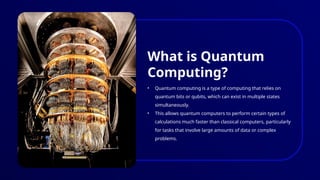
• Quantum computingis a type of computing that relies on
quantum bits or qubits, which can exist in multiple states
simultaneously.
• This allows quantum computers to perform certain types of
calculations much faster than classical computers, particularly
for tasks that involve large amounts of data or complex
problems.
What is Quantum
Computing?
5.
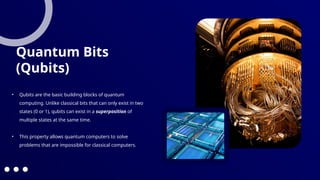
• Qubits arethe basic building blocks of quantum
computing. Unlike classical bits that can only exist in two
states (0 or 1), qubits can exist in a superposition of
multiple states at the same time.
• This property allows quantum computers to solve
problems that are impossible for classical computers.
Quantum Bits
(Qubits)
6.
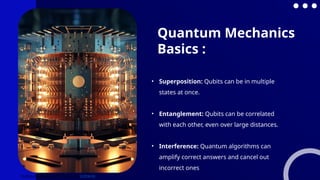
• Superposition: Qubitscan be in multiple
states at once.
• Entanglement: Qubits can be correlated
with each other, even over large distances.
• Interference: Quantum algorithms can
amplify correct answers and cancel out
incorrect ones
Quantum Mechanics
Basics :
This Photo by Unknown Author is licensed under CC BY-SA-NC
8.
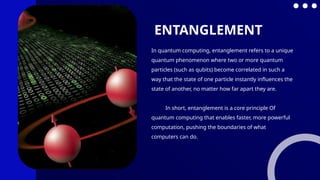
In quantum computing,entanglement refers to a unique
quantum phenomenon where two or more quantum
particles (such as qubits) become correlated in such a
way that the state of one particle instantly influences the
state of another, no matter how far apart they are.
In short, entanglement is a core principle Of
quantum computing that enables faster, more powerful
computation, pushing the boundaries of what
computers can do.
ENTANGLEMENT
9.
In quantum computing,interference refers to a
phenomenon where the probability amplitudes of
quantum states interact in such a way that they either
reinforce or cancel each other out.
Interference in quantum computing is a powerful
tool that enhances the probability of getting the correct
answer by manipulating the probability amplitudes of
quantum states.
INTERFERENCE
10.
The Importance ofQuantum Computing
Faster computation for exponentially quicker problem
solving
Revolutionizes cryptography by breaking traditional
encryption and creating new, quantum-safe methods
Advances drug discovery and healthcare by simulating
molecules for new medicines and treatments
Improves artificial intelligence and machine learning by
enhancing algorithms for pattern recognition and
optimization
11.
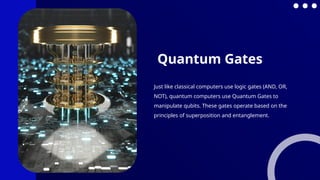
Just like classicalcomputers use logic gates (AND, OR,
NOT), quantum computers use Quantum Gates to
manipulate qubits. These gates operate based on the
principles of superposition and entanglement.
Quantum Gates
12.
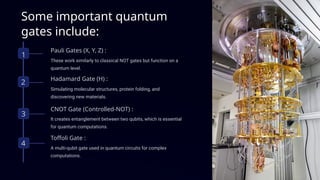
Some important quantum
gatesinclude:
1
Pauli Gates (X, Y, Z) :
These work similarly to classical NOT gates but function on a
quantum level.
2
Hadamard Gate (H) :
Simulating molecular structures, protein folding, and
discovering new materials.
3
CNOT Gate (Controlled-NOT) :
It creates entanglement between two qubits, which is essential
for quantum computations.
4
Toffoli Gate :
A multi-qubit gate used in quantum circuits for complex
computations.
13.
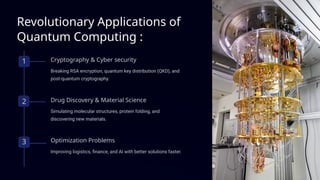
Revolutionary Applications of
QuantumComputing :
1 Cryptography & Cyber security
Breaking RSA encryption, quantum key distribution (QKD), and
post-quantum cryptography.
2 Drug Discovery & Material Science
Simulating molecular structures, protein folding, and
discovering new materials.
3 Optimization Problems
Improving logistics, finance, and AI with better solutions faster.
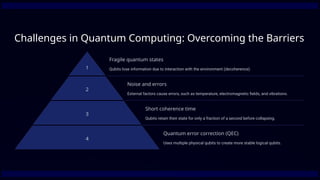
Challenges in QuantumComputing: Overcoming the Barriers
1
Fragile quantum states
Qubits lose information due to interaction with the environment (decoherence).
2
Noise and errors
External factors cause errors, such as temperature, electromagnetic fields, and vibrations.
3
Short coherence time
Qubits retain their state for only a fraction of a second before collapsing.
4
Quantum error correction (QEC)
Uses multiple physical qubits to create more stable logical qubits.
16.
Quantum Error
Correction
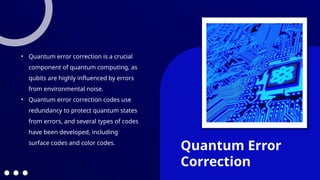
• Quantumerror correction is a crucial
component of quantum computing, as
qubits are highly influenced by errors
from environmental noise.
• Quantum error correction codes use
redundancy to protect quantum states
from errors, and several types of codes
have been developed, including
surface codes and color codes.
17.
The current quantumcomputing landscape is characterized by rapid
growth and innovation, with many companies and research labs working
to develop new quantum hardware, software, and applications. Major
players in the industry include IBM, Google, and Rigetti, and recent
developments include breakthroughs in quantum supremacy and
quantum machine learning.
Quantum
Computing
Landscape
18.
Future of Quantum
Computing
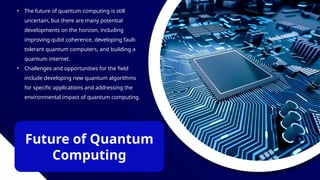
•The future of quantum computing is still
uncertain, but there are many potential
developments on the horizon, including
improving qubit coherence, developing fault-
tolerant quantum computers, and building a
quantum internet.
• Challenges and opportunities for the field
include developing new quantum algorithms
for specific applications and addressing the
environmental impact of quantum computing.