Introduction to programming
concepts
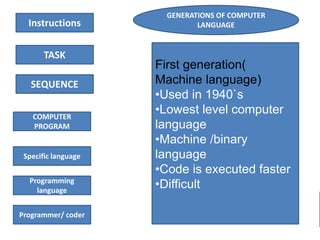
Instructions
TASK
SEQUENCE
COMPUTER
PROGRAM
Specific language
Programming
language
Programmer/ coder
GENERATIONS OF COMPUTER
LANGUAGE
First generation(
Machine language)
•Used in 1940`s
•Lowest level computer
language
•Machine /binary
language
•Code is executed faster
•Difficult
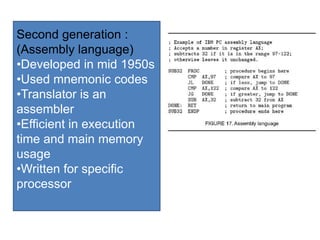
Second generation :
(Assembly language)
•Developed in mid 1950s
•Used mnemonic codes
•Translator is an
assembler
•Efficient in execution
time and main memory
usage
•Written for specific
processor
Third generation : (High
level language)
•Evolved in mid 1960s
and 1970s
•Instructions in form of
english
•Translators needed
•E.g Fortran , COBOL,
BASIC , C , C++
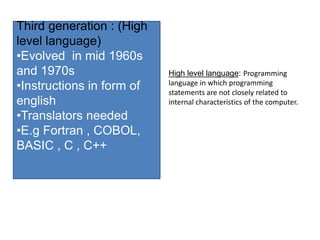
High level language: Programming
language in which programming
statements are not closely related to
internal characteristics of the computer.
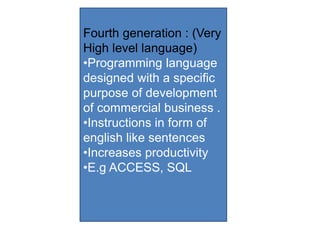
Fourth generation : (Very
High level language)
•Programming language
designed with a specific
purpose of development
of commercial business .
•Instructions in form of
english like sentences
•Increases productivity
•E.g ACCESS, SQL
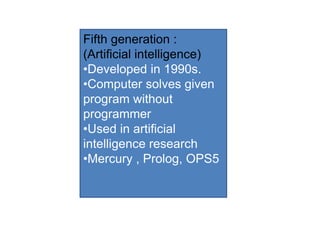
Fifth generation :
(Artificial intelligence)
•Developed in 1990s.
•Computer solves given
program without
programmer
•Used in artificial
intelligence research
•Mercury , Prolog, OPS5
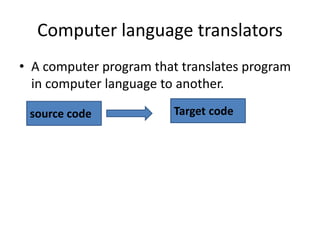
Computer language translators
• A computer program that translates program
in computer language to another.
source code Target code
Assembler
Assembly
language
Machine
language
compiler
• Lots of disk space consumed to save
executable code
High level
language
Machine
language
Executable
code
Interpreter
• Every time a program is executed , the source
code has to be converted afresh.
Source code
Intermediate
code
Executes it line
by line
Important terms
• Modular
• Procedural
• Event Driven programming
• Object oriented programming
• Rapid application development

Introduction to programming concepts