PRESENTED BY
SOMDEEP KUMAR SEN
 A product is anything that has the capacity
to satisfy customer’s need/want/demand
 A product is anything offered for attention,
use or consumption that might satisfy the
need/want/demand
 The term product covers both goods and
services
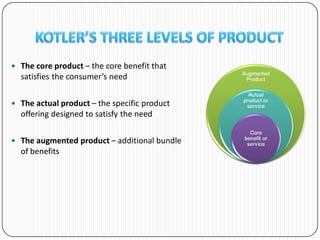
 The core product – the core benefit that
satisfies the consumer’s need
 The actual product – the specific product
offering designed to satisfy the need
 The augmented product – additional bundle
of benefits
 Core product benefit: Transportation
 Actual product: The car itself – design, styling,
quality, performance, reliability, etc.
 Augmented product: Warranty, Extended
warranty, credit, zero % finance, etc.
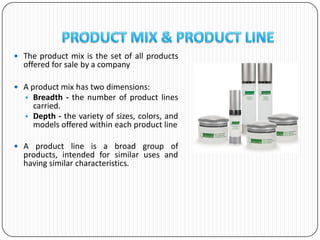
 The product mix is the set of all products
offered for sale by a company
 A product mix has two dimensions:
 Breadth - the number of product lines
carried.
 Depth - the variety of sizes, colors, and
models offered within each product line
 A product line is a broad group of
products, intended for similar uses and
having similar characteristics.
Product Line- I Product Line- II Product Line - III
Bath Soap Detergent Beverage
•Dove
•Lirl
•Lux
•Pears
•Rexona
•Lifebuoy
•Hamam
•Jai
•Breeze
•Moti
•Surf
•Rin
•Wheel
•Sunlight
•501
•Bru
•Brook-Bond
•Taaza
•Tajmahal
ProductDepth
Product Breadth
LINE STRECHING
 Whenever the marketer feels that they can increase the profit by either adding
or dropping items from the product line, it is called Line stretching
 Line Stretching can be both- upward or downward
 Downward Stretching – P & G’s “Ariel” detergent begun at a premium end
& then down stretched to lower market segment by introducing “Ariel Bar”
 Upward Stretching- HUL’s Lifebuoy started as a hygienic bath soap, but later
moved to premium segment as HUL introduced Liquid Hand-Wash
Line Modernization-
 Even when the product is adequate, the line might need to be modernized
 In modern business line modernization is carried out to gain competitive
advantage as the competitors are also upgrading their products
 TATA Sumo (1994) >> Sumo DX (1996) >> Sumo DI Spectra (2000)……………..
So on
Line Pruning-
 Company may find out that one end of its line selling well & other end is not &
hence they may try to boost the demand for slower sales
Line Extension-
 Adding a new product line in the product mix is called Line Extension
 In economics and marketing, product
differentiation is the process of distinguishing a
product or offering from others, to make it more
attractive to a particular target market
 This involves differentiating it from competitors'
products as well as a firm's own product offerings
 Product differentiation can be achieved on the
basis of price, style, packaging, size, flavor etc.
 The stages through which a new product idea goes through from beginning to
end
 It is a generic description of the way a product behaves in the market place
 Every product passes through certain identifiable stages
 Basically, it is a model that describes the stages a product goes through
 This is stage where the product is first introduced to the market
 This stage is most risky and expensive as the brand awareness & the
volume of sales is very low (almost zero)
 This is also known as the stage of negative return
 The product has developed gained certain degree of brand awareness
 The sales volume starts to grow quickly & the profits peak
 However during the later phase of the stage sales volume starts to dip as new
competitors enter the market
 The most profitable Stage as the product has achieved acceptance by most
potential customers
 Sales continue to increase but at a slower pace
 Advertisement expenditures will be reduced as the brand awareness is strong
 Company not only looks to extend its market share but also it looks to defend
its existing one
 Sales begins to decline as the demand for the product decreases
 The product becomes technologically obsolete
 During the decline phase the firm generally have following options
1. Maintain the product & hope that the competitors will exit the market
2. Decrease the price of the product or use other pricing techniques to
increase the sales
3. Reposition the product
4. Discontinue the product
MARKETING OBJETIVES
 To create the product awareness and to attract the customers towards the product
Product
 They offer only on product in the market. They did not come up with the differentiated product
Price
 In the initial stages of the product, they offer the relatively higher price than their competitor
(LIFEBUOY). Because, they want to recover their initial cost of making the product
Promotion
 In the initial stages, they allocated more advertising budget So that more and more customers could
be attracted towards the product
 In ads they targeted the early adopters, who were readiest to buy the product
 The first ambassador, Leela Chitnis.
Place
 Distribution was selective and only covers the major cities of India to get recognition in those cities.
Marketing Objectives
 The marketing objectives of the Lux were to expand their market to the other cities of India
MARKETING STRATEGIES
Product
 In the growth stage, the company had offered the same product in the market.
Price
 In this stage, the company had changed their price to some extent because of maximizing the
market share. ( Slightly cut down the prices )
Place
 In this stage, company had expanded their market to the other cities of INDIA. Their distribution
channel was the same as in the initial stages of the product.
Promotion
 In the growth stage, they had increased their advertising budget as in the initial stages because of
attracting the new customers or to retain the existing customers.
 Sharmila Tagore, Hema Malini, Zeenat Amaan, Juhi Chawla, Madhuri Dixit, Sridevi
MARKETING OBJECTIVES
 The marketing objective of Lux is to maximize more profit while defending the market share. And to expand
the market to all the cities of INDIA.
MARKETING STRATEGIES
Product
 The Lux has made the modification in the product by introducing
 Lux Almond, Lux Orchid , Lux Fruit, Lux Saffron, Lux Chocolate, Lux Oil and Honey.etc
Price
 The Lux products are now available at higher prices in the market, the reason behind is that the company’s
marketing objectives is to maximize more profit
Place
 Now Lux products are available in almost all the cities of India
Promotion
 In this stage Lux advertising has been reduced to some extent because of the more brand awareness in the
minds of customers.
 Recently, they have shown Aishwarya Rai , kareena kapoor & ShahRukh khan
 A product that opens up entirely a new
market
 A product that replaces an existing
product
 An old product introduced in a new
market
 An old product packaged in a different
way
 An old product marketed in a different
way
 A new product launched in a new market
 A new product launched in an old market
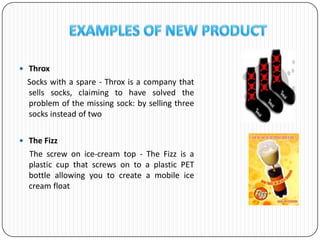
 Throx
Socks with a spare - Throx is a company that
sells socks, claiming to have solved the
problem of the missing sock: by selling three
socks instead of two
 The Fizz
The screw on ice-cream top - The Fizz is a
plastic cup that screws on to a plastic PET
bottle allowing you to create a mobile ice
cream float
 Neglect of market research
 Inaccurate market research
 Poor marketing after launch
 Poor distribution
 Performance below expectation
 Product too complex
 Market not ready for the product
 To add to product mix
 To replace declining products
 To take advantage of new technology
 To maintain/increase market share
 To defeat or to keep up with rivals
 To maintain competitive advantage
 To bring in new customers
Idea Generation
Idea Screening
Concept Testing
Business Analysis
Product Development
Test Marketing
Commercialization
AmountofInvestment
 New Products by their very nature are the results of innovations
 These innovations result from creative & free thinking
 The sources of Idea generation are:
 R & D Department
 Production Department
 Sales Team
 Employees
 Customers
 Competitors
 Market Sources
 The main objective of idea screening is to spot good ideas and reject
poor ones
 Ideas are checked for technical feasibility, financial viability &
marketability
 Ideas are rated according to marketing, production & strategic factors
 During this stage the consumers are presented with a proposed product to
measure their attitude & intentions
 Sample of potential buyers are presented with the product idea through a
written or oral description to determine the attitudes & initial buying
intentions
 In this stage potential profitability of the new product are evaluated
 During this phase potential sales, profit, BEP , ROI, etc. are reviewed
 During this phase the company analyzes the feedback of the sample of the
potential buyers.
 Analysts look to study the technical & the financial feasibility of the product
 Several statistical analysis such regressing, hypothesis testing etc. are used
during this phase
 R&D turns the idea into a product
 Engg. & production issues are involved
 Concern with design, materials, production, processes, quality & safety
 Developing the product concept into a physical product
 Launching a product in small geographical area
 A field experiment in realistic market setting
 Releasing the product into a small but representative market where
consumer reactions can be assessed & the marketing mix checked and
adjusted
Objectives
 Forecast likely results of a national launch
 Test the operational effectiveness of the marketing plan
 To identify possible problems & customer reaction
 Introducing a new product in the market
 Heavy promotional expenditure at the launch as the product is in the
introduction stage
 Product has to be well targeted and positioned
 Choice of skimming or penetration pricing

Introduction to Product

  • 1.
  • 2.
     A productis anything that has the capacity to satisfy customer’s need/want/demand  A product is anything offered for attention, use or consumption that might satisfy the need/want/demand  The term product covers both goods and services
  • 3.
     The coreproduct – the core benefit that satisfies the consumer’s need  The actual product – the specific product offering designed to satisfy the need  The augmented product – additional bundle of benefits
  • 4.
     Core productbenefit: Transportation  Actual product: The car itself – design, styling, quality, performance, reliability, etc.  Augmented product: Warranty, Extended warranty, credit, zero % finance, etc.
  • 5.
     The productmix is the set of all products offered for sale by a company  A product mix has two dimensions:  Breadth - the number of product lines carried.  Depth - the variety of sizes, colors, and models offered within each product line  A product line is a broad group of products, intended for similar uses and having similar characteristics.
  • 6.
    Product Line- IProduct Line- II Product Line - III Bath Soap Detergent Beverage •Dove •Lirl •Lux •Pears •Rexona •Lifebuoy •Hamam •Jai •Breeze •Moti •Surf •Rin •Wheel •Sunlight •501 •Bru •Brook-Bond •Taaza •Tajmahal ProductDepth Product Breadth
  • 8.
    LINE STRECHING  Wheneverthe marketer feels that they can increase the profit by either adding or dropping items from the product line, it is called Line stretching  Line Stretching can be both- upward or downward  Downward Stretching – P & G’s “Ariel” detergent begun at a premium end & then down stretched to lower market segment by introducing “Ariel Bar”  Upward Stretching- HUL’s Lifebuoy started as a hygienic bath soap, but later moved to premium segment as HUL introduced Liquid Hand-Wash
  • 9.
    Line Modernization-  Evenwhen the product is adequate, the line might need to be modernized  In modern business line modernization is carried out to gain competitive advantage as the competitors are also upgrading their products  TATA Sumo (1994) >> Sumo DX (1996) >> Sumo DI Spectra (2000)…………….. So on Line Pruning-  Company may find out that one end of its line selling well & other end is not & hence they may try to boost the demand for slower sales Line Extension-  Adding a new product line in the product mix is called Line Extension
  • 10.
     In economicsand marketing, product differentiation is the process of distinguishing a product or offering from others, to make it more attractive to a particular target market  This involves differentiating it from competitors' products as well as a firm's own product offerings  Product differentiation can be achieved on the basis of price, style, packaging, size, flavor etc.
  • 11.
     The stagesthrough which a new product idea goes through from beginning to end  It is a generic description of the way a product behaves in the market place  Every product passes through certain identifiable stages  Basically, it is a model that describes the stages a product goes through
  • 13.
     This isstage where the product is first introduced to the market  This stage is most risky and expensive as the brand awareness & the volume of sales is very low (almost zero)  This is also known as the stage of negative return
  • 14.
     The producthas developed gained certain degree of brand awareness  The sales volume starts to grow quickly & the profits peak  However during the later phase of the stage sales volume starts to dip as new competitors enter the market
  • 15.
     The mostprofitable Stage as the product has achieved acceptance by most potential customers  Sales continue to increase but at a slower pace  Advertisement expenditures will be reduced as the brand awareness is strong  Company not only looks to extend its market share but also it looks to defend its existing one
  • 16.
     Sales beginsto decline as the demand for the product decreases  The product becomes technologically obsolete  During the decline phase the firm generally have following options 1. Maintain the product & hope that the competitors will exit the market 2. Decrease the price of the product or use other pricing techniques to increase the sales 3. Reposition the product 4. Discontinue the product
  • 18.
    MARKETING OBJETIVES  Tocreate the product awareness and to attract the customers towards the product Product  They offer only on product in the market. They did not come up with the differentiated product Price  In the initial stages of the product, they offer the relatively higher price than their competitor (LIFEBUOY). Because, they want to recover their initial cost of making the product Promotion  In the initial stages, they allocated more advertising budget So that more and more customers could be attracted towards the product  In ads they targeted the early adopters, who were readiest to buy the product  The first ambassador, Leela Chitnis. Place  Distribution was selective and only covers the major cities of India to get recognition in those cities.
  • 19.
    Marketing Objectives  Themarketing objectives of the Lux were to expand their market to the other cities of India MARKETING STRATEGIES Product  In the growth stage, the company had offered the same product in the market. Price  In this stage, the company had changed their price to some extent because of maximizing the market share. ( Slightly cut down the prices ) Place  In this stage, company had expanded their market to the other cities of INDIA. Their distribution channel was the same as in the initial stages of the product. Promotion  In the growth stage, they had increased their advertising budget as in the initial stages because of attracting the new customers or to retain the existing customers.  Sharmila Tagore, Hema Malini, Zeenat Amaan, Juhi Chawla, Madhuri Dixit, Sridevi
  • 20.
    MARKETING OBJECTIVES  Themarketing objective of Lux is to maximize more profit while defending the market share. And to expand the market to all the cities of INDIA. MARKETING STRATEGIES Product  The Lux has made the modification in the product by introducing  Lux Almond, Lux Orchid , Lux Fruit, Lux Saffron, Lux Chocolate, Lux Oil and Honey.etc Price  The Lux products are now available at higher prices in the market, the reason behind is that the company’s marketing objectives is to maximize more profit Place  Now Lux products are available in almost all the cities of India Promotion  In this stage Lux advertising has been reduced to some extent because of the more brand awareness in the minds of customers.  Recently, they have shown Aishwarya Rai , kareena kapoor & ShahRukh khan
  • 22.
     A productthat opens up entirely a new market  A product that replaces an existing product  An old product introduced in a new market  An old product packaged in a different way  An old product marketed in a different way  A new product launched in a new market  A new product launched in an old market
  • 23.
     Throx Socks witha spare - Throx is a company that sells socks, claiming to have solved the problem of the missing sock: by selling three socks instead of two  The Fizz The screw on ice-cream top - The Fizz is a plastic cup that screws on to a plastic PET bottle allowing you to create a mobile ice cream float
  • 24.
     Neglect ofmarket research  Inaccurate market research  Poor marketing after launch  Poor distribution  Performance below expectation  Product too complex  Market not ready for the product
  • 25.
     To addto product mix  To replace declining products  To take advantage of new technology  To maintain/increase market share  To defeat or to keep up with rivals  To maintain competitive advantage  To bring in new customers
  • 26.
    Idea Generation Idea Screening ConceptTesting Business Analysis Product Development Test Marketing Commercialization AmountofInvestment
  • 27.
     New Productsby their very nature are the results of innovations  These innovations result from creative & free thinking  The sources of Idea generation are:  R & D Department  Production Department  Sales Team  Employees  Customers  Competitors  Market Sources
  • 28.
     The mainobjective of idea screening is to spot good ideas and reject poor ones  Ideas are checked for technical feasibility, financial viability & marketability  Ideas are rated according to marketing, production & strategic factors
  • 29.
     During thisstage the consumers are presented with a proposed product to measure their attitude & intentions  Sample of potential buyers are presented with the product idea through a written or oral description to determine the attitudes & initial buying intentions
  • 30.
     In thisstage potential profitability of the new product are evaluated  During this phase potential sales, profit, BEP , ROI, etc. are reviewed  During this phase the company analyzes the feedback of the sample of the potential buyers.  Analysts look to study the technical & the financial feasibility of the product  Several statistical analysis such regressing, hypothesis testing etc. are used during this phase
  • 31.
     R&D turnsthe idea into a product  Engg. & production issues are involved  Concern with design, materials, production, processes, quality & safety  Developing the product concept into a physical product
  • 32.
     Launching aproduct in small geographical area  A field experiment in realistic market setting  Releasing the product into a small but representative market where consumer reactions can be assessed & the marketing mix checked and adjusted Objectives  Forecast likely results of a national launch  Test the operational effectiveness of the marketing plan  To identify possible problems & customer reaction
  • 33.
     Introducing anew product in the market  Heavy promotional expenditure at the launch as the product is in the introduction stage  Product has to be well targeted and positioned  Choice of skimming or penetration pricing