

P.SARANYA
I-M.COM
SYNOPSIS:
 New product planning and development.
 Steps in new product development.
 Management of product life cycle.
 Product line and mix strategies.
The creation of products with new or
different characteristics that offer new or
additional benefits to the customer.
Product development may involve
modification of an existing product or its
presentation , or formulation of an entirely new
product that satisfies a newly defined customer
wants and needs.
New product planning and development
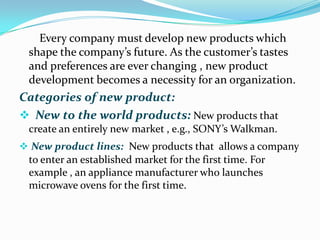
Every company must develop new products which
shape the company’s future. As the customer’s tastes
and preferences are ever changing , new product
development becomes a necessity for an organization.
Categories of new product:
 New to the world products: New products that
create an entirely new market , e.g., SONY’s Walkman.
 New product lines: New products that allows a company
to enter an established market for the first time. For
example , an appliance manufacturer who launches
microwave ovens for the first time.
Additions to the existing product lines: new
products that supplement a company’s existing product
line (package sizes , flavors , from window – type to split
air-conditioners , and so on).
Improvements and revisions of existing products: new
products that improved performance or greater perceived
value and replace existing product.
Repositioning: existing products that are targeted to new
markets or new market segments , e.g., products
repositioned for other uses.
Cost reductions: new products that provide similar
performance at lower cost , e.g., reverse osmosis – type
water filter.
Challenges in new product development
Why do new products fail ?
Over estimated market size
Wrong positioning of the new product
Development cost overshoot expectation
Triggers hyper competitive market position
Superseded by better products from competitors ,
by the time it reaches the market.
What stops new product development ?
Lack of ideas
Social and governmental constraints
Technological constraints
Too high developmental cost
Capital shortage
Faster time required from idea to product
Shorter product life cycle.
What are the criteria for new product
development ?
Specific time frame
Optimum potential market and growth rate
Minimum return on sales and return on investments
Should lead to market leadership position
New product development process
Idea Generation:
New products ideas can
come from:
Interacting with others
(sales representatives
and intermediaries)
Creativity techniques –
attribute listing , mind
mapping.
Idea screening:
Idea screening is the process of comparing
and contrasting new product related ideas in order to
select the most promising ones for your business. Not
all ideas are relevant for your company. To be able to
screen the good from the not so good , all ideas need
to be evaluated according to some criteria , like
strategic fit , technical difficulties , and market
opportunities.
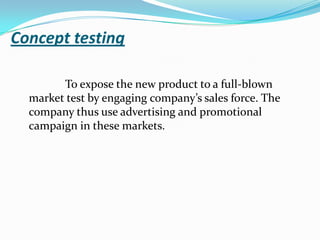
Concept testing
To expose the new product to a full-blown
market test by engaging company’s sales force. The
company thus use advertising and promotional
campaign in these markets.
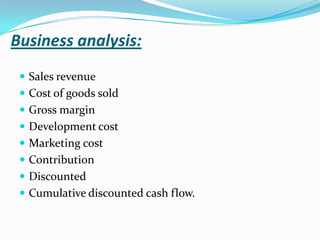
Business analysis:
 Sales revenue
 Cost of goods sold
 Gross margin
 Development cost
 Marketing cost
 Contribution
 Discounted
 Cumulative discounted cash flow.
Product development
At this stage , the company has to decide whether
the product idea can be translated into a technically
and commercially feasible product , as there will be a
considerable jump in investment if the company wants
to go ahead with the proposal.
Moreover , consumer testing has to be done in
the form of bringing consumers into the laboratory for
usage under controlled conditions , giving them
samples to use in their homes , or product
demonstrations to elicit their off-the-off reactions.
Test marketing
 To expose the new product to a full-blown market test
by engaging company’s sales force.
 The company thus use advertising and promotional
campaign in these markets.
Commercialization
Major decisions to be taken are:
Timing of commercialization , i.e., when to
commercialize?
first entry , parallel entry , late entry
The geographic strategy , i.e., where to commercialize?
Who are the target market , i.e., whom to
commercialize?
Introductory marketing strategy , i.e., how to
commercialize?
MANAGEMENT OF
PRODUCT LIFE
CYCLE
Introduction
The concept of product life cycle is concerned
with the sales history of a product. It portrays there
changes in sales and profit overtime.
Profits maximize before there sales are highest
because the intensity of competition increases at the
end of growth and before the start of maturity stage.
Stages in the product life cycle
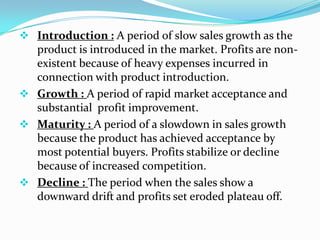
 Introduction : A period of slow sales growth as the
product is introduced in the market. Profits are non-
existent because of heavy expenses incurred in
connection with product introduction.
 Growth : A period of rapid market acceptance and
substantial profit improvement.
 Maturity : A period of a slowdown in sales growth
because the product has achieved acceptance by
most potential buyers. Profits stabilize or decline
because of increased competition.
 Decline : The period when the sales show a
downward drift and profits set eroded plateau off.
Benefits of product life cycle concept
 The product life cycle concept is useful to chart
individual item , brands , product forms and product
classes.
 This concept can also be used to chart styles , fashions
and fads.
 The management can understand what typically
happens at different stages in product life. Therefore ,
it can improve its forward planning.
 Different suitable price policies can be formulated for
different products passing through different stages.
Criticisms against the concept:
 It has a limited value
 It measures only the fluctuations in sales and
profits that a profit during the time of its
fluctuations.
 It does not explain the causes for these
fluctuations or when they will occur.
PRODUCT MIX AND PRODUCT LINE
Meaning of product mix: The expression product mix
refers to the collection of products dealt with by a
business firm. The product mix is one of the elements
in the product policy.
Definition of philip kotler : “product mix is the set of
all product lines and items that a particular seller
offers for sale to buyers”.
Meaning of the product line and item
At this stage , it is more appropriate to understand
the meaning of the terms product line and product
item.
A product item is a specific product. In the words
of philip kotler, “product item is a distinct unit that is
distinguishable by size , price , appearance or some
other attribute”.
A product line , on the other , is a collective term.
It refers to a group of products intended for essentially
similar uses and possessing reasonably similar physical
characteristics.
Dimensions of product mix:
 Length of the product mix: the length of the
product mix refers to the total number of items in its
product mix.
 Width of the product mix: the width of the product
mix refers to the number of different product lines the
company carries.
 Depth of the product mix: it refers how many
varieties are offered in each product line.
 Consistency of the product mix: product mix is
measure of hoe closely related its various product lines
are to one another.
 Expansion of product mix
 Contraction of product mix
 Alteration of product mix
 Positioning the product
 Trading up and trading down
 Product differentiation and market segmentation
Product development

Product development

  • 1.
  • 2.
    SYNOPSIS:  New productplanning and development.  Steps in new product development.  Management of product life cycle.  Product line and mix strategies.
  • 4.
    The creation ofproducts with new or different characteristics that offer new or additional benefits to the customer. Product development may involve modification of an existing product or its presentation , or formulation of an entirely new product that satisfies a newly defined customer wants and needs.
  • 5.
    New product planningand development
  • 6.
    Every company mustdevelop new products which shape the company’s future. As the customer’s tastes and preferences are ever changing , new product development becomes a necessity for an organization. Categories of new product:  New to the world products: New products that create an entirely new market , e.g., SONY’s Walkman.  New product lines: New products that allows a company to enter an established market for the first time. For example , an appliance manufacturer who launches microwave ovens for the first time.
  • 7.
    Additions to theexisting product lines: new products that supplement a company’s existing product line (package sizes , flavors , from window – type to split air-conditioners , and so on). Improvements and revisions of existing products: new products that improved performance or greater perceived value and replace existing product. Repositioning: existing products that are targeted to new markets or new market segments , e.g., products repositioned for other uses. Cost reductions: new products that provide similar performance at lower cost , e.g., reverse osmosis – type water filter.
  • 8.
    Challenges in newproduct development Why do new products fail ? Over estimated market size Wrong positioning of the new product Development cost overshoot expectation Triggers hyper competitive market position Superseded by better products from competitors , by the time it reaches the market.
  • 9.
    What stops newproduct development ? Lack of ideas Social and governmental constraints Technological constraints Too high developmental cost Capital shortage Faster time required from idea to product Shorter product life cycle.
  • 10.
    What are thecriteria for new product development ? Specific time frame Optimum potential market and growth rate Minimum return on sales and return on investments Should lead to market leadership position
  • 11.
  • 12.
    Idea Generation: New productsideas can come from: Interacting with others (sales representatives and intermediaries) Creativity techniques – attribute listing , mind mapping.
  • 13.
    Idea screening: Idea screeningis the process of comparing and contrasting new product related ideas in order to select the most promising ones for your business. Not all ideas are relevant for your company. To be able to screen the good from the not so good , all ideas need to be evaluated according to some criteria , like strategic fit , technical difficulties , and market opportunities.
  • 14.
    Concept testing To exposethe new product to a full-blown market test by engaging company’s sales force. The company thus use advertising and promotional campaign in these markets.
  • 15.
    Business analysis:  Salesrevenue  Cost of goods sold  Gross margin  Development cost  Marketing cost  Contribution  Discounted  Cumulative discounted cash flow.
  • 16.
    Product development At thisstage , the company has to decide whether the product idea can be translated into a technically and commercially feasible product , as there will be a considerable jump in investment if the company wants to go ahead with the proposal. Moreover , consumer testing has to be done in the form of bringing consumers into the laboratory for usage under controlled conditions , giving them samples to use in their homes , or product demonstrations to elicit their off-the-off reactions.
  • 17.
    Test marketing  Toexpose the new product to a full-blown market test by engaging company’s sales force.  The company thus use advertising and promotional campaign in these markets.
  • 18.
    Commercialization Major decisions tobe taken are: Timing of commercialization , i.e., when to commercialize? first entry , parallel entry , late entry The geographic strategy , i.e., where to commercialize? Who are the target market , i.e., whom to commercialize? Introductory marketing strategy , i.e., how to commercialize?
  • 19.
  • 20.
    Introduction The concept ofproduct life cycle is concerned with the sales history of a product. It portrays there changes in sales and profit overtime. Profits maximize before there sales are highest because the intensity of competition increases at the end of growth and before the start of maturity stage.
  • 21.
    Stages in theproduct life cycle
  • 22.
     Introduction :A period of slow sales growth as the product is introduced in the market. Profits are non- existent because of heavy expenses incurred in connection with product introduction.  Growth : A period of rapid market acceptance and substantial profit improvement.  Maturity : A period of a slowdown in sales growth because the product has achieved acceptance by most potential buyers. Profits stabilize or decline because of increased competition.  Decline : The period when the sales show a downward drift and profits set eroded plateau off.
  • 23.
    Benefits of productlife cycle concept  The product life cycle concept is useful to chart individual item , brands , product forms and product classes.  This concept can also be used to chart styles , fashions and fads.  The management can understand what typically happens at different stages in product life. Therefore , it can improve its forward planning.  Different suitable price policies can be formulated for different products passing through different stages.
  • 24.
    Criticisms against theconcept:  It has a limited value  It measures only the fluctuations in sales and profits that a profit during the time of its fluctuations.  It does not explain the causes for these fluctuations or when they will occur.
  • 25.
    PRODUCT MIX ANDPRODUCT LINE Meaning of product mix: The expression product mix refers to the collection of products dealt with by a business firm. The product mix is one of the elements in the product policy. Definition of philip kotler : “product mix is the set of all product lines and items that a particular seller offers for sale to buyers”.
  • 26.
    Meaning of theproduct line and item At this stage , it is more appropriate to understand the meaning of the terms product line and product item. A product item is a specific product. In the words of philip kotler, “product item is a distinct unit that is distinguishable by size , price , appearance or some other attribute”. A product line , on the other , is a collective term. It refers to a group of products intended for essentially similar uses and possessing reasonably similar physical characteristics.
  • 27.
    Dimensions of productmix:  Length of the product mix: the length of the product mix refers to the total number of items in its product mix.  Width of the product mix: the width of the product mix refers to the number of different product lines the company carries.  Depth of the product mix: it refers how many varieties are offered in each product line.  Consistency of the product mix: product mix is measure of hoe closely related its various product lines are to one another.
  • 28.
     Expansion ofproduct mix  Contraction of product mix  Alteration of product mix  Positioning the product  Trading up and trading down  Product differentiation and market segmentation