1EnterpriseDB, Postgres Plus and Dynatune are trademarks
of EnterpriseDB Corporation. Other names may be
trademarks of their respective owners. © 2010. All rights
reserved.
Postgres-XC
Write-scalable, Synchronous Multi-master,
Transparent PostgreSQL Cluster with Shared
Nothing Approach
Presented by Ashutosh Bapat
November 22, 2011
@ OSI Days 2011
Agenda
● High-lights
● Architecture overview
● Performance
● Release and development processes
● Your contributions
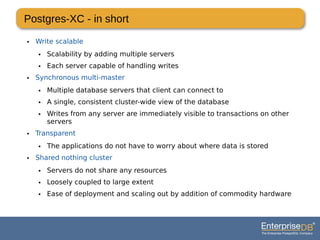
Postgres-XC - in short
● Write scalable
● Scalability by adding multiple servers
● Each server capable of handling writes
● Synchronous multi-master
● Multiple database servers that client can connect to
● A single, consistent cluster-wide view of the database
● Writes from any server are immediately visible to transactions on other
servers
● Transparent
● The applications do not have to worry about where data is stored
● Shared nothing cluster
● Servers do not share any resources
● Loosely coupled to large extent
● Ease of deployment and scaling out by addition of commodity hardware
Postgres-XC - high-lights
● Based on world's most advance open source database –
PostgreSQL
● Same client APIs as PostgreSQL
● Ease of application migration from existing
PostgreSQL deployment
● Licensing – same as PostgreSQL license
● Free to use, modify and redistribute for commercial
purposes
Postgres-XC - history
● Started through a collaboration between EnterpriseDB
and NTT Open Source Software Center in 2009
● Mandate to build a PostgreSQL based clustering solution
which can serve as an alternative to Oracle RAC
● Very well represented by NTT in terms of engineers,
hardware and funding
● EnterpriseDB provides key technical resources and
PostgreSQL expertise to the project
● Licensing terms changed from GPL to BSD (or
PostgreSQL) this year
Architecture Overview
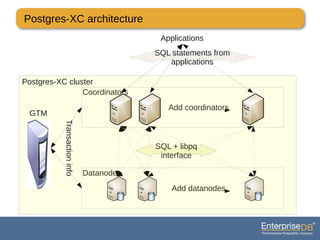
Postgres-XC architecture
Applications
Coordinators
Add coordinators
Datanodes
Add datanodes
SQL + libpq
interface
Postgres-XC cluster
SQL statements from
applicationsTransactioninfo
GTM
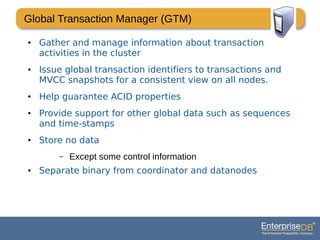
Global Transaction Manager (GTM)
● Gather and manage information about transaction
activities in the cluster
● Issue global transaction identifiers to transactions and
MVCC snapshots for a consistent view on all nodes.
● Help guarantee ACID properties
● Provide support for other global data such as sequences
and time-stamps
● Store no data
– Except some control information
● Separate binary from coordinator and datanodes
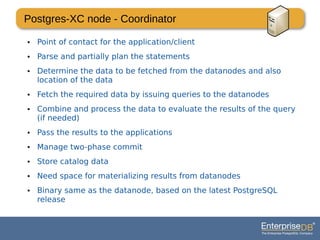
Postgres-XC node - Coordinator
● Point of contact for the application/client
● Parse and partially plan the statements
● Determine the data to be fetched from the datanodes and also
location of the data
● Fetch the required data by issuing queries to the datanodes
● Combine and process the data to evaluate the results of the query
(if needed)
● Pass the results to the applications
● Manage two-phase commit
● Store catalog data
● Need space for materializing results from datanodes
● Binary same as the datanode, based on the latest PostgreSQL
release
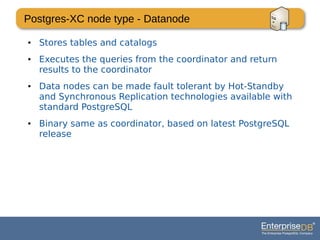
Postgres-XC node type - Datanode
● Stores tables and catalogs
● Executes the queries from the coordinator and return
results to the coordinator
● Data nodes can be made fault tolerant by Hot-Standby
and Synchronous Replication technologies available with
standard PostgreSQL
● Binary same as coordinator, based on latest PostgreSQL
release
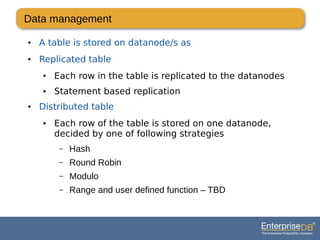
Data management
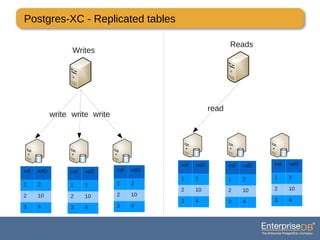
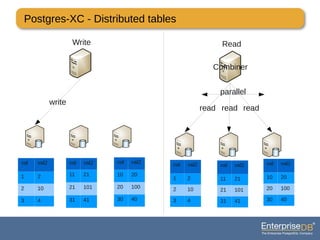
● A table is stored on datanode/s as
● Replicated table
● Each row in the table is replicated to the datanodes
● Statement based replication
● Distributed table
● Each row of the table is stored on one datanode,
decided by one of following strategies
– Hash
– Round Robin
– Modulo
– Range and user defined function – TBD
Postgres-XC - Replicated tables
Writes
write write write
val val2
1 2
2 10
3 4
val val2
1 2
2 10
3 4
val val2
1 2
2 10
3 4
Reads
read
val val2
1 2
2 10
3 4
val val2
1 2
2 10
3 4
val val2
1 2
2 10
3 4
Postgres-XC - Distributed tables
Combiner
Read
read read read
val val2
1 2
2 10
3 4
val val2
11 21
21 101
31 41
val val2
10 20
20 100
30 40
Write
write
val val2
1 2
2 10
3 4
val val2
11 21
21 101
31 41
val val2
10 20
20 100
30 40
parallel
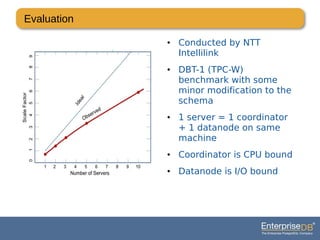
Evaluation
● Conducted by NTT
Intellilink
● DBT-1 (TPC-W)
benchmark with some
minor modification to the
schema
● 1 server = 1 coordinator
+ 1 datanode on same
machine
● Coordinator is CPU bound
● Datanode is I/O bound
Release management
Postgres-XC - Development and Release process
● Primary contribution from NTT/EnterpriseDB with at least
4 full time engineers and 2 part time engineers working
on the project
● Open source model where many issues are discussed on
the public mailing lists
● Increased interests from other community developers
● One release almost every 3-4 months to get new PGXC
features to the users as soon as possible
● Keep pace with the PostgreSQL development to benefit
from the new features in PostgreSQL
● GIT repository ensures a clean and quick merge process
Upto V 0.9.6
● Based on PostgreSQL 9.1
● SQL support
● Major DDL/DML (TABLE, ROLE, VIEW...)
● PREPAREd statements
● SELECT queries: support extension aggregates,
HAVING, GROUP BY, ORDER BY, LIMIT, OFFSET...
– No CTAS, INSERT SELECT, SELECT INTO (Being
worked on)
● Cursors
– no backward, no CURRENT OF
● Session parameters
● Temporary objects
Expectations from V 1.0
● SQL support
● Subqueries (WITH)
● CREATE AS/SELECT INTO
● Trigger, rules
● CURRENT OF
● TABLESPACE extension (case of multiple Datanodes
on same server...)
● Concurrent index creation
● Changing distribution strategy
– Distribution column, nodes or type
After V 1.0
● Global constraints
● Unique/Reference integrity among partition
● Exclusion constraint among partition
● Global deadlock detection (wait-for-graph mechanism)
● Online server removal/addition
● SQL/MED mechanisms, FDW integration
● Connection balancing between master and slave
Datanodes for read transactions
● SAVEPOINT
Project resources and contacts
● Project home
– http://postgres-xc.sourceforge.net
● Developer mailing list
– postgres-xc-developers@lists.sourceforge.net
– postgres-xc-general@lists.sourceforge.net
● Contact me
– ashutosh.bapat@enterprisedb.com
– EnterpriseDB, the PostgreSQL company
Resources needed for
● Writing Code
– Backend - New distributed/parallel query
handling/optimization, HA capabilities, Utilities, Bug fixes
– Installers, building binaries, distribution packages
● Test
– Performance evaluation with various benchmarks
– Finding bugs
– New feature proposals
● Deployment
– Running practical applications against Postgres-XC
Thank you

Introduction to Postrges-XC

  • 1.
    1EnterpriseDB, Postgres Plusand Dynatune are trademarks of EnterpriseDB Corporation. Other names may be trademarks of their respective owners. © 2010. All rights reserved. Postgres-XC Write-scalable, Synchronous Multi-master, Transparent PostgreSQL Cluster with Shared Nothing Approach Presented by Ashutosh Bapat November 22, 2011 @ OSI Days 2011
  • 2.
    Agenda ● High-lights ● Architectureoverview ● Performance ● Release and development processes ● Your contributions
  • 3.
    Postgres-XC - inshort ● Write scalable ● Scalability by adding multiple servers ● Each server capable of handling writes ● Synchronous multi-master ● Multiple database servers that client can connect to ● A single, consistent cluster-wide view of the database ● Writes from any server are immediately visible to transactions on other servers ● Transparent ● The applications do not have to worry about where data is stored ● Shared nothing cluster ● Servers do not share any resources ● Loosely coupled to large extent ● Ease of deployment and scaling out by addition of commodity hardware
  • 4.
    Postgres-XC - high-lights ●Based on world's most advance open source database – PostgreSQL ● Same client APIs as PostgreSQL ● Ease of application migration from existing PostgreSQL deployment ● Licensing – same as PostgreSQL license ● Free to use, modify and redistribute for commercial purposes
  • 5.
    Postgres-XC - history ●Started through a collaboration between EnterpriseDB and NTT Open Source Software Center in 2009 ● Mandate to build a PostgreSQL based clustering solution which can serve as an alternative to Oracle RAC ● Very well represented by NTT in terms of engineers, hardware and funding ● EnterpriseDB provides key technical resources and PostgreSQL expertise to the project ● Licensing terms changed from GPL to BSD (or PostgreSQL) this year
  • 6.
  • 7.
    Postgres-XC architecture Applications Coordinators Add coordinators Datanodes Adddatanodes SQL + libpq interface Postgres-XC cluster SQL statements from applicationsTransactioninfo GTM
  • 8.
    Global Transaction Manager(GTM) ● Gather and manage information about transaction activities in the cluster ● Issue global transaction identifiers to transactions and MVCC snapshots for a consistent view on all nodes. ● Help guarantee ACID properties ● Provide support for other global data such as sequences and time-stamps ● Store no data – Except some control information ● Separate binary from coordinator and datanodes
  • 9.
    Postgres-XC node -Coordinator ● Point of contact for the application/client ● Parse and partially plan the statements ● Determine the data to be fetched from the datanodes and also location of the data ● Fetch the required data by issuing queries to the datanodes ● Combine and process the data to evaluate the results of the query (if needed) ● Pass the results to the applications ● Manage two-phase commit ● Store catalog data ● Need space for materializing results from datanodes ● Binary same as the datanode, based on the latest PostgreSQL release
  • 10.
    Postgres-XC node type- Datanode ● Stores tables and catalogs ● Executes the queries from the coordinator and return results to the coordinator ● Data nodes can be made fault tolerant by Hot-Standby and Synchronous Replication technologies available with standard PostgreSQL ● Binary same as coordinator, based on latest PostgreSQL release
  • 11.
    Data management ● Atable is stored on datanode/s as ● Replicated table ● Each row in the table is replicated to the datanodes ● Statement based replication ● Distributed table ● Each row of the table is stored on one datanode, decided by one of following strategies – Hash – Round Robin – Modulo – Range and user defined function – TBD
  • 12.
    Postgres-XC - Replicatedtables Writes write write write val val2 1 2 2 10 3 4 val val2 1 2 2 10 3 4 val val2 1 2 2 10 3 4 Reads read val val2 1 2 2 10 3 4 val val2 1 2 2 10 3 4 val val2 1 2 2 10 3 4
  • 13.
    Postgres-XC - Distributedtables Combiner Read read read read val val2 1 2 2 10 3 4 val val2 11 21 21 101 31 41 val val2 10 20 20 100 30 40 Write write val val2 1 2 2 10 3 4 val val2 11 21 21 101 31 41 val val2 10 20 20 100 30 40 parallel
  • 14.
    Evaluation ● Conducted byNTT Intellilink ● DBT-1 (TPC-W) benchmark with some minor modification to the schema ● 1 server = 1 coordinator + 1 datanode on same machine ● Coordinator is CPU bound ● Datanode is I/O bound
  • 15.
  • 16.
    Postgres-XC - Developmentand Release process ● Primary contribution from NTT/EnterpriseDB with at least 4 full time engineers and 2 part time engineers working on the project ● Open source model where many issues are discussed on the public mailing lists ● Increased interests from other community developers ● One release almost every 3-4 months to get new PGXC features to the users as soon as possible ● Keep pace with the PostgreSQL development to benefit from the new features in PostgreSQL ● GIT repository ensures a clean and quick merge process
  • 17.
    Upto V 0.9.6 ●Based on PostgreSQL 9.1 ● SQL support ● Major DDL/DML (TABLE, ROLE, VIEW...) ● PREPAREd statements ● SELECT queries: support extension aggregates, HAVING, GROUP BY, ORDER BY, LIMIT, OFFSET... – No CTAS, INSERT SELECT, SELECT INTO (Being worked on) ● Cursors – no backward, no CURRENT OF ● Session parameters ● Temporary objects
  • 18.
    Expectations from V1.0 ● SQL support ● Subqueries (WITH) ● CREATE AS/SELECT INTO ● Trigger, rules ● CURRENT OF ● TABLESPACE extension (case of multiple Datanodes on same server...) ● Concurrent index creation ● Changing distribution strategy – Distribution column, nodes or type
  • 19.
    After V 1.0 ●Global constraints ● Unique/Reference integrity among partition ● Exclusion constraint among partition ● Global deadlock detection (wait-for-graph mechanism) ● Online server removal/addition ● SQL/MED mechanisms, FDW integration ● Connection balancing between master and slave Datanodes for read transactions ● SAVEPOINT
  • 20.
    Project resources andcontacts ● Project home – http://postgres-xc.sourceforge.net ● Developer mailing list – postgres-xc-developers@lists.sourceforge.net – postgres-xc-general@lists.sourceforge.net ● Contact me – ashutosh.bapat@enterprisedb.com – EnterpriseDB, the PostgreSQL company
  • 21.
    Resources needed for ●Writing Code – Backend - New distributed/parallel query handling/optimization, HA capabilities, Utilities, Bug fixes – Installers, building binaries, distribution packages ● Test – Performance evaluation with various benchmarks – Finding bugs – New feature proposals ● Deployment – Running practical applications against Postgres-XC
  • 22.