





Maintaining Terabytes
   with Postgres

          Selena Deckelmann
     Emma, Inc - http://myemma.com
 PostgreSQL Global Development Group
http://tech.myemma.com
   @emmaemailtech
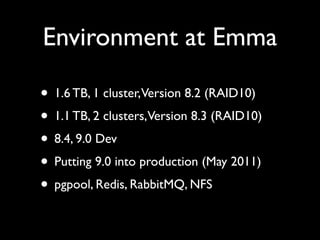
Environment at Emma

• 1.6 TB, 1 cluster,Version 8.2 (RAID10)
• 1.1 TB, 2 clusters,Version 8.3 (RAID10)
• 8.4, 9.0 Dev
• Putting 9.0 into production (May 2011)
• pgpool, Redis, RabbitMQ, NFS
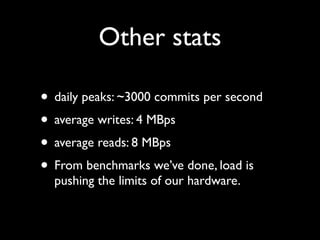
Other stats

• daily peaks: ~3000 commits per second
• average writes: 4 MBps
• average reads: 8 MBps
• From benchmarks we’ve done, load is
  pushing the limits of our hardware.
I say all of this with
         love.
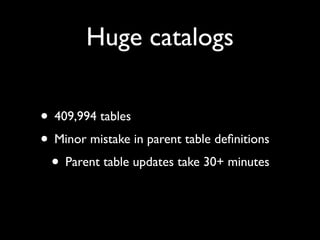
Huge catalogs

• 409,994 tables
• Minor mistake in parent table definitions
 • Parent table updates take 30+ minutes
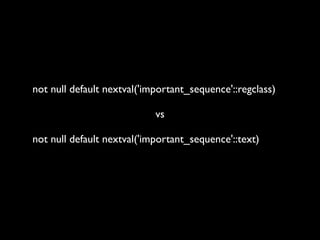
not null default nextval('important_sequence'::regclass)

                            vs

not null default nextval('important_sequence'::text)
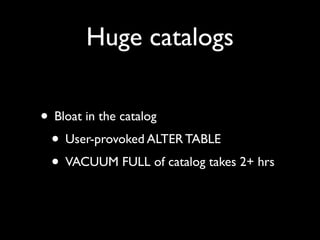
Huge catalogs

• Bloat in the catalog
 • User-provoked ALTER TABLE
 • VACUUM FULL of catalog takes 2+ hrs
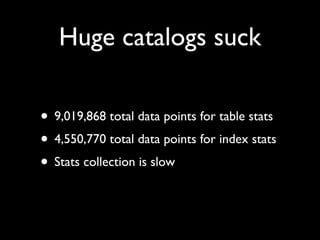
Huge catalogs suck

• 9,019,868 total data points for table stats
• 4,550,770 total data points for index stats
• Stats collection is slow
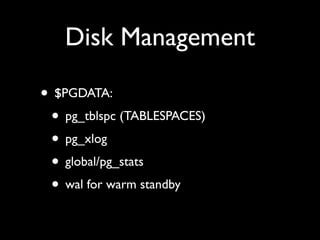
Disk Management

• $PGDATA:
 • pg_tblspc (TABLESPACES)
 • pg_xlog
 • global/pg_stats
 • wal for warm standby
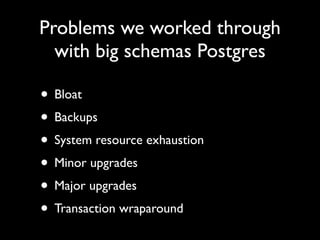
Problems we worked through
  with big schemas Postgres

• Bloat
• Backups
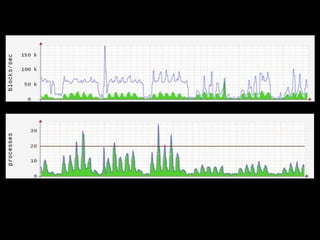
• System resource exhaustion
• Minor upgrades
• Major upgrades
• Transaction wraparound
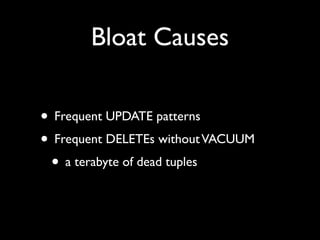
Bloat Causes

• Frequent UPDATE patterns
• Frequent DELETEs without VACUUM
 • a terabyte of dead tuples
SELECT
                  BLOAT QUERY
   schemaname, tablename, reltuples::bigint, relpages::bigint, otta,
   ROUND(CASE WHEN otta=0 THEN 0.0 ELSE sml.relpages/otta::numeric END,1) AS tbloat,
   CASE WHEN relpages < otta THEN 0 ELSE relpages::bigint - otta END AS wastedpages,
   CASE WHEN relpages < otta THEN 0 ELSE bs*(sml.relpages-otta)::bigint END AS wastedbytes,
   CASE WHEN relpages < otta THEN '0 bytes'::text ELSE (bs*(relpages-otta))::bigint || ' bytes' END AS wastedsize,
   iname, ituples::bigint, ipages::bigint, iotta,
   ROUND(CASE WHEN iotta=0 OR ipages=0 THEN 0.0 ELSE ipages/iotta::numeric END,1) AS ibloat,
   CASE WHEN ipages < iotta THEN 0 ELSE ipages::bigint - iotta END AS wastedipages,
   CASE WHEN ipages < iotta THEN 0 ELSE bs*(ipages-iotta) END AS wastedibytes,
   CASE WHEN ipages < iotta THEN '0 bytes' ELSE (bs*(ipages-iotta))::bigint || ' bytes' END AS wastedisize
 FROM (
   SELECT
     schemaname, tablename, cc.reltuples, cc.relpages, bs,
     CEIL((cc.reltuples*((datahdr+ma-
        (CASE WHEN datahdr%ma=0 THEN ma ELSE datahdr%ma END))+nullhdr2+4))/(bs-20::float)) AS otta,
     COALESCE(c2.relname,'?') AS iname, COALESCE(c2.reltuples,0) AS ituples, COALESCE(c2.relpages,0) AS ipages,
     COALESCE(CEIL((c2.reltuples*(datahdr-12))/(bs-20::float)),0) AS iotta
   FROM (
     SELECT
        ma,bs,schemaname,tablename,
        (datawidth+(hdr+ma-(case when hdr%ma=0 THEN ma ELSE hdr%ma END)))::numeric AS datahdr,
        (maxfracsum*(nullhdr+ma-(case when nullhdr%ma=0 THEN ma ELSE nullhdr%ma END))) AS nullhdr2
     FROM (
        SELECT
          schemaname, tablename, hdr, ma, bs,
          SUM((1-null_frac)*avg_width) AS datawidth,
          MAX(null_frac) AS maxfracsum,
          hdr+(
            SELECT 1+count(*)/8
            FROM pg_stats s2
            WHERE null_frac<>0 AND s2.schemaname = s.schemaname AND s2.tablename = s.tablename
          ) AS nullhdr
        FROM pg_stats s, (
          SELECT
            (SELECT current_setting('block_size')::numeric) AS bs,
            CASE WHEN substring(v,12,3) IN ('8.0','8.1','8.2') THEN 27 ELSE 23 END AS hdr,
            CASE WHEN v ~ 'mingw32' THEN 8 ELSE 4 END AS ma
          FROM (SELECT version() AS v) AS foo
        ) AS constants
        GROUP BY 1,2,3,4,5
     ) AS foo
   ) AS rs
   JOIN pg_class cc ON cc.relname = rs.tablename
   JOIN pg_namespace nn ON cc.relnamespace = nn.oid AND nn.nspname = rs.schemaname AND nn.nspname <> 'information_schema'
   LEFT JOIN pg_index i ON indrelid = cc.oid
   LEFT JOIN pg_class c2 ON c2.oid = i.indexrelid
 ) AS sml
 WHERE tablename = 'addr'
 ORDER BY wastedbytes DESC LIMIT 1;


            Use check_postgres.pl
https://github.com/bucardo/check_postgres/
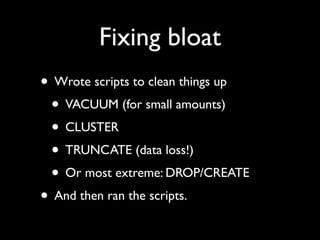
Fixing bloat
• Wrote scripts to clean things up
 • VACUUM (for small amounts)
 • CLUSTER
 • TRUNCATE (data loss!)
 • Or most extreme: DROP/CREATE
• And then ran the scripts.
Backups


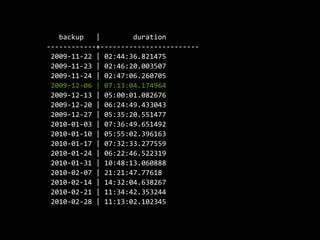
• pg_dump takes longer and longer
 	
  	
  backup	
  	
  	
  |	


  duration	


-­‐-­‐-­‐-­‐-­‐-­‐-­‐-­‐-­‐-­‐-­‐-­‐+-­‐-­‐-­‐-­‐-­‐-­‐-­‐-­‐-­‐-­‐-­‐-­‐-­‐-­‐-­‐-­‐-­‐-­‐-­‐-­‐-­‐-­‐-­‐-­‐
	
  2009-­‐11-­‐22	
  |	
  02:44:36.821475
	
  2009-­‐11-­‐23	
  |	
  02:46:20.003507
	
  2009-­‐11-­‐24	
  |	
  02:47:06.260705
	
  2009-­‐12-­‐06	
  |	
  07:13:04.174964
	
  2009-­‐12-­‐13	
  |	
  05:00:01.082676
	
  2009-­‐12-­‐20	
  |	
  06:24:49.433043
	
  2009-­‐12-­‐27	
  |	
  05:35:20.551477
	
  2010-­‐01-­‐03	
  |	
  07:36:49.651492
	
  2010-­‐01-­‐10	
  |	
  05:55:02.396163
	
  2010-­‐01-­‐17	
  |	
  07:32:33.277559
	
  2010-­‐01-­‐24	
  |	
  06:22:46.522319
	
  2010-­‐01-­‐31	
  |	
  10:48:13.060888
	
  2010-­‐02-­‐07	
  |	
  21:21:47.77618
	
  2010-­‐02-­‐14	
  |	
  14:32:04.638267
	
  2010-­‐02-­‐21	
  |	
  11:34:42.353244
	
  2010-­‐02-­‐28	
  |	
  11:13:02.102345
Backups

• pg_dump fails
 • patching pg_dump for SELECT ... LIMIT
 • Crank down shared_buffers
 • or...
http://seeifixedit.com/view/there-i-fixed-it/45
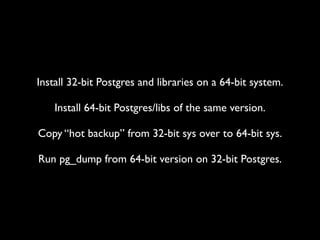
Install 32-bit Postgres and libraries on a 64-bit system.

    Install 64-bit Postgres/libs of the same version.

Copy “hot backup” from 32-bit sys over to 64-bit sys.

Run pg_dump from 64-bit version on 32-bit Postgres.
PSA

• Warm standby is not a backup
 • Hot backup instances
 • “You don’t have valid backups, you have
    valid restores.” (thanks @sarahnovotny)
 • Necessity is the mother of invention...
Ship WAL from Solaris x86 -> Linux
           It did work!
Running out of inodes
• UFS on Solaris
    “The only way to add more inodes to a UFS
    filesystem is:
    1. destroy the filesystem and create a new
    filesystem with a higher inode density
    2. enlarge the filesystem - growfs man page”
•   Solution 0: Delete files.

•   Solution 1: Sharding and bigger FS on Linux

•   Solution 2: ext4 (soon!)
Running out of
available file descriptors

• Too many open files by the database
• Pooling - pgpool-II or pgbouncer?
Minor upgrades


• Stop/start database
• CHECKPOINT() before shutdown
Major Version upgrades

• Too much downtime to dump/restore
 • Write tools to migrate data
 • Trigger-based replication
 •  pg_upgrade
Transaction
wraparound avoidance
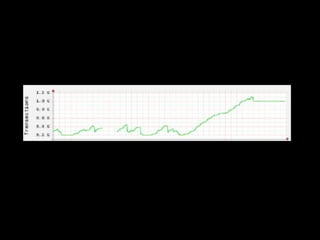
• autovacuum triggers are too small
 • 200,000 transactions (2 days)
 • Watch age(datfrozenxid)
 • Increase autovacuum_freeze_max_age
Thanks!

• We’re hiring! - selena@myemma.com
• Emma’s Tech Blog: http://tech.myemma.com
• My blog: http://chesnok.com
• http://twitter.com/selenamarie

Managing terabytes: When Postgres gets big

  • 1.
    Maintaining Terabytes with Postgres Selena Deckelmann Emma, Inc - http://myemma.com PostgreSQL Global Development Group
  • 2.
  • 3.
    Environment at Emma •1.6 TB, 1 cluster,Version 8.2 (RAID10) • 1.1 TB, 2 clusters,Version 8.3 (RAID10) • 8.4, 9.0 Dev • Putting 9.0 into production (May 2011) • pgpool, Redis, RabbitMQ, NFS
  • 4.
    Other stats • dailypeaks: ~3000 commits per second • average writes: 4 MBps • average reads: 8 MBps • From benchmarks we’ve done, load is pushing the limits of our hardware.
  • 5.
    I say allof this with love.
  • 6.
    Huge catalogs • 409,994tables • Minor mistake in parent table definitions • Parent table updates take 30+ minutes
  • 7.
    not null defaultnextval('important_sequence'::regclass) vs not null default nextval('important_sequence'::text)
  • 8.
    Huge catalogs • Bloatin the catalog • User-provoked ALTER TABLE • VACUUM FULL of catalog takes 2+ hrs
  • 9.
    Huge catalogs suck •9,019,868 total data points for table stats • 4,550,770 total data points for index stats • Stats collection is slow
  • 10.
    Disk Management • $PGDATA: • pg_tblspc (TABLESPACES) • pg_xlog • global/pg_stats • wal for warm standby
  • 11.
    Problems we workedthrough with big schemas Postgres • Bloat • Backups • System resource exhaustion • Minor upgrades • Major upgrades • Transaction wraparound
  • 12.
    Bloat Causes • FrequentUPDATE patterns • Frequent DELETEs without VACUUM • a terabyte of dead tuples
  • 13.
    SELECT BLOAT QUERY schemaname, tablename, reltuples::bigint, relpages::bigint, otta, ROUND(CASE WHEN otta=0 THEN 0.0 ELSE sml.relpages/otta::numeric END,1) AS tbloat, CASE WHEN relpages < otta THEN 0 ELSE relpages::bigint - otta END AS wastedpages, CASE WHEN relpages < otta THEN 0 ELSE bs*(sml.relpages-otta)::bigint END AS wastedbytes, CASE WHEN relpages < otta THEN '0 bytes'::text ELSE (bs*(relpages-otta))::bigint || ' bytes' END AS wastedsize, iname, ituples::bigint, ipages::bigint, iotta, ROUND(CASE WHEN iotta=0 OR ipages=0 THEN 0.0 ELSE ipages/iotta::numeric END,1) AS ibloat, CASE WHEN ipages < iotta THEN 0 ELSE ipages::bigint - iotta END AS wastedipages, CASE WHEN ipages < iotta THEN 0 ELSE bs*(ipages-iotta) END AS wastedibytes, CASE WHEN ipages < iotta THEN '0 bytes' ELSE (bs*(ipages-iotta))::bigint || ' bytes' END AS wastedisize FROM ( SELECT schemaname, tablename, cc.reltuples, cc.relpages, bs, CEIL((cc.reltuples*((datahdr+ma- (CASE WHEN datahdr%ma=0 THEN ma ELSE datahdr%ma END))+nullhdr2+4))/(bs-20::float)) AS otta, COALESCE(c2.relname,'?') AS iname, COALESCE(c2.reltuples,0) AS ituples, COALESCE(c2.relpages,0) AS ipages, COALESCE(CEIL((c2.reltuples*(datahdr-12))/(bs-20::float)),0) AS iotta FROM ( SELECT ma,bs,schemaname,tablename, (datawidth+(hdr+ma-(case when hdr%ma=0 THEN ma ELSE hdr%ma END)))::numeric AS datahdr, (maxfracsum*(nullhdr+ma-(case when nullhdr%ma=0 THEN ma ELSE nullhdr%ma END))) AS nullhdr2 FROM ( SELECT schemaname, tablename, hdr, ma, bs, SUM((1-null_frac)*avg_width) AS datawidth, MAX(null_frac) AS maxfracsum, hdr+( SELECT 1+count(*)/8 FROM pg_stats s2 WHERE null_frac<>0 AND s2.schemaname = s.schemaname AND s2.tablename = s.tablename ) AS nullhdr FROM pg_stats s, ( SELECT (SELECT current_setting('block_size')::numeric) AS bs, CASE WHEN substring(v,12,3) IN ('8.0','8.1','8.2') THEN 27 ELSE 23 END AS hdr, CASE WHEN v ~ 'mingw32' THEN 8 ELSE 4 END AS ma FROM (SELECT version() AS v) AS foo ) AS constants GROUP BY 1,2,3,4,5 ) AS foo ) AS rs JOIN pg_class cc ON cc.relname = rs.tablename JOIN pg_namespace nn ON cc.relnamespace = nn.oid AND nn.nspname = rs.schemaname AND nn.nspname <> 'information_schema' LEFT JOIN pg_index i ON indrelid = cc.oid LEFT JOIN pg_class c2 ON c2.oid = i.indexrelid ) AS sml WHERE tablename = 'addr' ORDER BY wastedbytes DESC LIMIT 1; Use check_postgres.pl https://github.com/bucardo/check_postgres/
  • 14.
    Fixing bloat • Wrotescripts to clean things up • VACUUM (for small amounts) • CLUSTER • TRUNCATE (data loss!) • Or most extreme: DROP/CREATE • And then ran the scripts.
  • 15.
    Backups • pg_dump takeslonger and longer
  • 16.
         backup      |                duration                 -­‐-­‐-­‐-­‐-­‐-­‐-­‐-­‐-­‐-­‐-­‐-­‐+-­‐-­‐-­‐-­‐-­‐-­‐-­‐-­‐-­‐-­‐-­‐-­‐-­‐-­‐-­‐-­‐-­‐-­‐-­‐-­‐-­‐-­‐-­‐-­‐  2009-­‐11-­‐22  |  02:44:36.821475  2009-­‐11-­‐23  |  02:46:20.003507  2009-­‐11-­‐24  |  02:47:06.260705  2009-­‐12-­‐06  |  07:13:04.174964  2009-­‐12-­‐13  |  05:00:01.082676  2009-­‐12-­‐20  |  06:24:49.433043  2009-­‐12-­‐27  |  05:35:20.551477  2010-­‐01-­‐03  |  07:36:49.651492  2010-­‐01-­‐10  |  05:55:02.396163  2010-­‐01-­‐17  |  07:32:33.277559  2010-­‐01-­‐24  |  06:22:46.522319  2010-­‐01-­‐31  |  10:48:13.060888  2010-­‐02-­‐07  |  21:21:47.77618  2010-­‐02-­‐14  |  14:32:04.638267  2010-­‐02-­‐21  |  11:34:42.353244  2010-­‐02-­‐28  |  11:13:02.102345
  • 17.
    Backups • pg_dump fails • patching pg_dump for SELECT ... LIMIT • Crank down shared_buffers • or...
  • 18.
  • 19.
    Install 32-bit Postgresand libraries on a 64-bit system. Install 64-bit Postgres/libs of the same version. Copy “hot backup” from 32-bit sys over to 64-bit sys. Run pg_dump from 64-bit version on 32-bit Postgres.
  • 20.
    PSA • Warm standbyis not a backup • Hot backup instances • “You don’t have valid backups, you have valid restores.” (thanks @sarahnovotny) • Necessity is the mother of invention...
  • 21.
    Ship WAL fromSolaris x86 -> Linux It did work!
  • 22.
    Running out ofinodes • UFS on Solaris “The only way to add more inodes to a UFS filesystem is: 1. destroy the filesystem and create a new filesystem with a higher inode density 2. enlarge the filesystem - growfs man page” • Solution 0: Delete files. • Solution 1: Sharding and bigger FS on Linux • Solution 2: ext4 (soon!)
  • 23.
    Running out of availablefile descriptors • Too many open files by the database • Pooling - pgpool-II or pgbouncer?
  • 24.
    Minor upgrades • Stop/startdatabase • CHECKPOINT() before shutdown
  • 25.
    Major Version upgrades •Too much downtime to dump/restore • Write tools to migrate data • Trigger-based replication • pg_upgrade
  • 26.
    Transaction wraparound avoidance • autovacuumtriggers are too small • 200,000 transactions (2 days) • Watch age(datfrozenxid) • Increase autovacuum_freeze_max_age
  • 29.
    Thanks! • We’re hiring!- selena@myemma.com • Emma’s Tech Blog: http://tech.myemma.com • My blog: http://chesnok.com • http://twitter.com/selenamarie