Introduction to OSGi
Neil Bartlett –   2009 12 23
❶
Brief Intro to OSGi
OSGi: The Module
System for Java
Standard Java


JARs are Deployment
Units
                       ABC.JAR
They are Not Modules
What’s Missing?

Meaningful name

Version

Vendor
                  ABC.JAR
Exports

Dependencies
Dependencies

JARs do have dependencies

They are implicit.

A dependency is an assumption.

“I assume module X (version Y) is on the
classpath. If not I will crash and burn.”
Module = “Bundle”
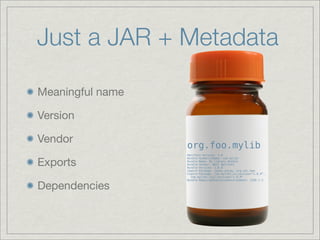
Just a JAR + Metadata

Meaningful name

Version

Vendor
                  org.foo.mylib
                  Manifest-Version: 1.0


Exports
                  Bundle-SymbolicName: com.mylib
                  Bundle-Name: My Library Bundle
                  Bundle-Vendor: Neil Bartlett
                  Bundle-Version: 1.0.0
                  Import-Package: javax.swing, org.w3c.dom
                  Export-Package: com.mylib1.ui;version=“1.0.0”,
                    com.mylib1.util;version=“1.0.0”
                  Bundle-RequiredExecutionEnvironment: J2SE-1.5

Dependencies
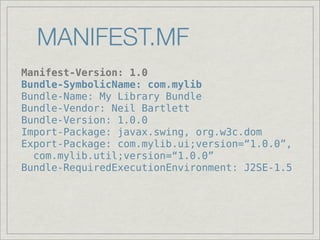
MANIFEST.MF
Manifest-Version: 1.0
Bundle-SymbolicName: com.mylib
Bundle-Name: My Library Bundle
Bundle-Vendor: Neil Bartlett
Bundle-Version: 1.0.0
Import-Package: javax.swing, org.w3c.dom
Export-Package: com.mylib.ui;version=“1.0.0”,
  com.mylib.util;version=“1.0.0”
Bundle-RequiredExecutionEnvironment: J2SE-1.5
Works Outside OSGi
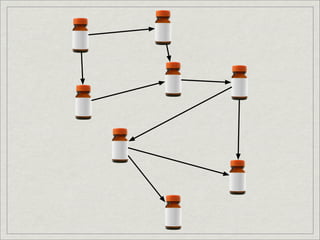
Dependency Graphs
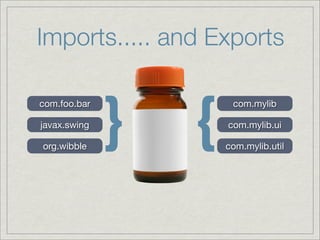
Imports..... and Exports


              }   {
com.foo.bar            com.mylib

javax.swing           com.mylib.ui

org.wibble            com.mylib.util
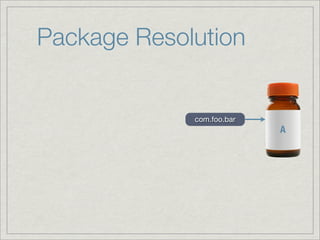
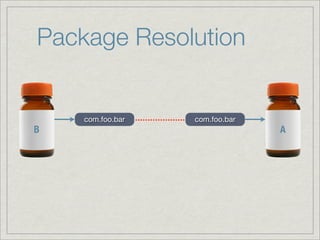
Package Resolution


             com.foo.bar
                           A
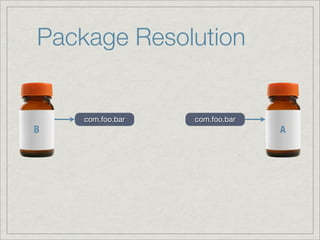
Package Resolution


    com.foo.bar   com.foo.bar
B                               A
Package Resolution


    com.foo.bar   com.foo.bar
B                               A
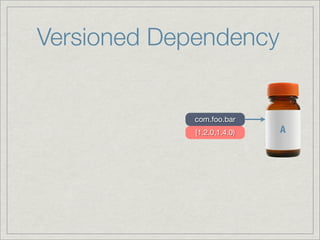
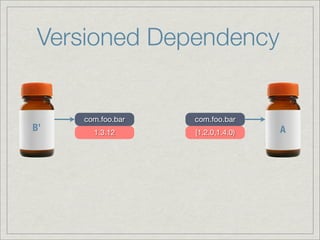
Versioned Dependency


             com.foo.bar
             [1.2.0,1.4.0)   A
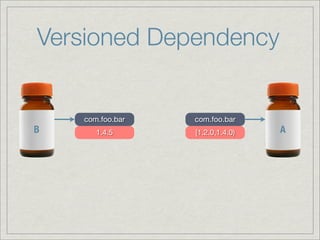
Versioned Dependency


    com.foo.bar   com.foo.bar
B      1.4.5      [1.2.0,1.4.0)   A
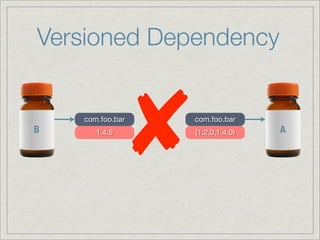
Versioned Dependency


B
    com.foo.bar
       1.4.5

                  ✘   com.foo.bar
                      [1.2.0,1.4.0)   A
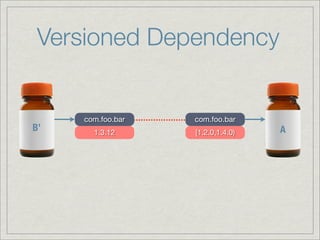
Versioned Dependency


     com.foo.bar   com.foo.bar
B’     1.3.12      [1.2.0,1.4.0)   A
Versioned Dependency


     com.foo.bar   com.foo.bar
B’     1.3.12      [1.2.0,1.4.0)   A
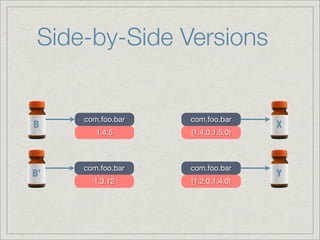
Side-by-Side Versions


     com.foo.bar   com.foo.bar
B                                  X
        1.4.5      [1.4.0,1.5.0)


     com.foo.bar   com.foo.bar
B’                                 Y
       1.3.12      [1.2.0,1.4.0)
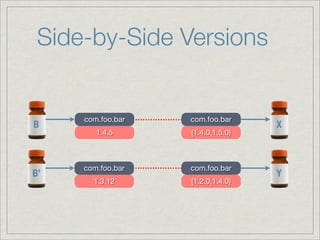
Side-by-Side Versions


     com.foo.bar   com.foo.bar
B                                  X
        1.4.5      [1.4.0,1.5.0)


     com.foo.bar   com.foo.bar
B’                                 Y
       1.3.12      [1.2.0,1.4.0)
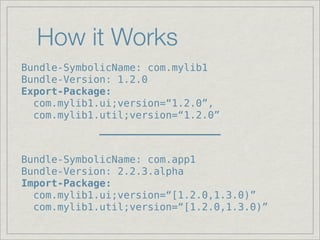
How it Works
Bundle-SymbolicName: com.mylib1
Bundle-Version: 1.2.0
Export-Package:
  com.mylib1.ui;version=“1.2.0”,
  com.mylib1.util;version=“1.2.0”


Bundle-SymbolicName: com.app1
Bundle-Version: 2.2.3.alpha
Import-Package:
  com.mylib1.ui;version=“[1.2.0,1.3.0)”
  com.mylib1.util;version=“[1.2.0,1.3.0)”
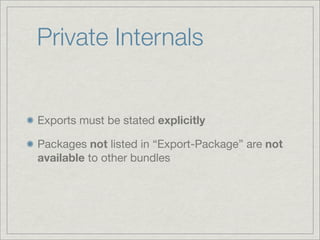
Private Internals


Exports must be stated explicitly

Packages not listed in “Export-Package” are not
available to other bundles
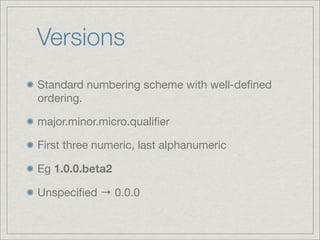
Versions
Standard numbering scheme with well-defined
ordering.

major.minor.micro.qualifier

First three numeric, last alphanumeric

Eg 1.0.0.beta2

Unspecified ! 0.0.0
Version Ranges
Open, closed or implicit

[1.0.0, 2.0.0] ! 1.0.0 ! version ! 2.0.0

[1.0.0, 2.0.0) ! 1.0.0 ! version < 2.0.0

    Informally “1.*”

1 ! [1.0.0, ")

Unspecified ! [0.0.0, ")
Our Promise*: No More
NoClassDefFoundErrors!
Dynamic!
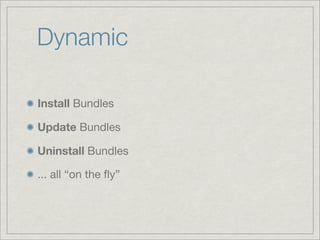
Dynamic

Install Bundles

Update Bundles

Uninstall Bundles

... all “on the fly”
❷
OSGi in Infrastructure
OSGi is the King of
Infrastructure
All Major JEE Application Servers use OSGi

Most ESBs use OSGi

2 of 3 Open Source IDEs use OSGi

Even Build Tools (Maven and Hudson) Moving to
OSGi
Where are the
“Business” Apps?
OSGi for Applications
Until Recently, Application Servers used OSGi “on
the inside”

Now SpringSource dm Server, Paremus Infiniflow,
WAS 7, GlassFish v3 and WebLogic DM all expose
OSGi

Application Developers can Finally Deploy OSGi
bundles to their OSGi servers!
Why is OSGi Attractive
for Application
Development?
❸
The Failure of Object
Oriented Programming
OOP Was Meant to
Enable Reuse
HARDER THAN
 EXPECTED!
“Building a new system
would be a snap. Just get a
  few classes, bunch them
      together... and voila!”
                  – Peter Kriens
What Went Wrong??
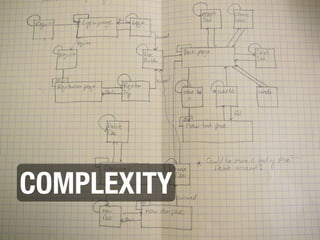
Tight Coupling
COMPLEXITY
Classes coupled to
Other Classes
Packages coupled to
Other Packages
Packages coupled to
JARs
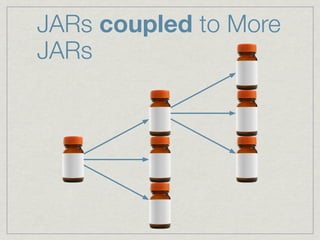
JARs coupled to More
JARs
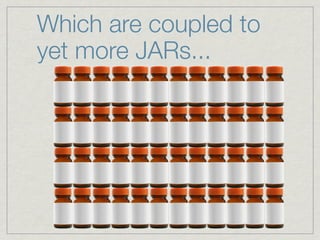
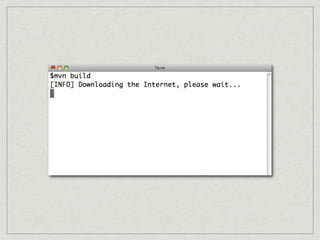
Which are coupled to
yet more JARs...
Dependency Injection?
DI Frameworks


Provide “Late Binding” of Implementations to
Interfaces

But Not Late Enough!
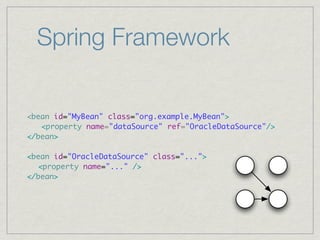
Spring Framework


<bean id="MyBean" class="org.example.MyBean">
	 <property name="dataSource" ref="OracleDataSource"/>
</bean>

<bean id="OracleDataSource" class="...">
	 <property name="..." />
</bean>
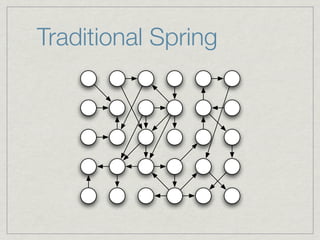
Traditional Spring
Static DI


“Beans” are wired together once, at start-up

They cannot be rewired

Limited support for optional dependencies
FRAGILE
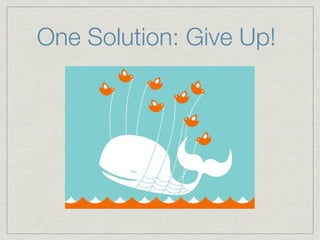
One Solution: Give Up!
Reuse is Hard, So Don’t
Try!
Leave Code in One
Place, and Call
Remotely
(...also known as “SOA”)
❹
Component Oriented
Programming
What is a
“Component”?
The Usual Analogy:
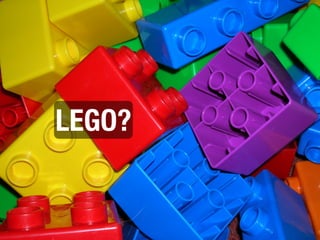
LEGO?
Not Really...


Dead Lumps of Plastic

Many Copies of the Same Thing
BIOLOGY
BIOLOGY
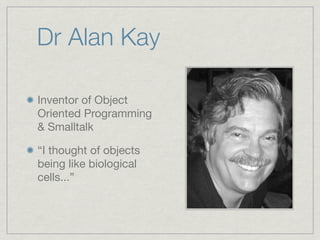
Dr Alan Kay

Inventor of Object
Oriented Programming
& Smalltalk

“I thought of objects
being like biological
cells...”
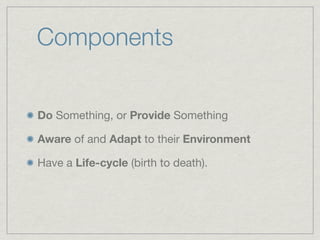
Components


Do Something, or Provide Something

Aware of and Adapt to their Environment

Have a Life-cycle (birth to death).
“Do” Something

Open a socket

Monitor a device

Poll a queue

Display a GUI

.... etc.
“Provide” Something


Publish a Service – may be used by other
components
The “Environment”


The “Environment” of a Component means:

 Services provided by other Components

 Resources, Devices, Network etc
Components Adapt to
their Environment
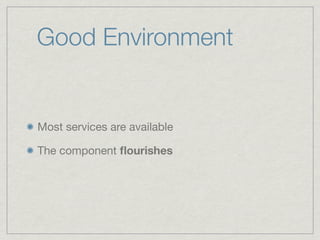
Good Environment


Most services are available

The component flourishes
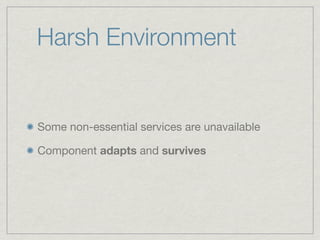
Harsh Environment


Some non-essential services are unavailable

Component adapts and survives
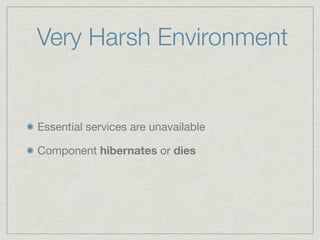
Very Harsh Environment


Essential services are unavailable

Component hibernates or dies
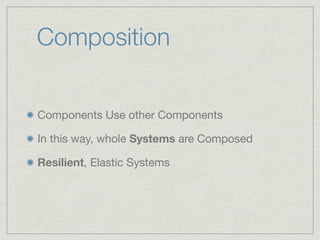
Composition


Components Use other Components

In this way, whole Systems are Composed

Resilient, Elastic Systems
❺
Developing
Components
Services

Components provide Services

Registered with a Service Registry

Services are POJOs!

Looked up by Java interface name
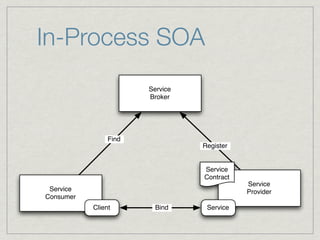
In-Process SOA
                       Service
                       Broker


                Find
                                 Register


                                 Service
                                 Contract
                                            Service
 Service                                    Provider
Consumer
           Client        Bind     Service
Plain Old Java Objects
The Glue Between
Components
Dynamics Make
Services Slippery
We Don’t Code Directly
against Services (it’s too hard!)
Let a Framework
Handle the Hard Stuff
Choice of Frameworks

Declarative Services (DS)

Blueprint (from Spring-DM)

iPOJO

Guice Peaberry
Framework Interop

Perfect Interoperability of these Frameworks!

No need to choose “The One True Framework”

Use 3rd-party components implemented with
other frameworks.
Examining DS


Dynamic dependency injection (DI)

... and “uninjection”
Starting Point...
import javax.sql.DataSource;

public class DbMailbox implements Mailbox {

    private DataSource dataSource;

    void setDataSource(DataSource ds) { /*...*/ }
    void unsetDataSource(DataSource ds) { /*...*/ }

    public long[] getAllMessages() {
       // ...
    }
}
Starting Point...
                                          No OSGi API Used
import javax.sql.DataSource;

public class DbMailbox implements Mailbox {

    private DataSource dataSource;

    void setDataSource(DataSource ds) { /*...*/ }
    void unsetDataSource(DataSource ds) { /*...*/ }

    public long[] getAllMessages() {
       // ...
    }
}
Starting Point...
                                             No OSGi API Used
import javax.sql.DataSource;

public class DbMailbox implements Mailbox {

    private DataSource dataSource;

    void setDataSource(DataSource ds) { /*...*/ }
    void unsetDataSource(DataSource ds) { /*...*/ }

    public long[] getAllMessages() {
       // ...
    }
}                                    JavaBeans Style => Testable
Make it a Component
import javax.sql.DataSource;

@Component
public class DbMailbox implements Mailbox {

    private DataSource dataSource;

    @Reference(service = DataSource.class)
    void setDataSource(DataSource ds) { /*...*/ }
    void unsetDataSource(DataSource ds) { /*...*/ }

    public long[] getAllMessages() {
       // ...
    }
}
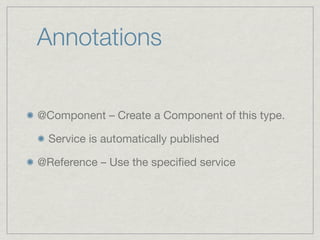
Annotations


@Component – Create a Component of this type.

  Service is automatically published

@Reference – Use the specified service
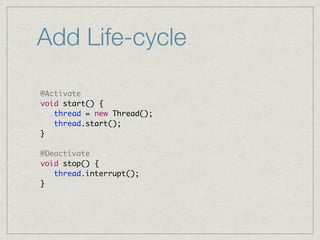
Add Life-cycle

@Activate
void start() {
   thread = new Thread();
   thread.start();
}

@Deactivate
void stop() {
   thread.interrupt();
}
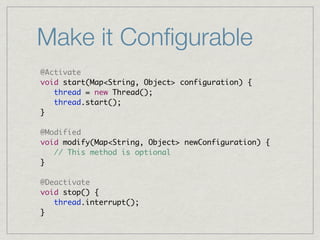
Make it Configurable
@Activate
void start(Map<String, Object> configuration) {
   thread = new Thread();
   thread.start();
}

@Modified
void modify(Map<String, Object> newConfiguration) {
   // This method is optional
}

@Deactivate
void stop() {
   thread.interrupt();
}
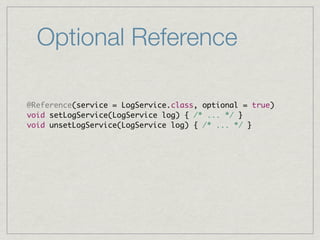
Optional Reference

@Reference(service = LogService.class, optional = true)
void setLogService(LogService log) { /* ... */ }
void unsetLogService(LogService log) { /* ... */ }
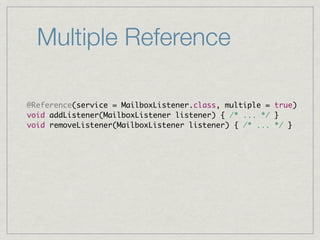
Multiple Reference

@Reference(service = MailboxListener.class, multiple = true)
void addListener(MailboxListener listener) { /* ... */ }
void removeListener(MailboxListener listener) { /* ... */ }
❻
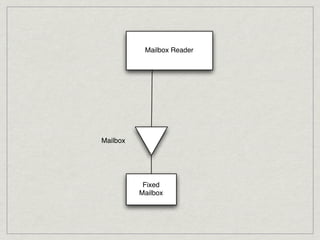
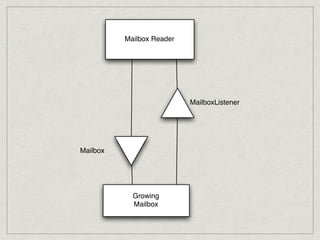
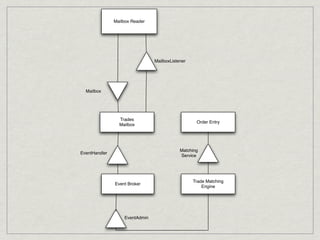
DEMO
Mailbox Reader


Mailbox


           Fixed
          Mailbox
Mailbox Reader


                           MailboxListener


Mailbox


            Growing
            Mailbox
Mailbox Reader


                                MailboxListener


  Mailbox


                 Trades
                                                   Order Entry
                 Mailbox


                                            Matching
EventHandler
                                            Service


                                                  Trade Matching
               Event Broker
                                                      Engine


                   EventAdmin

Introduction to OSGi (Tokyo JUG)