By : Sumit Gole & Sourabh Aggarwal
Date : 13 August 2015
SPRING 4
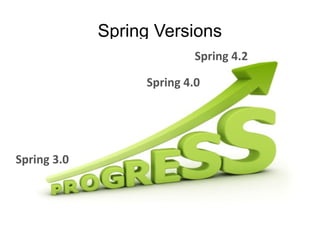
Spring Versions
Spring 4.0
Spring 4.2
Spring 3.0
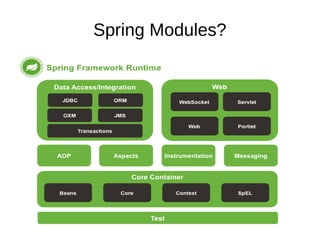
Spring Modules?
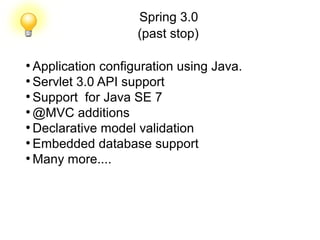
Spring 3.0
(past stop)
●
Application configuration using Java.
●
Servlet 3.0 API support
●
Support for Java SE 7
●
@MVC additions
●
Declarative model validation
●
Embedded database support
●
Many more....
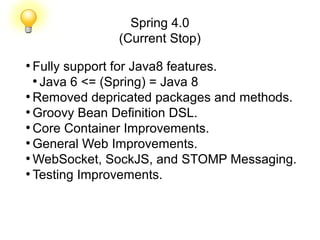
Spring 4.0
(Current Stop)
●
Fully support for Java8 features.
●
Java 6 <= (Spring) = Java 8
●
Removed depricated packages and methods.
●
Groovy Bean Definition DSL.
●
Core Container Improvements.
●
General Web Improvements.
●
WebSocket, SockJS, and STOMP Messaging.
●
Testing Improvements.
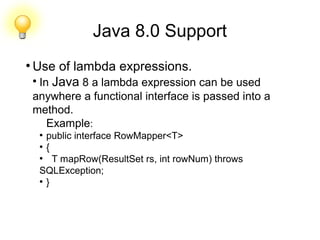
Java 8.0 Support
●
Use of lambda expressions.
●
In Java 8 a lambda expression can be used
anywhere a functional interface is passed into a
method.
Example:
●
public interface RowMapper<T>
●
{
●
T mapRow(ResultSet rs, int rowNum) throws
SQLException;
●
}
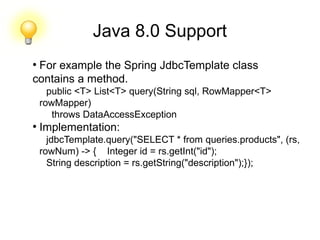
Java 8.0 Support
●
For example the Spring JdbcTemplate class
contains a method.
public <T> List<T> query(String sql, RowMapper<T>
rowMapper)
throws DataAccessException
●
Implementation:
jdbcTemplate.query("SELECT * from queries.products", (rs,
rowNum) -> { Integer id = rs.getInt("id");
String description = rs.getString("description");});
Java 8.0 Support
●
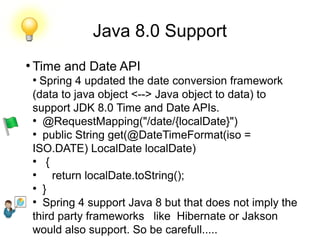
Time and Date API
●
Spring 4 updated the date conversion framework
(data to java object <--> Java object to data) to
support JDK 8.0 Time and Date APIs.
●
@RequestMapping("/date/{localDate}")
●
public String get(@DateTimeFormat(iso =
ISO.DATE) LocalDate localDate)
●
{
●
return localDate.toString();
●
}
●
Spring 4 support Java 8 but that does not imply the
third party frameworks like Hibernate or Jakson
would also support. So be carefull.....
Java 8.0 Support
●
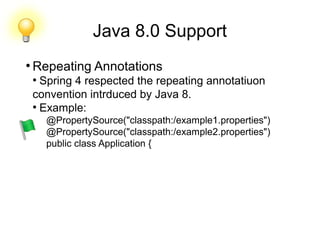
Repeating Annotations
●
Spring 4 respected the repeating annotatiuon
convention intrduced by Java 8.
●
Example:
@PropertySource("classpath:/example1.properties")
@PropertySource("classpath:/example2.properties")
public class Application {
Java 8.0 Support
●
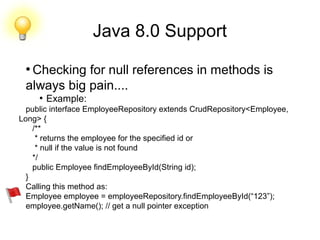
Checking for null references in methods is
always big pain....
●
Example:
public interface EmployeeRepository extends CrudRepository<Employee,
Long> {
/**
* returns the employee for the specified id or
* null if the value is not found
*/
public Employee findEmployeeById(String id);
}
Calling this method as:
Employee employee = employeeRepository.findEmployeeById(“123”);
employee.getName(); // get a null pointer exception
Java 8.0 Support
●
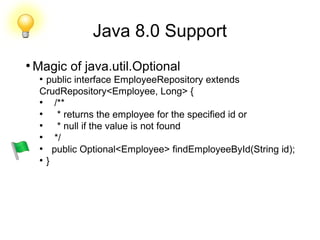
Magic of java.util.Optional
●
public interface EmployeeRepository extends
CrudRepository<Employee, Long> {
●
/**
●
* returns the employee for the specified id or
●
* null if the value is not found
●
*/
●
public Optional<Employee> findEmployeeById(String id);
●
}
Java 8.0 Support
●
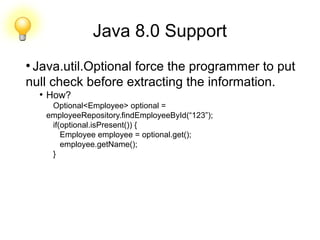
Java.util.Optional force the programmer to put
null check before extracting the information.
●
How?
Optional<Employee> optional =
employeeRepository.findEmployeeById(“123”);
if(optional.isPresent()) {
Employee employee = optional.get();
employee.getName();
}
Java 8.0 Support
●
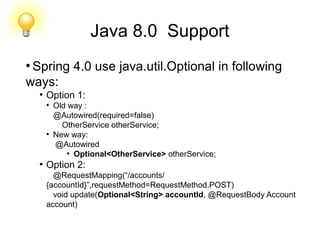
Spring 4.0 use java.util.Optional in following
ways:
●
Option 1:
●
Old way :
@Autowired(required=false)
OtherService otherService;
●
New way:
@Autowired
●
Optional<OtherService> otherService;
●
Option 2:
@RequestMapping(“/accounts/
{accountId}”,requestMethod=RequestMethod.POST)
void update(Optional<String> accountId, @RequestBody Account
account)
Java 8.0 Support
●
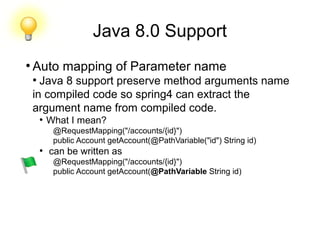
Auto mapping of Parameter name
●
Java 8 support preserve method arguments name
in compiled code so spring4 can extract the
argument name from compiled code.
●
What I mean?
@RequestMapping("/accounts/{id}")
public Account getAccount(@PathVariable("id") String id)
●
can be written as
@RequestMapping("/accounts/{id}")
public Account getAccount(@PathVariable String id)
Java 8.0 support
l
Hands on!!!!
l
Groovy Bean Definition DSL
●
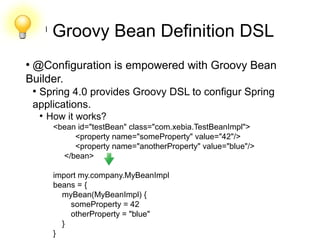
@Configuration is empowered with Groovy Bean
Builder.
●
Spring 4.0 provides Groovy DSL to configur Spring
applications.
●
How it works?
<bean id="testBean" class="com.xebia.TestBeanImpl">
<property name="someProperty" value="42"/>
<property name="anotherProperty" value="blue"/>
</bean>
import my.company.MyBeanImpl
beans = {
myBean(MyBeanImpl) {
someProperty = 42
otherProperty = "blue"
}
}
l
Groovy Bean Definition DSL
●
Additionally it allows to configure Spring bean
defination properties.
●
How?
●
sessionFactory(ConfigurableLocalSessionFactoryBean) { bean ->
●
// Sets the initialization method to 'init'. [init-method]
●
bean.initMethod = 'init'
●
// Sets the destruction method to 'destroy'. [destroy-method]
●
bean.destroyMethod = 'destroy'
●
Spring + Groovy ---> More Strong and clean
implementation.
l
Groovy Bean Definition DSL
●
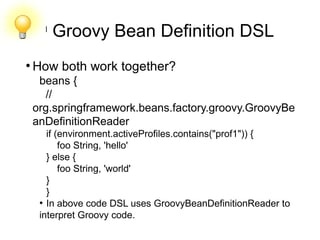
How both work together?
beans {
//
org.springframework.beans.factory.groovy.GroovyBe
anDefinitionReader
if (environment.activeProfiles.contains("prof1")) {
foo String, 'hello'
} else {
foo String, 'world'
}
}
●
In above code DSL uses GroovyBeanDefinitionReader to
interpret Groovy code.
Groovy Bean Definition DSL
●
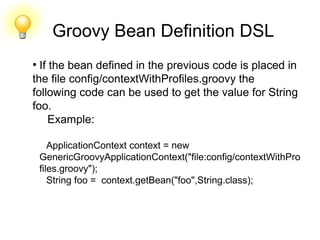
If the bean defined in the previous code is placed in
the file config/contextWithProfiles.groovy the
following code can be used to get the value for String
foo.
Example:
ApplicationContext context = new
GenericGroovyApplicationContext("file:config/contextWithPro
files.groovy");
String foo = context.getBean("foo",String.class);
Groovy Bean Definition DSL
Hands on!!!!
l
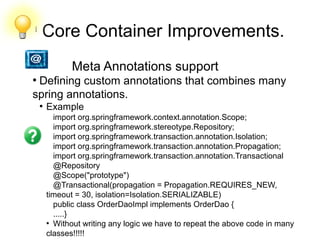
Core Container Improvements.
●
Meta Annotations support
●
Defining custom annotations that combines many
spring annotations.
●
Example
import org.springframework.context.annotation.Scope;
import org.springframework.stereotype.Repository;
import org.springframework.transaction.annotation.Isolation;
import org.springframework.transaction.annotation.Propagation;
import org.springframework.transaction.annotation.Transactional
@Repository
@Scope("prototype")
@Transactional(propagation = Propagation.REQUIRES_NEW,
timeout = 30, isolation=Isolation.SERIALIZABLE)
public class OrderDaoImpl implements OrderDao {
.....}
●
Without writing any logic we have to repeat the above code in many
classes!!!!!
l
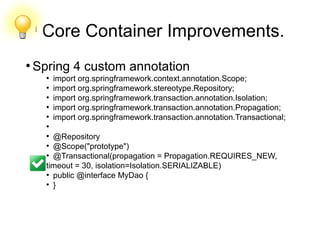
Core Container Improvements.
●
Spring 4 custom annotation
●
import org.springframework.context.annotation.Scope;
●
import org.springframework.stereotype.Repository;
●
import org.springframework.transaction.annotation.Isolation;
●
import org.springframework.transaction.annotation.Propagation;
●
import org.springframework.transaction.annotation.Transactional;
●
●
@Repository
●
@Scope("prototype")
●
@Transactional(propagation = Propagation.REQUIRES_NEW,
timeout = 30, isolation=Isolation.SERIALIZABLE)
●
public @interface MyDao {
●
}
l
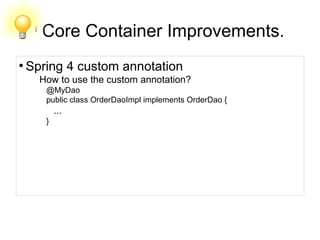
Core Container Improvements.
●
Spring 4 custom annotation
How to use the custom annotation?
@MyDao
public class OrderDaoImpl implements OrderDao {
...
}
l
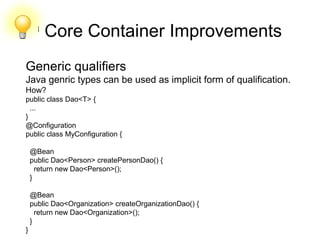
Core Container Improvements
Generic qualifiers
Java genric types can be used as implicit form of qualification.
How?
public class Dao<T> {
...
}
@Configuration
public class MyConfiguration {
@Bean
public Dao<Person> createPersonDao() {
return new Dao<Person>();
}
@Bean
public Dao<Organization> createOrganizationDao() {
return new Dao<Organization>();
}
}
Core Container Improvements
●
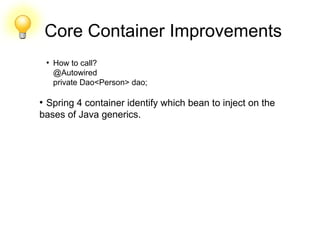
How to call?
@Autowired
private Dao<Person> dao;
●
Spring 4 container identify which bean to inject on the
bases of Java generics.
Core Container Improvements
●
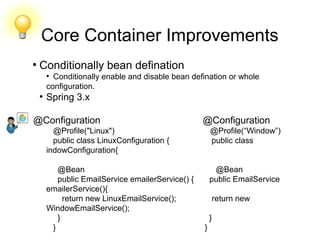
Conditionally bean defination
●
Conditionally enable and disable bean defination or whole
configuration.
●
Spring 3.x
@Configuration @Configuration
@Profile("Linux") @Profile(“Window”)
public class LinuxConfiguration { public class
indowConfiguration{
@Bean @Bean
public EmailService emailerService() { public EmailService
emailerService(){
return new LinuxEmailService(); return new
WindowEmailService();
} }
} }
Core Container Improvements
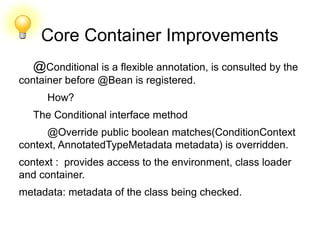
@Conditional is a flexible annotation, is consulted by the
container before @Bean is registered.
How?
The Conditional interface method
@Override public boolean matches(ConditionContext
context, AnnotatedTypeMetadata metadata) is overridden.
context : provides access to the environment, class loader
and container.
metadata: metadata of the class being checked.
Core Container Improvements
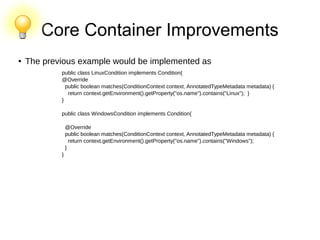
● The previous example would be implemented as
public class LinuxCondition implements Condition{
@Override
public boolean matches(ConditionContext context, AnnotatedTypeMetadata metadata) {
return context.getEnvironment().getProperty("os.name").contains("Linux"); }
}
public class WindowsCondition implements Condition{
@Override
public boolean matches(ConditionContext context, AnnotatedTypeMetadata metadata) {
return context.getEnvironment().getProperty("os.name").contains("Windows");
}
}
Core Container Improvements
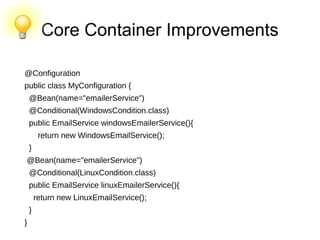
@Configuration
public class MyConfiguration {
@Bean(name="emailerService")
@Conditional(WindowsCondition.class)
public EmailService windowsEmailerService(){
return new WindowsEmailService();
}
@Bean(name="emailerService")
@Conditional(LinuxCondition.class)
public EmailService linuxEmailerService(){
return new LinuxEmailService();
}
}
Core Container Improvements
● @Order and Autowiring
– Beans can be orderly wired by adding the @Order annotation in the @Bean
implementations as follows
@Component
@Order(value=1)
public class Employee implements Person {
..
}
@Component
@Order(value=2)
public class Customer implements Person {
......
}
Using the
@Autowired
List<Person> people;
Results in
[com.intertech.Employee@a52728a, com.intertech.Customer@2addc751]
Java 8.0 support
Hands on!!!!
General Web Improvments
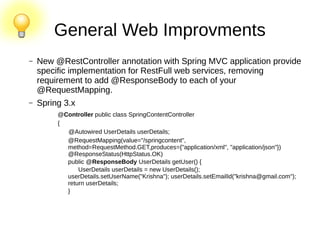
– New @RestController annotation with Spring MVC application provide
specific implementation for RestFull web services, removing
requirement to add @ResponseBody to each of your
@RequestMapping.
– Spring 3.x
@Controller public class SpringContentController
{
@Autowired UserDetails userDetails;
@RequestMapping(value="/springcontent",
method=RequestMethod.GET,produces={"application/xml", "application/json"})
@ResponseStatus(HttpStatus.OK)
public @ResponseBody UserDetails getUser() {
UserDetails userDetails = new UserDetails();
userDetails.setUserName("Krishna"); userDetails.setEmailId("krishna@gmail.com");
return userDetails;
}
General Web Improvments
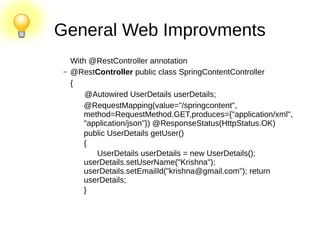
With @RestController annotation
– @RestController public class SpringContentController
{
@Autowired UserDetails userDetails;
@RequestMapping(value="/springcontent",
method=RequestMethod.GET,produces={"application/xml",
"application/json"}) @ResponseStatus(HttpStatus.OK)
public UserDetails getUser()
{
UserDetails userDetails = new UserDetails();
userDetails.setUserName("Krishna");
userDetails.setEmailId("krishna@gmail.com"); return
userDetails;
}
General Web Improvments
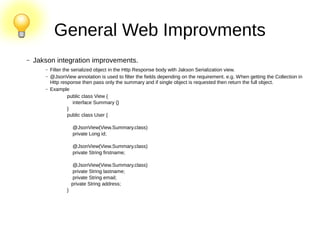
– Jakson integration improvements.
– Filter the serialized object in the Http Response body with Jakson Serialization view.
– @JsonView annotation is used to filter the fields depending on the requirement. e.g. When getting the Collection in
Http response then pass only the summary and if single object is requested then return the full object.
– Example
public class View {
interface Summary {}
}
public class User {
@JsonView(View.Summary.class)
private Long id;
@JsonView(View.Summary.class)
private String firstname;
@JsonView(View.Summary.class)
private String lastname;
private String email;
private String address;
}
General Web Improvments
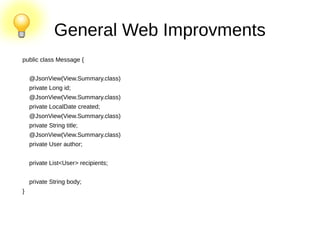
public class Message {
@JsonView(View.Summary.class)
private Long id;
@JsonView(View.Summary.class)
private LocalDate created;
@JsonView(View.Summary.class)
private String title;
@JsonView(View.Summary.class)
private User author;
private List<User> recipients;
private String body;
}
General Web Improvments
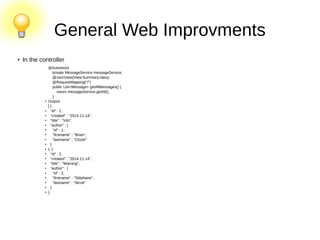
● In the controller
@Autowired
private MessageService messageService;
@JsonView(View.Summary.class)
@RequestMapping("/")
public List<Message> getAllMessages() {
return messageService.getAll();
}
● Output:
[ {
● "id" : 1,
● "created" : "2014-11-14",
● "title" : "Info",
● "author" : {
● "id" : 1,
● "firstname" : "Brian",
●
"lastname" : "Clozel"
● }
● }, {
● "id" : 2,
●
"created" : "2014-11-14",
● "title" : "Warning",
● "author" : {
● "id" : 2,
●
"firstname" : "Stéphane",
● "lastname" : "Nicoll"
● }
● }
General Web Improvments
– @ControllerAdvice improvements
● Can be configured to support defined subset of controllers through
annotations, basePackageClasses, basePackages.
– Example:
● @Controller
● @RequestMapping("/api/article")
● class ArticleApiController {
●
● @RequestMapping(value = "{articleId}", produces = "application/json")
● @ResponseStatus(value = HttpStatus.OK)
● @ResponseBody
● Article getArticle(@PathVariable Long articleId) {
● throw new IllegalArgumentException("[API] Getting article problem.");
● }
● }
General Web Improvments
●
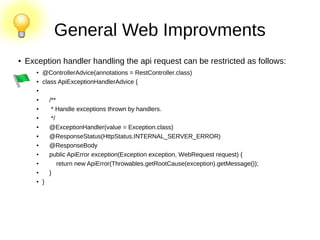
Exception handler handling the api request can be restricted as follows:
●
@ControllerAdvice(annotations = RestController.class)
● class ApiExceptionHandlerAdvice {
●
●
/**
● * Handle exceptions thrown by handlers.
●
*/
● @ExceptionHandler(value = Exception.class)
● @ResponseStatus(HttpStatus.INTERNAL_SERVER_ERROR)
●
@ResponseBody
● public ApiError exception(Exception exception, WebRequest request) {
● return new ApiError(Throwables.getRootCause(exception).getMessage());
●
}
● }
Java 8.0 support
l
Hands on!!!!
Testing Improvements
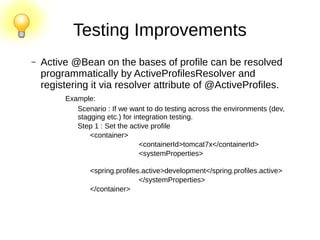
– Active @Bean on the bases of profile can be resolved
programmatically by ActiveProfilesResolver and
registering it via resolver attribute of @ActiveProfiles.
Example:
Scenario : If we want to do testing across the environments (dev,
stagging etc.) for integration testing.
Step 1 : Set the active profile
<container>
<containerId>tomcat7x</containerId>
<systemProperties>
<spring.profiles.active>development</spring.profiles.active>
</systemProperties>
</container>
Testing improvements
public class SpringActiveProfileResolver implements ActiveProfilesResolver {
@Override
public String[] resolve(final Class<?> aClass) {
final String activeProfile System.getProperty("spring.profiles.active");
return new String[] { activeProfile == null ? "integration" : activeProfile };
}
– And in the test class we use the annotation.
@ActiveProfiles(resolver = SpringActiveProfileResolver.class)
public class IT1DataSetup {
......
}
Testing improvements
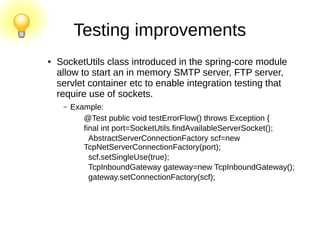
● SocketUtils class introduced in the spring-core module
allow to start an in memory SMTP server, FTP server,
servlet container etc to enable integration testing that
require use of sockets.
– Example:
@Test public void testErrorFlow() throws Exception {
final int port=SocketUtils.findAvailableServerSocket();
AbstractServerConnectionFactory scf=new
TcpNetServerConnectionFactory(port);
scf.setSingleUse(true);
TcpInboundGateway gateway=new TcpInboundGateway();
gateway.setConnectionFactory(scf);
Java 8.0 support
l
Hands on!!!!

Spring 4 final xtr_presentation

  • 1.
    By : SumitGole & Sourabh Aggarwal Date : 13 August 2015 SPRING 4
  • 2.
  • 3.
  • 4.
    Spring 3.0 (past stop) ● Applicationconfiguration using Java. ● Servlet 3.0 API support ● Support for Java SE 7 ● @MVC additions ● Declarative model validation ● Embedded database support ● Many more....
  • 5.
    Spring 4.0 (Current Stop) ● Fullysupport for Java8 features. ● Java 6 <= (Spring) = Java 8 ● Removed depricated packages and methods. ● Groovy Bean Definition DSL. ● Core Container Improvements. ● General Web Improvements. ● WebSocket, SockJS, and STOMP Messaging. ● Testing Improvements.
  • 6.
    Java 8.0 Support ● Useof lambda expressions. ● In Java 8 a lambda expression can be used anywhere a functional interface is passed into a method. Example: ● public interface RowMapper<T> ● { ● T mapRow(ResultSet rs, int rowNum) throws SQLException; ● }
  • 7.
    Java 8.0 Support ● Forexample the Spring JdbcTemplate class contains a method. public <T> List<T> query(String sql, RowMapper<T> rowMapper) throws DataAccessException ● Implementation: jdbcTemplate.query("SELECT * from queries.products", (rs, rowNum) -> { Integer id = rs.getInt("id"); String description = rs.getString("description");});
  • 8.
    Java 8.0 Support ● Timeand Date API ● Spring 4 updated the date conversion framework (data to java object <--> Java object to data) to support JDK 8.0 Time and Date APIs. ● @RequestMapping("/date/{localDate}") ● public String get(@DateTimeFormat(iso = ISO.DATE) LocalDate localDate) ● { ● return localDate.toString(); ● } ● Spring 4 support Java 8 but that does not imply the third party frameworks like Hibernate or Jakson would also support. So be carefull.....
  • 9.
    Java 8.0 Support ● RepeatingAnnotations ● Spring 4 respected the repeating annotatiuon convention intrduced by Java 8. ● Example: @PropertySource("classpath:/example1.properties") @PropertySource("classpath:/example2.properties") public class Application {
  • 10.
    Java 8.0 Support ● Checkingfor null references in methods is always big pain.... ● Example: public interface EmployeeRepository extends CrudRepository<Employee, Long> { /** * returns the employee for the specified id or * null if the value is not found */ public Employee findEmployeeById(String id); } Calling this method as: Employee employee = employeeRepository.findEmployeeById(“123”); employee.getName(); // get a null pointer exception
  • 11.
    Java 8.0 Support ● Magicof java.util.Optional ● public interface EmployeeRepository extends CrudRepository<Employee, Long> { ● /** ● * returns the employee for the specified id or ● * null if the value is not found ● */ ● public Optional<Employee> findEmployeeById(String id); ● }
  • 12.
    Java 8.0 Support ● Java.util.Optionalforce the programmer to put null check before extracting the information. ● How? Optional<Employee> optional = employeeRepository.findEmployeeById(“123”); if(optional.isPresent()) { Employee employee = optional.get(); employee.getName(); }
  • 13.
    Java 8.0 Support ● Spring4.0 use java.util.Optional in following ways: ● Option 1: ● Old way : @Autowired(required=false) OtherService otherService; ● New way: @Autowired ● Optional<OtherService> otherService; ● Option 2: @RequestMapping(“/accounts/ {accountId}”,requestMethod=RequestMethod.POST) void update(Optional<String> accountId, @RequestBody Account account)
  • 14.
    Java 8.0 Support ● Automapping of Parameter name ● Java 8 support preserve method arguments name in compiled code so spring4 can extract the argument name from compiled code. ● What I mean? @RequestMapping("/accounts/{id}") public Account getAccount(@PathVariable("id") String id) ● can be written as @RequestMapping("/accounts/{id}") public Account getAccount(@PathVariable String id)
  • 15.
  • 16.
    l Groovy Bean DefinitionDSL ● @Configuration is empowered with Groovy Bean Builder. ● Spring 4.0 provides Groovy DSL to configur Spring applications. ● How it works? <bean id="testBean" class="com.xebia.TestBeanImpl"> <property name="someProperty" value="42"/> <property name="anotherProperty" value="blue"/> </bean> import my.company.MyBeanImpl beans = { myBean(MyBeanImpl) { someProperty = 42 otherProperty = "blue" } }
  • 17.
    l Groovy Bean DefinitionDSL ● Additionally it allows to configure Spring bean defination properties. ● How? ● sessionFactory(ConfigurableLocalSessionFactoryBean) { bean -> ● // Sets the initialization method to 'init'. [init-method] ● bean.initMethod = 'init' ● // Sets the destruction method to 'destroy'. [destroy-method] ● bean.destroyMethod = 'destroy' ● Spring + Groovy ---> More Strong and clean implementation.
  • 18.
    l Groovy Bean DefinitionDSL ● How both work together? beans { // org.springframework.beans.factory.groovy.GroovyBe anDefinitionReader if (environment.activeProfiles.contains("prof1")) { foo String, 'hello' } else { foo String, 'world' } } ● In above code DSL uses GroovyBeanDefinitionReader to interpret Groovy code.
  • 19.
    Groovy Bean DefinitionDSL ● If the bean defined in the previous code is placed in the file config/contextWithProfiles.groovy the following code can be used to get the value for String foo. Example: ApplicationContext context = new GenericGroovyApplicationContext("file:config/contextWithPro files.groovy"); String foo = context.getBean("foo",String.class);
  • 20.
    Groovy Bean DefinitionDSL Hands on!!!!
  • 21.
    l Core Container Improvements. ● MetaAnnotations support ● Defining custom annotations that combines many spring annotations. ● Example import org.springframework.context.annotation.Scope; import org.springframework.stereotype.Repository; import org.springframework.transaction.annotation.Isolation; import org.springframework.transaction.annotation.Propagation; import org.springframework.transaction.annotation.Transactional @Repository @Scope("prototype") @Transactional(propagation = Propagation.REQUIRES_NEW, timeout = 30, isolation=Isolation.SERIALIZABLE) public class OrderDaoImpl implements OrderDao { .....} ● Without writing any logic we have to repeat the above code in many classes!!!!!
  • 22.
    l Core Container Improvements. ● Spring4 custom annotation ● import org.springframework.context.annotation.Scope; ● import org.springframework.stereotype.Repository; ● import org.springframework.transaction.annotation.Isolation; ● import org.springframework.transaction.annotation.Propagation; ● import org.springframework.transaction.annotation.Transactional; ● ● @Repository ● @Scope("prototype") ● @Transactional(propagation = Propagation.REQUIRES_NEW, timeout = 30, isolation=Isolation.SERIALIZABLE) ● public @interface MyDao { ● }
  • 23.
    l Core Container Improvements. ● Spring4 custom annotation How to use the custom annotation? @MyDao public class OrderDaoImpl implements OrderDao { ... }
  • 24.
    l Core Container Improvements Genericqualifiers Java genric types can be used as implicit form of qualification. How? public class Dao<T> { ... } @Configuration public class MyConfiguration { @Bean public Dao<Person> createPersonDao() { return new Dao<Person>(); } @Bean public Dao<Organization> createOrganizationDao() { return new Dao<Organization>(); } }
  • 25.
    Core Container Improvements ● Howto call? @Autowired private Dao<Person> dao; ● Spring 4 container identify which bean to inject on the bases of Java generics.
  • 26.
    Core Container Improvements ● Conditionallybean defination ● Conditionally enable and disable bean defination or whole configuration. ● Spring 3.x @Configuration @Configuration @Profile("Linux") @Profile(“Window”) public class LinuxConfiguration { public class indowConfiguration{ @Bean @Bean public EmailService emailerService() { public EmailService emailerService(){ return new LinuxEmailService(); return new WindowEmailService(); } } } }
  • 27.
    Core Container Improvements @Conditionalis a flexible annotation, is consulted by the container before @Bean is registered. How? The Conditional interface method @Override public boolean matches(ConditionContext context, AnnotatedTypeMetadata metadata) is overridden. context : provides access to the environment, class loader and container. metadata: metadata of the class being checked.
  • 28.
    Core Container Improvements ●The previous example would be implemented as public class LinuxCondition implements Condition{ @Override public boolean matches(ConditionContext context, AnnotatedTypeMetadata metadata) { return context.getEnvironment().getProperty("os.name").contains("Linux"); } } public class WindowsCondition implements Condition{ @Override public boolean matches(ConditionContext context, AnnotatedTypeMetadata metadata) { return context.getEnvironment().getProperty("os.name").contains("Windows"); } }
  • 29.
    Core Container Improvements @Configuration publicclass MyConfiguration { @Bean(name="emailerService") @Conditional(WindowsCondition.class) public EmailService windowsEmailerService(){ return new WindowsEmailService(); } @Bean(name="emailerService") @Conditional(LinuxCondition.class) public EmailService linuxEmailerService(){ return new LinuxEmailService(); } }
  • 30.
    Core Container Improvements ●@Order and Autowiring – Beans can be orderly wired by adding the @Order annotation in the @Bean implementations as follows @Component @Order(value=1) public class Employee implements Person { .. } @Component @Order(value=2) public class Customer implements Person { ...... } Using the @Autowired List<Person> people; Results in [com.intertech.Employee@a52728a, com.intertech.Customer@2addc751]
  • 31.
  • 32.
    General Web Improvments –New @RestController annotation with Spring MVC application provide specific implementation for RestFull web services, removing requirement to add @ResponseBody to each of your @RequestMapping. – Spring 3.x @Controller public class SpringContentController { @Autowired UserDetails userDetails; @RequestMapping(value="/springcontent", method=RequestMethod.GET,produces={"application/xml", "application/json"}) @ResponseStatus(HttpStatus.OK) public @ResponseBody UserDetails getUser() { UserDetails userDetails = new UserDetails(); userDetails.setUserName("Krishna"); userDetails.setEmailId("krishna@gmail.com"); return userDetails; }
  • 33.
    General Web Improvments With@RestController annotation – @RestController public class SpringContentController { @Autowired UserDetails userDetails; @RequestMapping(value="/springcontent", method=RequestMethod.GET,produces={"application/xml", "application/json"}) @ResponseStatus(HttpStatus.OK) public UserDetails getUser() { UserDetails userDetails = new UserDetails(); userDetails.setUserName("Krishna"); userDetails.setEmailId("krishna@gmail.com"); return userDetails; }
  • 34.
    General Web Improvments –Jakson integration improvements. – Filter the serialized object in the Http Response body with Jakson Serialization view. – @JsonView annotation is used to filter the fields depending on the requirement. e.g. When getting the Collection in Http response then pass only the summary and if single object is requested then return the full object. – Example public class View { interface Summary {} } public class User { @JsonView(View.Summary.class) private Long id; @JsonView(View.Summary.class) private String firstname; @JsonView(View.Summary.class) private String lastname; private String email; private String address; }
  • 35.
    General Web Improvments publicclass Message { @JsonView(View.Summary.class) private Long id; @JsonView(View.Summary.class) private LocalDate created; @JsonView(View.Summary.class) private String title; @JsonView(View.Summary.class) private User author; private List<User> recipients; private String body; }
  • 36.
    General Web Improvments ●In the controller @Autowired private MessageService messageService; @JsonView(View.Summary.class) @RequestMapping("/") public List<Message> getAllMessages() { return messageService.getAll(); } ● Output: [ { ● "id" : 1, ● "created" : "2014-11-14", ● "title" : "Info", ● "author" : { ● "id" : 1, ● "firstname" : "Brian", ● "lastname" : "Clozel" ● } ● }, { ● "id" : 2, ● "created" : "2014-11-14", ● "title" : "Warning", ● "author" : { ● "id" : 2, ● "firstname" : "Stéphane", ● "lastname" : "Nicoll" ● } ● }
  • 37.
    General Web Improvments –@ControllerAdvice improvements ● Can be configured to support defined subset of controllers through annotations, basePackageClasses, basePackages. – Example: ● @Controller ● @RequestMapping("/api/article") ● class ArticleApiController { ● ● @RequestMapping(value = "{articleId}", produces = "application/json") ● @ResponseStatus(value = HttpStatus.OK) ● @ResponseBody ● Article getArticle(@PathVariable Long articleId) { ● throw new IllegalArgumentException("[API] Getting article problem."); ● } ● }
  • 38.
    General Web Improvments ● Exceptionhandler handling the api request can be restricted as follows: ● @ControllerAdvice(annotations = RestController.class) ● class ApiExceptionHandlerAdvice { ● ● /** ● * Handle exceptions thrown by handlers. ● */ ● @ExceptionHandler(value = Exception.class) ● @ResponseStatus(HttpStatus.INTERNAL_SERVER_ERROR) ● @ResponseBody ● public ApiError exception(Exception exception, WebRequest request) { ● return new ApiError(Throwables.getRootCause(exception).getMessage()); ● } ● }
  • 39.
  • 40.
    Testing Improvements – Active@Bean on the bases of profile can be resolved programmatically by ActiveProfilesResolver and registering it via resolver attribute of @ActiveProfiles. Example: Scenario : If we want to do testing across the environments (dev, stagging etc.) for integration testing. Step 1 : Set the active profile <container> <containerId>tomcat7x</containerId> <systemProperties> <spring.profiles.active>development</spring.profiles.active> </systemProperties> </container>
  • 41.
    Testing improvements public classSpringActiveProfileResolver implements ActiveProfilesResolver { @Override public String[] resolve(final Class<?> aClass) { final String activeProfile System.getProperty("spring.profiles.active"); return new String[] { activeProfile == null ? "integration" : activeProfile }; } – And in the test class we use the annotation. @ActiveProfiles(resolver = SpringActiveProfileResolver.class) public class IT1DataSetup { ...... }
  • 42.
    Testing improvements ● SocketUtilsclass introduced in the spring-core module allow to start an in memory SMTP server, FTP server, servlet container etc to enable integration testing that require use of sockets. – Example: @Test public void testErrorFlow() throws Exception { final int port=SocketUtils.findAvailableServerSocket(); AbstractServerConnectionFactory scf=new TcpNetServerConnectionFactory(port); scf.setSingleUse(true); TcpInboundGateway gateway=new TcpInboundGateway(); gateway.setConnectionFactory(scf);
  • 43.