OPERATIONS and LOGISTICSOPERATIONS and LOGISTICS
MANAGEMENTMANAGEMENT
 IntroductionIntroduction
 ImportanceImportance
 ScopeScope
 TrendsTrends
 CareersCareers
 Course OverviewCourse Overview
plied Management Science for Decision Making, 1e © 2012 Pearson Prentice-Hall, Inc. Philip A. Vaccaro, Ph
Operations ManagementOperations Management
The competent and adept management
of complex systems in the service, non-
profit, manufacturing, and government
sectors via the effective and efficient
utilization of time, labor, money, and
materials in the generation of goods
and/or services.
DEFINITION
OverviewOverview
Operations Management plans for, and creates the
competitive advantagescompetitive advantages that all businesses need
for fueling profitable growth. As a result, OM is
the most critical of the business functions.
Studying OM means studying modern planning,
decision-making and management methods in all
functional areas of an organization, including
strategic and tactical planning, products and services
development, product and project management,
process and supply chain management, and more.
Why Study OM?Why Study OM?
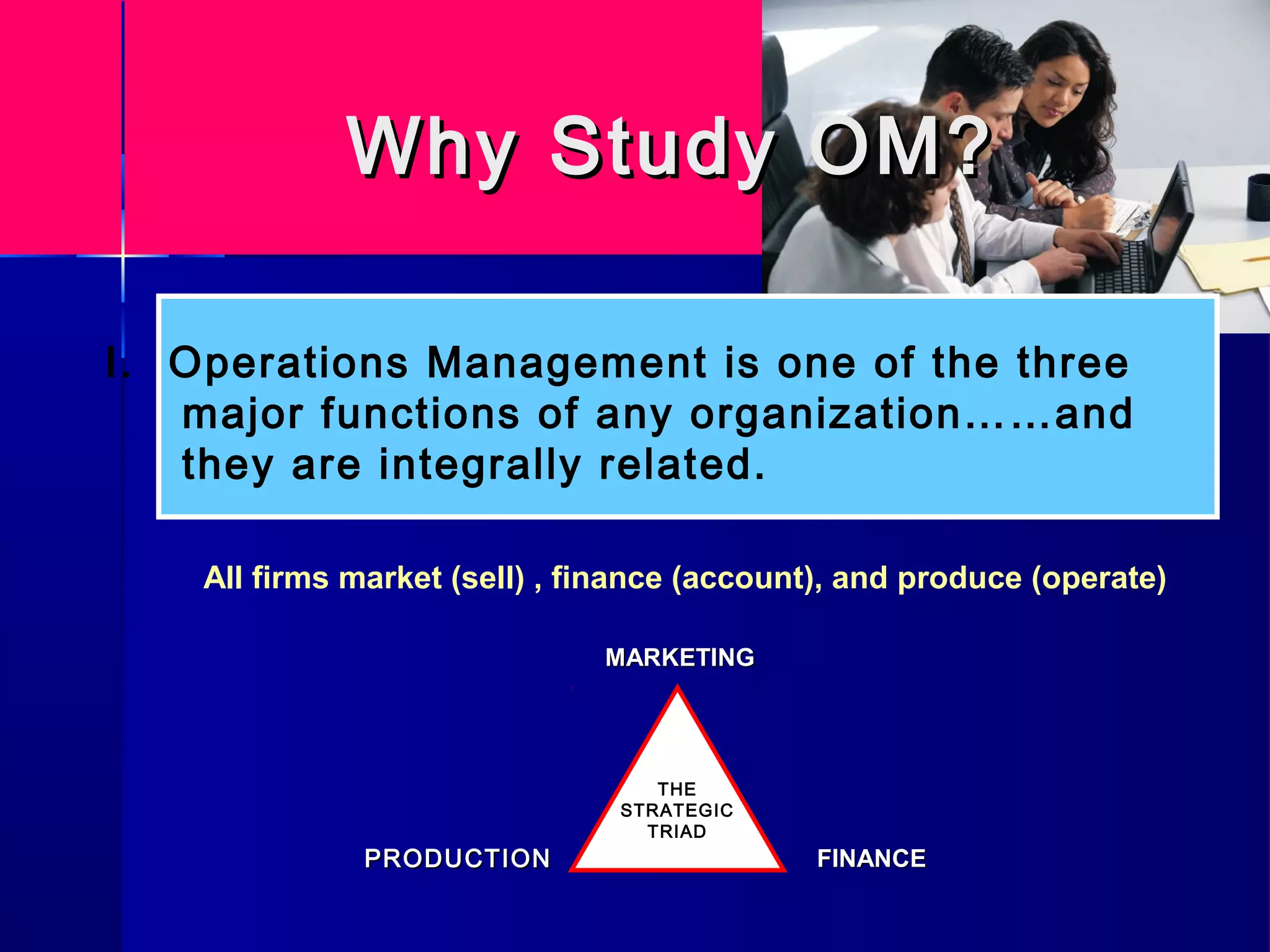
MARKETINGMARKETING
FINANCEFINANCE
All firms market (sell) , finance (account), and produce (operate)
The
Strategic
Triad
I. Operations Management is one of the three
major functions of any organization……and
they are integrally related.
THE
STRATEGIC
TRIAD
PRODUCTIONPRODUCTION
Why Study OM?Why Study OM?
II. Operations Management shows
us how goods and services are
generated. Consequently, it is
the………
foundation of all business!foundation of all business!
Why Study OM?Why Study OM?
III. Operations Management shows us what
OM managers do. This enables us to learn
the skills, techniques, and models needed
to practice 21st
century management, and
to also explore the lucrative career oppor-
tunities in OM.
Why Study OM?Why Study OM?
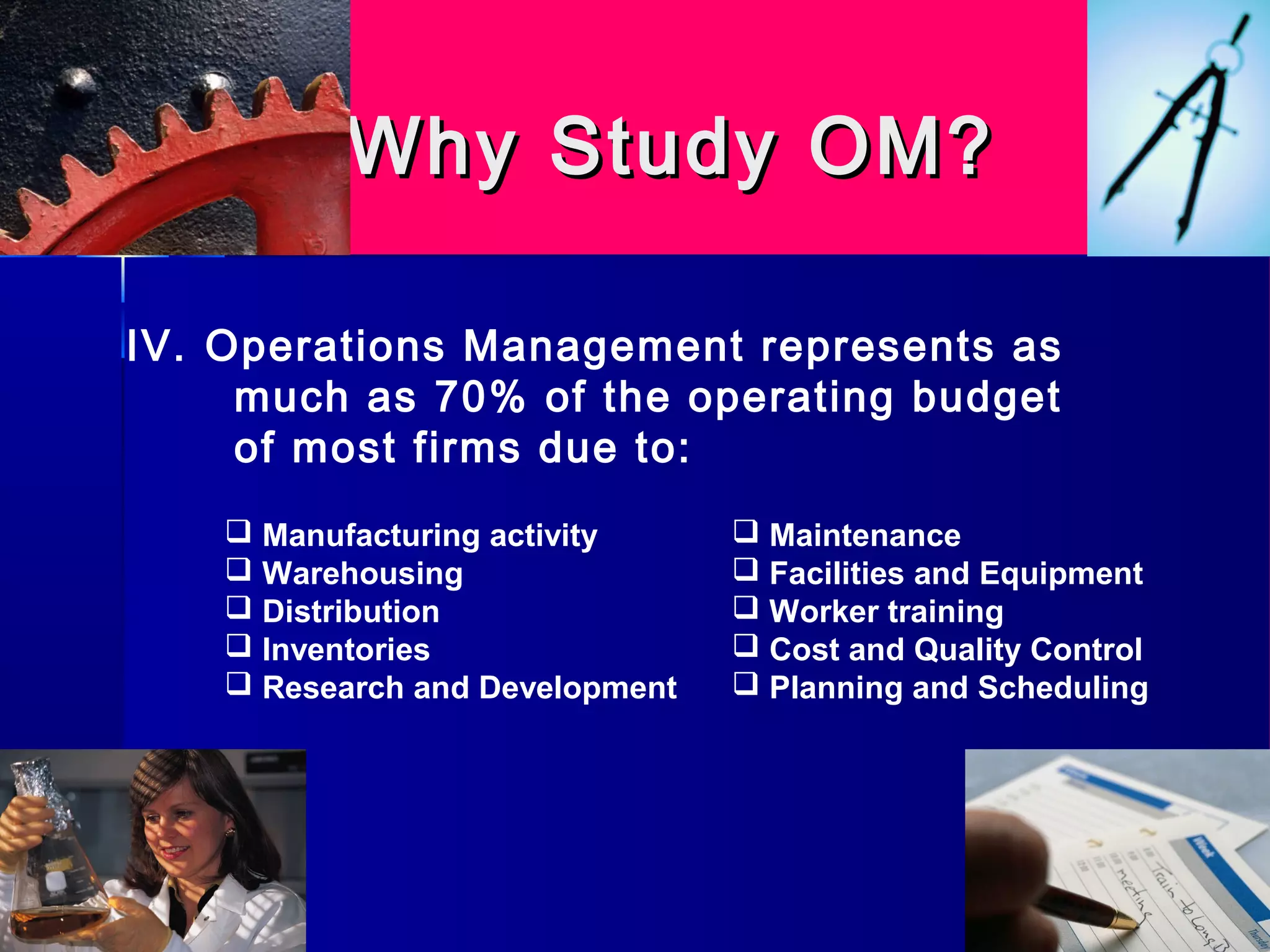
 Manufacturing activity
 Warehousing
 Distribution
 Inventories
 Research and Development
 Maintenance
 Facilities and Equipment
 Worker training
 Cost and Quality Control
 Planning and Scheduling
IV. Operations Management represents as
much as 70% of the operating budget
of most firms due to:
Why Study OM?Why Study OM?
V. Operations Management, by virtue of its
huge collective budget, provides a major
opportunity for the firm to improve its
profitability.
In fact, OM has become the last resort
for most firms that have exhausted the
potential of marketing, finance, and
general management.
Why Study OM?Why Study OM?
VI. About 40% of allAbout 40% of all jobs in the United Statesjobs in the United States
are inare in Operations ManagementOperations Management..
Exposure to the following disciplines willExposure to the following disciplines will
enhance one’s job prospects:enhance one’s job prospects:
 Operations research
 Statistics
 Information systems
 Economics
 Logistics / Transportation
 Mathematics
 Accounting / Finance
 Computer science
 Engineering
 Manufacturing
What OM Managers DoWhat OM Managers Do
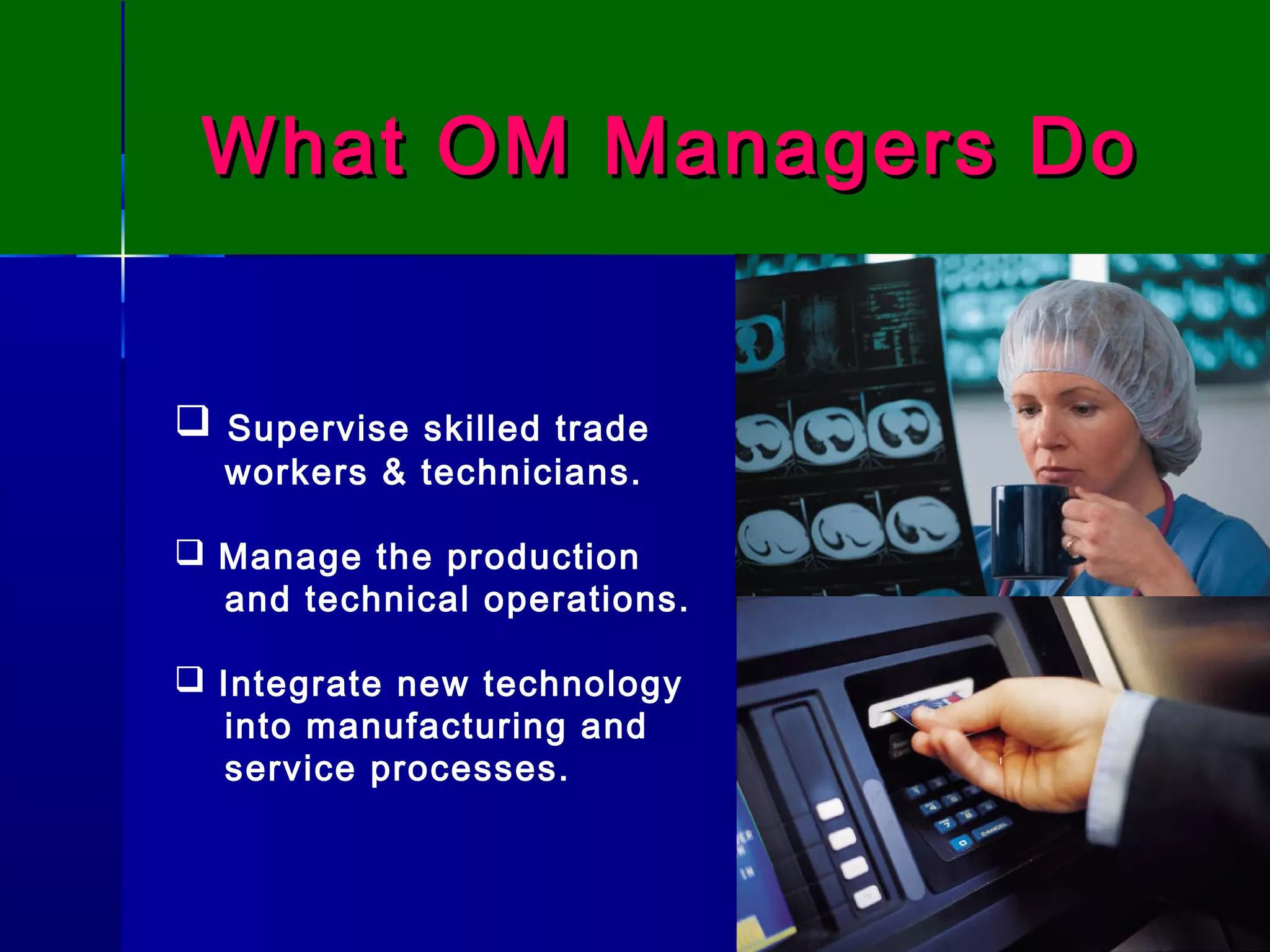
 Supervise skilled trade
workers & technicians.
 Manage the production
and technical operations.
 Integrate new technology
into manufacturing and
service processes.
What OM Managers DoWhat OM Managers Do
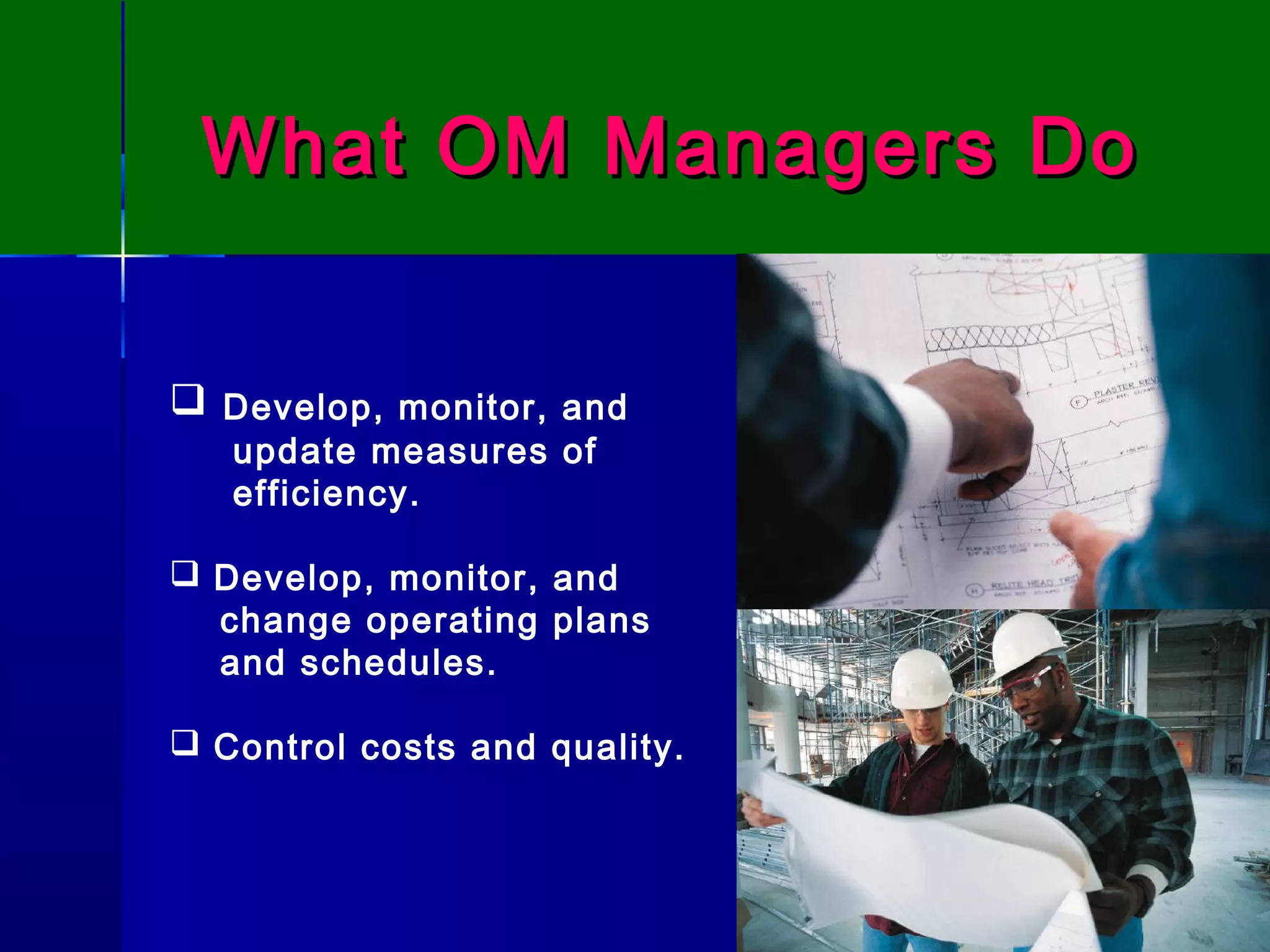
 Develop, monitor, and
update measures of
efficiency.
 Develop, monitor, and
change operating plans
and schedules.
 Control costs and quality.
What OM Managers DoWhat OM Managers Do
 Evaluate and improve the
existing operating system
in terms of productivity and
customer responsiveness.
 Translate improved operating
systems into competitive ad-
vantage in the marketplace.
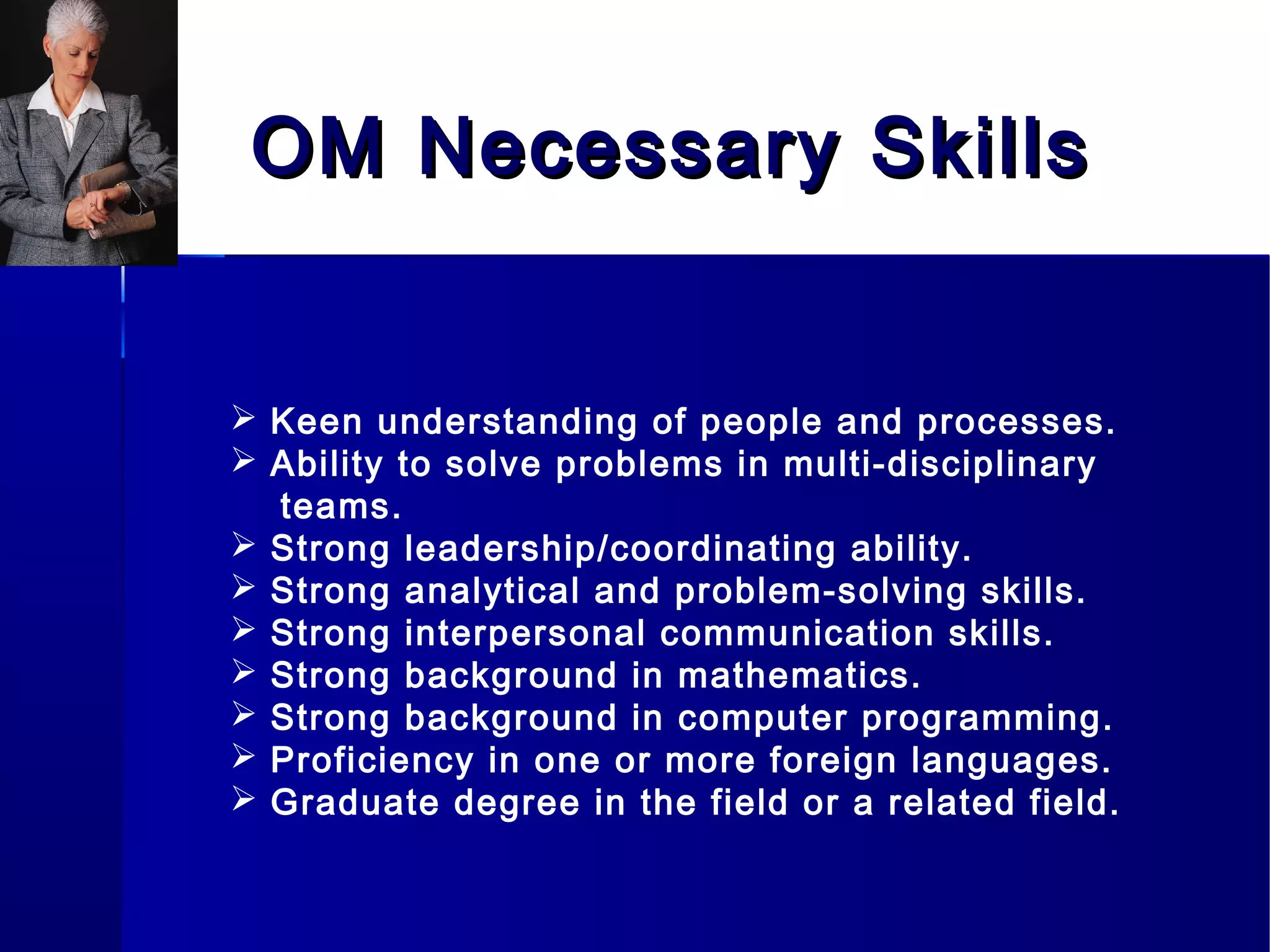
OM Necessary SkillsOM Necessary Skills
 Keen understanding of people and processes.
 Ability to solve problems in multi-disciplinary
teams.
 Strong leadership/coordinating ability.
 Strong analytical and problem-solving skills.
 Strong interpersonal communication skills.
 Strong background in mathematics.
 Strong background in computer programming.
 Proficiency in one or more foreign languages.
 Graduate degree in the field or a related field.
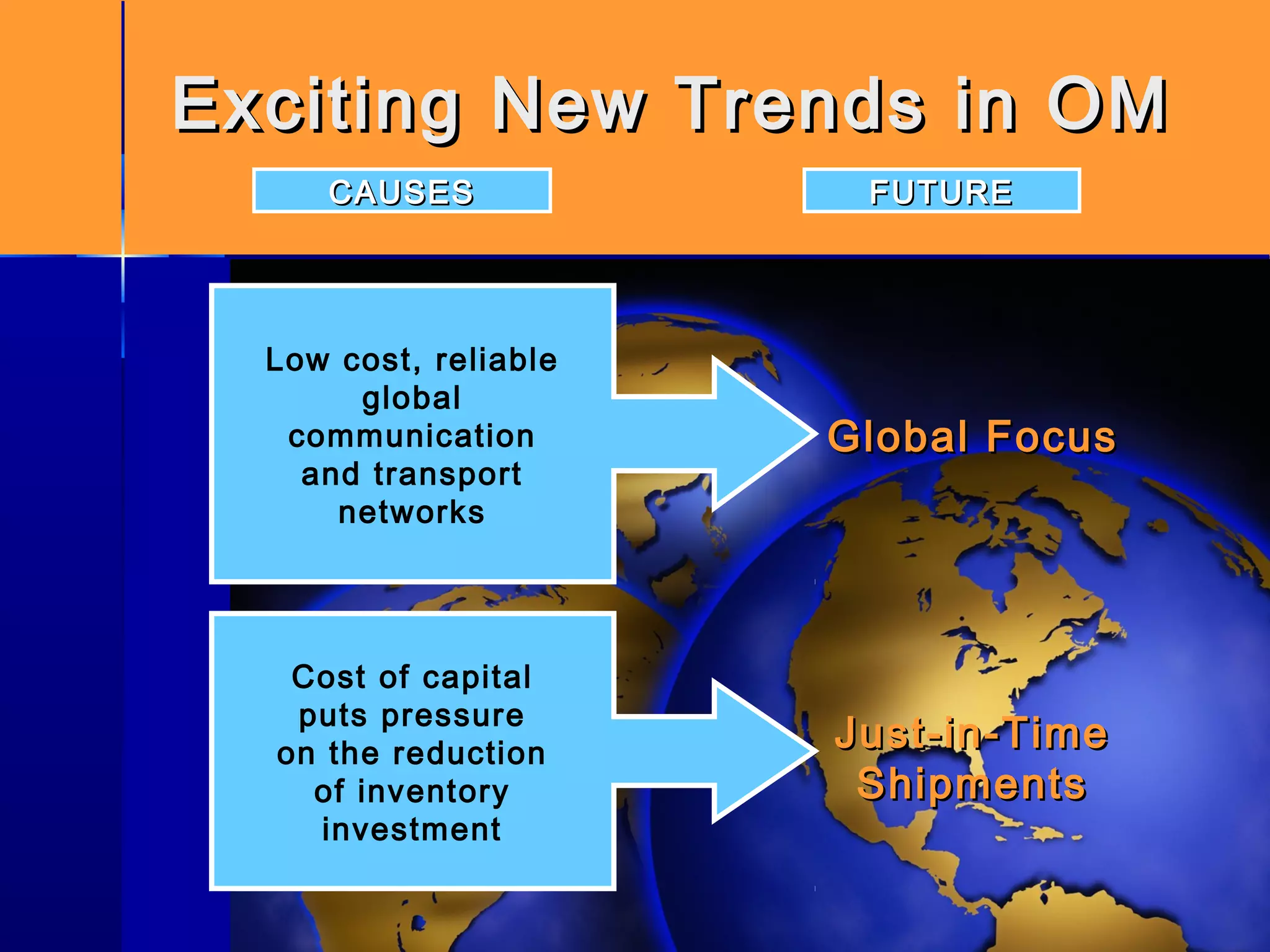
Exciting New Trends in OMExciting New Trends in OM
CAUSESCAUSES FUTUREFUTURE
Global FocusGlobal Focus
Just-in-TimeJust-in-Time
ShipmentsShipments
Low cost, reliable
global
communication
and transport
networks
Cost of capital
puts pressure
on the reduction
of inventory
investment
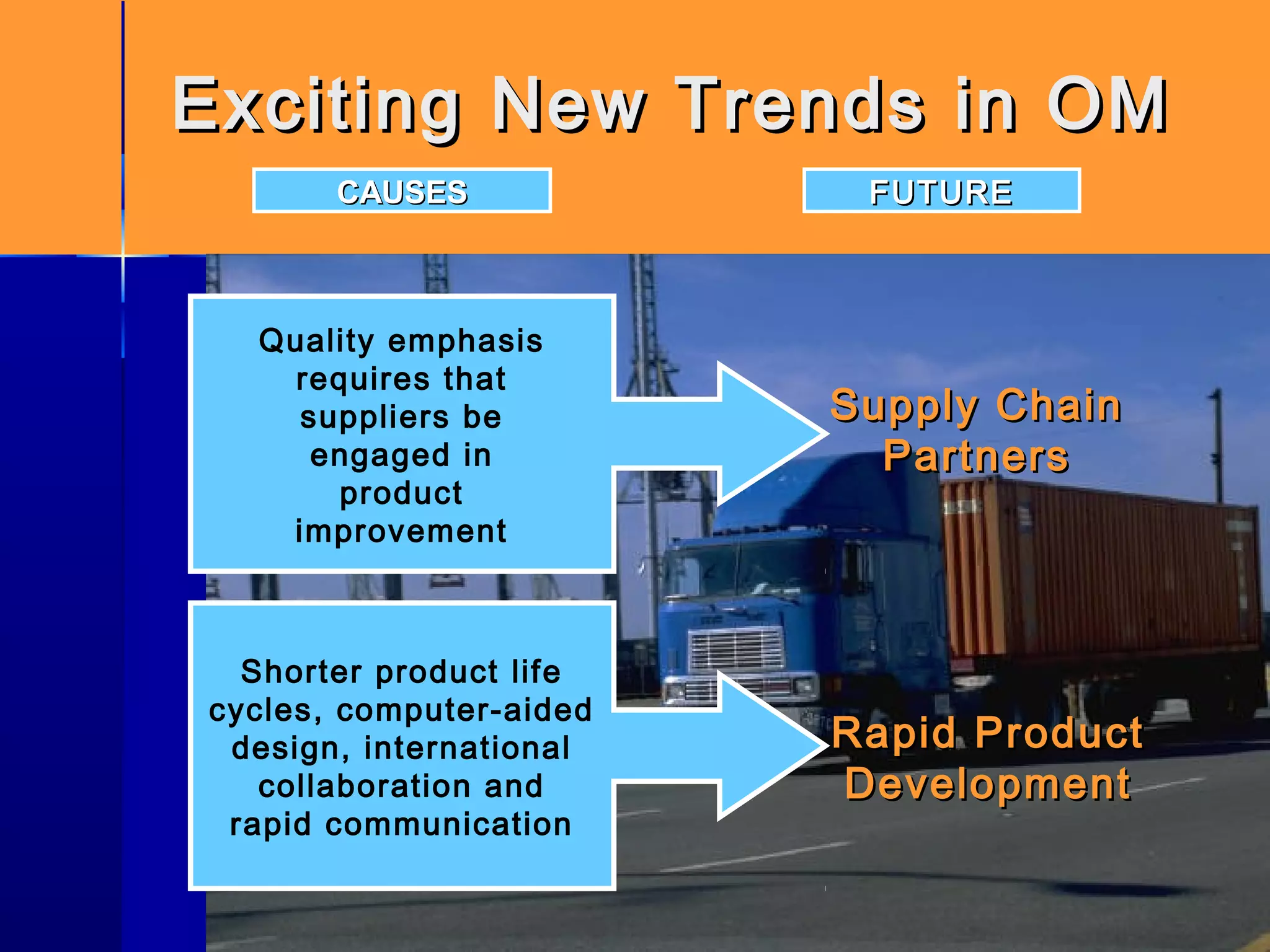
Exciting New Trends in OMExciting New Trends in OM
CAUSESCAUSES FUTUREFUTURE
Quality emphasis
requires that
suppliers be
engaged in
product
improvement
Shorter product life
cycles, computer-aided
design, international
collaboration and
rapid communication
Supply ChainSupply Chain
PartnersPartners
Rapid ProductRapid Product
DevelopmentDevelopment
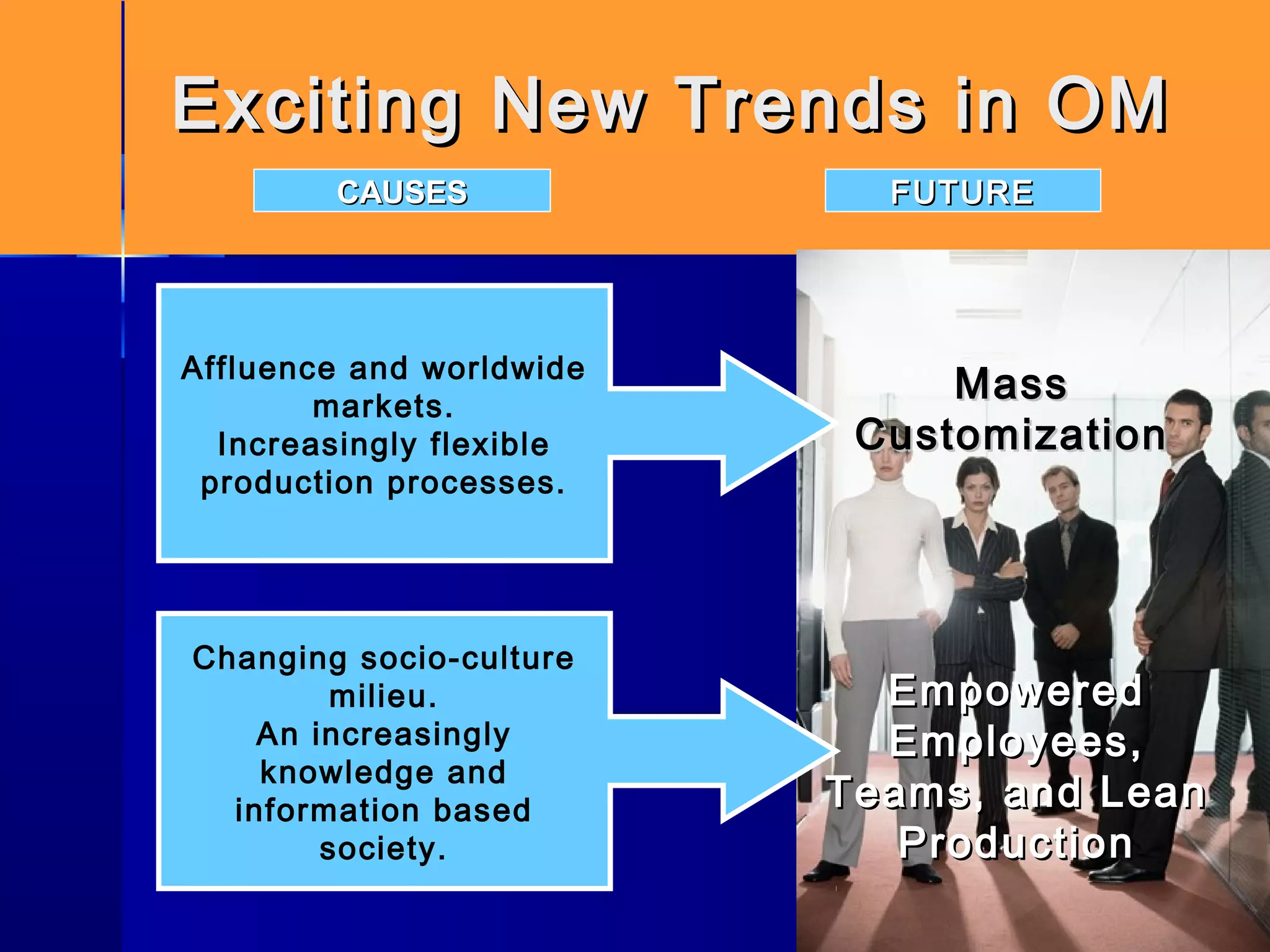
Exciting New Trends in OMExciting New Trends in OM
CAUSESCAUSES FUTUREFUTURE
Affluence and worldwide
markets.
Increasingly flexible
production processes.
Changing socio-culture
milieu.
An increasingly
knowledge and
information based
society.
MassMass
CustomizationCustomization
EmpoweredEmpowered
Employees,Employees,
Teams, and LeanTeams, and Lean
ProductionProduction
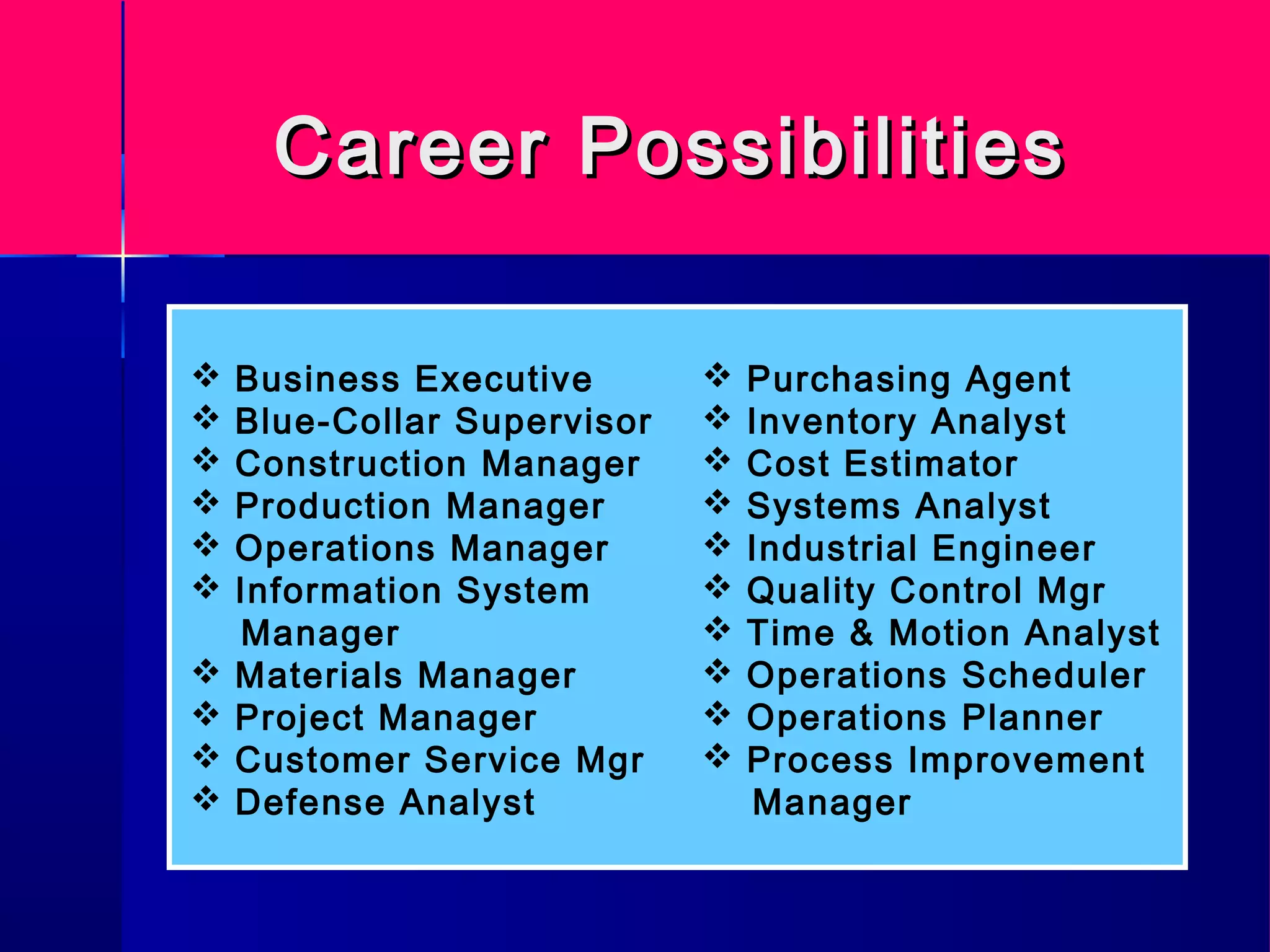
Career PossibilitiesCareer Possibilities
 Business Executive
 Blue-Collar Supervisor
 Construction Manager
 Production Manager
 Operations Manager
 Information System
Manager
 Materials Manager
 Project Manager
 Customer Service Mgr
 Defense Analyst
 Purchasing Agent
 Inventory Analyst
 Cost Estimator
 Systems Analyst
 Industrial Engineer
 Quality Control Mgr
 Time & Motion Analyst
 Operations Scheduler
 Operations Planner
 Process Improvement
Manager
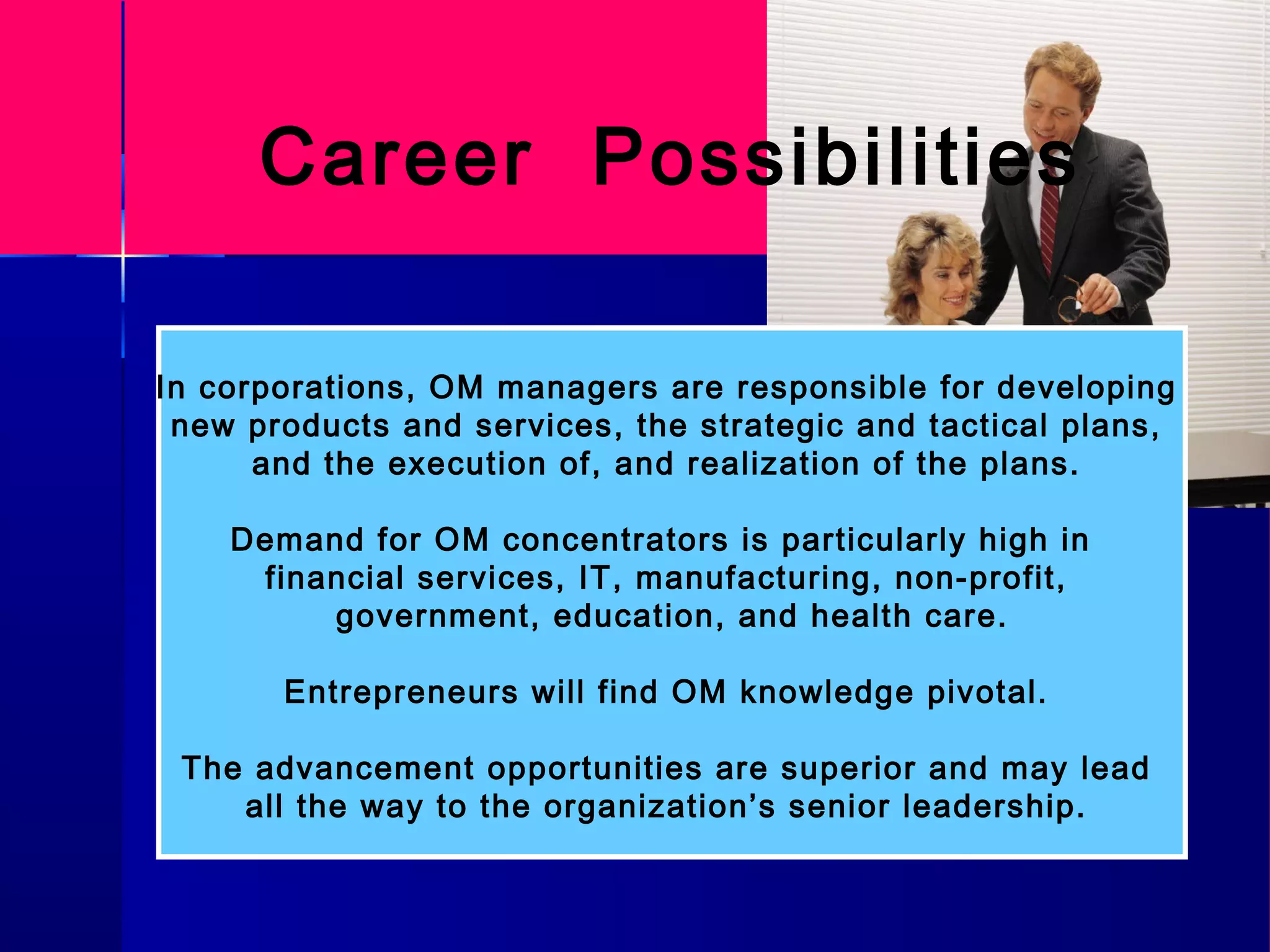
Career Possibilities
In corporations, OM managers are responsible for developing
new products and services, the strategic and tactical plans,
and the execution of, and realization of the plans.
Demand for OM concentrators is particularly high in
financial services, IT, manufacturing, non-profit,
government, education, and health care.
Entrepreneurs will find OM knowledge pivotal.
The advancement opportunities are superior and may lead
all the way to the organization’s senior leadership.
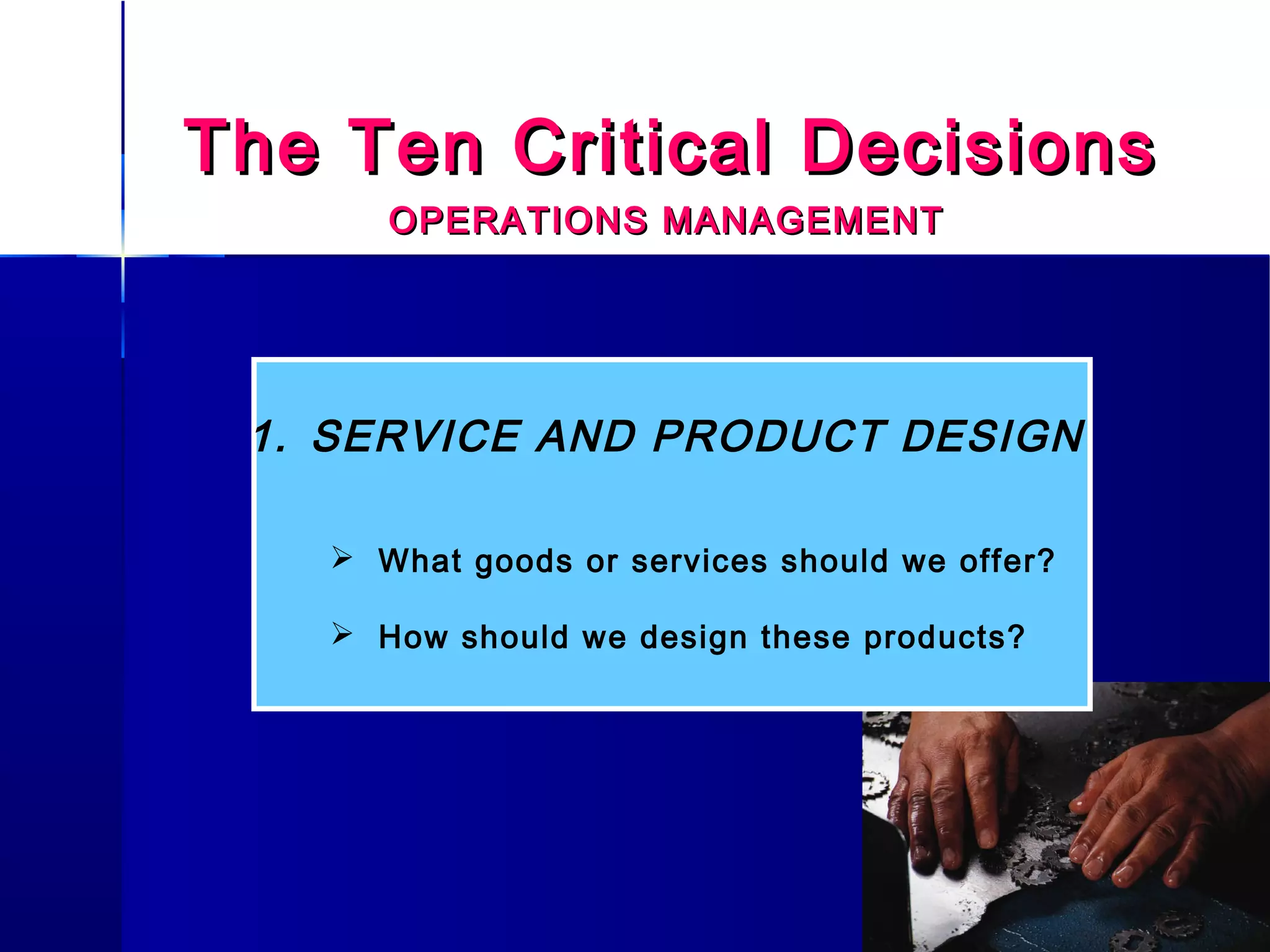
The Ten Critical DecisionsThe Ten Critical Decisions
OPERATIONS MANAGEMENTOPERATIONS MANAGEMENT
1. SERVICE AND PRODUCT DESIGN
 What goods or services should we offer?
 How should we design these products?
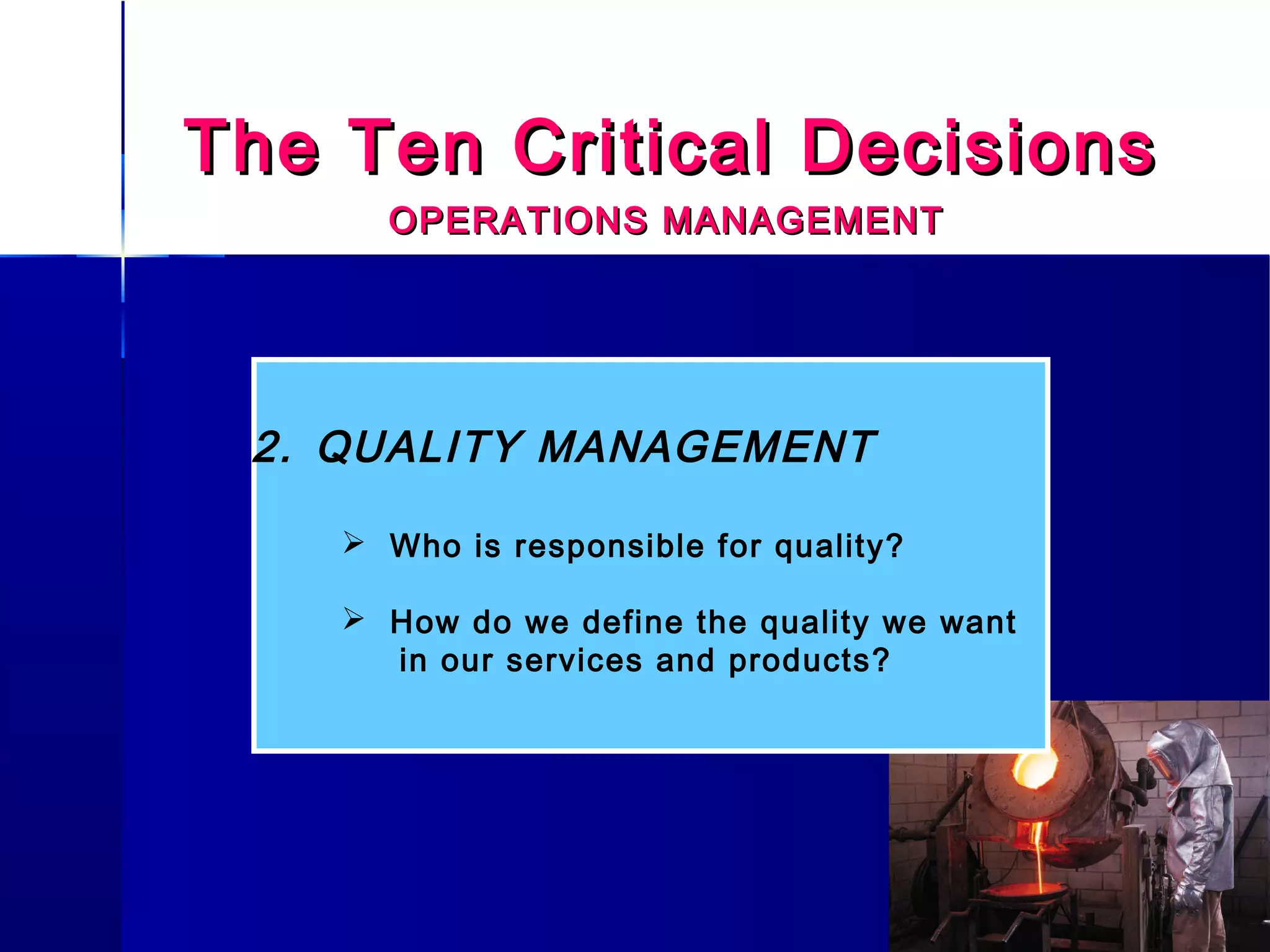
The Ten Critical DecisionsThe Ten Critical Decisions
OPERATIONS MANAGEMENTOPERATIONS MANAGEMENT
2. QUALITY MANAGEMENT
 Who is responsible for quality?
 How do we define the quality we want
in our services and products?
The Ten Critical DecisionsThe Ten Critical Decisions
OPERATIONS MANAGEMENTOPERATIONS MANAGEMENT
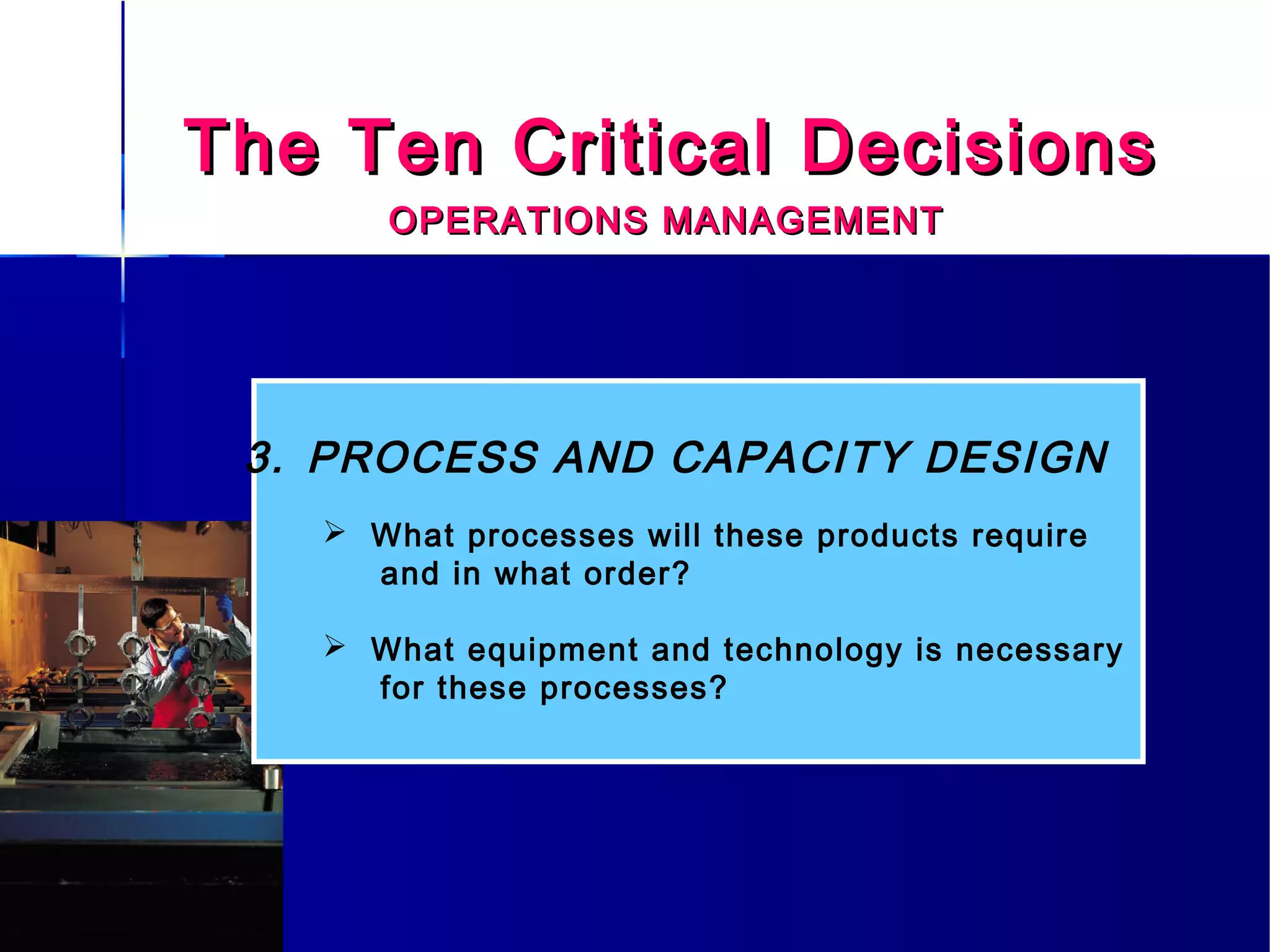
3. PROCESS AND CAPACITY DESIGN
 What processes will these products require
and in what order?
 What equipment and technology is necessary
for these processes?
The Ten Critical DecisionsThe Ten Critical Decisions
OPERATIONS MANAGEMENTOPERATIONS MANAGEMENT
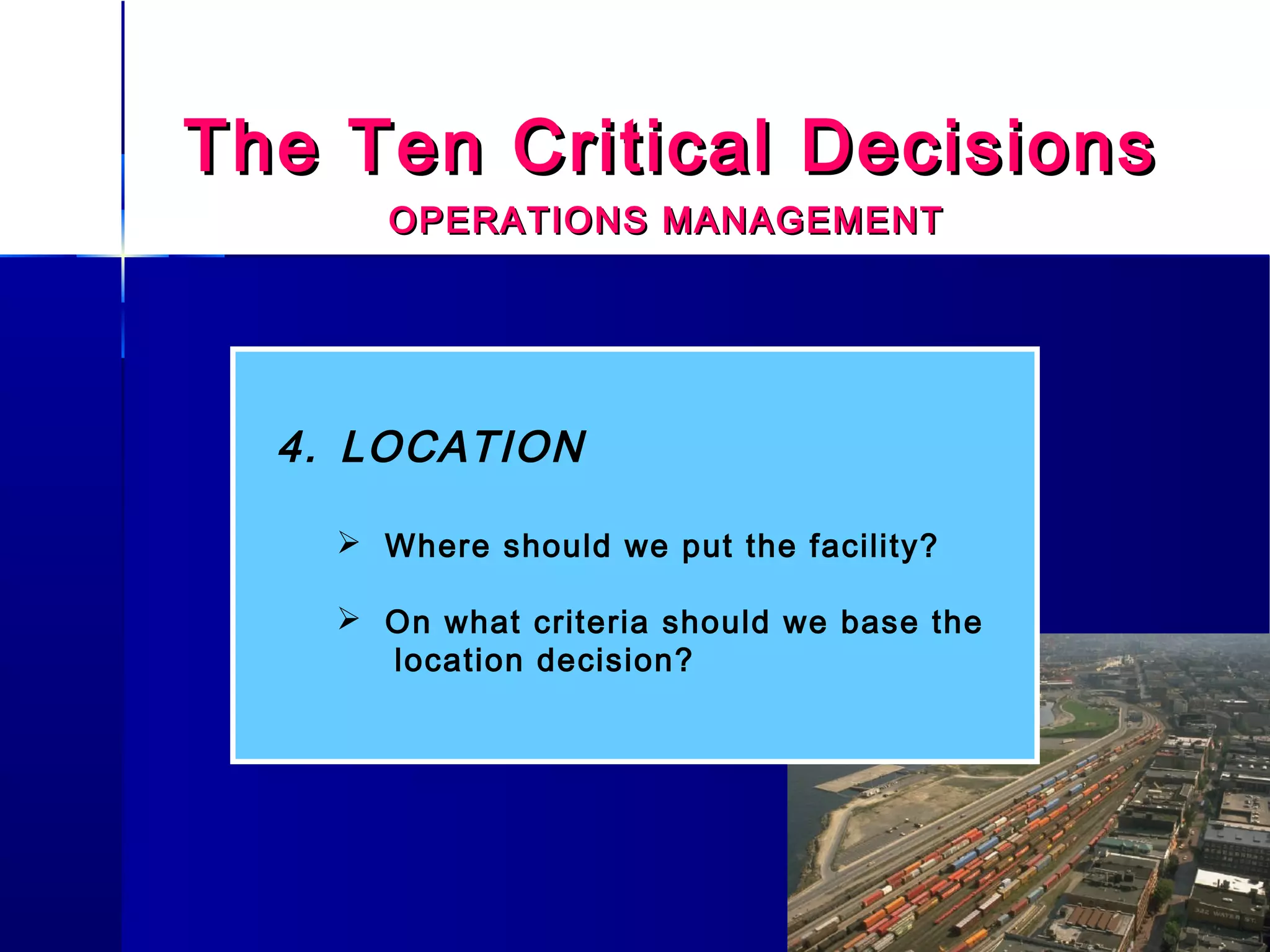
4. LOCATION
 Where should we put the facility?
 On what criteria should we base the
location decision?
The Ten Critical DecisionsThe Ten Critical Decisions
OPERATIONS MANAGEMENTOPERATIONS MANAGEMENT
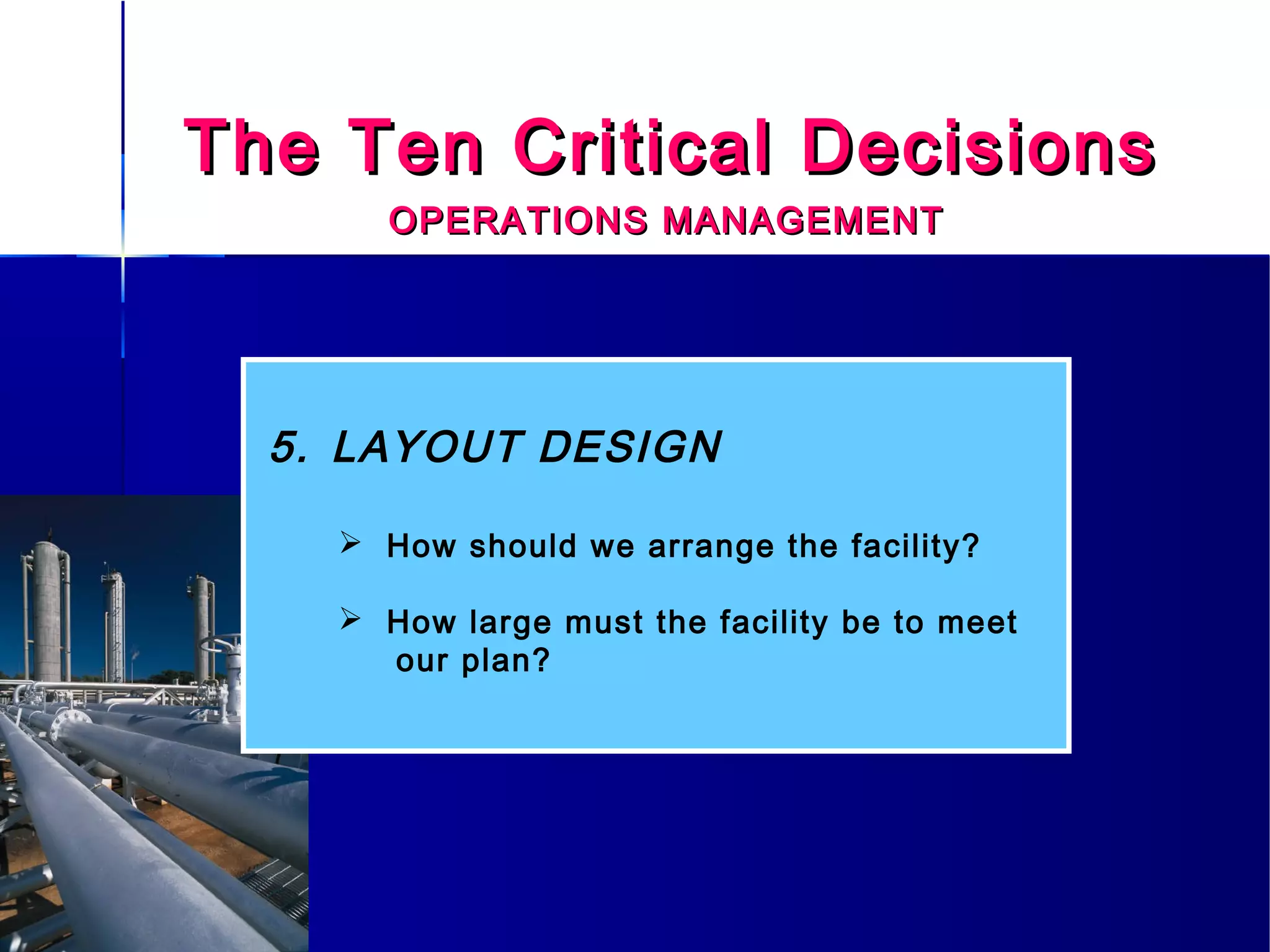
5. LAYOUT DESIGN
 How should we arrange the facility?
 How large must the facility be to meet
our plan?
The Ten Critical DecisionsThe Ten Critical Decisions
OPERATIONS MANAGEMENTOPERATIONS MANAGEMENT
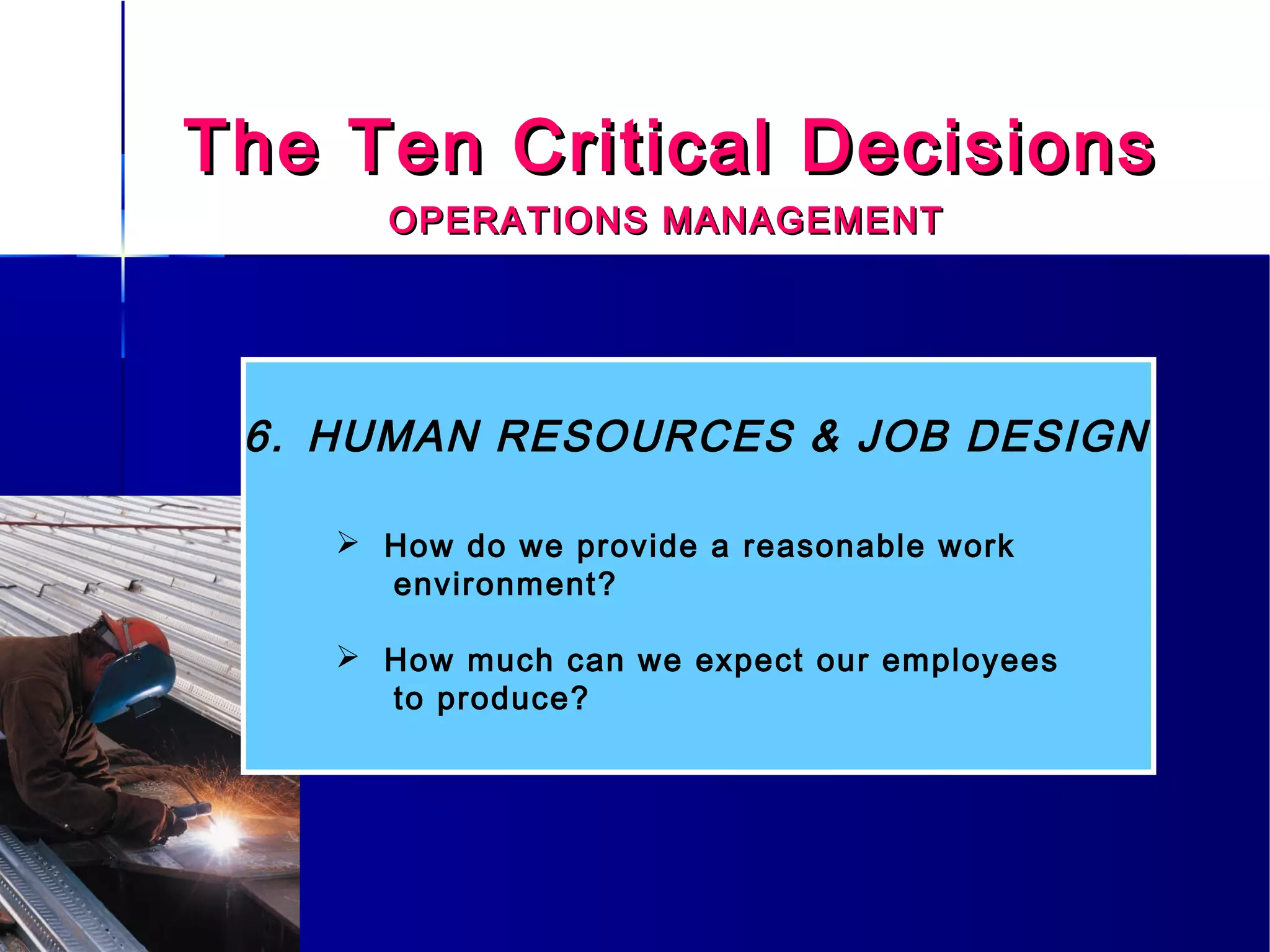
6. HUMAN RESOURCES & JOB DESIGN
 How do we provide a reasonable work
environment?
 How much can we expect our employees
to produce?
The Ten Critical DecisionsThe Ten Critical Decisions
OPERATIONS MANAGEMENTOPERATIONS MANAGEMENT
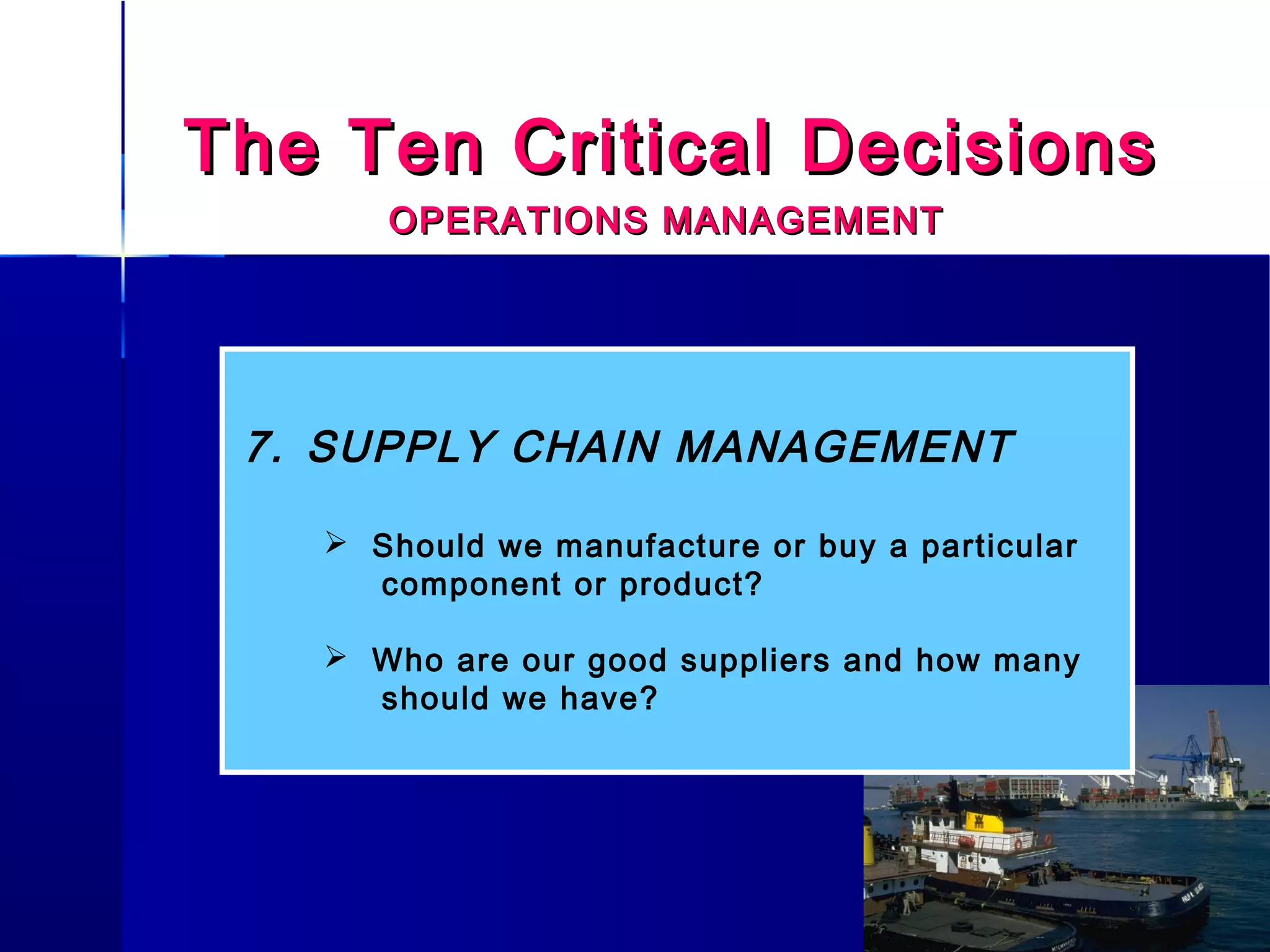
7. SUPPLY CHAIN MANAGEMENT
 Should we manufacture or buy a particular
component or product?
 Who are our good suppliers and how many
should we have?
The Ten Critical DecisionsThe Ten Critical Decisions
OPERATIONS MANAGEMENTOPERATIONS MANAGEMENT
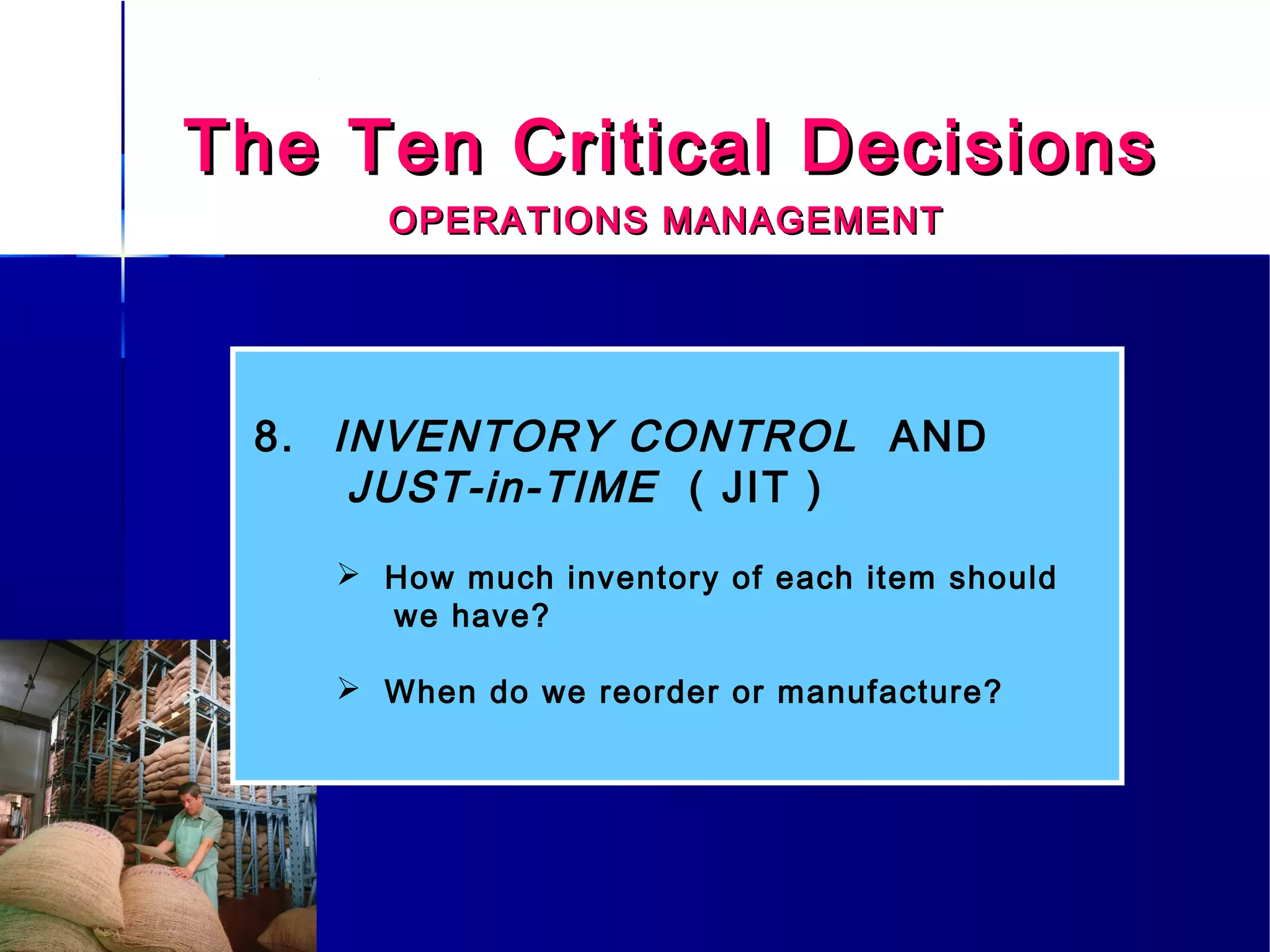
8. INVENTORY CONTROL AND
JUST-in-TIME ( JIT )
 How much inventory of each item should
we have?
 When do we reorder or manufacture?
The Ten Critical DecisionsThe Ten Critical Decisions
OPERATIONS MANAGEMENTOPERATIONS MANAGEMENT
9. INTERMEDIATE, SHORT-TERM, AND
PROJECT SCHEDULING
 Is subcontracting or outsourcing production
a good idea?
 Are we better off keeping people on the payroll
during slowdowns?
 Which job do we perform next?
The Ten Critical DecisionsThe Ten Critical Decisions
OPERATIONS MANAGEMENTOPERATIONS MANAGEMENT
10. MAINTENANCE
 Who is responsible for maintenance?
 When do we perform maintenance?
 What are the effects of a maintenance
program on productivity and efficiency?
WHY AACSB ACCREDITORSWHY AACSB ACCREDITORS
STRENGTHENED OMSTRENGTHENED OM
GUIDELINESGUIDELINES
“ To sustain a career in business for
many years, a business graduate
needs an understanding of the
analytical foundations and tools
that are important for managerial
decision-making.”
WHY AACSB ACCREDITORSWHY AACSB ACCREDITORS
STRENGTHENED OMSTRENGTHENED OM
GUIDELINESGUIDELINES
“ The explosive growth of information
technology applications is being driven by
management science-based models such as
decision analysis, scenario generation,
simulation, and optimization ”. *
* OPERATIONS MANAGEMENTOPERATIONS MANAGEMENT
WHY AACSB ACCREDITORSWHY AACSB ACCREDITORS
STRENGTHENED OMSTRENGTHENED OM
GUIDELINESGUIDELINES
“Since management science techniques
are driving operations, supply chains,
and e-commerce, they constitute a
major driver of the entire economy.”
OPERATIONSOPERATIONS
MANAGEMENTMANAGEMENT
A Brief HistoryA Brief History
pplied Management Science for Decision Making, 1e © 2012 Pearson Prentice-Hall, Inc. Philip A. Vaccaro, P
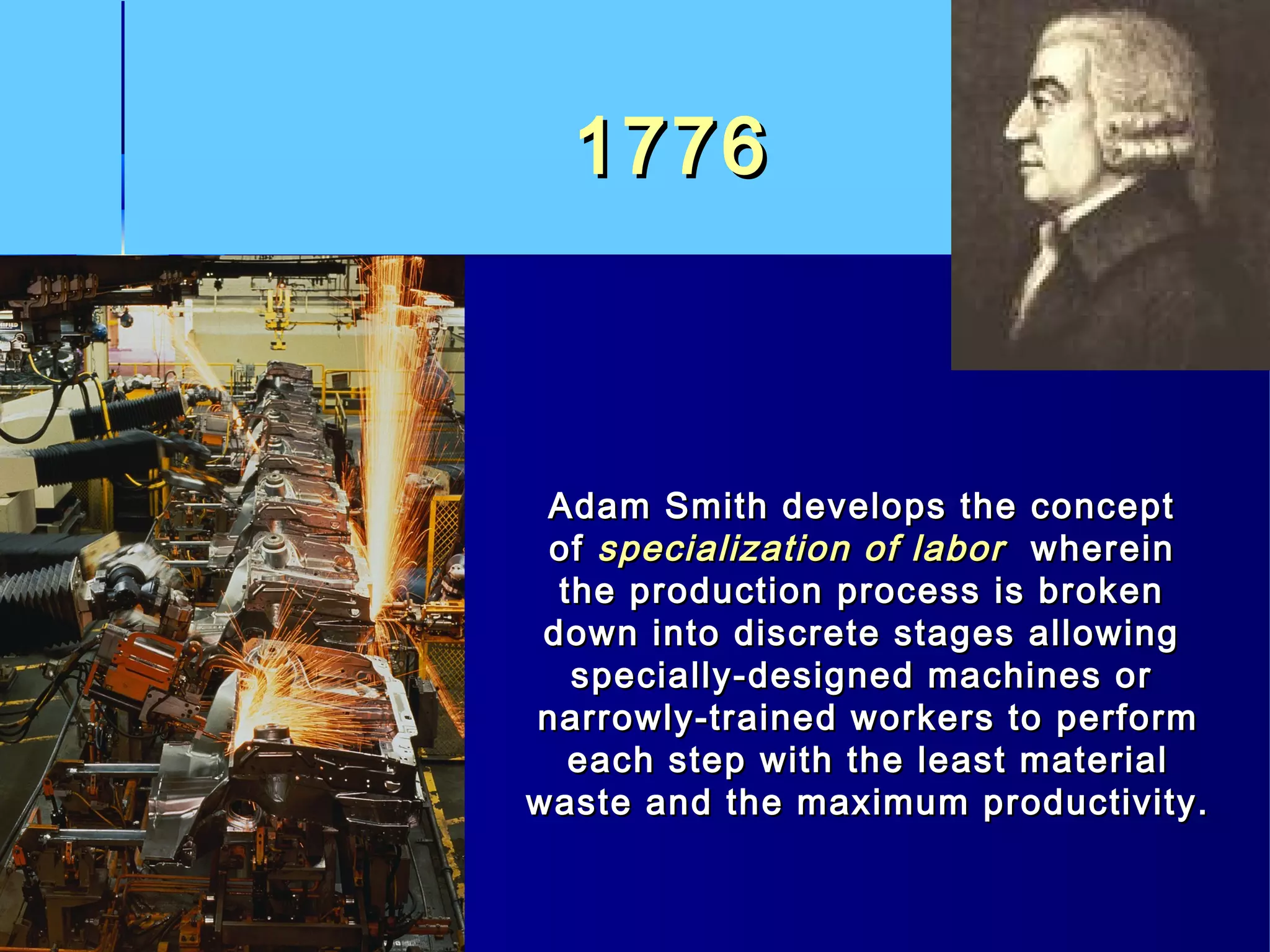
17761776
Adam Smith develops the conceptAdam Smith develops the concept
ofof specialization of laborspecialization of labor whereinwherein
the production process is brokenthe production process is broken
down into discrete stages allowingdown into discrete stages allowing
specially-designed machines orspecially-designed machines or
narrowly-trained workers to performnarrowly-trained workers to perform
each step with the least materialeach step with the least material
waste and the maximum productivity.waste and the maximum productivity.
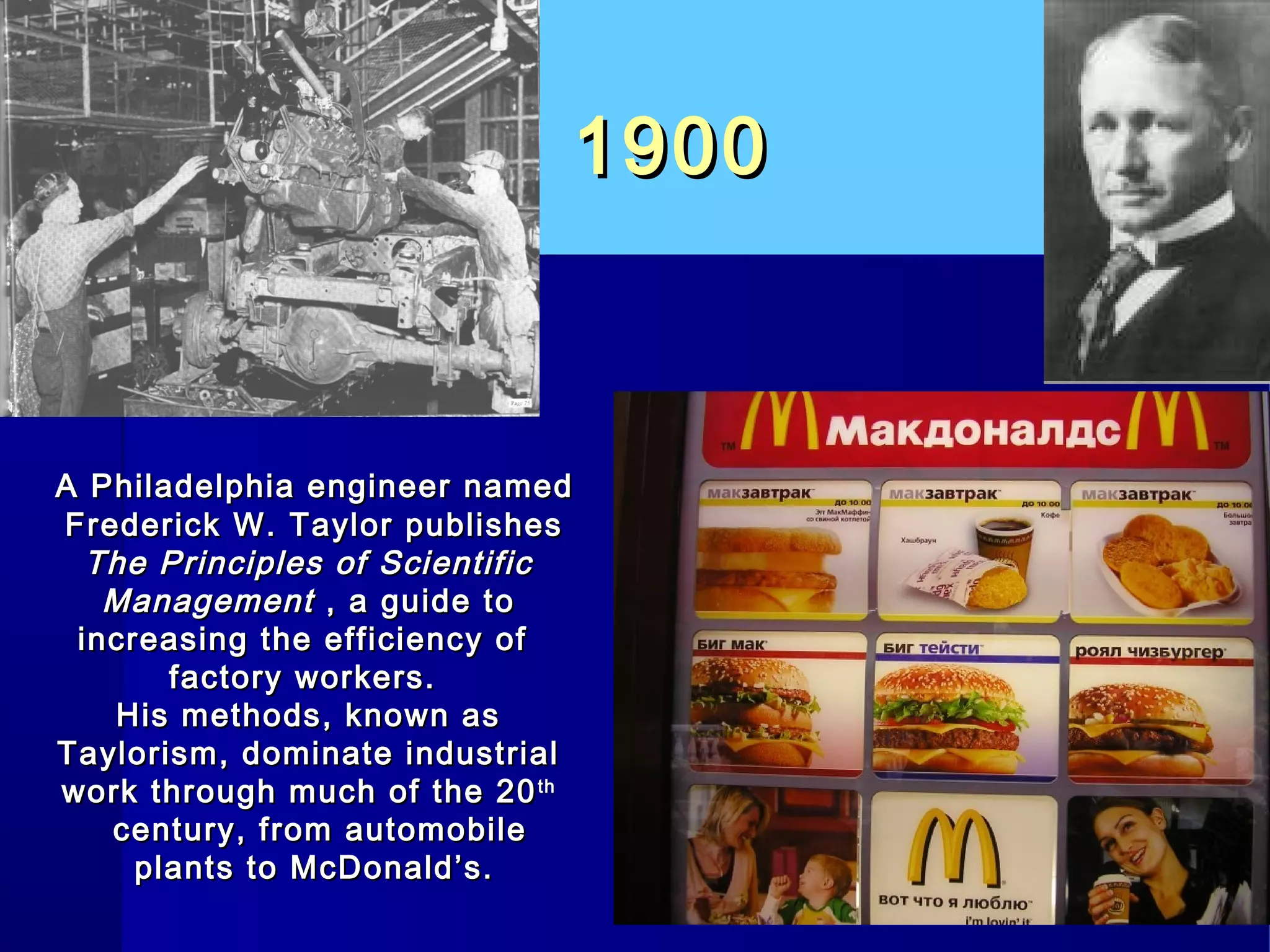
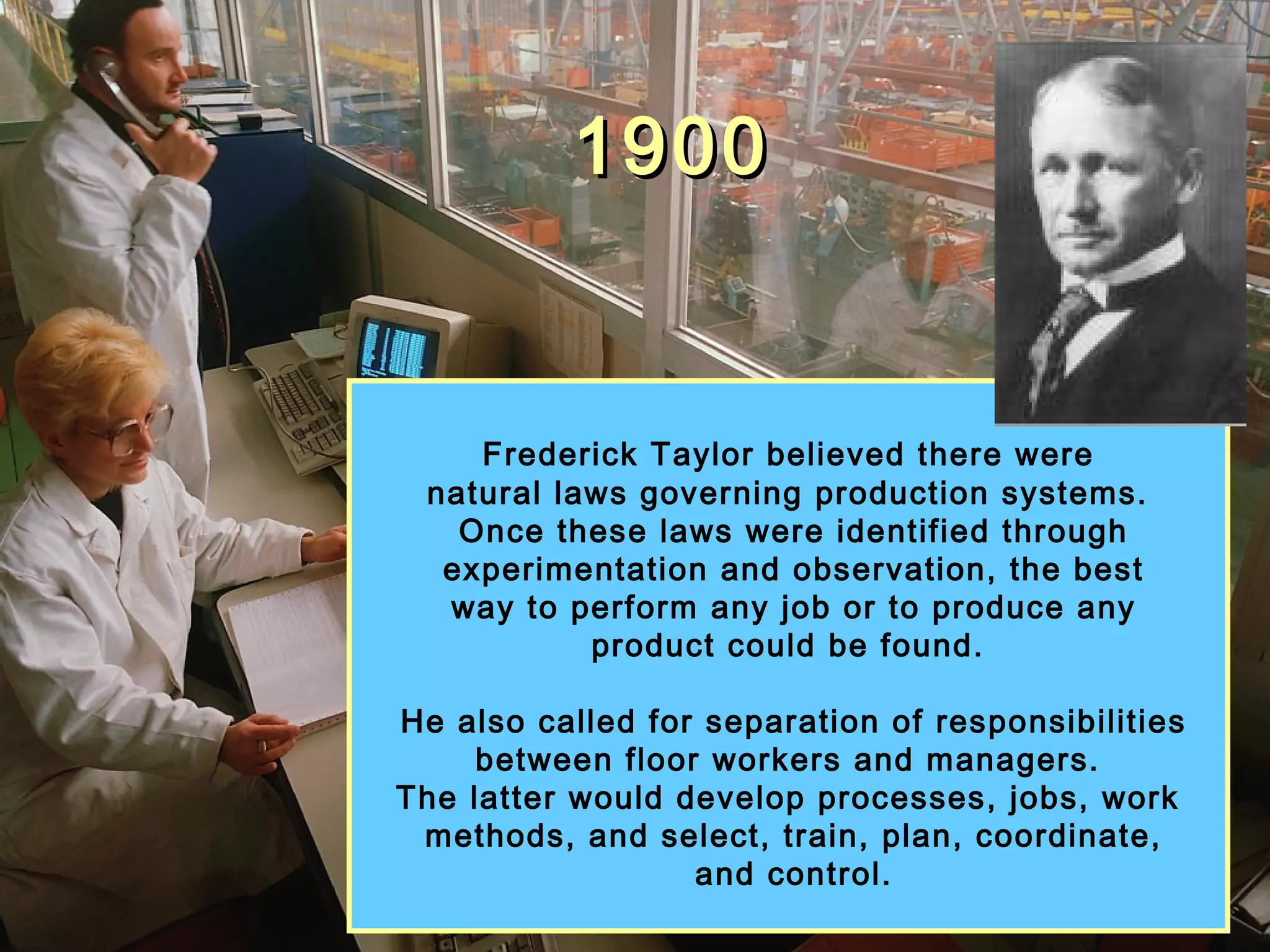
19001900
A Philadelphia engineer namedA Philadelphia engineer named
Frederick W. Taylor publishesFrederick W. Taylor publishes
The Principles of ScientificThe Principles of Scientific
ManagementManagement , a guide to, a guide to
increasing the efficiency ofincreasing the efficiency of
factory workers.factory workers.
His methods, known asHis methods, known as
Taylorism, dominate industrialTaylorism, dominate industrial
work through much of the 20work through much of the 20thth
century, from automobilecentury, from automobile
plants to McDonald’s.plants to McDonald’s.
19001900
Frederick Taylor believed there were
natural laws governing production systems.
Once these laws were identified through
experimentation and observation, the best
way to perform any job or to produce any
product could be found.
He also called for separation of responsibilities
between floor workers and managers.
The latter would develop processes, jobs, work
methods, and select, train, plan, coordinate,
and control.
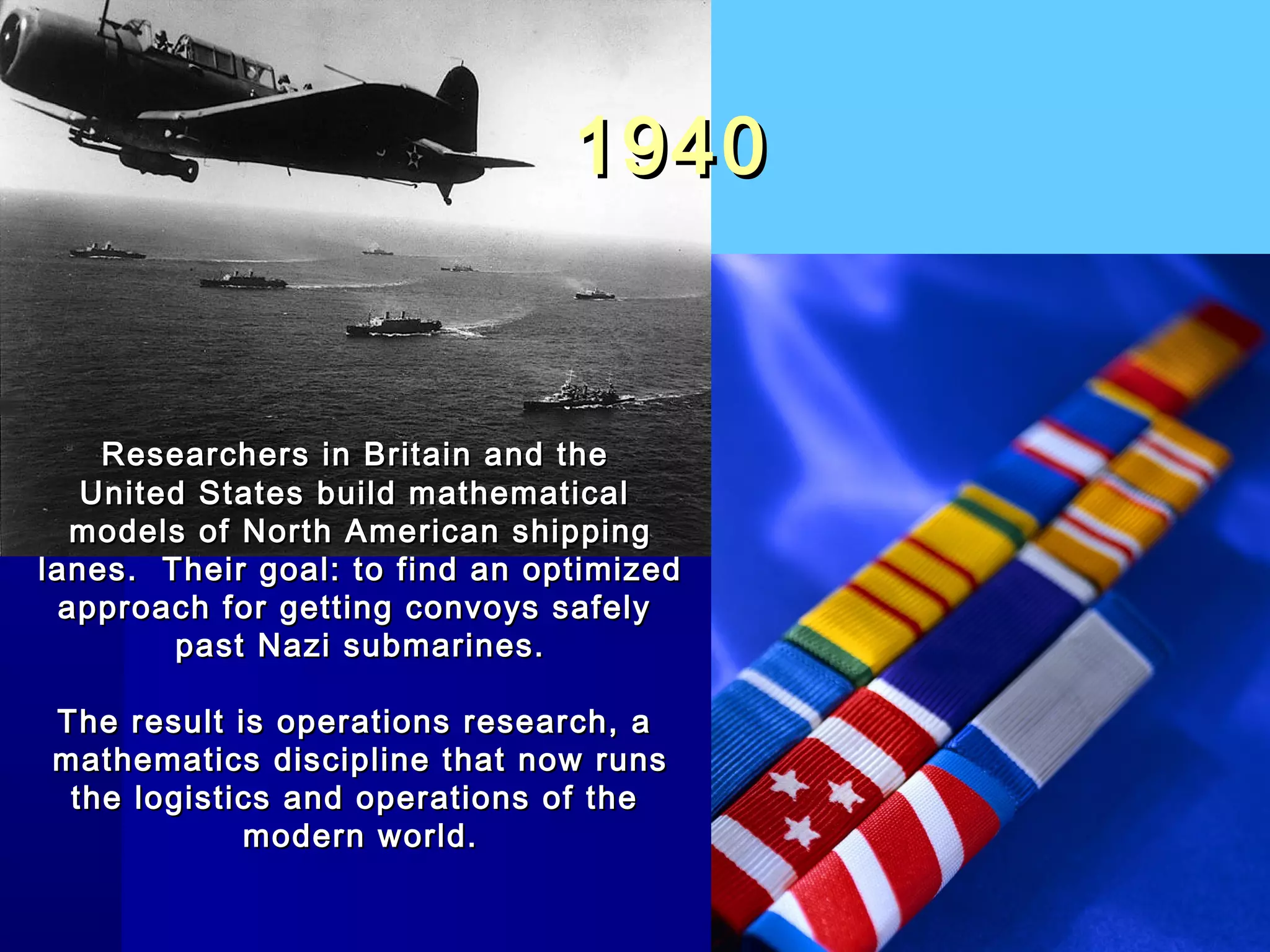
19401940
Researchers in Britain and theResearchers in Britain and the
United States build mathematicalUnited States build mathematical
models of North American shippingmodels of North American shipping
lanes. Their goal: to find an optimizedlanes. Their goal: to find an optimized
approach for getting convoys safelyapproach for getting convoys safely
past Nazi submarines.past Nazi submarines.
The result is operations research, aThe result is operations research, a
mathematics discipline that now runsmathematics discipline that now runs
the logistics and operations of thethe logistics and operations of the
modern world.modern world.
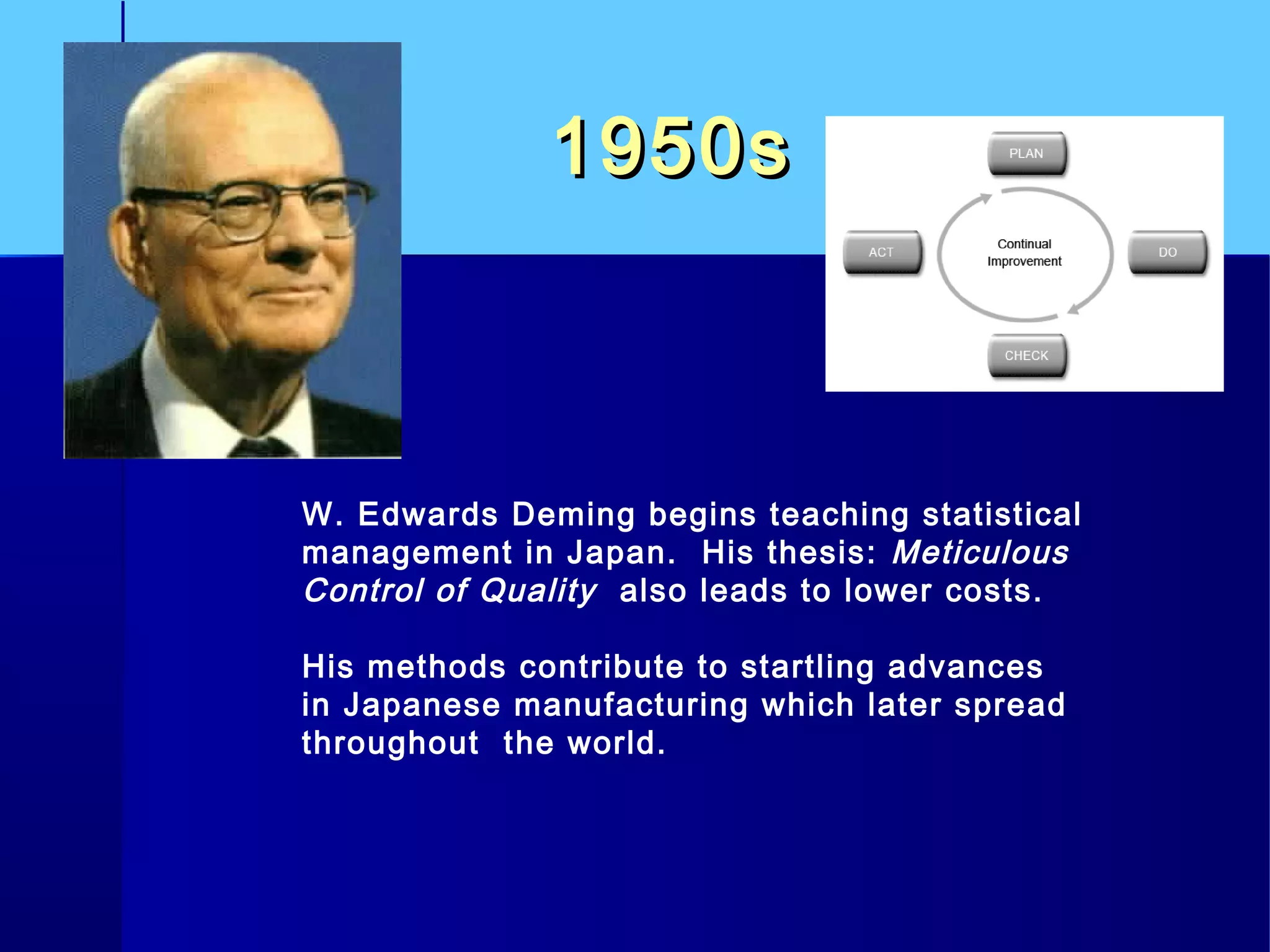
1950s1950s
W. Edwards Deming begins teaching statistical
management in Japan. His thesis: Meticulous
Control of Quality also leads to lower costs.
His methods contribute to startling advances
in Japanese manufacturing which later spread
throughout the world.
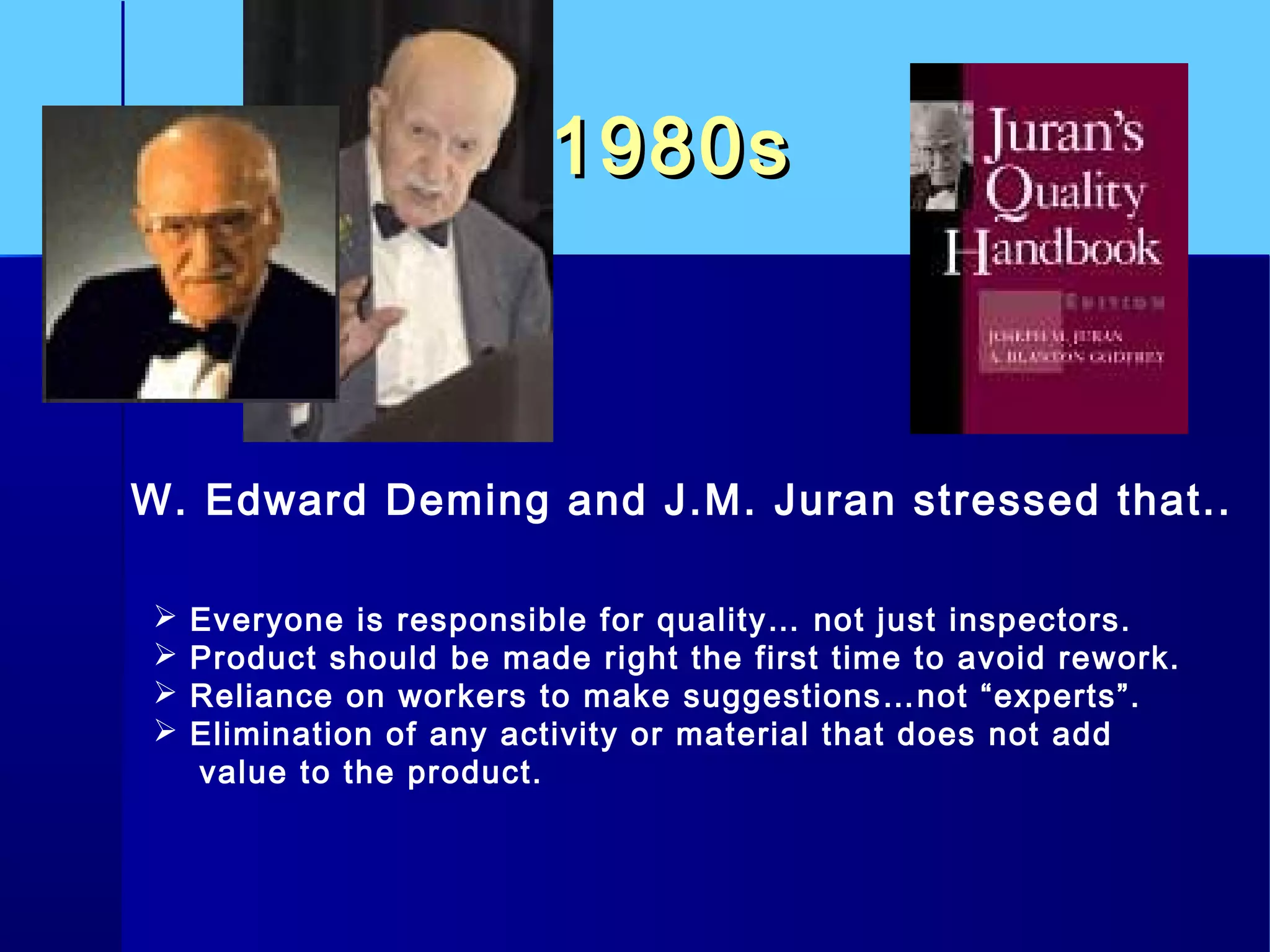
1980s1980s
W. Edward Deming and J.M. Juran stressed that..
 Everyone is responsible for quality… not just inspectors.
 Product should be made right the first time to avoid rework.
 Reliance on workers to make suggestions…not “experts”.
 Elimination of any activity or material that does not add
value to the product.
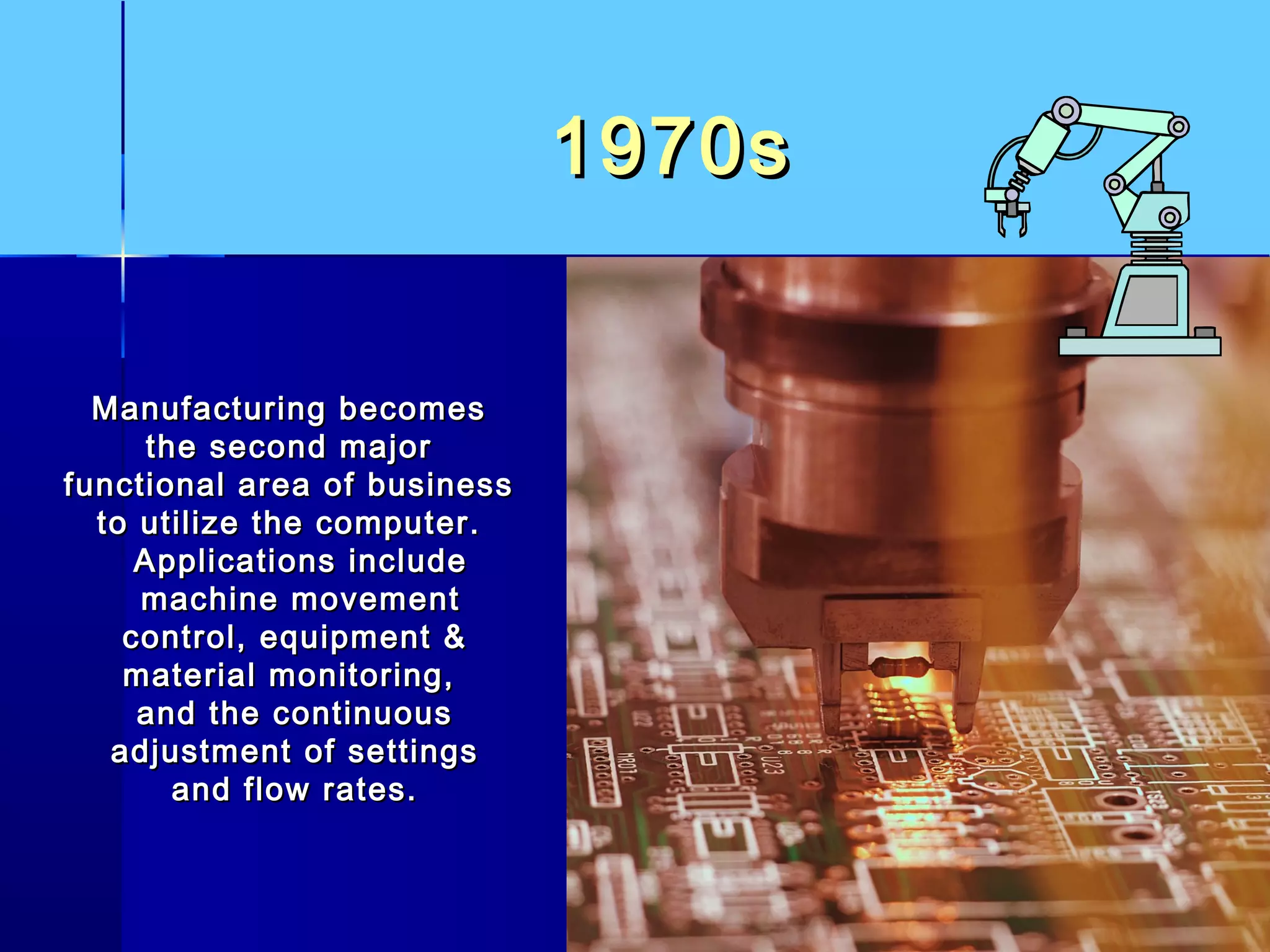
1970s1970s
Manufacturing becomesManufacturing becomes
the second majorthe second major
functional area of businessfunctional area of business
to utilize the computer.to utilize the computer.
Applications includeApplications include
machine movementmachine movement
control, equipment &control, equipment &
material monitoring,material monitoring,
and the continuousand the continuous
adjustment of settingsadjustment of settings
and flow rates.and flow rates.
Early 21Early 21stst
CenturyCentury
Database systems and all manufacturing equipment
and subsystems are integrated into a single system.
In theory, this computer-integrated manufacturing
system (CIM) would control and coordinate every
phase of production from initial customer order, to
custom-product design, inventory purchase orders,
tooling requirements, production schedules, tracking,
quality control monitoring, assembly of information
on productivity, profitability, and tool wear, as well
as shipping and billing.
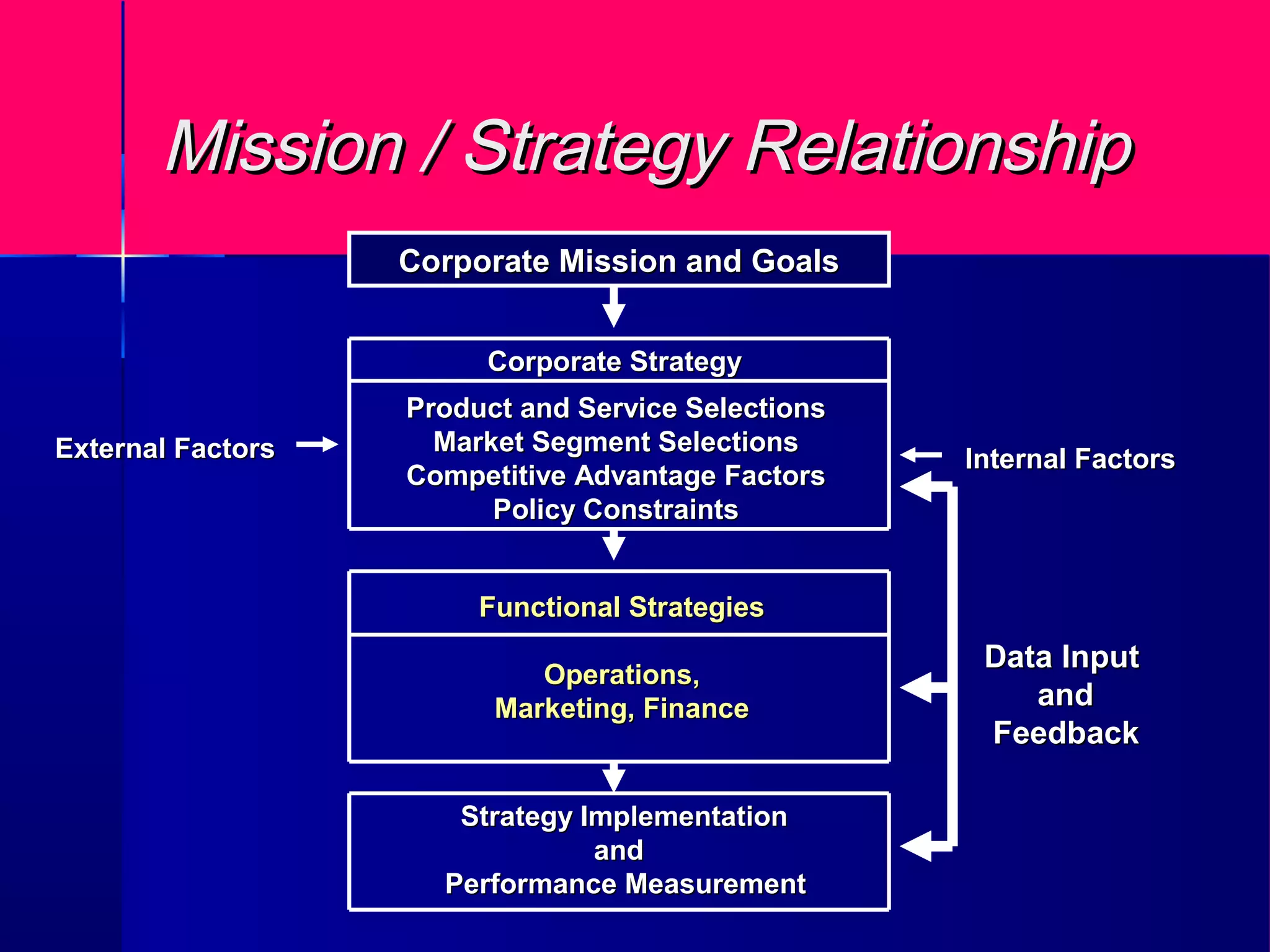
Mission / Strategy RelationshipMission / Strategy Relationship
Corporate Mission and GoalsCorporate Mission and Goals
Product and Service SelectionsProduct and Service Selections
Market Segment SelectionsMarket Segment Selections
Competitive Advantage FactorsCompetitive Advantage Factors
Policy ConstraintsPolicy Constraints
Functional StrategiesFunctional Strategies
Operations,Operations,
Marketing, FinanceMarketing, Finance
Strategy ImplementationStrategy Implementation
andand
Performance MeasurementPerformance Measurement
Corporate StrategyCorporate Strategy
External FactorsExternal Factors Internal FactorsInternal Factors
Data InputData Input
andand
FeedbackFeedback
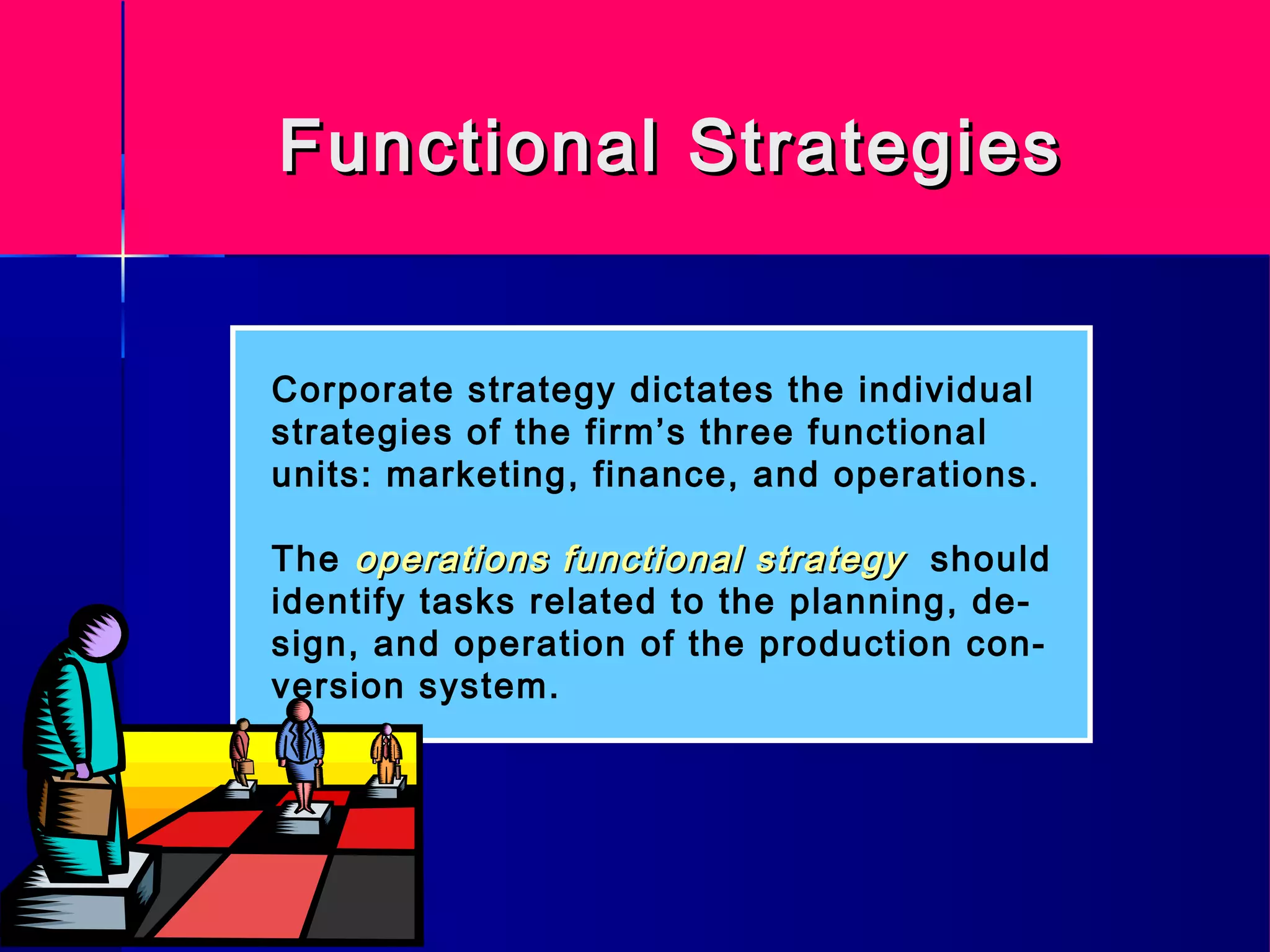
Functional StrategiesFunctional Strategies
Corporate strategy dictates the individual
strategies of the firm’s three functional
units: marketing, finance, and operations.
The operations functional strategyoperations functional strategy should
identify tasks related to the planning, de-
sign, and operation of the production con-
version system.
Operations FunctionalOperations Functional
StrategyStrategy
 It must delineate the tasks that the operations
function must do well in order to support and
achieve the corporate strategy.
 Almost any operations task can be used to sup-
port a firm’s strategy but most firms can compete
very effectively by emphasizing one or two.
 The operations functional strategy should be con-
sistent with the marketing and finance strategies,
as well.
Operations FunctionalOperations Functional
StrategyStrategy
The ten critical decisionsten critical decisions of operations management
developed in chapter one provide an excellent check-
list for identifying the particular tasks that an opera-
tions functional strategy must perform in supporting
and achieving the firm’s corporate strategy.
Operations FunctionalOperations Functional
Strategy ChecklistStrategy Checklist
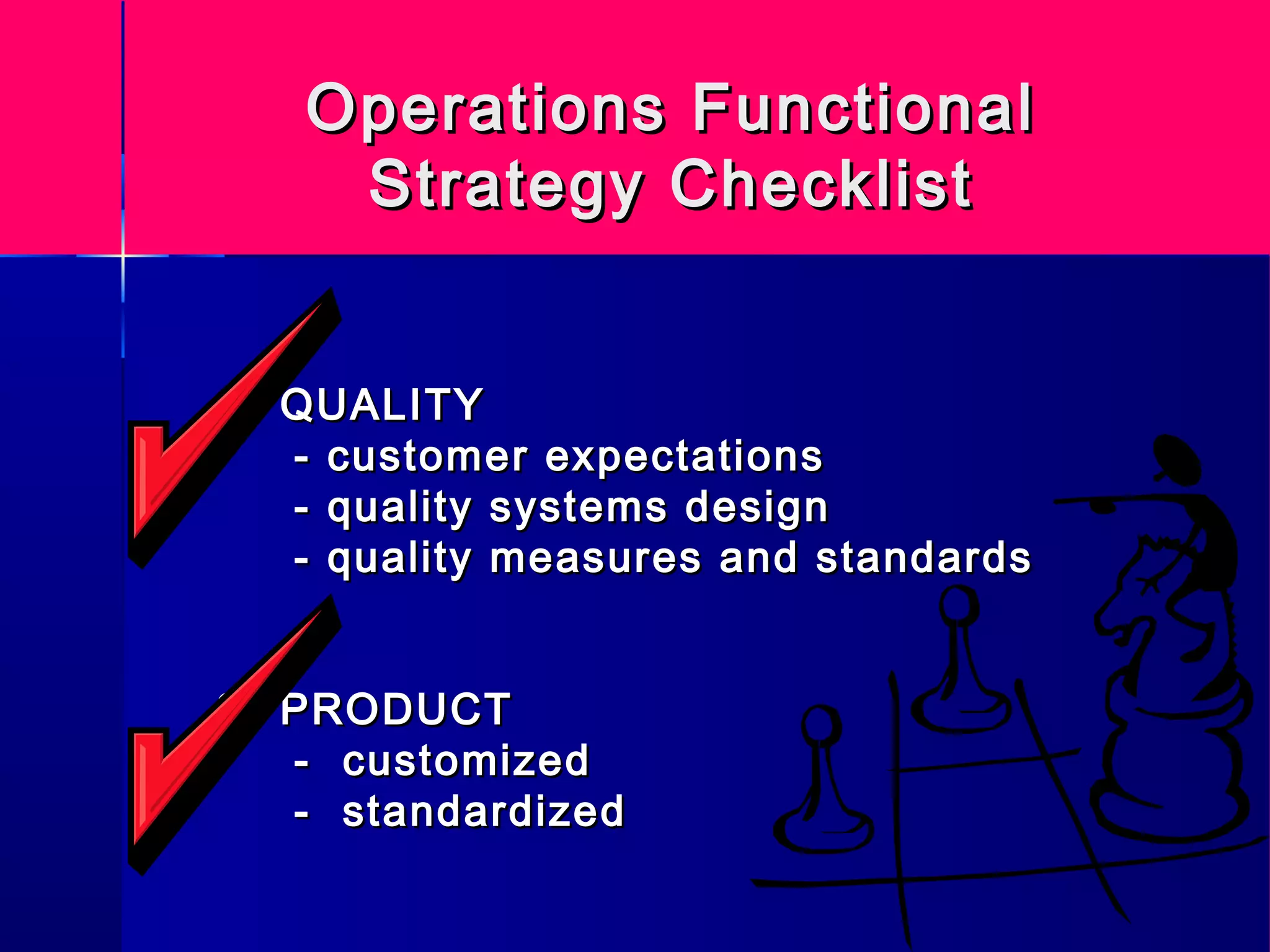
1. QUALITYQUALITY
- customer expectations- customer expectations
- quality systems design- quality systems design
- quality measures and standards- quality measures and standards
2.2. PRODUCTPRODUCT
- customized- customized
- standardized- standardized
Operations FunctionalOperations Functional
Strategy ChecklistStrategy Checklist
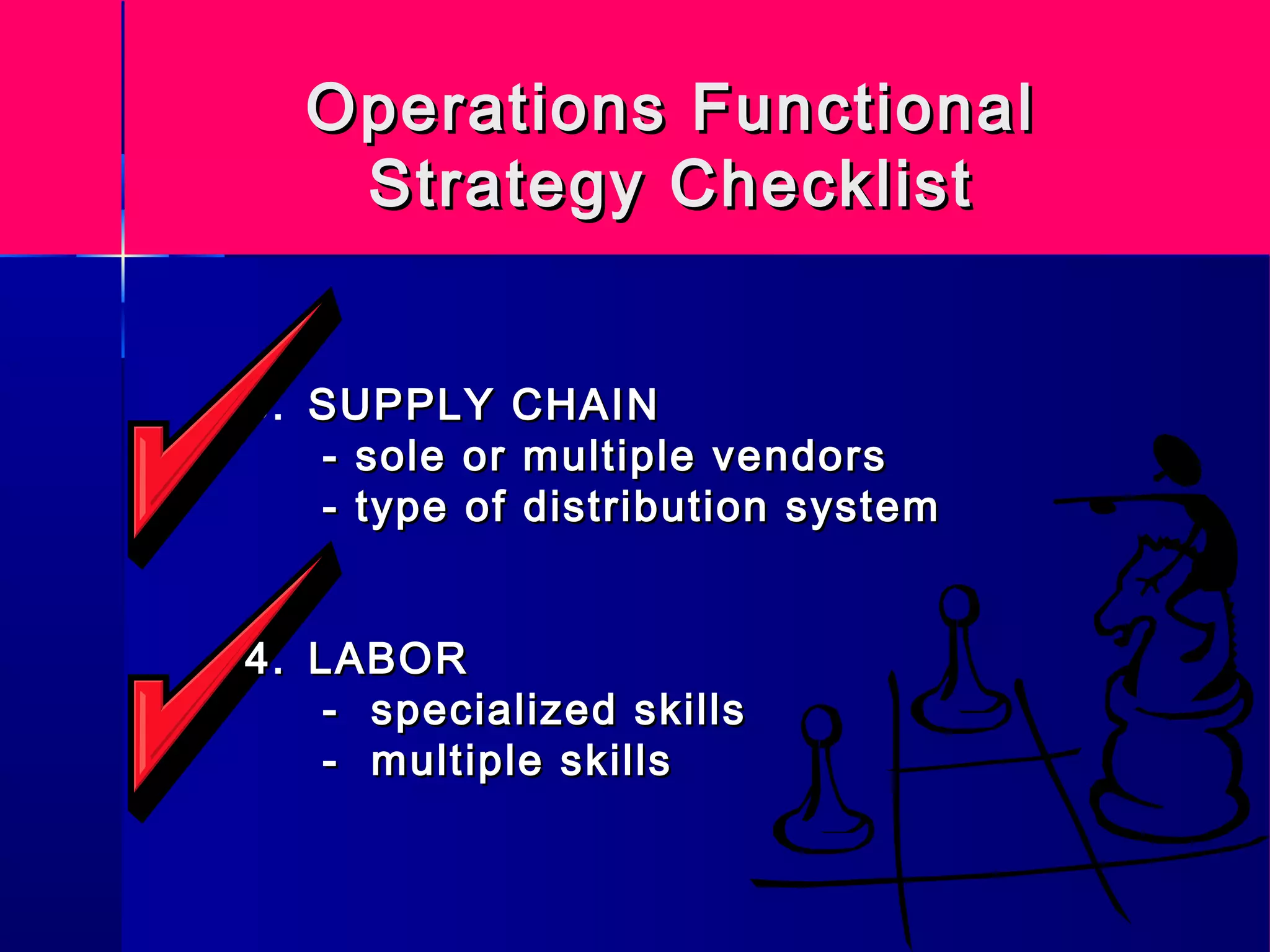
3. SUPPLY CHAINSUPPLY CHAIN
- sole or multiple vendors- sole or multiple vendors
- type of distribution system- type of distribution system
4.4. LABORLABOR
- specialized skills- specialized skills
- multiple skills- multiple skills
Operations FunctionalOperations Functional
Strategy ChecklistStrategy Checklist
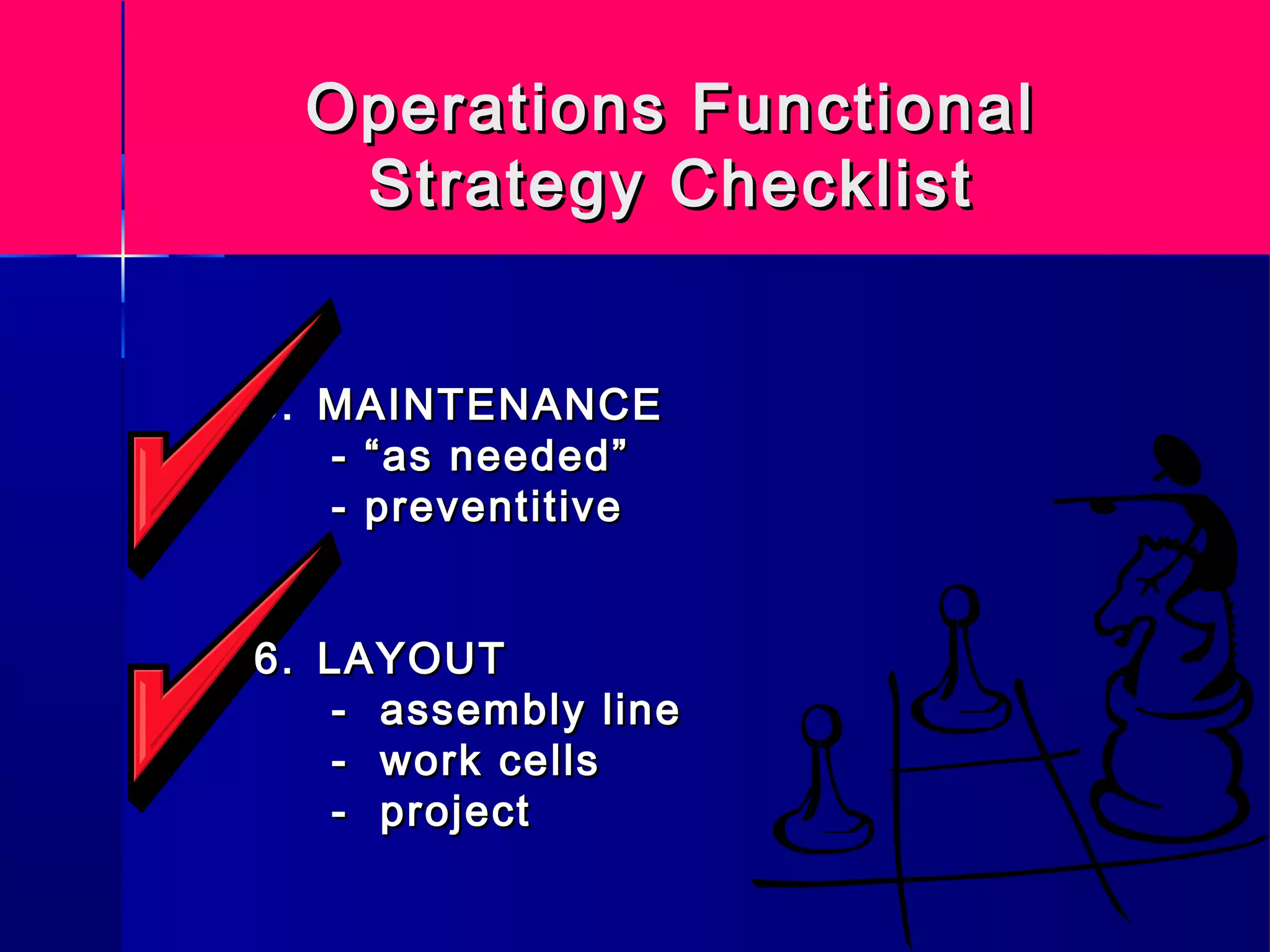
5. MAINTENANCEMAINTENANCE
- “as needed”- “as needed”
- preventitive- preventitive
6.6. LAYOUTLAYOUT
- assembly line- assembly line
- work cells- work cells
- project- project
Operations FunctionalOperations Functional
Strategy ChecklistStrategy Checklist
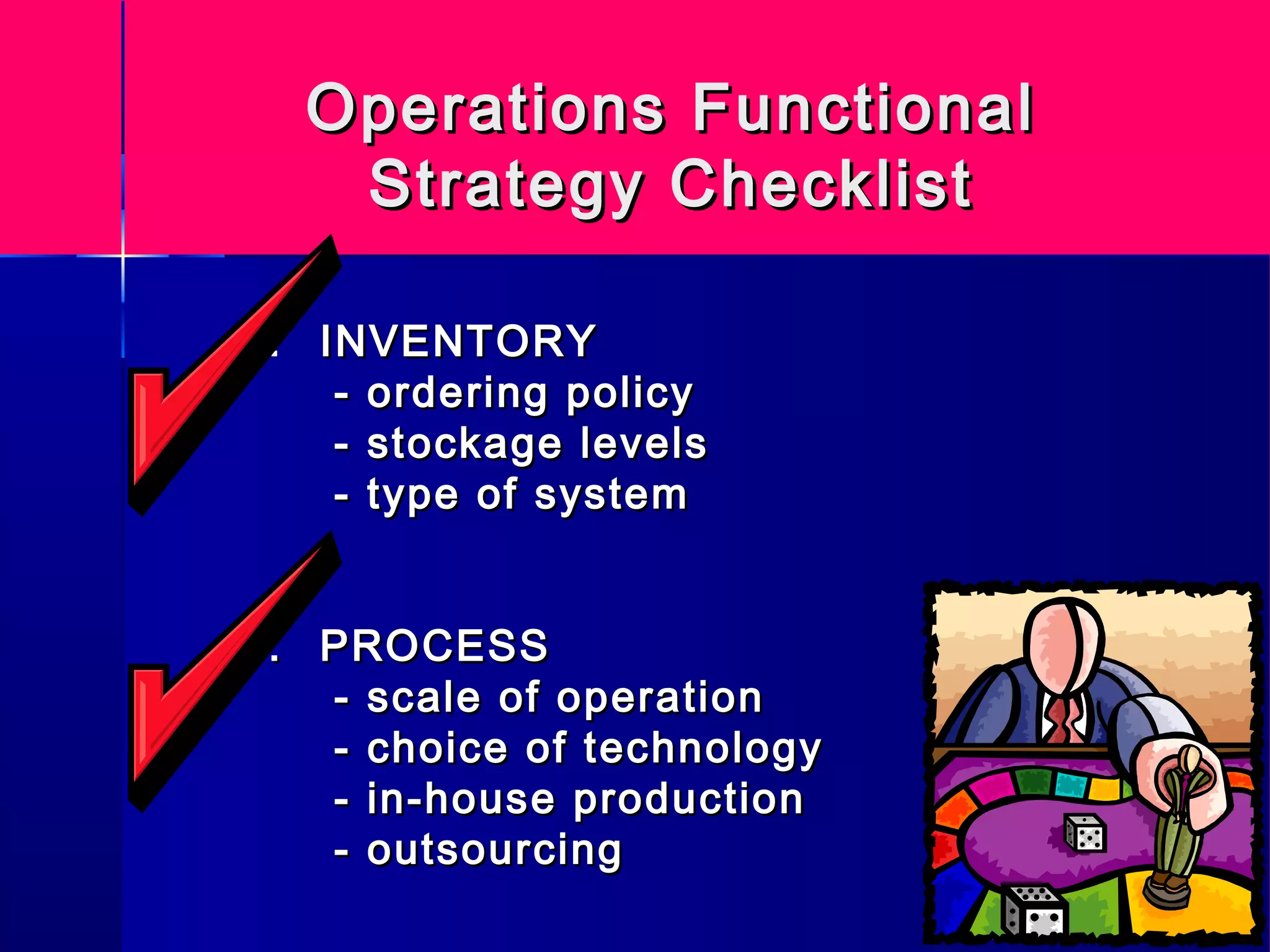
7. INVENTORYINVENTORY
- ordering policy- ordering policy
- stockage levels- stockage levels
- type of system- type of system
8.8. PROCESSPROCESS
- scale of operation- scale of operation
- choice of technology- choice of technology
- in-house production- in-house production
- outsourcing- outsourcing
Operations FunctionalOperations Functional
Strategy ChecklistStrategy Checklist
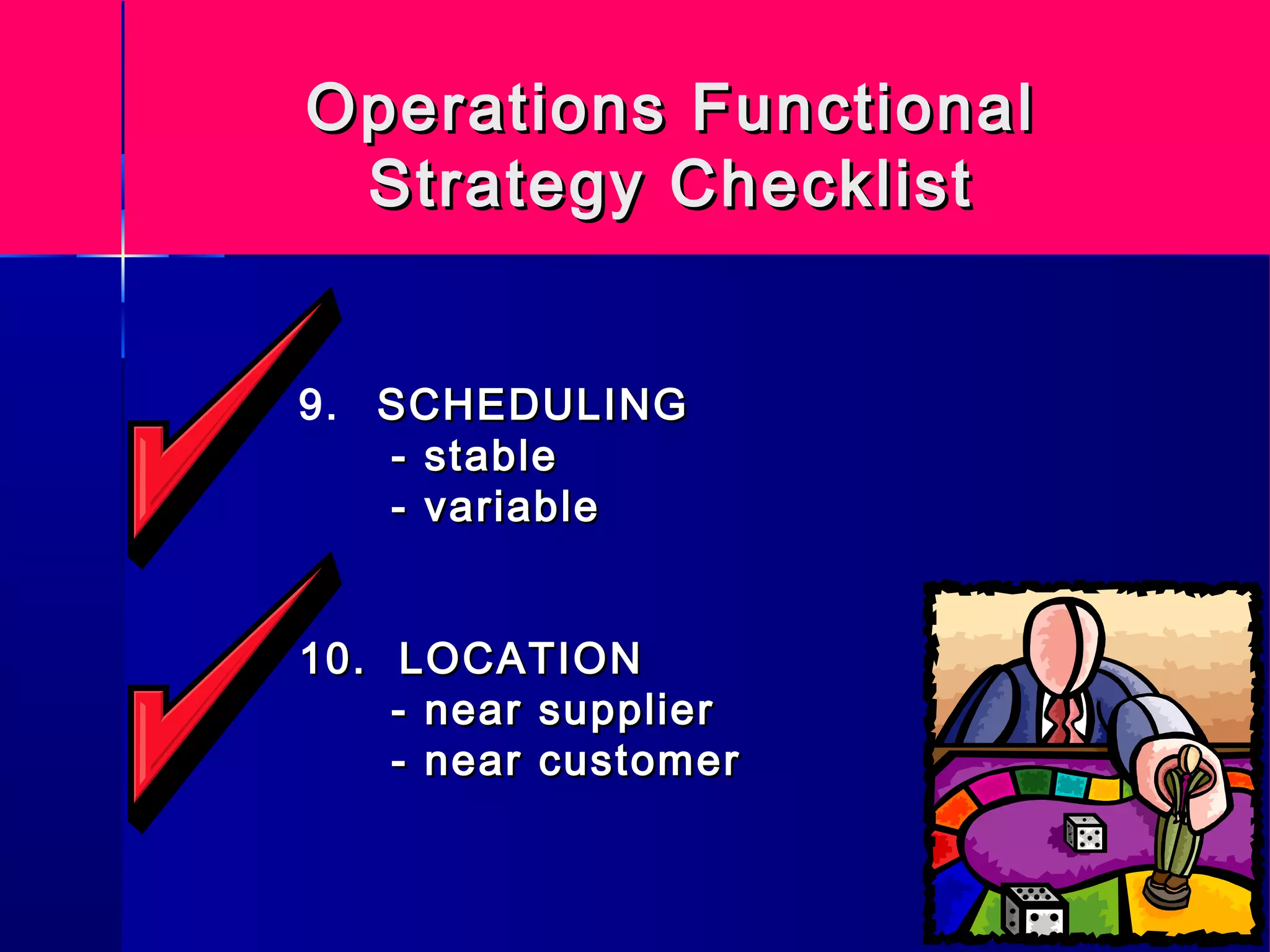
9. SCHEDULINGSCHEDULING
- stable- stable
- variable- variable
10.10. LOCATIONLOCATION
- near supplier- near supplier
- near customer- near customer
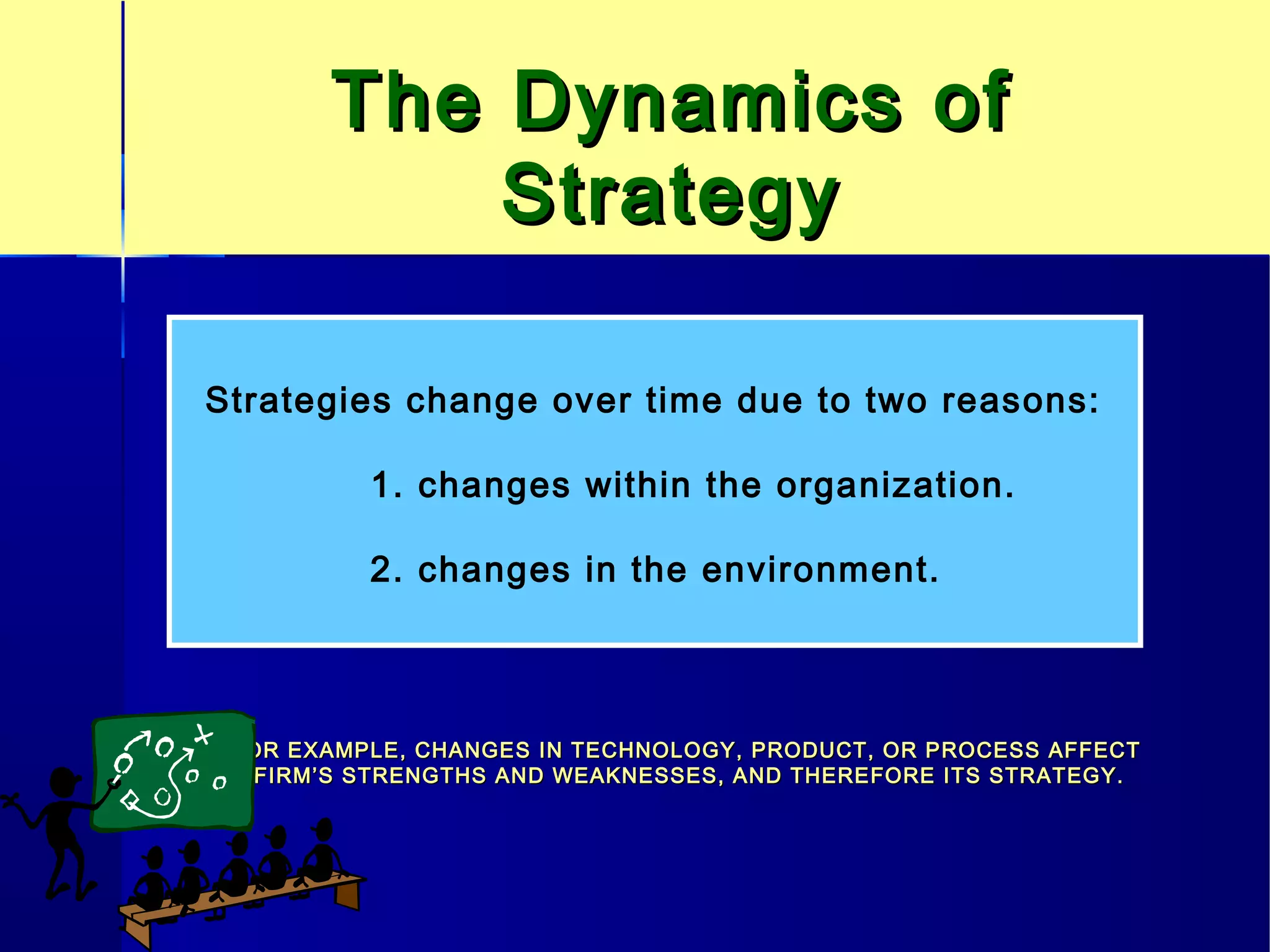
The Dynamics ofThe Dynamics of
StrategyStrategy
Strategies change over time due to two reasons:
1. changes within the organization.
2. changes in the environment.
FOR EXAMPLE, CHANGES IN TECHNOLOGY, PRODUCT, OR PROCESS AFFECTFOR EXAMPLE, CHANGES IN TECHNOLOGY, PRODUCT, OR PROCESS AFFECT
A FIRM’S STRENGTHS AND WEAKNESSES, AND THEREFORE ITS STRATEGY.A FIRM’S STRENGTHS AND WEAKNESSES, AND THEREFORE ITS STRATEGY.
The Dynamics ofThe Dynamics of
StrategyStrategy
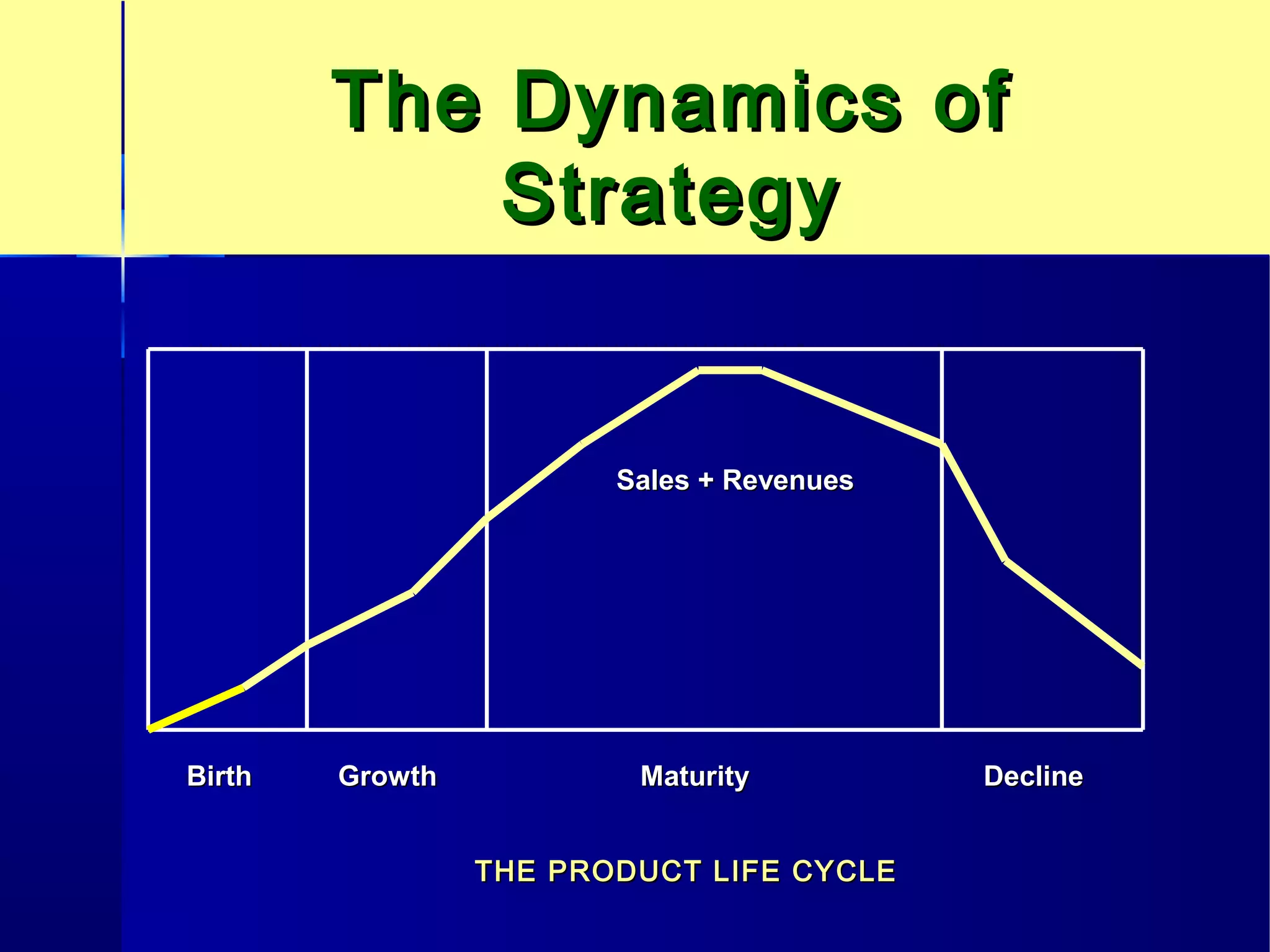
Birth Growth Maturity DeclineBirth Growth Maturity Decline
Sales + RevenuesSales + Revenues
THE PRODUCT LIFE CYCLETHE PRODUCT LIFE CYCLE
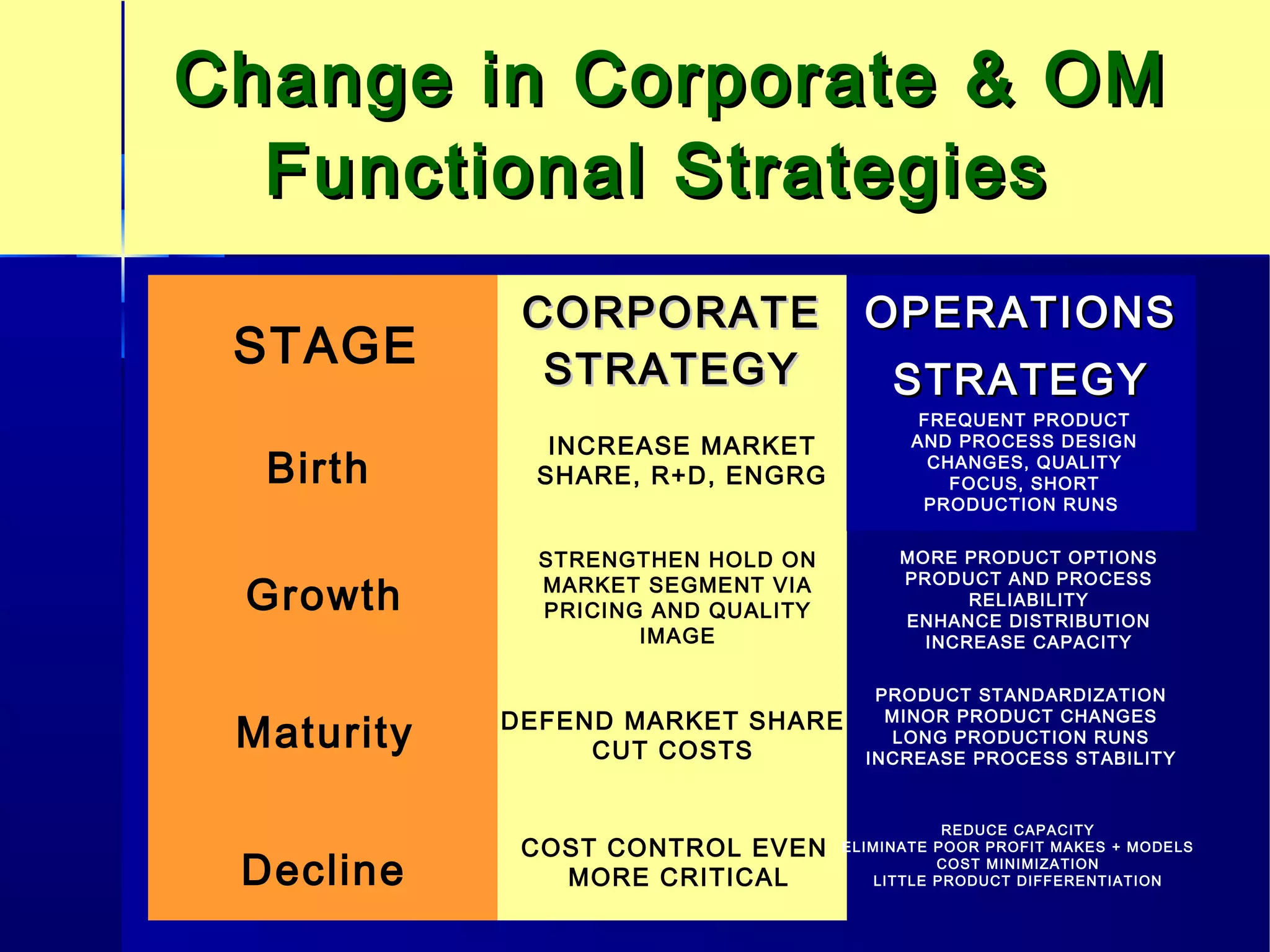
Change in Corporate & OMChange in Corporate & OM
Functional StrategiesFunctional Strategies
CORPORATECORPORATE
STRATEGYSTRATEGY
OPERATIONSOPERATIONS
STRATEGYSTRATEGY
STAGE
Birth
Growth
Maturity
Decline
INCREASE MARKET
SHARE, R+D, ENGRG
FREQUENT PRODUCT
AND PROCESS DESIGN
CHANGES, QUALITY
FOCUS, SHORT
PRODUCTION RUNS
STRENGTHEN HOLD ON
MARKET SEGMENT VIA
PRICING AND QUALITY
IMAGE
MORE PRODUCT OPTIONS
PRODUCT AND PROCESS
RELIABILITY
ENHANCE DISTRIBUTION
INCREASE CAPACITY
DEFEND MARKET SHARE
CUT COSTS
PRODUCT STANDARDIZATION
MINOR PRODUCT CHANGES
LONG PRODUCTION RUNS
INCREASE PROCESS STABILITY
COST CONTROL EVEN
MORE CRITICAL
REDUCE CAPACITY
ELIMINATE POOR PROFIT MAKES + MODELS
COST MINIMIZATION
LITTLE PRODUCT DIFFERENTIATION
INTRODUCTION TOINTRODUCTION TO
OPERATIONSOPERATIONS
MANAGEMENTMANAGEMENT
pplied Management Science for Decision Making, 1e © 2012 Pearson Prentice-Hall, Inc. Philip A. Vaccaro , Ppplied Management Science for Decision Making, 1e © 2012 Pearson Prentice-Hall, Inc. Philip A. Vaccaro , Ph
OPERATIONS and LOGISTICSOPERATIONS and LOGISTICS
MANAGEMENTMANAGEMENT
EPILOGUEEPILOGUE
pplied Management Science for Decision Making, 1e © 2012 Pearson Prentice-Hall, Inc. Philip A. Vaccaro , P
What You Have SeenWhat You Have Seen
• Decision Theory
• Basic Simulation
• Queuing Theory
• Manufacturing Processes
What You Have SeenWhat You Have Seen
• Service Processes
• Transportation Algorithm
• Line Balancing
• Work Measurement
• Time Standards
What You Have SeenWhat You Have Seen
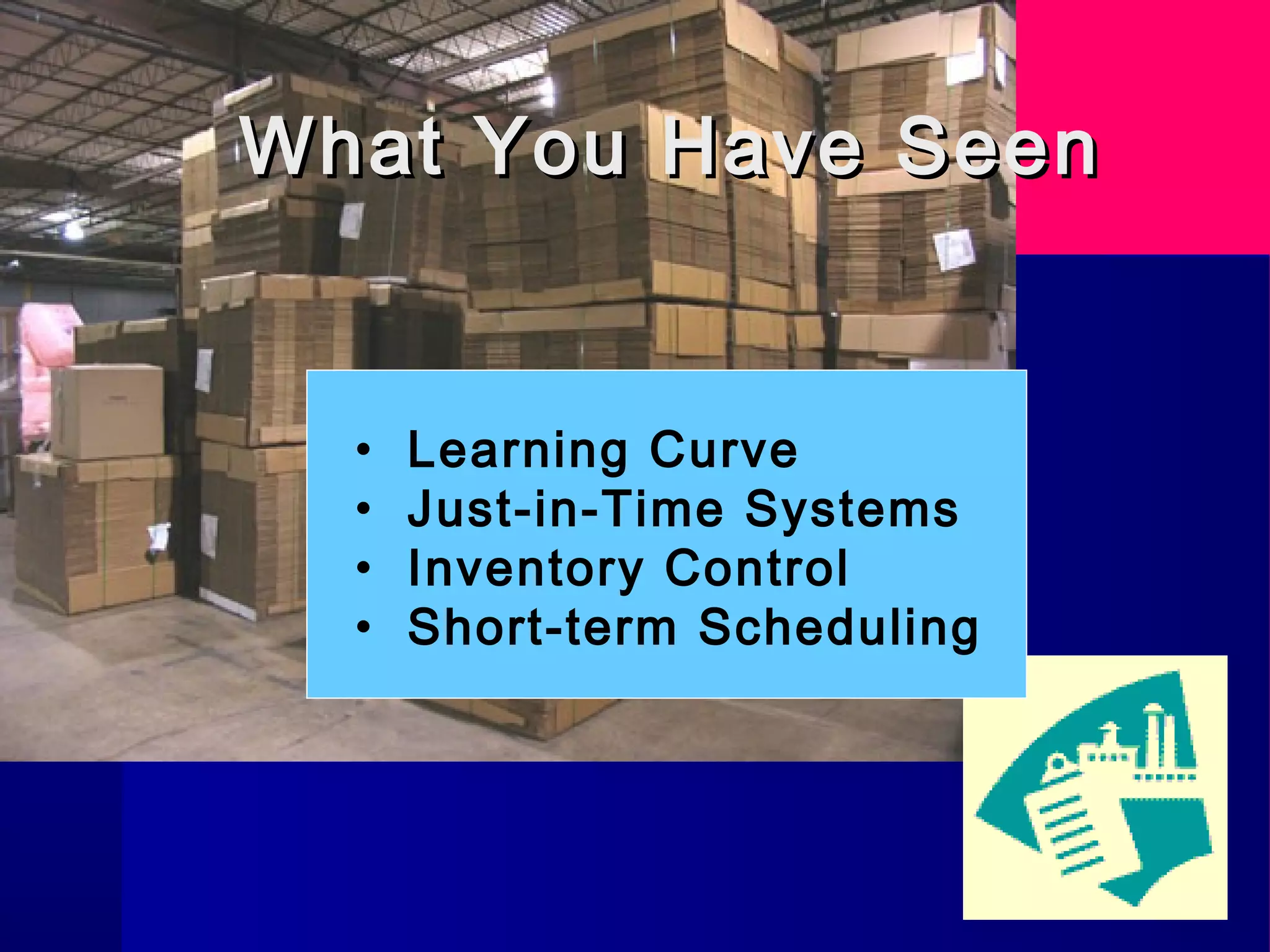
• Learning Curve
• Just-in-Time Systems
• Inventory Control
• Short-term Scheduling
What You Have SeenWhat You Have Seen
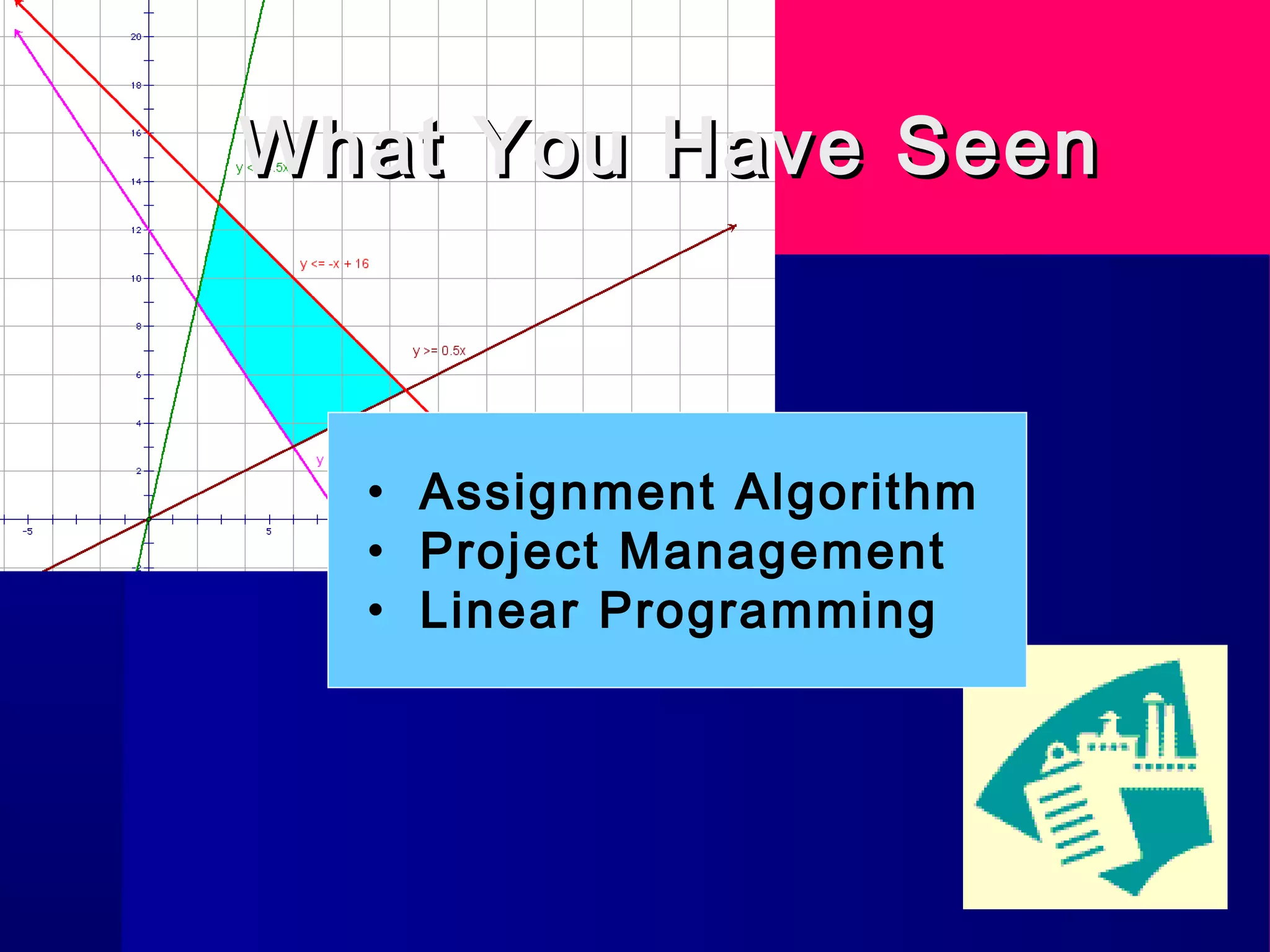
• Assignment Algorithm
• Project Management
• Linear Programming
What You Have NotWhat You Have Not
SeenSeen
• Decoupling Theory
• Outsourcing / Offshoring
• Telecommunications
• Yield Management
What You Have NotWhat You Have Not
SeenSeen
• Data Envelopment Analysis
• Data Mining
• Internet Service Design
• Environmental Management
What You Have NotWhat You Have Not
SeenSeen
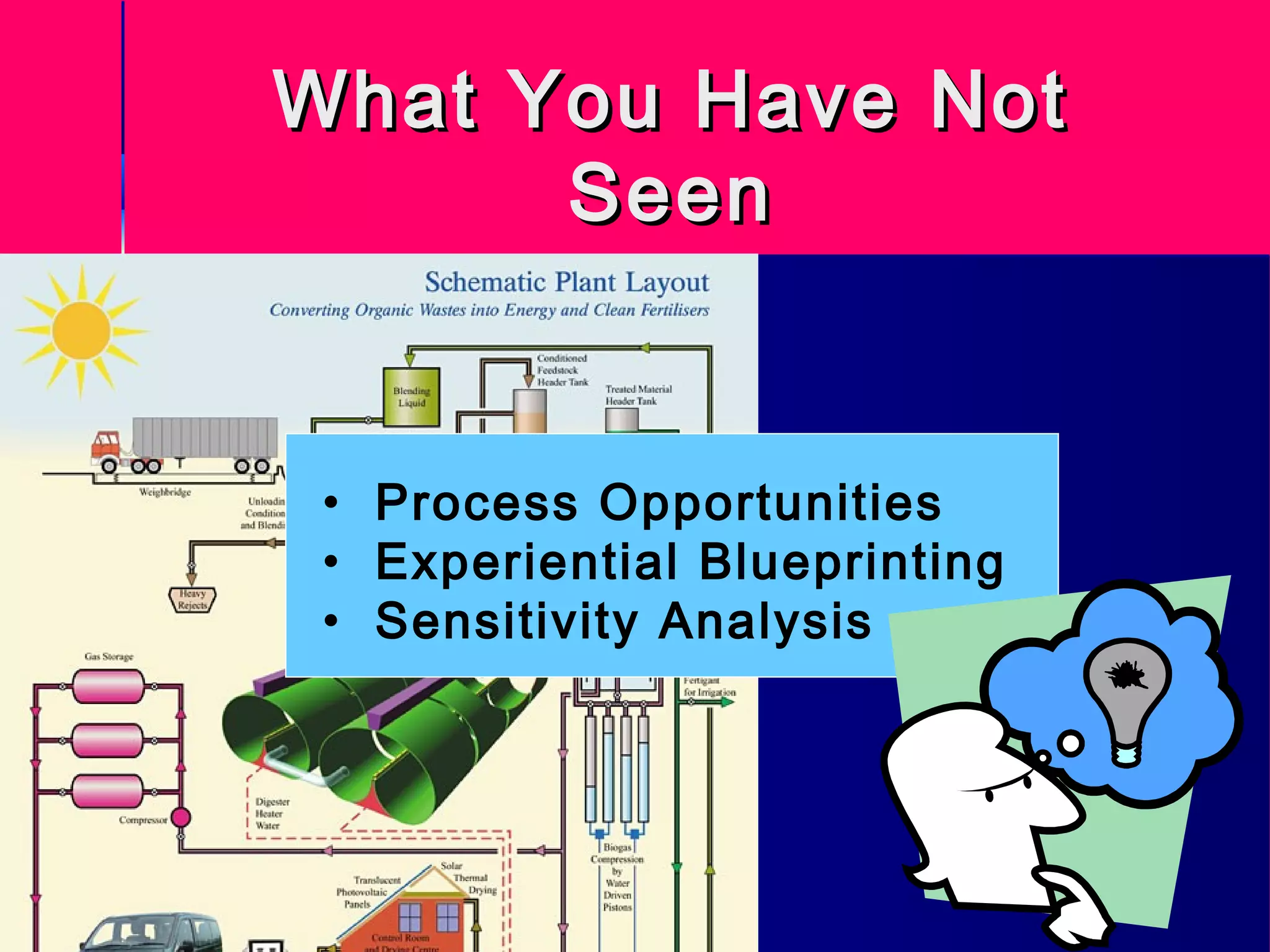
• Process Opportunities
• Experiential Blueprinting
• Sensitivity Analysis
What You Have NotWhat You Have Not
SeenSeen
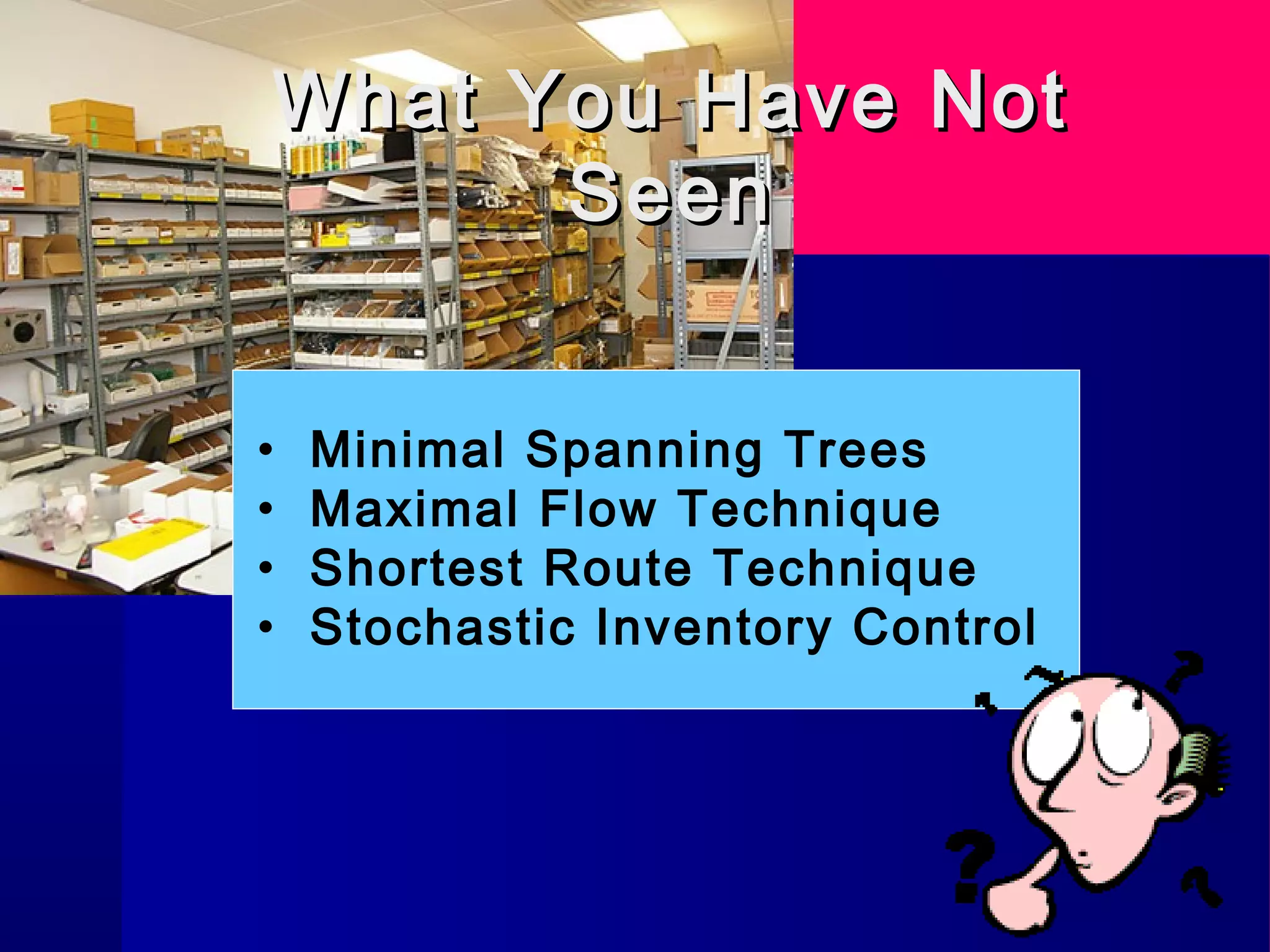
• Minimal Spanning Trees
• Maximal Flow Technique
• Shortest Route Technique
• Stochastic Inventory Control
What You Have NotWhat You Have Not
SeenSeen
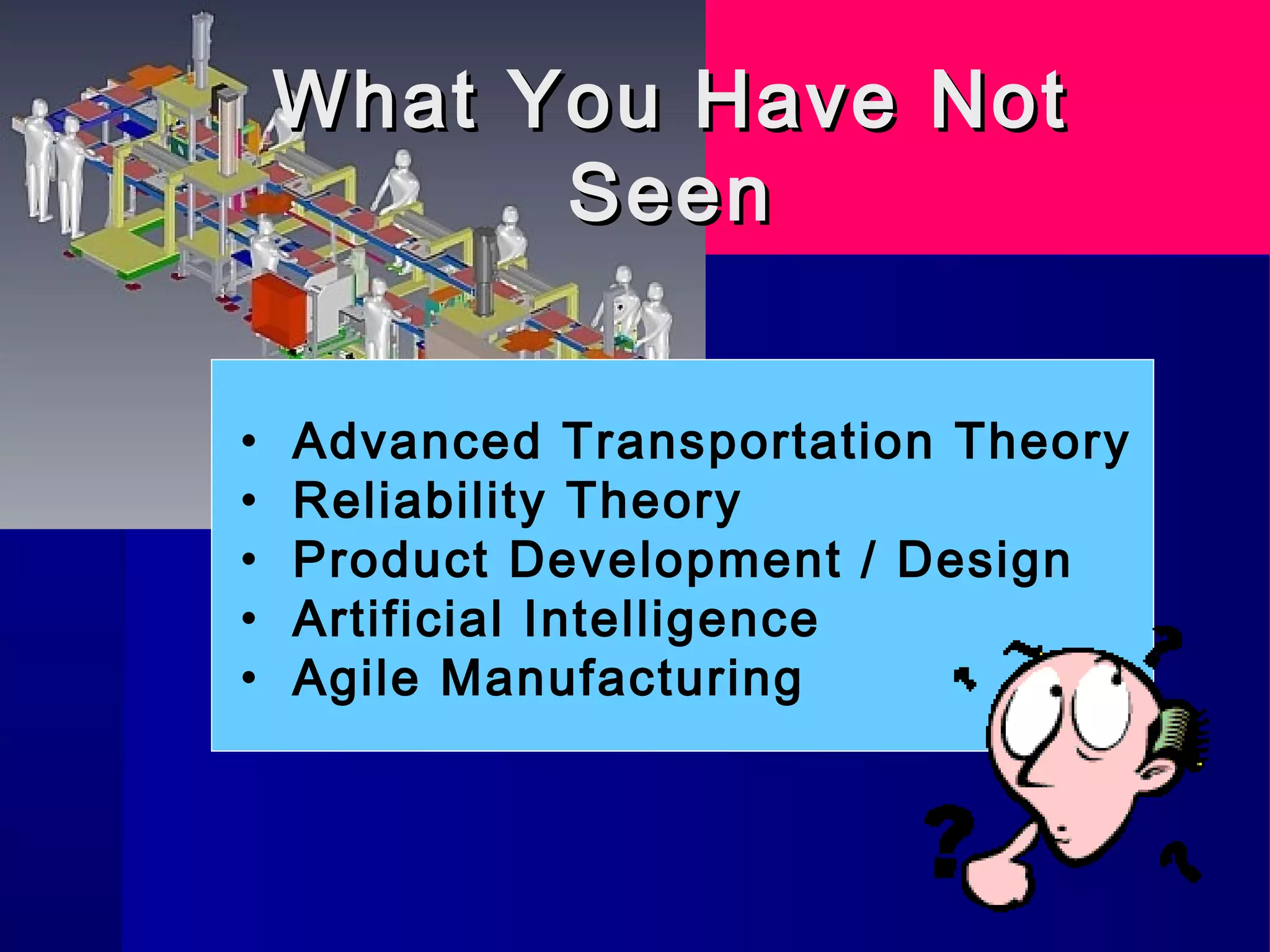
• Advanced Transportation Theory
• Reliability Theory
• Product Development / Design
• Artificial Intelligence
• Agile Manufacturing
What You Have NotWhat You Have Not
SeenSeen
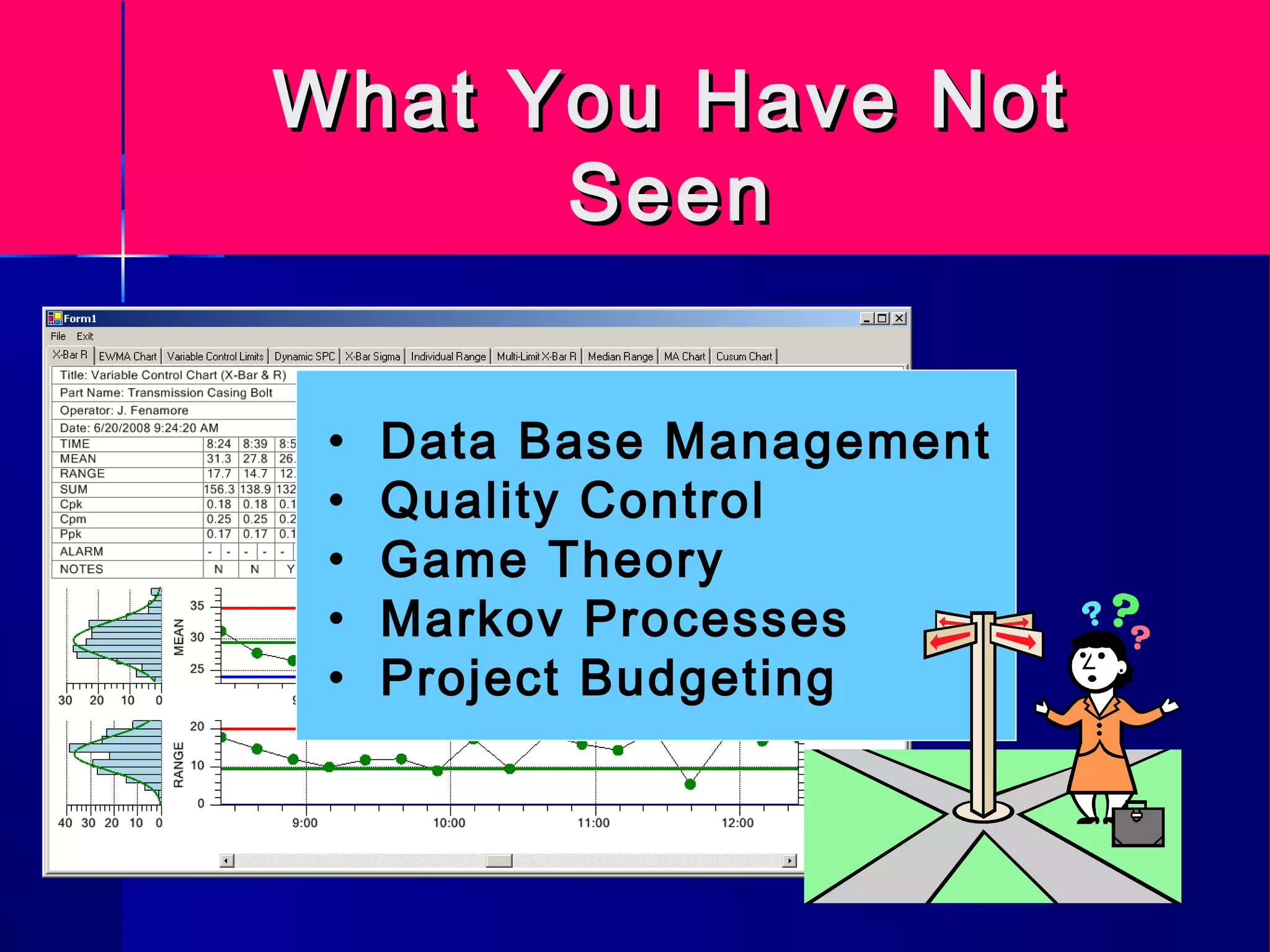
• Data Base Management
• Quality Control
• Game Theory
• Markov Processes
• Project Budgeting
What You Have NotWhat You Have Not
SeenSeen
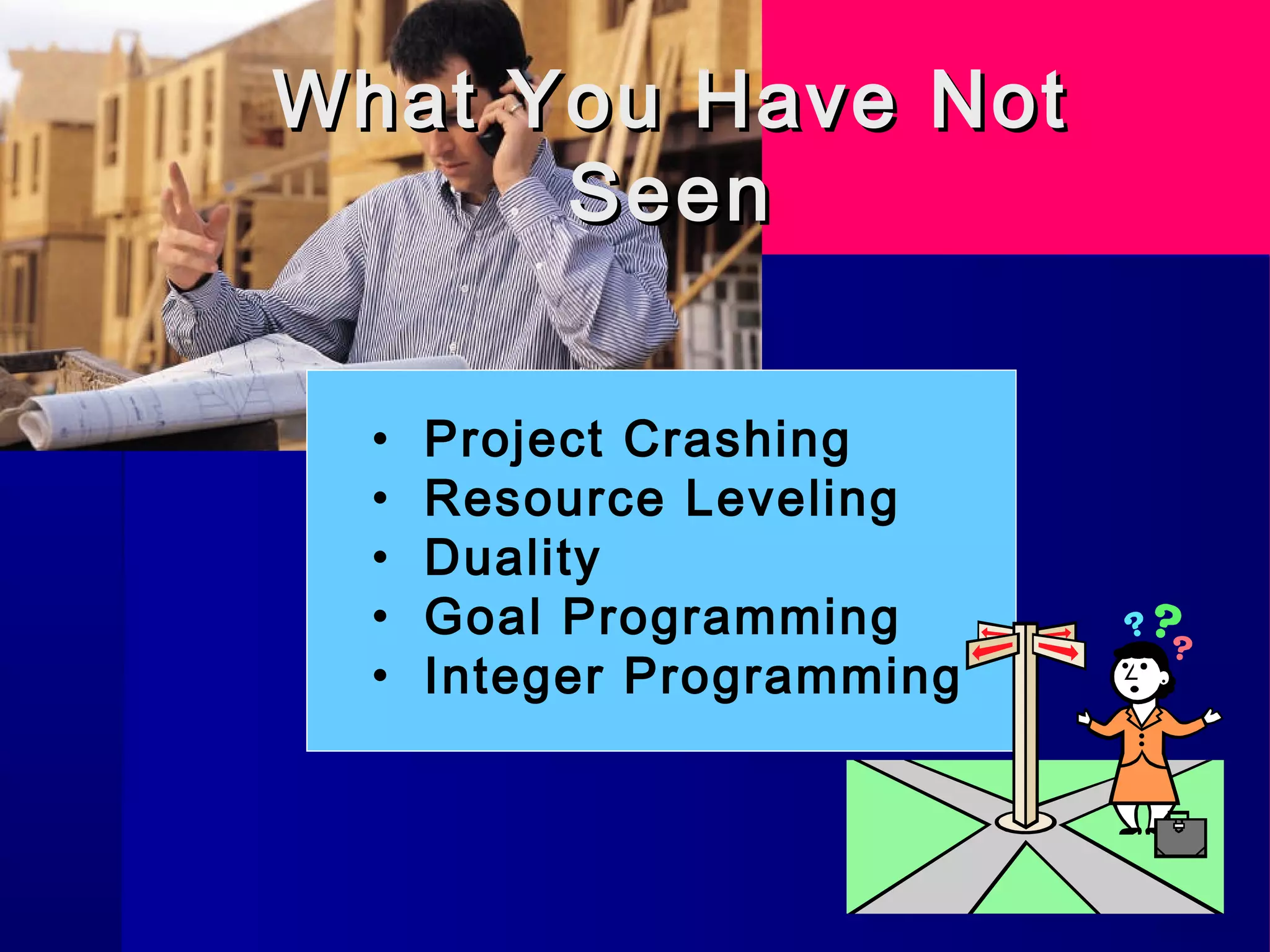
• Project Crashing
• Resource Leveling
• Duality
• Goal Programming
• Integer Programming
What You Have NotWhat You Have Not
SeenSeen
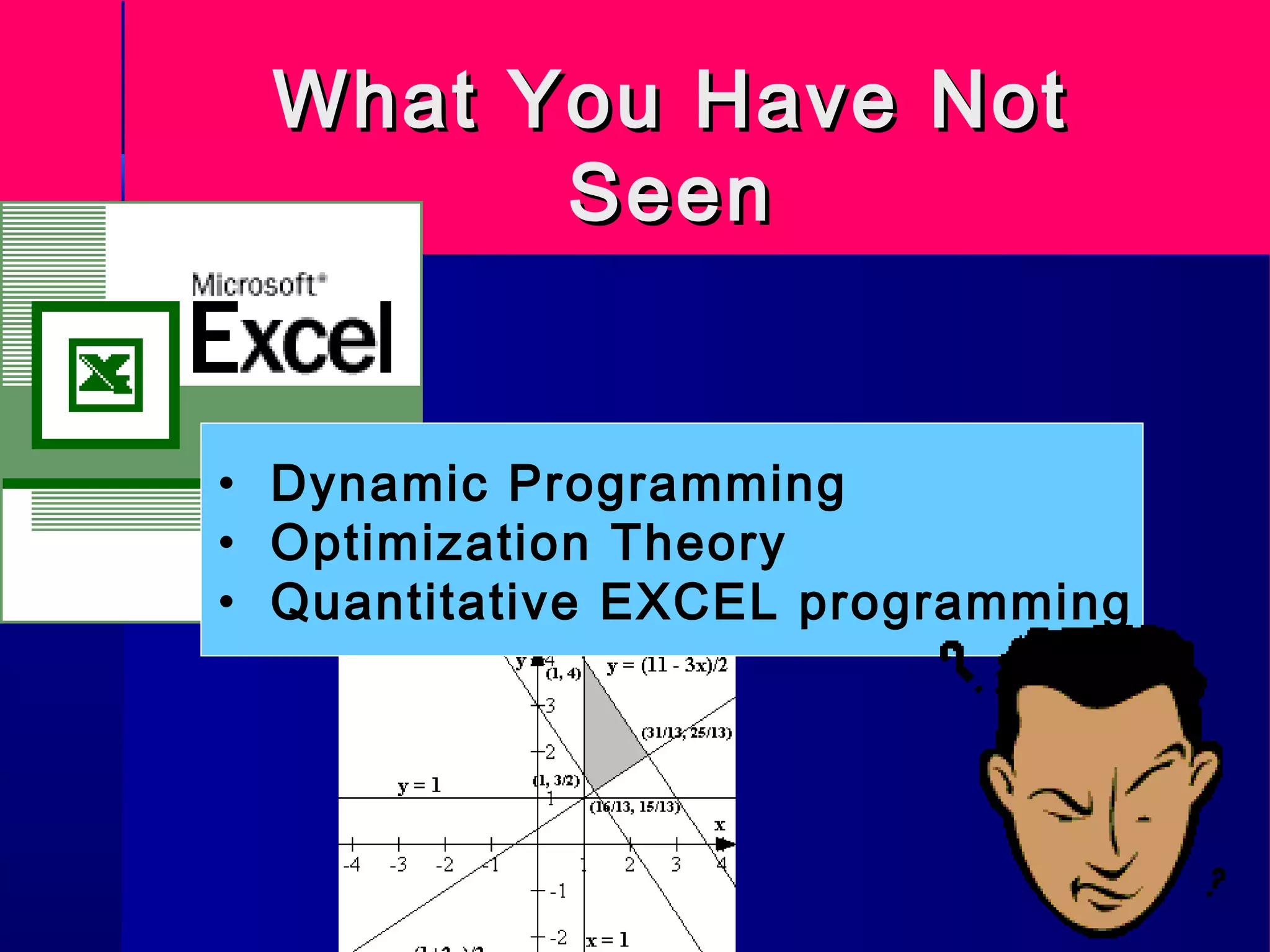
• Dynamic Programming
• Optimization Theory
• Quantitative EXCEL programming
What You Have NotWhat You Have Not
SeenSeen
• Survey Information
• Utility Theory
• Complex Simulation
• Service Systems Theory
What You Have NotWhat You Have Not
SeenSeen
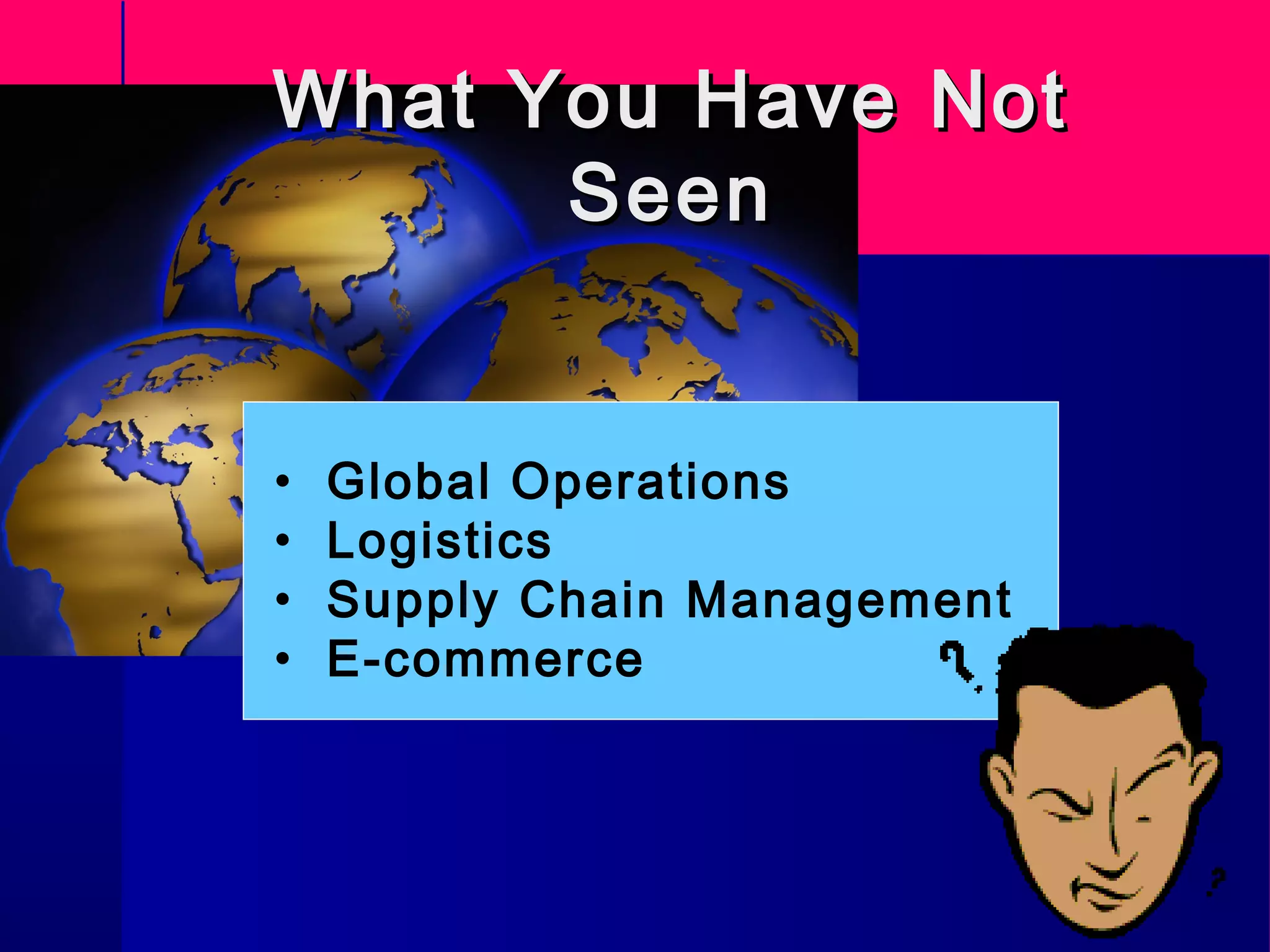
• Global Operations
• Logistics
• Supply Chain Management
• E-commerce
What You Have NotWhat You Have Not
SeenSeen
• Maintenance & Reliability Theory
• Mathematical Modeling
• Materials Requirements Planning
What You Have NotWhat You Have Not
SeenSeen
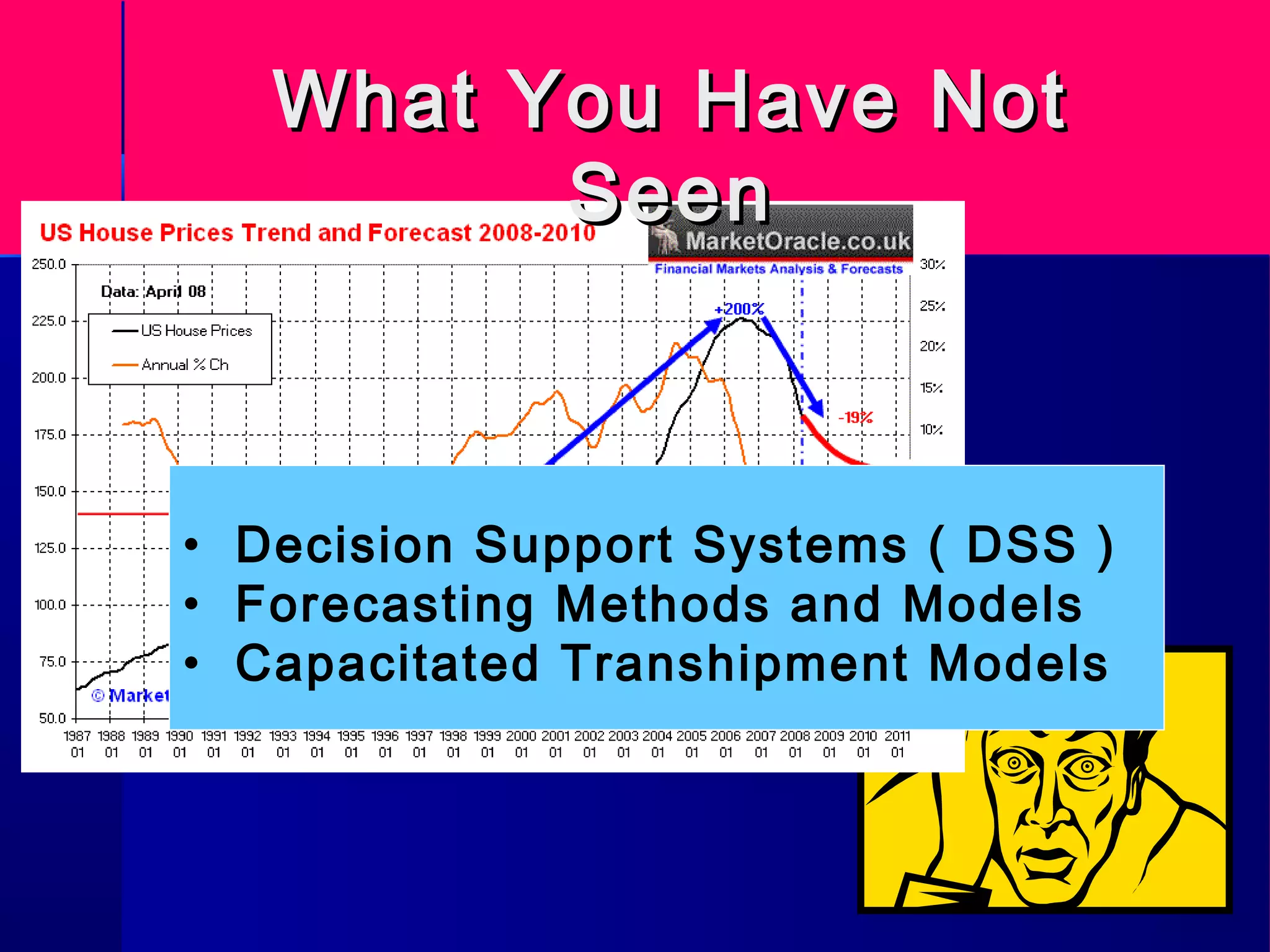
• Decision Support Systems ( DSS )
• Forecasting Methods and Models
• Capacitated Transhipment Models
What You Have NotWhat You Have Not
SeenSeen
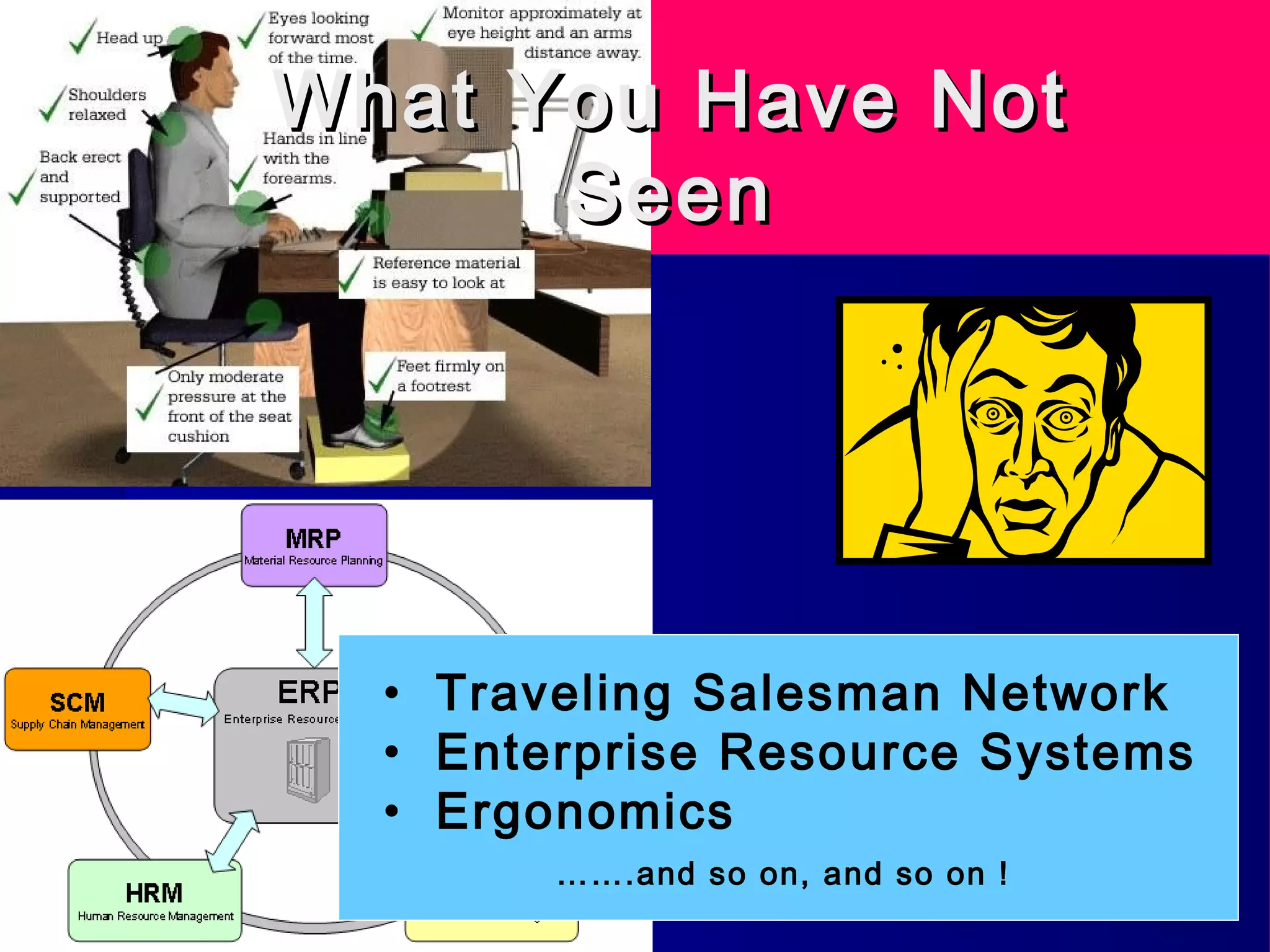
• Traveling Salesman Network
• Enterprise Resource Systems
• Ergonomics
…….and so on, and so on !
Solutions to the DilemmaSolutions to the Dilemma
APPLY YOUR
DEGREE CREDITS
TOWARD A
2nd
DEGREE
IN
ODS or MIS
Solutions to the DilemmaSolutions to the Dilemma
 Earn an MBA or MSEarn an MBA or MS
in:in:
- Decision Sciences- Decision Sciences
- Operations Research- Operations Research
- Operations- Operations
ManagementManagement
- Logistics- Logistics
- Materials ManagementMaterials Management
- TransportationTransportation
- Management ScienceManagement Science
- Decision Support SystemsDecision Support Systems
- Industrial engineering- Industrial engineering
Solutions to the DilemmaSolutions to the Dilemma
 Earn a certificate or certification in:
• Supply chain management
• Quality control
• Integrated resource management
• Manufacturing management
…..and many more !
Operations and LogisticsOperations and Logistics
ManagementManagement
Thank you !
Come again !
pplied Management Science for Decision Making, 1e © 2012 Pearson Prentice-Hall, Inc. Philip A. Vaccaro , Ppplied Management Science for Decision Making, 1e © 2012 Pearson Prentice-Hall, Inc. Philip A. Vaccaro , P

Introduction to operations and logistics management

  • 1.
    OPERATIONS and LOGISTICSOPERATIONSand LOGISTICS MANAGEMENTMANAGEMENT  IntroductionIntroduction  ImportanceImportance  ScopeScope  TrendsTrends  CareersCareers  Course OverviewCourse Overview plied Management Science for Decision Making, 1e © 2012 Pearson Prentice-Hall, Inc. Philip A. Vaccaro, Ph
  • 2.
    Operations ManagementOperations Management Thecompetent and adept management of complex systems in the service, non- profit, manufacturing, and government sectors via the effective and efficient utilization of time, labor, money, and materials in the generation of goods and/or services. DEFINITION
  • 3.
    OverviewOverview Operations Management plansfor, and creates the competitive advantagescompetitive advantages that all businesses need for fueling profitable growth. As a result, OM is the most critical of the business functions. Studying OM means studying modern planning, decision-making and management methods in all functional areas of an organization, including strategic and tactical planning, products and services development, product and project management, process and supply chain management, and more.
  • 4.
    Why Study OM?WhyStudy OM? MARKETINGMARKETING FINANCEFINANCE All firms market (sell) , finance (account), and produce (operate) The Strategic Triad I. Operations Management is one of the three major functions of any organization……and they are integrally related. THE STRATEGIC TRIAD PRODUCTIONPRODUCTION
  • 5.
    Why Study OM?WhyStudy OM? II. Operations Management shows us how goods and services are generated. Consequently, it is the……… foundation of all business!foundation of all business!
  • 6.
    Why Study OM?WhyStudy OM? III. Operations Management shows us what OM managers do. This enables us to learn the skills, techniques, and models needed to practice 21st century management, and to also explore the lucrative career oppor- tunities in OM.
  • 7.
    Why Study OM?WhyStudy OM?  Manufacturing activity  Warehousing  Distribution  Inventories  Research and Development  Maintenance  Facilities and Equipment  Worker training  Cost and Quality Control  Planning and Scheduling IV. Operations Management represents as much as 70% of the operating budget of most firms due to:
  • 8.
    Why Study OM?WhyStudy OM? V. Operations Management, by virtue of its huge collective budget, provides a major opportunity for the firm to improve its profitability. In fact, OM has become the last resort for most firms that have exhausted the potential of marketing, finance, and general management.
  • 9.
    Why Study OM?WhyStudy OM? VI. About 40% of allAbout 40% of all jobs in the United Statesjobs in the United States are inare in Operations ManagementOperations Management.. Exposure to the following disciplines willExposure to the following disciplines will enhance one’s job prospects:enhance one’s job prospects:  Operations research  Statistics  Information systems  Economics  Logistics / Transportation  Mathematics  Accounting / Finance  Computer science  Engineering  Manufacturing
  • 10.
    What OM ManagersDoWhat OM Managers Do  Supervise skilled trade workers & technicians.  Manage the production and technical operations.  Integrate new technology into manufacturing and service processes.
  • 11.
    What OM ManagersDoWhat OM Managers Do  Develop, monitor, and update measures of efficiency.  Develop, monitor, and change operating plans and schedules.  Control costs and quality.
  • 12.
    What OM ManagersDoWhat OM Managers Do  Evaluate and improve the existing operating system in terms of productivity and customer responsiveness.  Translate improved operating systems into competitive ad- vantage in the marketplace.
  • 13.
    OM Necessary SkillsOMNecessary Skills  Keen understanding of people and processes.  Ability to solve problems in multi-disciplinary teams.  Strong leadership/coordinating ability.  Strong analytical and problem-solving skills.  Strong interpersonal communication skills.  Strong background in mathematics.  Strong background in computer programming.  Proficiency in one or more foreign languages.  Graduate degree in the field or a related field.
  • 14.
    Exciting New Trendsin OMExciting New Trends in OM CAUSESCAUSES FUTUREFUTURE Global FocusGlobal Focus Just-in-TimeJust-in-Time ShipmentsShipments Low cost, reliable global communication and transport networks Cost of capital puts pressure on the reduction of inventory investment
  • 15.
    Exciting New Trendsin OMExciting New Trends in OM CAUSESCAUSES FUTUREFUTURE Quality emphasis requires that suppliers be engaged in product improvement Shorter product life cycles, computer-aided design, international collaboration and rapid communication Supply ChainSupply Chain PartnersPartners Rapid ProductRapid Product DevelopmentDevelopment
  • 16.
    Exciting New Trendsin OMExciting New Trends in OM CAUSESCAUSES FUTUREFUTURE Affluence and worldwide markets. Increasingly flexible production processes. Changing socio-culture milieu. An increasingly knowledge and information based society. MassMass CustomizationCustomization EmpoweredEmpowered Employees,Employees, Teams, and LeanTeams, and Lean ProductionProduction
  • 17.
    Career PossibilitiesCareer Possibilities Business Executive  Blue-Collar Supervisor  Construction Manager  Production Manager  Operations Manager  Information System Manager  Materials Manager  Project Manager  Customer Service Mgr  Defense Analyst  Purchasing Agent  Inventory Analyst  Cost Estimator  Systems Analyst  Industrial Engineer  Quality Control Mgr  Time & Motion Analyst  Operations Scheduler  Operations Planner  Process Improvement Manager
  • 18.
    Career Possibilities In corporations,OM managers are responsible for developing new products and services, the strategic and tactical plans, and the execution of, and realization of the plans. Demand for OM concentrators is particularly high in financial services, IT, manufacturing, non-profit, government, education, and health care. Entrepreneurs will find OM knowledge pivotal. The advancement opportunities are superior and may lead all the way to the organization’s senior leadership.
  • 19.
    The Ten CriticalDecisionsThe Ten Critical Decisions OPERATIONS MANAGEMENTOPERATIONS MANAGEMENT 1. SERVICE AND PRODUCT DESIGN  What goods or services should we offer?  How should we design these products?
  • 20.
    The Ten CriticalDecisionsThe Ten Critical Decisions OPERATIONS MANAGEMENTOPERATIONS MANAGEMENT 2. QUALITY MANAGEMENT  Who is responsible for quality?  How do we define the quality we want in our services and products?
  • 21.
    The Ten CriticalDecisionsThe Ten Critical Decisions OPERATIONS MANAGEMENTOPERATIONS MANAGEMENT 3. PROCESS AND CAPACITY DESIGN  What processes will these products require and in what order?  What equipment and technology is necessary for these processes?
  • 22.
    The Ten CriticalDecisionsThe Ten Critical Decisions OPERATIONS MANAGEMENTOPERATIONS MANAGEMENT 4. LOCATION  Where should we put the facility?  On what criteria should we base the location decision?
  • 23.
    The Ten CriticalDecisionsThe Ten Critical Decisions OPERATIONS MANAGEMENTOPERATIONS MANAGEMENT 5. LAYOUT DESIGN  How should we arrange the facility?  How large must the facility be to meet our plan?
  • 24.
    The Ten CriticalDecisionsThe Ten Critical Decisions OPERATIONS MANAGEMENTOPERATIONS MANAGEMENT 6. HUMAN RESOURCES & JOB DESIGN  How do we provide a reasonable work environment?  How much can we expect our employees to produce?
  • 25.
    The Ten CriticalDecisionsThe Ten Critical Decisions OPERATIONS MANAGEMENTOPERATIONS MANAGEMENT 7. SUPPLY CHAIN MANAGEMENT  Should we manufacture or buy a particular component or product?  Who are our good suppliers and how many should we have?
  • 26.
    The Ten CriticalDecisionsThe Ten Critical Decisions OPERATIONS MANAGEMENTOPERATIONS MANAGEMENT 8. INVENTORY CONTROL AND JUST-in-TIME ( JIT )  How much inventory of each item should we have?  When do we reorder or manufacture?
  • 27.
    The Ten CriticalDecisionsThe Ten Critical Decisions OPERATIONS MANAGEMENTOPERATIONS MANAGEMENT 9. INTERMEDIATE, SHORT-TERM, AND PROJECT SCHEDULING  Is subcontracting or outsourcing production a good idea?  Are we better off keeping people on the payroll during slowdowns?  Which job do we perform next?
  • 28.
    The Ten CriticalDecisionsThe Ten Critical Decisions OPERATIONS MANAGEMENTOPERATIONS MANAGEMENT 10. MAINTENANCE  Who is responsible for maintenance?  When do we perform maintenance?  What are the effects of a maintenance program on productivity and efficiency?
  • 29.
    WHY AACSB ACCREDITORSWHYAACSB ACCREDITORS STRENGTHENED OMSTRENGTHENED OM GUIDELINESGUIDELINES “ To sustain a career in business for many years, a business graduate needs an understanding of the analytical foundations and tools that are important for managerial decision-making.”
  • 30.
    WHY AACSB ACCREDITORSWHYAACSB ACCREDITORS STRENGTHENED OMSTRENGTHENED OM GUIDELINESGUIDELINES “ The explosive growth of information technology applications is being driven by management science-based models such as decision analysis, scenario generation, simulation, and optimization ”. * * OPERATIONS MANAGEMENTOPERATIONS MANAGEMENT
  • 31.
    WHY AACSB ACCREDITORSWHYAACSB ACCREDITORS STRENGTHENED OMSTRENGTHENED OM GUIDELINESGUIDELINES “Since management science techniques are driving operations, supply chains, and e-commerce, they constitute a major driver of the entire economy.”
  • 32.
    OPERATIONSOPERATIONS MANAGEMENTMANAGEMENT A Brief HistoryABrief History pplied Management Science for Decision Making, 1e © 2012 Pearson Prentice-Hall, Inc. Philip A. Vaccaro, P
  • 33.
    17761776 Adam Smith developsthe conceptAdam Smith develops the concept ofof specialization of laborspecialization of labor whereinwherein the production process is brokenthe production process is broken down into discrete stages allowingdown into discrete stages allowing specially-designed machines orspecially-designed machines or narrowly-trained workers to performnarrowly-trained workers to perform each step with the least materialeach step with the least material waste and the maximum productivity.waste and the maximum productivity.
  • 34.
    19001900 A Philadelphia engineernamedA Philadelphia engineer named Frederick W. Taylor publishesFrederick W. Taylor publishes The Principles of ScientificThe Principles of Scientific ManagementManagement , a guide to, a guide to increasing the efficiency ofincreasing the efficiency of factory workers.factory workers. His methods, known asHis methods, known as Taylorism, dominate industrialTaylorism, dominate industrial work through much of the 20work through much of the 20thth century, from automobilecentury, from automobile plants to McDonald’s.plants to McDonald’s.
  • 35.
    19001900 Frederick Taylor believedthere were natural laws governing production systems. Once these laws were identified through experimentation and observation, the best way to perform any job or to produce any product could be found. He also called for separation of responsibilities between floor workers and managers. The latter would develop processes, jobs, work methods, and select, train, plan, coordinate, and control.
  • 36.
    19401940 Researchers in Britainand theResearchers in Britain and the United States build mathematicalUnited States build mathematical models of North American shippingmodels of North American shipping lanes. Their goal: to find an optimizedlanes. Their goal: to find an optimized approach for getting convoys safelyapproach for getting convoys safely past Nazi submarines.past Nazi submarines. The result is operations research, aThe result is operations research, a mathematics discipline that now runsmathematics discipline that now runs the logistics and operations of thethe logistics and operations of the modern world.modern world.
  • 37.
    1950s1950s W. Edwards Demingbegins teaching statistical management in Japan. His thesis: Meticulous Control of Quality also leads to lower costs. His methods contribute to startling advances in Japanese manufacturing which later spread throughout the world.
  • 38.
    1980s1980s W. Edward Demingand J.M. Juran stressed that..  Everyone is responsible for quality… not just inspectors.  Product should be made right the first time to avoid rework.  Reliance on workers to make suggestions…not “experts”.  Elimination of any activity or material that does not add value to the product.
  • 39.
    1970s1970s Manufacturing becomesManufacturing becomes thesecond majorthe second major functional area of businessfunctional area of business to utilize the computer.to utilize the computer. Applications includeApplications include machine movementmachine movement control, equipment &control, equipment & material monitoring,material monitoring, and the continuousand the continuous adjustment of settingsadjustment of settings and flow rates.and flow rates.
  • 40.
    Early 21Early 21stst CenturyCentury Databasesystems and all manufacturing equipment and subsystems are integrated into a single system. In theory, this computer-integrated manufacturing system (CIM) would control and coordinate every phase of production from initial customer order, to custom-product design, inventory purchase orders, tooling requirements, production schedules, tracking, quality control monitoring, assembly of information on productivity, profitability, and tool wear, as well as shipping and billing.
  • 41.
    Mission / StrategyRelationshipMission / Strategy Relationship Corporate Mission and GoalsCorporate Mission and Goals Product and Service SelectionsProduct and Service Selections Market Segment SelectionsMarket Segment Selections Competitive Advantage FactorsCompetitive Advantage Factors Policy ConstraintsPolicy Constraints Functional StrategiesFunctional Strategies Operations,Operations, Marketing, FinanceMarketing, Finance Strategy ImplementationStrategy Implementation andand Performance MeasurementPerformance Measurement Corporate StrategyCorporate Strategy External FactorsExternal Factors Internal FactorsInternal Factors Data InputData Input andand FeedbackFeedback
  • 42.
    Functional StrategiesFunctional Strategies Corporatestrategy dictates the individual strategies of the firm’s three functional units: marketing, finance, and operations. The operations functional strategyoperations functional strategy should identify tasks related to the planning, de- sign, and operation of the production con- version system.
  • 43.
    Operations FunctionalOperations Functional StrategyStrategy It must delineate the tasks that the operations function must do well in order to support and achieve the corporate strategy.  Almost any operations task can be used to sup- port a firm’s strategy but most firms can compete very effectively by emphasizing one or two.  The operations functional strategy should be con- sistent with the marketing and finance strategies, as well.
  • 44.
    Operations FunctionalOperations Functional StrategyStrategy Theten critical decisionsten critical decisions of operations management developed in chapter one provide an excellent check- list for identifying the particular tasks that an opera- tions functional strategy must perform in supporting and achieving the firm’s corporate strategy.
  • 45.
    Operations FunctionalOperations Functional StrategyChecklistStrategy Checklist 1. QUALITYQUALITY - customer expectations- customer expectations - quality systems design- quality systems design - quality measures and standards- quality measures and standards 2.2. PRODUCTPRODUCT - customized- customized - standardized- standardized
  • 46.
    Operations FunctionalOperations Functional StrategyChecklistStrategy Checklist 3. SUPPLY CHAINSUPPLY CHAIN - sole or multiple vendors- sole or multiple vendors - type of distribution system- type of distribution system 4.4. LABORLABOR - specialized skills- specialized skills - multiple skills- multiple skills
  • 47.
    Operations FunctionalOperations Functional StrategyChecklistStrategy Checklist 5. MAINTENANCEMAINTENANCE - “as needed”- “as needed” - preventitive- preventitive 6.6. LAYOUTLAYOUT - assembly line- assembly line - work cells- work cells - project- project
  • 48.
    Operations FunctionalOperations Functional StrategyChecklistStrategy Checklist 7. INVENTORYINVENTORY - ordering policy- ordering policy - stockage levels- stockage levels - type of system- type of system 8.8. PROCESSPROCESS - scale of operation- scale of operation - choice of technology- choice of technology - in-house production- in-house production - outsourcing- outsourcing
  • 49.
    Operations FunctionalOperations Functional StrategyChecklistStrategy Checklist 9. SCHEDULINGSCHEDULING - stable- stable - variable- variable 10.10. LOCATIONLOCATION - near supplier- near supplier - near customer- near customer
  • 50.
    The Dynamics ofTheDynamics of StrategyStrategy Strategies change over time due to two reasons: 1. changes within the organization. 2. changes in the environment. FOR EXAMPLE, CHANGES IN TECHNOLOGY, PRODUCT, OR PROCESS AFFECTFOR EXAMPLE, CHANGES IN TECHNOLOGY, PRODUCT, OR PROCESS AFFECT A FIRM’S STRENGTHS AND WEAKNESSES, AND THEREFORE ITS STRATEGY.A FIRM’S STRENGTHS AND WEAKNESSES, AND THEREFORE ITS STRATEGY.
  • 51.
    The Dynamics ofTheDynamics of StrategyStrategy Birth Growth Maturity DeclineBirth Growth Maturity Decline Sales + RevenuesSales + Revenues THE PRODUCT LIFE CYCLETHE PRODUCT LIFE CYCLE
  • 52.
    Change in Corporate& OMChange in Corporate & OM Functional StrategiesFunctional Strategies CORPORATECORPORATE STRATEGYSTRATEGY OPERATIONSOPERATIONS STRATEGYSTRATEGY STAGE Birth Growth Maturity Decline INCREASE MARKET SHARE, R+D, ENGRG FREQUENT PRODUCT AND PROCESS DESIGN CHANGES, QUALITY FOCUS, SHORT PRODUCTION RUNS STRENGTHEN HOLD ON MARKET SEGMENT VIA PRICING AND QUALITY IMAGE MORE PRODUCT OPTIONS PRODUCT AND PROCESS RELIABILITY ENHANCE DISTRIBUTION INCREASE CAPACITY DEFEND MARKET SHARE CUT COSTS PRODUCT STANDARDIZATION MINOR PRODUCT CHANGES LONG PRODUCTION RUNS INCREASE PROCESS STABILITY COST CONTROL EVEN MORE CRITICAL REDUCE CAPACITY ELIMINATE POOR PROFIT MAKES + MODELS COST MINIMIZATION LITTLE PRODUCT DIFFERENTIATION
  • 53.
    INTRODUCTION TOINTRODUCTION TO OPERATIONSOPERATIONS MANAGEMENTMANAGEMENT ppliedManagement Science for Decision Making, 1e © 2012 Pearson Prentice-Hall, Inc. Philip A. Vaccaro , Ppplied Management Science for Decision Making, 1e © 2012 Pearson Prentice-Hall, Inc. Philip A. Vaccaro , Ph
  • 54.
    OPERATIONS and LOGISTICSOPERATIONSand LOGISTICS MANAGEMENTMANAGEMENT EPILOGUEEPILOGUE pplied Management Science for Decision Making, 1e © 2012 Pearson Prentice-Hall, Inc. Philip A. Vaccaro , P
  • 55.
    What You HaveSeenWhat You Have Seen • Decision Theory • Basic Simulation • Queuing Theory • Manufacturing Processes
  • 56.
    What You HaveSeenWhat You Have Seen • Service Processes • Transportation Algorithm • Line Balancing • Work Measurement • Time Standards
  • 57.
    What You HaveSeenWhat You Have Seen • Learning Curve • Just-in-Time Systems • Inventory Control • Short-term Scheduling
  • 58.
    What You HaveSeenWhat You Have Seen • Assignment Algorithm • Project Management • Linear Programming
  • 59.
    What You HaveNotWhat You Have Not SeenSeen • Decoupling Theory • Outsourcing / Offshoring • Telecommunications • Yield Management
  • 60.
    What You HaveNotWhat You Have Not SeenSeen • Data Envelopment Analysis • Data Mining • Internet Service Design • Environmental Management
  • 61.
    What You HaveNotWhat You Have Not SeenSeen • Process Opportunities • Experiential Blueprinting • Sensitivity Analysis
  • 62.
    What You HaveNotWhat You Have Not SeenSeen • Minimal Spanning Trees • Maximal Flow Technique • Shortest Route Technique • Stochastic Inventory Control
  • 63.
    What You HaveNotWhat You Have Not SeenSeen • Advanced Transportation Theory • Reliability Theory • Product Development / Design • Artificial Intelligence • Agile Manufacturing
  • 64.
    What You HaveNotWhat You Have Not SeenSeen • Data Base Management • Quality Control • Game Theory • Markov Processes • Project Budgeting
  • 65.
    What You HaveNotWhat You Have Not SeenSeen • Project Crashing • Resource Leveling • Duality • Goal Programming • Integer Programming
  • 66.
    What You HaveNotWhat You Have Not SeenSeen • Dynamic Programming • Optimization Theory • Quantitative EXCEL programming
  • 67.
    What You HaveNotWhat You Have Not SeenSeen • Survey Information • Utility Theory • Complex Simulation • Service Systems Theory
  • 68.
    What You HaveNotWhat You Have Not SeenSeen • Global Operations • Logistics • Supply Chain Management • E-commerce
  • 69.
    What You HaveNotWhat You Have Not SeenSeen • Maintenance & Reliability Theory • Mathematical Modeling • Materials Requirements Planning
  • 70.
    What You HaveNotWhat You Have Not SeenSeen • Decision Support Systems ( DSS ) • Forecasting Methods and Models • Capacitated Transhipment Models
  • 71.
    What You HaveNotWhat You Have Not SeenSeen • Traveling Salesman Network • Enterprise Resource Systems • Ergonomics …….and so on, and so on !
  • 72.
    Solutions to theDilemmaSolutions to the Dilemma APPLY YOUR DEGREE CREDITS TOWARD A 2nd DEGREE IN ODS or MIS
  • 73.
    Solutions to theDilemmaSolutions to the Dilemma  Earn an MBA or MSEarn an MBA or MS in:in: - Decision Sciences- Decision Sciences - Operations Research- Operations Research - Operations- Operations ManagementManagement - Logistics- Logistics - Materials ManagementMaterials Management - TransportationTransportation - Management ScienceManagement Science - Decision Support SystemsDecision Support Systems - Industrial engineering- Industrial engineering
  • 74.
    Solutions to theDilemmaSolutions to the Dilemma  Earn a certificate or certification in: • Supply chain management • Quality control • Integrated resource management • Manufacturing management …..and many more !
  • 75.
    Operations and LogisticsOperationsand Logistics ManagementManagement Thank you ! Come again ! pplied Management Science for Decision Making, 1e © 2012 Pearson Prentice-Hall, Inc. Philip A. Vaccaro , Ppplied Management Science for Decision Making, 1e © 2012 Pearson Prentice-Hall, Inc. Philip A. Vaccaro , P