OPERATIONS
MANAGEMENT
FUNDAMENTALS
Definition of Operations
Management
• Management of business (transformation
or value addition) processes
• How to align the processes and manage
resources to develop the appropriate
capabilities to convert inputs to outputs
(transformation process).
Importance of Operations
Management
• During the past couple of decades, competitiveness in
the marketplace has brought the focus on cost, quality
and high service level
• Todays Customer wants a high quality product at a
competitive cost and at the shortest time
• World-class performance by operations in delivering
high-quality, cost-competitive products and services is
essential for survival in today's global economy.
• Therefore, cost saving measures ( lean manufacturing),
improved manufacturing process via automation and
digitization is becoming important which highlights the
important role of Operations
• New Government Initiatives – Make in India initiative
India Infrastructure
Pipeline
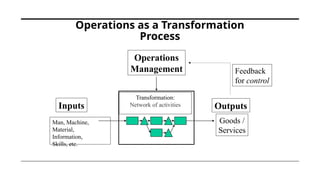
Inputs Outputs
Goods /
Services
Feedback
for control
Transformation:
Network of activities
Man, Machine,
Material,
Information,
Skills, etc.
Operations
Management
Operations as a Transformation
Process
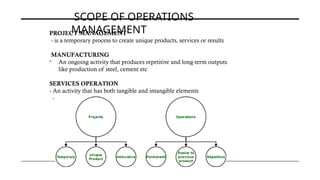
SCOPE OF OPERATIONS
MANAGEMENT
PROJECT MANAGEMENT
- is a temporary process to create unique products, services or results
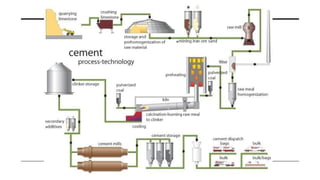
MANUFACTURING
- An ongoing activity that produces repetitive and long-term outputs
like production of steel, cement etc
SERVICES OPERATION
- An activity that has both tangible and intangible elements
-
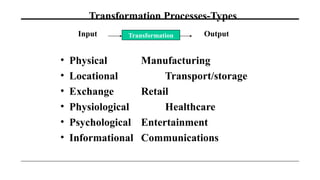
Transformation Processes-Types
• Physical Manufacturing
• Locational Transport/storage
• Exchange Retail
• Physiological Healthcare
• Psychological Entertainment
• Informational Communications
Transformation
Input Output
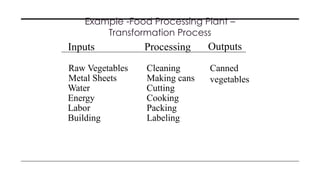
Example -Food Processing Plant –
Transformation Process
Inputs Processing Outputs
Raw Vegetables Cleaning Canned
vegetables
Metal Sheets Making cans
Water Cutting
Energy Cooking
Labor Packing
Building Labeling
Equipment
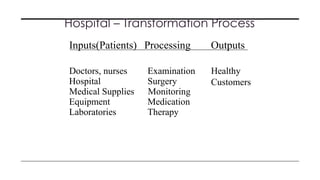
Hospital – Transformation Process
Inputs(Patients) Processing Outputs
Doctors, nurses Examination Healthy
Customers
Hospital Surgery
Medical Supplies Monitoring
Equipment Medication
Laboratories Therapy
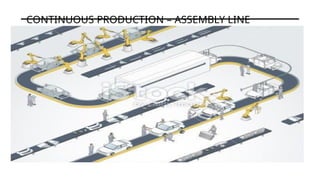
CONTINUOUS PRODUCTION – ASSEMBLY LINE
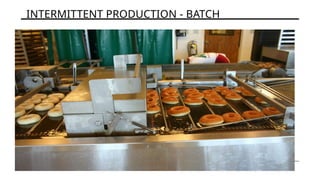
INTERMITTENT PRODUCTION - BATCH
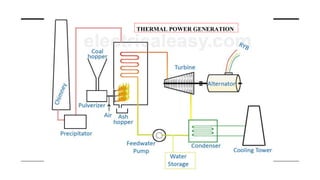
THERMAL POWER GENERATION
Interface between OM and
Marketing
• What operations can do relative to
meeting due dates, product
customization, new product introduction.
• In service industries, marketing and
production take place simultaneously ?
Interface Between OM & Human
Resources
• How jobs are designed?
• Compensation and incentive programs.
• Skills of work force.
• Work Study comprising of Method Study
and Work Measurement
Interface Between OM and
Finance
• Understand inventory management, capacity
utilization and labour standards to develop
accurate cost data, perform audits, and prepare
financial reports.
• Need for capital investments.
• Working Capital Management
• Forecast cash flows.
• Make-or-buy decision.
• Plant expansion and/or relocation.
Interface Between OM & IT
• Application of software for Project Planning,
Monitoring and Control
• Business applications of computers in production
planning & control.
• Application for software for Predictive
Maintenance
• Software for actual operation of the machine
( like CNC Machine, Automatic Welding) and for
Material Handling
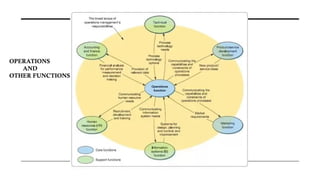
OPERATIONS
AND
OTHER FUNCTIONS
EMERGING ROLE OF OPERATIONS
MANAGER
• Take part in Strategic Decision Making
• Take Decisions regarding outsourcing of business processes
• Act as member of engineering team for new product design and
development
• Take care of issues relating to service operations management
• Implement the environmental and pollution norms
• Act as supply chain manager for forging long term strategic relationship
with suppliers
• Technology management due to JVs with MNCs
• Oversee timely implementation of projects to meet increased competition.
• Man management, leadership role and mentoring.
Challenges before Operations
Management
• During the past couple of decades, competitiveness in
the marketplace has brought the focus on cost, quality
and high service level
• Todays Customer wants a high quality product at a
competitive cost and at the shortest time
• World-class performance by operations in delivering
high-quality, cost-competitive products and services is
essential for survival in today's global economy.
• Therefore cost saving measures ( lean manufacturing),
improved manufacturing process via automation and
digitization is becoming important which highlights the
important role of Operations
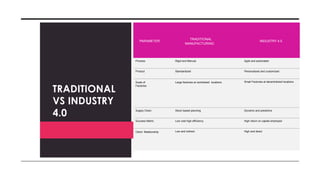
TRADITIONAL
VS INDUSTRY
4.0
PARAMETER
TRADITIONAL
MANUFACTURING
INDUSTRY 4.0
Process Rigid and Manual Agile and automated
Product Standardized Personalized and customized
Scale of
Factories
Large factories at centralized locations Small Factories at decentralized locations
Supply Chain Stock based planning Dynamic and predictive
Success Metric Low cost high efficiency High return on capital employed
Client Relationship Low and indirect High and direct
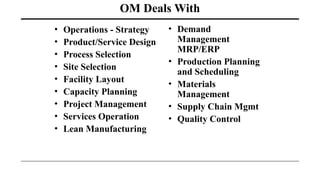
• Operations - Strategy
• Product/Service Design
• Process Selection
• Site Selection
• Facility Layout
• Capacity Planning
• Project Management
• Services Operation
• Lean Manufacturing
• Demand
Management
MRP/ERP
• Production Planning
and Scheduling
• Materials
Management
• Supply Chain Mgmt
• Quality Control
OM Deals With
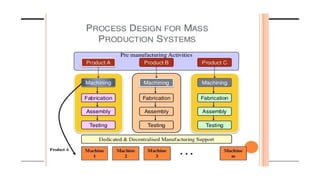
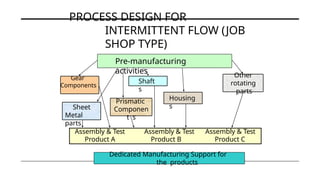
Pre-manufacturing
activities
Gear
Components
Prismatic
Componen
t s
Other
rotating
parts
Sheet
Metal
parts
Housing
s
Shaft
s
Assembly & Test Assembly & Test Assembly & Test
Product A Product B Product C
Dedicated Manufacturing Support for
the products
PROCESS DESIGN FOR
INTERMITTENT FLOW (JOB
SHOP TYPE)
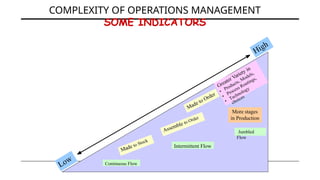
COMPLEXITY OF OPERATIONS MANAGEMENT
SOME INDICATORS
Greater Variety in
•
•
•
Products, Models,
Process Routings,
Technology
choices
High
Low
Intermittent Flow
Continuous Flow
Made to Order
Assemble to Order
Made to Stock
More stages
in Production
Jumbled
Flow
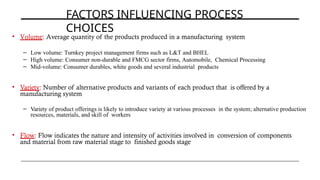
FACTORS INFLUENCING PROCESS
CHOICES
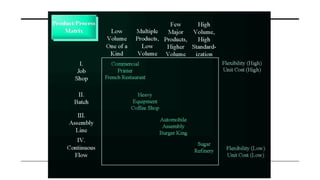
• Volume: Average quantity of the products produced in a manufacturing system
– Low volume: Turnkey project management firms such as L&T and BHEL
– High volume: Consumer non-durable and FMCG sector firms, Automobile, Chemical Processing
– Mid-volume: Consumer durables, white goods and several industrial products
• Variety: Number of alternative products and variants of each product that is offered by a
manufacturing system
– Variety of product offerings is likely to introduce variety at various processes in the system; alternative production
resources, materials, and skill of workers
• Flow: Flow indicates the nature and intensity of activities involved in conversion of components
and material from raw material stage to finished goods stage
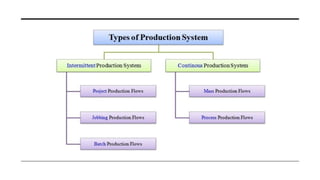
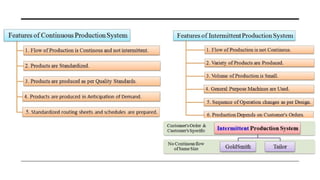
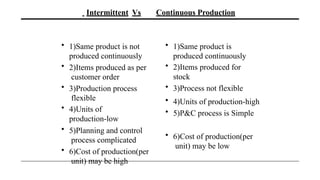
Intermittent Vs Continuous Production
• 1)Same product is not
produced continuously
• 2)Items produced as per
customer order
• 3)Production process
flexible
• 4)Units of
production-low
• 5)Planning and control
process complicated
• 6)Cost of production(per
unit) may be high
• 1)Same product is
produced continuously
• 2)Items produced for
stock
• 3)Process not flexible
• 4)Units of production-high
• 5)P&C process is Simple
• 6)Cost of production(per
unit) may be low
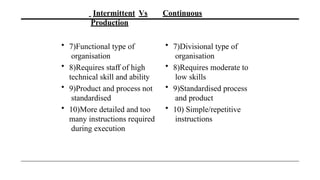
Intermittent Vs Continuous
Production
• 7)Functional type of
organisation
• 8)Requires staff of high
technical skill and ability
• 9)Product and process not
standardised
• 10)More detailed and too
many instructions required
during execution
• 7)Divisional type of
organisation
• 8)Requires moderate to
low skills
• 9)Standardised process
and product
• 10) Simple/repetitive
instructions
STRATEGIC ROLE AND OBJECTIVES OF OM
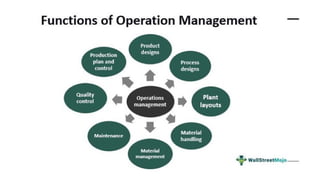
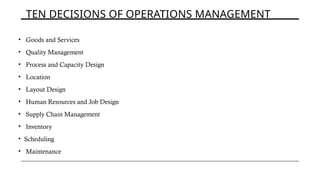
TEN DECISIONS OF OPERATIONS MANAGEMENT
• Goods and Services
• Quality Management
• Process and Capacity Design
• Location
• Layout Design
• Human Resources and Job Design
• Supply Chain Management
• Inventory
• Scheduling
• Maintenance
OPERATIONS STRATEGY
• Operations Strategy should be in line with vision and mission of the firm
• For gaining competitive advantage firm should compete on
- Cost
- Speed
- Quality
- Flexibility
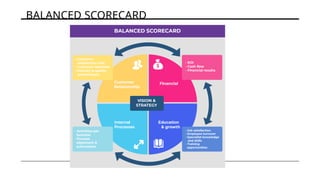
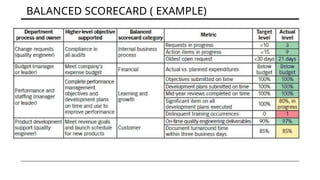
BALANCED SCORECARD
 IS A STRATEGIC MANAGEMENT PERFORMANCE MATRIX THAT HELPS COMPANIES
IDENTIFY AND IMPROVE ITS PERFORMANCE
 MEASURES PAST PERFORMANCE DATA AND PROVIDES ORGANIZATION WITH FEEDBACK
AND HOW TO MAKE BETTER DECISIONS IN FUTURE
 INTRODUCED BY KAPLAN AND NORTON OF HBS
 PERSPECTIVE OF BALANCED SCORECARD
- Financial Perspective
- Customer Perspective
- Internal Business Process Perspective
- Organizational Capacity Perspective
BALANCED SCORECARD
BALANCED SCORECARD ( EXAMPLE)
BALANCED SCORECARD - ADVANTAGES
• Presents complete view of Business performance
• Relevant not just for financial stakeholders
• Encourages long term strategy

Lecture 1 Operations giving fundamentals

  • 1.
  • 2.
    Definition of Operations Management •Management of business (transformation or value addition) processes • How to align the processes and manage resources to develop the appropriate capabilities to convert inputs to outputs (transformation process).
  • 3.
    Importance of Operations Management •During the past couple of decades, competitiveness in the marketplace has brought the focus on cost, quality and high service level • Todays Customer wants a high quality product at a competitive cost and at the shortest time • World-class performance by operations in delivering high-quality, cost-competitive products and services is essential for survival in today's global economy. • Therefore, cost saving measures ( lean manufacturing), improved manufacturing process via automation and digitization is becoming important which highlights the important role of Operations • New Government Initiatives – Make in India initiative India Infrastructure Pipeline
  • 4.
    Inputs Outputs Goods / Services Feedback forcontrol Transformation: Network of activities Man, Machine, Material, Information, Skills, etc. Operations Management Operations as a Transformation Process
  • 5.
    SCOPE OF OPERATIONS MANAGEMENT PROJECTMANAGEMENT - is a temporary process to create unique products, services or results MANUFACTURING - An ongoing activity that produces repetitive and long-term outputs like production of steel, cement etc SERVICES OPERATION - An activity that has both tangible and intangible elements -
  • 6.
    Transformation Processes-Types • PhysicalManufacturing • Locational Transport/storage • Exchange Retail • Physiological Healthcare • Psychological Entertainment • Informational Communications Transformation Input Output
  • 7.
    Example -Food ProcessingPlant – Transformation Process Inputs Processing Outputs Raw Vegetables Cleaning Canned vegetables Metal Sheets Making cans Water Cutting Energy Cooking Labor Packing Building Labeling Equipment
  • 8.
    Hospital – TransformationProcess Inputs(Patients) Processing Outputs Doctors, nurses Examination Healthy Customers Hospital Surgery Medical Supplies Monitoring Equipment Medication Laboratories Therapy
  • 11.
  • 12.
  • 13.
  • 17.
    Interface between OMand Marketing • What operations can do relative to meeting due dates, product customization, new product introduction. • In service industries, marketing and production take place simultaneously ?
  • 18.
    Interface Between OM& Human Resources • How jobs are designed? • Compensation and incentive programs. • Skills of work force. • Work Study comprising of Method Study and Work Measurement
  • 19.
    Interface Between OMand Finance • Understand inventory management, capacity utilization and labour standards to develop accurate cost data, perform audits, and prepare financial reports. • Need for capital investments. • Working Capital Management • Forecast cash flows. • Make-or-buy decision. • Plant expansion and/or relocation.
  • 20.
    Interface Between OM& IT • Application of software for Project Planning, Monitoring and Control • Business applications of computers in production planning & control. • Application for software for Predictive Maintenance • Software for actual operation of the machine ( like CNC Machine, Automatic Welding) and for Material Handling
  • 21.
  • 22.
    EMERGING ROLE OFOPERATIONS MANAGER • Take part in Strategic Decision Making • Take Decisions regarding outsourcing of business processes • Act as member of engineering team for new product design and development • Take care of issues relating to service operations management • Implement the environmental and pollution norms • Act as supply chain manager for forging long term strategic relationship with suppliers • Technology management due to JVs with MNCs • Oversee timely implementation of projects to meet increased competition. • Man management, leadership role and mentoring.
  • 23.
    Challenges before Operations Management •During the past couple of decades, competitiveness in the marketplace has brought the focus on cost, quality and high service level • Todays Customer wants a high quality product at a competitive cost and at the shortest time • World-class performance by operations in delivering high-quality, cost-competitive products and services is essential for survival in today's global economy. • Therefore cost saving measures ( lean manufacturing), improved manufacturing process via automation and digitization is becoming important which highlights the important role of Operations
  • 25.
    TRADITIONAL VS INDUSTRY 4.0 PARAMETER TRADITIONAL MANUFACTURING INDUSTRY 4.0 ProcessRigid and Manual Agile and automated Product Standardized Personalized and customized Scale of Factories Large factories at centralized locations Small Factories at decentralized locations Supply Chain Stock based planning Dynamic and predictive Success Metric Low cost high efficiency High return on capital employed Client Relationship Low and indirect High and direct
  • 26.
    • Operations -Strategy • Product/Service Design • Process Selection • Site Selection • Facility Layout • Capacity Planning • Project Management • Services Operation • Lean Manufacturing • Demand Management MRP/ERP • Production Planning and Scheduling • Materials Management • Supply Chain Mgmt • Quality Control OM Deals With
  • 27.
    Pre-manufacturing activities Gear Components Prismatic Componen t s Other rotating parts Sheet Metal parts Housing s Shaft s Assembly &Test Assembly & Test Assembly & Test Product A Product B Product C Dedicated Manufacturing Support for the products PROCESS DESIGN FOR INTERMITTENT FLOW (JOB SHOP TYPE)
  • 28.
    COMPLEXITY OF OPERATIONSMANAGEMENT SOME INDICATORS Greater Variety in • • • Products, Models, Process Routings, Technology choices High Low Intermittent Flow Continuous Flow Made to Order Assemble to Order Made to Stock More stages in Production Jumbled Flow
  • 29.
    FACTORS INFLUENCING PROCESS CHOICES •Volume: Average quantity of the products produced in a manufacturing system – Low volume: Turnkey project management firms such as L&T and BHEL – High volume: Consumer non-durable and FMCG sector firms, Automobile, Chemical Processing – Mid-volume: Consumer durables, white goods and several industrial products • Variety: Number of alternative products and variants of each product that is offered by a manufacturing system – Variety of product offerings is likely to introduce variety at various processes in the system; alternative production resources, materials, and skill of workers • Flow: Flow indicates the nature and intensity of activities involved in conversion of components and material from raw material stage to finished goods stage
  • 30.
    Intermittent Vs ContinuousProduction • 1)Same product is not produced continuously • 2)Items produced as per customer order • 3)Production process flexible • 4)Units of production-low • 5)Planning and control process complicated • 6)Cost of production(per unit) may be high • 1)Same product is produced continuously • 2)Items produced for stock • 3)Process not flexible • 4)Units of production-high • 5)P&C process is Simple • 6)Cost of production(per unit) may be low
  • 31.
    Intermittent Vs Continuous Production •7)Functional type of organisation • 8)Requires staff of high technical skill and ability • 9)Product and process not standardised • 10)More detailed and too many instructions required during execution • 7)Divisional type of organisation • 8)Requires moderate to low skills • 9)Standardised process and product • 10) Simple/repetitive instructions
  • 33.
    STRATEGIC ROLE ANDOBJECTIVES OF OM
  • 34.
    TEN DECISIONS OFOPERATIONS MANAGEMENT • Goods and Services • Quality Management • Process and Capacity Design • Location • Layout Design • Human Resources and Job Design • Supply Chain Management • Inventory • Scheduling • Maintenance
  • 35.
    OPERATIONS STRATEGY • OperationsStrategy should be in line with vision and mission of the firm • For gaining competitive advantage firm should compete on - Cost - Speed - Quality - Flexibility
  • 36.
    BALANCED SCORECARD  ISA STRATEGIC MANAGEMENT PERFORMANCE MATRIX THAT HELPS COMPANIES IDENTIFY AND IMPROVE ITS PERFORMANCE  MEASURES PAST PERFORMANCE DATA AND PROVIDES ORGANIZATION WITH FEEDBACK AND HOW TO MAKE BETTER DECISIONS IN FUTURE  INTRODUCED BY KAPLAN AND NORTON OF HBS  PERSPECTIVE OF BALANCED SCORECARD - Financial Perspective - Customer Perspective - Internal Business Process Perspective - Organizational Capacity Perspective
  • 37.
  • 38.
  • 39.
    BALANCED SCORECARD -ADVANTAGES • Presents complete view of Business performance • Relevant not just for financial stakeholders • Encourages long term strategy