Introduction to
Network Security
Protocols
www.digitdefence.com
Definition and
Importance of
Network Security
Protocols
Foundation of Cybersecurity
Network security protocols are essential
frameworks that establish rules and
standards for securing data transmission
over networks, ensuring confidentiality,
integrity, and authentication to protect
sensitive information from unauthorized
access and cyber threats.
www.digitdefence.com
Key Objectives:
Confidentiality,
Integrity, and
Authentication
Core Principles of
Security
The key objectives of network security
protocols—confidentiality, integrity, and
authentication—serve as the foundational
pillars that ensure data is kept private
from unauthorized access, remains
unaltered during transmission, and
verifies the identities of communicating
parties, thereby fostering trust in digital
communications.
www.digitdefence.com
Frameworks and Standards Governing Network Security
Importance of
Frameworks
Role of
Standards
Frameworks such as NIST Cybersecurity
Framework and ISO/IEC 27001 provide
structured approaches for organizations
to manage and mitigate cybersecurity
risks, ensuring compliance with legal and
regulatory requirements while enhancing
overall security posture through
standardized practices and guidelines.
Standards like IEEE 802.1X and IETF
RFCs establish specific protocols and
procedures for network security,
facilitating interoperability among
devices and systems, promoting best
practices, and ensuring that security
measures are consistently applied across
diverse network environments to protect
against evolving threats.
www.digitdefence.com
Secure
Sockets
Layer (SSL)
Explained
Purpose of SSL
Secure Sockets Layer (SSL) is a
cryptographic protocol designed to
provide secure communication over a
computer network, primarily the
Internet, by encrypting data transmitted
between a client and a server, thus
ensuring confidentiality and integrity
while also authenticating the parties
involved to prevent eavesdropping and
tampering by malicious actors.
www.digitdefence.com
Transport Layer Security
(TLS) Overview
TLS has evolved through multiple versions,
with TLS 1.2 and TLS 1.3 being the most
widely adopted; these versions not only offer
significant performance improvements but
also address vulnerabilities found in earlier
iterations, making them essential for modern
secure communications across various
applications and services.
Transport Layer Security (TLS) is the
successor to SSL, providing improved
security through stronger encryption
algorithms, better authentication
mechanisms, and enhanced integrity checks,
which collectively protect data in transit
from interception and tampering by
malicious entities.
www.digitdefence.com
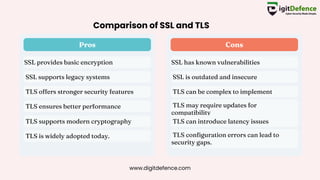
Comparison of SSL and TLS
Pros Cons
SSL provides basic encryption
SSL supports legacy systems
TLS offers stronger security features
TLS ensures better performance
TLS supports modern cryptography
TLS is widely adopted today.
SSL has known vulnerabilities
SSL is outdated and insecure
TLS can be complex to implement
TLS may require updates for
compatibility
TLS can introduce latency issues
TLS configuration errors can lead to
security gaps.
www.digitdefence.com
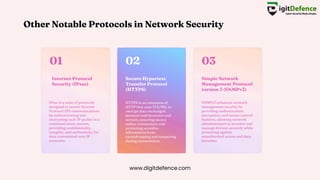
01 02 03
Internet Protocol
Security (IPsec)
Secure Hypertext
Transfer Protocol
(HTTPS)
Simple Network
Management Protocol
version 3 (SNMPv3)
IPsec is a suite of protocols
designed to secure Internet
Protocol (IP) communications
by authenticating and
encrypting each IP packet in a
communication session,
providing confidentiality,
integrity, and authenticity for
data transmitted over IP
networks.
HTTPS is an extension of
HTTP that uses TLS/SSL to
encrypt data exchanged
between web browsers and
servers, ensuring secure
online transactions and
protecting sensitive
information from
eavesdropping and tampering
during transmission.
SNMPv3 enhances network
management security by
providing authentication,
encryption, and access control
features, allowing network
administrators to monitor and
manage devices securely while
protecting against
unauthorized access and data
breaches.
Other Notable Protocols in Network Security
www.digitdefence.com
Emerging
Technologies
and Protocols
Emerging technologies such as blockchain,
artificial intelligence, and quantum
cryptography are revolutionizing network
security protocols by providing enhanced
data integrity, real-time threat detection,
and unprecedented levels of encryption,
thereby addressing the evolving landscape
of cyber threats and ensuring robust
protection for sensitive information.
Innovative Security
Solutions
www.digitdefence.com
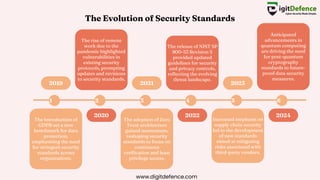
The Evolution of Security Standards
2019
2020
2021
2022
2023
2024
The introduction of
GDPR set a new
benchmark for data
protection,
emphasizing the need
for stringent security
standards across
organizations.
The rise of remote
work due to the
pandemic highlighted
vulnerabilities in
existing security
protocols, prompting
updates and revisions
to security standards.
The adoption of Zero
Trust architecture
gained momentum,
reshaping security
standards to focus on
continuous
verification and least
privilege access.
The release of NIST SP
800-53 Revision 5
provided updated
guidelines for security
and privacy controls,
reflecting the evolving
threat landscape.
Increased emphasis on
supply chain security
led to the development
of new standards
aimed at mitigating
risks associated with
third-party vendors.
Anticipated
advancements in
quantum computing
are driving the need
for post-quantum
cryptography
standards to future-
proof data security
measures.
1 2 3 4 5 6
www.digitdefence.com

Introduction to Network Security Protocols.pptx.pdf

  • 1.
  • 2.
    Definition and Importance of NetworkSecurity Protocols Foundation of Cybersecurity Network security protocols are essential frameworks that establish rules and standards for securing data transmission over networks, ensuring confidentiality, integrity, and authentication to protect sensitive information from unauthorized access and cyber threats. www.digitdefence.com
  • 3.
    Key Objectives: Confidentiality, Integrity, and Authentication CorePrinciples of Security The key objectives of network security protocols—confidentiality, integrity, and authentication—serve as the foundational pillars that ensure data is kept private from unauthorized access, remains unaltered during transmission, and verifies the identities of communicating parties, thereby fostering trust in digital communications. www.digitdefence.com
  • 4.
    Frameworks and StandardsGoverning Network Security Importance of Frameworks Role of Standards Frameworks such as NIST Cybersecurity Framework and ISO/IEC 27001 provide structured approaches for organizations to manage and mitigate cybersecurity risks, ensuring compliance with legal and regulatory requirements while enhancing overall security posture through standardized practices and guidelines. Standards like IEEE 802.1X and IETF RFCs establish specific protocols and procedures for network security, facilitating interoperability among devices and systems, promoting best practices, and ensuring that security measures are consistently applied across diverse network environments to protect against evolving threats. www.digitdefence.com
  • 5.
    Secure Sockets Layer (SSL) Explained Purpose ofSSL Secure Sockets Layer (SSL) is a cryptographic protocol designed to provide secure communication over a computer network, primarily the Internet, by encrypting data transmitted between a client and a server, thus ensuring confidentiality and integrity while also authenticating the parties involved to prevent eavesdropping and tampering by malicious actors. www.digitdefence.com
  • 6.
    Transport Layer Security (TLS)Overview TLS has evolved through multiple versions, with TLS 1.2 and TLS 1.3 being the most widely adopted; these versions not only offer significant performance improvements but also address vulnerabilities found in earlier iterations, making them essential for modern secure communications across various applications and services. Transport Layer Security (TLS) is the successor to SSL, providing improved security through stronger encryption algorithms, better authentication mechanisms, and enhanced integrity checks, which collectively protect data in transit from interception and tampering by malicious entities. www.digitdefence.com
  • 7.
    Comparison of SSLand TLS Pros Cons SSL provides basic encryption SSL supports legacy systems TLS offers stronger security features TLS ensures better performance TLS supports modern cryptography TLS is widely adopted today. SSL has known vulnerabilities SSL is outdated and insecure TLS can be complex to implement TLS may require updates for compatibility TLS can introduce latency issues TLS configuration errors can lead to security gaps. www.digitdefence.com
  • 8.
    01 02 03 InternetProtocol Security (IPsec) Secure Hypertext Transfer Protocol (HTTPS) Simple Network Management Protocol version 3 (SNMPv3) IPsec is a suite of protocols designed to secure Internet Protocol (IP) communications by authenticating and encrypting each IP packet in a communication session, providing confidentiality, integrity, and authenticity for data transmitted over IP networks. HTTPS is an extension of HTTP that uses TLS/SSL to encrypt data exchanged between web browsers and servers, ensuring secure online transactions and protecting sensitive information from eavesdropping and tampering during transmission. SNMPv3 enhances network management security by providing authentication, encryption, and access control features, allowing network administrators to monitor and manage devices securely while protecting against unauthorized access and data breaches. Other Notable Protocols in Network Security www.digitdefence.com
  • 9.
    Emerging Technologies and Protocols Emerging technologiessuch as blockchain, artificial intelligence, and quantum cryptography are revolutionizing network security protocols by providing enhanced data integrity, real-time threat detection, and unprecedented levels of encryption, thereby addressing the evolving landscape of cyber threats and ensuring robust protection for sensitive information. Innovative Security Solutions www.digitdefence.com
  • 10.
    The Evolution ofSecurity Standards 2019 2020 2021 2022 2023 2024 The introduction of GDPR set a new benchmark for data protection, emphasizing the need for stringent security standards across organizations. The rise of remote work due to the pandemic highlighted vulnerabilities in existing security protocols, prompting updates and revisions to security standards. The adoption of Zero Trust architecture gained momentum, reshaping security standards to focus on continuous verification and least privilege access. The release of NIST SP 800-53 Revision 5 provided updated guidelines for security and privacy controls, reflecting the evolving threat landscape. Increased emphasis on supply chain security led to the development of new standards aimed at mitigating risks associated with third-party vendors. Anticipated advancements in quantum computing are driving the need for post-quantum cryptography standards to future- proof data security measures. 1 2 3 4 5 6 www.digitdefence.com