Does Moral Action
Depend on Reasoning?
The answer is “Yes and No” (Antonio Damasio)
Analysis made by:
Diego Mora
Shareefa Abdul-Ali
Md Khan
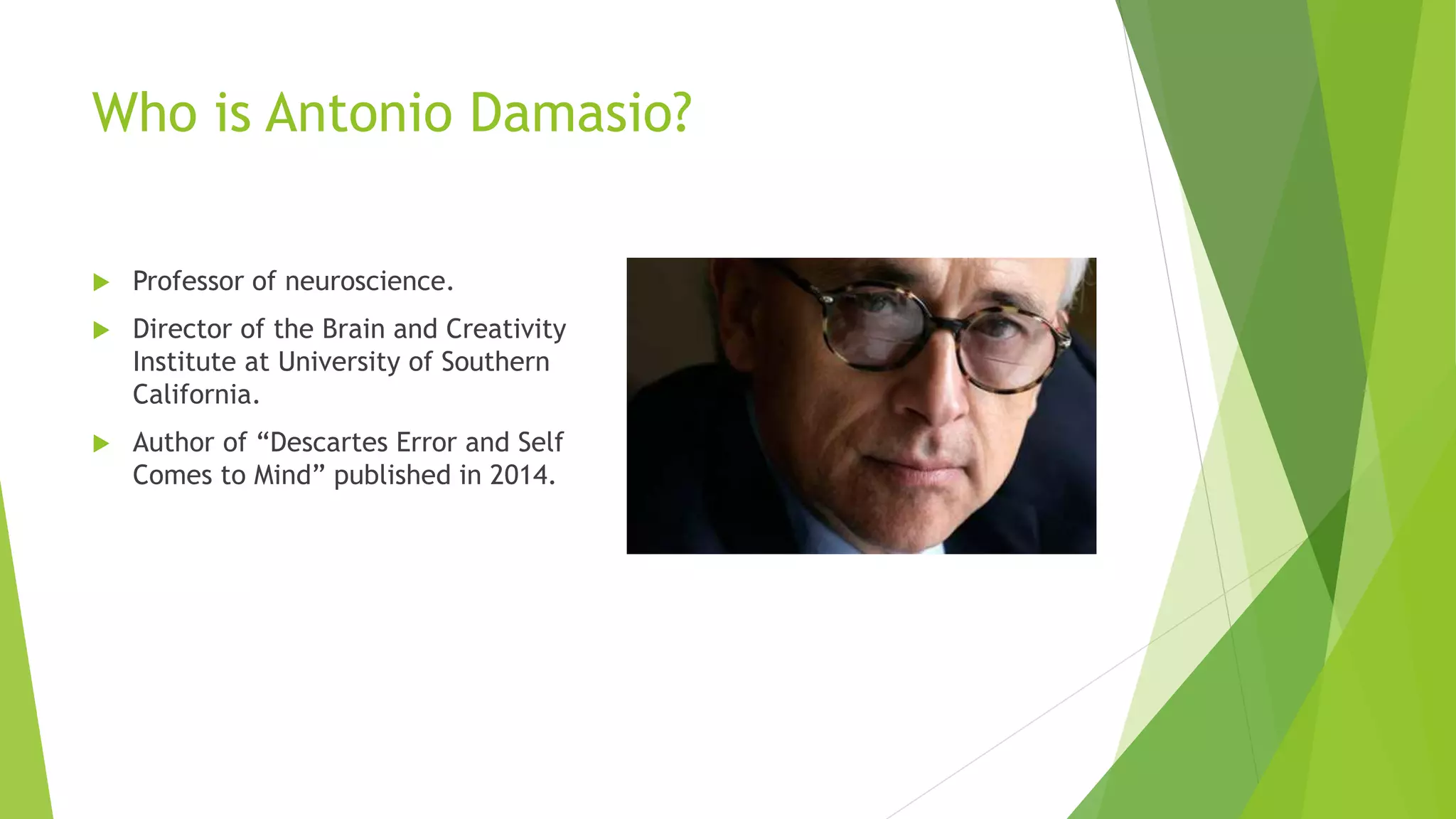
Who is Antonio Damasio?
 Professor of neuroscience.
 Director of the Brain and Creativity
Institute at University of Southern
California.
 Author of “Descartes Error and Self
Comes to Mind” published in 2014.
Main argument quote and paraphrase
 “My answer is a strong ‘yes’
because the actions we can truly
call moral depends on the work of
reason at some stage in the
process leading to their execution”
 “My answer is also ‘no’ because
the moment-to-moment execution
of actions, moral or otherwise, is
not necessary under the control of
reason…”
(Antonio Damasio, A Templeton
Conversation, page 46 paragraph 1).
 Morality depends on reasoning
within a conscious level but not
when it comes to basic moral
values stacked in the back of your
mind.
 Most of us do not realize that the
values or morals that are pass
down to us from generation to
generation (grandparents to
parents) are learn behaviors that
we are not aware of until
questioned.
Main argument
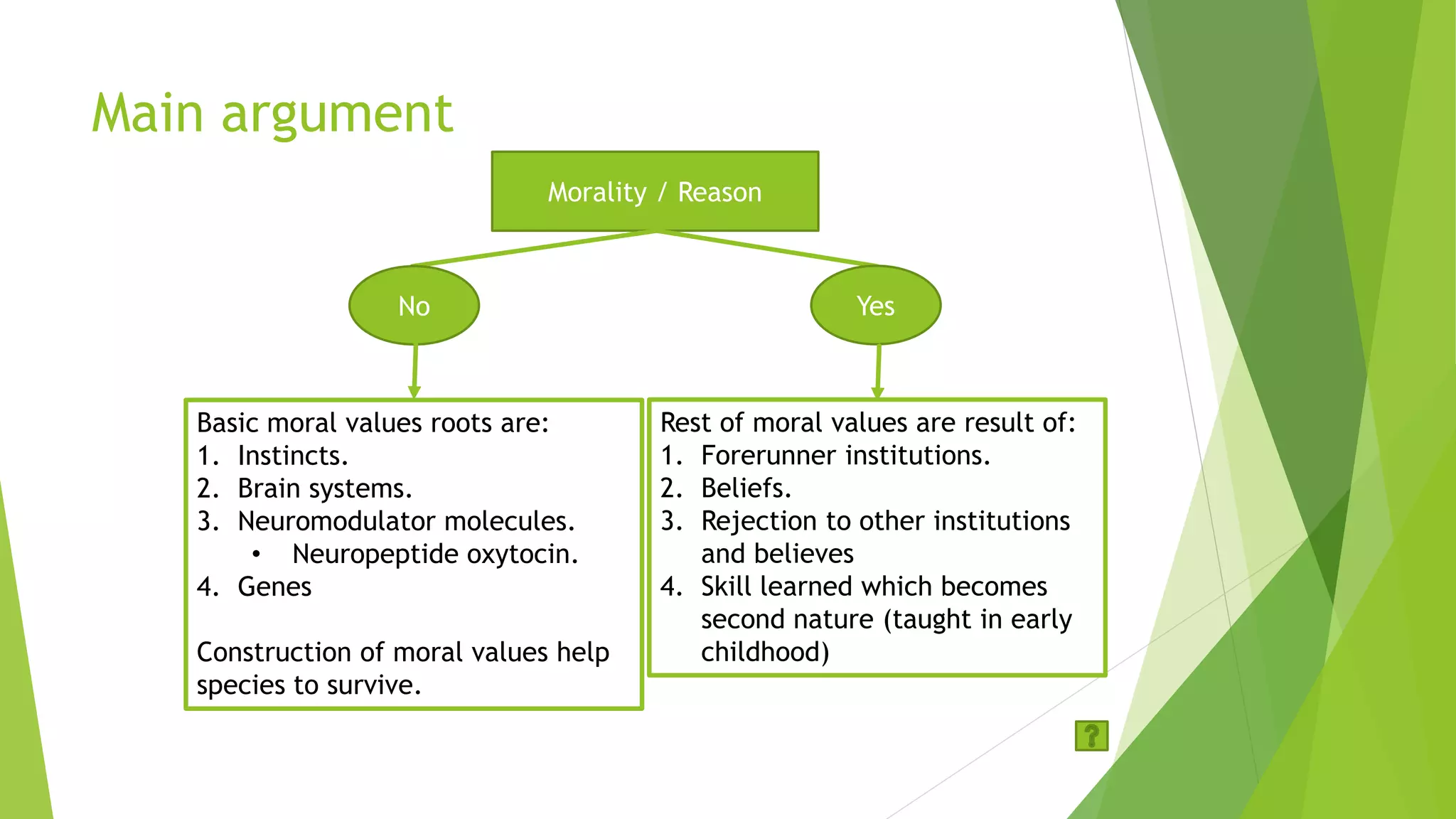
Morality / Reason
No Yes
Basic moral values roots are:
1. Instincts.
2. Brain systems.
3. Neuromodulator molecules.
• Neuropeptide oxytocin.
4. Genes
Construction of moral values help
species to survive.
Rest of moral values are result of:
1. Forerunner institutions.
2. Beliefs.
3. Rejection to other institutions
and believes
4. Skill learned which becomes
second nature (taught in early
childhood)
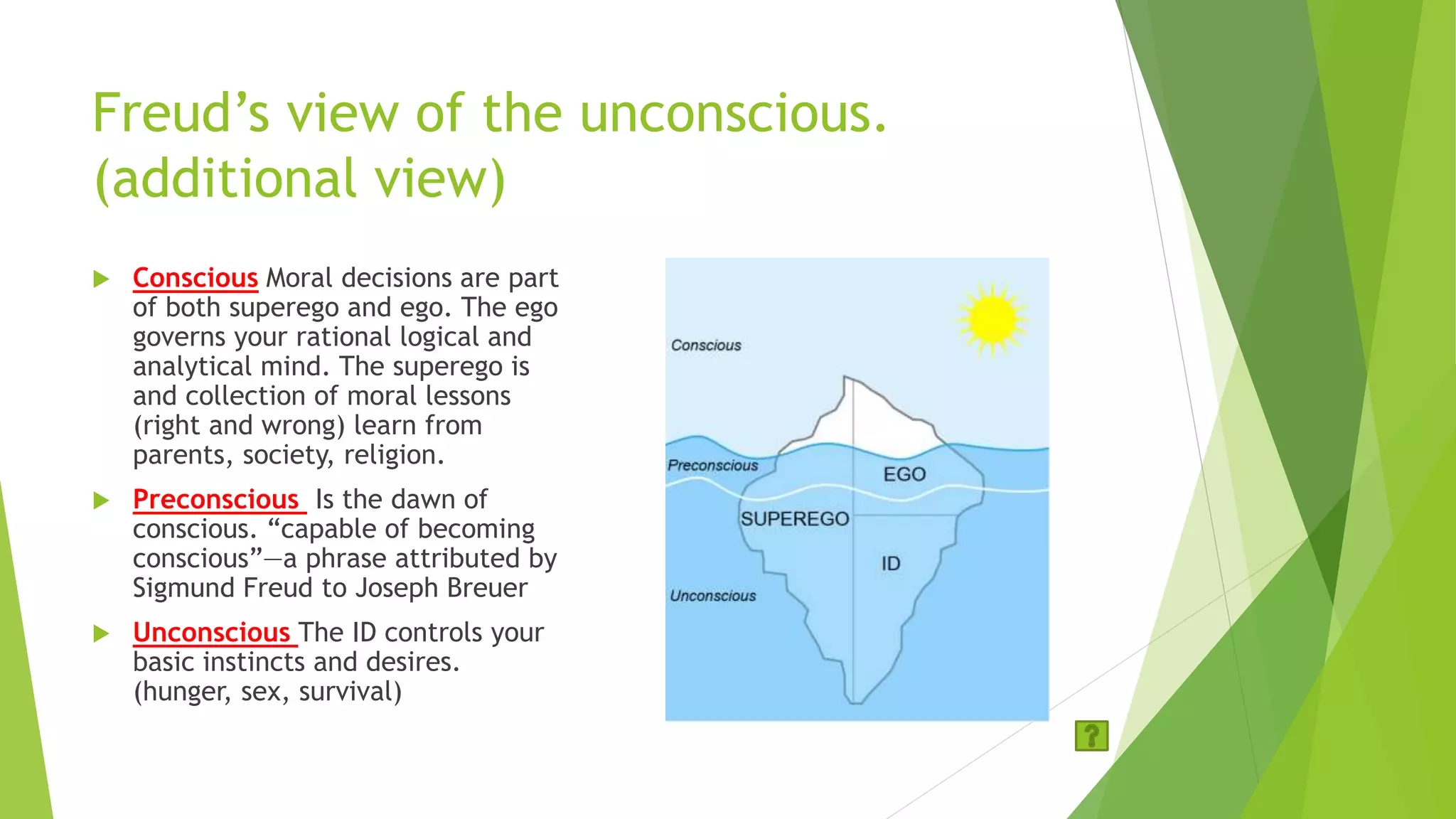
Freud’s view of the unconscious.
(additional view)
 Conscious Moral decisions are part
of both superego and ego. The ego
governs your rational logical and
analytical mind. The superego is
and collection of moral lessons
(right and wrong) learn from
parents, society, religion.
 Preconscious Is the dawn of
conscious. “capable of becoming
conscious”—a phrase attributed by
Sigmund Freud to Joseph Breuer
 Unconscious The ID controls your
basic instincts and desires.
(hunger, sex, survival)
Construction of basic moral values with
instincts, brain systems and neuromodulators
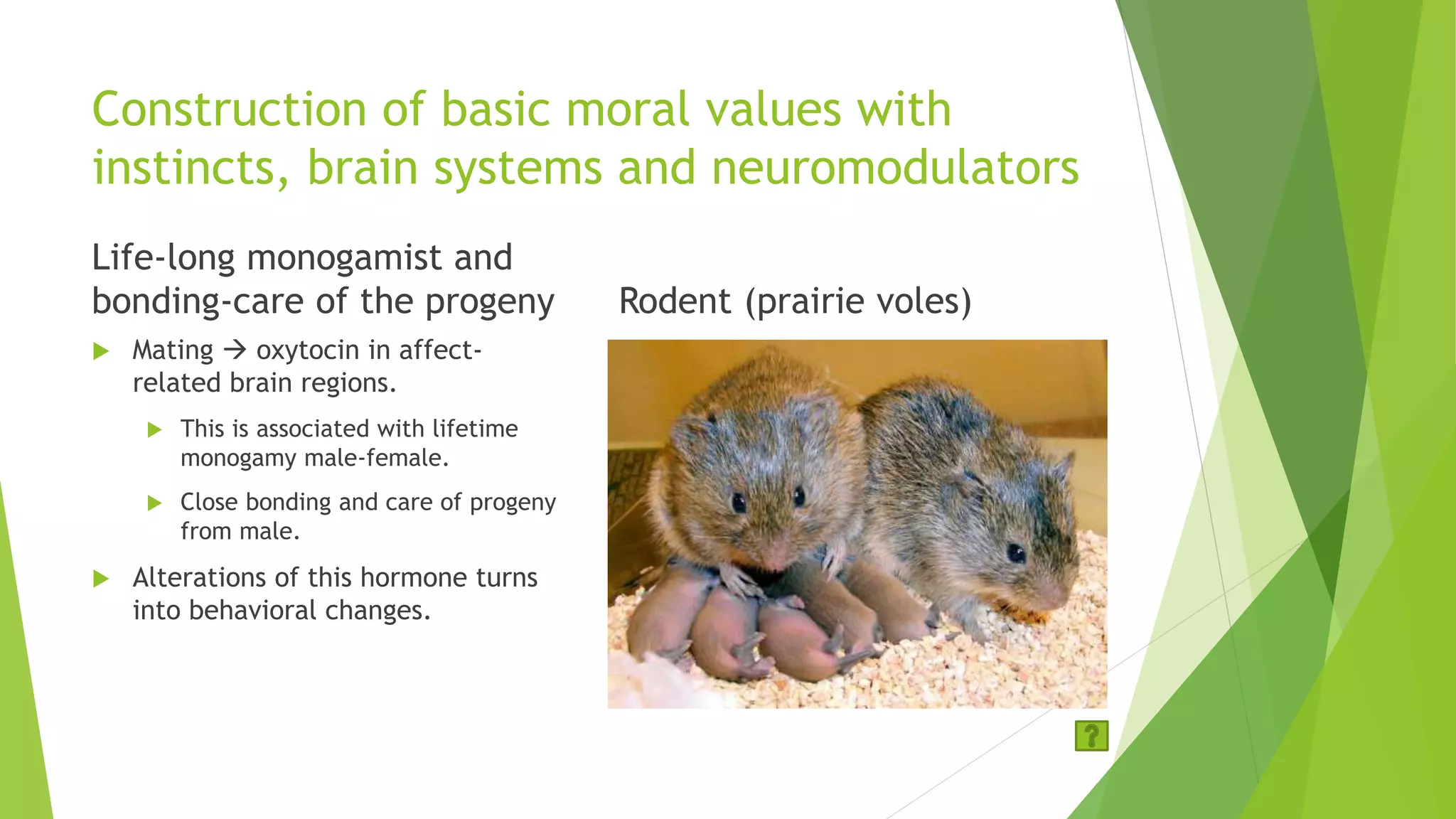
Life-long monogamist and
bonding-care of the progeny
 Mating  oxytocin in affect-
related brain regions.
 This is associated with lifetime
monogamy male-female.
 Close bonding and care of progeny
from male.
 Alterations of this hormone turns
into behavioral changes.
Rodent (prairie voles)
Social homeostasis
 Humans compared to other species takes moral to new heights.
 Using creativity.
 Served by social standards.
 Social homeostasis is moral decisions and principles taken:
 Deliberate.
 High level of consciousness.
 Create social laws (moral) and the jurisprudence that follows from it.
 Neuroscience proves humans are capable of consciously controlling their
moral behavior.
 Morals can become a skill that will act as “second nature”.
 Process that begins in childhood.
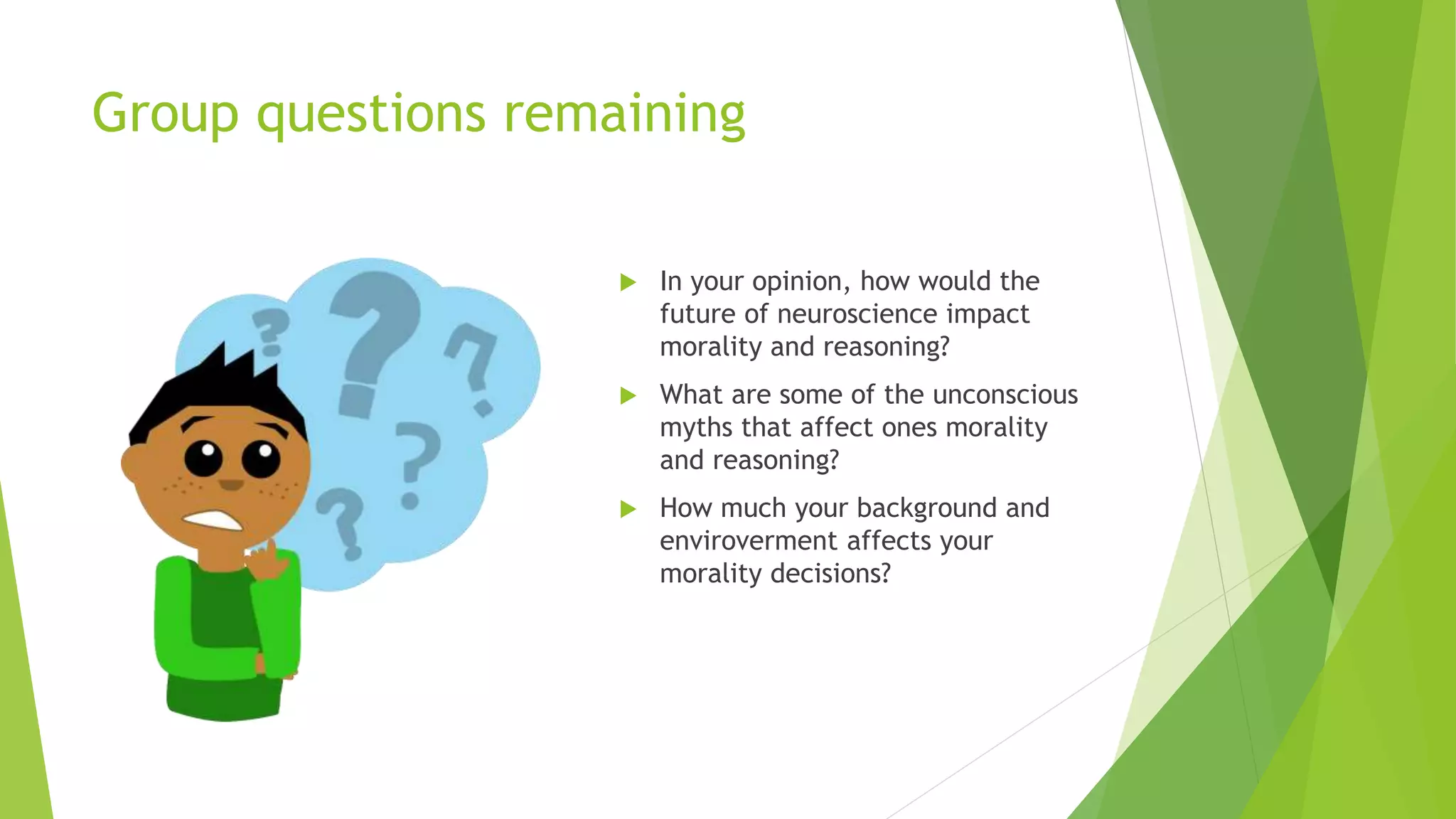
Group questions remaining
 In your opinion, how would the
future of neuroscience impact
morality and reasoning?
 What are some of the unconscious
myths that affect ones morality
and reasoning?
 How much your background and
enviroverment affects your
morality decisions?
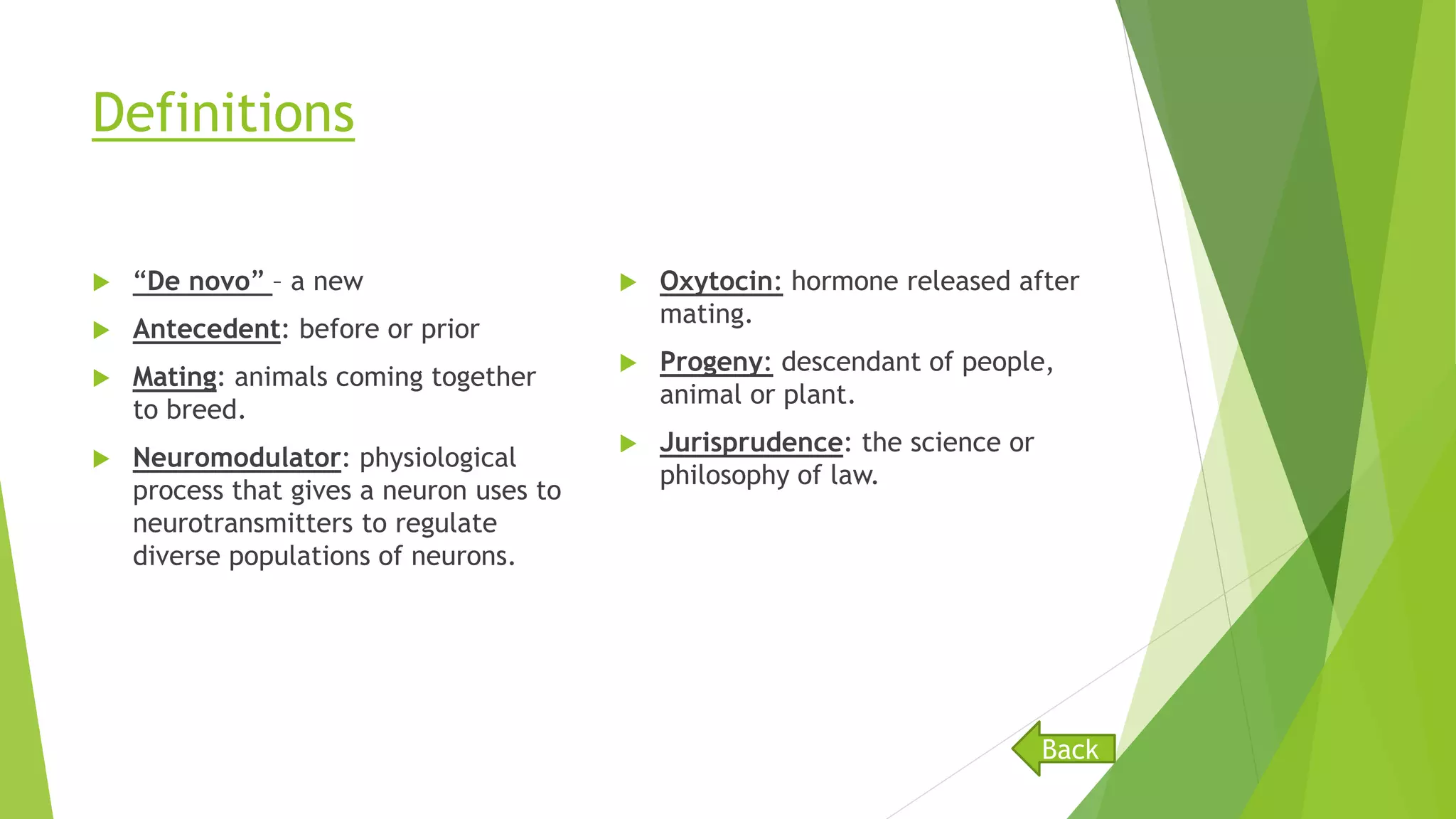
Definitions
 “De novo” – a new
 Antecedent: before or prior
 Mating: animals coming together
to breed.
 Neuromodulator: physiological
process that gives a neuron uses to
neurotransmitters to regulate
diverse populations of neurons.
 Oxytocin: hormone released after
mating.
 Progeny: descendant of people,
animal or plant.
 Jurisprudence: the science or
philosophy of law.
Back

Does moral action depend on reasoning?

  • 1.
    Does Moral Action Dependon Reasoning? The answer is “Yes and No” (Antonio Damasio) Analysis made by: Diego Mora Shareefa Abdul-Ali Md Khan
  • 2.
    Who is AntonioDamasio?  Professor of neuroscience.  Director of the Brain and Creativity Institute at University of Southern California.  Author of “Descartes Error and Self Comes to Mind” published in 2014.
  • 3.
    Main argument quoteand paraphrase  “My answer is a strong ‘yes’ because the actions we can truly call moral depends on the work of reason at some stage in the process leading to their execution”  “My answer is also ‘no’ because the moment-to-moment execution of actions, moral or otherwise, is not necessary under the control of reason…” (Antonio Damasio, A Templeton Conversation, page 46 paragraph 1).  Morality depends on reasoning within a conscious level but not when it comes to basic moral values stacked in the back of your mind.  Most of us do not realize that the values or morals that are pass down to us from generation to generation (grandparents to parents) are learn behaviors that we are not aware of until questioned.
  • 4.
    Main argument Morality /Reason No Yes Basic moral values roots are: 1. Instincts. 2. Brain systems. 3. Neuromodulator molecules. • Neuropeptide oxytocin. 4. Genes Construction of moral values help species to survive. Rest of moral values are result of: 1. Forerunner institutions. 2. Beliefs. 3. Rejection to other institutions and believes 4. Skill learned which becomes second nature (taught in early childhood)
  • 5.
    Freud’s view ofthe unconscious. (additional view)  Conscious Moral decisions are part of both superego and ego. The ego governs your rational logical and analytical mind. The superego is and collection of moral lessons (right and wrong) learn from parents, society, religion.  Preconscious Is the dawn of conscious. “capable of becoming conscious”—a phrase attributed by Sigmund Freud to Joseph Breuer  Unconscious The ID controls your basic instincts and desires. (hunger, sex, survival)
  • 6.
    Construction of basicmoral values with instincts, brain systems and neuromodulators Life-long monogamist and bonding-care of the progeny  Mating  oxytocin in affect- related brain regions.  This is associated with lifetime monogamy male-female.  Close bonding and care of progeny from male.  Alterations of this hormone turns into behavioral changes. Rodent (prairie voles)
  • 7.
    Social homeostasis  Humanscompared to other species takes moral to new heights.  Using creativity.  Served by social standards.  Social homeostasis is moral decisions and principles taken:  Deliberate.  High level of consciousness.  Create social laws (moral) and the jurisprudence that follows from it.  Neuroscience proves humans are capable of consciously controlling their moral behavior.  Morals can become a skill that will act as “second nature”.  Process that begins in childhood.
  • 8.
    Group questions remaining In your opinion, how would the future of neuroscience impact morality and reasoning?  What are some of the unconscious myths that affect ones morality and reasoning?  How much your background and enviroverment affects your morality decisions?
  • 9.
    Definitions  “De novo”– a new  Antecedent: before or prior  Mating: animals coming together to breed.  Neuromodulator: physiological process that gives a neuron uses to neurotransmitters to regulate diverse populations of neurons.  Oxytocin: hormone released after mating.  Progeny: descendant of people, animal or plant.  Jurisprudence: the science or philosophy of law. Back