MOLDING & CASTING
INTRODUCTION TO
KEYWORDS
mold
model/master
cast/copy
MOLDING & CASTING
KEYWORDS
mold
model/master
cast/copy
The mold is the negative shape. It is the starting
point of the process and it can be designed and
fabricated from scratch or it can derive from an
existing object (model or master) that you want to
copy.
For a successful job, the mold must be carefully
engineered and fabricated, taking into account the
complexity of the shape, the behavior of the
materials (flexibility, stiffness), the number of copies
to reproduce.
The cast (or copy) is the positive shape,
complementary to the mold, and it is the final result
of the process.
Molding and casting in industrial manufacturing:
Ceramic factories: plaster molds and slip (liquid clay).
Plastic factories: metal molds and injection molding, rotational
molding, blow molding.
Glass industry: metal or graphite molds and blown molten silica.
MOLDING & CASTING
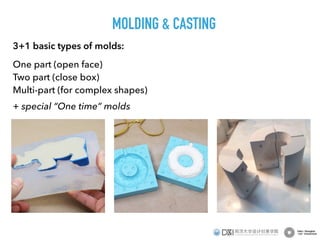
3+1 basic types of molds:
One part (open face)
Two part (close box)
Multi-part (for complex shapes)
+ special “One time” molds
MOLDING & CASTING
ONE PART MOLD
Wooden mold for mooncakes. The mold is directly carved into wood.
ONE PART MOLD
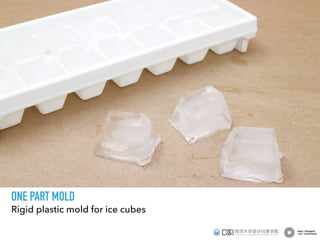
Rigid plastic mold for ice cubes
ONE PART MOLD
Silicone mold for complex ice shapes
ONE PART MOLD
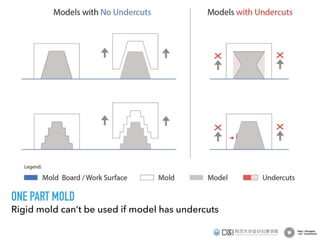
Rigid mold can’t be used if model has undercuts
ONE PART MOLD
Flexible molds allows extraction of models with undercuts
TWO PARTS MOLD
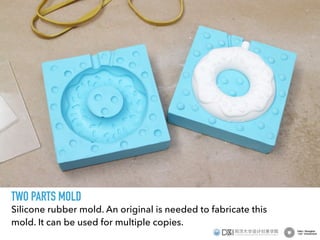
Silicone rubber mold. An original is needed to fabricate this
mold. It can be used for multiple copies.
TWO PARTS MOLD
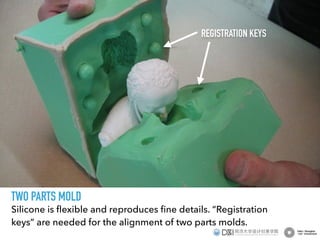
Silicone is flexible and reproduces fine details. “Registration
keys” are needed for the alignment of two parts molds.
REGISTRATION KEYS
TWO PARTS MOLD
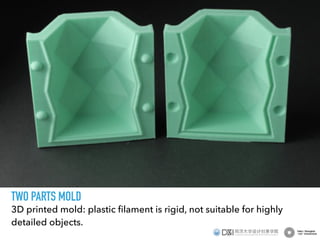
3D printed mold: plastic filament is rigid, not suitable for highly
detailed objects.
TWO PARTS MOLD
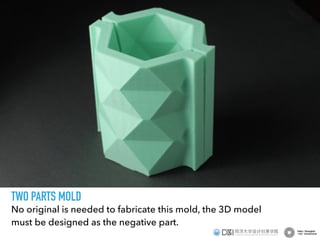
No original is needed to fabricate this mold, the 3D model
must be designed as the negative part.
TWO PARTS MOLD
High rigidity of the mold allows only simple shapes to be casted
MULTI-PART MOLD
Complex shapes, with extreme undercuts or intersecting components,
require a multi part mold that must be precisely engineered.
Complex shapes, with extreme undercuts or intersecting components,
require a multi part mold that must be precisely engineered.
MULTI-PART MOLD
Complex shapes, with extreme undercuts or intersecting components,
require a multi part mold that must be precisely engineered.
MULTI-PART MOLD
Complex shapes, with extreme undercuts or intersecting components,
require a multi part mold that must be precisely engineered.
MULTI-PART MOLD
“ONE TIME” MOLD
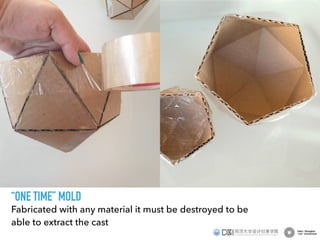
Fabricated with any material it must be destroyed to be
able to extract the cast
“ONE TIME” MOLD
Fabricated with any material it must be destroyed to be
able to extract the cast
Cardboard soaks too much water from concrete and bends loosing
any structural strenght. Plastic film can be used as isolation.
“ONE TIME” MOLD
A 3D model is “unfolded” onto a plane using a dedicated software
(Pepakura), printed on paper and assembled.
“ONE TIME” MOLD
Mold: paper (to avoid soaking, the paper can be laminated).
Cast: colored plaster or concrete.
“ONE TIME” MOLD
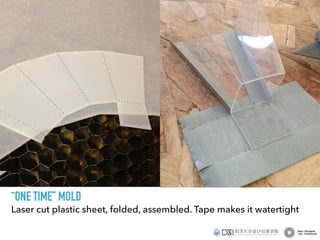
Laser cut plastic sheet, folded, assembled. Tape makes it watertight
“ONE TIME” MOLD
This mold can be reassembled and reused. The choice of material is
optimal: concrete doesn’t stick to plastic and the surface is smooth.
“ONE TIME” MOLD
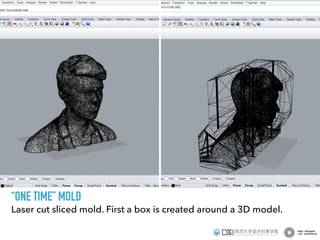
Laser cut sliced mold. First a box is created around a 3D model.
“ONE TIME” MOLD
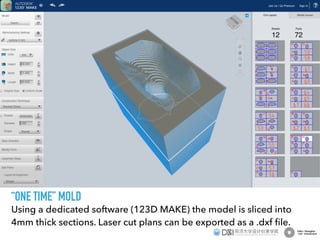
Using a dedicated software (123D MAKE) the model is sliced into
4mm thick sections. Laser cut plans can be exported as a .dxf file.
“ONE TIME” MOLD
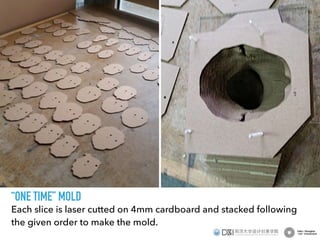
Each slice is laser cutted on 4mm cardboard and stacked following
the given order to make the mold.
“ONE TIME” MOLD
Plaster is poured into the mold. The materials used are not optimal:
the fluid plaster fill the corrugated cardboard. The resulting texture is
very interesting, but needs a lot of clean up.
“ONE TIME” MOLD
The same technique shown before can use styrofoam sheets instead
of carbboard, thus creating a smoother surface texture.
“ONE TIME” MOLD
Cast material is usually a substance in its liquid or fluid state, able to
solidify after being poured into the mold. Nevertheless, anything that
is able to fill an hollow space and keep the shape is a suitable material.
Take a look at this model of a room.
WHAT KIND OF MATERIALS CAN BE USED?
This is a multi-part mold. It appear to be the final model, but in this
case we need the cast to be around the mold and not into it. As seen in
the previous image, the final model will be a room. It is composed of
small parts for easy disassembling.
WHAT KIND OF MATERIALS CAN BE USED?
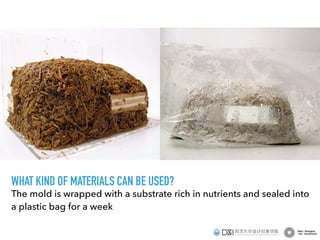
The mold is wrapped with a substrate rich in nutrients and sealed into
a plastic bag for a week
WHAT KIND OF MATERIALS CAN BE USED?
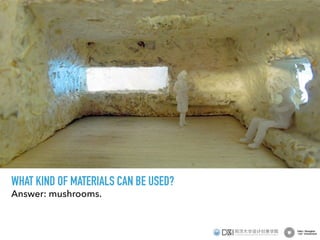
After a week the substrate has turned into mushrooms that grow
around the mold filling any hollow space.
WHAT KIND OF MATERIALS CAN BE USED?
The mold is then disassembled and removed and the resulting cast is a
model of the interior of a room.
WHAT KIND OF MATERIALS CAN BE USED?
Answer: mushrooms.
WHAT KIND OF MATERIALS CAN BE USED?
Vacuum-forming gives great, fast results when used in combination
with 3D printing. Open-source plans for a vacuum table are available.
The plastic material used comes from a recycled milk/water bottle.
ADVANCED MOLD MAKING TECHNIQUE
http://www.thingiverse.com/thing:1951311
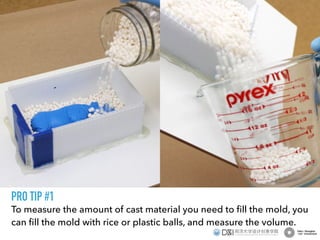
To measure the amount of cast material you need to fill the mold, you
can fill the mold with rice or plastic balls, and measure the volume.
PRO TIP #1
You should always use a release agent to prevent your cast to stick to
the mold (especially when using styrofoam).

Introduction to Molding & Casting

  • 1.
  • 2.
  • 3.
    MOLDING & CASTING KEYWORDS mold model/master cast/copy Themold is the negative shape. It is the starting point of the process and it can be designed and fabricated from scratch or it can derive from an existing object (model or master) that you want to copy. For a successful job, the mold must be carefully engineered and fabricated, taking into account the complexity of the shape, the behavior of the materials (flexibility, stiffness), the number of copies to reproduce. The cast (or copy) is the positive shape, complementary to the mold, and it is the final result of the process.
  • 4.
    Molding and castingin industrial manufacturing: Ceramic factories: plaster molds and slip (liquid clay). Plastic factories: metal molds and injection molding, rotational molding, blow molding. Glass industry: metal or graphite molds and blown molten silica. MOLDING & CASTING
  • 5.
    3+1 basic typesof molds: One part (open face) Two part (close box) Multi-part (for complex shapes) + special “One time” molds MOLDING & CASTING
  • 6.
    ONE PART MOLD Woodenmold for mooncakes. The mold is directly carved into wood.
  • 7.
    ONE PART MOLD Rigidplastic mold for ice cubes
  • 8.
    ONE PART MOLD Siliconemold for complex ice shapes
  • 9.
    ONE PART MOLD Rigidmold can’t be used if model has undercuts
  • 10.
    ONE PART MOLD Flexiblemolds allows extraction of models with undercuts
  • 11.
    TWO PARTS MOLD Siliconerubber mold. An original is needed to fabricate this mold. It can be used for multiple copies.
  • 12.
    TWO PARTS MOLD Siliconeis flexible and reproduces fine details. “Registration keys” are needed for the alignment of two parts molds. REGISTRATION KEYS
  • 13.
    TWO PARTS MOLD 3Dprinted mold: plastic filament is rigid, not suitable for highly detailed objects.
  • 14.
    TWO PARTS MOLD Nooriginal is needed to fabricate this mold, the 3D model must be designed as the negative part.
  • 15.
    TWO PARTS MOLD Highrigidity of the mold allows only simple shapes to be casted
  • 16.
    MULTI-PART MOLD Complex shapes,with extreme undercuts or intersecting components, require a multi part mold that must be precisely engineered.
  • 17.
    Complex shapes, withextreme undercuts or intersecting components, require a multi part mold that must be precisely engineered. MULTI-PART MOLD
  • 18.
    Complex shapes, withextreme undercuts or intersecting components, require a multi part mold that must be precisely engineered. MULTI-PART MOLD
  • 19.
    Complex shapes, withextreme undercuts or intersecting components, require a multi part mold that must be precisely engineered. MULTI-PART MOLD
  • 20.
    “ONE TIME” MOLD Fabricatedwith any material it must be destroyed to be able to extract the cast
  • 21.
    “ONE TIME” MOLD Fabricatedwith any material it must be destroyed to be able to extract the cast
  • 22.
    Cardboard soaks toomuch water from concrete and bends loosing any structural strenght. Plastic film can be used as isolation. “ONE TIME” MOLD
  • 23.
    A 3D modelis “unfolded” onto a plane using a dedicated software (Pepakura), printed on paper and assembled. “ONE TIME” MOLD
  • 24.
    Mold: paper (toavoid soaking, the paper can be laminated). Cast: colored plaster or concrete. “ONE TIME” MOLD
  • 25.
    Laser cut plasticsheet, folded, assembled. Tape makes it watertight “ONE TIME” MOLD
  • 26.
    This mold canbe reassembled and reused. The choice of material is optimal: concrete doesn’t stick to plastic and the surface is smooth. “ONE TIME” MOLD
  • 27.
    Laser cut slicedmold. First a box is created around a 3D model. “ONE TIME” MOLD
  • 28.
    Using a dedicatedsoftware (123D MAKE) the model is sliced into 4mm thick sections. Laser cut plans can be exported as a .dxf file. “ONE TIME” MOLD
  • 29.
    Each slice islaser cutted on 4mm cardboard and stacked following the given order to make the mold. “ONE TIME” MOLD
  • 30.
    Plaster is pouredinto the mold. The materials used are not optimal: the fluid plaster fill the corrugated cardboard. The resulting texture is very interesting, but needs a lot of clean up. “ONE TIME” MOLD
  • 31.
    The same techniqueshown before can use styrofoam sheets instead of carbboard, thus creating a smoother surface texture. “ONE TIME” MOLD
  • 32.
    Cast material isusually a substance in its liquid or fluid state, able to solidify after being poured into the mold. Nevertheless, anything that is able to fill an hollow space and keep the shape is a suitable material. Take a look at this model of a room. WHAT KIND OF MATERIALS CAN BE USED?
  • 33.
    This is amulti-part mold. It appear to be the final model, but in this case we need the cast to be around the mold and not into it. As seen in the previous image, the final model will be a room. It is composed of small parts for easy disassembling. WHAT KIND OF MATERIALS CAN BE USED?
  • 34.
    The mold iswrapped with a substrate rich in nutrients and sealed into a plastic bag for a week WHAT KIND OF MATERIALS CAN BE USED?
  • 35.
    After a weekthe substrate has turned into mushrooms that grow around the mold filling any hollow space. WHAT KIND OF MATERIALS CAN BE USED?
  • 36.
    The mold isthen disassembled and removed and the resulting cast is a model of the interior of a room. WHAT KIND OF MATERIALS CAN BE USED?
  • 37.
    Answer: mushrooms. WHAT KINDOF MATERIALS CAN BE USED?
  • 38.
    Vacuum-forming gives great,fast results when used in combination with 3D printing. Open-source plans for a vacuum table are available. The plastic material used comes from a recycled milk/water bottle. ADVANCED MOLD MAKING TECHNIQUE http://www.thingiverse.com/thing:1951311
  • 39.
    To measure theamount of cast material you need to fill the mold, you can fill the mold with rice or plastic balls, and measure the volume. PRO TIP #1
  • 40.
    You should alwaysuse a release agent to prevent your cast to stick to the mold (especially when using styrofoam).