INTRO TO MACHINE LEARNING
150
MIN
5.0
DMYTRO FISHMAN
UNIVERSITY OF TARTU
INSTITUTE OF COMPUTER SCIENCE
New York City Taxi
Fare Prediction
https://www.kaggle.com/c/new-york-city-taxi-fare-prediction
x
y
-0.8
0.2
-0.6
-0.4
-0.2
0.0
0.4
0.6
-0.75 -0.50 -0.25 0.00 0.25 0.50 0.75 1.00
type in your browser:
tinyurl.com/yxb5k5jl
(save a copy to your drive)
The following slides are inspired by
“An Introduction to Linear Regression Analysis” video
https://youtu.be/zPG4NjIkCjc
y
X
independent variable
dependentvariable
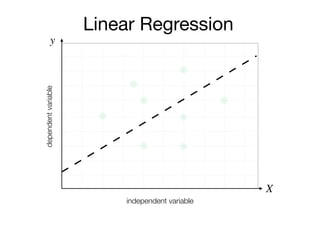
Linear Regression
y
X
independent variable
dependentvariable
Linear Regression
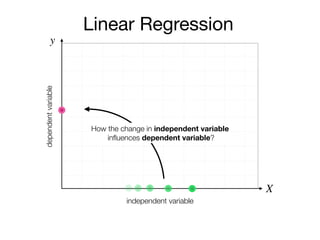
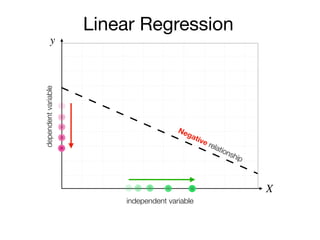
How the change in independent variable
influences dependent variable?
y
X
independent variable
dependentvariable
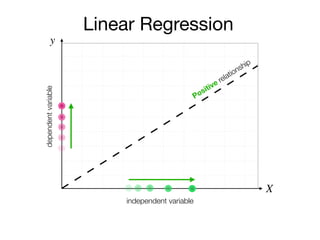
Positive relationship
Linear Regression
y
X
independent variable
dependentvariable
Negative relationship
Linear Regression
y
X
independent variable
dependentvariable
Linear Regression
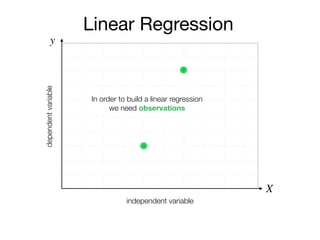
In order to build a linear regression
we need observations
y
X
independent variable
dependentvariable
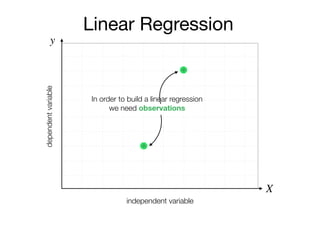
In order to build a linear regression
we need observations
Linear Regression
y
X
independent variable
dependentvariable
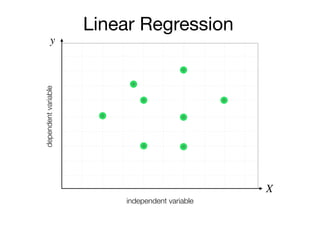
Linear Regression
y
X
independent variable
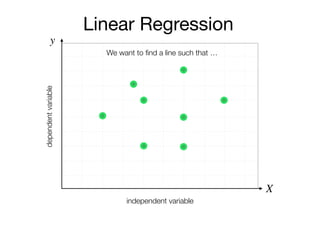
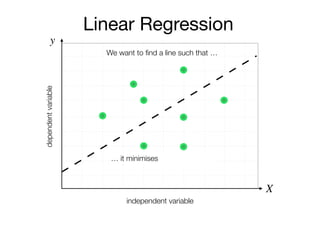
dependentvariable We want to find a line such that …
Linear Regression
y
X
independent variable
dependentvariable We want to find a line such that …
… it minimises the sum of errors
Linear Regression
y
X
independent variable
dependentvariable
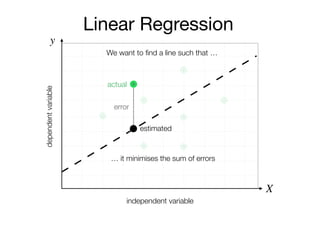
actual
estimated
error
We want to find a line such that …
… it minimises the sum of errors
Linear Regression
y
X
independent variable
dependentvariable
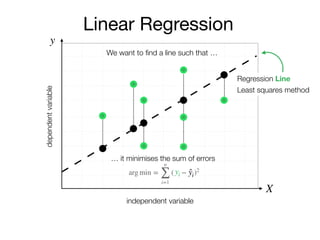
arg min =
n
∑
i=1
( − )2yi ̂yi
Regression Line
Least squares method
We want to find a line such that …
… it minimises the sum of errors
Linear Regression
y
X
independent variable
dependentvariable
Linear Regression
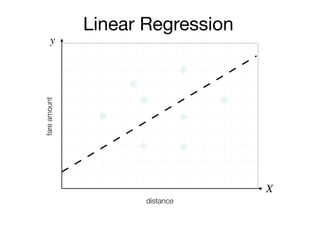
y
X
fareamount
distance
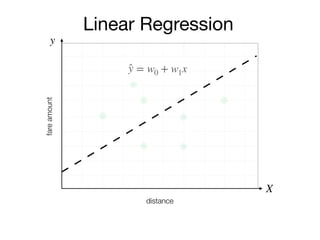
Linear Regression
y
X
fareamount
̂y xw0 w1+=
distance
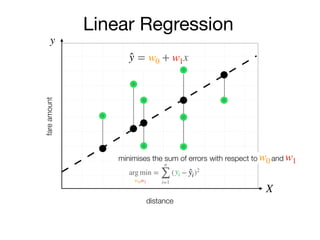
Linear Regression
y
X
fareamount
xw0 w1+=
arg min
,
=
n
∑
i=1
( − )2yi ̂yi
w0 w1
distance
̂y
Linear Regression
minimises the sum of errors with respect to w0 and w1w0 w1
y
X
fareamount
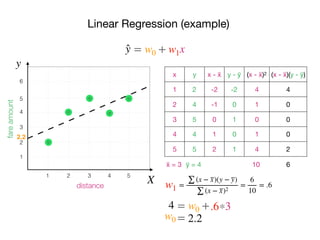
Linear Regression (example)
distance
2
3
4
5
6
1
1 2 3 4 5
x y x - x̄ y - ȳ (x - x̄ )2 (x - x̄ )(y - ȳ)
1 2 -2 -2 4 4
2 4 -1 0 1 0
3 5 0 1 0 0
4 4 1 0 1 0
5 5 2 1 4 2
x̄ = 3 ȳ = 4 10 6
xw0 w1+=̂y
w1
3w0 .6+=4 *
w0 = 2.2
2.2
=
∑ (x − x)(y − y)
∑ (x − x)2
=
6
10
= .6
=
∑ (x − x)(y − y)
∑ (x − x)2
=
6
10
= .6
y
X
fareamount
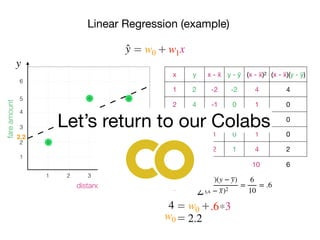
Linear Regression (example)
distance
2
3
4
5
6
1
1 2 3 4 5
x y x - x̄ y - ȳ (x - x̄ )2 (x - x̄ )(y - ȳ)
1 2 -2 -2 4 4
2 4 -1 0 1 0
3 5 0 1 0 0
4 4 1 0 1 0
5 5 2 1 4 2
x̄ = 3 ȳ = 4 10 6
xw0 w1+=̂y
w1
3w0 .6+=4 *
w0 = 2.2
2.2
Let’s return to our Colabs
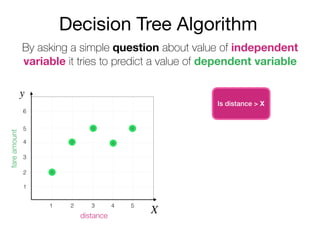
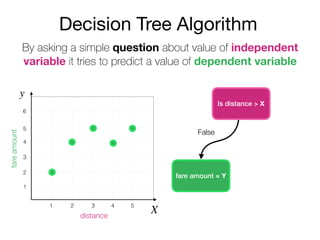
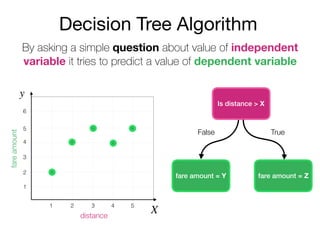
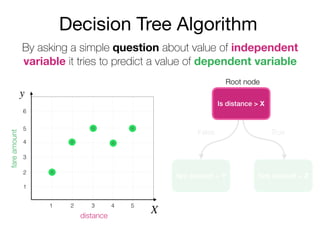
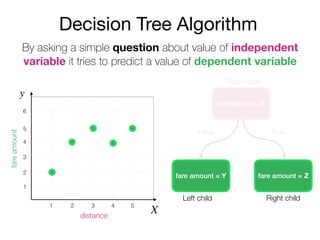
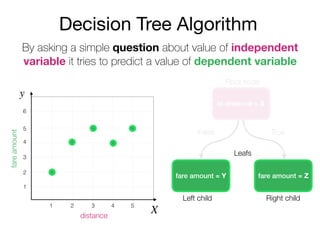
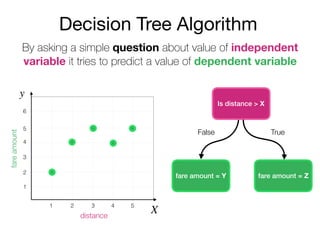
Decision Tree Algorithm
By asking a simple question about value of independent
variable it tries to predict a value of dependent variable
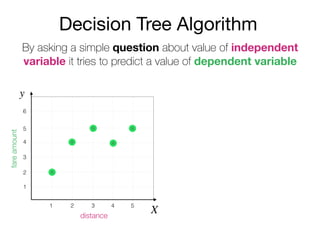
Decision Tree Algorithm
By asking a simple question about value of independent
variable it tries to predict a value of dependent variable
y
X
fareamount
distance
2
3
4
5
6
1
1 2 3 4 5
Decision Tree Algorithm
By asking a simple question about value of independent
variable it tries to predict a value of dependent variable
Is distance > X
y
X
fareamount
distance
2
3
4
5
6
1
1 2 3 4 5
Decision Tree Algorithm
By asking a simple question about value of independent
variable it tries to predict a value of dependent variable
Is distance > X
y
X
fareamount
distance
2
3
4
5
6
1
1 2 3 4 5
fare amount = Y
False
Decision Tree Algorithm
By asking a simple question about value of independent
variable it tries to predict a value of dependent variable
Is distance > X
y
X
fareamount
distance
2
3
4
5
6
1
1 2 3 4 5
fare amount = Y fare amount = Z
False True
Decision Tree Algorithm
By asking a simple question about value of independent
variable it tries to predict a value of dependent variable
Is distance > X
y
X
fareamount
distance
2
3
4
5
6
1
1 2 3 4 5
fare amount = Y fare amount = Z
False True
Root node
Decision Tree Algorithm
By asking a simple question about value of independent
variable it tries to predict a value of dependent variable
Is distance > X
y
X
fareamount
distance
2
3
4
5
6
1
1 2 3 4 5
fare amount = Y fare amount = Z
False True
Root node
Left child Right child
Decision Tree Algorithm
By asking a simple question about value of independent
variable it tries to predict a value of dependent variable
Is distance > X
y
X
fareamount
distance
2
3
4
5
6
1
1 2 3 4 5
fare amount = Y fare amount = Z
False True
Root node
Left child Right child
Leafs
Decision Tree Algorithm
By asking a simple question about value of independent
variable it tries to predict a value of dependent variable
Is distance > X
y
X
fareamount
distance
2
3
4
5
6
1
1 2 3 4 5
fare amount = Y fare amount = Z
False True
Decision Tree Algorithm
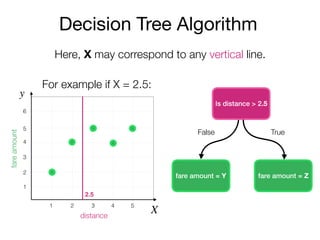
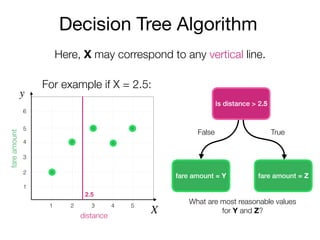
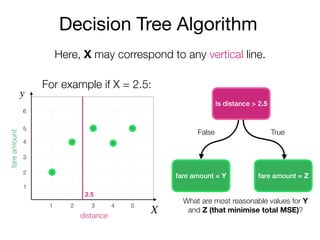
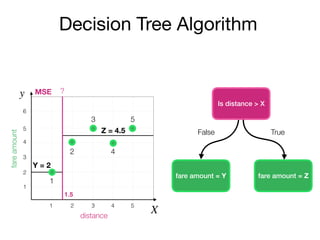
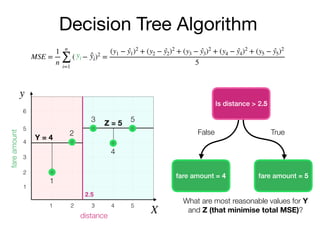
Here, X may correspond to any vertical line.
Is distance > 2.5
y
X
fareamount
distance
2
3
4
5
6
1
1 2 3 4 5
fare amount = Y fare amount = Z
False True
For example if X = 2.5:
2.5
Decision Tree Algorithm
Here, X may correspond to any vertical line.
Is distance > 2.5
y
X
fareamount
distance
2
3
4
5
6
1
1 2 3 4 5
fare amount = Y fare amount = Z
False True
For example if X = 2.5:
2.5
What are most reasonable values
for Y and Z?
Decision Tree Algorithm
Here, X may correspond to any vertical line.
Is distance > 2.5
y
X
fareamount
distance
2
3
4
5
6
1
1 2 3 4 5
fare amount = Y fare amount = Z
False True
For example if X = 2.5:
2.5
What are most reasonable values for Y
and Z (that minimise total MSE)?
Decision Tree Algorithm
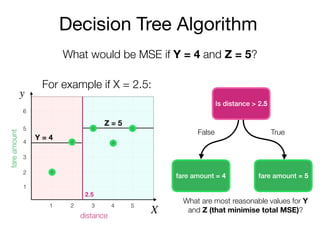
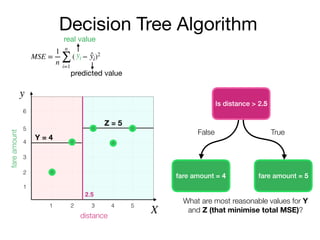
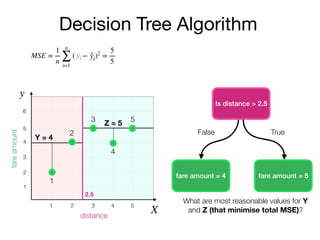
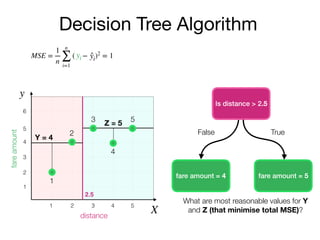
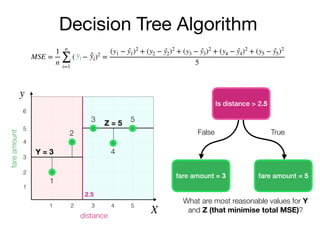
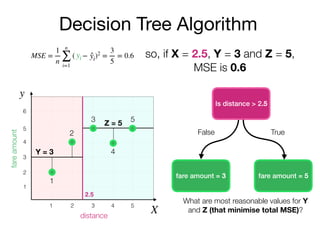
What would be MSE if Y = 4 and Z = 5?
Is distance > 2.5
y
X
fareamount
distance
2
3
4
5
6
1
1 2 3 4 5
fare amount = 4 fare amount = 5
False True
For example if X = 2.5:
2.5
What are most reasonable values for Y
and Z (that minimise total MSE)?
Y = 4
Z = 5
Decision Tree Algorithm
Is distance > 2.5
y
X
fareamount
distance
2
3
4
5
6
1
1 2 3 4 5
fare amount = 4 fare amount = 5
False True
2.5
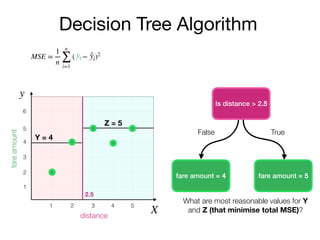
What are most reasonable values for Y
and Z (that minimise total MSE)?
Y = 4
Z = 5
yi ̂yiMSE =
1
n
n
∑
i=1
( − )2
Decision Tree Algorithm
Is distance > 2.5
y
X
fareamount
distance
2
3
4
5
6
1
1 2 3 4 5
fare amount = 4 fare amount = 5
False True
2.5
What are most reasonable values for Y
and Z (that minimise total MSE)?
Y = 4
Z = 5
yi ̂yiMSE =
1
n
n
∑
i=1
( − )2
real value
predicted value
Decision Tree Algorithm
Is distance > 2.5
y
X
fareamount
distance
2
3
4
5
6
1
1 2 3 4 5
fare amount = 4 fare amount = 5
False True
2.5
What are most reasonable values for Y
and Z (that minimise total MSE)?
Y = 4
Z = 5
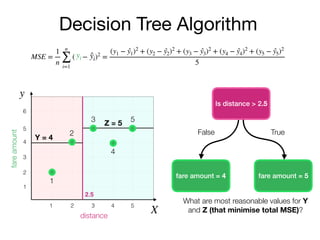
MSE =
1
n
n
∑
i=1
( − )2
=
(y1 − ̂y1)2
+ (y2 − ̂y2)2
+ (y3 − ̂y3)2
+ (y4 − ̂y4)2
+ (y5 − ̂y5)2
5
yi ̂yi
1
2
3
4
5
Decision Tree Algorithm
Is distance > 2.5
y
X
fareamount
distance
2
3
4
5
6
1
1 2 3 4 5
fare amount = 4 fare amount = 5
False True
2.5
What are most reasonable values for Y
and Z (that minimise total MSE)?
Y = 4
Z = 5
MSE =
1
n
n
∑
i=1
( − )2
=
(y1 − ̂y1)2
+ (y2 − ̂y2)2
+ (y3 − ̂y3)2
+ (y4 − ̂y4)2
+ (y5 − ̂y5)2
5
yi ̂yi
1
2
3
4
5
Decision Tree Algorithm
Is distance > 2.5
y
X
fareamount
distance
2
3
4
5
6
1
1 2 3 4 5
fare amount = 4 fare amount = 5
False True
2.5
What are most reasonable values for Y
and Z (that minimise total MSE)?
Y = 4
Z = 5
MSE =
1
n
n
∑
i=1
( − )2
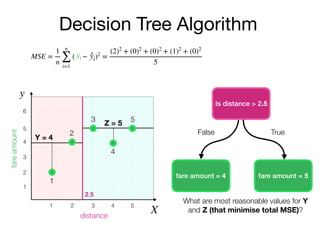
=
(2)2
+ (0)2
+ (0)2
+ (1)2
+ (0)2
5
yi ̂yi
1
2
3
4
5
Decision Tree Algorithm
Is distance > 2.5
y
X
fareamount
distance
2
3
4
5
6
1
1 2 3 4 5
fare amount = 4 fare amount = 5
False True
2.5
What are most reasonable values for Y
and Z (that minimise total MSE)?
Y = 4
Z = 5
MSE =
1
n
n
∑
i=1
( − )2
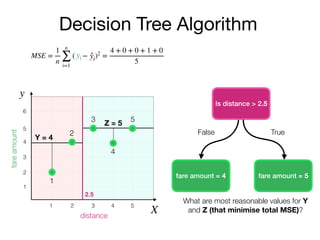
=
4 + 0 + 0 + 1 + 0
5
yi ̂yi
1
2
3
4
5
Decision Tree Algorithm
Is distance > 2.5
y
X
fareamount
distance
2
3
4
5
6
1
1 2 3 4 5
fare amount = 4 fare amount = 5
False True
2.5
What are most reasonable values for Y
and Z (that minimise total MSE)?
Y = 4
Z = 5
MSE =
1
n
n
∑
i=1
( − )2
=
5
5
yi ̂yi
1
2
3
4
5
Decision Tree Algorithm
Is distance > 2.5
y
X
fareamount
distance
2
3
4
5
6
1
1 2 3 4 5
fare amount = 4 fare amount = 5
False True
2.5
What are most reasonable values for Y
and Z (that minimise total MSE)?
Y = 4
Z = 5
MSE =
1
n
n
∑
i=1
( − )2
= 1yi ̂yi
1
2
3
4
5
Decision Tree Algorithm
Is distance > 2.5
y
X
fareamount
distance
2
3
4
5
6
1
1 2 3 4 5
fare amount = 4 fare amount = 5
False True
2.5
What are most reasonable values for Y
and Z (that minimise total MSE)?
Y = 4
Z = 5
MSE =
1
n
n
∑
i=1
( − )2
= 1yi ̂yi
1
2
3
4
5
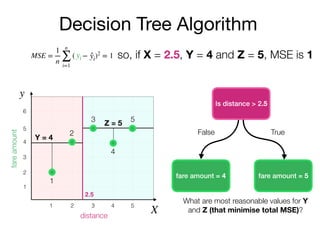
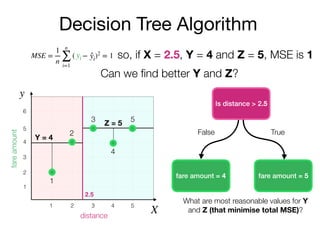
so, if X = 2.5, Y = 4 and Z = 5, MSE is 1
Decision Tree Algorithm
Is distance > 2.5
y
X
fareamount
distance
2
3
4
5
6
1
1 2 3 4 5
fare amount = 4 fare amount = 5
False True
2.5
What are most reasonable values for Y
and Z (that minimise total MSE)?
Y = 4
Z = 5
MSE =
1
n
n
∑
i=1
( − )2
= 1yi ̂yi
1
2
3
4
5
Can we find better Y and Z?
so, if X = 2.5, Y = 4 and Z = 5, MSE is 1
Decision Tree Algorithm
Is distance > 2.5
y
X
fareamount
distance
2
3
4
5
6
1
1 2 3 4 5
fare amount = 3 fare amount = 5
False True
2.5
What are most reasonable values for Y
and Z (that minimise total MSE)?
Y = 3
Z = 5
1
2
3
4
5
MSE =
1
n
n
∑
i=1
( − )2
=
(y1 − ̂y1)2
+ (y2 − ̂y2)2
+ (y3 − ̂y3)2
+ (y4 − ̂y4)2
+ (y5 − ̂y5)2
5
yi ̂yi
Decision Tree Algorithm
Is distance > 2.5
y
X
fareamount
distance
2
3
4
5
6
1
1 2 3 4 5
fare amount = 3 fare amount = 5
False True
2.5
What are most reasonable values for Y
and Z (that minimise total MSE)?
Y = 3
Z = 5
1
2
3
4
5
MSE =
1
n
n
∑
i=1
( − )2
=
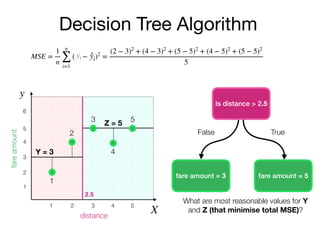
(2 − 3)2
+ (4 − 3)2
+ (5 − 5)2
+ (4 − 5)2
+ (5 − 5)2
5
yi ̂yi
Decision Tree Algorithm
Is distance > 2.5
y
X
fareamount
distance
2
3
4
5
6
1
1 2 3 4 5
fare amount = 3 fare amount = 5
False True
2.5
What are most reasonable values for Y
and Z (that minimise total MSE)?
Y = 3
Z = 5
1
2
3
4
5
MSE =
1
n
n
∑
i=1
( − )2
=
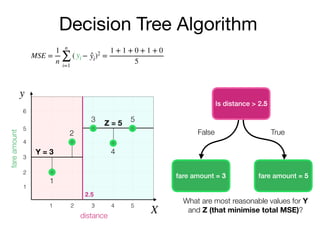
1 + 1 + 0 + 1 + 0
5
yi ̂yi
Decision Tree Algorithm
Is distance > 2.5
y
X
fareamount
distance
2
3
4
5
6
1
1 2 3 4 5
fare amount = 3 fare amount = 5
False True
2.5
What are most reasonable values for Y
and Z (that minimise total MSE)?
Y = 3
Z = 5
1
2
3
4
5
MSE =
1
n
n
∑
i=1
( − )2
=
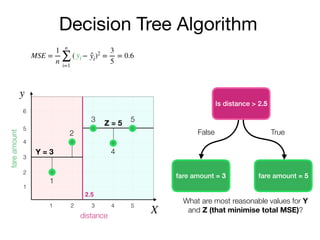
3
5
= 0.6yi ̂yi
Decision Tree Algorithm
Is distance > 2.5
y
X
fareamount
distance
2
3
4
5
6
1
1 2 3 4 5
fare amount = 3 fare amount = 5
False True
2.5
What are most reasonable values for Y
and Z (that minimise total MSE)?
Y = 3
Z = 5
1
2
3
4
5
MSE =
1
n
n
∑
i=1
( − )2
=
3
5
= 0.6yi ̂yi
so, if X = 2.5, Y = 3 and Z = 5,
MSE is 0.6
Decision Tree Algorithm
Is distance > 2.5
y
X
fareamount
distance
2
3
4
5
6
1
1 2 3 4 5
fare amount = 3
fare amount =
4.5
False True
2.5
What are most reasonable values for Y
and Z (that minimise total MSE)?
Y = 3
Z = 4.66
1
2
3
4
5
MSE =
1
n
n
∑
i=1
( − )2
=
(2 − 3)2
+ (4 − 3)2
+ (5 − 4.66)2
+ (4 − 4.66)2
+ (5 − 4.66)2
5
yi ̂yi
Decision Tree Algorithm
Is distance > 2.5
y
X
fareamount
distance
2
3
4
5
6
1
1 2 3 4 5
fare amount = 3
fare amount =
4.5
False True
2.5
What are most reasonable values for Y
and Z (that minimise total MSE)?
Y = 3
1
2
3
4
5
MSE =
1
n
n
∑
i=1
( − )2
=
1 + 1 + 0.12 + 0.43 + 0.12
5
yi ̂yi
Z = 4.66
Decision Tree Algorithm
Is distance > 2.5
y
X
fareamount
distance
2
3
4
5
6
1
1 2 3 4 5
fare amount = 3
fare amount =
4.5
False True
2.5
Y = 3
1
2
3
4
5
MSE =
1
n
n
∑
i=1
( − )2
=
2.67
5
= 0.53yi ̂yi so, if Y = 3 and Z = 4.5,
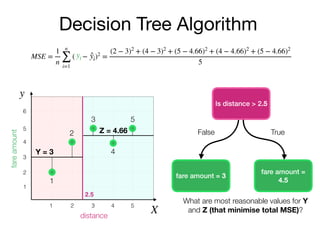
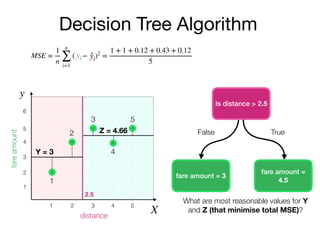
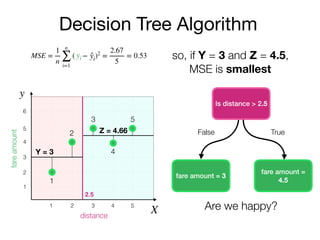
MSE is smallest
Are we happy?
Z = 4.66
Decision Tree Algorithm
Is distance > 2.5
fare amount = 3
fare amount =
4.5
False True
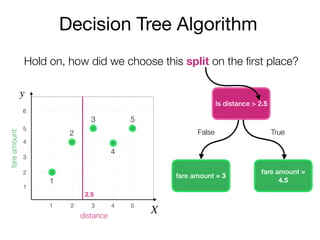
Hold on, how did we choose this split on the first place?
y
X
fareamount
distance
2
3
4
5
6
1
1 2 3 4 5
2.5
1
2
3
4
5
Decision Tree Algorithm
Is distance > 2.5
y
X
fareamount
distance
2
3
4
5
6
1
1 2 3 4 5
fare amount = 3
fare amount =
4.5
False True
2.5
1
2
3
4
5
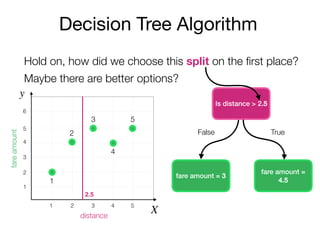
Hold on, how did we choose this split on the first place?
Maybe there are better options?
Decision Tree Algorithm
Is distance > X
y
X
fareamount
distance
2
3
4
5
6
1
1 2 3 4 5
fare amount = Y fare amount = Z
False True
1
2
3
4
5
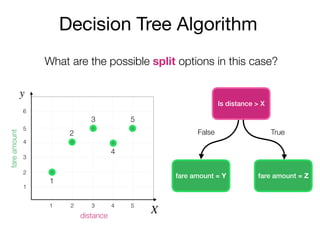
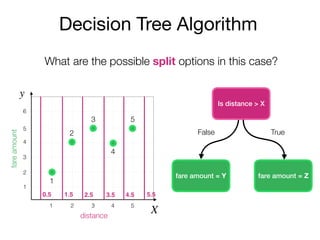
What are the possible split options in this case?
Decision Tree Algorithm
Is distance > X
y
X
fareamount
distance
2
3
4
5
6
1
1 2 3 4 5
fare amount = Y fare amount = Z
False True
1
2
3
4
5
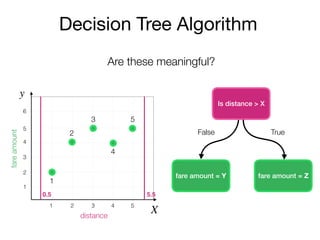
What are the possible split options in this case?
0.5 1.5 2.5 3.5 4.5 5.5
Decision Tree Algorithm
Is distance > X
y
X
fareamount
distance
2
3
4
5
6
1
1 2 3 4 5
fare amount = Y fare amount = Z
False True
1
2
3
4
5
Are these meaningful?
0.5 5.5
Decision Tree Algorithm
Is distance > X
y
X
fareamount
distance
2
3
4
5
6
1
1 2 3 4 5
fare amount = Y fare amount = Z
False True
1
2
3
4
5
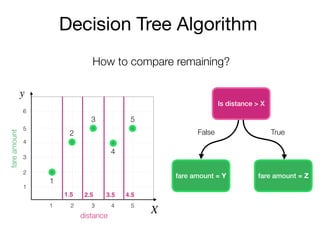
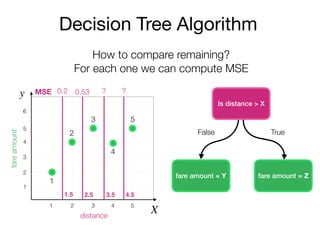
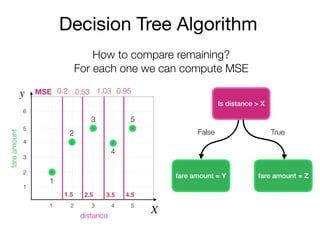
How to compare remaining?
1.5 2.5 3.5 4.5
Decision Tree Algorithm
Is distance > X
y
X
fareamount
distance
2
3
4
5
6
1
1 2 3 4 5
fare amount = Y fare amount = Z
False True
1
2
3
4
5
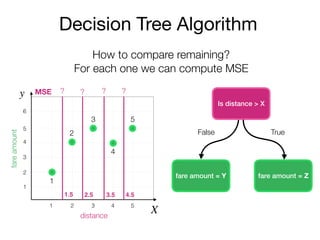
How to compare remaining?
For each one we can compute MSE
?? ? ?MSE
1.5 2.5 3.5 4.5
Decision Tree Algorithm
Is distance > X
y
X
fareamount
distance
2
3
4
5
6
1
1 2 3 4 5
fare amount = Y fare amount = Z
False True
1
2
3
4
5
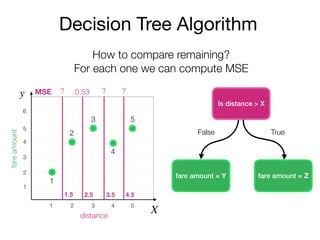
How to compare remaining?
For each one we can compute MSE
0.53? ? ?
1.5 2.5 3.5 4.5
MSE
Decision Tree Algorithm
Is distance > X
y
X
fareamount
distance
2
3
4
5
6
1
1 2 3 4 5
fare amount = Y fare amount = Z
False True
1
2
3
4
5
?
Y = 2
Z = 4.5
1.5
MSE
Decision Tree Algorithm
Is distance > X
y
X
fareamount
distance
2
3
4
5
6
1
1 2 3 4 5
fare amount = Y fare amount = Z
False True
1
2
3
4
5
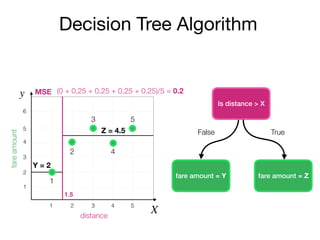
(0 + 0.25 + 0.25 + 0.25 + 0.25)/5 = 0.2
Y = 2
Z = 4.5
1.5
MSE
Decision Tree Algorithm
Is distance > X
y
X
fareamount
distance
2
3
4
5
6
1
1 2 3 4 5
fare amount = Y fare amount = Z
False True
1
2
3
4
5
How to compare remaining?
For each one we can compute MSE
0.2 ? ?
1.5 2.5 3.5 4.5
MSE 0.53
Decision Tree Algorithm
Is distance > X
y
X
fareamount
distance
2
3
4
5
6
1
1 2 3 4 5
fare amount = Y fare amount = Z
False True
1
2
3
4
5
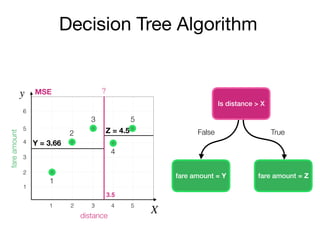
?
3.5
MSE
Y = 3.66
Z = 4.5
Decision Tree Algorithm
Is distance > X
y
X
fareamount
distance
2
3
4
5
6
1
1 2 3 4 5
fare amount = Y fare amount = Z
False True
1
2
3
4
5
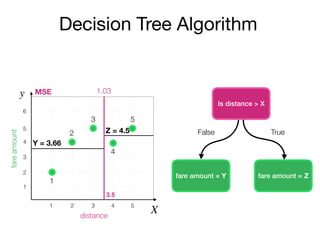
1.03
3.5
MSE
Y = 3.66
Z = 4.5
Decision Tree Algorithm
Is distance > X
y
X
fareamount
distance
2
3
4
5
6
1
1 2 3 4 5
fare amount = Y fare amount = Z
False True
1
2
3
4
5
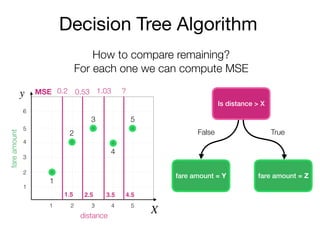
How to compare remaining?
For each one we can compute MSE
0.2 1.03 ?
1.5 2.5 3.5 4.5
MSE 0.53
Decision Tree Algorithm
Is distance > X
y
X
fareamount
distance
2
3
4
5
6
1
1 2 3 4 5
fare amount = Y fare amount = Z
False True
1
2
3
4
5
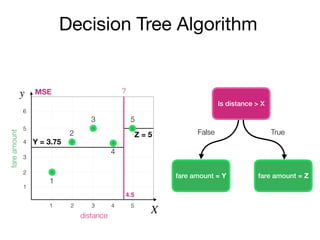
?
4.5
MSE
Y = 3.75
Z = 5
Decision Tree Algorithm
Is distance > X
y
X
fareamount
distance
2
3
4
5
6
1
1 2 3 4 5
fare amount = Y fare amount = Z
False True
1
2
3
4
5
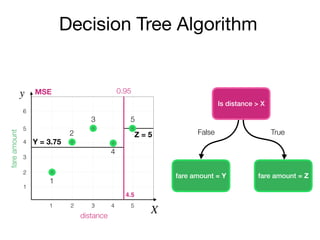
0.95
4.5
MSE
Y = 3.75
Z = 5
Decision Tree Algorithm
Is distance > X
y
X
fareamount
distance
2
3
4
5
6
1
1 2 3 4 5
fare amount = Y fare amount = Z
False True
1
2
3
4
5
How to compare remaining?
For each one we can compute MSE
0.2 1.03 0.95
1.5 2.5 3.5 4.5
MSE 0.53
Decision Tree Algorithm
Is distance > X
y
X
fareamount
distance
2
3
4
5
6
1
1 2 3 4 5
fare amount = Y fare amount = Z
False True
1
2
3
4
5
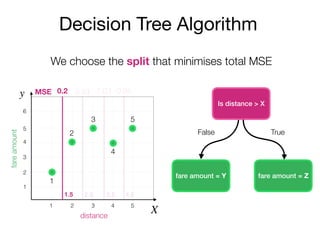
We choose the split that minimises total MSE
0.2 1.03 0.95
1.5 2.5 3.5 4.5
MSE 0.53
Decision Tree Algorithm
Is distance > 1.5
y
X
fareamount
distance
2
3
4
5
6
1
1 2 3 4 5
fare amount = 2
fare amount =
4.5
False True
1
2
3
4
5
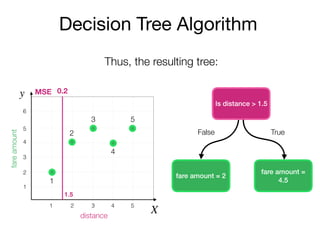
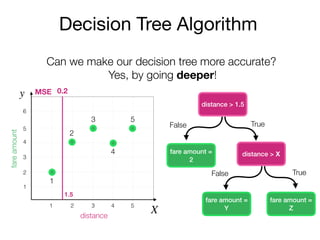
Thus, the resulting tree:
0.2
1.5
MSE
Decision Tree Algorithm
Is distance > 1.5
y
X
fareamount
distance
2
3
4
5
6
1
1 2 3 4 5
fare amount = 2
fare amount =
4.5
False True
1
2
3
4
5
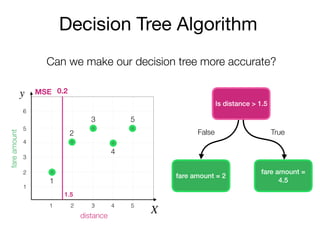
Can we make our decision tree more accurate?
0.2
1.5
MSE
Decision Tree Algorithm
distance > 1.5
y
X
fareamount
distance
2
3
4
5
6
1
1 2 3 4 5
False True
1
2
3
4
5
Can we make our decision tree more accurate?
0.2
1.5
MSE
Yes, by going deeper!
fare amount =
2
distance > X
fare amount =
Y
fare amount =
Z
False True
Decision Tree Algorithm
distance > 1.5
y
X
fareamount
distance
2
3
4
5
6
1
1 2 3 4 5
False True
1
2
3
4
5
Can we make our decision tree more accurate?
0.2
1.5
MSE
Yes, by going deeper!
fare amount =
2
distance > X
fare amount =
Y
fare amount =
Z
False True
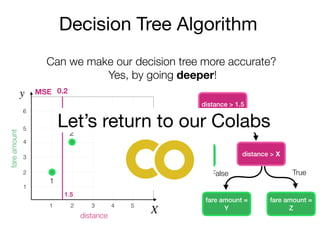
Let’s return to our Colabs
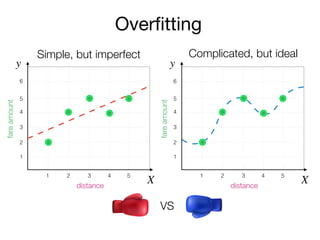
Overfitting
y
X
fareamount
distance
2
3
4
5
6
1
1 2 3 4 5
y
X
fareamount
distance
2
3
4
5
6
1
1 2 3 4 5
Simple, but imperfect Complicated, but ideal
VS
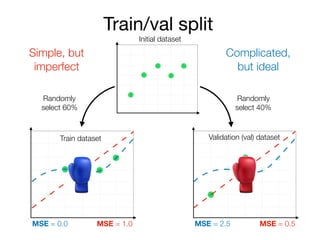
Train/val split
Initial dataset
MSE = 1.0
Train dataset
Randomly
select 60%
MSE = 0.0
Simple, but
imperfect
Complicated,
but ideal
Validation (val) dataset
Randomly
select 40%
MSE = 2.5 MSE = 0.5
POINTS
POINTS
1. MACHINE LEARNING
MODEL IS NOT MAGIC

2. YOU CAN SAVE AND
LOAD ML MODELS

3. EVALUATING MODEL
PERFORMANCE IS
IMPORTANT

4. YOU MAY NEED TO
RETRAIN YOUR
MODELS
THANK YOU

Introduction to Machine Learning for Taxify/Bolt

  • 1.
    INTRO TO MACHINELEARNING 150 MIN 5.0 DMYTRO FISHMAN UNIVERSITY OF TARTU INSTITUTE OF COMPUTER SCIENCE
  • 2.
    New York CityTaxi Fare Prediction https://www.kaggle.com/c/new-york-city-taxi-fare-prediction
  • 3.
    x y -0.8 0.2 -0.6 -0.4 -0.2 0.0 0.4 0.6 -0.75 -0.50 -0.250.00 0.25 0.50 0.75 1.00 type in your browser: tinyurl.com/yxb5k5jl (save a copy to your drive)
  • 4.
    The following slidesare inspired by “An Introduction to Linear Regression Analysis” video https://youtu.be/zPG4NjIkCjc
  • 5.
  • 6.
    y X independent variable dependentvariable Linear Regression Howthe change in independent variable influences dependent variable?
  • 7.
  • 8.
  • 9.
    y X independent variable dependentvariable Linear Regression Inorder to build a linear regression we need observations
  • 10.
    y X independent variable dependentvariable In orderto build a linear regression we need observations Linear Regression
  • 11.
  • 12.
    y X independent variable dependentvariable Wewant to find a line such that … Linear Regression
  • 13.
    y X independent variable dependentvariable Wewant to find a line such that … … it minimises the sum of errors Linear Regression
  • 14.
    y X independent variable dependentvariable actual estimated error We wantto find a line such that … … it minimises the sum of errors Linear Regression
  • 15.
    y X independent variable dependentvariable arg min= n ∑ i=1 ( − )2yi ̂yi Regression Line Least squares method We want to find a line such that … … it minimises the sum of errors Linear Regression
  • 16.
  • 17.
  • 18.
  • 19.
    y X fareamount xw0 w1+= arg min , = n ∑ i=1 (− )2yi ̂yi w0 w1 distance ̂y Linear Regression minimises the sum of errors with respect to w0 and w1w0 w1
  • 20.
    y X fareamount Linear Regression (example) distance 2 3 4 5 6 1 12 3 4 5 x y x - x̄ y - ȳ (x - x̄ )2 (x - x̄ )(y - ȳ) 1 2 -2 -2 4 4 2 4 -1 0 1 0 3 5 0 1 0 0 4 4 1 0 1 0 5 5 2 1 4 2 x̄ = 3 ȳ = 4 10 6 xw0 w1+=̂y w1 3w0 .6+=4 * w0 = 2.2 2.2 = ∑ (x − x)(y − y) ∑ (x − x)2 = 6 10 = .6
  • 21.
    = ∑ (x −x)(y − y) ∑ (x − x)2 = 6 10 = .6 y X fareamount Linear Regression (example) distance 2 3 4 5 6 1 1 2 3 4 5 x y x - x̄ y - ȳ (x - x̄ )2 (x - x̄ )(y - ȳ) 1 2 -2 -2 4 4 2 4 -1 0 1 0 3 5 0 1 0 0 4 4 1 0 1 0 5 5 2 1 4 2 x̄ = 3 ȳ = 4 10 6 xw0 w1+=̂y w1 3w0 .6+=4 * w0 = 2.2 2.2 Let’s return to our Colabs
  • 22.
    Decision Tree Algorithm Byasking a simple question about value of independent variable it tries to predict a value of dependent variable
  • 23.
    Decision Tree Algorithm Byasking a simple question about value of independent variable it tries to predict a value of dependent variable y X fareamount distance 2 3 4 5 6 1 1 2 3 4 5
  • 24.
    Decision Tree Algorithm Byasking a simple question about value of independent variable it tries to predict a value of dependent variable Is distance > X y X fareamount distance 2 3 4 5 6 1 1 2 3 4 5
  • 25.
    Decision Tree Algorithm Byasking a simple question about value of independent variable it tries to predict a value of dependent variable Is distance > X y X fareamount distance 2 3 4 5 6 1 1 2 3 4 5 fare amount = Y False
  • 26.
    Decision Tree Algorithm Byasking a simple question about value of independent variable it tries to predict a value of dependent variable Is distance > X y X fareamount distance 2 3 4 5 6 1 1 2 3 4 5 fare amount = Y fare amount = Z False True
  • 27.
    Decision Tree Algorithm Byasking a simple question about value of independent variable it tries to predict a value of dependent variable Is distance > X y X fareamount distance 2 3 4 5 6 1 1 2 3 4 5 fare amount = Y fare amount = Z False True Root node
  • 28.
    Decision Tree Algorithm Byasking a simple question about value of independent variable it tries to predict a value of dependent variable Is distance > X y X fareamount distance 2 3 4 5 6 1 1 2 3 4 5 fare amount = Y fare amount = Z False True Root node Left child Right child
  • 29.
    Decision Tree Algorithm Byasking a simple question about value of independent variable it tries to predict a value of dependent variable Is distance > X y X fareamount distance 2 3 4 5 6 1 1 2 3 4 5 fare amount = Y fare amount = Z False True Root node Left child Right child Leafs
  • 30.
    Decision Tree Algorithm Byasking a simple question about value of independent variable it tries to predict a value of dependent variable Is distance > X y X fareamount distance 2 3 4 5 6 1 1 2 3 4 5 fare amount = Y fare amount = Z False True
  • 31.
    Decision Tree Algorithm Here,X may correspond to any vertical line. Is distance > 2.5 y X fareamount distance 2 3 4 5 6 1 1 2 3 4 5 fare amount = Y fare amount = Z False True For example if X = 2.5: 2.5
  • 32.
    Decision Tree Algorithm Here,X may correspond to any vertical line. Is distance > 2.5 y X fareamount distance 2 3 4 5 6 1 1 2 3 4 5 fare amount = Y fare amount = Z False True For example if X = 2.5: 2.5 What are most reasonable values for Y and Z?
  • 33.
    Decision Tree Algorithm Here,X may correspond to any vertical line. Is distance > 2.5 y X fareamount distance 2 3 4 5 6 1 1 2 3 4 5 fare amount = Y fare amount = Z False True For example if X = 2.5: 2.5 What are most reasonable values for Y and Z (that minimise total MSE)?
  • 34.
    Decision Tree Algorithm Whatwould be MSE if Y = 4 and Z = 5? Is distance > 2.5 y X fareamount distance 2 3 4 5 6 1 1 2 3 4 5 fare amount = 4 fare amount = 5 False True For example if X = 2.5: 2.5 What are most reasonable values for Y and Z (that minimise total MSE)? Y = 4 Z = 5
  • 35.
    Decision Tree Algorithm Isdistance > 2.5 y X fareamount distance 2 3 4 5 6 1 1 2 3 4 5 fare amount = 4 fare amount = 5 False True 2.5 What are most reasonable values for Y and Z (that minimise total MSE)? Y = 4 Z = 5 yi ̂yiMSE = 1 n n ∑ i=1 ( − )2
  • 36.
    Decision Tree Algorithm Isdistance > 2.5 y X fareamount distance 2 3 4 5 6 1 1 2 3 4 5 fare amount = 4 fare amount = 5 False True 2.5 What are most reasonable values for Y and Z (that minimise total MSE)? Y = 4 Z = 5 yi ̂yiMSE = 1 n n ∑ i=1 ( − )2 real value predicted value
  • 37.
    Decision Tree Algorithm Isdistance > 2.5 y X fareamount distance 2 3 4 5 6 1 1 2 3 4 5 fare amount = 4 fare amount = 5 False True 2.5 What are most reasonable values for Y and Z (that minimise total MSE)? Y = 4 Z = 5 MSE = 1 n n ∑ i=1 ( − )2 = (y1 − ̂y1)2 + (y2 − ̂y2)2 + (y3 − ̂y3)2 + (y4 − ̂y4)2 + (y5 − ̂y5)2 5 yi ̂yi 1 2 3 4 5
  • 38.
    Decision Tree Algorithm Isdistance > 2.5 y X fareamount distance 2 3 4 5 6 1 1 2 3 4 5 fare amount = 4 fare amount = 5 False True 2.5 What are most reasonable values for Y and Z (that minimise total MSE)? Y = 4 Z = 5 MSE = 1 n n ∑ i=1 ( − )2 = (y1 − ̂y1)2 + (y2 − ̂y2)2 + (y3 − ̂y3)2 + (y4 − ̂y4)2 + (y5 − ̂y5)2 5 yi ̂yi 1 2 3 4 5
  • 39.
    Decision Tree Algorithm Isdistance > 2.5 y X fareamount distance 2 3 4 5 6 1 1 2 3 4 5 fare amount = 4 fare amount = 5 False True 2.5 What are most reasonable values for Y and Z (that minimise total MSE)? Y = 4 Z = 5 MSE = 1 n n ∑ i=1 ( − )2 = (2)2 + (0)2 + (0)2 + (1)2 + (0)2 5 yi ̂yi 1 2 3 4 5
  • 40.
    Decision Tree Algorithm Isdistance > 2.5 y X fareamount distance 2 3 4 5 6 1 1 2 3 4 5 fare amount = 4 fare amount = 5 False True 2.5 What are most reasonable values for Y and Z (that minimise total MSE)? Y = 4 Z = 5 MSE = 1 n n ∑ i=1 ( − )2 = 4 + 0 + 0 + 1 + 0 5 yi ̂yi 1 2 3 4 5
  • 41.
    Decision Tree Algorithm Isdistance > 2.5 y X fareamount distance 2 3 4 5 6 1 1 2 3 4 5 fare amount = 4 fare amount = 5 False True 2.5 What are most reasonable values for Y and Z (that minimise total MSE)? Y = 4 Z = 5 MSE = 1 n n ∑ i=1 ( − )2 = 5 5 yi ̂yi 1 2 3 4 5
  • 42.
    Decision Tree Algorithm Isdistance > 2.5 y X fareamount distance 2 3 4 5 6 1 1 2 3 4 5 fare amount = 4 fare amount = 5 False True 2.5 What are most reasonable values for Y and Z (that minimise total MSE)? Y = 4 Z = 5 MSE = 1 n n ∑ i=1 ( − )2 = 1yi ̂yi 1 2 3 4 5
  • 43.
    Decision Tree Algorithm Isdistance > 2.5 y X fareamount distance 2 3 4 5 6 1 1 2 3 4 5 fare amount = 4 fare amount = 5 False True 2.5 What are most reasonable values for Y and Z (that minimise total MSE)? Y = 4 Z = 5 MSE = 1 n n ∑ i=1 ( − )2 = 1yi ̂yi 1 2 3 4 5 so, if X = 2.5, Y = 4 and Z = 5, MSE is 1
  • 44.
    Decision Tree Algorithm Isdistance > 2.5 y X fareamount distance 2 3 4 5 6 1 1 2 3 4 5 fare amount = 4 fare amount = 5 False True 2.5 What are most reasonable values for Y and Z (that minimise total MSE)? Y = 4 Z = 5 MSE = 1 n n ∑ i=1 ( − )2 = 1yi ̂yi 1 2 3 4 5 Can we find better Y and Z? so, if X = 2.5, Y = 4 and Z = 5, MSE is 1
  • 45.
    Decision Tree Algorithm Isdistance > 2.5 y X fareamount distance 2 3 4 5 6 1 1 2 3 4 5 fare amount = 3 fare amount = 5 False True 2.5 What are most reasonable values for Y and Z (that minimise total MSE)? Y = 3 Z = 5 1 2 3 4 5 MSE = 1 n n ∑ i=1 ( − )2 = (y1 − ̂y1)2 + (y2 − ̂y2)2 + (y3 − ̂y3)2 + (y4 − ̂y4)2 + (y5 − ̂y5)2 5 yi ̂yi
  • 46.
    Decision Tree Algorithm Isdistance > 2.5 y X fareamount distance 2 3 4 5 6 1 1 2 3 4 5 fare amount = 3 fare amount = 5 False True 2.5 What are most reasonable values for Y and Z (that minimise total MSE)? Y = 3 Z = 5 1 2 3 4 5 MSE = 1 n n ∑ i=1 ( − )2 = (2 − 3)2 + (4 − 3)2 + (5 − 5)2 + (4 − 5)2 + (5 − 5)2 5 yi ̂yi
  • 47.
    Decision Tree Algorithm Isdistance > 2.5 y X fareamount distance 2 3 4 5 6 1 1 2 3 4 5 fare amount = 3 fare amount = 5 False True 2.5 What are most reasonable values for Y and Z (that minimise total MSE)? Y = 3 Z = 5 1 2 3 4 5 MSE = 1 n n ∑ i=1 ( − )2 = 1 + 1 + 0 + 1 + 0 5 yi ̂yi
  • 48.
    Decision Tree Algorithm Isdistance > 2.5 y X fareamount distance 2 3 4 5 6 1 1 2 3 4 5 fare amount = 3 fare amount = 5 False True 2.5 What are most reasonable values for Y and Z (that minimise total MSE)? Y = 3 Z = 5 1 2 3 4 5 MSE = 1 n n ∑ i=1 ( − )2 = 3 5 = 0.6yi ̂yi
  • 49.
    Decision Tree Algorithm Isdistance > 2.5 y X fareamount distance 2 3 4 5 6 1 1 2 3 4 5 fare amount = 3 fare amount = 5 False True 2.5 What are most reasonable values for Y and Z (that minimise total MSE)? Y = 3 Z = 5 1 2 3 4 5 MSE = 1 n n ∑ i=1 ( − )2 = 3 5 = 0.6yi ̂yi so, if X = 2.5, Y = 3 and Z = 5, MSE is 0.6
  • 50.
    Decision Tree Algorithm Isdistance > 2.5 y X fareamount distance 2 3 4 5 6 1 1 2 3 4 5 fare amount = 3 fare amount = 4.5 False True 2.5 What are most reasonable values for Y and Z (that minimise total MSE)? Y = 3 Z = 4.66 1 2 3 4 5 MSE = 1 n n ∑ i=1 ( − )2 = (2 − 3)2 + (4 − 3)2 + (5 − 4.66)2 + (4 − 4.66)2 + (5 − 4.66)2 5 yi ̂yi
  • 51.
    Decision Tree Algorithm Isdistance > 2.5 y X fareamount distance 2 3 4 5 6 1 1 2 3 4 5 fare amount = 3 fare amount = 4.5 False True 2.5 What are most reasonable values for Y and Z (that minimise total MSE)? Y = 3 1 2 3 4 5 MSE = 1 n n ∑ i=1 ( − )2 = 1 + 1 + 0.12 + 0.43 + 0.12 5 yi ̂yi Z = 4.66
  • 52.
    Decision Tree Algorithm Isdistance > 2.5 y X fareamount distance 2 3 4 5 6 1 1 2 3 4 5 fare amount = 3 fare amount = 4.5 False True 2.5 Y = 3 1 2 3 4 5 MSE = 1 n n ∑ i=1 ( − )2 = 2.67 5 = 0.53yi ̂yi so, if Y = 3 and Z = 4.5, MSE is smallest Are we happy? Z = 4.66
  • 53.
    Decision Tree Algorithm Isdistance > 2.5 fare amount = 3 fare amount = 4.5 False True Hold on, how did we choose this split on the first place? y X fareamount distance 2 3 4 5 6 1 1 2 3 4 5 2.5 1 2 3 4 5
  • 54.
    Decision Tree Algorithm Isdistance > 2.5 y X fareamount distance 2 3 4 5 6 1 1 2 3 4 5 fare amount = 3 fare amount = 4.5 False True 2.5 1 2 3 4 5 Hold on, how did we choose this split on the first place? Maybe there are better options?
  • 55.
    Decision Tree Algorithm Isdistance > X y X fareamount distance 2 3 4 5 6 1 1 2 3 4 5 fare amount = Y fare amount = Z False True 1 2 3 4 5 What are the possible split options in this case?
  • 56.
    Decision Tree Algorithm Isdistance > X y X fareamount distance 2 3 4 5 6 1 1 2 3 4 5 fare amount = Y fare amount = Z False True 1 2 3 4 5 What are the possible split options in this case? 0.5 1.5 2.5 3.5 4.5 5.5
  • 57.
    Decision Tree Algorithm Isdistance > X y X fareamount distance 2 3 4 5 6 1 1 2 3 4 5 fare amount = Y fare amount = Z False True 1 2 3 4 5 Are these meaningful? 0.5 5.5
  • 58.
    Decision Tree Algorithm Isdistance > X y X fareamount distance 2 3 4 5 6 1 1 2 3 4 5 fare amount = Y fare amount = Z False True 1 2 3 4 5 How to compare remaining? 1.5 2.5 3.5 4.5
  • 59.
    Decision Tree Algorithm Isdistance > X y X fareamount distance 2 3 4 5 6 1 1 2 3 4 5 fare amount = Y fare amount = Z False True 1 2 3 4 5 How to compare remaining? For each one we can compute MSE ?? ? ?MSE 1.5 2.5 3.5 4.5
  • 60.
    Decision Tree Algorithm Isdistance > X y X fareamount distance 2 3 4 5 6 1 1 2 3 4 5 fare amount = Y fare amount = Z False True 1 2 3 4 5 How to compare remaining? For each one we can compute MSE 0.53? ? ? 1.5 2.5 3.5 4.5 MSE
  • 61.
    Decision Tree Algorithm Isdistance > X y X fareamount distance 2 3 4 5 6 1 1 2 3 4 5 fare amount = Y fare amount = Z False True 1 2 3 4 5 ? Y = 2 Z = 4.5 1.5 MSE
  • 62.
    Decision Tree Algorithm Isdistance > X y X fareamount distance 2 3 4 5 6 1 1 2 3 4 5 fare amount = Y fare amount = Z False True 1 2 3 4 5 (0 + 0.25 + 0.25 + 0.25 + 0.25)/5 = 0.2 Y = 2 Z = 4.5 1.5 MSE
  • 63.
    Decision Tree Algorithm Isdistance > X y X fareamount distance 2 3 4 5 6 1 1 2 3 4 5 fare amount = Y fare amount = Z False True 1 2 3 4 5 How to compare remaining? For each one we can compute MSE 0.2 ? ? 1.5 2.5 3.5 4.5 MSE 0.53
  • 64.
    Decision Tree Algorithm Isdistance > X y X fareamount distance 2 3 4 5 6 1 1 2 3 4 5 fare amount = Y fare amount = Z False True 1 2 3 4 5 ? 3.5 MSE Y = 3.66 Z = 4.5
  • 65.
    Decision Tree Algorithm Isdistance > X y X fareamount distance 2 3 4 5 6 1 1 2 3 4 5 fare amount = Y fare amount = Z False True 1 2 3 4 5 1.03 3.5 MSE Y = 3.66 Z = 4.5
  • 66.
    Decision Tree Algorithm Isdistance > X y X fareamount distance 2 3 4 5 6 1 1 2 3 4 5 fare amount = Y fare amount = Z False True 1 2 3 4 5 How to compare remaining? For each one we can compute MSE 0.2 1.03 ? 1.5 2.5 3.5 4.5 MSE 0.53
  • 67.
    Decision Tree Algorithm Isdistance > X y X fareamount distance 2 3 4 5 6 1 1 2 3 4 5 fare amount = Y fare amount = Z False True 1 2 3 4 5 ? 4.5 MSE Y = 3.75 Z = 5
  • 68.
    Decision Tree Algorithm Isdistance > X y X fareamount distance 2 3 4 5 6 1 1 2 3 4 5 fare amount = Y fare amount = Z False True 1 2 3 4 5 0.95 4.5 MSE Y = 3.75 Z = 5
  • 69.
    Decision Tree Algorithm Isdistance > X y X fareamount distance 2 3 4 5 6 1 1 2 3 4 5 fare amount = Y fare amount = Z False True 1 2 3 4 5 How to compare remaining? For each one we can compute MSE 0.2 1.03 0.95 1.5 2.5 3.5 4.5 MSE 0.53
  • 70.
    Decision Tree Algorithm Isdistance > X y X fareamount distance 2 3 4 5 6 1 1 2 3 4 5 fare amount = Y fare amount = Z False True 1 2 3 4 5 We choose the split that minimises total MSE 0.2 1.03 0.95 1.5 2.5 3.5 4.5 MSE 0.53
  • 71.
    Decision Tree Algorithm Isdistance > 1.5 y X fareamount distance 2 3 4 5 6 1 1 2 3 4 5 fare amount = 2 fare amount = 4.5 False True 1 2 3 4 5 Thus, the resulting tree: 0.2 1.5 MSE
  • 72.
    Decision Tree Algorithm Isdistance > 1.5 y X fareamount distance 2 3 4 5 6 1 1 2 3 4 5 fare amount = 2 fare amount = 4.5 False True 1 2 3 4 5 Can we make our decision tree more accurate? 0.2 1.5 MSE
  • 73.
    Decision Tree Algorithm distance> 1.5 y X fareamount distance 2 3 4 5 6 1 1 2 3 4 5 False True 1 2 3 4 5 Can we make our decision tree more accurate? 0.2 1.5 MSE Yes, by going deeper! fare amount = 2 distance > X fare amount = Y fare amount = Z False True
  • 74.
    Decision Tree Algorithm distance> 1.5 y X fareamount distance 2 3 4 5 6 1 1 2 3 4 5 False True 1 2 3 4 5 Can we make our decision tree more accurate? 0.2 1.5 MSE Yes, by going deeper! fare amount = 2 distance > X fare amount = Y fare amount = Z False True Let’s return to our Colabs
  • 75.
    Overfitting y X fareamount distance 2 3 4 5 6 1 1 2 34 5 y X fareamount distance 2 3 4 5 6 1 1 2 3 4 5 Simple, but imperfect Complicated, but ideal VS
  • 76.
    Train/val split Initial dataset MSE= 1.0 Train dataset Randomly select 60% MSE = 0.0 Simple, but imperfect Complicated, but ideal Validation (val) dataset Randomly select 40% MSE = 2.5 MSE = 0.5
  • 77.
  • 78.
    POINTS 1. MACHINE LEARNING MODELIS NOT MAGIC 2. YOU CAN SAVE AND LOAD ML MODELS 3. EVALUATING MODEL PERFORMANCE IS IMPORTANT 4. YOU MAY NEED TO RETRAIN YOUR MODELS
  • 79.