1. Leaders are important.
2. Everyone is already a leader.
3. Leadership skills can and should
be developed.
Three Premises on Leadership
1. Reasons for Leadership
2. Requirements of Leadership
3. Roles in Leadership
Leadership Themes
4. Responsibilities of Leadership
5. Risks in Leadership
6. Rewards of Leadership
Leadership Themes
Two main questions about
Leadership
A. What is it?
» Influence:
» Dominance
» Mission focus
B. How is it Measured?
» Followers-How many?
» Empire-Area of influence
» Time-How Long?
What is Leadership?
 The process of moving a group of people in
some direction through non-coercive means.
John Kotter of Harvard Business School
 The ability to capture the attention of people.
Richard Cyert
 Anyone who can gather followers in a
particular situation. Warren Bennis
 “To an extent, leadership is like beauty: it’s
hard to define, but you know it when you see
it.” Warren Bennis
What is Leadership?
 All leadership has a spiritual context.
Peter Vail
Leadership is social influence.
By their IDEAS and DEEDS, leaders
show the way and influence the
behavior of others.
What is Leadership?
Leadership is not magnetic personality
—that can just as well be a glib tongue.
It is not “making friends and influencing
people”—that is flattery. Leadership is
lifting a person’s vision to a higher
standard, the building of a personality
beyond its normal limitations. Peter
Drucker
Dwight David Eisenhower
 Leadership is getting
people to do what you
want them to do
because they want to
do it.
Why Are Leaders
Important?
Dr. Warren Bennis suggests three:
1. Leaders are responsible for the
effectiveness of organizations.
2. Leaders provide anchors in our
lives.
3. Leaders define cultural and
institutional integrity.
People want leaders.
What do Leaders Do?
1. “Create a climate of trust, respect,
innovation, and openness so that everyone
may work effectively.
2. Robert Tucker: Setting goals,
allocating resources,
staffing, delegating
3. Management Texts Often Suggest
a. Planning
b. leading
c. organizing
d. controlling
Three Types of Leaders
 1. Teachers: willing to break the rules
while following their value code.
 2. Heroes: devoted to great causes
and noble works.
 3. Rulers: motivated to use power to
dominate others.
Interaction between
Individual and Environment
Leaders may emerge during times of
crisis (Emergent Leadership)
A certain crisis may call upon skills that
a certain person has and thus they find
themselves in a leadership position.
(military officers during national
emergencies)
Where Do Leaders Learn to Lead?
1. Leaders Learn From Experience
2. Leaders Learn from Example
3. Leaders Learn from Education
What is Desired in a
Leader?
1. Integrity and honesty
2. Job or task knowledge (often these are
organizational skills like goal setting, resource
management, time management, business
strategy.)
3. People building skills (performance
coaching, motivation, mentoring,
communication and human resource skills)
Can Leadership Be Taught?
National Training Director Chris Lee
suggests that Everyone Can:
1. Learn new responsibilities and risks.
2. Learn to build consensus and trust
among social groups.
3. Learn to develop a vision for the future.
4. Learn to better communicate that vision.
Not reaching your goal
is not a tragedy.
The tragedy is not
having a goal.
Benjamin Mays
Leadership or Management
Management involves:
1. Planning
2. Organizing
3. Directing
4. Controlling
Leadership Must Generally Involve:
1. Establishing a Direction
2. Aligning people and resources
3. Energizing people to accomplish results
The Vital Requirements of
Leaders
Consensus of Views Suggests that
Leaders
1. Define the Mission
2. Articulate the Mission
3. Empower Followers
4. Identify the enemy
5. Keep “Hope” Alive
Leaders Dissatisfaction
1. Too much time demanded.
2. Too many personnel and personal problems.
3. Too much responsibility with no real authority.
4. Loneliness
5. Too many people problems
6. Organizational politics
7. The pursuit of conflicting goals.
General Attributes of
Leaders
1. The skillful use of power
2. Understanding follower empowerment
3. Understanding teamwork
4. Good at motivating and coaching
5. Creative problem solver
6. Multicultural skills
7. Conflict resolution skills
8. Good communication skills
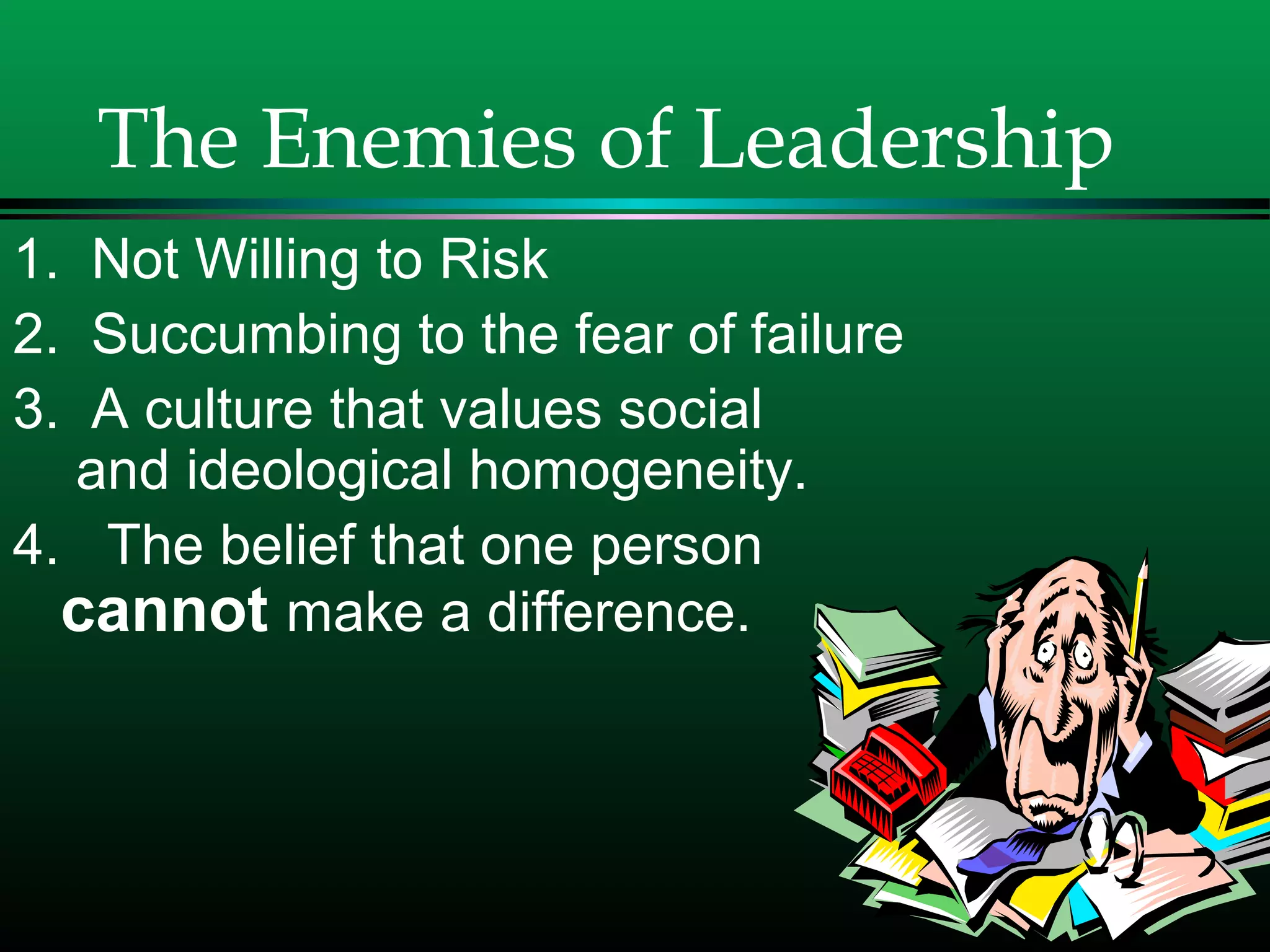
The Enemies of Leadership
1. Not Willing to Risk
2. Succumbing to the fear of failure
3. A culture that values social
and ideological homogeneity.
4. The belief that one person
cannot make a difference.
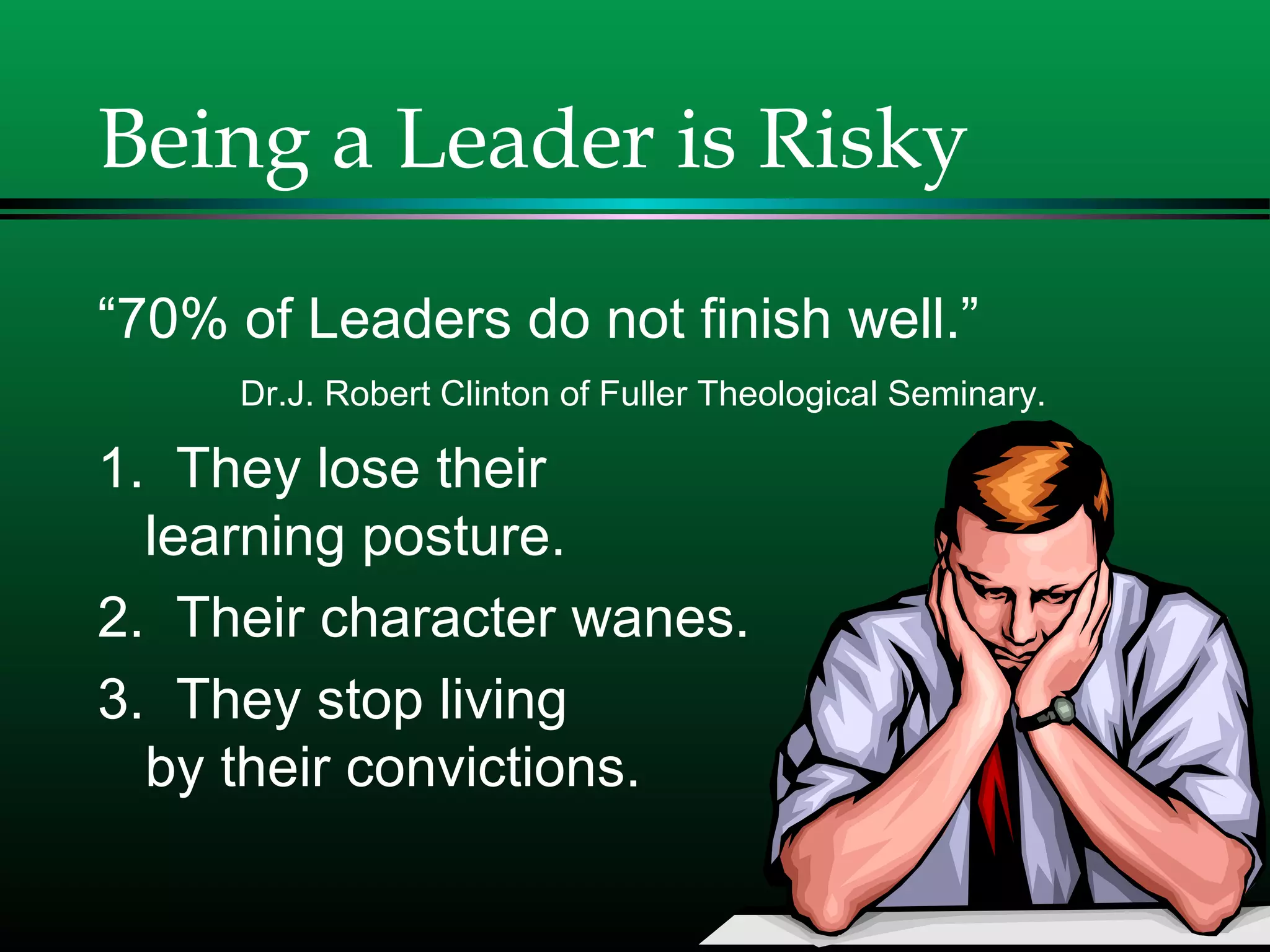
Being a Leader is Risky
“70% of Leaders do not finish well.”
Dr.J. Robert Clinton of Fuller Theological Seminary.
1. They lose their
learning posture.
2. Their character wanes.
3. They stop living
by their convictions.
4. They fail to leave behind ultimate
contributions.
5. They stop walking in awareness of
their influence and destiny.
“A leader whose skills outstrip his
character formation will eventually
falter.”
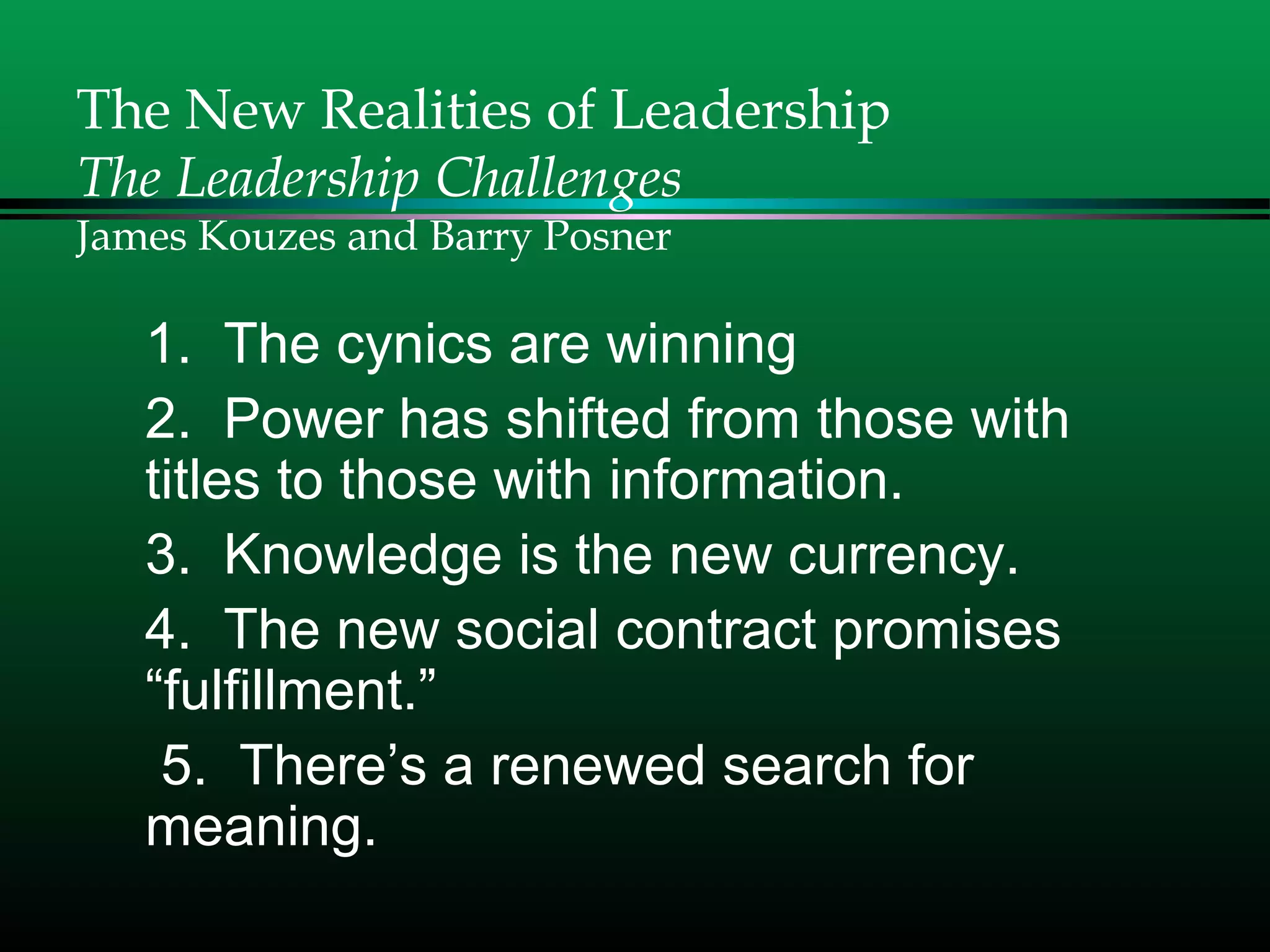
The New Realities of Leadership
The Leadership Challenges
James Kouzes and Barry Posner
1. The cynics are winning
2. Power has shifted from those with
titles to those with information.
3. Knowledge is the new currency.
4. The new social contract promises
“fulfillment.”
5. There’s a renewed search for
meaning.
All our leadership knowledge needs to be
translated into willpower.
Study after study over the past 20 years has
found essentially the same thing: more than
half the organizations who start a change
program fail within 12 months.
Why do you believe this occurs?
Self-determination theory
“Ask any kid why he plays ball and he’ll say
because it’s fun, not because it will help him
stay healthy when he’s 80. That’s the nature
of intrinsic motivation, it’s something done for
its own sake.
That doesn’t mean external rewards aren’t
motivating. It’s that the motivation becomes
dependent upon rewards, and if they’re not
salient enough and not continuous enough,
then the motivation will track that.” – Dr. Ryan
SDT researchers say:
“you’re intrinsically motivated to perform an activity if it
meets three basic needs:
Autonomy – the choice to do it was made by you, not
somebody else.
Competence – you know what you are doing,or are at
least becoming better at it. Repetition helps.
Relatedness – the activity connects you in some way
to other people.
Intrinsic motivation
“What drives most people away from successfully
achieving goals is mental abuse.
Successful programs are powered not by threats,
intimidation or screaming, but by peoples’ natural
passion for being successful.
And when it comes to motivation, internal passion
trounces intimidation any day of the week.”
Leaders have High EI
…What is Emotional Intelligence?
The ability to monitor one’s own and
others emotions, to discriminate among
them, and to use the information to
guide one’s thinking and actions.
Emotional Intelligence Domains
Self Awareness-Ability to understand
your emotions and their effect on others
Self Awareness Competencies–
Emotional self awareness; Accurate
self-assessment; Self confidence
Emotional Intelligence Domains
Self Management-Ability to control
impulses and suspend judgment
“Think before acting”
Self Management Competencies-
Emotional self-control ; Transparency;
Adaptability; Achievement; Initiative;
Optimism
Emotional Intelligence Domains
Social Awareness-Empathy, awareness
of others emotions
Social Awareness Competencies-
Empathy; Organizational awareness ;
Service
Emotional Intelligence Domains
Social Skills-Managing Relations with
others
Relationship Management
Competencies-Inspirational leadership ;
Influence; Developing others; Change
catalyst; Conflict management; Building
bonds ; Teamwork and collaboration
Three Approaches to the
Study Leadership
1. Qualities of the individual
» The “Great Man” theory
» Trait Theory
–Ralph M. Stogdill
2. Environmental factors
» Leadership is viewed as an acquired
competency including an understanding of
how to respond to environment and
circumstance.
Let us try to become EMOTIONALLY
INTELLIGENT
Thank you!

Introduction To Leadership

  • 2.
    1. Leaders areimportant. 2. Everyone is already a leader. 3. Leadership skills can and should be developed. Three Premises on Leadership
  • 3.
    1. Reasons forLeadership 2. Requirements of Leadership 3. Roles in Leadership Leadership Themes
  • 4.
    4. Responsibilities ofLeadership 5. Risks in Leadership 6. Rewards of Leadership Leadership Themes
  • 5.
    Two main questionsabout Leadership A. What is it? » Influence: » Dominance » Mission focus B. How is it Measured? » Followers-How many? » Empire-Area of influence » Time-How Long?
  • 6.
    What is Leadership? The process of moving a group of people in some direction through non-coercive means. John Kotter of Harvard Business School  The ability to capture the attention of people. Richard Cyert  Anyone who can gather followers in a particular situation. Warren Bennis  “To an extent, leadership is like beauty: it’s hard to define, but you know it when you see it.” Warren Bennis
  • 7.
    What is Leadership? All leadership has a spiritual context. Peter Vail Leadership is social influence. By their IDEAS and DEEDS, leaders show the way and influence the behavior of others.
  • 8.
    What is Leadership? Leadershipis not magnetic personality —that can just as well be a glib tongue. It is not “making friends and influencing people”—that is flattery. Leadership is lifting a person’s vision to a higher standard, the building of a personality beyond its normal limitations. Peter Drucker
  • 9.
    Dwight David Eisenhower Leadership is getting people to do what you want them to do because they want to do it.
  • 10.
    Why Are Leaders Important? Dr.Warren Bennis suggests three: 1. Leaders are responsible for the effectiveness of organizations. 2. Leaders provide anchors in our lives. 3. Leaders define cultural and institutional integrity. People want leaders.
  • 11.
    What do LeadersDo? 1. “Create a climate of trust, respect, innovation, and openness so that everyone may work effectively. 2. Robert Tucker: Setting goals, allocating resources, staffing, delegating 3. Management Texts Often Suggest a. Planning b. leading c. organizing d. controlling
  • 12.
    Three Types ofLeaders  1. Teachers: willing to break the rules while following their value code.  2. Heroes: devoted to great causes and noble works.  3. Rulers: motivated to use power to dominate others.
  • 13.
    Interaction between Individual andEnvironment Leaders may emerge during times of crisis (Emergent Leadership) A certain crisis may call upon skills that a certain person has and thus they find themselves in a leadership position. (military officers during national emergencies)
  • 14.
    Where Do LeadersLearn to Lead? 1. Leaders Learn From Experience 2. Leaders Learn from Example 3. Leaders Learn from Education
  • 15.
    What is Desiredin a Leader? 1. Integrity and honesty 2. Job or task knowledge (often these are organizational skills like goal setting, resource management, time management, business strategy.) 3. People building skills (performance coaching, motivation, mentoring, communication and human resource skills)
  • 16.
    Can Leadership BeTaught? National Training Director Chris Lee suggests that Everyone Can: 1. Learn new responsibilities and risks. 2. Learn to build consensus and trust among social groups. 3. Learn to develop a vision for the future. 4. Learn to better communicate that vision.
  • 17.
    Not reaching yourgoal is not a tragedy. The tragedy is not having a goal. Benjamin Mays
  • 18.
    Leadership or Management Managementinvolves: 1. Planning 2. Organizing 3. Directing 4. Controlling Leadership Must Generally Involve: 1. Establishing a Direction 2. Aligning people and resources 3. Energizing people to accomplish results
  • 19.
    The Vital Requirementsof Leaders Consensus of Views Suggests that Leaders 1. Define the Mission 2. Articulate the Mission 3. Empower Followers 4. Identify the enemy 5. Keep “Hope” Alive
  • 20.
    Leaders Dissatisfaction 1. Toomuch time demanded. 2. Too many personnel and personal problems. 3. Too much responsibility with no real authority. 4. Loneliness 5. Too many people problems 6. Organizational politics 7. The pursuit of conflicting goals.
  • 21.
    General Attributes of Leaders 1.The skillful use of power 2. Understanding follower empowerment 3. Understanding teamwork 4. Good at motivating and coaching 5. Creative problem solver 6. Multicultural skills 7. Conflict resolution skills 8. Good communication skills
  • 22.
    The Enemies ofLeadership 1. Not Willing to Risk 2. Succumbing to the fear of failure 3. A culture that values social and ideological homogeneity. 4. The belief that one person cannot make a difference.
  • 23.
    Being a Leaderis Risky “70% of Leaders do not finish well.” Dr.J. Robert Clinton of Fuller Theological Seminary. 1. They lose their learning posture. 2. Their character wanes. 3. They stop living by their convictions.
  • 24.
    4. They failto leave behind ultimate contributions. 5. They stop walking in awareness of their influence and destiny. “A leader whose skills outstrip his character formation will eventually falter.”
  • 25.
    The New Realitiesof Leadership The Leadership Challenges James Kouzes and Barry Posner 1. The cynics are winning 2. Power has shifted from those with titles to those with information. 3. Knowledge is the new currency. 4. The new social contract promises “fulfillment.” 5. There’s a renewed search for meaning.
  • 26.
    All our leadershipknowledge needs to be translated into willpower. Study after study over the past 20 years has found essentially the same thing: more than half the organizations who start a change program fail within 12 months. Why do you believe this occurs?
  • 27.
    Self-determination theory “Ask anykid why he plays ball and he’ll say because it’s fun, not because it will help him stay healthy when he’s 80. That’s the nature of intrinsic motivation, it’s something done for its own sake. That doesn’t mean external rewards aren’t motivating. It’s that the motivation becomes dependent upon rewards, and if they’re not salient enough and not continuous enough, then the motivation will track that.” – Dr. Ryan
  • 28.
    SDT researchers say: “you’reintrinsically motivated to perform an activity if it meets three basic needs: Autonomy – the choice to do it was made by you, not somebody else. Competence – you know what you are doing,or are at least becoming better at it. Repetition helps. Relatedness – the activity connects you in some way to other people.
  • 29.
    Intrinsic motivation “What drivesmost people away from successfully achieving goals is mental abuse. Successful programs are powered not by threats, intimidation or screaming, but by peoples’ natural passion for being successful. And when it comes to motivation, internal passion trounces intimidation any day of the week.”
  • 30.
    Leaders have HighEI …What is Emotional Intelligence? The ability to monitor one’s own and others emotions, to discriminate among them, and to use the information to guide one’s thinking and actions.
  • 31.
    Emotional Intelligence Domains SelfAwareness-Ability to understand your emotions and their effect on others Self Awareness Competencies– Emotional self awareness; Accurate self-assessment; Self confidence
  • 32.
    Emotional Intelligence Domains SelfManagement-Ability to control impulses and suspend judgment “Think before acting” Self Management Competencies- Emotional self-control ; Transparency; Adaptability; Achievement; Initiative; Optimism
  • 33.
    Emotional Intelligence Domains SocialAwareness-Empathy, awareness of others emotions Social Awareness Competencies- Empathy; Organizational awareness ; Service
  • 34.
    Emotional Intelligence Domains SocialSkills-Managing Relations with others Relationship Management Competencies-Inspirational leadership ; Influence; Developing others; Change catalyst; Conflict management; Building bonds ; Teamwork and collaboration
  • 35.
    Three Approaches tothe Study Leadership 1. Qualities of the individual » The “Great Man” theory » Trait Theory –Ralph M. Stogdill 2. Environmental factors » Leadership is viewed as an acquired competency including an understanding of how to respond to environment and circumstance.
  • 36.
    Let us tryto become EMOTIONALLY INTELLIGENT Thank you!