INTRODUCTION TO
JOURNALISTIC
WRITING
WRITING IS:
Practical
Job-Related
Stimulating
Social
Therapeutic
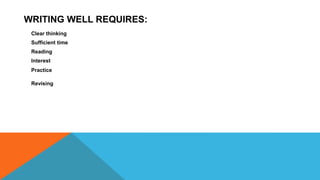
WRITING WELL REQUIRES:
Clear thinking
Sufficient time
Reading
Interest
Practice
Revising
DIFFERENCE
BETWEEN
SPEAKING AND
WRITING
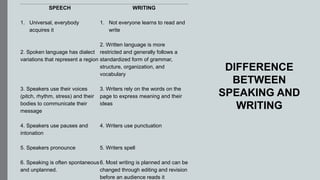
SPEECH
1. Universal, everybody
acquires it
2. Spoken language has dialect
variations that represent a region
3. Speakers use their voices
(pitch, rhythm, stress) and their
bodies to communicate their
message
4. Speakers use pauses and
intonation
5. Speakers pronounce
6. Speaking is often spontaneous
and unplanned.
WRITING
1. Not everyone learns to read and
write
2. Written language is more
restricted and generally follows a
standardized form of grammar,
structure, organization, and
vocabulary
3. Writers rely on the words on the
page to express meaning and their
ideas
4. Writers use punctuation
5. Writers spell
6. Most writing is planned and can be
changed through editing and revision
before an audience reads it
DIFFERENCE
BETWEEN
SPEAKING AND
WRITING
SPEECH
7. Speakers have immediate audiences
who
nod, interrupt, question and comment
8. Speech is usually informal and
repetitive
9. Speakers use simpler sentences
connected by lots of ands and buts.
10. Speakers draw on their listeners
reactions to know how or whether to
continue
11. Speakers can gauge the attitudes,
beliefs, and feelings of their audience
WRITING
7. Writers have a delayed response from
audiences or none at all and have only
one
opportunity to convey their message, be
interesting, informative, accurate and
hold
their reader’s attention
8. Writing on the other hand is more
formal and compact. It progresses more
logically with fewer explanations and
digressions.
9. Writers use more complex sentences
with
connecting words like however, who,
although, and in addition.
10. Writers are often solitary in their
process
11. Writers must consider what and how
much their audience needs to know
JOURNALISTIC WRITING
News style (also journalistic style or news writing style) is the prose style used for news reporting in
media such as newspapers, radio and television.
Journalistic prose is explicit and precise, and tries not to rely on jargon. As a rule, journalists will not use a
long word when a short one will do.
They offer anecdotes, examples and metaphors, and they rarely depend on generalizations or abstract ideas.
News writers try to avoid using the same word more than once in a paragraph (sometimes called an "echo" or
"word mirror").
The most important structural element of a story is the lead — the story's first, or opening paragraph.
Article leads are sometimes categorized into hard leads and soft leads. A hard lead aims to provide a
comprehensive thesis which tells the reader what the article will cover. A soft lead introduces the topic in
a more creative, attention-seeking fashion.
INVERTED PYRAMID
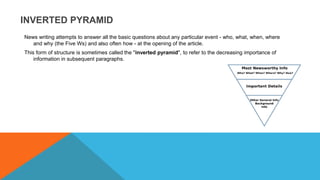
News writing attempts to answer all the basic questions about any particular event - who, what, when, where
and why (the Five Ws) and also often how - at the opening of the article.
This form of structure is sometimes called the "inverted pyramid", to refer to the decreasing importance of
information in subsequent paragraphs.
INVERTED PYRAMID
In the inverted pyramid, the essential and most interesting elements of a story are put at the beginning, with
supporting information following in order of diminishing importance.
This structure enables readers to stop reading at any point and still come away with the essence of a story. It
allows people to explore a topic to only the depth that their curiosity takes them.
INVERTED PYRAMID
Writers are often admonished "Don't bury the lead!" to ensure that they present the most important facts first,
rather than requiring the reader to go through several paragraphs to find them.
INVERTED PYRAMID
The inverted pyramid style has the following advantages:
 The structure of the story remains complete even when paragraphs are
deleted from the bottom for space shortage.
 A busy reader could skip over many stories in a short time by just reading the
lead paragraph.
 It helps the sub editor to give the headline by reading the gist of the story in the
Lead.
 The chronological style, which is narrating the story in the sequence in which it
happened, has none of these flexibilities, and often the most important part of
the story may come at the end, putting the reader’s patience on trial.
INVERTED PYRAMID
If the most important point in a story is buried in the last paragraph, it needs to
be rewritten and brought it to the lead.
In case there are more points fighting for prominence, the point that has more
reader appeal is chosen.
If the second paragraph does not support the lead, rewrite it.
The third paragraph should further develop the second paragraph and the lead.
Ideally, each paragraph should not exceed three sentences.
Direct quotes add flavor to the story.

Introduction To Journalistic Writing - @learnwithsamii

  • 1.
  • 2.
  • 3.
    WRITING WELL REQUIRES: Clearthinking Sufficient time Reading Interest Practice Revising
  • 4.
    DIFFERENCE BETWEEN SPEAKING AND WRITING SPEECH 1. Universal,everybody acquires it 2. Spoken language has dialect variations that represent a region 3. Speakers use their voices (pitch, rhythm, stress) and their bodies to communicate their message 4. Speakers use pauses and intonation 5. Speakers pronounce 6. Speaking is often spontaneous and unplanned. WRITING 1. Not everyone learns to read and write 2. Written language is more restricted and generally follows a standardized form of grammar, structure, organization, and vocabulary 3. Writers rely on the words on the page to express meaning and their ideas 4. Writers use punctuation 5. Writers spell 6. Most writing is planned and can be changed through editing and revision before an audience reads it
  • 5.
    DIFFERENCE BETWEEN SPEAKING AND WRITING SPEECH 7. Speakershave immediate audiences who nod, interrupt, question and comment 8. Speech is usually informal and repetitive 9. Speakers use simpler sentences connected by lots of ands and buts. 10. Speakers draw on their listeners reactions to know how or whether to continue 11. Speakers can gauge the attitudes, beliefs, and feelings of their audience WRITING 7. Writers have a delayed response from audiences or none at all and have only one opportunity to convey their message, be interesting, informative, accurate and hold their reader’s attention 8. Writing on the other hand is more formal and compact. It progresses more logically with fewer explanations and digressions. 9. Writers use more complex sentences with connecting words like however, who, although, and in addition. 10. Writers are often solitary in their process 11. Writers must consider what and how much their audience needs to know
  • 6.
    JOURNALISTIC WRITING News style(also journalistic style or news writing style) is the prose style used for news reporting in media such as newspapers, radio and television. Journalistic prose is explicit and precise, and tries not to rely on jargon. As a rule, journalists will not use a long word when a short one will do. They offer anecdotes, examples and metaphors, and they rarely depend on generalizations or abstract ideas. News writers try to avoid using the same word more than once in a paragraph (sometimes called an "echo" or "word mirror").
  • 7.
    The most importantstructural element of a story is the lead — the story's first, or opening paragraph. Article leads are sometimes categorized into hard leads and soft leads. A hard lead aims to provide a comprehensive thesis which tells the reader what the article will cover. A soft lead introduces the topic in a more creative, attention-seeking fashion.
  • 8.
    INVERTED PYRAMID News writingattempts to answer all the basic questions about any particular event - who, what, when, where and why (the Five Ws) and also often how - at the opening of the article. This form of structure is sometimes called the "inverted pyramid", to refer to the decreasing importance of information in subsequent paragraphs.
  • 9.
    INVERTED PYRAMID In theinverted pyramid, the essential and most interesting elements of a story are put at the beginning, with supporting information following in order of diminishing importance. This structure enables readers to stop reading at any point and still come away with the essence of a story. It allows people to explore a topic to only the depth that their curiosity takes them.
  • 10.
    INVERTED PYRAMID Writers areoften admonished "Don't bury the lead!" to ensure that they present the most important facts first, rather than requiring the reader to go through several paragraphs to find them.
  • 11.
    INVERTED PYRAMID The invertedpyramid style has the following advantages:  The structure of the story remains complete even when paragraphs are deleted from the bottom for space shortage.  A busy reader could skip over many stories in a short time by just reading the lead paragraph.  It helps the sub editor to give the headline by reading the gist of the story in the Lead.  The chronological style, which is narrating the story in the sequence in which it happened, has none of these flexibilities, and often the most important part of the story may come at the end, putting the reader’s patience on trial.
  • 12.
    INVERTED PYRAMID If themost important point in a story is buried in the last paragraph, it needs to be rewritten and brought it to the lead. In case there are more points fighting for prominence, the point that has more reader appeal is chosen. If the second paragraph does not support the lead, rewrite it. The third paragraph should further develop the second paragraph and the lead. Ideally, each paragraph should not exceed three sentences. Direct quotes add flavor to the story.