
Internet of Things:
Introduction to IoT
Leopoldo Armesto
Senior Lecturer
Universidad Politécnica de València
1
Outline
What is IoT?
Background, future and market share
IoT Networks: WPAN, WLAN and WAN.
Ethernet, WiFi and BLE
TCP/IP vs UDP/IP
IoT Application Layer protocols: HTTP vs. MQTT.
Web-server
IoT Platform
2
Internet of Things
Is a network of “physical” objects or “things” using embedded electronics.
It enables “things” to exchange data.
Machine to machine communication (M2M).
Applications: Health, home automation, transportation systems, home appliances, energy, cities, wearables, etc…
3
Internet of Things
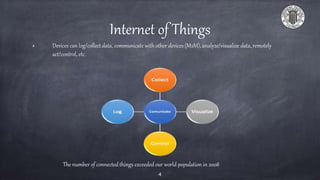
Devices can log/collect data, communicate with other devices (M2M), analyze/visualize data, remotely
act/control, etc.
The number of connected things exceeded our world population in 2008
4
IoT Background
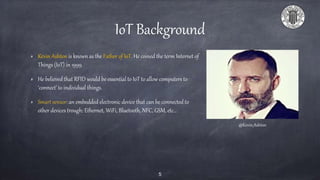
Kevin Ashton is known as the Father of IoT. He coined the term Internet of
Things (IoT) in 1999.
He believed that RFID would be essential to IoT to allow computers to
‘connect’ to individual things.
Smart sensor: an embedded electronic device that can be connected to
other devices trough: Ethernet, WiFi, Bluetooth, NFC, GSM, etc…
@Kevin_Ashton
5
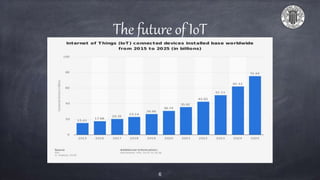
The future of IoT
6
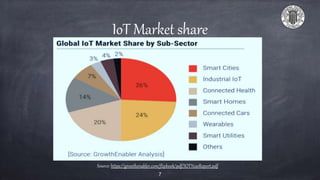
IoT Market share
Source: https://growthenabler.com/flipbook/pdf/IOT%20Report.pdf
7
IoT Networks
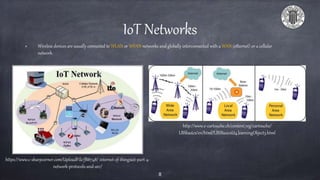
Wireless devices are usually connected to WLAN or WPAN networks and globally interconnected with a WAN (ethernet) or a cellular
network.
8
WAN
https://www.c-sharpcorner.com/UploadFile/f88748/ internet-of-thingsiot-part-4-
network-protocols-and-arc/
http://www.e-cartouche.ch/content_reg/cartouche/
LBSbasics/en/html/LBSBasicsU4_learningObject3.html
Ethernet
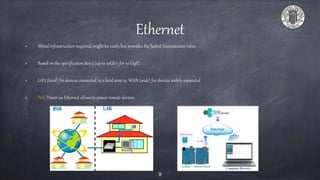
Wired infrastructure required, might be costly but provides the fastest transmission rates.
Based on the specification 802.3 (up to 10Gb/s for 10 GigE)
LAN (local) for devices connected in a local area vs. WAN (wide) for devices widely separated
PoE: Power on Ethernet allows to power remote devices.
9
WiFi
Wireless LAN based on the specification 802.11 (802.11n achieves up to 450 Mbit/s).
In IoT, we requires a balance between security, power, and cost.
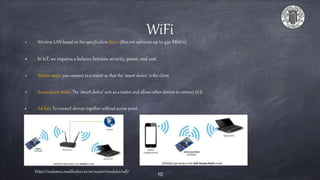
Station mode: you connect to a router so that the ‘smart device’ is the client.
Access point mode: The ‘smart device’ acts as a router and allows other devices to connect to it.
Ad-hoc: To connect devices together without access point.
10
https://nodemcu.readthedocs.io/en/master/modules/wifi/
BLE Devices
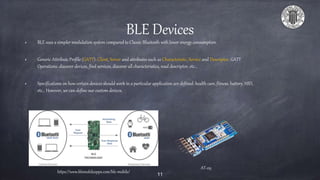
BLE uses a simpler modulation system compared to Classic Bluetooth with lower energy consumption.
Generic Attribute Profile (GATT): Client, Server and attributes such as Characteristic, Service and Descriptor. GATT
Operations: discover devices, find services, discover all characteristics, read descriptor, etc…
Specifications on how certain devices should work in a particular application are defined: health care, fitness, battery, HID,
etc… However, we can define our custom devices.
https://www.blemobileapps.com/ble-mobile/
11
AT-09
TCP/IP vs. UDP/IP
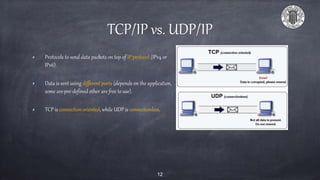
Protocols to send data packets on top of IP protocol (IPv4 or
IPv6).
Data is sent using different ports (depends on the application,
some are pre-defined other are free to use).
TCP is connection oriented, while UDP is connectionless.
12
IoT Application Layer Protocols
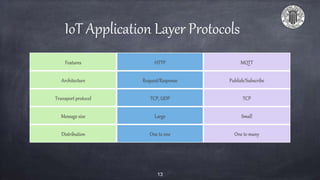
Features HTTP MQTT
Architecture Request/Response Publish/Subscribe
Transport protocol TCP, UDP TCP
Message size Large Small
Distribution One to one One to many
13
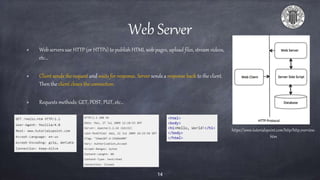
Web Server
Web servers use HTTP (or HTTPs) to publish HTML web pages, upload files, stream videos,
etc…
Client sends the request and waits for response. Server sends a response back to the client.
Then the client closes the connection.
Requests methods: GET, POST, PUT, etc…
14
https://www.tutorialspoint.com/http/http_overview.
htm
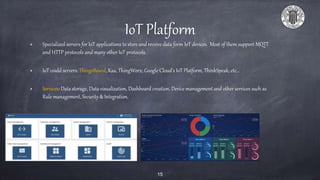
IoT Platform
Specialized servers for IoT applications to store and receive data form IoT devices. Most of them support MQTT
and HTTP protocols and many other IoT protocols.
IoT could servers: ThingsBoard, Kaa, ThingWorx, Google Cloud’s IoT Platform, ThinkSpeak, etc…
Services: Data storage, Data visualization, Dashboard creation, Device management and other services such as
Rule management, Security & Integration.
15
Internet of Things:
Introduction to IoT
Leopoldo Armesto
Senior Lecturer
Universidad Politécnica de València
16

Introduction to IoT

  • 1.
    Internet of Things: Introductionto IoT Leopoldo Armesto Senior Lecturer Universidad Politécnica de València 1
  • 2.
    Outline What is IoT? Background,future and market share IoT Networks: WPAN, WLAN and WAN. Ethernet, WiFi and BLE TCP/IP vs UDP/IP IoT Application Layer protocols: HTTP vs. MQTT. Web-server IoT Platform 2
  • 3.
    Internet of Things Isa network of “physical” objects or “things” using embedded electronics. It enables “things” to exchange data. Machine to machine communication (M2M). Applications: Health, home automation, transportation systems, home appliances, energy, cities, wearables, etc… 3
  • 4.
    Internet of Things Devicescan log/collect data, communicate with other devices (M2M), analyze/visualize data, remotely act/control, etc. The number of connected things exceeded our world population in 2008 4
  • 5.
    IoT Background Kevin Ashtonis known as the Father of IoT. He coined the term Internet of Things (IoT) in 1999. He believed that RFID would be essential to IoT to allow computers to ‘connect’ to individual things. Smart sensor: an embedded electronic device that can be connected to other devices trough: Ethernet, WiFi, Bluetooth, NFC, GSM, etc… @Kevin_Ashton 5
  • 6.
  • 7.
    IoT Market share Source:https://growthenabler.com/flipbook/pdf/IOT%20Report.pdf 7
  • 8.
    IoT Networks Wireless devicesare usually connected to WLAN or WPAN networks and globally interconnected with a WAN (ethernet) or a cellular network. 8 WAN https://www.c-sharpcorner.com/UploadFile/f88748/ internet-of-thingsiot-part-4- network-protocols-and-arc/ http://www.e-cartouche.ch/content_reg/cartouche/ LBSbasics/en/html/LBSBasicsU4_learningObject3.html
  • 9.
    Ethernet Wired infrastructure required,might be costly but provides the fastest transmission rates. Based on the specification 802.3 (up to 10Gb/s for 10 GigE) LAN (local) for devices connected in a local area vs. WAN (wide) for devices widely separated PoE: Power on Ethernet allows to power remote devices. 9
  • 10.
    WiFi Wireless LAN basedon the specification 802.11 (802.11n achieves up to 450 Mbit/s). In IoT, we requires a balance between security, power, and cost. Station mode: you connect to a router so that the ‘smart device’ is the client. Access point mode: The ‘smart device’ acts as a router and allows other devices to connect to it. Ad-hoc: To connect devices together without access point. 10 https://nodemcu.readthedocs.io/en/master/modules/wifi/
  • 11.
    BLE Devices BLE usesa simpler modulation system compared to Classic Bluetooth with lower energy consumption. Generic Attribute Profile (GATT): Client, Server and attributes such as Characteristic, Service and Descriptor. GATT Operations: discover devices, find services, discover all characteristics, read descriptor, etc… Specifications on how certain devices should work in a particular application are defined: health care, fitness, battery, HID, etc… However, we can define our custom devices. https://www.blemobileapps.com/ble-mobile/ 11 AT-09
  • 12.
    TCP/IP vs. UDP/IP Protocolsto send data packets on top of IP protocol (IPv4 or IPv6). Data is sent using different ports (depends on the application, some are pre-defined other are free to use). TCP is connection oriented, while UDP is connectionless. 12
  • 13.
    IoT Application LayerProtocols Features HTTP MQTT Architecture Request/Response Publish/Subscribe Transport protocol TCP, UDP TCP Message size Large Small Distribution One to one One to many 13
  • 14.
    Web Server Web serversuse HTTP (or HTTPs) to publish HTML web pages, upload files, stream videos, etc… Client sends the request and waits for response. Server sends a response back to the client. Then the client closes the connection. Requests methods: GET, POST, PUT, etc… 14 https://www.tutorialspoint.com/http/http_overview. htm
  • 15.
    IoT Platform Specialized serversfor IoT applications to store and receive data form IoT devices. Most of them support MQTT and HTTP protocols and many other IoT protocols. IoT could servers: ThingsBoard, Kaa, ThingWorx, Google Cloud’s IoT Platform, ThinkSpeak, etc… Services: Data storage, Data visualization, Dashboard creation, Device management and other services such as Rule management, Security & Integration. 15
  • 16.
    Internet of Things: Introductionto IoT Leopoldo Armesto Senior Lecturer Universidad Politécnica de València 16