IN THE NAME OF ALLAH, THE MOST
BENEFICENT, THE MOST MERCIFUL
FME-202, I.C. Engine
Course Credit Hours: 3(2-1)
Course Contact Hours: 5(2-3)
Introduction to Heat Engine
• Heat Engine:
A machine which converts heat energy into mechanical energy (work) as a result of
combustion
• Combstion:
A process in which fuel combines with oxygen or air and liberates heat. As a
result of combustion of hydrocarbons (of which the fuel consists of), CO2 and H2O are
produced. These types of reactions are exothermic and significant amount of heat is evolved
which increases temperature and pressure.
• For Petrol:
2C8H18 +25O2 = 16CO2 + 18H2O + Heat
• For Diesel:
2C16H34 +49O2 = 32CO2 + 34H2O + Heat
• For Natural Gas:
CH4 + O2 = CO2 + H2O + Heat
• General case:
Hydrocarbons (Fuel) + O2 = C02 + H2O + Heat
Types Heat Engine
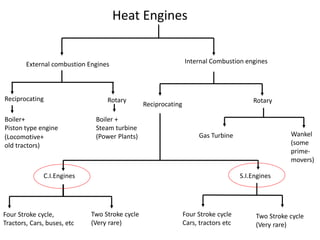
• External Combustion Engine:
In steam engine the combustion of fuel takes
place outside the engine and the steam thus
formed is used to run the engine. Thus it is
known external combustion engine.
• Internal Combustion Engine:
In case of internal combustion engine the
combustion of fuel takes place inside the
engine cylinder
Heat Engines
External combustion Engines
Boiler+
Piston type engine
Boiler +
Steam turbine
(Power Plants)
Internal Combustion engines
Reciprocating
Rotary
Gas Turbine Wankel
(some
prime-
movers)
Reciprocating Rotary
C.I.Engines S.I.Engines
Four Stroke cycle,
Tractors, Cars, buses, etc
Two Stroke cycle
(Very rare)
Four Stroke cycle
Cars, tractors etc
Two Stroke cycle
(Very rare)
(Locomotive+
old tractors)
Classification of IC Engine
IC engine can be further classified as:
• Stationary or mobile
• Horizontal and vertical
• Low, Medium or high speed
Two distinct types of the IC Engines used for
either mobile or stationary operations are
• Diesel type IC Engine
• Carburetor type IC Engine
Compression
Heat
addition
Expansion
Heat
rejection
Heat engine
cycle
Internal combustion engines
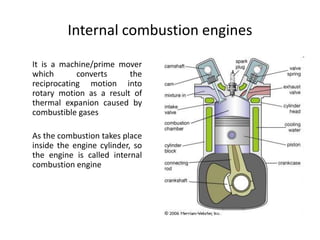
It is a machine/prime mover
which converts the
reciprocating motion into
rotary motion as a result of
thermal expanion caused by
combustible gases
As the combustion takes place
inside the engine cylinder, so
the engine is called internal
combustion engine
Components of Internal combustion Engines
Cylinder:
The nucleus of all activity but principally for
receiving and burning the fuel
Piston:
Receives power generated in the cylinder
Connecting Rod:
Transmits power to crankshaft and assists in
changing to and fro motion to rotary motion of
crankshaft
Crankshaft:
Receives power from the piston through connecting
rod and converts the reciprocating motion into
rotary motion
Components of Internal combustion Engines
Cylinder head:
Covers the top of the cylinder and
houses other components
Crankcase:
Covers the bottom of the cylinder and
holds engine lubricating oil and other
components
Inlet and Exhaust valves:
Inlet receives fuel (petrol engine) or air
(diesel engine) while exhaust releases
burnt gases.
Components of Internal combustion Engines
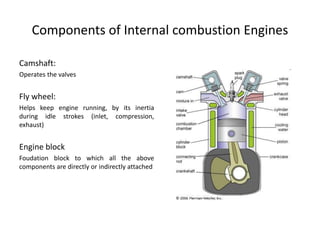
Camshaft:
Operates the valves
Fly wheel:
Helps keep engine running, by its inertia
during idle strokes (inlet, compression,
exhaust)
Engine block
Foudation block to which all the above
components are directly or indirectly attached
Engine Terminology
Bore (d):
The internal diameter of the cylinder
Stroke (l):
The maximum length of travel of piston from one
extreme position to other extreme position in one
direction
Top dead cenre(TDC):
The position of the piston at the end of its travel when
moving towards the cylinder head
Bottom Dead Centre (BDC):
The position of the pistonat the end of its travel when
movingtowards the crankcase
Piston displacement (PD):
The volume displaced or covered by the piston when it
moves from TDC to BDC
𝑃𝐷 = 𝜋
4 𝑑2
𝑙
CV
d
l P.D
Connecting rod
crankshaft
Cylinder
Piston
Engine Terminology
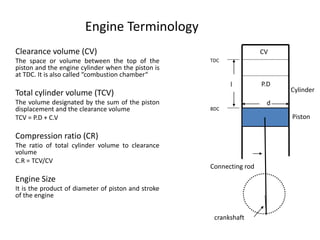
Clearance volume (CV)
The space or volume between the top of the
piston and the engine cylinder when the piston is
at TDC. It is also called “combustion chamber“
Total cylinder volume (TCV)
The volume designated by the sum of the piston
displacement and the clearance volume
TCV = P.D + C.V
Compression ratio (CR)
The ratio of total cylinder volume to clearance
volume
C.R = TCV/CV
Engine Size
It is the product of diameter of piston and stroke
of the engine
CV
d
l P.D
Connecting rod
crankshaft
Cylinder
Piston
TDC
BDC
CV
d
l PD
Connecting rod
Crankshaft
Cylinder
Piston
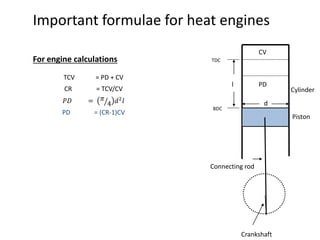
For engine calculations
TCV = PD + CV
CR = TCV/CV
𝑃𝐷 = 𝜋
4 𝑑2
𝑙
PD = (CR-1)CV
Important formulae for heat engines
TDC
BDC
Example 1: An engine has bore of 100 mm and stroke of 124 mm. If the
compression ratio is 6. Calculate:
a- Piston Displacement (PD), b- Clearance volume (CV )
c- Total Cylinder Volume (TCV)
Solution:
Given data
cylinder bore = diameter of piston(d) = 100 mm
Stroke length (l) = 124 mm
Compression Ration (CR) = 6
(a) Piston Displacement(PD) =??
We know that
PD = (πd2/4)*l
= [(3.14)(100)2/4]*124 = 973,400 mm3
(b) Clearance volume (CV) = ??
TCV = PD + CV (dividing by CV)
CR = PD/CV + 1
PD = (CR-1)CV
CV = PD/(CR -1)
= 973,400 / (6-1) = 194680 mm3
Cylinder Volume (TCV) = ??
TCV = PD + CV
= 973400 + 194680 =1168080 mm3
CV
d
l P.D
Connecting rod
crankshaft
Cylinder
Piston
Example2: An engine has a bore of 91.44 mm and a stroke of
127 mm. Find the clearance volume (CV) when the
compression ratio (CR) is 18.5
Solution
Given data
Cylinder bore (d) = 91.44 mm
Stroke(l) = 127 mm
Compression ration (CR) = 18.5
Clearance volume (CV) =??
For PD
PD =( πd2/4)*l
= (3.14 (91.44)2/4 )*(127)
= 833,577 mm3
We know that
P.D = (CR- 1)CV
CV = PD/(CR-1)
CV = 833,577/17.5
CV = 50,490 mm3
CV
d
l P.D
Connecting rod
crankshaft
Cylinder
Piston
91.44 mm
127 mm
Example 3
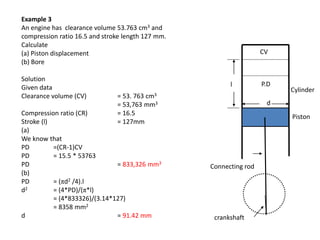
An engine has clearance volume 53.763 cm3 and
compression ratio 16.5 and stroke length 127 mm.
Calculate
(a) Piston displacement
(b) Bore
Solution
Given data
Clearance volume (CV) = 53. 763 cm3
= 53,763 mm3
Compression ratio (CR) = 16.5
Stroke (l) = 127mm
(a)
We know that
PD =(CR-1)CV
PD = 15.5 * 53763
PD = 833,326 mm3
(b)
PD = (πd2 /4).l
d2 = (4*PD)/(π*l)
= (4*833326)/(3.14*127)
= 8358 mm2
d = 91.42 mm
CV
d
l P.D
Connecting rod
crankshaft
Cylinder
Piston
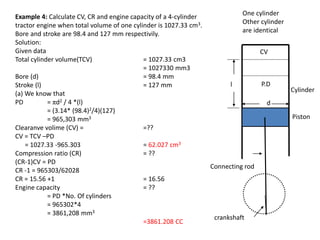
Example 4: Calculate CV, CR and engine capacity of a 4-cylinder
tractor engine when total volume of one cylinder is 1027.33 cm3.
Bore and stroke are 98.4 and 127 mm respectivily.
Solution:
Given data
Total cylinder volume(TCV) = 1027.33 cm3
= 1027330 mm3
Bore (d) = 98.4 mm
Stroke (l) = 127 mm
(a) We know that
PD = πd2 / 4 *(l)
= (3.14* (98.4)2/4)(127)
= 965,303 mm3
Clearanve volime (CV) = =??
CV = TCV –PD
= 1027.33 -965.303 = 62.027 cm3
Compression ratio (CR) = ??
(CR-1)CV = PD
CR -1 = 965303/62028
CR = 15.56 +1 = 16.56
Engine capacity = ??
= PD *No. Of cylinders
= 965302*4
= 3861,208 mm3
=3861.208 CC
CV
d
l P.D
Connecting rod
crankshaft
Cylinder
Piston
One cylinder
Other cylinder
are identical
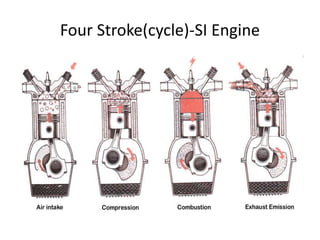
Four Stroke( cycle) SI Engine
A four stroke cycle engine one which completes its cycle (suction, compression, power, exhaust)
in four stroke of the piston resulting two complete revolution (360*2 = 720) of crankshaft
Suction stroke
The piston moves from TDC to BDC. The inlet valve is opened to allow the fuel mixture to enter
and fill the partial vacuum created by the movement of the piston. The exhaust valve remaim
closed.
Compression stroke
The inlet valve is closed. The exhaust valve also remain closed. The piston moves from BDC to
TDC compressing the fuel mixture into the clearance volume; thereby raising the temperature
and pressure
Power Stroke
When the piston approaches TDC during the compression stroke, a spark ignites the fuel mixture
and expanding gases, drive the piston from TDC to BDC
Exhaust Stroke
The piston returns from BDC to TDC, sweeping the the burnt fuel/gases through the exhaust valve
which has been opened, while the intake valve remain closed
Four Stroke(cycle)-SI Engine
Four stroke cycle-SI Engine
For two stroke animation, browse the link
http://www.keveney.com/otto.html
Four stroke cycle-CI engines
In case of diesel engine, the same number of piston events take place as in 4-
troke petrol engine but the method of igniting of the fuel is different. The
following sequence of operation occurs
Intake /suction stroke
Only air is drawn into the cylinder
Compression Stroke
The air is compressed into the cylinder which raised its temperature and
pressure very high
Power stroke
Just at the end of compression stroke, a fine spay of diesel is injected into the
hot compessed air which ignites the fuel instantly and expanding gases, drive
the piston for the power stroke.
Exhaust Stroke
Similar to that of petrol engine
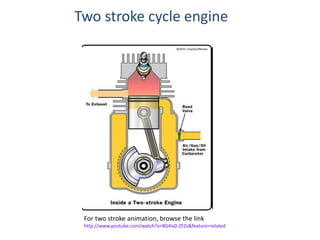
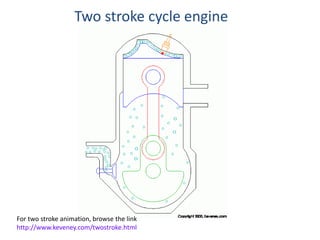
Two stroke Engine
• This type of engines completes one cycle in only two strokes of the piston.
• There are no definite intake and exhaust valves but instead, there are
openings or ports located in the cylinder wall which get covered and
uncovered as the piston moves up and down the cylinder.
• When the piston moves from TDC to BDC, a fresh fuel mixture enters the
intake port, at the same time the burnt fuel escapes though the exhaust port
which is also uncovered.Due to scavenging, some of the unburnt fuels also
escapes with exhaust gases, which not only reduce the thermal efficieny but
also cause environmental pollution. Now a days, these engines are rarely used
• The compression and power stroke are similar to those for four stroke
engines.
• However to complete one revolution of the crankshaft, revolution of the
piston, makes only two strokes which is equivalent to 2*180 = 360° or one
revolution of the crankshaft.
For two stroke animation, browse the link
http://www.youtube.com/watch?v=8G4is0-ZFZs&feature=related
Two stroke cycle engine
For two stroke animation, browse the link
http://www.keveney.com/twostroke.html

Introduction to IC Engine.pptx

  • 1.
    IN THE NAMEOF ALLAH, THE MOST BENEFICENT, THE MOST MERCIFUL FME-202, I.C. Engine Course Credit Hours: 3(2-1) Course Contact Hours: 5(2-3)
  • 2.
    Introduction to HeatEngine • Heat Engine: A machine which converts heat energy into mechanical energy (work) as a result of combustion • Combstion: A process in which fuel combines with oxygen or air and liberates heat. As a result of combustion of hydrocarbons (of which the fuel consists of), CO2 and H2O are produced. These types of reactions are exothermic and significant amount of heat is evolved which increases temperature and pressure. • For Petrol: 2C8H18 +25O2 = 16CO2 + 18H2O + Heat • For Diesel: 2C16H34 +49O2 = 32CO2 + 34H2O + Heat • For Natural Gas: CH4 + O2 = CO2 + H2O + Heat • General case: Hydrocarbons (Fuel) + O2 = C02 + H2O + Heat
  • 3.
    Types Heat Engine •External Combustion Engine: In steam engine the combustion of fuel takes place outside the engine and the steam thus formed is used to run the engine. Thus it is known external combustion engine. • Internal Combustion Engine: In case of internal combustion engine the combustion of fuel takes place inside the engine cylinder
  • 4.
    Heat Engines External combustionEngines Boiler+ Piston type engine Boiler + Steam turbine (Power Plants) Internal Combustion engines Reciprocating Rotary Gas Turbine Wankel (some prime- movers) Reciprocating Rotary C.I.Engines S.I.Engines Four Stroke cycle, Tractors, Cars, buses, etc Two Stroke cycle (Very rare) Four Stroke cycle Cars, tractors etc Two Stroke cycle (Very rare) (Locomotive+ old tractors)
  • 5.
    Classification of ICEngine IC engine can be further classified as: • Stationary or mobile • Horizontal and vertical • Low, Medium or high speed Two distinct types of the IC Engines used for either mobile or stationary operations are • Diesel type IC Engine • Carburetor type IC Engine
  • 6.
  • 7.
    Internal combustion engines Itis a machine/prime mover which converts the reciprocating motion into rotary motion as a result of thermal expanion caused by combustible gases As the combustion takes place inside the engine cylinder, so the engine is called internal combustion engine
  • 8.
    Components of Internalcombustion Engines Cylinder: The nucleus of all activity but principally for receiving and burning the fuel Piston: Receives power generated in the cylinder Connecting Rod: Transmits power to crankshaft and assists in changing to and fro motion to rotary motion of crankshaft Crankshaft: Receives power from the piston through connecting rod and converts the reciprocating motion into rotary motion
  • 9.
    Components of Internalcombustion Engines Cylinder head: Covers the top of the cylinder and houses other components Crankcase: Covers the bottom of the cylinder and holds engine lubricating oil and other components Inlet and Exhaust valves: Inlet receives fuel (petrol engine) or air (diesel engine) while exhaust releases burnt gases.
  • 10.
    Components of Internalcombustion Engines Camshaft: Operates the valves Fly wheel: Helps keep engine running, by its inertia during idle strokes (inlet, compression, exhaust) Engine block Foudation block to which all the above components are directly or indirectly attached
  • 11.
    Engine Terminology Bore (d): Theinternal diameter of the cylinder Stroke (l): The maximum length of travel of piston from one extreme position to other extreme position in one direction Top dead cenre(TDC): The position of the piston at the end of its travel when moving towards the cylinder head Bottom Dead Centre (BDC): The position of the pistonat the end of its travel when movingtowards the crankcase Piston displacement (PD): The volume displaced or covered by the piston when it moves from TDC to BDC 𝑃𝐷 = 𝜋 4 𝑑2 𝑙 CV d l P.D Connecting rod crankshaft Cylinder Piston
  • 12.
    Engine Terminology Clearance volume(CV) The space or volume between the top of the piston and the engine cylinder when the piston is at TDC. It is also called “combustion chamber“ Total cylinder volume (TCV) The volume designated by the sum of the piston displacement and the clearance volume TCV = P.D + C.V Compression ratio (CR) The ratio of total cylinder volume to clearance volume C.R = TCV/CV Engine Size It is the product of diameter of piston and stroke of the engine CV d l P.D Connecting rod crankshaft Cylinder Piston TDC BDC
  • 13.
    CV d l PD Connecting rod Crankshaft Cylinder Piston Forengine calculations TCV = PD + CV CR = TCV/CV 𝑃𝐷 = 𝜋 4 𝑑2 𝑙 PD = (CR-1)CV Important formulae for heat engines TDC BDC
  • 14.
    Example 1: Anengine has bore of 100 mm and stroke of 124 mm. If the compression ratio is 6. Calculate: a- Piston Displacement (PD), b- Clearance volume (CV ) c- Total Cylinder Volume (TCV) Solution: Given data cylinder bore = diameter of piston(d) = 100 mm Stroke length (l) = 124 mm Compression Ration (CR) = 6 (a) Piston Displacement(PD) =?? We know that PD = (πd2/4)*l = [(3.14)(100)2/4]*124 = 973,400 mm3 (b) Clearance volume (CV) = ?? TCV = PD + CV (dividing by CV) CR = PD/CV + 1 PD = (CR-1)CV CV = PD/(CR -1) = 973,400 / (6-1) = 194680 mm3 Cylinder Volume (TCV) = ?? TCV = PD + CV = 973400 + 194680 =1168080 mm3 CV d l P.D Connecting rod crankshaft Cylinder Piston
  • 15.
    Example2: An enginehas a bore of 91.44 mm and a stroke of 127 mm. Find the clearance volume (CV) when the compression ratio (CR) is 18.5 Solution Given data Cylinder bore (d) = 91.44 mm Stroke(l) = 127 mm Compression ration (CR) = 18.5 Clearance volume (CV) =?? For PD PD =( πd2/4)*l = (3.14 (91.44)2/4 )*(127) = 833,577 mm3 We know that P.D = (CR- 1)CV CV = PD/(CR-1) CV = 833,577/17.5 CV = 50,490 mm3 CV d l P.D Connecting rod crankshaft Cylinder Piston 91.44 mm 127 mm
  • 16.
    Example 3 An enginehas clearance volume 53.763 cm3 and compression ratio 16.5 and stroke length 127 mm. Calculate (a) Piston displacement (b) Bore Solution Given data Clearance volume (CV) = 53. 763 cm3 = 53,763 mm3 Compression ratio (CR) = 16.5 Stroke (l) = 127mm (a) We know that PD =(CR-1)CV PD = 15.5 * 53763 PD = 833,326 mm3 (b) PD = (πd2 /4).l d2 = (4*PD)/(π*l) = (4*833326)/(3.14*127) = 8358 mm2 d = 91.42 mm CV d l P.D Connecting rod crankshaft Cylinder Piston
  • 17.
    Example 4: CalculateCV, CR and engine capacity of a 4-cylinder tractor engine when total volume of one cylinder is 1027.33 cm3. Bore and stroke are 98.4 and 127 mm respectivily. Solution: Given data Total cylinder volume(TCV) = 1027.33 cm3 = 1027330 mm3 Bore (d) = 98.4 mm Stroke (l) = 127 mm (a) We know that PD = πd2 / 4 *(l) = (3.14* (98.4)2/4)(127) = 965,303 mm3 Clearanve volime (CV) = =?? CV = TCV –PD = 1027.33 -965.303 = 62.027 cm3 Compression ratio (CR) = ?? (CR-1)CV = PD CR -1 = 965303/62028 CR = 15.56 +1 = 16.56 Engine capacity = ?? = PD *No. Of cylinders = 965302*4 = 3861,208 mm3 =3861.208 CC CV d l P.D Connecting rod crankshaft Cylinder Piston One cylinder Other cylinder are identical
  • 18.
    Four Stroke( cycle)SI Engine A four stroke cycle engine one which completes its cycle (suction, compression, power, exhaust) in four stroke of the piston resulting two complete revolution (360*2 = 720) of crankshaft Suction stroke The piston moves from TDC to BDC. The inlet valve is opened to allow the fuel mixture to enter and fill the partial vacuum created by the movement of the piston. The exhaust valve remaim closed. Compression stroke The inlet valve is closed. The exhaust valve also remain closed. The piston moves from BDC to TDC compressing the fuel mixture into the clearance volume; thereby raising the temperature and pressure Power Stroke When the piston approaches TDC during the compression stroke, a spark ignites the fuel mixture and expanding gases, drive the piston from TDC to BDC Exhaust Stroke The piston returns from BDC to TDC, sweeping the the burnt fuel/gases through the exhaust valve which has been opened, while the intake valve remain closed
  • 19.
  • 20.
    Four stroke cycle-SIEngine For two stroke animation, browse the link http://www.keveney.com/otto.html
  • 21.
    Four stroke cycle-CIengines In case of diesel engine, the same number of piston events take place as in 4- troke petrol engine but the method of igniting of the fuel is different. The following sequence of operation occurs Intake /suction stroke Only air is drawn into the cylinder Compression Stroke The air is compressed into the cylinder which raised its temperature and pressure very high Power stroke Just at the end of compression stroke, a fine spay of diesel is injected into the hot compessed air which ignites the fuel instantly and expanding gases, drive the piston for the power stroke. Exhaust Stroke Similar to that of petrol engine
  • 22.
    Two stroke Engine •This type of engines completes one cycle in only two strokes of the piston. • There are no definite intake and exhaust valves but instead, there are openings or ports located in the cylinder wall which get covered and uncovered as the piston moves up and down the cylinder. • When the piston moves from TDC to BDC, a fresh fuel mixture enters the intake port, at the same time the burnt fuel escapes though the exhaust port which is also uncovered.Due to scavenging, some of the unburnt fuels also escapes with exhaust gases, which not only reduce the thermal efficieny but also cause environmental pollution. Now a days, these engines are rarely used • The compression and power stroke are similar to those for four stroke engines. • However to complete one revolution of the crankshaft, revolution of the piston, makes only two strokes which is equivalent to 2*180 = 360° or one revolution of the crankshaft.
  • 23.
    For two strokeanimation, browse the link http://www.youtube.com/watch?v=8G4is0-ZFZs&feature=related Two stroke cycle engine
  • 24.
    Two stroke cycleengine For two stroke animation, browse the link http://www.keveney.com/twostroke.html