Hacking Fundamentals
Luis Herrera, CISM, CRISC, CEH, Pentest+, ITILv3, PSM1
Nov-2018
2 IBM Security
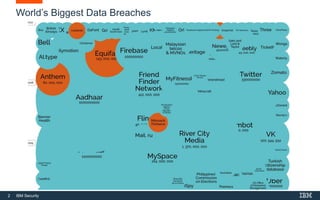
World’s Biggest Data Breaches
3 IBM Security
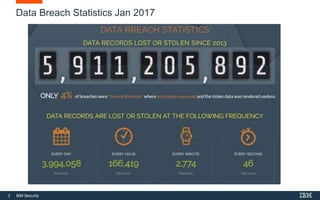
Data Breach Statistics Jan 2017
4 IBM Security
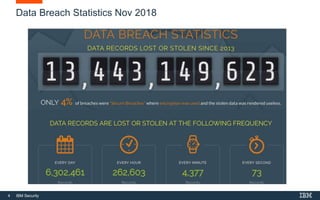
Data Breach Statistics Nov 2018
5 IBM Security
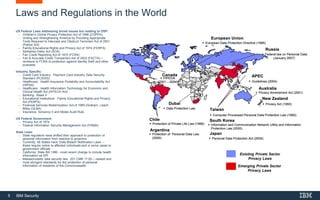
Laws and Regulations in the World
US Federal Laws addressing broad issues but relating to DSP:
̶ Children’s Online Privacy Protection Act of 1998 (COPPA)
̶ Uniting and Strengthening America by Providing Appropriate
Tools Required to Intercept and Obstruct Terrorism Act of 2001
(Patriot Act)
̶ Family Educational Rights and Privacy Act of 1974 (FERPA)
̶ Sarbanes-Oxley Act (SOX)
̶ Fair Credit Reporting Act of 1970 (FCRA)
̶ Fair & Accurate Credit Transaction Act of 2003 (FACTA) –
revisions to FCRA to protection against identity theft and other
purposes
Industry Specific:
̶ Credit Card Industry: Payment Card Industry Data Security
Standard (PCIDSS)
̶ Healthcare: Health Insurance Portability and Accountability Act
(HIPAA)
̶ Healthcare: Health Information Technology for Economic and
Clinical Health Act (HITECH Act)
̶ Banking: Basel II
̶ Educational Institutions: Family Educational Rights and Privacy
Act (FERPA)
̶ Financial Services Modernization Act of 1999 (Graham, Leach,
Bliley (GLBA)
̶ Insurance: Solvency II and Model Audit Rule
US Federal Government:
̶ Privacy Act of 1974
̶ Federal Information Security Management Act (FISMA)
State Laws:
̶ State regulators have shifted their approach to protection of
personal information from reactive to proactive
̶ Currently, 46 States have ‘Data Breach Notification Laws’ –
these require notice to affected individuals and in some cases to
government officials
̶ California: State Bill 1386 - most recent change to include health
information as SPI
̶ Massachusetts data security law: 201 CMR 17.00 – newest and
most stringent standards for the protection of personal
information of residents of the Commonwealth
European Union
 European Data Protection Directive (1995)
Canada
 PIPEDA
(2001 – 2004)-
Taiwan
 Computer Processed Personal Data Protection Law (1995)
South Korea
 Information and Communication Network Utility and Information
Protection Law (2000)
Japan
 Personal Data Protection Act (2005)
APEC
 Guidelines (2004)
Russia
 Federal law on Personal Data
(January 2007)
Australia
 Privacy Amendment Act (2001)
New Zealand
 Privacy Act (1993)
Chile
 Protection of Private Life Law (1999)
Argentina
 Protection of Personal Data Law
(2000)
Dubai
 Data Protection Law
European Union
 European Data Protection Directive (1995)
Canada
 PIPEDA
(2001 – 2004)-
Taiwan
 Computer Processed Personal Data Protection Law (1995)
South Korea
 Information and Communication Network Utility and Information
Protection Law (2000)
Japan
 Personal Data Protection Act (2005)
APEC
 Guidelines (2004)
Russia
 Federal law on Personal Data
(January 2007)
Australia
 Privacy Amendment Act (2001)
New Zealand
 Privacy Act (1993)
Chile
 Protection of Private Life Law (1999)
Argentina
 Protection of Personal Data Law
(2000)
Dubai
 Data Protection Law
Emerging Private Sector
Privacy Laws
Existing Private Sector
Privacy Laws
6 IBM Security
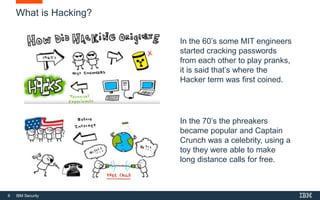
What is Hacking?
In the 60’s some MIT engineers
started cracking passwords
from each other to play pranks,
it is said that’s where the
Hacker term was first coined.
In the 70’s the phreakers
became popular and Captain
Crunch was a celebrity, using a
toy they were able to make
long distance calls for free.
7 IBM Security
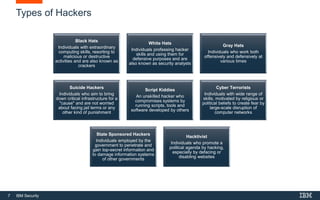
Types of Hackers
Black Hats
Individuals with extraordinary
computing skills, resorting to
malicious or destructive
activities and are also known as
crackers
White Hats
Individuals professing hacker
skills and using them for
defensive purposes and are
also known as security analysts
Gray Hats
Individuals who work both
offensively and defensively at
various times
Suicide Hackers
Individuals who aim to bring
down critical infrastructure for a
"cause" and are not worried
about facing jail terms or any
other kind of punishment
Script Kiddies
An unskilled hacker who
compromises systems by
running scripts, tools and
software developed by others
Cyber Terrorists
Individuals with wide range of
skills, motivated by religious or
political beliefs to create fear by
large-scale disruption of
computer networks
State Sponsored Hackers
Individuals employed by the
government to penetrate and
gain top-secret information and
to damage information systems
of other governments
Hacktivist
Individuals who promote a
political agenda by hacking,
especially by defacing or
disabling websites
8 IBM Security
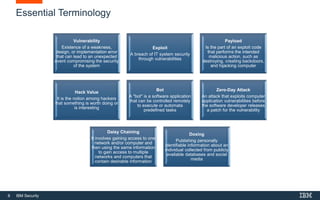
Essential Terminology
Vulnerability
Existence of a weakness,
design, or implementation error
that can lead to an unexpected
event compromising the security
of the system
Exploit
A breach of IT system security
through vulnerabilities
Payload
Is the part of an exploit code
that performs the intended
malicious action, such as
destroying, creating backdoors,
and hijacking computer
Hack Value
It is the notion among hackers
that something is worth doing or
is interesting
Bot
A "bot" is a software application
that can be controlled remotely
to execute or automata
predefined tasks
Zero-Day Attack
An attack that exploits computer
application vulnerabilities before
the software developer releases
a patch for the vulnerability
Daisy Chaining
It involves gaining access to one
network and/or computer and
then using the same information
to gain access to multiple
networks and computers that
contain desirable information
Doxing
Publishing personally
identifiable information about an
individual collected from publicly
available databases and social
media
9 IBM Security
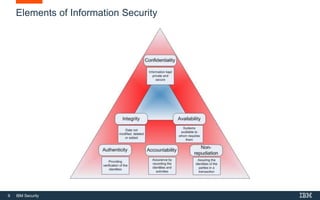
Elements of Information Security
10 IBM Security
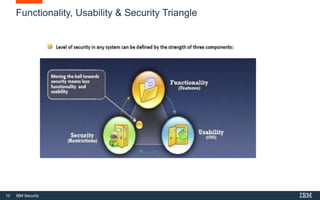
Functionality, Usability & Security Triangle
11 IBM Security
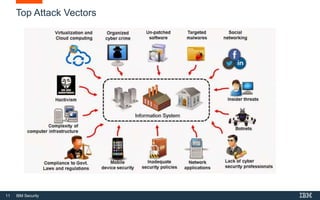
Top Attack Vectors
12 IBM Security
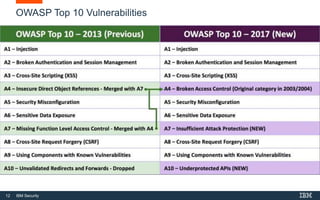
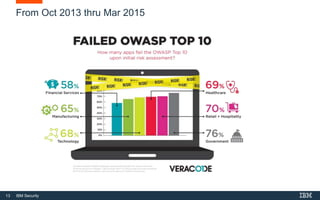
OWASP Top 10 Vulnerabilities
13 IBM Security
From Oct 2013 thru Mar 2015
14 IBM Security
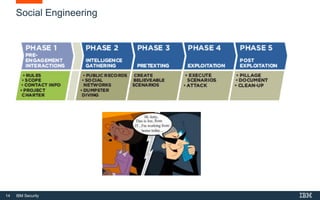
Social Engineering
15 IBM Security
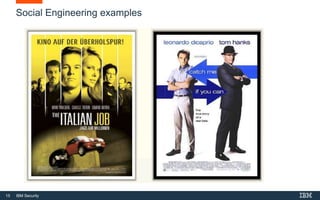
Social Engineering examples
16 IBM Security
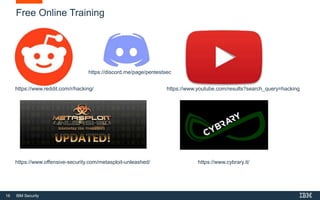
Free Online Training
https://www.offensive-security.com/metasploit-unleashed/ https://www.cybrary.it/
https://www.reddit.com/r/hacking/ https://www.youtube.com/results?search_query=hacking
https://discord.me/page/pentestsec
17 IBM Security
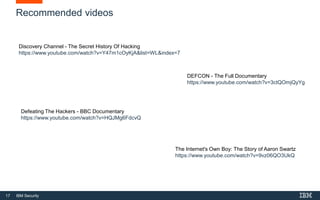
Recommended videos
Discovery Channel - The Secret History Of Hacking
https://www.youtube.com/watch?v=Y47m1cOyKjA&list=WL&index=7
Defeating The Hackers - BBC Documentary
https://www.youtube.com/watch?v=HQJMg6FdcvQ
The Internet's Own Boy: The Story of Aaron Swartz
https://www.youtube.com/watch?v=9vz06QO3UkQ
DEFCON - The Full Documentary
https://www.youtube.com/watch?v=3ctQOmjQyYg
ibm.com/security
securityintelligence.com
xforce.ibmcloud.com
@ibmsecurity
youtube/user/ibmsecuritysolutions
© Copyright IBM Corporation 2016. All rights reserved. The information contained in these materials is provided for informational purposes only, and is provided AS IS without warranty of any kind,
express or implied. Any statement of direction represents IBM's current intent, is subject to change or withdrawal, and represent only goals and objectives. IBM, the IBM logo, and other IBM products
and services are trademarks of the International Business Machines Corporation, in the United States, other countries or both. Other company, product, or service names may be trademarks or service
marks of others.
Statement of Good Security Practices: IT system security involves protecting systems and information through prevention, detection and response to improper access from within and outside your
enterprise. Improper access can result in information being altered, destroyed, misappropriated or misused or can result in damage to or misuse of your systems, including for use in attacks on others.
No IT system or product should be considered completely secure and no single product, service or security measure can be completely effective in preventing improper use or access. IBM systems,
products and services are designed to be part of a lawful, comprehensive security approach, which will necessarily involve additional operational procedures, and may require other systems, products
or services to be most effective. IBM does not warrant that any systems, products or services are immune from, or will make your enterprise immune from, the malicious or illegal conduct of any party.
FOLLOW US ON:
THANK YOU

Introduction to Hacking (101) Fundamentals

  • 1.
    Hacking Fundamentals Luis Herrera,CISM, CRISC, CEH, Pentest+, ITILv3, PSM1 Nov-2018
  • 2.
    2 IBM Security World’sBiggest Data Breaches
  • 3.
    3 IBM Security DataBreach Statistics Jan 2017
  • 4.
    4 IBM Security DataBreach Statistics Nov 2018
  • 5.
    5 IBM Security Lawsand Regulations in the World US Federal Laws addressing broad issues but relating to DSP: ̶ Children’s Online Privacy Protection Act of 1998 (COPPA) ̶ Uniting and Strengthening America by Providing Appropriate Tools Required to Intercept and Obstruct Terrorism Act of 2001 (Patriot Act) ̶ Family Educational Rights and Privacy Act of 1974 (FERPA) ̶ Sarbanes-Oxley Act (SOX) ̶ Fair Credit Reporting Act of 1970 (FCRA) ̶ Fair & Accurate Credit Transaction Act of 2003 (FACTA) – revisions to FCRA to protection against identity theft and other purposes Industry Specific: ̶ Credit Card Industry: Payment Card Industry Data Security Standard (PCIDSS) ̶ Healthcare: Health Insurance Portability and Accountability Act (HIPAA) ̶ Healthcare: Health Information Technology for Economic and Clinical Health Act (HITECH Act) ̶ Banking: Basel II ̶ Educational Institutions: Family Educational Rights and Privacy Act (FERPA) ̶ Financial Services Modernization Act of 1999 (Graham, Leach, Bliley (GLBA) ̶ Insurance: Solvency II and Model Audit Rule US Federal Government: ̶ Privacy Act of 1974 ̶ Federal Information Security Management Act (FISMA) State Laws: ̶ State regulators have shifted their approach to protection of personal information from reactive to proactive ̶ Currently, 46 States have ‘Data Breach Notification Laws’ – these require notice to affected individuals and in some cases to government officials ̶ California: State Bill 1386 - most recent change to include health information as SPI ̶ Massachusetts data security law: 201 CMR 17.00 – newest and most stringent standards for the protection of personal information of residents of the Commonwealth European Union  European Data Protection Directive (1995) Canada  PIPEDA (2001 – 2004)- Taiwan  Computer Processed Personal Data Protection Law (1995) South Korea  Information and Communication Network Utility and Information Protection Law (2000) Japan  Personal Data Protection Act (2005) APEC  Guidelines (2004) Russia  Federal law on Personal Data (January 2007) Australia  Privacy Amendment Act (2001) New Zealand  Privacy Act (1993) Chile  Protection of Private Life Law (1999) Argentina  Protection of Personal Data Law (2000) Dubai  Data Protection Law European Union  European Data Protection Directive (1995) Canada  PIPEDA (2001 – 2004)- Taiwan  Computer Processed Personal Data Protection Law (1995) South Korea  Information and Communication Network Utility and Information Protection Law (2000) Japan  Personal Data Protection Act (2005) APEC  Guidelines (2004) Russia  Federal law on Personal Data (January 2007) Australia  Privacy Amendment Act (2001) New Zealand  Privacy Act (1993) Chile  Protection of Private Life Law (1999) Argentina  Protection of Personal Data Law (2000) Dubai  Data Protection Law Emerging Private Sector Privacy Laws Existing Private Sector Privacy Laws
  • 6.
    6 IBM Security Whatis Hacking? In the 60’s some MIT engineers started cracking passwords from each other to play pranks, it is said that’s where the Hacker term was first coined. In the 70’s the phreakers became popular and Captain Crunch was a celebrity, using a toy they were able to make long distance calls for free.
  • 7.
    7 IBM Security Typesof Hackers Black Hats Individuals with extraordinary computing skills, resorting to malicious or destructive activities and are also known as crackers White Hats Individuals professing hacker skills and using them for defensive purposes and are also known as security analysts Gray Hats Individuals who work both offensively and defensively at various times Suicide Hackers Individuals who aim to bring down critical infrastructure for a "cause" and are not worried about facing jail terms or any other kind of punishment Script Kiddies An unskilled hacker who compromises systems by running scripts, tools and software developed by others Cyber Terrorists Individuals with wide range of skills, motivated by religious or political beliefs to create fear by large-scale disruption of computer networks State Sponsored Hackers Individuals employed by the government to penetrate and gain top-secret information and to damage information systems of other governments Hacktivist Individuals who promote a political agenda by hacking, especially by defacing or disabling websites
  • 8.
    8 IBM Security EssentialTerminology Vulnerability Existence of a weakness, design, or implementation error that can lead to an unexpected event compromising the security of the system Exploit A breach of IT system security through vulnerabilities Payload Is the part of an exploit code that performs the intended malicious action, such as destroying, creating backdoors, and hijacking computer Hack Value It is the notion among hackers that something is worth doing or is interesting Bot A "bot" is a software application that can be controlled remotely to execute or automata predefined tasks Zero-Day Attack An attack that exploits computer application vulnerabilities before the software developer releases a patch for the vulnerability Daisy Chaining It involves gaining access to one network and/or computer and then using the same information to gain access to multiple networks and computers that contain desirable information Doxing Publishing personally identifiable information about an individual collected from publicly available databases and social media
  • 9.
    9 IBM Security Elementsof Information Security
  • 10.
    10 IBM Security Functionality,Usability & Security Triangle
  • 11.
    11 IBM Security TopAttack Vectors
  • 12.
    12 IBM Security OWASPTop 10 Vulnerabilities
  • 13.
    13 IBM Security FromOct 2013 thru Mar 2015
  • 14.
  • 15.
    15 IBM Security SocialEngineering examples
  • 16.
    16 IBM Security FreeOnline Training https://www.offensive-security.com/metasploit-unleashed/ https://www.cybrary.it/ https://www.reddit.com/r/hacking/ https://www.youtube.com/results?search_query=hacking https://discord.me/page/pentestsec
  • 17.
    17 IBM Security Recommendedvideos Discovery Channel - The Secret History Of Hacking https://www.youtube.com/watch?v=Y47m1cOyKjA&list=WL&index=7 Defeating The Hackers - BBC Documentary https://www.youtube.com/watch?v=HQJMg6FdcvQ The Internet's Own Boy: The Story of Aaron Swartz https://www.youtube.com/watch?v=9vz06QO3UkQ DEFCON - The Full Documentary https://www.youtube.com/watch?v=3ctQOmjQyYg
  • 18.
    ibm.com/security securityintelligence.com xforce.ibmcloud.com @ibmsecurity youtube/user/ibmsecuritysolutions © Copyright IBMCorporation 2016. All rights reserved. The information contained in these materials is provided for informational purposes only, and is provided AS IS without warranty of any kind, express or implied. Any statement of direction represents IBM's current intent, is subject to change or withdrawal, and represent only goals and objectives. IBM, the IBM logo, and other IBM products and services are trademarks of the International Business Machines Corporation, in the United States, other countries or both. Other company, product, or service names may be trademarks or service marks of others. Statement of Good Security Practices: IT system security involves protecting systems and information through prevention, detection and response to improper access from within and outside your enterprise. Improper access can result in information being altered, destroyed, misappropriated or misused or can result in damage to or misuse of your systems, including for use in attacks on others. No IT system or product should be considered completely secure and no single product, service or security measure can be completely effective in preventing improper use or access. IBM systems, products and services are designed to be part of a lawful, comprehensive security approach, which will necessarily involve additional operational procedures, and may require other systems, products or services to be most effective. IBM does not warrant that any systems, products or services are immune from, or will make your enterprise immune from, the malicious or illegal conduct of any party. FOLLOW US ON: THANK YOU