Information
Privacy and
Security
Presented By: Anu Mary Sunny (6030063)
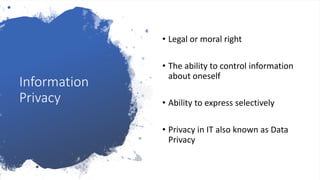
Information
Privacy
• Legal or moral right
• The ability to control information
about oneself
• Ability to express selectively
• Privacy in IT also known as Data
Privacy
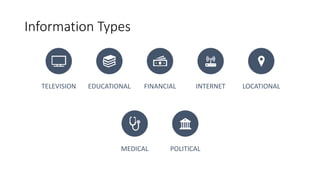
Information Types
TELEVISION EDUCATIONAL FINANCIAL INTERNET LOCATIONAL
MEDICAL POLITICAL
Laws and Authorities
• Each country has its own
privacy protection policies
Example: Office of the Australian
Information Commissioner(OAIC)
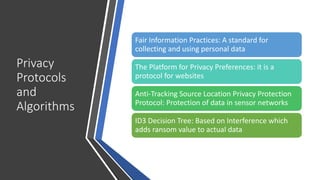
Privacy
Protocols
and
Algorithms
Fair Information Practices: A standard for
collecting and using personal data
The Platform for Privacy Preferences: it is a
protocol for websites
Anti-Tracking Source Location Privacy Protection
Protocol: Protection of data in sensor networks
ID3 Decision Tree: Based on Interference which
adds ransom value to actual data
Privacy
Protocols,
Technologies
and
Algorithms
(Contd..)
Distributed Data Mining: An
algorithm based on secure
multi-party computation
Privacy Enhancing Technologies:
Methods of data protection in
accordance with law
Information
Security
Methods used for the
protection of data
Principles are:
Confidentiality, Integrity
and Availability
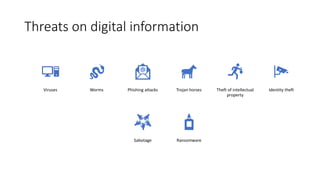
Threats on digital information
Viruses Worms Phishing attacks Trojan horses Theft of intellectual
property
Identity theft
Sabotage Ransomware
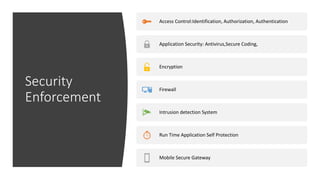
Security
Enforcement
Access Control:Identification, Authorization, Authentication
Application Security: Antivirus,Secure Coding,
Encryption
Firewall
Intrusion detection System
Run Time Application Self Protection
Mobile Secure Gateway
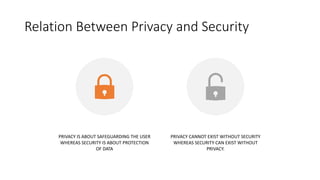
Relation Between Privacy and Security
PRIVACY IS ABOUT SAFEGUARDING THE USER
WHEREAS SECURITY IS ABOUT PROTECTION
OF DATA
PRIVACY CANNOT EXIST WITHOUT SECURITY
WHEREAS SECURITY CAN EXIST WITHOUT
PRIVACY.
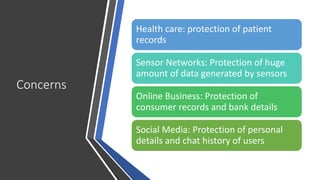
Concerns
Health care: protection of patient
records
Sensor Networks: Protection of huge
amount of data generated by sensors
Online Business: Protection of
consumer records and bank details
Social Media: Protection of personal
details and chat history of users
Conclusion
• The term Information privacy and security are
closely related, where privacy cannot exist
without security whereas security can exist
without privacy.
• The threats of information can be from hackers,
vulnerabilities in software, lack of transparency
in privacy policies, collection of unnecessary
data, personal data sharing, data transfer over
insecure channels etc.
• https://www.youtube.com/watch?v=6vNxslcf9A
E
References
Anthony D, M, Ana Fernandez 2001, ‘Consumer Perceptions of Privacy and Security Risks
for Online Shopping’, vol. 35, no. 1, pp. 27-44.
Dimitrova, A & Brkan, M 2018, ‘Balancing National Security and Data Protection: The
Role of EU and US Policy-Makers and Courts before and after the NSA Affair’, JCMS:
Journal of Common Market Studies, vol. 56, no. 4, pp. 751-67.
France Belanger & crossler, RE 2011, ‘Privacy in the Digital Age: A Review of Information
Privacy Research in InformationSystems’, MIS Quarterly, vol. 35, no. 4, pp. 1017-41.
Kagal L, FT, Joshi A, Greenspan S. 2006, ‘Security and Privacy Challenges in Open and
Dynamic Environments’, Computer, vol. 39, no. 6, pp. 89-91.
Li, C & Liu, H-w 2015, ‘A Review of Privacy Protection in E-commerce’, Journal of
Advanced Management Science, pp. 50-3.
Marci Meingast, TRSS 2006, ‘Security and Privacy Issues with Health Care Information
Technology’, in International Conference of the IEEE Engineering in Medicine and Biology
Society, New York, NY, USA.
Meng, X 2008, ‘Analyze and Prevent the Security Risks of E-Commerce Privacy’, paper
presented to 2008 International Conference on Management of e-Commerce and e-
Government.
References
Santosh Krishna Putchala, KB, R Anitha 2013, ‘Information
security challenges in social media interactions: strategies
to normalize practices across physical and virtual worlds’,
paper presented to DSCI - Best Practices Meet, Chennai,
India, 12-12 July 2013.
Weber, RH 2010, ‘Internet of Things – New security and
privacy challenges’, Computer Law & Security Review, vol.
26, no. 1, pp. 23-30.
Xin He, WPT 2017, ‘Multilayer Sensor Network for
Information Privacy’, in IEEE International Conference on
Acoustics, Speech and Signal Processing (ICASSP), New
Orleans, LA, USA.

Information privacy and Security

  • 1.
  • 2.
    Information Privacy • Legal ormoral right • The ability to control information about oneself • Ability to express selectively • Privacy in IT also known as Data Privacy
  • 3.
    Information Types TELEVISION EDUCATIONALFINANCIAL INTERNET LOCATIONAL MEDICAL POLITICAL
  • 4.
    Laws and Authorities •Each country has its own privacy protection policies Example: Office of the Australian Information Commissioner(OAIC)
  • 5.
    Privacy Protocols and Algorithms Fair Information Practices:A standard for collecting and using personal data The Platform for Privacy Preferences: it is a protocol for websites Anti-Tracking Source Location Privacy Protection Protocol: Protection of data in sensor networks ID3 Decision Tree: Based on Interference which adds ransom value to actual data
  • 6.
    Privacy Protocols, Technologies and Algorithms (Contd..) Distributed Data Mining:An algorithm based on secure multi-party computation Privacy Enhancing Technologies: Methods of data protection in accordance with law
  • 7.
    Information Security Methods used forthe protection of data Principles are: Confidentiality, Integrity and Availability
  • 8.
    Threats on digitalinformation Viruses Worms Phishing attacks Trojan horses Theft of intellectual property Identity theft Sabotage Ransomware
  • 9.
    Security Enforcement Access Control:Identification, Authorization,Authentication Application Security: Antivirus,Secure Coding, Encryption Firewall Intrusion detection System Run Time Application Self Protection Mobile Secure Gateway
  • 10.
    Relation Between Privacyand Security PRIVACY IS ABOUT SAFEGUARDING THE USER WHEREAS SECURITY IS ABOUT PROTECTION OF DATA PRIVACY CANNOT EXIST WITHOUT SECURITY WHEREAS SECURITY CAN EXIST WITHOUT PRIVACY.
  • 11.
    Concerns Health care: protectionof patient records Sensor Networks: Protection of huge amount of data generated by sensors Online Business: Protection of consumer records and bank details Social Media: Protection of personal details and chat history of users
  • 12.
    Conclusion • The termInformation privacy and security are closely related, where privacy cannot exist without security whereas security can exist without privacy. • The threats of information can be from hackers, vulnerabilities in software, lack of transparency in privacy policies, collection of unnecessary data, personal data sharing, data transfer over insecure channels etc. • https://www.youtube.com/watch?v=6vNxslcf9A E
  • 13.
    References Anthony D, M,Ana Fernandez 2001, ‘Consumer Perceptions of Privacy and Security Risks for Online Shopping’, vol. 35, no. 1, pp. 27-44. Dimitrova, A & Brkan, M 2018, ‘Balancing National Security and Data Protection: The Role of EU and US Policy-Makers and Courts before and after the NSA Affair’, JCMS: Journal of Common Market Studies, vol. 56, no. 4, pp. 751-67. France Belanger & crossler, RE 2011, ‘Privacy in the Digital Age: A Review of Information Privacy Research in InformationSystems’, MIS Quarterly, vol. 35, no. 4, pp. 1017-41. Kagal L, FT, Joshi A, Greenspan S. 2006, ‘Security and Privacy Challenges in Open and Dynamic Environments’, Computer, vol. 39, no. 6, pp. 89-91. Li, C & Liu, H-w 2015, ‘A Review of Privacy Protection in E-commerce’, Journal of Advanced Management Science, pp. 50-3. Marci Meingast, TRSS 2006, ‘Security and Privacy Issues with Health Care Information Technology’, in International Conference of the IEEE Engineering in Medicine and Biology Society, New York, NY, USA. Meng, X 2008, ‘Analyze and Prevent the Security Risks of E-Commerce Privacy’, paper presented to 2008 International Conference on Management of e-Commerce and e- Government.
  • 14.
    References Santosh Krishna Putchala,KB, R Anitha 2013, ‘Information security challenges in social media interactions: strategies to normalize practices across physical and virtual worlds’, paper presented to DSCI - Best Practices Meet, Chennai, India, 12-12 July 2013. Weber, RH 2010, ‘Internet of Things – New security and privacy challenges’, Computer Law & Security Review, vol. 26, no. 1, pp. 23-30. Xin He, WPT 2017, ‘Multilayer Sensor Network for Information Privacy’, in IEEE International Conference on Acoustics, Speech and Signal Processing (ICASSP), New Orleans, LA, USA.