© 2007 M. Tallman
© 2007 M. Tallman
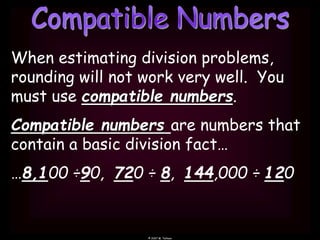
When estimating division problems,
rounding will not work very well. You
must use compatible numbers.
Compatible numbers are numbers that
contain a basic division fact…
…8,100 ÷90, 720 ÷ 8, 144,000 ÷ 120
© 2007 M. Tallman
1. 120 ÷ 4
2.
3. 21,000 ÷ 7
4. 240 ÷ 6
5.
6.
7. 320 ÷ 8
8.
35,000
Find the compatible numbers in these division problems.
3,600
)
9
→ 12 ÷ 4
→ 36 ÷ 9
→ 21 ÷ 7
→ 24 ÷ 6
→ 42 ÷ 7
→ 35 ÷ 5
→ 32 ÷ 8
→ 96 ÷ 8
4,200
)
7
)
5
9,600
)
8
© 2007 M. Tallman
5
450
437 ÷ 9
9
÷ =
1
1
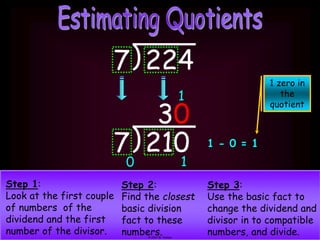
Step 1:
Look at the first couple
of numbers of the
dividend and the first
number of the divisor.
Step 2:
Find the closest
basic division
fact to these
numbers.
Step 3:
Use the basic fact to
change the dividend and
divisor in to compatible
numbers, and divide.
0
1 - 0 = 1
0
1 zero in the
quotient
© 2007 M. Tallman
7
490
508 ÷ 7
7
÷ =
1
1
Step 1:
Look at the first couple
of numbers of the
dividend and the first
number of the divisor.
Step 2:
Find the closest
basic division
fact to these
numbers.
Step 3:
Use the basic fact to
change the dividend and
divisor in to compatible
numbers, and divide.
0
1 - 0 = 1
0
1 zero in the
quotient
© 2007 M. Tallman
0
7 224
3
21
1
1
Step 1:
Look at the first couple
of numbers of the
dividend and the first
number of the divisor.
Step 2:
Find the closest
basic division
fact to these
numbers.
Step 3:
Use the basic fact to
change the dividend and
divisor in to compatible
numbers, and divide.
0
1 - 0 = 1
0
)
7)
1 zero in
the
quotient
© 2007 M. Tallman
7
4,20
4,324 ÷ 6
6
÷ =
1
1
Step 1:
Look at the first couple
of numbers of the
dividend and the first
number of the divisor.
Step 2:
Find the closest
basic division
fact to these
numbers
Step 3:
Use the basic fact to
change the dividend and
divisor in to compatible
numbers, and divide.
0
2 - 0 = 2
0
0
2
0
2
2 zeros in the
quotient
© 2007 M. Tallman
3,200
4 3,105
8
1
1
Step 1:
Look at the first couple
of numbers of the
dividend and the first
number of the divisor.
Step 2:
Find the closest
basic division
fact to these
numbers.
Step 3:
Use the basic fact to
change the dividend and
divisor in to compatible
numbers, and divide.
0
2 - 0 = 2
0
)
4)
0
2
2
2 zeros
in the
quotient
© 2007 M. Tallman
4,000
5 4,175
8
1
1
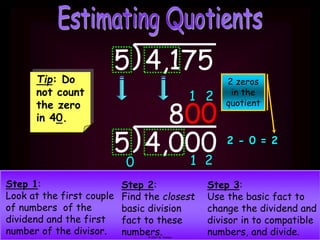
Step 1:
Look at the first couple
of numbers of the
dividend and the first
number of the divisor.
Step 2:
Find the closest
basic division
fact to these
numbers.
Step 3:
Use the basic fact to
change the dividend and
divisor in to compatible
numbers, and divide.
0
2 - 0 = 2
0
)
5)
0
2
2
2 zeros
in the
quotient
Tip: Do
not count
the zero
in 40.
© 2007 M. Tallman
Estimate 468 ÷ 8
Division Fact:_________
Estimate:____________
480 ÷ 8 = 80
48 ÷ 8 = 8
© 2007 M. Tallman
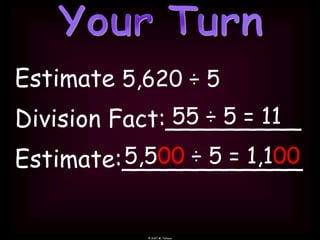
Estimate
Division Fact:_________
Estimate:____________
5,500 ÷ 5 = 1,100
55 ÷ 5 = 11
5,620 ÷ 5
© 2007 M. Tallman
Estimate
Division Fact:_________
Estimate:____________
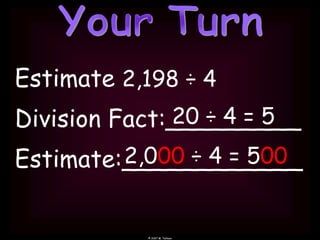
2,000 ÷ 4 = 500
20 ÷ 4 = 5
2,198 ÷ 4
© 2007 M. Tallman
Estimate
Division Fact:_________
Estimate:____________
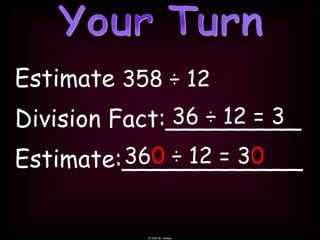
360 ÷ 12 = 30
36 ÷ 12 = 3
358 ÷ 12
© 2007 M. Tallman
Estimate
Division Fact:_________
Estimate:____________
1,800 ÷ 9 = 200
18 ÷ 9 = 2
1,976 ÷ 9

Estimate quotients 4

  • 1.
    © 2007 M.Tallman
  • 2.
    © 2007 M.Tallman When estimating division problems, rounding will not work very well. You must use compatible numbers. Compatible numbers are numbers that contain a basic division fact… …8,100 ÷90, 720 ÷ 8, 144,000 ÷ 120
  • 3.
    © 2007 M.Tallman 1. 120 ÷ 4 2. 3. 21,000 ÷ 7 4. 240 ÷ 6 5. 6. 7. 320 ÷ 8 8. 35,000 Find the compatible numbers in these division problems. 3,600 ) 9 → 12 ÷ 4 → 36 ÷ 9 → 21 ÷ 7 → 24 ÷ 6 → 42 ÷ 7 → 35 ÷ 5 → 32 ÷ 8 → 96 ÷ 8 4,200 ) 7 ) 5 9,600 ) 8
  • 4.
    © 2007 M.Tallman 5 450 437 ÷ 9 9 ÷ = 1 1 Step 1: Look at the first couple of numbers of the dividend and the first number of the divisor. Step 2: Find the closest basic division fact to these numbers. Step 3: Use the basic fact to change the dividend and divisor in to compatible numbers, and divide. 0 1 - 0 = 1 0 1 zero in the quotient
  • 5.
    © 2007 M.Tallman 7 490 508 ÷ 7 7 ÷ = 1 1 Step 1: Look at the first couple of numbers of the dividend and the first number of the divisor. Step 2: Find the closest basic division fact to these numbers. Step 3: Use the basic fact to change the dividend and divisor in to compatible numbers, and divide. 0 1 - 0 = 1 0 1 zero in the quotient
  • 6.
    © 2007 M.Tallman 0 7 224 3 21 1 1 Step 1: Look at the first couple of numbers of the dividend and the first number of the divisor. Step 2: Find the closest basic division fact to these numbers. Step 3: Use the basic fact to change the dividend and divisor in to compatible numbers, and divide. 0 1 - 0 = 1 0 ) 7) 1 zero in the quotient
  • 7.
    © 2007 M.Tallman 7 4,20 4,324 ÷ 6 6 ÷ = 1 1 Step 1: Look at the first couple of numbers of the dividend and the first number of the divisor. Step 2: Find the closest basic division fact to these numbers Step 3: Use the basic fact to change the dividend and divisor in to compatible numbers, and divide. 0 2 - 0 = 2 0 0 2 0 2 2 zeros in the quotient
  • 8.
    © 2007 M.Tallman 3,200 4 3,105 8 1 1 Step 1: Look at the first couple of numbers of the dividend and the first number of the divisor. Step 2: Find the closest basic division fact to these numbers. Step 3: Use the basic fact to change the dividend and divisor in to compatible numbers, and divide. 0 2 - 0 = 2 0 ) 4) 0 2 2 2 zeros in the quotient
  • 9.
    © 2007 M.Tallman 4,000 5 4,175 8 1 1 Step 1: Look at the first couple of numbers of the dividend and the first number of the divisor. Step 2: Find the closest basic division fact to these numbers. Step 3: Use the basic fact to change the dividend and divisor in to compatible numbers, and divide. 0 2 - 0 = 2 0 ) 5) 0 2 2 2 zeros in the quotient Tip: Do not count the zero in 40.
  • 10.
    © 2007 M.Tallman Estimate 468 ÷ 8 Division Fact:_________ Estimate:____________ 480 ÷ 8 = 80 48 ÷ 8 = 8
  • 11.
    © 2007 M.Tallman Estimate Division Fact:_________ Estimate:____________ 5,500 ÷ 5 = 1,100 55 ÷ 5 = 11 5,620 ÷ 5
  • 12.
    © 2007 M.Tallman Estimate Division Fact:_________ Estimate:____________ 2,000 ÷ 4 = 500 20 ÷ 4 = 5 2,198 ÷ 4
  • 13.
    © 2007 M.Tallman Estimate Division Fact:_________ Estimate:____________ 360 ÷ 12 = 30 36 ÷ 12 = 3 358 ÷ 12
  • 14.
    © 2007 M.Tallman Estimate Division Fact:_________ Estimate:____________ 1,800 ÷ 9 = 200 18 ÷ 9 = 2 1,976 ÷ 9