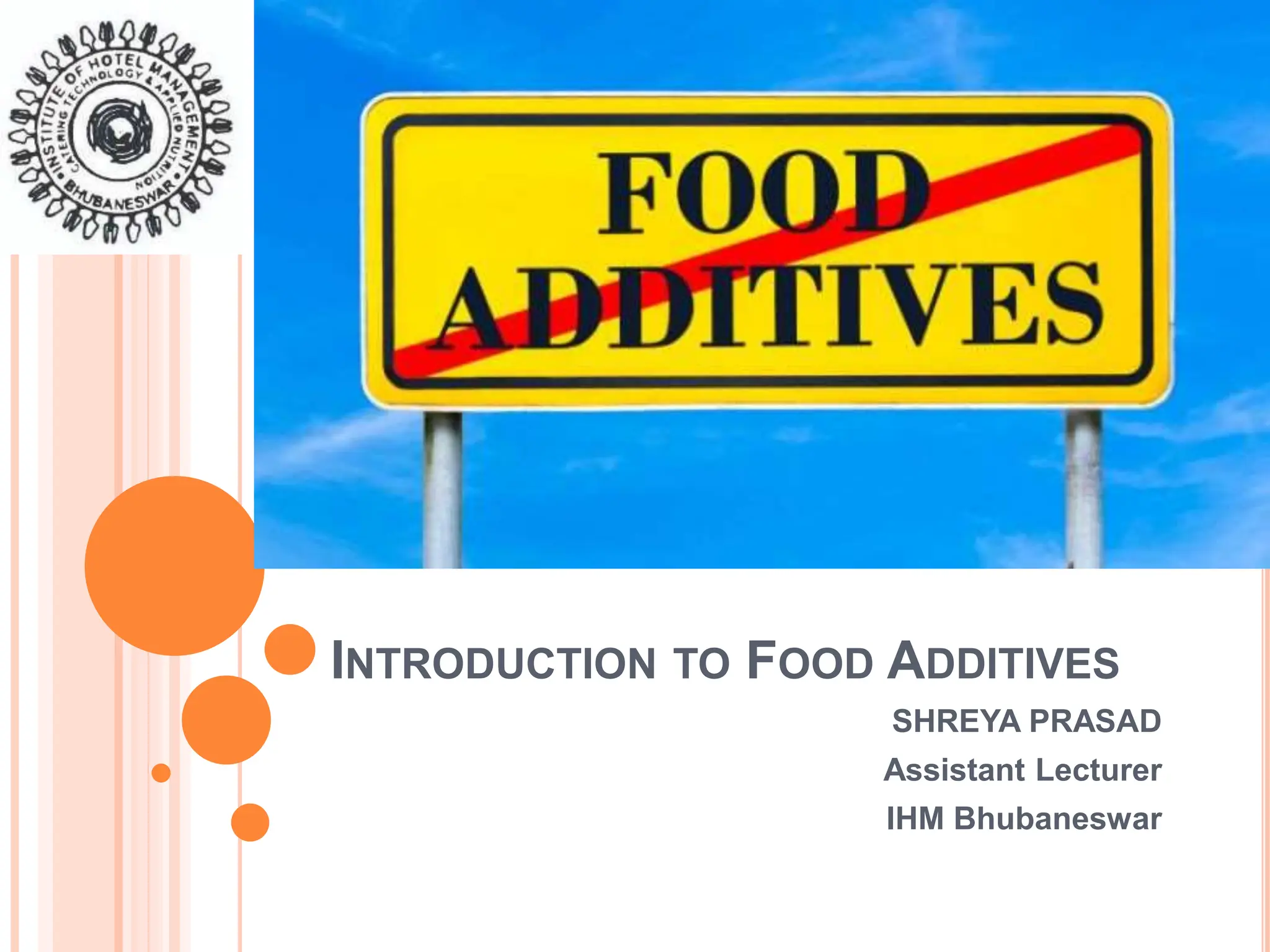
INTRODUCTION TO FOOD ADDITIVES
SHREYA PRASAD
Assistant Lecturer
IHM Bhubaneswar
FOOD ADDITIVES
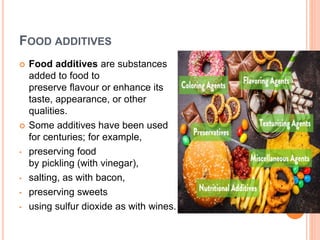
 Food additives are substances
added to food to
preserve flavour or enhance its
taste, appearance, or other
qualities.
 Some additives have been used
for centuries; for example,
• preserving food
by pickling (with vinegar),
• salting, as with bacon,
• preserving sweets
• using sulfur dioxide as with wines.
WHAT IS A FOOD ADDITIVE?
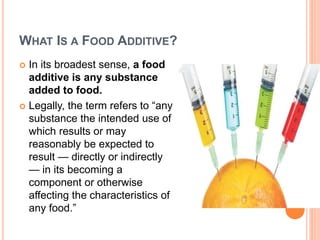
 In its broadest sense, a food
additive is any substance
added to food.
 Legally, the term refers to “any
substance the intended use of
which results or may
reasonably be expected to
result — directly or indirectly
— in its becoming a
component or otherwise
affecting the characteristics of
any food.”
 This definition includes any
substance used in the
production, processing,
treatment, packaging,
transportation or storage of
food.
 The purpose of the legal
definition, however, is to impose
a premarket approval
requirement.
DIRECT
 Direct food additives are those that
are added to a food for a specific
purpose in that food.
For example,
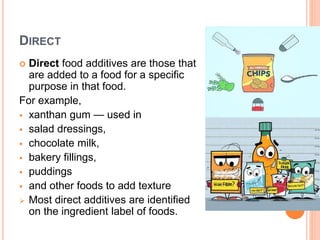
 xanthan gum — used in
 salad dressings,
 chocolate milk,
 bakery fillings,
 puddings
 and other foods to add texture
 Most direct additives are identified
on the ingredient label of foods.
INDIRECT
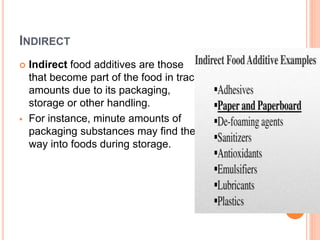
 Indirect food additives are those
that become part of the food in trace
amounts due to its packaging,
storage or other handling.
 For instance, minute amounts of
packaging substances may find their
way into foods during storage.
EXAMPLES OF FOOD ADDITIVES
 Preservative, such as ascorbic acid, potassium
sorbate, sodium nitrite, and calcium sorbate.
 Prevent oxidation of fats, which cause an off-flavour
to develop; prevent the growth of microbes by
changing the acidity, and prevent other changes in
flavour.
 Preservative-type food additives can be found in
anything from canned fruits and vegetables to
bread and meats.
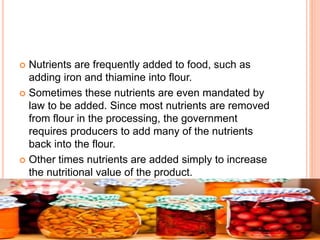
 Nutrients are frequently added to food, such as
adding iron and thiamine into flour.
 Sometimes these nutrients are even mandated by
law to be added. Since most nutrients are removed
from flour in the processing, the government
requires producers to add many of the nutrients
back into the flour.
 Other times nutrients are added simply to increase
the nutritional value of the product.
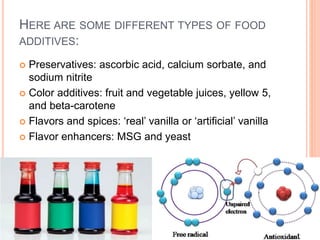
HERE ARE SOME DIFFERENT TYPES OF FOOD
ADDITIVES:
 Preservatives: ascorbic acid, calcium sorbate, and
sodium nitrite
 Color additives: fruit and vegetable juices, yellow 5,
and beta-carotene
 Flavors and spices: ‘real’ vanilla or ‘artificial’ vanilla
 Flavor enhancers: MSG and yeast
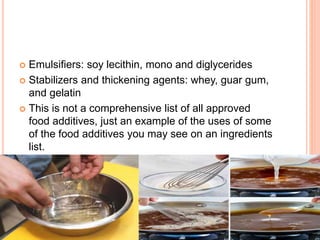
 Emulsifiers: soy lecithin, mono and diglycerides
 Stabilizers and thickening agents: whey, guar gum,
and gelatin
 This is not a comprehensive list of all approved
food additives, just an example of the uses of some
of the food additives you may see on an ingredients
list.
PRESERVATIVES
 Preservative, in foods, any of numerous chemical
additives used to prevent or retard spoilage caused
by chemical changes,
 e.g., oxidation or the growth of mould.
 Along with emulsifying and stabilizing agents,
 preservatives also help to maintain freshness of
appearance and consistency.
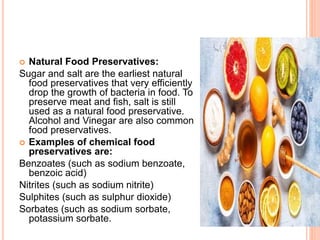
 Natural Food Preservatives:
Sugar and salt are the earliest natural
food preservatives that very efficiently
drop the growth of bacteria in food. To
preserve meat and fish, salt is still
used as a natural food preservative.
Alcohol and Vinegar are also common
food preservatives.
 Examples of chemical food
preservatives are:
Benzoates (such as sodium benzoate,
benzoic acid)
Nitrites (such as sodium nitrite)
Sulphites (such as sulphur dioxide)
Sorbates (such as sodium sorbate,
potassium sorbate.
ANTIOXIDANTS
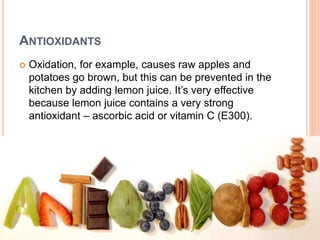
 Oxidation, for example, causes raw apples and
potatoes go brown, but this can be prevented in the
kitchen by adding lemon juice. It’s very effective
because lemon juice contains a very strong
antioxidant – ascorbic acid or vitamin C (E300).
 By preventing or slowing down the oxidation
process in foods, waste through spoilage is
reduced.
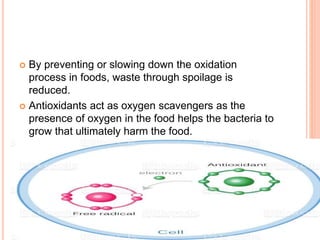
 Antioxidants act as oxygen scavengers as the
presence of oxygen in the food helps the bacteria to
grow that ultimately harm the food.
 Antioxidants Food Additives List
E300 – Ascorbic acid
E301 – Sodium ascorbate
E302 – Calcium ascorbate
E304 – Fatty acid esters of ascorbic acid
E306 – Tocopherols
E307 – Alpha-tocopherol
E308 – Gamma-tocopherol
E309 – Delta-tocopherol
E310 – Propyl gallate
E311 – Octyl gallate
E312 – Dodecyl gallate
E315 – Erythorbic acid
E316 – Sodium erythorbate
E312 – Dodecyl gallate
E319 – Tertiary-butyl hydroquinone (TBHQ)
E320 – Butylated hydroxyanisole (BHA)
E321 – Butylated hydroxytoluene (BHT)
E330 – Citric Acid
E586 – 4-Hexylresorcinol
SWEETENERS
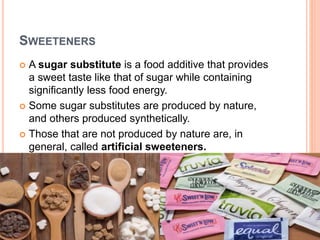
 A sugar substitute is a food additive that provides
a sweet taste like that of sugar while containing
significantly less food energy.
 Some sugar substitutes are produced by nature,
and others produced synthetically.
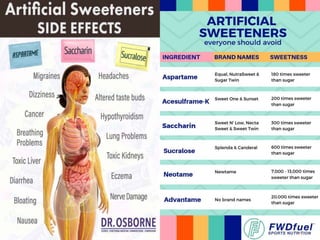
 Those that are not produced by nature are, in
general, called artificial sweeteners.
USES FOR ARTIFICIAL SWEETENERS
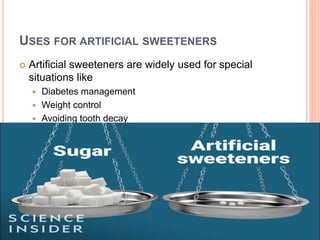
 Artificial sweeteners are widely used for special
situations like
 Diabetes management
 Weight control
 Avoiding tooth decay
Introduction to Food Additives.pptx

Introduction to Food Additives.pptx

  • 1.
    INTRODUCTION TO FOODADDITIVES SHREYA PRASAD Assistant Lecturer IHM Bhubaneswar
  • 2.
    FOOD ADDITIVES  Foodadditives are substances added to food to preserve flavour or enhance its taste, appearance, or other qualities.  Some additives have been used for centuries; for example, • preserving food by pickling (with vinegar), • salting, as with bacon, • preserving sweets • using sulfur dioxide as with wines.
  • 3.
    WHAT IS AFOOD ADDITIVE?  In its broadest sense, a food additive is any substance added to food.  Legally, the term refers to “any substance the intended use of which results or may reasonably be expected to result — directly or indirectly — in its becoming a component or otherwise affecting the characteristics of any food.”
  • 4.
     This definitionincludes any substance used in the production, processing, treatment, packaging, transportation or storage of food.  The purpose of the legal definition, however, is to impose a premarket approval requirement.
  • 5.
    DIRECT  Direct foodadditives are those that are added to a food for a specific purpose in that food. For example,  xanthan gum — used in  salad dressings,  chocolate milk,  bakery fillings,  puddings  and other foods to add texture  Most direct additives are identified on the ingredient label of foods.
  • 6.
    INDIRECT  Indirect foodadditives are those that become part of the food in trace amounts due to its packaging, storage or other handling.  For instance, minute amounts of packaging substances may find their way into foods during storage.
  • 7.
    EXAMPLES OF FOODADDITIVES  Preservative, such as ascorbic acid, potassium sorbate, sodium nitrite, and calcium sorbate.  Prevent oxidation of fats, which cause an off-flavour to develop; prevent the growth of microbes by changing the acidity, and prevent other changes in flavour.  Preservative-type food additives can be found in anything from canned fruits and vegetables to bread and meats.
  • 8.
     Nutrients arefrequently added to food, such as adding iron and thiamine into flour.  Sometimes these nutrients are even mandated by law to be added. Since most nutrients are removed from flour in the processing, the government requires producers to add many of the nutrients back into the flour.  Other times nutrients are added simply to increase the nutritional value of the product.
  • 9.
    HERE ARE SOMEDIFFERENT TYPES OF FOOD ADDITIVES:  Preservatives: ascorbic acid, calcium sorbate, and sodium nitrite  Color additives: fruit and vegetable juices, yellow 5, and beta-carotene  Flavors and spices: ‘real’ vanilla or ‘artificial’ vanilla  Flavor enhancers: MSG and yeast
  • 10.
     Emulsifiers: soylecithin, mono and diglycerides  Stabilizers and thickening agents: whey, guar gum, and gelatin  This is not a comprehensive list of all approved food additives, just an example of the uses of some of the food additives you may see on an ingredients list.
  • 11.
    PRESERVATIVES  Preservative, infoods, any of numerous chemical additives used to prevent or retard spoilage caused by chemical changes,  e.g., oxidation or the growth of mould.  Along with emulsifying and stabilizing agents,  preservatives also help to maintain freshness of appearance and consistency.
  • 12.
     Natural FoodPreservatives: Sugar and salt are the earliest natural food preservatives that very efficiently drop the growth of bacteria in food. To preserve meat and fish, salt is still used as a natural food preservative. Alcohol and Vinegar are also common food preservatives.  Examples of chemical food preservatives are: Benzoates (such as sodium benzoate, benzoic acid) Nitrites (such as sodium nitrite) Sulphites (such as sulphur dioxide) Sorbates (such as sodium sorbate, potassium sorbate.
  • 13.
    ANTIOXIDANTS  Oxidation, forexample, causes raw apples and potatoes go brown, but this can be prevented in the kitchen by adding lemon juice. It’s very effective because lemon juice contains a very strong antioxidant – ascorbic acid or vitamin C (E300).
  • 14.
     By preventingor slowing down the oxidation process in foods, waste through spoilage is reduced.  Antioxidants act as oxygen scavengers as the presence of oxygen in the food helps the bacteria to grow that ultimately harm the food.
  • 15.
     Antioxidants FoodAdditives List E300 – Ascorbic acid E301 – Sodium ascorbate E302 – Calcium ascorbate E304 – Fatty acid esters of ascorbic acid E306 – Tocopherols E307 – Alpha-tocopherol E308 – Gamma-tocopherol E309 – Delta-tocopherol E310 – Propyl gallate E311 – Octyl gallate E312 – Dodecyl gallate E315 – Erythorbic acid E316 – Sodium erythorbate E312 – Dodecyl gallate E319 – Tertiary-butyl hydroquinone (TBHQ) E320 – Butylated hydroxyanisole (BHA) E321 – Butylated hydroxytoluene (BHT) E330 – Citric Acid E586 – 4-Hexylresorcinol
  • 16.
    SWEETENERS  A sugarsubstitute is a food additive that provides a sweet taste like that of sugar while containing significantly less food energy.  Some sugar substitutes are produced by nature, and others produced synthetically.  Those that are not produced by nature are, in general, called artificial sweeteners.
  • 17.
    USES FOR ARTIFICIALSWEETENERS  Artificial sweeteners are widely used for special situations like  Diabetes management  Weight control  Avoiding tooth decay