Sowmya K S
Assistant Professor
Dept. of Commerce
GFGC,
Bharamasagara.
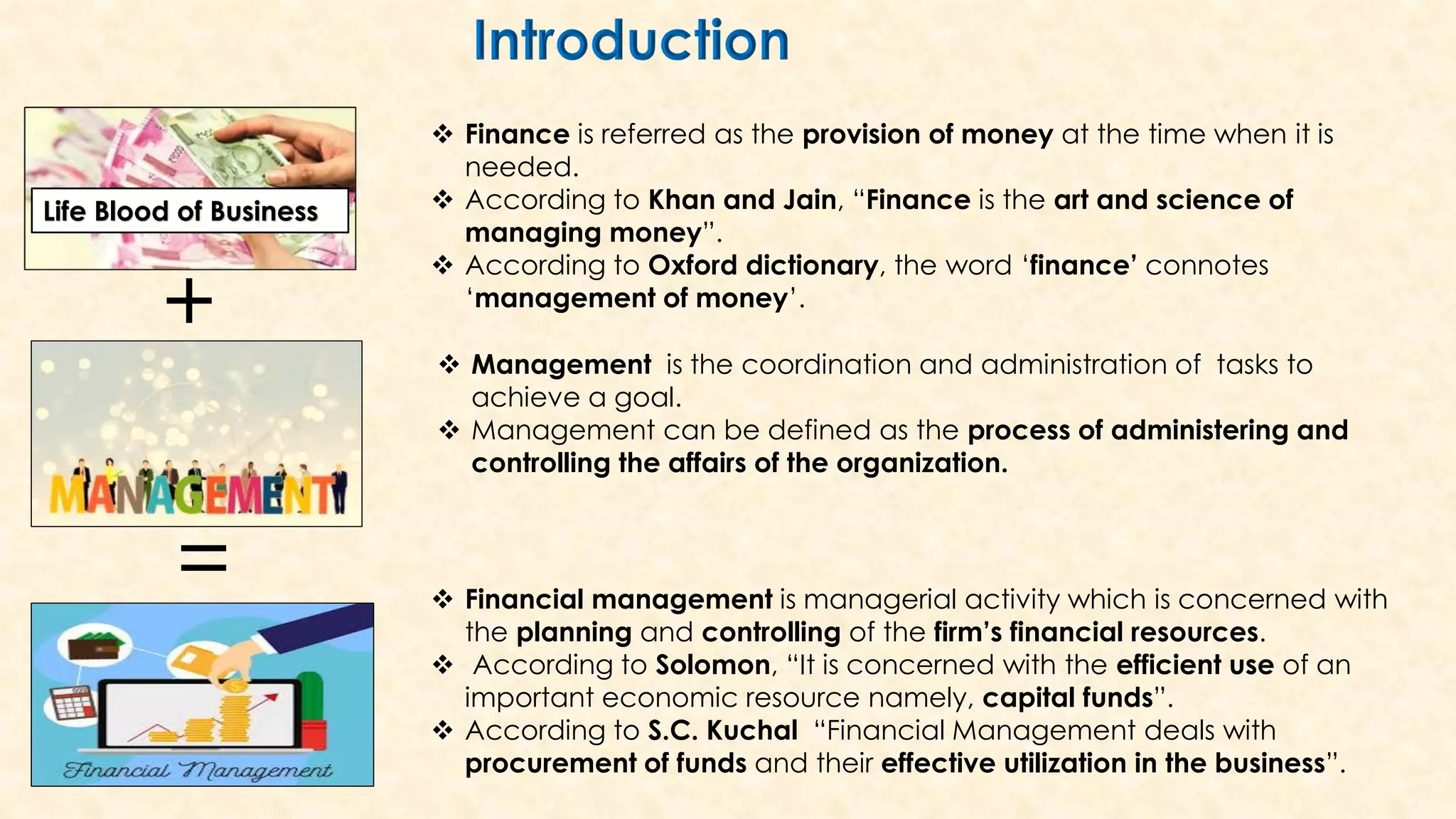
 Management is the coordination and administration of tasks to
achieve a goal.
 Management can be defined as the process of administering and
controlling the affairs of the organization.
+
 Finance is referred as the provision of money at the time when it is
needed.
 According to Khan and Jain, “Finance is the art and science of
managing money”.
 According to Oxford dictionary, the word ‘finance’ connotes
‘management of money’.
=
Life Blood of Business
 Financial management is managerial activity which is concerned with
the planning and controlling of the firm’s financial resources.
 According to Solomon, “It is concerned with the efficient use of an
important economic resource namely, capital funds”.
 According to S.C. Kuchal “Financial Management deals with
procurement of funds and their effective utilization in the business”.
Objectives of Financial Management may be broadly divided into two
parts such as:
• It is the traditional and narrow approach, which aims at,
maximizing the profit of the concern
• It leads to maximize the business operation for profit
maximization.
• Profit is the parameter of measuring the efficiency of the
business concern.
Profit
Maximisation
• It is the modern approach
• The term wealth means shareholder wealth or the wealth of
the persons those who are involved in the business concern
• Wealth maximization is also known as value maximization.
Wealth
Maximisation
 Estimating the requirement of funds
for a given period.
 Raising and investing the funds
 Funding day-to-day working capital
requirements of business;
 Collecting on time from debtors and
paying to creditors on time;
 Ensuring a satisfactory return to all
the stake holders;
 Paying interest on borrowings;
 Repaying lenders on due dates;
 Maximizing the wealth of the
shareholders over the long term;
 Interfacing with the capital markets;
 Increasing the firm’s competitive
financial strength in the market;
 Adhering to the requirements of
corporate governance.
 Helps organisations in financial planning;
 Assists organisations in the planning and acquisition of funds;
 Helps organisations in effectively utilising and allocating the funds received or
acquired;
 Assists organisations in making critical financial decisions;
 Helps in improving the profitability of organisations;
 Increases the overall value of the firms or organisations;
 Provides economic stability;
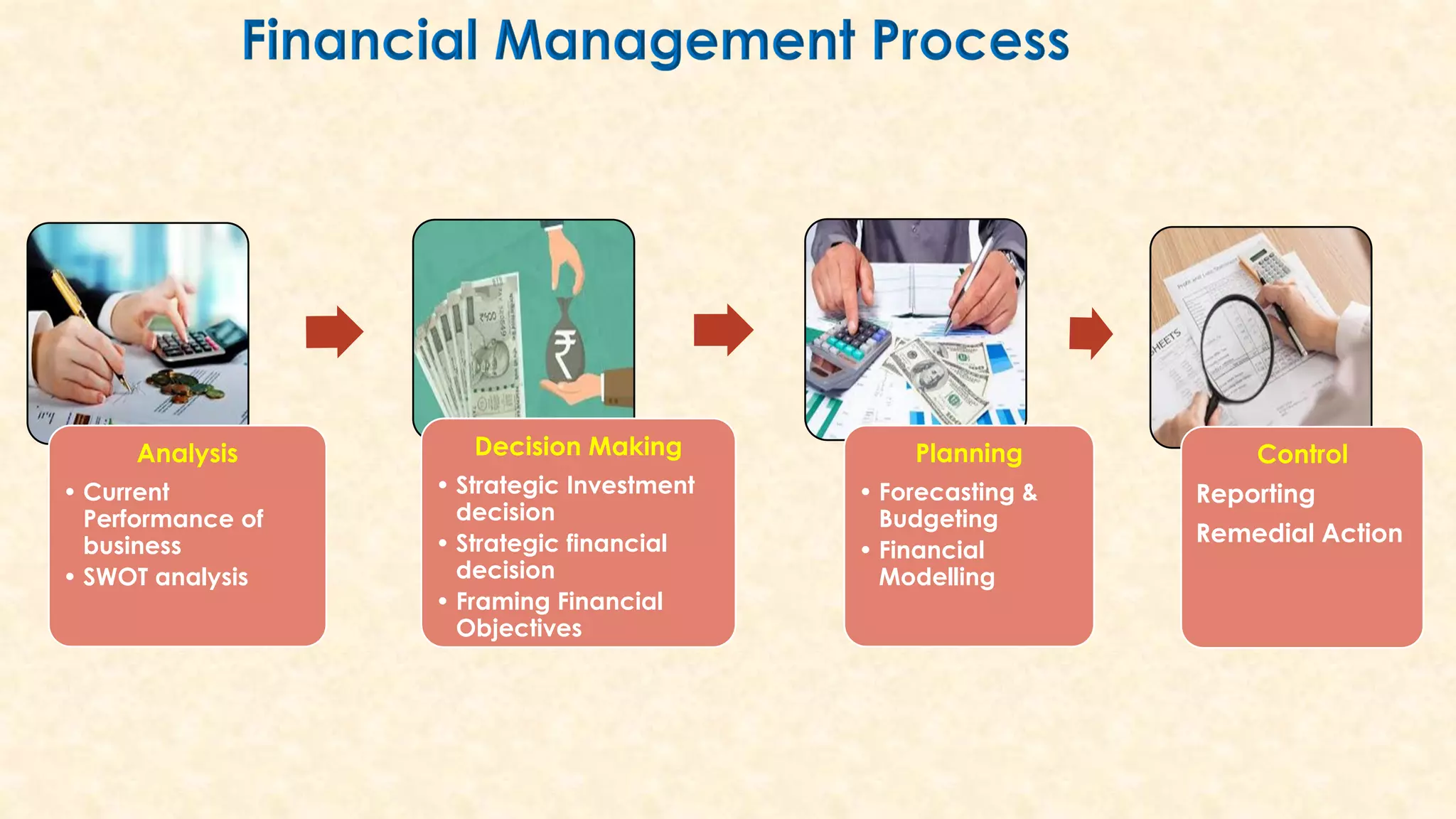
Analysis
• Current
Performance of
business
• SWOT analysis
Decision Making
• Strategic Investment
decision
• Strategic financial
decision
• Framing Financial
Objectives
Planning
• Forecasting &
Budgeting
• Financial
Modelling
Control
Reporting
Remedial Action
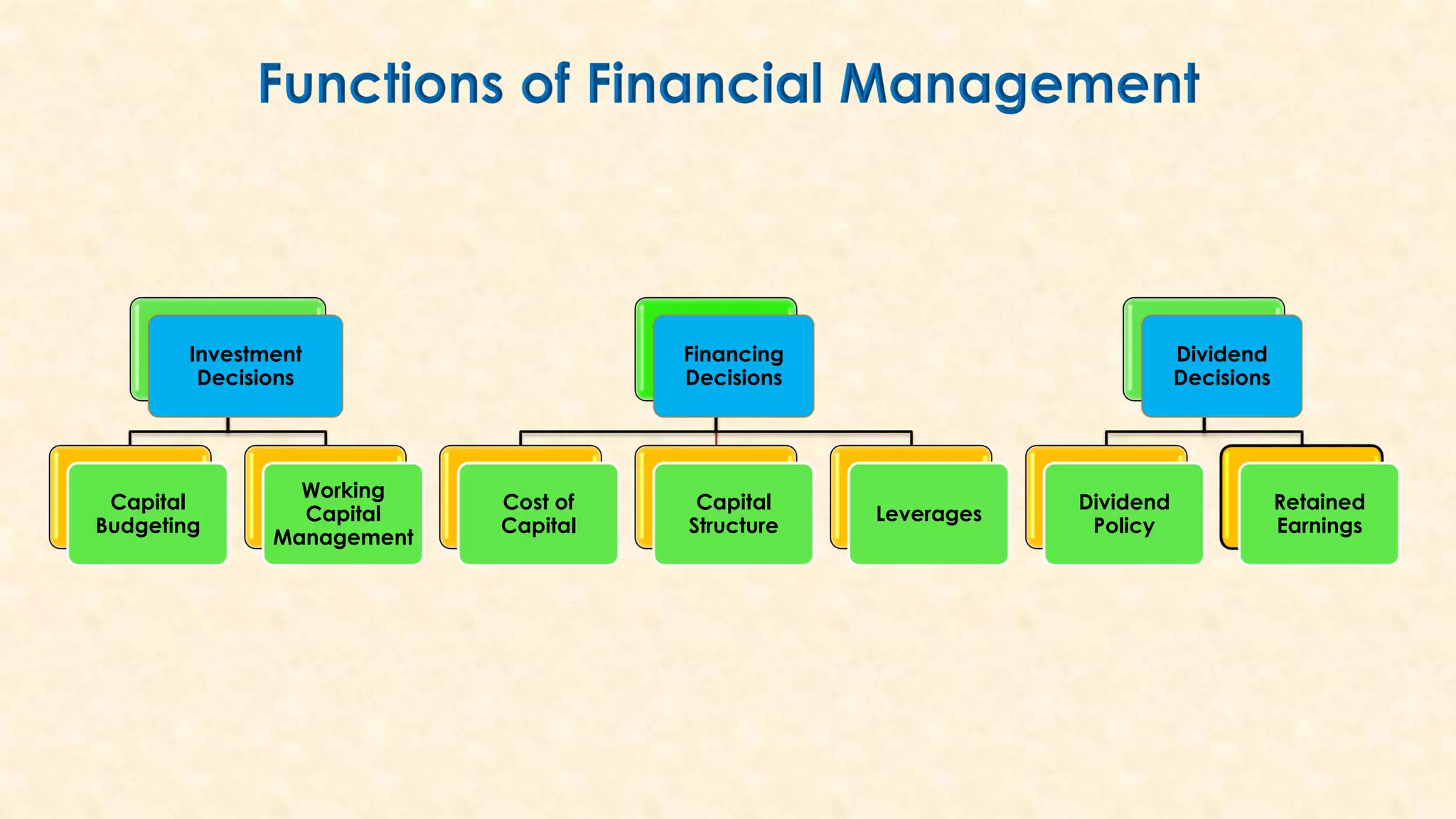
Investment
Decisions
Capital
Budgeting
Working
Capital
Management
Financing
Decisions
Cost of
Capital
Capital
Structure
Leverages
Dividend
Decisions
Dividend
Policy
Retained
Earnings
 Corporate manager;
 Investment banker;
 Financial advisor;
 Financial analyst;
 Financial examiners
 Financial managers;
 Personal financial planners;
 Budget analysts;
 Investor relations associate or executive;
 Credit analyst.
Studying financial management opens up a lot of diverse career opportunities. It could be in
the private or public sector. Some of the career options include:
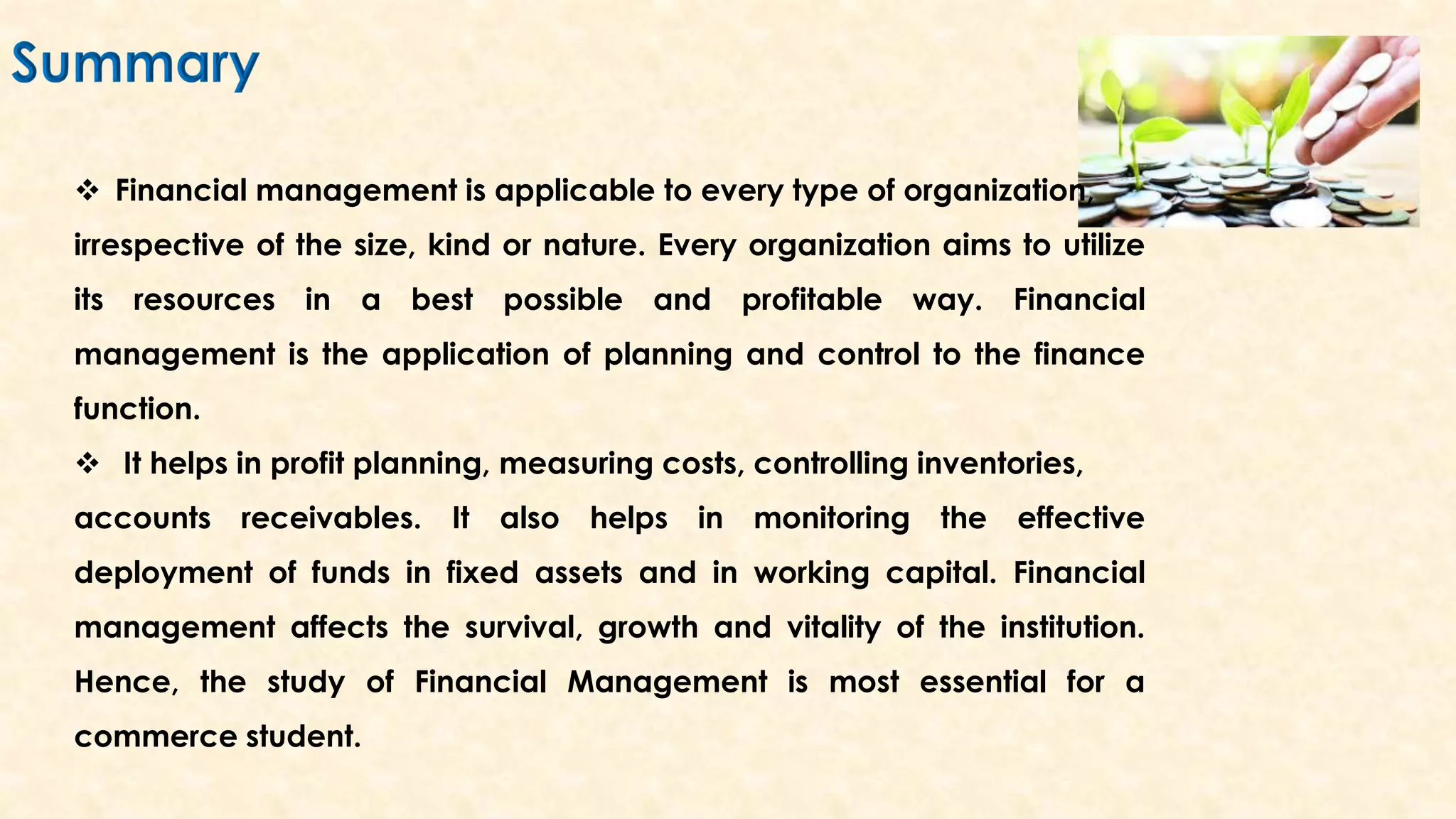
 Financial management is applicable to every type of organization,
irrespective of the size, kind or nature. Every organization aims to utilize
its resources in a best possible and profitable way. Financial
management is the application of planning and control to the finance
function.
 It helps in profit planning, measuring costs, controlling inventories,
accounts receivables. It also helps in monitoring the effective
deployment of funds in fixed assets and in working capital. Financial
management affects the survival, growth and vitality of the institution.
Hence, the study of Financial Management is most essential for a
commerce student.
 Basic Financial Management – MY Khan and P K Jain – Tata Mcgraw Hill Publishing Co. Ltd.
 Financial Management- I M Pandey – Vikas Publishing House Pvt Ltd.
 Financial Management Theory and Practice – Prasanna Chandra – Tata Mcgraw Hill
Publishing co.Ltd.
 Financial Management – Ravi M Kishore – Taxmann Publications Ltd.

Introduction to financial management

  • 1.
    Sowmya K S AssistantProfessor Dept. of Commerce GFGC, Bharamasagara.
  • 2.
     Management isthe coordination and administration of tasks to achieve a goal.  Management can be defined as the process of administering and controlling the affairs of the organization. +  Finance is referred as the provision of money at the time when it is needed.  According to Khan and Jain, “Finance is the art and science of managing money”.  According to Oxford dictionary, the word ‘finance’ connotes ‘management of money’. = Life Blood of Business  Financial management is managerial activity which is concerned with the planning and controlling of the firm’s financial resources.  According to Solomon, “It is concerned with the efficient use of an important economic resource namely, capital funds”.  According to S.C. Kuchal “Financial Management deals with procurement of funds and their effective utilization in the business”.
  • 3.
    Objectives of FinancialManagement may be broadly divided into two parts such as: • It is the traditional and narrow approach, which aims at, maximizing the profit of the concern • It leads to maximize the business operation for profit maximization. • Profit is the parameter of measuring the efficiency of the business concern. Profit Maximisation • It is the modern approach • The term wealth means shareholder wealth or the wealth of the persons those who are involved in the business concern • Wealth maximization is also known as value maximization. Wealth Maximisation
  • 4.
     Estimating therequirement of funds for a given period.  Raising and investing the funds  Funding day-to-day working capital requirements of business;  Collecting on time from debtors and paying to creditors on time;  Ensuring a satisfactory return to all the stake holders;  Paying interest on borrowings;  Repaying lenders on due dates;  Maximizing the wealth of the shareholders over the long term;  Interfacing with the capital markets;  Increasing the firm’s competitive financial strength in the market;  Adhering to the requirements of corporate governance.
  • 5.
     Helps organisationsin financial planning;  Assists organisations in the planning and acquisition of funds;  Helps organisations in effectively utilising and allocating the funds received or acquired;  Assists organisations in making critical financial decisions;  Helps in improving the profitability of organisations;  Increases the overall value of the firms or organisations;  Provides economic stability;
  • 6.
    Analysis • Current Performance of business •SWOT analysis Decision Making • Strategic Investment decision • Strategic financial decision • Framing Financial Objectives Planning • Forecasting & Budgeting • Financial Modelling Control Reporting Remedial Action
  • 7.
  • 8.
     Corporate manager; Investment banker;  Financial advisor;  Financial analyst;  Financial examiners  Financial managers;  Personal financial planners;  Budget analysts;  Investor relations associate or executive;  Credit analyst. Studying financial management opens up a lot of diverse career opportunities. It could be in the private or public sector. Some of the career options include:
  • 9.
     Financial managementis applicable to every type of organization, irrespective of the size, kind or nature. Every organization aims to utilize its resources in a best possible and profitable way. Financial management is the application of planning and control to the finance function.  It helps in profit planning, measuring costs, controlling inventories, accounts receivables. It also helps in monitoring the effective deployment of funds in fixed assets and in working capital. Financial management affects the survival, growth and vitality of the institution. Hence, the study of Financial Management is most essential for a commerce student.
  • 10.
     Basic FinancialManagement – MY Khan and P K Jain – Tata Mcgraw Hill Publishing Co. Ltd.  Financial Management- I M Pandey – Vikas Publishing House Pvt Ltd.  Financial Management Theory and Practice – Prasanna Chandra – Tata Mcgraw Hill Publishing co.Ltd.  Financial Management – Ravi M Kishore – Taxmann Publications Ltd.