STRATEGIC MANAGEMENT
THIPPESWAMI H
RESEARCH SCHOLAR
DEPT OF STUDIES IN COMMERCE
VSK UNIVERSITY
BALLARI
Mob no 8746022011
Meaning of SM
 What is strategy?
 What is management?
Strategy= Long term Plan
Management= Art of getting things by others
Concept of strategy
In Military Principle =“Strategy” is Derived from Greek word “Strategos”
Which means “Generalship” (Skills or Practices)
Strategy is a Plan of Action to win a war
In BusinessPrinciple
Strategy is an action that managers take to attain one or more of the
organizational goals.
Examples:
1. A cricketer have a strategy how to face the ball
2. A goal keeper have a strategy to stop the football.
Concept of strategy
A strategy is a plan of action, design to achieve the basic objectives of a
business.
A strategy is a high level future plan of action, undertaken by senior
management at a high level of abstraction, to achieve one or more goals
under conditions of the uncertainty.
Definitions
 Strategy is a plan of action or policy designed to achieve a major or overall
aim-------Oxford Dictionary
 Strategy is the way in which management chooses and utilises the firm
resources within its environment to reach the objectives--- J Stand Ford
Features of strategy
1. Future oriented
2. Deals with long term developments
3. Deals with the environment
4.
strategic intents
 Vision
 Mission
 Goal
 objectives
Vision statement
Vision statement is a sentence or short paragraph
providing a broad aspiration image of the future.
“an image of the future we seeks to create is vision”
Vision serves the purpose of stating what an
organization wishes to achieve in the long run.
Vision statement
Definitions
MILLER and DESS defined vision as the “category of intentions that are
broad, all inclusive and forward thinking”
Examples
Envisioning the power of mind (“Dhiyo yo naha
prachodayath“)---VSK University
My SBI : First in Customer Satisfaction---SBI
vision statement
Features of Good vision Statement
1. It indicates the whole corporate philosophy
2. At most clarity
3. Well anticipated but easy to understand
4. Realistic and achievable aspirations
5. Future focus
mission statement
Mission statement is defined as short sentences or short
paragraph written by the companies, corporations or
Business which reflects their core purpose, identity,
values and principles.
In other words mission is what an organization is and
why its exists.
definitions
According to Hunger & Wheelem defined as “purpose
or reason for the organization existences”.
mission statement
Examples
To provide equality banking services with enhanced
customer orientation, higher value creation for
stakeholders and to continue as a responsive
corporate social citizen by effectively blending
commercial pursuits with social banking
------------ Canara Bank
To keep common man in sharper focus to encourage
savings and investment habits among them
--------------- UTI
mission statement
Characteristics
1. It should be feasible or realistic
2. It should be precise or specific
3. It should be clear and clarity
4. It should be motivating
5. It should be distinctive
goal
Goal means “what an organisation hopes to
accomplish in a future period of time”, they
represent a future state or an outcome of the effort
that putting in now.
It is precise and measurable desired future state that a
company attempts to realise.
Examples
Growth, innovativeness, high profits as a barometer of
efficiency, highly involved employees distinctively
charge with pride----------------- Canara Bank
goal
Features of goal
1. Precise and measurable
2. Challenging and realistic
3. Time period
Objective/aims
Objectives or aims that organisation wishes to achieve
over a period of time. They are intended end results
that an organisation desires to achieve over varying
periods of time. Hence an objectives may be set for
long term, medium term and short term.
Features of Objectives
1. Understandable
2. Relating to time frame
3. Measurable & controllable
4. Objectives should co-relate each other.
Strategic management
It is managerial process of making strategies towards
organisational objectives.
Strategic management is the art and science or
formulating, implementing and evaluation of cross
functional decisions, that will enable an organisation
to achieve its objectives.
definitions
SM is a stream of decisions and actions which leads to
the development of an effective strategies or strategy
to help to achieve corporate objectives
------------------ William F Gluk
Strategic management
definitions
“SM is a set of decisions and actions resulting in
formulation, implementation, evaluation and control
of strategies to realise the organisation strategy
intent.”
---------- John and Richard
Strategic management
Features
1. Decision making process
2. Wider application
3. A continuous process
4. Resource management
Benefits of SM
1. It defines the goals and mission of the organisation
2. It helps organisations to be proactive instead of
reactive in shaping the future
Strategic management
Benefits of SM
3. It provides framework for all major decisions of an
enterprise
4. It prepares the organisations to face the future and act
as path finder to various business opportunities.
limitations of SM
1. Environment is highly complex and dynamic
2. SM is a time consuming process
3. It is a costly process
4. The future does not unfold as anticipated
Strategic management
Importance/role/ of SM
1. Improvement in sales
2. Improvement in profitability
3. Improvement in productivity
4. Enhanced problem prevention capability
5. Provides a framework for decision making
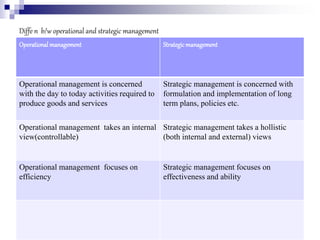
Diffe n b/w operational and strategic management
Operational management Strategicmanagement
Operational management is concerned
with the day to today activities required to
produce goods and services
Strategic management is concerned with
formulation and implementation of long
term plans, policies etc.
Operational management takes an internal
view(controllable)
Strategic management takes a hollistic
(both internal and external) views
Operational management focuses on
efficiency
Strategic management focuses on
effectiveness and ability
Strategic management

Strategic mangement (module 1)

  • 1.
    STRATEGIC MANAGEMENT THIPPESWAMI H RESEARCHSCHOLAR DEPT OF STUDIES IN COMMERCE VSK UNIVERSITY BALLARI Mob no 8746022011
  • 2.
    Meaning of SM What is strategy?  What is management? Strategy= Long term Plan Management= Art of getting things by others
  • 3.
    Concept of strategy InMilitary Principle =“Strategy” is Derived from Greek word “Strategos” Which means “Generalship” (Skills or Practices) Strategy is a Plan of Action to win a war In BusinessPrinciple Strategy is an action that managers take to attain one or more of the organizational goals. Examples: 1. A cricketer have a strategy how to face the ball 2. A goal keeper have a strategy to stop the football.
  • 4.
    Concept of strategy Astrategy is a plan of action, design to achieve the basic objectives of a business. A strategy is a high level future plan of action, undertaken by senior management at a high level of abstraction, to achieve one or more goals under conditions of the uncertainty. Definitions  Strategy is a plan of action or policy designed to achieve a major or overall aim-------Oxford Dictionary  Strategy is the way in which management chooses and utilises the firm resources within its environment to reach the objectives--- J Stand Ford
  • 5.
    Features of strategy 1.Future oriented 2. Deals with long term developments 3. Deals with the environment 4.
  • 6.
    strategic intents  Vision Mission  Goal  objectives
  • 7.
    Vision statement Vision statementis a sentence or short paragraph providing a broad aspiration image of the future. “an image of the future we seeks to create is vision” Vision serves the purpose of stating what an organization wishes to achieve in the long run.
  • 8.
    Vision statement Definitions MILLER andDESS defined vision as the “category of intentions that are broad, all inclusive and forward thinking” Examples Envisioning the power of mind (“Dhiyo yo naha prachodayath“)---VSK University My SBI : First in Customer Satisfaction---SBI
  • 9.
    vision statement Features ofGood vision Statement 1. It indicates the whole corporate philosophy 2. At most clarity 3. Well anticipated but easy to understand 4. Realistic and achievable aspirations 5. Future focus
  • 10.
    mission statement Mission statementis defined as short sentences or short paragraph written by the companies, corporations or Business which reflects their core purpose, identity, values and principles. In other words mission is what an organization is and why its exists. definitions According to Hunger & Wheelem defined as “purpose or reason for the organization existences”.
  • 11.
    mission statement Examples To provideequality banking services with enhanced customer orientation, higher value creation for stakeholders and to continue as a responsive corporate social citizen by effectively blending commercial pursuits with social banking ------------ Canara Bank To keep common man in sharper focus to encourage savings and investment habits among them --------------- UTI
  • 12.
    mission statement Characteristics 1. Itshould be feasible or realistic 2. It should be precise or specific 3. It should be clear and clarity 4. It should be motivating 5. It should be distinctive
  • 13.
    goal Goal means “whatan organisation hopes to accomplish in a future period of time”, they represent a future state or an outcome of the effort that putting in now. It is precise and measurable desired future state that a company attempts to realise. Examples Growth, innovativeness, high profits as a barometer of efficiency, highly involved employees distinctively charge with pride----------------- Canara Bank
  • 14.
    goal Features of goal 1.Precise and measurable 2. Challenging and realistic 3. Time period
  • 15.
    Objective/aims Objectives or aimsthat organisation wishes to achieve over a period of time. They are intended end results that an organisation desires to achieve over varying periods of time. Hence an objectives may be set for long term, medium term and short term. Features of Objectives 1. Understandable 2. Relating to time frame 3. Measurable & controllable 4. Objectives should co-relate each other.
  • 16.
    Strategic management It ismanagerial process of making strategies towards organisational objectives. Strategic management is the art and science or formulating, implementing and evaluation of cross functional decisions, that will enable an organisation to achieve its objectives. definitions SM is a stream of decisions and actions which leads to the development of an effective strategies or strategy to help to achieve corporate objectives ------------------ William F Gluk
  • 17.
    Strategic management definitions “SM isa set of decisions and actions resulting in formulation, implementation, evaluation and control of strategies to realise the organisation strategy intent.” ---------- John and Richard
  • 18.
    Strategic management Features 1. Decisionmaking process 2. Wider application 3. A continuous process 4. Resource management Benefits of SM 1. It defines the goals and mission of the organisation 2. It helps organisations to be proactive instead of reactive in shaping the future
  • 19.
    Strategic management Benefits ofSM 3. It provides framework for all major decisions of an enterprise 4. It prepares the organisations to face the future and act as path finder to various business opportunities. limitations of SM 1. Environment is highly complex and dynamic 2. SM is a time consuming process 3. It is a costly process 4. The future does not unfold as anticipated
  • 20.
    Strategic management Importance/role/ ofSM 1. Improvement in sales 2. Improvement in profitability 3. Improvement in productivity 4. Enhanced problem prevention capability 5. Provides a framework for decision making
  • 21.
    Diffe n b/woperational and strategic management Operational management Strategicmanagement Operational management is concerned with the day to today activities required to produce goods and services Strategic management is concerned with formulation and implementation of long term plans, policies etc. Operational management takes an internal view(controllable) Strategic management takes a hollistic (both internal and external) views Operational management focuses on efficiency Strategic management focuses on effectiveness and ability
  • 22.