Major: Environmental Science 
Subject: Forest Ecology 
8-9:30Am 
Instructor: Dr. Kao Dana 
CHAPTER15: THE PHYSICAL ENVIRONMENT AS A BASIS FOR MANAGING ECOSYSTEM 
Prepared by: Yang Hour 
E-mail: yanghour@puc.edu.kh
•Keywords 
•Objectives 
I. Introduction 
II. Landscape Pattern and Processes 
III.History of Landscape Change in Pacific Northwest 
IV.Regional Ecological Assessments 
V. Future Landscape Management 
VI.Conclusion
Keywords 
• Physical Environment:= are consists of physical 
features that occur naturally - 4 major components : 
Water ( rivers, seas, oceans), Natural Vegetation, 
Landform and rocks, weather and climate Natural 
resources are found here Examples: rivers, seas , ocean, 
mountains, rocks, volcanoes, tornadoes 
• Implication= the action or state of being involved in 
something. 
• Ecosystems= is an a community of living organism( 
plants, animals an microbes). 
• Prominent= is projecting from s.th
Objectives 
 To think some implications for physical 
environment and ecosystem dynamic in land 
management 
 To know pattern-process relations in landscapes as a 
basis for managing ecosystem 
 You know the history of landscape management in 
Pacific Northwest
I. Introduction 
Manage or control one ecosystem, 
environmentalists have to collect data/info to 
analyze then find the effective implications to 
solve the problems 
Information on physical environment is used to 
minimize undesired environmental effects 
through actions such as surveying proposed 
road locations to avoid potential landslide sites.
I. Introduction 
Knowledge about physical environment has 
played an important role in conservation 
strategies focused on recovery of forest habitats 
for wildlife species 
We expect understanding of physical 
environment gain a more prominent position in 
land-use planning, sustain the dynamic 
ecosystem that support life
II. Landscape Pattern and 
Processes 
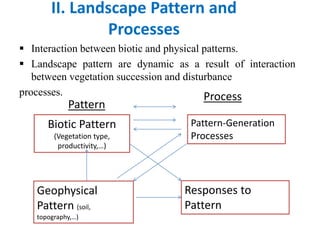
 Interaction between biotic and physical patterns. 
 Landscape pattern are dynamic as a result of interaction 
between vegetation succession and disturbance 
processes. 
Pattern 
Process 
Biotic Pattern 
(Vegetation type, 
productivity,…) 
Pattern-Generation 
Processes 
Geophysical 
Pattern (soil, 
topography,…) 
Responses to 
Pattern
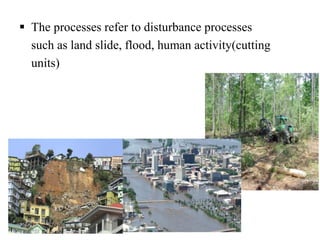
 The processes refer to disturbance processes 
such as land slide, flood, human activity(cutting 
units)
II. History of landscape change in 
the pacific northwest 
• Landscape pattern in the Pacific Northwest have 
developed sequentially through 3 stages 
1) A wild landscape dominated by natural disturbances and 
action of native people, spanning of most of Holocene 
until the early 1800s; 
2) The landscape managed by European setters through 
much of 19th and 20th centuries; 
3) The present period of regional ecological assessment
• Management of landscape pattern on public lands in the 
Pacific Northwest has changed dramatically 
• From the early 1990s, cutting rates have dramatically 
decreased and the concept about how to manage the 
landscape pattern have changed 
Ex: Growing interest is allowed limiting the size of cutting 
units on private land.. 
 Management in those areas will be altered by Northwest 
Forest Plan developed by Forest Ecosystem Management 
Assessment Team (FEMAT)
III. Regional Ecological Assessments 
 FEMAT, the Columbia River Basin/East Side 
Ecosystem Project, the Sierra Navada Ecosystem 
Project, studies and assess on ecosystem management 
on major pieces of public land use in US. 
 To conserve threatened and endangered species and 
old-growth forest ecosystem 
 To reintroduce feature of disturbance in some areas 
 In other regions, the ecological assessments and plans 
provide better fit of managed biotic patterns to 
patterns controlled by natural disturbance regimes and 
landforms.
IV. Future Landscape management 
 In the 21st century, we expect land management to better 
fit the managed biological landscape with the physical 
landscape and its historic disturbance processes and 
patterns. 
 Mapping Units characterize wildfire describe the 
frequency and severity of disturbances. 
 Land-use designation has been used to develop landscape 
management
V. Conclusion 
Understanding the physical environment including natural 
disturbance helps repair the damage and minimize the effects 
of further management, and lead to implicate the effective 
landscape management. 
We also need to know history of landscape change so that we 
can know how is disturbances look like in order to be well-managed. 
Regional ecological assessment lead to well control in the 
regions of interest. In 21st century, we expect land 
management to better fit the biological landscape.
Thanks for your Attention!! 
Q&A

Chap15

  • 1.
    Major: Environmental Science Subject: Forest Ecology 8-9:30Am Instructor: Dr. Kao Dana CHAPTER15: THE PHYSICAL ENVIRONMENT AS A BASIS FOR MANAGING ECOSYSTEM Prepared by: Yang Hour E-mail: yanghour@puc.edu.kh
  • 2.
    •Keywords •Objectives I.Introduction II. Landscape Pattern and Processes III.History of Landscape Change in Pacific Northwest IV.Regional Ecological Assessments V. Future Landscape Management VI.Conclusion
  • 3.
    Keywords • PhysicalEnvironment:= are consists of physical features that occur naturally - 4 major components : Water ( rivers, seas, oceans), Natural Vegetation, Landform and rocks, weather and climate Natural resources are found here Examples: rivers, seas , ocean, mountains, rocks, volcanoes, tornadoes • Implication= the action or state of being involved in something. • Ecosystems= is an a community of living organism( plants, animals an microbes). • Prominent= is projecting from s.th
  • 4.
    Objectives  Tothink some implications for physical environment and ecosystem dynamic in land management  To know pattern-process relations in landscapes as a basis for managing ecosystem  You know the history of landscape management in Pacific Northwest
  • 5.
    I. Introduction Manageor control one ecosystem, environmentalists have to collect data/info to analyze then find the effective implications to solve the problems Information on physical environment is used to minimize undesired environmental effects through actions such as surveying proposed road locations to avoid potential landslide sites.
  • 6.
    I. Introduction Knowledgeabout physical environment has played an important role in conservation strategies focused on recovery of forest habitats for wildlife species We expect understanding of physical environment gain a more prominent position in land-use planning, sustain the dynamic ecosystem that support life
  • 7.
    II. Landscape Patternand Processes  Interaction between biotic and physical patterns.  Landscape pattern are dynamic as a result of interaction between vegetation succession and disturbance processes. Pattern Process Biotic Pattern (Vegetation type, productivity,…) Pattern-Generation Processes Geophysical Pattern (soil, topography,…) Responses to Pattern
  • 8.
     The processesrefer to disturbance processes such as land slide, flood, human activity(cutting units)
  • 9.
    II. History oflandscape change in the pacific northwest • Landscape pattern in the Pacific Northwest have developed sequentially through 3 stages 1) A wild landscape dominated by natural disturbances and action of native people, spanning of most of Holocene until the early 1800s; 2) The landscape managed by European setters through much of 19th and 20th centuries; 3) The present period of regional ecological assessment
  • 10.
    • Management oflandscape pattern on public lands in the Pacific Northwest has changed dramatically • From the early 1990s, cutting rates have dramatically decreased and the concept about how to manage the landscape pattern have changed Ex: Growing interest is allowed limiting the size of cutting units on private land..  Management in those areas will be altered by Northwest Forest Plan developed by Forest Ecosystem Management Assessment Team (FEMAT)
  • 11.
    III. Regional EcologicalAssessments  FEMAT, the Columbia River Basin/East Side Ecosystem Project, the Sierra Navada Ecosystem Project, studies and assess on ecosystem management on major pieces of public land use in US.  To conserve threatened and endangered species and old-growth forest ecosystem  To reintroduce feature of disturbance in some areas  In other regions, the ecological assessments and plans provide better fit of managed biotic patterns to patterns controlled by natural disturbance regimes and landforms.
  • 12.
    IV. Future Landscapemanagement  In the 21st century, we expect land management to better fit the managed biological landscape with the physical landscape and its historic disturbance processes and patterns.  Mapping Units characterize wildfire describe the frequency and severity of disturbances.  Land-use designation has been used to develop landscape management
  • 13.
    V. Conclusion Understandingthe physical environment including natural disturbance helps repair the damage and minimize the effects of further management, and lead to implicate the effective landscape management. We also need to know history of landscape change so that we can know how is disturbances look like in order to be well-managed. Regional ecological assessment lead to well control in the regions of interest. In 21st century, we expect land management to better fit the biological landscape.
  • 14.
    Thanks for yourAttention!! Q&A