ENGINEERING MATERIALS AND
THEIR PROPERTIES
LECTURE 2
Materials Technology
Classification of Materials
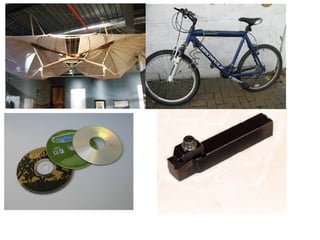
• Materials used in the design and manufacture of
products
• Ceramics
• Composites
• Fabrics
• Metals
• Plastics
• Wood
1.1 CLASSIFICATION OF ENGINEERING
MATERIALS
METALS AND ALLOYS
These are inorganic materials composed of one or
more metallic elements
Characteristics
▪ They usually have a crystalline structure and are good
thermal and electrical conductors
▪ Many metals have high strength and high elastic moduli
[changes its shape only slightly under elastic loads (e.g. diamond))]
▪ They maintain their good strength at high and low
temperatures.
▪ They also have sufficient ductility, which is
important for many engineering applications
▪ They can be strengthened by alloying and heat
treatment
▪ They are least resistant to corrosion
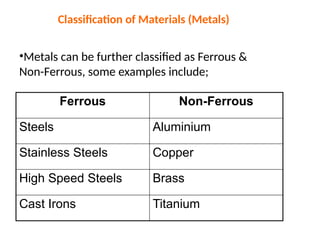
Classification of Materials (Metals)
•Metals can be further classified as Ferrous &
Non-Ferrous, some examples include;
Ferrous Non-Ferrous
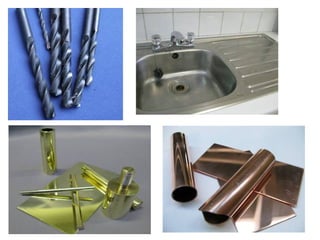
Steels Aluminium
Stainless Steels Copper
High Speed Steels Brass
Cast Irons Titanium
8
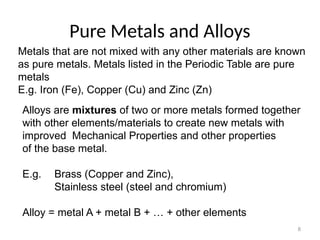
Pure Metals and Alloys
Metals that are not mixed with any other materials are known
as pure metals. Metals listed in the Periodic Table are pure
metals
E.g. Iron (Fe), Copper (Cu) and Zinc (Zn)
Alloys are mixtures of two or more metals formed together
with other elements/materials to create new metals with
improved Mechanical Properties and other properties
of the base metal.
E.g. Brass (Copper and Zinc),
Stainless steel (steel and chromium)
Alloy = metal A + metal B + … + other elements
9
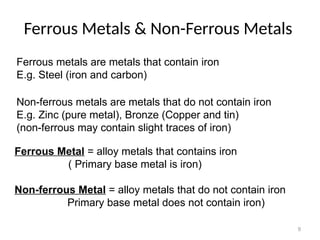
Ferrous Metals & Non-Ferrous Metals
Ferrous metals are metals that contain iron
E.g. Steel (iron and carbon)
Non-ferrous metals are metals that do not contain iron
E.g. Zinc (pure metal), Bronze (Copper and tin)
(non-ferrous may contain slight traces of iron)
Ferrous Metal = alloy metals that contains iron
( Primary base metal is iron)
Non-ferrous Metal = alloy metals that do not contain iron
Primary base metal does not contain iron)
10
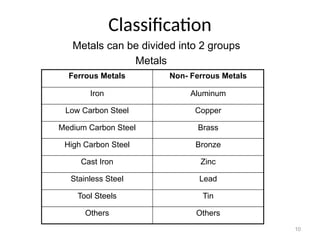
Classification
Metals can be divided into 2 groups
Metals
Ferrous Metals Non- Ferrous Metals
Iron Aluminum
Low Carbon Steel Copper
Medium Carbon Steel Brass
High Carbon Steel Bronze
Cast Iron Zinc
Stainless Steel Lead
Tool Steels Tin
Others Others
11
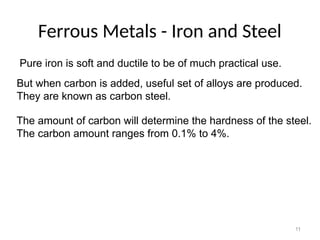
Ferrous Metals - Iron and Steel
Pure iron is soft and ductile to be of much practical use.
But when carbon is added, useful set of alloys are produced.
They are known as carbon steel.
The amount of carbon will determine the hardness of the steel.
The carbon amount ranges from 0.1% to 4%.
12
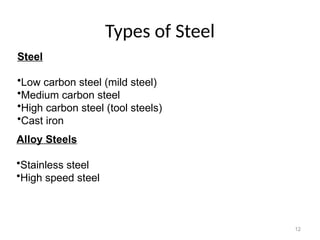
Types of Steel
Steel
•Low carbon steel (mild steel)
•Medium carbon steel
•High carbon steel (tool steels)
•Cast iron
Alloy Steels
•Stainless steel
•High speed steel
13
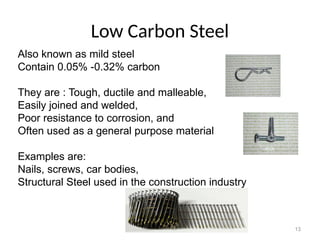
Low Carbon Steel
Also known as mild steel
Contain 0.05% -0.32% carbon
They are : Tough, ductile and malleable,
Easily joined and welded,
Poor resistance to corrosion, and
Often used as a general purpose material
Examples are:
Nails, screws, car bodies,
Structural Steel used in the construction industry
14
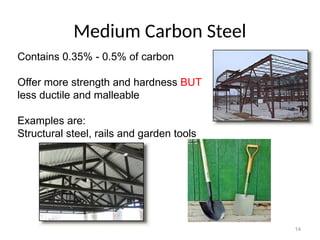
Medium Carbon Steel
Contains 0.35% - 0.5% of carbon
Offer more strength and hardness BUT
less ductile and malleable
Examples are:
Structural steel, rails and garden tools
15
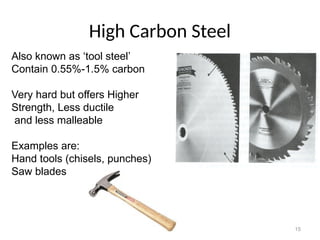
High Carbon Steel
Also known as ‘tool steel’
Contain 0.55%-1.5% carbon
Very hard but offers Higher
Strength, Less ductile
and less malleable
Examples are:
Hand tools (chisels, punches)
Saw blades
16
Cast Iron
Contains 2%-4% of carbon
Very hard and brittle
Strong under compression
Suitable for casting [can be poured at a relatively
low temperature]
Examples are:
Engine block, engineer vices, machine parts
17
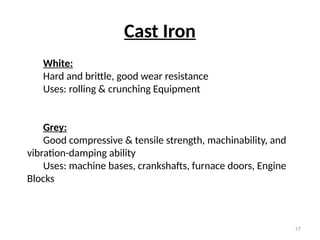
Cast Iron
White:
Hard and brittle, good wear resistance
Uses: rolling & crunching Equipment
Grey:
Good compressive & tensile strength, machinability, and
vibration-damping ability
Uses: machine bases, crankshafts, furnace doors, Engine
Blocks
18
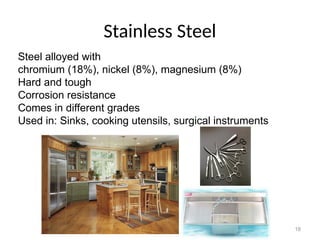
Stainless Steel
Steel alloyed with
chromium (18%), nickel (8%), magnesium (8%)
Hard and tough
Corrosion resistance
Comes in different grades
Used in: Sinks, cooking utensils, surgical instruments
19
Stainless Steels
Main types:
Ferritic chromium:
very formable, relatively weak;
used in kitchen range hoods, jewelry, decorations, utensils
Grades 409, 430, and other 400
Austentitic nickel-chromium:
non-magnetic, machinable, weldable, relatively weak; used in
architectural products, such as, curtain walls, storefronts,
doors & windows, railings; chemical processing, food utensils,
kitchen applications.
20
Martensitic chromium:
High strength, hardness, resistance to abrasion; used in
turbine parts, bearings, knives, e.t.c
Maraging (super alloys):
High strength, high Temperature alloy used in structural
applications, aircraft components and are generally magnetic.
Alloys containing around 18% Nickel.
21
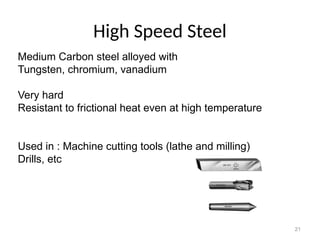
High Speed Steel
Medium Carbon steel alloyed with
Tungsten, chromium, vanadium
Very hard
Resistant to frictional heat even at high temperature
Used in : Machine cutting tools (lathe and milling)
Drills, etc
B. CERAMICS AND GLASSES
These are inorganic materials consisting of both
metallic and non-metallic elements bonded
together chemically.
CHARACTERISTICS
▪ They can be crystalline(ceramics), non-
crystalline(glasses) or a mixture of both (glass-
ceramics)
▪ Generally they have high melting points and high
chemical stabilities.
▪ They have high hardness, and high temperature
strength.
▪ Since they are very brittle they cannot be used as good
as metals.
▪ Ceramics are usually poor electrical conductors.
▪ Ceramics have a high strength on compression
Classification of Materials (Ceramics)
Examples include;
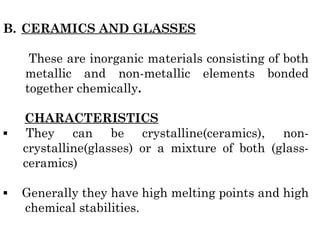
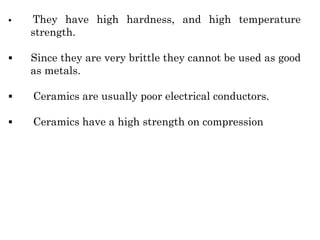
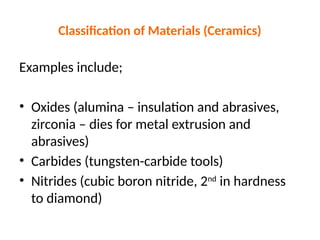
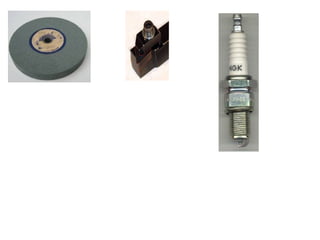
• Oxides (alumina – insulation and abrasives,
zirconia – dies for metal extrusion and
abrasives)
• Carbides (tungsten-carbide tools)
• Nitrides (cubic boron nitride, 2nd
in hardness
to diamond)
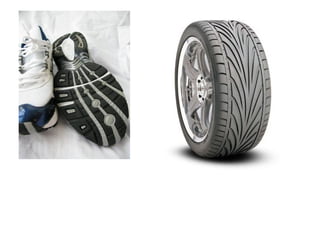
C. POLYMERS (PLASTICS)
These are organic materials which consist of long
molecular chains or networks containing carbon.
CHARACTERISTICS
▪ Most polymers are non-crystalline, but some
consist of mixtures of both crystalline and non-
crystalline regions.
▪ They generally have low densities and low
rigidity
▪ Most polymers are poor electrical conductors
due to the nature of the atomic bonding
▪ Most polymers are corrosion resistant, but cannot
be used at high temperatures
Classification of Materials (Polymers-Plastics)
Plastics can be further classified as;
• Thermoplastic
• Thermoset
• Elastomers
Thermoplastics Thermosets Elastomers
Acrylics Epoxy resins Rubbers
Nylons Phenolic Silicones
PVC Polyesters Polyurethanes
Polyethylene
D. COMPOSITES
These are materials where two or more of the above
materials are brought together on macroscopic level
CHARACTERISTICS
▪ Usually they consist of a matrix and a reinforcement.
▪ They are designed to combine the best properties of
each of its components.
Classification of Materials (Composites)
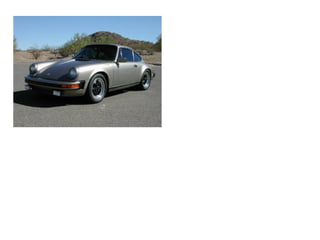
• A composite is a combination of two or more chemically distinct materials
whose physical characteristics are superior to its constituents acting
independently.
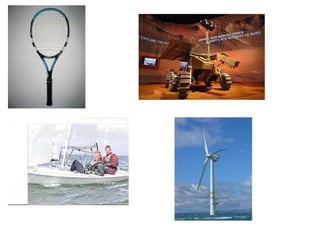
• Because of their high strength/stiffness to weight ratio they are widely used
in the;
• Aerospace industry
• Offshore structures
• Boats
• Sporting goods
Classification of Materials (Composites)
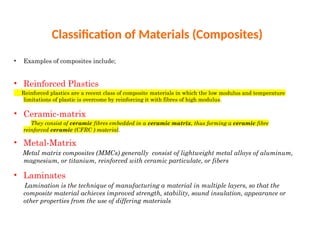
• Examples of composites include;
• Reinforced Plastics
Reinforced plastics are a recent class of composite materials in which the low modulus and temperature
limitations of plastic is overcome by reinforcing it with fibres of high modulus.
• Ceramic-matrix
They consist of ceramic fibres embedded in a ceramic matrix, thus forming a ceramic fibre
reinforced ceramic (CFRC ) material.
• Metal-Matrix
Metal matrix composites (MMCs) generally consist of lightweight metal alloys of aluminum,
magnesium, or titanium, reinforced with ceramic particulate, or fibers
• Laminates
Lamination is the technique of manufacturing a material in multiple layers, so that the
composite material achieves improved strength, stability, sound insulation, appearance or
other properties from the use of differing materials.
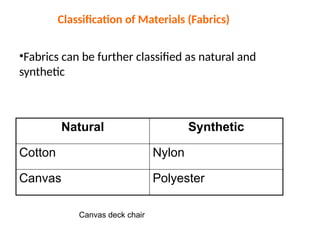
Classification of Materials (Fabrics)
•Fabrics can be further classified as natural and
synthetic
Natural Synthetic
Cotton Nylon
Canvas Polyester
Canvas deck chair
Canvas deck chair
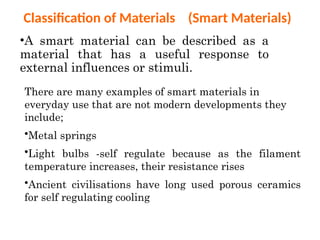
Classification of Materials (Smart Materials)
•A smart material can be described as a
material that has a useful response to
external influences or stimuli.
There are many examples of smart materials in
everyday use that are not modern developments they
include;
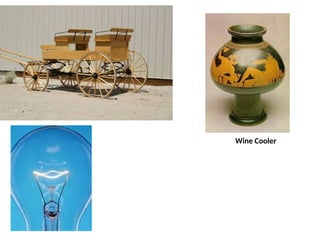
•Metal springs
•Light bulbs -self regulate because as the filament
temperature increases, their resistance rises
•Ancient civilisations have long used porous ceramics
for self regulating cooling
Wine Cooler
Classification of Materials (Smart
Materials)
•Other more modern examples of smart
materials include;
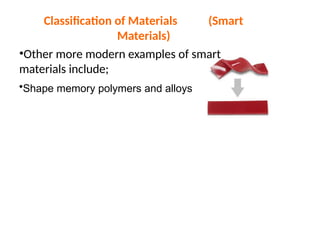
•Shape memory polymers and alloys
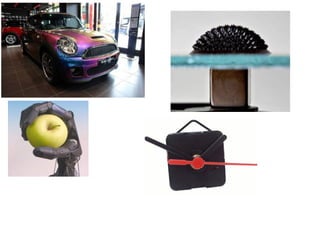
•Piezoelectric Materials
Sensors, musical cards, motors, actuators, clocks
•Smart Wire
Actuators- linear, angular and rotary
Anthromorphic actuation – human like robotic
motion
Classification of Materials (Smart Materials)
•Other more modern examples of smart
materials include;
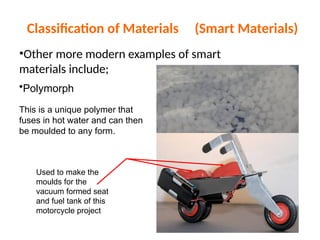
•Polymorph
This is a unique polymer that
fuses in hot water and can then
be moulded to any form.
Used to make the
moulds for the
vacuum formed seat
and fuel tank of this
motorcycle project
Classification of Materials (Smart
Materials)
• Other more modern examples of smart
materials include;
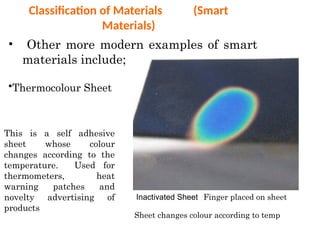
•Thermocolour Sheet
This is a self adhesive
sheet whose colour
changes according to the
temperature. Used for
thermometers, heat
warning patches and
novelty advertising of
products
Inactivated Sheet Finger placed on sheet
Sheet changes colour according to temp
Classification of Materials (Smart Materials)
•Other more modern examples of smart
materials include;
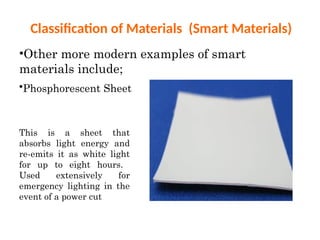
•Phosphorescent Sheet
This is a sheet that
absorbs light energy and
re-emits it as white light
for up to eight hours.
Used extensively for
emergency lighting in the
event of a power cut
Classification of Materials (Smart
Materials)
•Other more modern examples of smart
materials include;
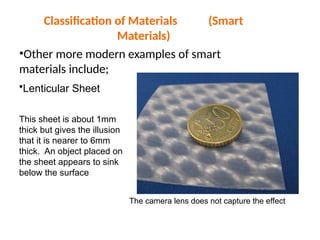
•Lenticular Sheet
This sheet is about 1mm
thick but gives the illusion
that it is nearer to 6mm
thick. An object placed on
the sheet appears to sink
below the surface
The camera lens does not capture the effect
Classification of Materials (Smart Materials)
•Other more modern examples of smart
materials include;
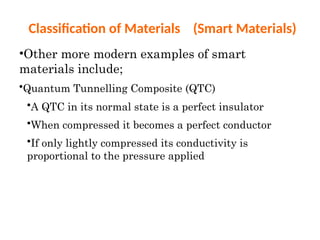
•Quantum Tunnelling Composite (QTC)
•A QTC in its normal state is a perfect insulator
•When compressed it becomes a perfect conductor
•If only lightly compressed its conductivity is
proportional to the pressure applied
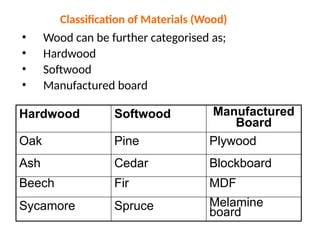
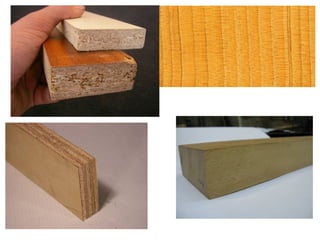
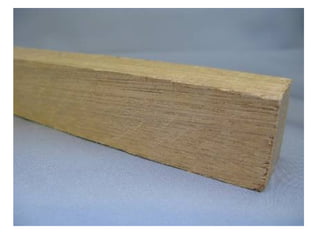
Classification of Materials (Wood)
• Wood can be further categorised as;
• Hardwood
• Softwood
• Manufactured board
Hardwood Softwood Manufactured
Board
Oak Pine Plywood
Ash Cedar Blockboard
Beech Fir MDF
Sycamore Spruce Melamine
board
Engineering Materials and their properties.pptx

Engineering Materials and their properties.pptx

  • 1.
    ENGINEERING MATERIALS AND THEIRPROPERTIES LECTURE 2 Materials Technology Classification of Materials
  • 2.
    Classification of Materials •Materials used in the design and manufacture of products • Ceramics • Composites • Fabrics • Metals • Plastics • Wood
  • 4.
    1.1 CLASSIFICATION OFENGINEERING MATERIALS METALS AND ALLOYS These are inorganic materials composed of one or more metallic elements Characteristics ▪ They usually have a crystalline structure and are good thermal and electrical conductors ▪ Many metals have high strength and high elastic moduli [changes its shape only slightly under elastic loads (e.g. diamond))] ▪ They maintain their good strength at high and low temperatures.
  • 5.
    ▪ They alsohave sufficient ductility, which is important for many engineering applications ▪ They can be strengthened by alloying and heat treatment ▪ They are least resistant to corrosion
  • 6.
    Classification of Materials(Metals) •Metals can be further classified as Ferrous & Non-Ferrous, some examples include; Ferrous Non-Ferrous Steels Aluminium Stainless Steels Copper High Speed Steels Brass Cast Irons Titanium
  • 8.
    8 Pure Metals andAlloys Metals that are not mixed with any other materials are known as pure metals. Metals listed in the Periodic Table are pure metals E.g. Iron (Fe), Copper (Cu) and Zinc (Zn) Alloys are mixtures of two or more metals formed together with other elements/materials to create new metals with improved Mechanical Properties and other properties of the base metal. E.g. Brass (Copper and Zinc), Stainless steel (steel and chromium) Alloy = metal A + metal B + … + other elements
  • 9.
    9 Ferrous Metals &Non-Ferrous Metals Ferrous metals are metals that contain iron E.g. Steel (iron and carbon) Non-ferrous metals are metals that do not contain iron E.g. Zinc (pure metal), Bronze (Copper and tin) (non-ferrous may contain slight traces of iron) Ferrous Metal = alloy metals that contains iron ( Primary base metal is iron) Non-ferrous Metal = alloy metals that do not contain iron Primary base metal does not contain iron)
  • 10.
    10 Classification Metals can bedivided into 2 groups Metals Ferrous Metals Non- Ferrous Metals Iron Aluminum Low Carbon Steel Copper Medium Carbon Steel Brass High Carbon Steel Bronze Cast Iron Zinc Stainless Steel Lead Tool Steels Tin Others Others
  • 11.
    11 Ferrous Metals -Iron and Steel Pure iron is soft and ductile to be of much practical use. But when carbon is added, useful set of alloys are produced. They are known as carbon steel. The amount of carbon will determine the hardness of the steel. The carbon amount ranges from 0.1% to 4%.
  • 12.
    12 Types of Steel Steel •Lowcarbon steel (mild steel) •Medium carbon steel •High carbon steel (tool steels) •Cast iron Alloy Steels •Stainless steel •High speed steel
  • 13.
    13 Low Carbon Steel Alsoknown as mild steel Contain 0.05% -0.32% carbon They are : Tough, ductile and malleable, Easily joined and welded, Poor resistance to corrosion, and Often used as a general purpose material Examples are: Nails, screws, car bodies, Structural Steel used in the construction industry
  • 14.
    14 Medium Carbon Steel Contains0.35% - 0.5% of carbon Offer more strength and hardness BUT less ductile and malleable Examples are: Structural steel, rails and garden tools
  • 15.
    15 High Carbon Steel Alsoknown as ‘tool steel’ Contain 0.55%-1.5% carbon Very hard but offers Higher Strength, Less ductile and less malleable Examples are: Hand tools (chisels, punches) Saw blades
  • 16.
    16 Cast Iron Contains 2%-4%of carbon Very hard and brittle Strong under compression Suitable for casting [can be poured at a relatively low temperature] Examples are: Engine block, engineer vices, machine parts
  • 17.
    17 Cast Iron White: Hard andbrittle, good wear resistance Uses: rolling & crunching Equipment Grey: Good compressive & tensile strength, machinability, and vibration-damping ability Uses: machine bases, crankshafts, furnace doors, Engine Blocks
  • 18.
    18 Stainless Steel Steel alloyedwith chromium (18%), nickel (8%), magnesium (8%) Hard and tough Corrosion resistance Comes in different grades Used in: Sinks, cooking utensils, surgical instruments
  • 19.
    19 Stainless Steels Main types: Ferriticchromium: very formable, relatively weak; used in kitchen range hoods, jewelry, decorations, utensils Grades 409, 430, and other 400 Austentitic nickel-chromium: non-magnetic, machinable, weldable, relatively weak; used in architectural products, such as, curtain walls, storefronts, doors & windows, railings; chemical processing, food utensils, kitchen applications.
  • 20.
    20 Martensitic chromium: High strength,hardness, resistance to abrasion; used in turbine parts, bearings, knives, e.t.c Maraging (super alloys): High strength, high Temperature alloy used in structural applications, aircraft components and are generally magnetic. Alloys containing around 18% Nickel.
  • 21.
    21 High Speed Steel MediumCarbon steel alloyed with Tungsten, chromium, vanadium Very hard Resistant to frictional heat even at high temperature Used in : Machine cutting tools (lathe and milling) Drills, etc
  • 22.
    B. CERAMICS ANDGLASSES These are inorganic materials consisting of both metallic and non-metallic elements bonded together chemically. CHARACTERISTICS ▪ They can be crystalline(ceramics), non- crystalline(glasses) or a mixture of both (glass- ceramics) ▪ Generally they have high melting points and high chemical stabilities.
  • 23.
    ▪ They havehigh hardness, and high temperature strength. ▪ Since they are very brittle they cannot be used as good as metals. ▪ Ceramics are usually poor electrical conductors. ▪ Ceramics have a high strength on compression
  • 24.
    Classification of Materials(Ceramics) Examples include; • Oxides (alumina – insulation and abrasives, zirconia – dies for metal extrusion and abrasives) • Carbides (tungsten-carbide tools) • Nitrides (cubic boron nitride, 2nd in hardness to diamond)
  • 26.
    C. POLYMERS (PLASTICS) Theseare organic materials which consist of long molecular chains or networks containing carbon. CHARACTERISTICS ▪ Most polymers are non-crystalline, but some consist of mixtures of both crystalline and non- crystalline regions. ▪ They generally have low densities and low rigidity ▪ Most polymers are poor electrical conductors due to the nature of the atomic bonding
  • 27.
    ▪ Most polymersare corrosion resistant, but cannot be used at high temperatures
  • 28.
    Classification of Materials(Polymers-Plastics) Plastics can be further classified as; • Thermoplastic • Thermoset • Elastomers Thermoplastics Thermosets Elastomers Acrylics Epoxy resins Rubbers Nylons Phenolic Silicones PVC Polyesters Polyurethanes Polyethylene
  • 31.
    D. COMPOSITES These arematerials where two or more of the above materials are brought together on macroscopic level CHARACTERISTICS ▪ Usually they consist of a matrix and a reinforcement. ▪ They are designed to combine the best properties of each of its components.
  • 32.
    Classification of Materials(Composites) • A composite is a combination of two or more chemically distinct materials whose physical characteristics are superior to its constituents acting independently. • Because of their high strength/stiffness to weight ratio they are widely used in the; • Aerospace industry • Offshore structures • Boats • Sporting goods
  • 34.
    Classification of Materials(Composites) • Examples of composites include; • Reinforced Plastics Reinforced plastics are a recent class of composite materials in which the low modulus and temperature limitations of plastic is overcome by reinforcing it with fibres of high modulus. • Ceramic-matrix They consist of ceramic fibres embedded in a ceramic matrix, thus forming a ceramic fibre reinforced ceramic (CFRC ) material. • Metal-Matrix Metal matrix composites (MMCs) generally consist of lightweight metal alloys of aluminum, magnesium, or titanium, reinforced with ceramic particulate, or fibers • Laminates Lamination is the technique of manufacturing a material in multiple layers, so that the composite material achieves improved strength, stability, sound insulation, appearance or other properties from the use of differing materials.
  • 37.
    Classification of Materials(Fabrics) •Fabrics can be further classified as natural and synthetic Natural Synthetic Cotton Nylon Canvas Polyester Canvas deck chair
  • 38.
  • 39.
    Classification of Materials(Smart Materials) •A smart material can be described as a material that has a useful response to external influences or stimuli. There are many examples of smart materials in everyday use that are not modern developments they include; •Metal springs •Light bulbs -self regulate because as the filament temperature increases, their resistance rises •Ancient civilisations have long used porous ceramics for self regulating cooling
  • 40.
  • 41.
    Classification of Materials(Smart Materials) •Other more modern examples of smart materials include; •Shape memory polymers and alloys
  • 42.
    •Piezoelectric Materials Sensors, musicalcards, motors, actuators, clocks •Smart Wire Actuators- linear, angular and rotary Anthromorphic actuation – human like robotic motion
  • 44.
    Classification of Materials(Smart Materials) •Other more modern examples of smart materials include; •Polymorph This is a unique polymer that fuses in hot water and can then be moulded to any form. Used to make the moulds for the vacuum formed seat and fuel tank of this motorcycle project
  • 45.
    Classification of Materials(Smart Materials) • Other more modern examples of smart materials include; •Thermocolour Sheet This is a self adhesive sheet whose colour changes according to the temperature. Used for thermometers, heat warning patches and novelty advertising of products Inactivated Sheet Finger placed on sheet Sheet changes colour according to temp
  • 46.
    Classification of Materials(Smart Materials) •Other more modern examples of smart materials include; •Phosphorescent Sheet This is a sheet that absorbs light energy and re-emits it as white light for up to eight hours. Used extensively for emergency lighting in the event of a power cut
  • 47.
    Classification of Materials(Smart Materials) •Other more modern examples of smart materials include; •Lenticular Sheet This sheet is about 1mm thick but gives the illusion that it is nearer to 6mm thick. An object placed on the sheet appears to sink below the surface The camera lens does not capture the effect
  • 48.
    Classification of Materials(Smart Materials) •Other more modern examples of smart materials include; •Quantum Tunnelling Composite (QTC) •A QTC in its normal state is a perfect insulator •When compressed it becomes a perfect conductor •If only lightly compressed its conductivity is proportional to the pressure applied
  • 49.
    Classification of Materials(Wood) • Wood can be further categorised as; • Hardwood • Softwood • Manufactured board Hardwood Softwood Manufactured Board Oak Pine Plywood Ash Cedar Blockboard Beech Fir MDF Sycamore Spruce Melamine board