Ferrous and
Non-Ferrous METALS
GROUP 5
AGUSTIN, VIC VINCENT D.
CASTILLO, JEBEN-JUN L.
PALAPUZ, JOANNA MARIE C.
PORRAS, RENEL S.
VIENTE, VIANCA V.
ZABAT, GWEN NICOLE
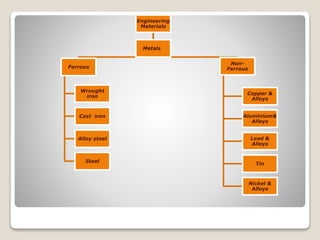
Engineering
Materials
Metals
Ferrous
Steel
Alloy steel
Cast iron
Wrought
iron
Non-
Ferrous
Copper &
Alloys
Aluminium&
Alloys
Lead &
Alloys
Tin
Nickel &
Alloys
Ferrous Materials
 Ferrous Materials - Ferrous metals and
alloys are widely used because they provide a
wide range of properties that are not found in
other family of materials.
The principle ferrous metals commonly
used in engineering practice are
(i)Wrought iron (ii)Steels (iii)alloy steel (iv) cast iron
The raw materials for all ferrous metal in pig iron.Pig iron is
obtained by smelting the iron in a blast furnace with the
help of coke and lime-stone.
Ferrous Materials
i. Wrought iron – Wrought iron is a highly
refined iron with a small amount of slag forged out into
fibers. The chemical analysis of the metal shows as much as
99% of iron.
◦ Properties -: The slag fibers in wrought iron
improve strength, fatigue resistance and corrosion
resistance of iron.
◦ Application -: Bolts and nuts,chain,crane hooks,
railway couplings, pipe and fittings, sheets and
boiler tubes are the main forms in which wrought
iron is used.
Ferrous Materials
ii. Cast iron – This is a primarily an alloy
of iron and carbon. The carbon in cast iron varies
form 2% to 4.3%.In addition to carbon ,cast iron
contains small amounts of silicon , manganese ,
phosphorous , and sulphur. Cast iron is the most
important and widely used metal. It is very brittle,
less ductile material.
The various types of cast iron in use are
as follows :
◦ i) Grey cast iron
◦ ii) White cast iron
◦ iii) Malleable cast iron
 Effect of the alloy materials on cast iron-:
1. Silicon -: It also helps to produce ,sound casting
free from blow-holes.
2. Sulphur -: It makes the cast iron hard and brittle.
3. Manganese -: It may be present in cast iron upto 0.75%.It
makes the cast iron white and hard.
4. Phosphorus-: It’s content in cast iron varies between 0.05
to 1.00%.
5. Carbon -: If carbon is present in combined form, it makes
the iron hard and strong.
Ferrous Materials
iii. Steels - In alloy of carbon and iron with
carbon content usually ranges from 0.08 to 1.5 %.
These steels are called plain carbon steels or
simply carbon steels. Steels generally contain small
amounts of sulphur , phosphorous , silicon ,and
manganese in addition to carbon.
The carbon steels can be classified on the basis of
their carbon content as:
i) Low carbon steel
ii) Medium carbon steel
iii) High carbon steel
Ferrous Materials
iv.Alloy steel - Alloy steel may be defined
as steels to which elements other than carbon are
added in sufficient amounts to produce improvements
in properties.
In general ,alloy steels can give better
strength,ductility,and toughness than plain carbon
steels. The commonly added elements include
nickel,chromium,silicon ,manganese ,tungsten
molybdenum, ,cobalt ,aluminium, etc.
 Main types of alloy steels used in practice are -:
i) Stainless steels
ii) Heat resisting steels
iii) High speed steels
iv) Spring steels
Ferrous Materials
Effect of the alloying elements on alloy steel-:
1. Silicon -: The amount of steel usually ranges from 0.05
to 0.30%.
2. Manganese -: It commonly ranges from 0.30 to 1.00%.
3. Sulphur -: It contains in steel either as iron sulphide or
manganese sulphide.
4. Phosphorus -: The phosphorus content should not exceed
0.05% in good quality steels.
5. Nickel -: It increases the strength and toughness of the
steel.
5. Chromium -: It imparts corrosion-resisting properties to
steels.
7. Tungsten -: It forms hard abrasion resistant particles,
increases strength and high elastic limit.
Non – Ferrous Materials
 Non-ferrous materials -:The non-ferrous
metals are those which contain a metal other
than iron as their chief constituent. They are
usually used in industry due to the following
characteristics.
(i) Ease of manufacturing
(ii) Resistance to corrosion
(iii) Electrical and thermal conductivity
(iv) Weight
Important non-ferrous metals are
aluminium,copper,lead,tin,nickel,zinc,and
titanium.
Non – Ferrous Materials
 Aluminium and its alloys-:
Aluminum is silvery-white and lighter in weight
than steel and copper. It has high corrosion
resistance.Aluminium has good
machinability,formability and castability.
Duralumin and Y-alloy are the important
aluminium alloys.
Application-: These are widely used in air craft
and automobile industry etc,.
Non – Ferrous Materials
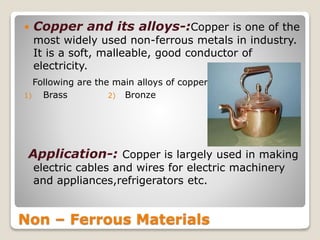
 Copper and its alloys-:Copper is one of the
most widely used non-ferrous metals in industry.
It is a soft, malleable, good conductor of
electricity.
Following are the main alloys of copper
1) Brass 2) Bronze
Application-: Copper is largely used in making
electric cables and wires for electric machinery
and appliances,refrigerators etc.
Non – Ferrous Materials
 Lead and its alloys-:Lead is the heaviest
and softest among all common metals. It is
corrosion resistant and having good lubricating
properties.
Application -: It is extensively used for making
solder, as a lining for acid tanks ,water pipes,
batteries ,bearings,etc.
Non – Ferrous Materials
 Tin-:Tin is brightly shining white , soft and
malleable metal . It can be rolled into very
thin sheets.
Applications -: It is used for making fine
solder ,as a protective coating for iron and
steel sheets ,for making tin foil used as
moisture proof packing , etc.
Non – Ferrous Materials
 Nickel and its alloys -: Nickel is an
important alloying element and widely used
in engineering industry on account of their
high mechanical strength properties ,
corrosion resistance,etc.
Application -: A large percentage of nickel
is used for production of stainless
steels.these are used in making
propellers,condenser tubes etc.
GROUP5-classification-of-metal (1)kk.ppt

GROUP5-classification-of-metal (1)kk.ppt

  • 1.
    Ferrous and Non-Ferrous METALS GROUP5 AGUSTIN, VIC VINCENT D. CASTILLO, JEBEN-JUN L. PALAPUZ, JOANNA MARIE C. PORRAS, RENEL S. VIENTE, VIANCA V. ZABAT, GWEN NICOLE
  • 2.
  • 3.
    Ferrous Materials  FerrousMaterials - Ferrous metals and alloys are widely used because they provide a wide range of properties that are not found in other family of materials. The principle ferrous metals commonly used in engineering practice are (i)Wrought iron (ii)Steels (iii)alloy steel (iv) cast iron The raw materials for all ferrous metal in pig iron.Pig iron is obtained by smelting the iron in a blast furnace with the help of coke and lime-stone.
  • 4.
    Ferrous Materials i. Wroughtiron – Wrought iron is a highly refined iron with a small amount of slag forged out into fibers. The chemical analysis of the metal shows as much as 99% of iron. ◦ Properties -: The slag fibers in wrought iron improve strength, fatigue resistance and corrosion resistance of iron. ◦ Application -: Bolts and nuts,chain,crane hooks, railway couplings, pipe and fittings, sheets and boiler tubes are the main forms in which wrought iron is used.
  • 5.
    Ferrous Materials ii. Castiron – This is a primarily an alloy of iron and carbon. The carbon in cast iron varies form 2% to 4.3%.In addition to carbon ,cast iron contains small amounts of silicon , manganese , phosphorous , and sulphur. Cast iron is the most important and widely used metal. It is very brittle, less ductile material. The various types of cast iron in use are as follows : ◦ i) Grey cast iron ◦ ii) White cast iron ◦ iii) Malleable cast iron
  • 6.
     Effect ofthe alloy materials on cast iron-: 1. Silicon -: It also helps to produce ,sound casting free from blow-holes. 2. Sulphur -: It makes the cast iron hard and brittle. 3. Manganese -: It may be present in cast iron upto 0.75%.It makes the cast iron white and hard. 4. Phosphorus-: It’s content in cast iron varies between 0.05 to 1.00%. 5. Carbon -: If carbon is present in combined form, it makes the iron hard and strong.
  • 7.
    Ferrous Materials iii. Steels- In alloy of carbon and iron with carbon content usually ranges from 0.08 to 1.5 %. These steels are called plain carbon steels or simply carbon steels. Steels generally contain small amounts of sulphur , phosphorous , silicon ,and manganese in addition to carbon. The carbon steels can be classified on the basis of their carbon content as: i) Low carbon steel ii) Medium carbon steel iii) High carbon steel
  • 8.
    Ferrous Materials iv.Alloy steel- Alloy steel may be defined as steels to which elements other than carbon are added in sufficient amounts to produce improvements in properties. In general ,alloy steels can give better strength,ductility,and toughness than plain carbon steels. The commonly added elements include nickel,chromium,silicon ,manganese ,tungsten molybdenum, ,cobalt ,aluminium, etc.  Main types of alloy steels used in practice are -: i) Stainless steels ii) Heat resisting steels iii) High speed steels iv) Spring steels
  • 9.
    Ferrous Materials Effect ofthe alloying elements on alloy steel-: 1. Silicon -: The amount of steel usually ranges from 0.05 to 0.30%. 2. Manganese -: It commonly ranges from 0.30 to 1.00%. 3. Sulphur -: It contains in steel either as iron sulphide or manganese sulphide. 4. Phosphorus -: The phosphorus content should not exceed 0.05% in good quality steels. 5. Nickel -: It increases the strength and toughness of the steel. 5. Chromium -: It imparts corrosion-resisting properties to steels. 7. Tungsten -: It forms hard abrasion resistant particles, increases strength and high elastic limit.
  • 10.
    Non – FerrousMaterials  Non-ferrous materials -:The non-ferrous metals are those which contain a metal other than iron as their chief constituent. They are usually used in industry due to the following characteristics. (i) Ease of manufacturing (ii) Resistance to corrosion (iii) Electrical and thermal conductivity (iv) Weight Important non-ferrous metals are aluminium,copper,lead,tin,nickel,zinc,and titanium.
  • 11.
    Non – FerrousMaterials  Aluminium and its alloys-: Aluminum is silvery-white and lighter in weight than steel and copper. It has high corrosion resistance.Aluminium has good machinability,formability and castability. Duralumin and Y-alloy are the important aluminium alloys. Application-: These are widely used in air craft and automobile industry etc,.
  • 12.
    Non – FerrousMaterials  Copper and its alloys-:Copper is one of the most widely used non-ferrous metals in industry. It is a soft, malleable, good conductor of electricity. Following are the main alloys of copper 1) Brass 2) Bronze Application-: Copper is largely used in making electric cables and wires for electric machinery and appliances,refrigerators etc.
  • 13.
    Non – FerrousMaterials  Lead and its alloys-:Lead is the heaviest and softest among all common metals. It is corrosion resistant and having good lubricating properties. Application -: It is extensively used for making solder, as a lining for acid tanks ,water pipes, batteries ,bearings,etc.
  • 14.
    Non – FerrousMaterials  Tin-:Tin is brightly shining white , soft and malleable metal . It can be rolled into very thin sheets. Applications -: It is used for making fine solder ,as a protective coating for iron and steel sheets ,for making tin foil used as moisture proof packing , etc.
  • 15.
    Non – FerrousMaterials  Nickel and its alloys -: Nickel is an important alloying element and widely used in engineering industry on account of their high mechanical strength properties , corrosion resistance,etc. Application -: A large percentage of nickel is used for production of stainless steels.these are used in making propellers,condenser tubes etc.