1
Introduction to
Digital Signal
Processing Systems
Shao-Yi Chien
DSP in VLSI Design Shao-Yi Chien 2
Outline
 Introduction
 Typical DSP algorithms
 Scaled CMOS technologies
 Representations of DSP algorithms
DSP in VLSI Design Shao-Yi Chien 3
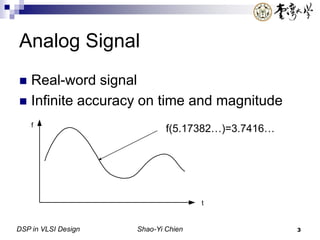
Analog Signal
 Real-word signal
 Infinite accuracy on time and magnitude
t
f
f(5.17382…)=3.7416…
DSP in VLSI Design Shao-Yi Chien 4
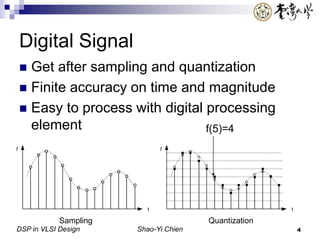
Digital Signal
 Get after sampling and quantization
 Finite accuracy on time and magnitude
 Easy to process with digital processing
element
t
f
t
f
Sampling Quantization
f(5)=4
DSP in VLSI Design Shao-Yi Chien 5
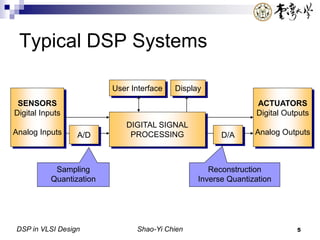
Typical DSP Systems
Sampling
Quantization
Reconstruction
Inverse Quantization
SENSORS
Digital Inputs
Analog Inputs
DIGITAL SIGNAL
PROCESSING
A/D D/A
User Interface Display
ACTUATORS
Digital Outputs
Analog Outputs
DSP in VLSI Design Shao-Yi Chien 6
Advantages of Analog Signal
Processing
 Can operate in very high frequency
 Sometimes low area
 Low power
DSP in VLSI Design Shao-Yi Chien 7
Advantages of Digital Signal
Processing (DSP)
 More robust
 Insensitive to environment and component tolerance
 The accuracy can be controlled better
 Can cancel the noise and interference while
amplifying the signal
 Predictable, repeatable behavior
 Can be stored and recovered, transmitted and
received, processed and manipulated without error
DSP in VLSI Design Shao-Yi Chien 8
Features of DSP Systems
 Real-time throughput requirement
So-called hard real-time systems
 Data-driven property
 Non-terminating program
DSP in VLSI Design Shao-Yi Chien 9
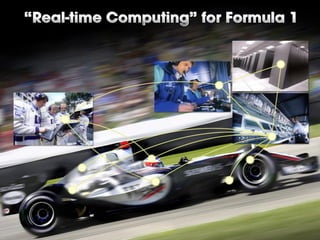
Hard Real-Time Systems
Courtesy Warner Brothers Studios
DSP in VLSI Design Shao-Yi Chien 10
DSP in VLSI Design Shao-Yi Chien 11
Performance Metrics of DSP
Systems
 Hardware circuitry and resources (area)
 Speed of execution
 Power consumption
 Finite word length performance
DSP in VLSI Design Shao-Yi Chien 12
Characteristics of DSP Systems
(1/4)
 Data format
1D speech
2D image
3D video
time
time
DSP in VLSI Design Shao-Yi Chien 13
Characteristics of DSP Systems
(2/4)
 Algorithms
DSP in VLSI Design Shao-Yi Chien 14
Characteristics of DSP Systems
(3/4)
 Sample
rates
DSP in VLSI Design Shao-Yi Chien 15
Characteristics of DSP Systems
(4/4)
 Clock rates
 Numeric representations
DSP in VLSI Design Shao-Yi Chien 16
Standard Digital Signal
Processors (1/2)
 Allow rapid prototyping and time-to-market
 Sometimes, the execution speed and code
size is reasonably good
 Not always cost effective
 Often cannot meet the requirements of
throughput, power consumption, and size
DSP in VLSI Design Shao-Yi Chien 17
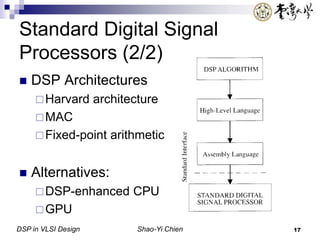
Standard Digital Signal
Processors (2/2)
 DSP Architectures
Harvard architecture
MAC
Fixed-point arithmetic
 Alternatives:
DSP-enhanced CPU
GPU
DSP in VLSI Design Shao-Yi Chien 18
Application-Specific ICs for DSP
(1/2)
 Better performances
Processing capacity
Power consumption
Pin-restriction problem
 Main problem: the system is very complex
to design
Long time-to-market
DSP in VLSI Design Shao-Yi Chien 19
Application-Specific ICs for DSP
(2/2)
 Large design space
 Hard to find optimal solution
 Systemspecification
algorithmhardware
architecturelogic
implementationVLSI
implementation
 ASIC  Accelerator design in
an SoC
DSP in VLSI Design Shao-Yi Chien 20
Typical DSP Algorithms
 Convolution
 Correlation
 Digital filters
 Adaptive filters
 Motion estimation
 Discrete cosine transform (DCT)
 Vector quantization (VQ)
 Viterbi algorithm and dynamic programming
 Decimator and expander
 Wavelets and filter banks
DSP in VLSI Design Shao-Yi Chien 21
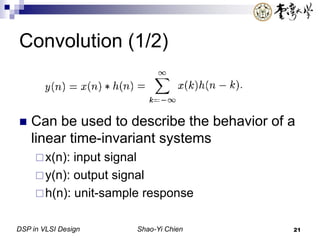
Convolution (1/2)
 Can be used to describe the behavior of a
linear time-invariant systems
x(n): input signal
y(n): output signal
h(n): unit-sample response
DSP in VLSI Design Shao-Yi Chien 22
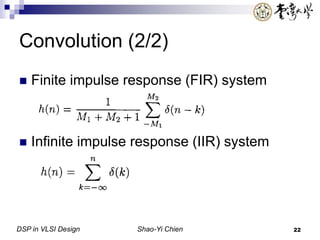
Convolution (2/2)
 Finite impulse response (FIR) system
 Infinite impulse response (IIR) system
DSP in VLSI Design Shao-Yi Chien 23
Digital Filters
 LTI, causal filter
 M-tap finite impulse response filter
DSP in VLSI Design Shao-Yi Chien 24
DSP in VLSI Design Shao-Yi Chien 25
Moore’s Law
DSP in VLSI Design Shao-Yi Chien 26
Scaled CMOS technology
(Moore’s Law) (1/3)
DSP in VLSI Design Shao-Yi Chien 27
Scaled CMOS technology
(Moore’s Law) (2/3)
180
160
140
120
100
80
Maximum power for high
performance with heat sink (W)
0.9
1.2
1.5
1.8
2.5
3.3
Power supply voltage (V) for
desktop
7-8
6-7
6
5-6
5
4-5
Maximum number of wiring levels
(logic), on chip
1,100
1,000
800
600
450
300
Chip frequency (MHz) for a
high-performance on-chip clock
430M
210M
50M
26M
14M
5M
ASIC (gate per chip)
800M
350M
150M
64M
28M
12M
Microprocessor transistor per chip
( 2.3 times per generation)
64G
16G
4G
1G
256M
64M
Memory in bits/chip
(DRAM/FLASH)
0.07
0.10
0.13
0.18
0.25
0.35
Minimum feature of size (um)
2010
2007
2004
2001
1998
1995
Year of first DRAM shipment
Source: SIA (Semiconductor Industry Association) road map
ITRS: International Technology Roadmap for Semiconductors
http://www.itrs.net/
DSP in VLSI Design
Scaled CMOS technology
(Moore’s Law) (3/3)
Shao-Yi Chien 28
DSP in VLSI Design Shao-Yi Chien 29
DSP and VLSI
 Modern DSP
 Well suite to VLSI implementation
 Feasible or economically viable only if implemented
using VLSI technologies
 VLSI
 Large investmentneed large volume of products
 Communication
 Consumer applications
 Necessary performance requirement (especially real-
time requirement)
 DSP systems are hard real-time systems
DSP in VLSI Design Shao-Yi Chien 30
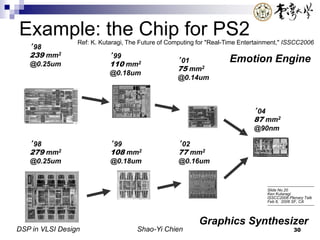
Example: the Chip for PS2
’98
239 mm2
@0.25um
’98
279 mm2
@0.25um
’99
110 mm2
@0.18um
’01
75 mm2
@0.14um
’99
108 mm2
@0.18um
’02
77 mm2
@0.16um
Emotion Engine
Graphics Synthesizer
’04
87 mm2
@90nm
-----------------------------------
Slide No.20
Ken Kutaragi
ISSCC2006 Plenary Talk
Feb 6, 2006 SF, CA
----------------------------------------
Ref: K. Kutaragi, The Future of Computing for "Real-Time Entertainment," ISSCC2006
DSP in VLSI Design Shao-Yi Chien 31
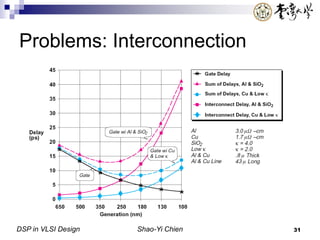
Problems: Interconnection
DSP in VLSI Design Shao-Yi Chien 32
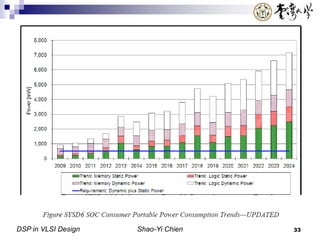
Problems: Increasing Static Power
 VDD decreases
 Save dynamic power
 Protect thin gate oxides and short channels
 No point in high value because of velocity sat.
 Vt must decrease to
maintain device performance
 But this causes exponential
increase in OFF leakage
 Major future challenge
Static
Dynamic
[Moore03]
DSP in VLSI Design Shao-Yi Chien 33
DSP in VLSI Design Shao-Yi Chien 34
Problems: Power Density
 Intel VP Patrick Gelsinger (ISSCC 2001)
 If scaling continues at present pace, by 2005, high
speed processors would have power density of
nuclear reactor, by 2010, a rocket nozzle, and by
2015, surface of sun.
 “Business as usual will not work in the future.”
 Intel stock dropped 8%
on the next day
 But attention to power is
increasing
[Gelsinger01]
DSP in VLSI Design Shao-Yi Chien 35
1950 1960 1970 1980 1990 2000 2010 2020
Module
Heat
Flux
(W/cm
2
)
Year of Announcement
Ultra-low Vdd
3-D integration ?
bipolar
CMOS
Problems: Scaling and the Power
Crisis
After: R. Schmidt et al., IBM J. R&D, (2002).
Delay 3-4X 
Power 15X 
Density 50X 
DSP in VLSI Design
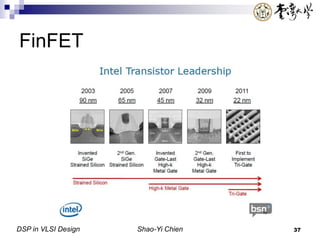
FinFET
Shao-Yi Chien 36
DSP in VLSI Design
FinFET
Shao-Yi Chien 37
DSP in VLSI Design
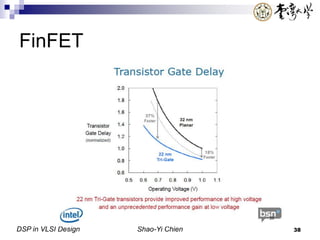
FinFET
Shao-Yi Chien 38
DSP in VLSI Design Shao-Yi Chien 39
Science and Technology Strategy / Roadmap
2000 2005 2010 2015 2020 2025 2030
Plan B: Subsytem Integration
R D
Plan C: Post Si CMOS Options
R R&D
Plan Q:
R D
Quantum Computing
Plan A: Extending Si CMOS
R D
Ref: Tze-Chiang Chen, "Where Si-CMOS is Going: Trendy Hype vs. Real Technology," ISSCC2006.
DSP in VLSI Design Shao-Yi Chien 40
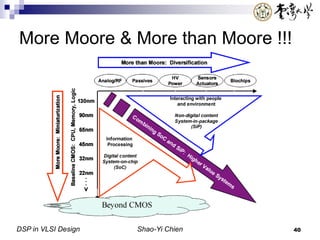
More Moore & More than Moore !!!
DSP in VLSI Design
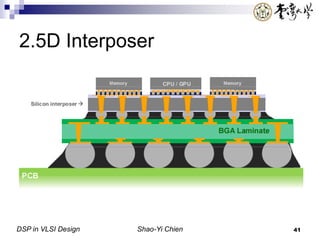
2.5D Interposer
Shao-Yi Chien 41
DSP in VLSI Design
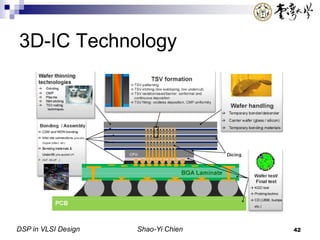
3D-IC Technology
Shao-Yi Chien 42
DSP in VLSI Design
Heterogeneous System Integration
Shao-Yi Chien 43
[TSMC 2015]
DSP in VLSI Design
InFO (Integrated Fan Out)
Shao-Yi Chien 44
[TSMC 2015]
DSP in VLSI Design
CoWoS (Chip-On-Wafer-On-Substrate)
Shao-Yi Chien 45
[TSMC 2015]
DSP in VLSI Design
Example of CoWoS
Shao-Yi Chien 46
[TSMC 2015]
DSP in VLSI Design Shao-Yi Chien 47
DSP Architecture Design?
 Given DSP algorithms, find the “best”
solution in the design space under certain
constraints
 Or, modified or develop the algorithm to be
“hardware oriented” or “hardware friendly,”
and then develop the hardware
architecture
DSP in VLSI Design Shao-Yi Chien 48
Abstraction Layers
 System (ex: MP3 player)
 Algorithm (ex: FIR filter)
 Hardware architecture (ex: array architecture,…)
 Arithmetic units (ex: multiplier, adder, …)
 Logic gates (ex: AND, OR, …)
 Transistors (ex: NMOS, PMOS)
 Layout
DSP in VLSI Design Shao-Yi Chien 49
The Higher the Abstraction,
The Larger Design Space
System Level
Algorithm Level
Hardware Architecture Level
Arithmetic Level
Gates Level
Transistors Level
Physical Level
Design Space
DSP in VLSI Design Shao-Yi Chien 50
The Higher the Abstraction,
The More Important
System Level
Algorithm Level
Hardware Architecture Level
Arithmetic Level
Gates Level
Transistors Level
Physical Level
Performance Space
DSP in VLSI Design Shao-Yi Chien 51
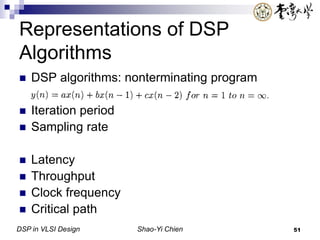
Representations of DSP
Algorithms
 DSP algorithms: nonterminating program
 Iteration period
 Sampling rate
 Latency
 Throughput
 Clock frequency
 Critical path
DSP in VLSI Design Shao-Yi Chien 52
Graphical Representations of
DSP Algorithms
 Can bridge the gap between algorithmic
descriptions and structural implementations
 Block diagram
 Signal-flow graph (SFG)
 Data-flow graph (DFG)
 Dependence graph (DG)
DSP in VLSI Design Shao-Yi Chien 53
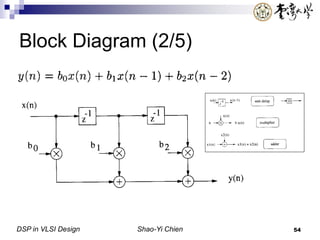
Block Diagram (1/5)
 The most frequently used representation
 Can be constructed with different levels of
abstraction
 Can be directly mapped to circuits
implementation
DSP in VLSI Design Shao-Yi Chien 54
Block Diagram (2/5)
DSP in VLSI Design Shao-Yi Chien 55
Block Diagram (3/5)
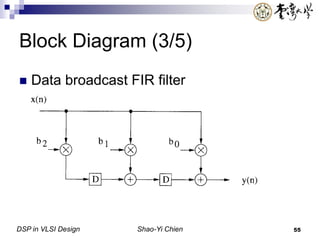
 Data broadcast FIR filter
DSP in VLSI Design Shao-Yi Chien 56
Block Diagram (4/5)
(4ns)
(1ns)
Critical path: 4+1+1=6ns
Max clock frequency = 1s/6ns=167MHz
DSP in VLSI Design Shao-Yi Chien 57
Block Diagram (5/5)
Critical path: 4+1=5ns
Max clock frequency = 1s/5ns=200MHz
DSP in VLSI Design Shao-Yi Chien 58
Signal Flow Graph (SFG) (1/4)
 Nodes k
Computation or task
 Directed edges (j, k)
Linear transformation
Source node
Sink node
DSP in VLSI Design Shao-Yi Chien 59
Signal Flow Graph (SFG) (2/4)
DSP in VLSI Design Shao-Yi Chien 60
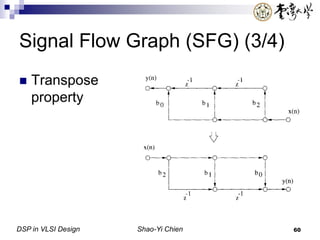
Signal Flow Graph (SFG) (3/4)
 Transpose
property
DSP in VLSI Design Shao-Yi Chien 61
Signal Flow Graph (SFG) (4/4)
 Used in digital filter structure and analysis
of finite word-length effects
 Only applicable to linear networks
 Cannot be used to describe multi-rate
DSP systems
DSP in VLSI Design Shao-Yi Chien 62
Data-Flow Graph (DFG) (1/4)
 Nodes
Computations
 Directed edges
Data paths (communication)
Has a nonnegative number of delays
DSP in VLSI Design Shao-Yi Chien 63
Data-Flow Graph (DFG) (2/4)
y(n)=x(n)+ay(n-1)
A: +
B: X
Execution time
Synchronous DFG
Rate
DSP in VLSI Design Shao-Yi Chien 64
Data-Flow Graph (DFG) (3/4)
 Data-driven property of DSP
Any node can fire whenever all the input data
are available
Intra-iteration precedence constraint
Inter-iteration precedence constraint
 Can be used to describe both linear
single-rate and nonlinear multi-rate DSP
systems
DSP in VLSI Design Shao-Yi Chien 65
Data-Flow Graph (DFG) (4/4)
 Use single rate DFG (SRDFG) to represent multi-rate
DFG (MRDFG)
3fA=5fB
2fB=3fC
DSP in VLSI Design Shao-Yi Chien 66
Dependence Graph (1/2)
 A directed graph that shows the
dependence of the computation
 Node: computation
 No node in a DG is ever reused on a
single computation basis
Single-assignment representation
 Used for systolic-array design
DSP in VLSI Design Shao-Yi Chien 67
Dependence Graph (2/2)
DSP in VLSI Design Shao-Yi Chien 68
DFG v.s. DG
 DFG
 Nodes only cover
computation in one
iteration, and will be
reused iteratively
 Contain delay
elements
 DG
 Contains computation
for all iterations, and is
used only once
 No delay elements
contained

introduction to digital signal processing systems

  • 1.
  • 2.
    DSP in VLSIDesign Shao-Yi Chien 2 Outline  Introduction  Typical DSP algorithms  Scaled CMOS technologies  Representations of DSP algorithms
  • 3.
    DSP in VLSIDesign Shao-Yi Chien 3 Analog Signal  Real-word signal  Infinite accuracy on time and magnitude t f f(5.17382…)=3.7416…
  • 4.
    DSP in VLSIDesign Shao-Yi Chien 4 Digital Signal  Get after sampling and quantization  Finite accuracy on time and magnitude  Easy to process with digital processing element t f t f Sampling Quantization f(5)=4
  • 5.
    DSP in VLSIDesign Shao-Yi Chien 5 Typical DSP Systems Sampling Quantization Reconstruction Inverse Quantization SENSORS Digital Inputs Analog Inputs DIGITAL SIGNAL PROCESSING A/D D/A User Interface Display ACTUATORS Digital Outputs Analog Outputs
  • 6.
    DSP in VLSIDesign Shao-Yi Chien 6 Advantages of Analog Signal Processing  Can operate in very high frequency  Sometimes low area  Low power
  • 7.
    DSP in VLSIDesign Shao-Yi Chien 7 Advantages of Digital Signal Processing (DSP)  More robust  Insensitive to environment and component tolerance  The accuracy can be controlled better  Can cancel the noise and interference while amplifying the signal  Predictable, repeatable behavior  Can be stored and recovered, transmitted and received, processed and manipulated without error
  • 8.
    DSP in VLSIDesign Shao-Yi Chien 8 Features of DSP Systems  Real-time throughput requirement So-called hard real-time systems  Data-driven property  Non-terminating program
  • 9.
    DSP in VLSIDesign Shao-Yi Chien 9 Hard Real-Time Systems Courtesy Warner Brothers Studios
  • 10.
    DSP in VLSIDesign Shao-Yi Chien 10
  • 11.
    DSP in VLSIDesign Shao-Yi Chien 11 Performance Metrics of DSP Systems  Hardware circuitry and resources (area)  Speed of execution  Power consumption  Finite word length performance
  • 12.
    DSP in VLSIDesign Shao-Yi Chien 12 Characteristics of DSP Systems (1/4)  Data format 1D speech 2D image 3D video time time
  • 13.
    DSP in VLSIDesign Shao-Yi Chien 13 Characteristics of DSP Systems (2/4)  Algorithms
  • 14.
    DSP in VLSIDesign Shao-Yi Chien 14 Characteristics of DSP Systems (3/4)  Sample rates
  • 15.
    DSP in VLSIDesign Shao-Yi Chien 15 Characteristics of DSP Systems (4/4)  Clock rates  Numeric representations
  • 16.
    DSP in VLSIDesign Shao-Yi Chien 16 Standard Digital Signal Processors (1/2)  Allow rapid prototyping and time-to-market  Sometimes, the execution speed and code size is reasonably good  Not always cost effective  Often cannot meet the requirements of throughput, power consumption, and size
  • 17.
    DSP in VLSIDesign Shao-Yi Chien 17 Standard Digital Signal Processors (2/2)  DSP Architectures Harvard architecture MAC Fixed-point arithmetic  Alternatives: DSP-enhanced CPU GPU
  • 18.
    DSP in VLSIDesign Shao-Yi Chien 18 Application-Specific ICs for DSP (1/2)  Better performances Processing capacity Power consumption Pin-restriction problem  Main problem: the system is very complex to design Long time-to-market
  • 19.
    DSP in VLSIDesign Shao-Yi Chien 19 Application-Specific ICs for DSP (2/2)  Large design space  Hard to find optimal solution  Systemspecification algorithmhardware architecturelogic implementationVLSI implementation  ASIC  Accelerator design in an SoC
  • 20.
    DSP in VLSIDesign Shao-Yi Chien 20 Typical DSP Algorithms  Convolution  Correlation  Digital filters  Adaptive filters  Motion estimation  Discrete cosine transform (DCT)  Vector quantization (VQ)  Viterbi algorithm and dynamic programming  Decimator and expander  Wavelets and filter banks
  • 21.
    DSP in VLSIDesign Shao-Yi Chien 21 Convolution (1/2)  Can be used to describe the behavior of a linear time-invariant systems x(n): input signal y(n): output signal h(n): unit-sample response
  • 22.
    DSP in VLSIDesign Shao-Yi Chien 22 Convolution (2/2)  Finite impulse response (FIR) system  Infinite impulse response (IIR) system
  • 23.
    DSP in VLSIDesign Shao-Yi Chien 23 Digital Filters  LTI, causal filter  M-tap finite impulse response filter
  • 24.
    DSP in VLSIDesign Shao-Yi Chien 24
  • 25.
    DSP in VLSIDesign Shao-Yi Chien 25 Moore’s Law
  • 26.
    DSP in VLSIDesign Shao-Yi Chien 26 Scaled CMOS technology (Moore’s Law) (1/3)
  • 27.
    DSP in VLSIDesign Shao-Yi Chien 27 Scaled CMOS technology (Moore’s Law) (2/3) 180 160 140 120 100 80 Maximum power for high performance with heat sink (W) 0.9 1.2 1.5 1.8 2.5 3.3 Power supply voltage (V) for desktop 7-8 6-7 6 5-6 5 4-5 Maximum number of wiring levels (logic), on chip 1,100 1,000 800 600 450 300 Chip frequency (MHz) for a high-performance on-chip clock 430M 210M 50M 26M 14M 5M ASIC (gate per chip) 800M 350M 150M 64M 28M 12M Microprocessor transistor per chip ( 2.3 times per generation) 64G 16G 4G 1G 256M 64M Memory in bits/chip (DRAM/FLASH) 0.07 0.10 0.13 0.18 0.25 0.35 Minimum feature of size (um) 2010 2007 2004 2001 1998 1995 Year of first DRAM shipment Source: SIA (Semiconductor Industry Association) road map ITRS: International Technology Roadmap for Semiconductors http://www.itrs.net/
  • 28.
    DSP in VLSIDesign Scaled CMOS technology (Moore’s Law) (3/3) Shao-Yi Chien 28
  • 29.
    DSP in VLSIDesign Shao-Yi Chien 29 DSP and VLSI  Modern DSP  Well suite to VLSI implementation  Feasible or economically viable only if implemented using VLSI technologies  VLSI  Large investmentneed large volume of products  Communication  Consumer applications  Necessary performance requirement (especially real- time requirement)  DSP systems are hard real-time systems
  • 30.
    DSP in VLSIDesign Shao-Yi Chien 30 Example: the Chip for PS2 ’98 239 mm2 @0.25um ’98 279 mm2 @0.25um ’99 110 mm2 @0.18um ’01 75 mm2 @0.14um ’99 108 mm2 @0.18um ’02 77 mm2 @0.16um Emotion Engine Graphics Synthesizer ’04 87 mm2 @90nm ----------------------------------- Slide No.20 Ken Kutaragi ISSCC2006 Plenary Talk Feb 6, 2006 SF, CA ---------------------------------------- Ref: K. Kutaragi, The Future of Computing for "Real-Time Entertainment," ISSCC2006
  • 31.
    DSP in VLSIDesign Shao-Yi Chien 31 Problems: Interconnection
  • 32.
    DSP in VLSIDesign Shao-Yi Chien 32 Problems: Increasing Static Power  VDD decreases  Save dynamic power  Protect thin gate oxides and short channels  No point in high value because of velocity sat.  Vt must decrease to maintain device performance  But this causes exponential increase in OFF leakage  Major future challenge Static Dynamic [Moore03]
  • 33.
    DSP in VLSIDesign Shao-Yi Chien 33
  • 34.
    DSP in VLSIDesign Shao-Yi Chien 34 Problems: Power Density  Intel VP Patrick Gelsinger (ISSCC 2001)  If scaling continues at present pace, by 2005, high speed processors would have power density of nuclear reactor, by 2010, a rocket nozzle, and by 2015, surface of sun.  “Business as usual will not work in the future.”  Intel stock dropped 8% on the next day  But attention to power is increasing [Gelsinger01]
  • 35.
    DSP in VLSIDesign Shao-Yi Chien 35 1950 1960 1970 1980 1990 2000 2010 2020 Module Heat Flux (W/cm 2 ) Year of Announcement Ultra-low Vdd 3-D integration ? bipolar CMOS Problems: Scaling and the Power Crisis After: R. Schmidt et al., IBM J. R&D, (2002). Delay 3-4X  Power 15X  Density 50X 
  • 36.
    DSP in VLSIDesign FinFET Shao-Yi Chien 36
  • 37.
    DSP in VLSIDesign FinFET Shao-Yi Chien 37
  • 38.
    DSP in VLSIDesign FinFET Shao-Yi Chien 38
  • 39.
    DSP in VLSIDesign Shao-Yi Chien 39 Science and Technology Strategy / Roadmap 2000 2005 2010 2015 2020 2025 2030 Plan B: Subsytem Integration R D Plan C: Post Si CMOS Options R R&D Plan Q: R D Quantum Computing Plan A: Extending Si CMOS R D Ref: Tze-Chiang Chen, "Where Si-CMOS is Going: Trendy Hype vs. Real Technology," ISSCC2006.
  • 40.
    DSP in VLSIDesign Shao-Yi Chien 40 More Moore & More than Moore !!!
  • 41.
    DSP in VLSIDesign 2.5D Interposer Shao-Yi Chien 41
  • 42.
    DSP in VLSIDesign 3D-IC Technology Shao-Yi Chien 42
  • 43.
    DSP in VLSIDesign Heterogeneous System Integration Shao-Yi Chien 43 [TSMC 2015]
  • 44.
    DSP in VLSIDesign InFO (Integrated Fan Out) Shao-Yi Chien 44 [TSMC 2015]
  • 45.
    DSP in VLSIDesign CoWoS (Chip-On-Wafer-On-Substrate) Shao-Yi Chien 45 [TSMC 2015]
  • 46.
    DSP in VLSIDesign Example of CoWoS Shao-Yi Chien 46 [TSMC 2015]
  • 47.
    DSP in VLSIDesign Shao-Yi Chien 47 DSP Architecture Design?  Given DSP algorithms, find the “best” solution in the design space under certain constraints  Or, modified or develop the algorithm to be “hardware oriented” or “hardware friendly,” and then develop the hardware architecture
  • 48.
    DSP in VLSIDesign Shao-Yi Chien 48 Abstraction Layers  System (ex: MP3 player)  Algorithm (ex: FIR filter)  Hardware architecture (ex: array architecture,…)  Arithmetic units (ex: multiplier, adder, …)  Logic gates (ex: AND, OR, …)  Transistors (ex: NMOS, PMOS)  Layout
  • 49.
    DSP in VLSIDesign Shao-Yi Chien 49 The Higher the Abstraction, The Larger Design Space System Level Algorithm Level Hardware Architecture Level Arithmetic Level Gates Level Transistors Level Physical Level Design Space
  • 50.
    DSP in VLSIDesign Shao-Yi Chien 50 The Higher the Abstraction, The More Important System Level Algorithm Level Hardware Architecture Level Arithmetic Level Gates Level Transistors Level Physical Level Performance Space
  • 51.
    DSP in VLSIDesign Shao-Yi Chien 51 Representations of DSP Algorithms  DSP algorithms: nonterminating program  Iteration period  Sampling rate  Latency  Throughput  Clock frequency  Critical path
  • 52.
    DSP in VLSIDesign Shao-Yi Chien 52 Graphical Representations of DSP Algorithms  Can bridge the gap between algorithmic descriptions and structural implementations  Block diagram  Signal-flow graph (SFG)  Data-flow graph (DFG)  Dependence graph (DG)
  • 53.
    DSP in VLSIDesign Shao-Yi Chien 53 Block Diagram (1/5)  The most frequently used representation  Can be constructed with different levels of abstraction  Can be directly mapped to circuits implementation
  • 54.
    DSP in VLSIDesign Shao-Yi Chien 54 Block Diagram (2/5)
  • 55.
    DSP in VLSIDesign Shao-Yi Chien 55 Block Diagram (3/5)  Data broadcast FIR filter
  • 56.
    DSP in VLSIDesign Shao-Yi Chien 56 Block Diagram (4/5) (4ns) (1ns) Critical path: 4+1+1=6ns Max clock frequency = 1s/6ns=167MHz
  • 57.
    DSP in VLSIDesign Shao-Yi Chien 57 Block Diagram (5/5) Critical path: 4+1=5ns Max clock frequency = 1s/5ns=200MHz
  • 58.
    DSP in VLSIDesign Shao-Yi Chien 58 Signal Flow Graph (SFG) (1/4)  Nodes k Computation or task  Directed edges (j, k) Linear transformation Source node Sink node
  • 59.
    DSP in VLSIDesign Shao-Yi Chien 59 Signal Flow Graph (SFG) (2/4)
  • 60.
    DSP in VLSIDesign Shao-Yi Chien 60 Signal Flow Graph (SFG) (3/4)  Transpose property
  • 61.
    DSP in VLSIDesign Shao-Yi Chien 61 Signal Flow Graph (SFG) (4/4)  Used in digital filter structure and analysis of finite word-length effects  Only applicable to linear networks  Cannot be used to describe multi-rate DSP systems
  • 62.
    DSP in VLSIDesign Shao-Yi Chien 62 Data-Flow Graph (DFG) (1/4)  Nodes Computations  Directed edges Data paths (communication) Has a nonnegative number of delays
  • 63.
    DSP in VLSIDesign Shao-Yi Chien 63 Data-Flow Graph (DFG) (2/4) y(n)=x(n)+ay(n-1) A: + B: X Execution time Synchronous DFG Rate
  • 64.
    DSP in VLSIDesign Shao-Yi Chien 64 Data-Flow Graph (DFG) (3/4)  Data-driven property of DSP Any node can fire whenever all the input data are available Intra-iteration precedence constraint Inter-iteration precedence constraint  Can be used to describe both linear single-rate and nonlinear multi-rate DSP systems
  • 65.
    DSP in VLSIDesign Shao-Yi Chien 65 Data-Flow Graph (DFG) (4/4)  Use single rate DFG (SRDFG) to represent multi-rate DFG (MRDFG) 3fA=5fB 2fB=3fC
  • 66.
    DSP in VLSIDesign Shao-Yi Chien 66 Dependence Graph (1/2)  A directed graph that shows the dependence of the computation  Node: computation  No node in a DG is ever reused on a single computation basis Single-assignment representation  Used for systolic-array design
  • 67.
    DSP in VLSIDesign Shao-Yi Chien 67 Dependence Graph (2/2)
  • 68.
    DSP in VLSIDesign Shao-Yi Chien 68 DFG v.s. DG  DFG  Nodes only cover computation in one iteration, and will be reused iteratively  Contain delay elements  DG  Contains computation for all iterations, and is used only once  No delay elements contained