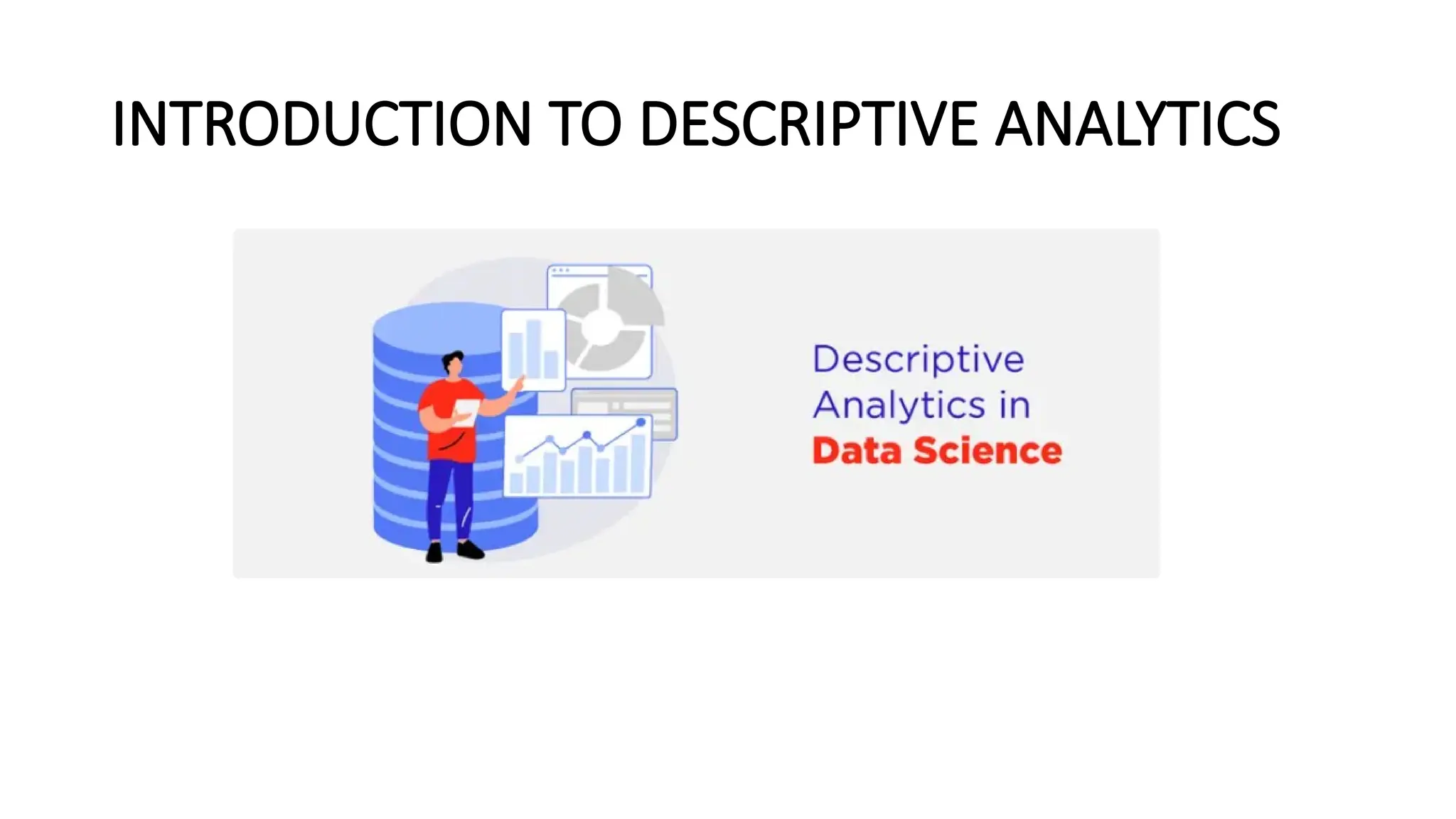
INTRODUCTION TO DESCRIPTIVE ANALYTICS
INTENDED LEARNING OUTCOMES
What is Descriptive Analytics in Data Science?
Types of Descriptive Analysis
The Five Steps Descriptive Data Science Involves
How Does Descriptive Analytics Work in Data Science?
Examples of Descriptive Analytics
The Advantages and Disadvantages of Descriptive Analytics in Data Science
How is Descriptive Analytics Used ?
Descriptive Analysis Techniques
Descriptive Analytics Use Cases
Descriptive vs Predictive vs Prescriptive Analytics
WHAT IS DESCRIPTIVE ANALYTICS…
Descriptive Analytics is a field of business intelligence with expertise in statistical
analysis, waiting for history, and other data. Descriptive Analytics professionals find the
data to question and study; they pose the questions that need answers; they translate
these queries into mathematical models and apply them to their chosen data. Using
descriptive analytics in data visualization is a practice that can greatly aid and improve
people’s decision-making. Their decisions are taken from over-reliance, wishful thinking,
and in isolation.
Descriptive analytics is a rapidly growing field with a promising future. It offers the
ability to make better business decisions and understand how customers interact with
companies and products. General techniques used in descriptive analytics include; Data
collection, Data preparation, exploratory data analysis, data visualization, statistical
analysis, and predictive modeling.
What is Descriptive Analytics in Data Science?
The purpose of descriptive analytics is to turn data into insights. It is
used to understand what happened in the past and why it happened.
Descriptive analytics uses various techniques to answer questions such
as “what is the average order value?”, “how many orders were placed
last month?” or “what was the most popular product last year?”.
What is Descriptive Analytics in Data Science?
There are four main steps in descriptive analytics:
• Data collection: Collecting data from various sources such as sales
reports, customer surveys, social media, etc.
• Data preparation: Cleaning and organizing the data so it can be
analyzed.
• Exploratory data analysis: Analyzing the data to find trends, patterns,
and relationships.
• Data visualization: Creating graphs and charts to visualize the data
and make it easy to understand.
What is Descriptive Analytics in Data Science?
The most common techniques used in descriptive analytics are
statistical analysis, data visualization, and predictive modeling.
Types of Descriptive Analysis
There are four different types of
descriptive analysis: measures of
frequency, central tendency,
dispersion or variation,
position, . These techniques
work best when only one
variable is present.
1. Measures of Frequency
• Understanding how frequently a specific event or response is likely to
occur is crucial for descriptive analysis. The main goal of frequency
measurements is to create something akin to a count or a percentage.
For example: Think about a survey where 500 people are questioned
about their favorite football team. A list of 500 responses would be
challenging to read and organize, but by counting the number of
times a specific football team was chosen, the data can be made
much more understandable.
Measures: Count, Percent, Frequency
2. Measures of Central Tendency
• A single value that seeks to characterize a set of data by pinpointing the central
position within that set of data is referred to as a measure of central tendency. As a
result, measures of central location are occasionally used to refer to measures of
central tendency. They also fit into the category of summary statistics. You are
probably most familiar with the mean (also known as the average), but there are
other central tendency measures, including the median and the mode.
• The mean, median, and mode are all reliable indicators of central tendency, but
depending on the situation, some indicators are more useful than others.
• Think about a survey where 1,000 people's body weight are recorded as an
example. The mean average would be a great descriptive metric to use in this
situation to measure mid-values.
Measures: Mean, Median, and Mode
3. Measures of Dispersion
• At times, understanding how data is distributed across a range is
crucial. Consider the average weight of a sample of two people to
further explain this. The average weight will be 60 kilograms if both
people weigh 60 kilograms. The average weight is still 60 kg even if
one person weighs 40 kg and the other 80 kg. This type of distribution
can be measured using dispersion metrics like range or standard
deviation.
Measures: Range, Variance, Standard Deviation
4. Measures of Position
• Identifying the position of a single value or its response in relation to
others is another aspect of descriptive analysis. In this field of
expertise, metrics like percentiles and quartiles are extremely helpful.
Measures: Percentile Ranks, Quartile Ranks
Similar to bivariate analysis, the multivariate analysis examines more
than two variables.
The two methods for bivariate analysis are:
1) Contingency Table
2) Scatter Plots
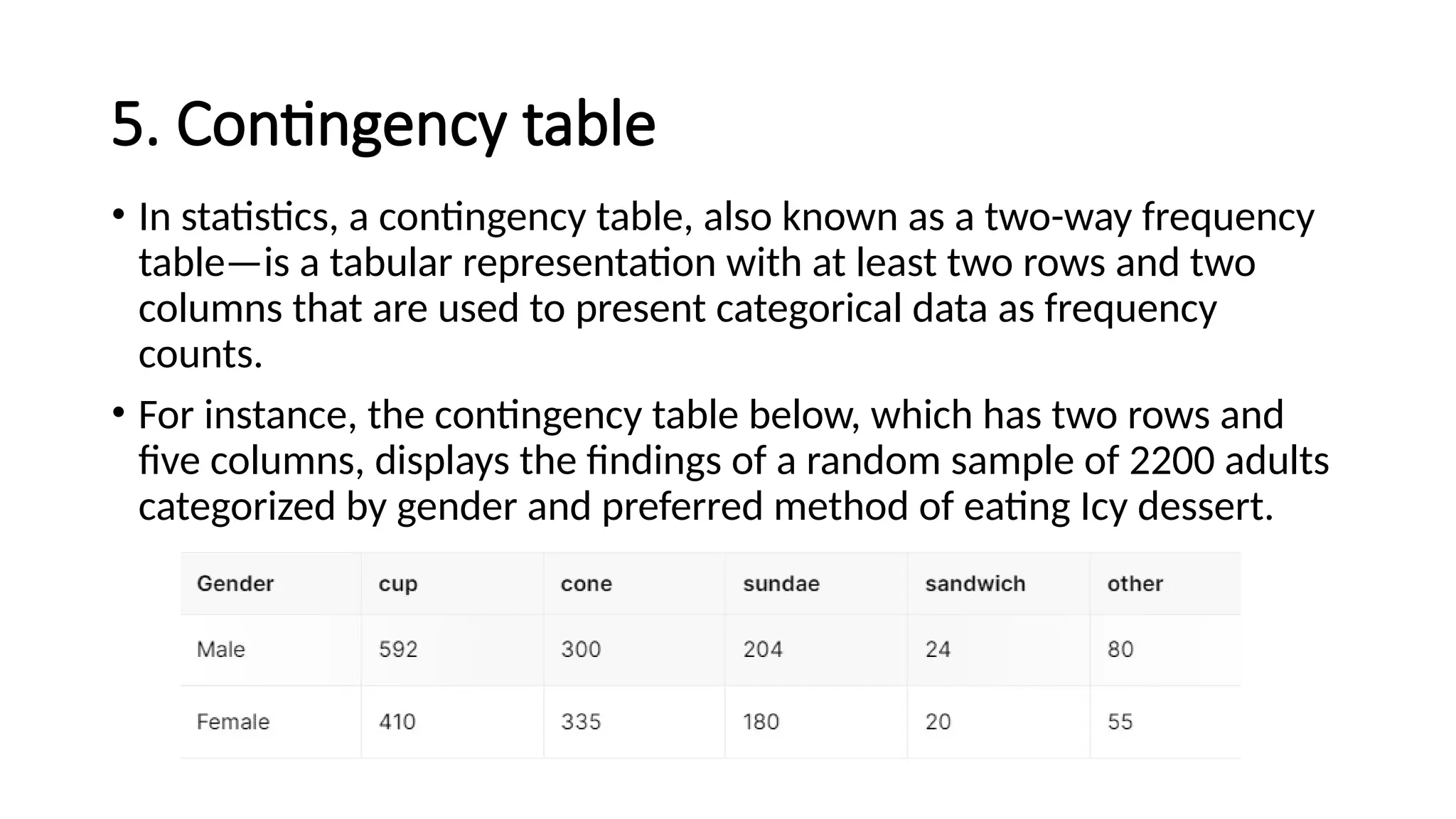
5. Contingency table
• In statistics, a contingency table, also known as a two-way frequency
table—is a tabular representation with at least two rows and two
columns that are used to present categorical data as frequency
counts.
• For instance, the contingency table below, which has two rows and
five columns, displays the findings of a random sample of 2200 adults
categorized by gender and preferred method of eating Icy dessert.
6. Scatter plots
• You can visualize the relationship between two or three different
variables using a scatter plot. It represents a relationship's strength in
a visual way. One variable should be plotted along the x-axis, and
another along the y-axis in a scatter plot. A point in the chart
represents each data point.
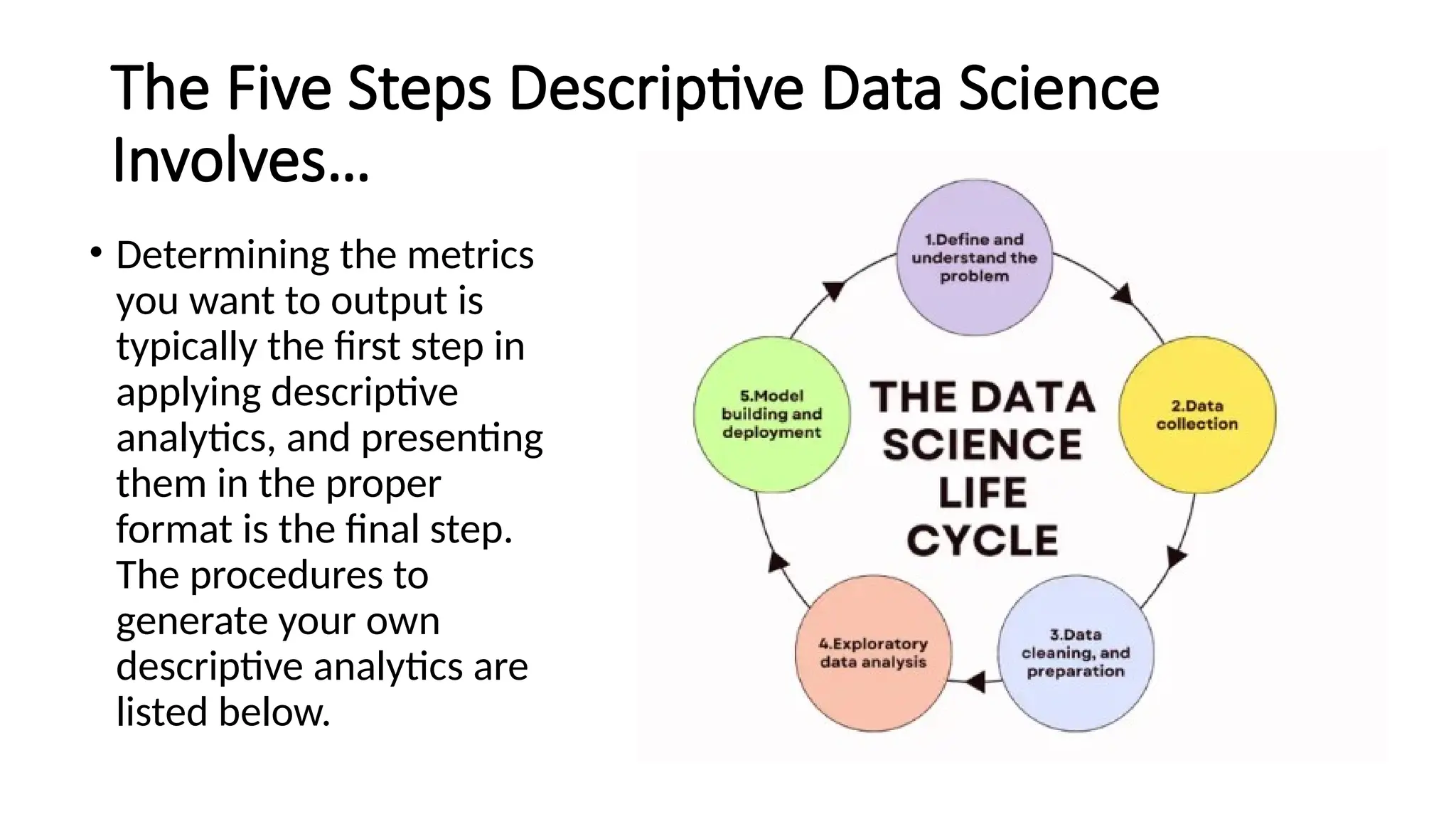
The Five Steps Descriptive Data Science
Involves…
• Determining the metrics
you want to output is
typically the first step in
applying descriptive
analytics, and presenting
them in the proper
format is the final step.
The procedures to
generate your own
descriptive analytics are
listed below.
Step 1: Define business metrics
• Defining the metrics you wish to measure is the first step. These
should represent the main organization’s objectives of each segment
or the organization as a whole. For instance, a company that
prioritizes expansion may track quarterly revenue growth, and its
accounts receivable department may monitor metrics like days sales
outstanding and other measures of how long does it take to get
payment from a customer?
Step 2: Identify data required
• Find the data you require to generate the desired stats. The data may
be dispersed over numerous programs and files at some businesses.
Businesses that use ERP systems can already have the majority or all
of the data they require in the databases of their systems. Some
indicators might also need information from outside sources, like
social media platforms, e-commerce websites, and databases used for
industry benchmarking.
Step 3: Extract and preprocess data
• When data is gathered from several sources, extracting, integrating,
and preprocessing it before analysis is a time-consuming but
necessary step to ensure accuracy. This procedure could include data
cleansing to eliminate conflicts and inaccuracies in data from diverse
sources and convert the data into a format compatible with
descriptive-analytical tools. Advanced data analytics employ the
method of data modeling to help prepare, shape, and organize
corporate data. Data modeling is a framework for describing and
formatting data inside information systems.
Step 4: Data Analysis
• Businesses can utilize a variety of technologies, such as spreadsheets
and business intelligence (BI) tools, to do descriptive analytics. In
descriptive analytics, applying simple mathematical operations to one
or more variables is a common step. For example, sales managers
could monitor the average profit per transaction or the monthly
revenue from new clients. Executives and financial professionals may
keep an eye on financial indicators like the gross profit margin, or the
ratio of gross profit to sales.
Step 5: Present data
• Data that is presented in visually appealing forms, such as pie charts,
bar charts, and line graphs, is typically easier for stakeholders to
understand. But some people, like financial professionals, could like
information that is provided in the form of figures and tables.
How Does Descriptive Analytics Work in Data
Science?
• Descriptive Analytics is a powerful tool that can summarize data and
communicate information in an understandable way. Statistics
associated with descriptive analytics can describe the distribution, the
data's central tendency, and the data's dispersion. Additionally,
descriptive statistics in data science can be used to identify
relationships between variables and examine the differences between
data groups. Descriptive statistics are an important part of any data
analysis and can be used to help make decisions about how to best
analyze a dataset. Reports, pivot tables, and visualizations like
histograms, line graphs, pie charts, and box and whisker plots are
frequently used to illustrate the results of descriptive analytics.
How Does Descriptive Analytics Work in Data
Science?
• Data analysis requires businesses to first gather and consolidate raw
data from multiple sources, then transform it into a standard format
for analysis. They can now begin analyzing the data. Many businesses
employ data intelligence, a collection of techniques and instruments
for gathering and analyzing data, then drawing conclusions and
formulating plans of action based on the results. Others add simple
descriptive analytics to the combined data using spreadsheet
formulas, producing KPIs and other statistics that are then included in
reports.
How Does Descriptive Analytics Work in Data
Science?
• Integrated ERP systems can store the organization's business data in a
single database, simplifying descriptive analytics. Leading suites also
come with integrated analysis tools to aid with data storytelling,
creating a narrative around data using visualizations to communicate
the significance of the data in an engaging manner. Common KPIs can
be provided with real-time data combined into dashboards, charts,
and reports using ERP-embedded business intelligence tools.
Examples of Descriptive Analytics
1. Traffic and Engagement Reports
• Reporting is a type of descriptive analytics. You already use descriptive analytics if
your organization monitors engagement through social media analytics or website
traffic. These reports are made by comparing current metrics to historical metrics and
visualizing trends using raw data that is generated when users interact with your
website, advertisements, or social media content.
• You might be in charge of reporting on which media outlets bring in the most visitors
to the product page on your company's website, for instance. You can count the
number of visitors from each source by examining the page's traffic statistics using
descriptive analytics. You might choose to go a step further and contrast current traffic
source data with earlier traffic source data. This will allow you to inform your team of
any changes, such as highlighting a 20 percent year-over-year increase in traffic from
paid advertisements.
Examples of Descriptive Analytics
2. Financial Statement Analysis
• Another well-known descriptive data analysis example is balance sheet analysis. Financial
statements are periodic reports detailing financial information about a company, which as a
whole, provide an overall picture of the company's financial position.
• There are several types of financial statements, such as Balance Sheets, Income Statements,
Cash Flow Statement and Shareholders' Equity Statements. Each is aimed at a specific audience
and conveys different information about the company's finances. Balance sheet analysis can be
performed in three ways: vertical, horizontal and ratio.
• Vertical analysis reads the statement from top to bottom, comparing each element to the
elements above and below it. This helps determine relationships between variables. For
example, if each item is a percentage of a total, comparisons can provide insight into which
percentages of the total are large and which are small.
• Horizontal analysis reads the statement from left to right and compares each item to itself in
the previous period. This type of analysis determines changes over time.
Examples of Descriptive Analytics
2. Financial Statement Analysis
• Finally, relationship analysis compares one section of the report to another
based on their relationship to the whole. This allows you to directly
compare articles and company metrics over multiple time periods to
industry metrics to determine if a company is over- or underperforming.
• Each of these balance sheet analysis methods is an example of descriptive
analysis because it provides information about trends and relationships
between variables based on current and historical data.
Examples of Descriptive Analytics
3. Demand Trends
• Additionally, descriptive analytics can be used to spot patterns in consumer
preferences and behavior and predict demand for particular goods or services.
• A great use case for descriptive analytics is trend identification by the streaming
service Netflix. The Netflix team, which has a history of being highly data-driven,
collects information on users' platform usage. They use this data to analyze what TV
shows and movies are popular right now, and they display those titles in a section on
the platform's home screen. This information not only enables Netflix subscribers to
see what's popular and, consequently, what they might enjoy watching, but it also
enables the Netflix team to understand which media genres, themes, and actors are
particularly favored at a given time. This may influence choices regarding the creation
of new original content, agreements with current production companies, marketing,
and retargeting campaigns.
Examples of Descriptive Analytics
4. Aggregated Survey Results
• Market research can also benefit from descriptive analytics. Descriptive analysis in
research can be used to find connections between variables and trends when extracting
insights from survey and focus group data.
• You might, for instance, carry out a survey and find that, as respondents' ages rise, so
does their propensity to buy your product. Descriptive analytics can determine whether
this age-purchase correlation has always existed or whether it was something that only
happened this year if you've conducted this survey repeatedly over a number of years.
• This kind of information can open the door for diagnostic analytics, which can explain
why certain variables are correlated. Using predictive and prescriptive analytics, you can
then use the trends to plan future product improvements or marketing campaigns.
Examples of Descriptive Analytics
5. Progress to Goals
• Descriptive analytics can also be used to monitor goal progress. Your team
can determine whether efforts are on track or if changes need to be made
by reporting on progress toward key performance indicators (KPIs).
• If your company wants to reach 500,000 unique page views per month, for
instance, you can use traffic data to show your progress. You have 200,000
unique page views, so you're probably halfway through the month. You
should be halfway toward your objective at that point—at 250,000 unique
page views—so this would be underperforming. With the help of this
descriptive analysis, your team can determine what needs to be changed
in order to increase traffic and get back on track to meet your KPI.
The Advantages and Disadvantages of
Descriptive Analytics in Data Science
Even though it is one of the more straightforward analytical strategies, descriptive
analysis in data science has many benefits:
• gives access to information that would otherwise be difficult to understand.
• gives a precise estimation of how frequently important data points occur.
• is cheap, and it only calls for rudimentary mathematical knowledge.
• is easier to complete, particularly with the aid of programs like Python or
Microsoft Excel.
• relies on information that businesses already have, so getting new information is
not necessary.
• compared to inferential statistics, it considers the entire population (rather than a
data sampling).
The Advantages and Disadvantages of
Descriptive Analytics in Data Science
We've examined the benefits of descriptive analytics, but what are its
drawbacks? The following are some drawbacks of descriptive analytics:
• Although you can summarize the data sets you have access to, they might
not provide the full picture.
• Descriptive analytics can't be used to test a theory or figure out why data
is presented in a certain way.
• Descriptive analytics cannot be used to make future predictions.
• Your results cannot be applied to a larger population as a whole.
• Descriptive analytics provide no information regarding the method of
data collection, so the data set may contain errors.
How is Descriptive Analytics Used ?
Businesses utilize descriptive analytics in various areas of their
operations to assess how well they are performing and if they are on
track to meet their objectives. Common financial measurements
generated by descriptive analytics, such as quarterly increases in sales
and expenses, are monitored by business executives and financial
experts. By tracking stats like conversion rates and the number of social
media followers, marketing teams may assess the effectiveness of their
campaigns. Production line throughput and downtime are among the
variables that manufacturing companies keep an eye on.
How is Descriptive Analytics Used ?
There are several uses for the metrics generated by descriptive analytics, including:
• Reports: Descriptive analytics is used to provide the primary financial indicators
found in a company's financial statements. Descriptive analytics are often used in
other typical reports to emphasize specific areas of business performance.
• Visualizations: Metrics can be more effectively communicated to a larger
audience by being displayed in charts and other graphic forms.
• Dashboards: Dashboards are a tool that executives, managers, and other staff
members can use to monitor progress and organize their daily workload.
Dashboards offer a selection of KPIs and other crucial data that are catered to the
needs of each individual. To help people quickly digest the information, it may be
presented as charts or other visualizations.
Descriptive Analysis Techniques
The techniques for descriptive analysis are the most common
descriptive methods of data analysis for qualitative data. Descriptive
data analysis techniques are used to describe the subjects of a study in
detail, identifying patterns and trends, and providing insights into how
subjects behave.
Descriptive Analysis Techniques
Some of the most common descriptive analysis methods for descriptive analysis
statistics are:
• The frequency distribution is a method that provides an overview of all the
responses to a question.
• The bar chart is a visual representation that displays how responses vary on
different dimensions.
• The pie chart displays how responses vary on different dimensions.
• A scatterplot displays how two variables relate to each other.
• A histogram provides an overview of all the responses to a question, with each
response grouped into bins according to some criterion such as age or income
level.
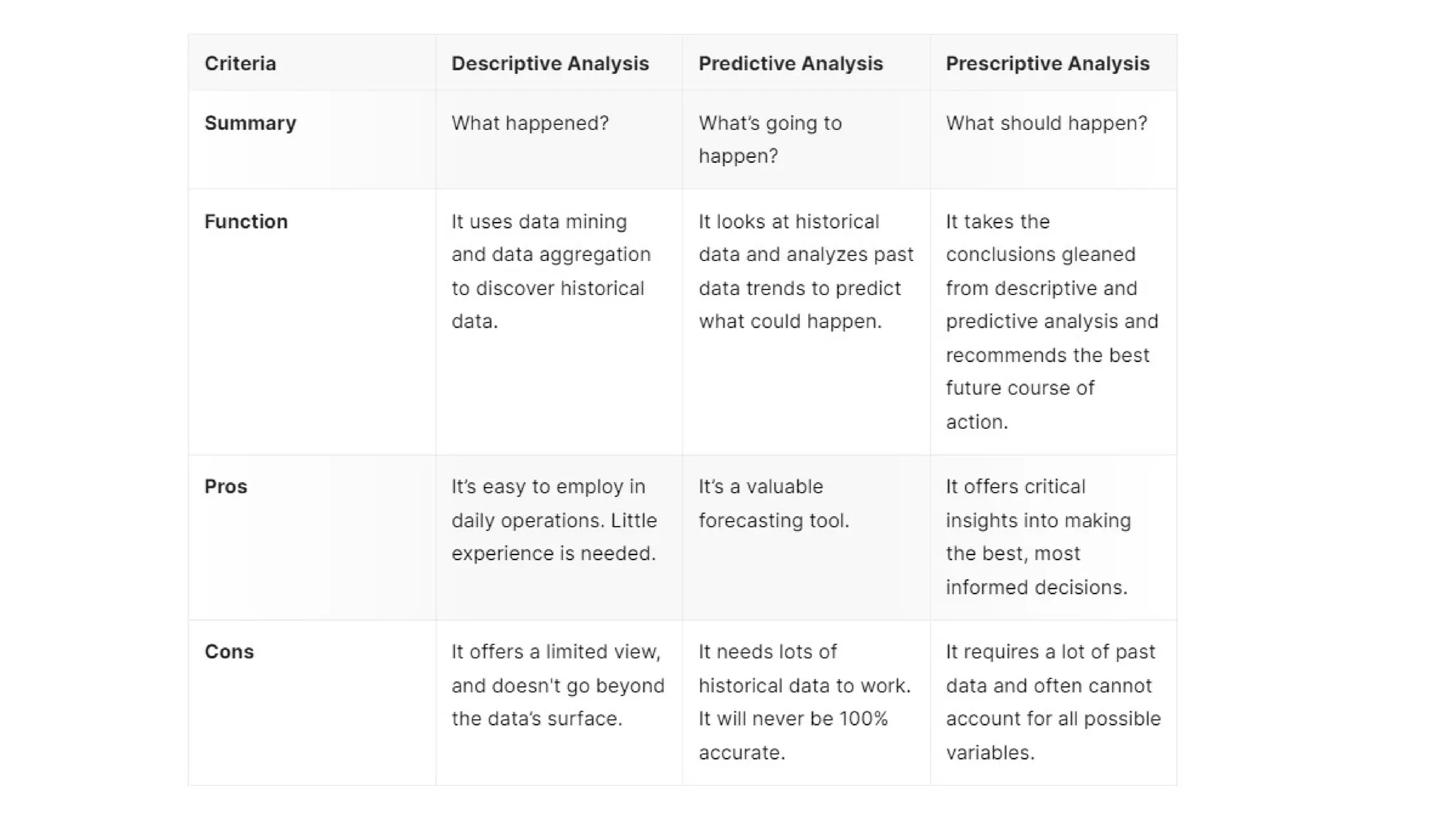
Descriptive vs Predictive vs Prescriptive
Analytics
The distinctions between descriptive, predictive, and prescriptive
analytics are outlined in the following table.
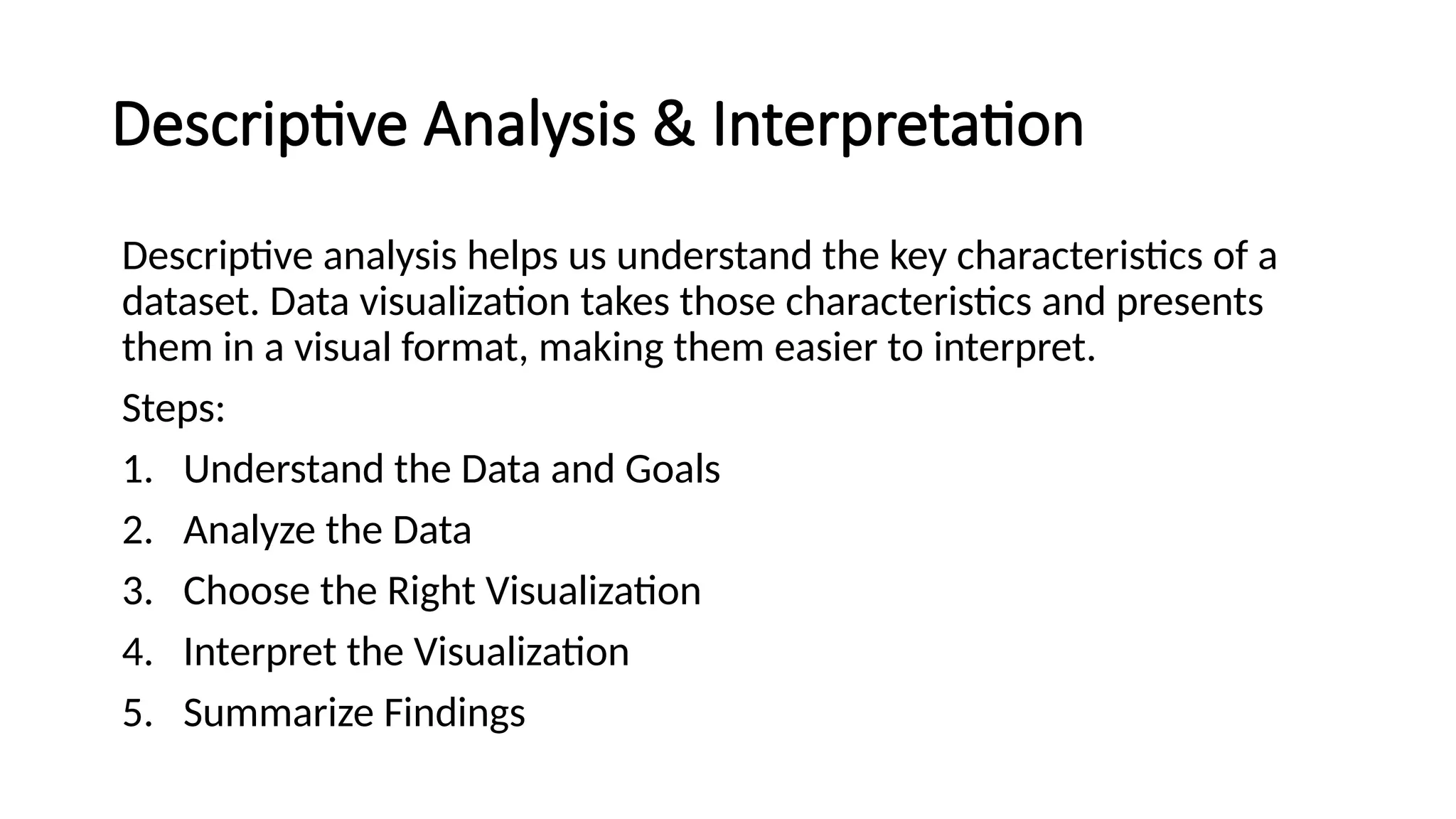
Descriptive Analysis & Interpretation
Descriptive analysis helps us understand the key characteristics of a
dataset. Data visualization takes those characteristics and presents
them in a visual format, making them easier to interpret.
Steps:
1. Understand the Data and Goals
2. Analyze the Data
3. Choose the Right Visualization
4. Interpret the Visualization
5. Summarize Findings
1. Understanding the Data and Goals
Identify the type of data. Is it numerical (continuous or discrete) or
categorical? Identify as well the variables (including metrics) measured
in the study.
Define your goals. What questions are you trying to answer with the
data visualization?
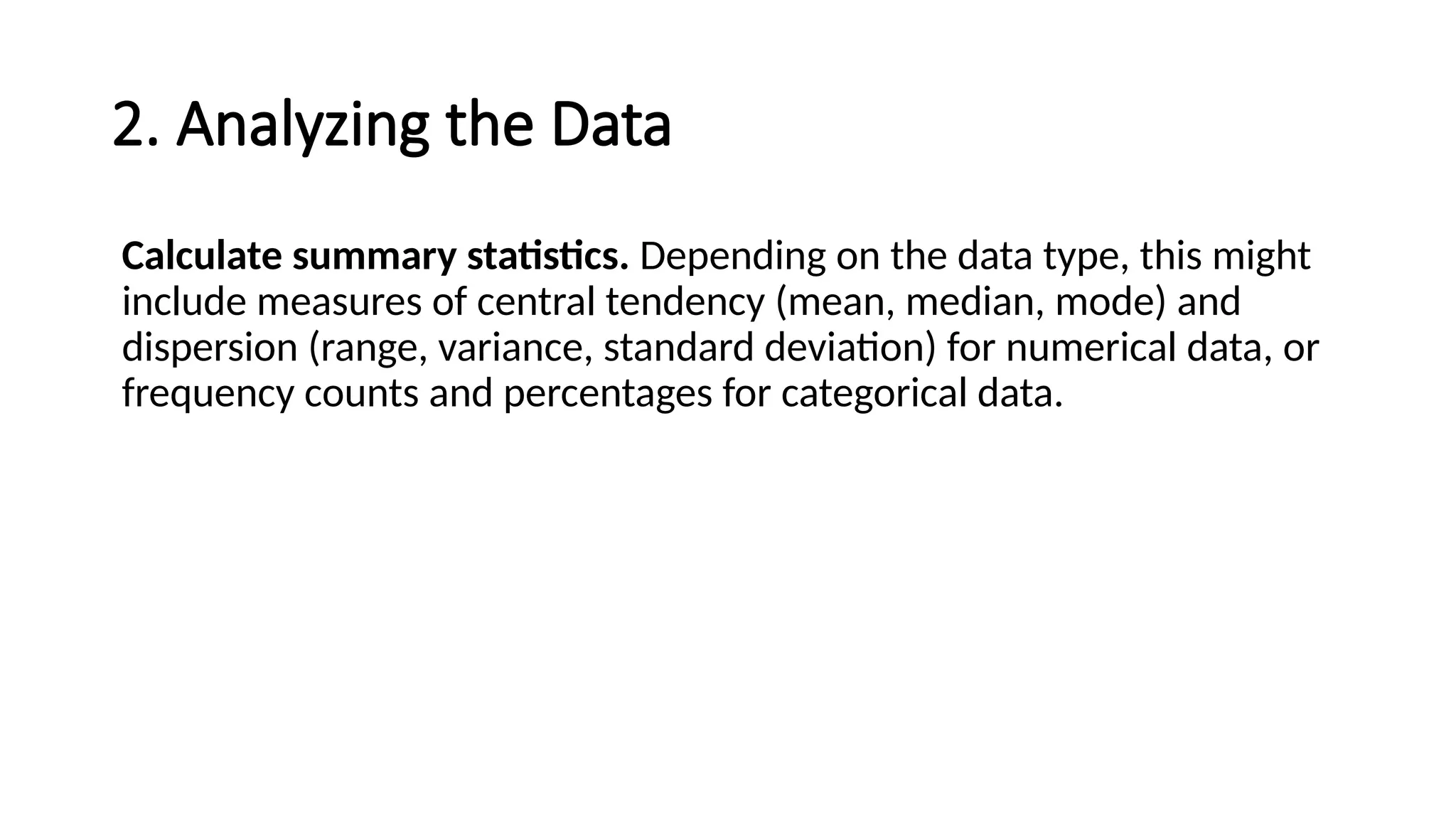
2. Analyzing the Data
Calculate summary statistics. Depending on the data type, this might
include measures of central tendency (mean, median, mode) and
dispersion (range, variance, standard deviation) for numerical data, or
frequency counts and percentages for categorical data.
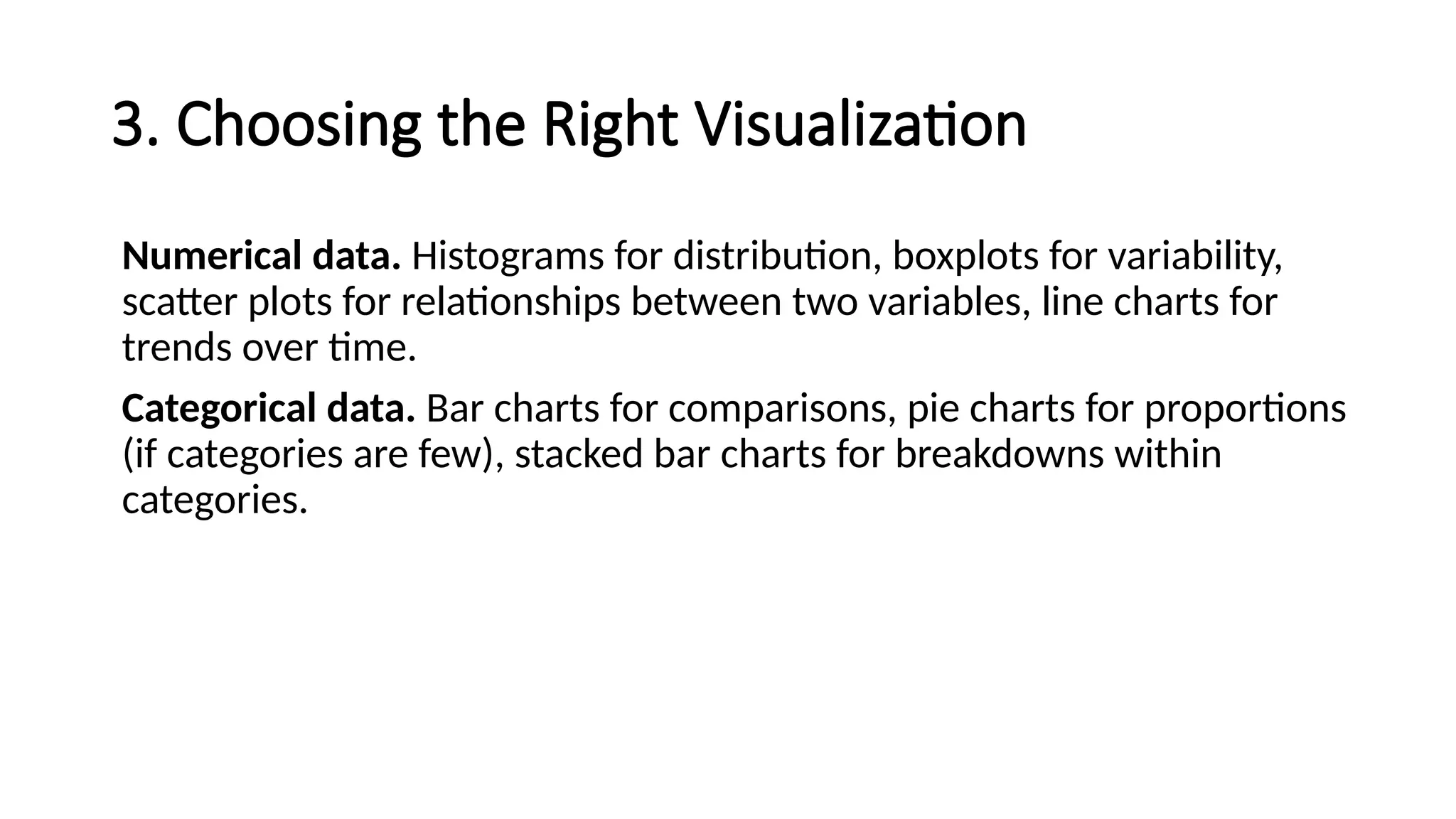
3. Choosing the Right Visualization
Numerical data. Histograms for distribution, boxplots for variability,
scatter plots for relationships between two variables, line charts for
trends over time.
Categorical data. Bar charts for comparisons, pie charts for proportions
(if categories are few), stacked bar charts for breakdowns within
categories.
4. Interpreting the Visualization
Look for patterns and trends. Are there central tendencies, outliers,
correlations, or changes over time?
Consider the context: Does the visualization align with your initial
understanding of the data? Are there any surprises?
Pay attention to chart elements: Titles, labels, axes, legends should be
clear and concise.
5. Summarizing Findings
Clearly explain what the visualization shows.
Connect the findings back to your initial goals.
Conclusion. Justify using empirical evidences (e.g. real-life
phenomenon/events)

INTRODUCTION TO DESCRIPTIVE ANALYTICS.pptx

  • 1.
  • 2.
    INTENDED LEARNING OUTCOMES Whatis Descriptive Analytics in Data Science? Types of Descriptive Analysis The Five Steps Descriptive Data Science Involves How Does Descriptive Analytics Work in Data Science? Examples of Descriptive Analytics The Advantages and Disadvantages of Descriptive Analytics in Data Science How is Descriptive Analytics Used ? Descriptive Analysis Techniques Descriptive Analytics Use Cases Descriptive vs Predictive vs Prescriptive Analytics
  • 3.
    WHAT IS DESCRIPTIVEANALYTICS… Descriptive Analytics is a field of business intelligence with expertise in statistical analysis, waiting for history, and other data. Descriptive Analytics professionals find the data to question and study; they pose the questions that need answers; they translate these queries into mathematical models and apply them to their chosen data. Using descriptive analytics in data visualization is a practice that can greatly aid and improve people’s decision-making. Their decisions are taken from over-reliance, wishful thinking, and in isolation. Descriptive analytics is a rapidly growing field with a promising future. It offers the ability to make better business decisions and understand how customers interact with companies and products. General techniques used in descriptive analytics include; Data collection, Data preparation, exploratory data analysis, data visualization, statistical analysis, and predictive modeling.
  • 4.
    What is DescriptiveAnalytics in Data Science? The purpose of descriptive analytics is to turn data into insights. It is used to understand what happened in the past and why it happened. Descriptive analytics uses various techniques to answer questions such as “what is the average order value?”, “how many orders were placed last month?” or “what was the most popular product last year?”.
  • 5.
    What is DescriptiveAnalytics in Data Science? There are four main steps in descriptive analytics: • Data collection: Collecting data from various sources such as sales reports, customer surveys, social media, etc. • Data preparation: Cleaning and organizing the data so it can be analyzed. • Exploratory data analysis: Analyzing the data to find trends, patterns, and relationships. • Data visualization: Creating graphs and charts to visualize the data and make it easy to understand.
  • 6.
    What is DescriptiveAnalytics in Data Science? The most common techniques used in descriptive analytics are statistical analysis, data visualization, and predictive modeling.
  • 7.
    Types of DescriptiveAnalysis There are four different types of descriptive analysis: measures of frequency, central tendency, dispersion or variation, position, . These techniques work best when only one variable is present.
  • 8.
    1. Measures ofFrequency • Understanding how frequently a specific event or response is likely to occur is crucial for descriptive analysis. The main goal of frequency measurements is to create something akin to a count or a percentage. For example: Think about a survey where 500 people are questioned about their favorite football team. A list of 500 responses would be challenging to read and organize, but by counting the number of times a specific football team was chosen, the data can be made much more understandable. Measures: Count, Percent, Frequency
  • 9.
    2. Measures ofCentral Tendency • A single value that seeks to characterize a set of data by pinpointing the central position within that set of data is referred to as a measure of central tendency. As a result, measures of central location are occasionally used to refer to measures of central tendency. They also fit into the category of summary statistics. You are probably most familiar with the mean (also known as the average), but there are other central tendency measures, including the median and the mode. • The mean, median, and mode are all reliable indicators of central tendency, but depending on the situation, some indicators are more useful than others. • Think about a survey where 1,000 people's body weight are recorded as an example. The mean average would be a great descriptive metric to use in this situation to measure mid-values. Measures: Mean, Median, and Mode
  • 10.
    3. Measures ofDispersion • At times, understanding how data is distributed across a range is crucial. Consider the average weight of a sample of two people to further explain this. The average weight will be 60 kilograms if both people weigh 60 kilograms. The average weight is still 60 kg even if one person weighs 40 kg and the other 80 kg. This type of distribution can be measured using dispersion metrics like range or standard deviation. Measures: Range, Variance, Standard Deviation
  • 11.
    4. Measures ofPosition • Identifying the position of a single value or its response in relation to others is another aspect of descriptive analysis. In this field of expertise, metrics like percentiles and quartiles are extremely helpful. Measures: Percentile Ranks, Quartile Ranks
  • 12.
    Similar to bivariateanalysis, the multivariate analysis examines more than two variables. The two methods for bivariate analysis are: 1) Contingency Table 2) Scatter Plots
  • 13.
    5. Contingency table •In statistics, a contingency table, also known as a two-way frequency table—is a tabular representation with at least two rows and two columns that are used to present categorical data as frequency counts. • For instance, the contingency table below, which has two rows and five columns, displays the findings of a random sample of 2200 adults categorized by gender and preferred method of eating Icy dessert.
  • 14.
    6. Scatter plots •You can visualize the relationship between two or three different variables using a scatter plot. It represents a relationship's strength in a visual way. One variable should be plotted along the x-axis, and another along the y-axis in a scatter plot. A point in the chart represents each data point.
  • 15.
    The Five StepsDescriptive Data Science Involves… • Determining the metrics you want to output is typically the first step in applying descriptive analytics, and presenting them in the proper format is the final step. The procedures to generate your own descriptive analytics are listed below.
  • 16.
    Step 1: Definebusiness metrics • Defining the metrics you wish to measure is the first step. These should represent the main organization’s objectives of each segment or the organization as a whole. For instance, a company that prioritizes expansion may track quarterly revenue growth, and its accounts receivable department may monitor metrics like days sales outstanding and other measures of how long does it take to get payment from a customer?
  • 17.
    Step 2: Identifydata required • Find the data you require to generate the desired stats. The data may be dispersed over numerous programs and files at some businesses. Businesses that use ERP systems can already have the majority or all of the data they require in the databases of their systems. Some indicators might also need information from outside sources, like social media platforms, e-commerce websites, and databases used for industry benchmarking.
  • 18.
    Step 3: Extractand preprocess data • When data is gathered from several sources, extracting, integrating, and preprocessing it before analysis is a time-consuming but necessary step to ensure accuracy. This procedure could include data cleansing to eliminate conflicts and inaccuracies in data from diverse sources and convert the data into a format compatible with descriptive-analytical tools. Advanced data analytics employ the method of data modeling to help prepare, shape, and organize corporate data. Data modeling is a framework for describing and formatting data inside information systems.
  • 19.
    Step 4: DataAnalysis • Businesses can utilize a variety of technologies, such as spreadsheets and business intelligence (BI) tools, to do descriptive analytics. In descriptive analytics, applying simple mathematical operations to one or more variables is a common step. For example, sales managers could monitor the average profit per transaction or the monthly revenue from new clients. Executives and financial professionals may keep an eye on financial indicators like the gross profit margin, or the ratio of gross profit to sales.
  • 20.
    Step 5: Presentdata • Data that is presented in visually appealing forms, such as pie charts, bar charts, and line graphs, is typically easier for stakeholders to understand. But some people, like financial professionals, could like information that is provided in the form of figures and tables.
  • 21.
    How Does DescriptiveAnalytics Work in Data Science? • Descriptive Analytics is a powerful tool that can summarize data and communicate information in an understandable way. Statistics associated with descriptive analytics can describe the distribution, the data's central tendency, and the data's dispersion. Additionally, descriptive statistics in data science can be used to identify relationships between variables and examine the differences between data groups. Descriptive statistics are an important part of any data analysis and can be used to help make decisions about how to best analyze a dataset. Reports, pivot tables, and visualizations like histograms, line graphs, pie charts, and box and whisker plots are frequently used to illustrate the results of descriptive analytics.
  • 22.
    How Does DescriptiveAnalytics Work in Data Science? • Data analysis requires businesses to first gather and consolidate raw data from multiple sources, then transform it into a standard format for analysis. They can now begin analyzing the data. Many businesses employ data intelligence, a collection of techniques and instruments for gathering and analyzing data, then drawing conclusions and formulating plans of action based on the results. Others add simple descriptive analytics to the combined data using spreadsheet formulas, producing KPIs and other statistics that are then included in reports.
  • 23.
    How Does DescriptiveAnalytics Work in Data Science? • Integrated ERP systems can store the organization's business data in a single database, simplifying descriptive analytics. Leading suites also come with integrated analysis tools to aid with data storytelling, creating a narrative around data using visualizations to communicate the significance of the data in an engaging manner. Common KPIs can be provided with real-time data combined into dashboards, charts, and reports using ERP-embedded business intelligence tools.
  • 24.
    Examples of DescriptiveAnalytics 1. Traffic and Engagement Reports • Reporting is a type of descriptive analytics. You already use descriptive analytics if your organization monitors engagement through social media analytics or website traffic. These reports are made by comparing current metrics to historical metrics and visualizing trends using raw data that is generated when users interact with your website, advertisements, or social media content. • You might be in charge of reporting on which media outlets bring in the most visitors to the product page on your company's website, for instance. You can count the number of visitors from each source by examining the page's traffic statistics using descriptive analytics. You might choose to go a step further and contrast current traffic source data with earlier traffic source data. This will allow you to inform your team of any changes, such as highlighting a 20 percent year-over-year increase in traffic from paid advertisements.
  • 25.
    Examples of DescriptiveAnalytics 2. Financial Statement Analysis • Another well-known descriptive data analysis example is balance sheet analysis. Financial statements are periodic reports detailing financial information about a company, which as a whole, provide an overall picture of the company's financial position. • There are several types of financial statements, such as Balance Sheets, Income Statements, Cash Flow Statement and Shareholders' Equity Statements. Each is aimed at a specific audience and conveys different information about the company's finances. Balance sheet analysis can be performed in three ways: vertical, horizontal and ratio. • Vertical analysis reads the statement from top to bottom, comparing each element to the elements above and below it. This helps determine relationships between variables. For example, if each item is a percentage of a total, comparisons can provide insight into which percentages of the total are large and which are small. • Horizontal analysis reads the statement from left to right and compares each item to itself in the previous period. This type of analysis determines changes over time.
  • 26.
    Examples of DescriptiveAnalytics 2. Financial Statement Analysis • Finally, relationship analysis compares one section of the report to another based on their relationship to the whole. This allows you to directly compare articles and company metrics over multiple time periods to industry metrics to determine if a company is over- or underperforming. • Each of these balance sheet analysis methods is an example of descriptive analysis because it provides information about trends and relationships between variables based on current and historical data.
  • 27.
    Examples of DescriptiveAnalytics 3. Demand Trends • Additionally, descriptive analytics can be used to spot patterns in consumer preferences and behavior and predict demand for particular goods or services. • A great use case for descriptive analytics is trend identification by the streaming service Netflix. The Netflix team, which has a history of being highly data-driven, collects information on users' platform usage. They use this data to analyze what TV shows and movies are popular right now, and they display those titles in a section on the platform's home screen. This information not only enables Netflix subscribers to see what's popular and, consequently, what they might enjoy watching, but it also enables the Netflix team to understand which media genres, themes, and actors are particularly favored at a given time. This may influence choices regarding the creation of new original content, agreements with current production companies, marketing, and retargeting campaigns.
  • 28.
    Examples of DescriptiveAnalytics 4. Aggregated Survey Results • Market research can also benefit from descriptive analytics. Descriptive analysis in research can be used to find connections between variables and trends when extracting insights from survey and focus group data. • You might, for instance, carry out a survey and find that, as respondents' ages rise, so does their propensity to buy your product. Descriptive analytics can determine whether this age-purchase correlation has always existed or whether it was something that only happened this year if you've conducted this survey repeatedly over a number of years. • This kind of information can open the door for diagnostic analytics, which can explain why certain variables are correlated. Using predictive and prescriptive analytics, you can then use the trends to plan future product improvements or marketing campaigns.
  • 29.
    Examples of DescriptiveAnalytics 5. Progress to Goals • Descriptive analytics can also be used to monitor goal progress. Your team can determine whether efforts are on track or if changes need to be made by reporting on progress toward key performance indicators (KPIs). • If your company wants to reach 500,000 unique page views per month, for instance, you can use traffic data to show your progress. You have 200,000 unique page views, so you're probably halfway through the month. You should be halfway toward your objective at that point—at 250,000 unique page views—so this would be underperforming. With the help of this descriptive analysis, your team can determine what needs to be changed in order to increase traffic and get back on track to meet your KPI.
  • 30.
    The Advantages andDisadvantages of Descriptive Analytics in Data Science Even though it is one of the more straightforward analytical strategies, descriptive analysis in data science has many benefits: • gives access to information that would otherwise be difficult to understand. • gives a precise estimation of how frequently important data points occur. • is cheap, and it only calls for rudimentary mathematical knowledge. • is easier to complete, particularly with the aid of programs like Python or Microsoft Excel. • relies on information that businesses already have, so getting new information is not necessary. • compared to inferential statistics, it considers the entire population (rather than a data sampling).
  • 31.
    The Advantages andDisadvantages of Descriptive Analytics in Data Science We've examined the benefits of descriptive analytics, but what are its drawbacks? The following are some drawbacks of descriptive analytics: • Although you can summarize the data sets you have access to, they might not provide the full picture. • Descriptive analytics can't be used to test a theory or figure out why data is presented in a certain way. • Descriptive analytics cannot be used to make future predictions. • Your results cannot be applied to a larger population as a whole. • Descriptive analytics provide no information regarding the method of data collection, so the data set may contain errors.
  • 32.
    How is DescriptiveAnalytics Used ? Businesses utilize descriptive analytics in various areas of their operations to assess how well they are performing and if they are on track to meet their objectives. Common financial measurements generated by descriptive analytics, such as quarterly increases in sales and expenses, are monitored by business executives and financial experts. By tracking stats like conversion rates and the number of social media followers, marketing teams may assess the effectiveness of their campaigns. Production line throughput and downtime are among the variables that manufacturing companies keep an eye on.
  • 33.
    How is DescriptiveAnalytics Used ? There are several uses for the metrics generated by descriptive analytics, including: • Reports: Descriptive analytics is used to provide the primary financial indicators found in a company's financial statements. Descriptive analytics are often used in other typical reports to emphasize specific areas of business performance. • Visualizations: Metrics can be more effectively communicated to a larger audience by being displayed in charts and other graphic forms. • Dashboards: Dashboards are a tool that executives, managers, and other staff members can use to monitor progress and organize their daily workload. Dashboards offer a selection of KPIs and other crucial data that are catered to the needs of each individual. To help people quickly digest the information, it may be presented as charts or other visualizations.
  • 34.
    Descriptive Analysis Techniques Thetechniques for descriptive analysis are the most common descriptive methods of data analysis for qualitative data. Descriptive data analysis techniques are used to describe the subjects of a study in detail, identifying patterns and trends, and providing insights into how subjects behave.
  • 35.
    Descriptive Analysis Techniques Someof the most common descriptive analysis methods for descriptive analysis statistics are: • The frequency distribution is a method that provides an overview of all the responses to a question. • The bar chart is a visual representation that displays how responses vary on different dimensions. • The pie chart displays how responses vary on different dimensions. • A scatterplot displays how two variables relate to each other. • A histogram provides an overview of all the responses to a question, with each response grouped into bins according to some criterion such as age or income level.
  • 36.
    Descriptive vs Predictivevs Prescriptive Analytics The distinctions between descriptive, predictive, and prescriptive analytics are outlined in the following table.
  • 38.
    Descriptive Analysis &Interpretation Descriptive analysis helps us understand the key characteristics of a dataset. Data visualization takes those characteristics and presents them in a visual format, making them easier to interpret. Steps: 1. Understand the Data and Goals 2. Analyze the Data 3. Choose the Right Visualization 4. Interpret the Visualization 5. Summarize Findings
  • 39.
    1. Understanding theData and Goals Identify the type of data. Is it numerical (continuous or discrete) or categorical? Identify as well the variables (including metrics) measured in the study. Define your goals. What questions are you trying to answer with the data visualization?
  • 40.
    2. Analyzing theData Calculate summary statistics. Depending on the data type, this might include measures of central tendency (mean, median, mode) and dispersion (range, variance, standard deviation) for numerical data, or frequency counts and percentages for categorical data.
  • 41.
    3. Choosing theRight Visualization Numerical data. Histograms for distribution, boxplots for variability, scatter plots for relationships between two variables, line charts for trends over time. Categorical data. Bar charts for comparisons, pie charts for proportions (if categories are few), stacked bar charts for breakdowns within categories.
  • 42.
    4. Interpreting theVisualization Look for patterns and trends. Are there central tendencies, outliers, correlations, or changes over time? Consider the context: Does the visualization align with your initial understanding of the data? Are there any surprises? Pay attention to chart elements: Titles, labels, axes, legends should be clear and concise.
  • 43.
    5. Summarizing Findings Clearlyexplain what the visualization shows. Connect the findings back to your initial goals. Conclusion. Justify using empirical evidences (e.g. real-life phenomenon/events)