Introduction to Database
Management
Gevita Chinnaiah
11/06/2023
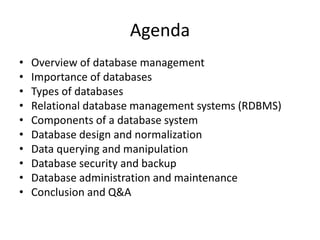
Agenda
• Overview of database management
• Importance of databases
• Types of databases
• Relational database management systems (RDBMS)
• Components of a database system
• Database design and normalization
• Data querying and manipulation
• Database security and backup
• Database administration and maintenance
• Conclusion and Q&A
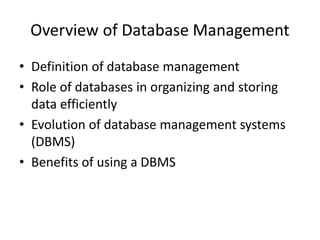
Overview of Database Management
• Definition of database management
• Role of databases in organizing and storing
data efficiently
• Evolution of database management systems
(DBMS)
• Benefits of using a DBMS
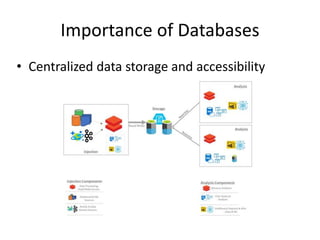
Importance of Databases
• Centralized data storage and accessibility
• Data consistency and integrity
• Improved data security
• Efficient data retrieval and manipulation
• Support for complex queries and analysis
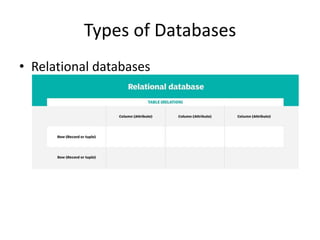
Types of Databases
• Relational databases
• Object-oriented databases
• NoSQL databases
Relational Database Management
Systems (RDBMS)
• Definition of RDBMS
• Key features and advantages
• Popular RDBMS examples (e.g., Oracle,
MySQL, SQL Server)
Components of a Database System
• Data model
• Database schema
• Data dictionary
• Data storage and access methods
• Query processor
• Transaction manager
• Recovery manager
Database Design and Normalization
• Conceptual, logical, and physical database
design
• Importance of normalization
• Normalization levels (1NF, 2NF, 3NF, BCNF)
Normalization levels (1NF)
• Rules for First Normal Form
– Rule 1: Single Valued Attributes
– Rule 2: Attribute Domain should not change
– Rule 3: Unique name for Attributes/Columns
– Rule 4: Order doesn't matters
Normalization levels (1NF)
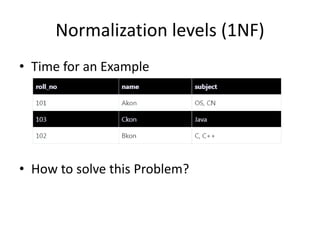
• Time for an Example
• How to solve this Problem?
Normalization levels (1NF)
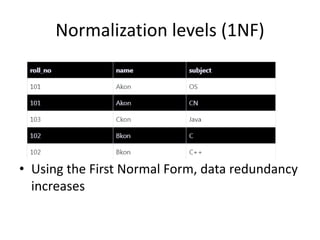
• Using the First Normal Form, data redundancy
increases
Normalization levels (2NF)
• What is Second Normal Form?
– The table should be in the First Normal Form.
– There should be no Partial Dependency.
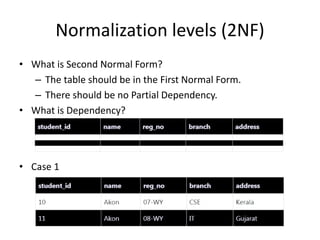
• What is Dependency?
• Case 1
What is Partial Dependency?
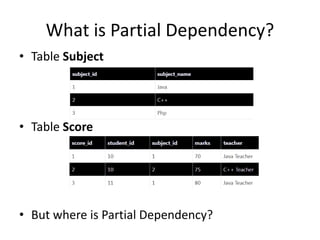
• Table Subject
• Table Score
• But where is Partial Dependency?
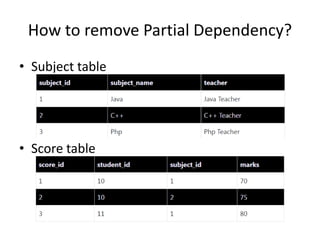
How to remove Partial Dependency?
• Subject table
• Score table
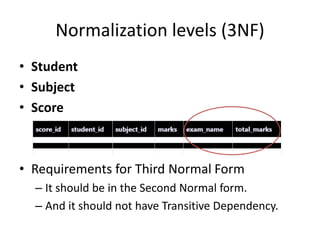
Normalization levels (3NF)
• Student
• Subject
• Score
• Requirements for Third Normal Form
– It should be in the Second Normal form.
– And it should not have Transitive Dependency.
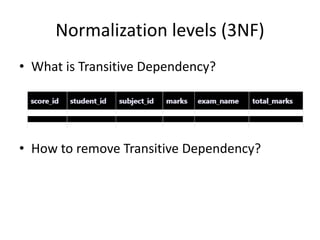
Normalization levels (3NF)
• What is Transitive Dependency?
• How to remove Transitive Dependency?
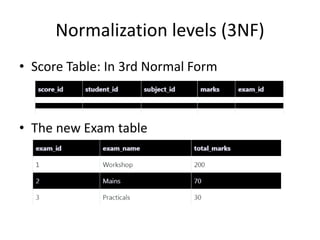
Normalization levels (3NF)
• Score Table: In 3rd Normal Form
• The new Exam table
Advantage of removing Transitive
Dependency
• Amount of data duplication is reduced.
• Data integrity achieved.
Boyce-Codd Normal Form (BCNF)
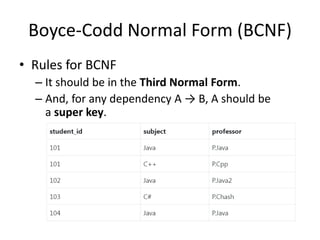
• Rules for BCNF
– It should be in the Third Normal Form.
– And, for any dependency A → B, A should be
a super key.
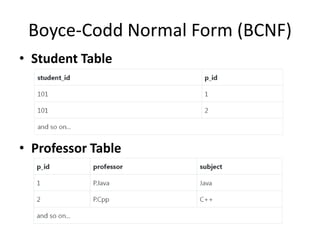
Boyce-Codd Normal Form (BCNF)
• Student Table
• Professor Table
Data Querying and Manipulation
• SQL (Structured Query Language)
• Basic SQL queries (SELECT, INSERT, UPDATE,
DELETE)
• Advanced SQL operations (JOIN, GROUP BY,
HAVING)
• Data manipulation language (DML) and data
definition language (DDL) statements
Database Security and Backup
• Importance of data security
• User authentication and access control
• Encryption and data masking
• Database backup and recovery strategies
• Disaster recovery planning
Database Administration and
Maintenance
• Role of database administrators (DBAs)
• Performance tuning and optimization
• Monitoring and troubleshooting
• Indexing and query optimization
• Database versioning and upgrades
Conclusion and Q&A
• Importance of database management in
modern organizations
• Opportunities for further learning and
exploration
• Question and answer session
Introduction to Database Management.pptx

Introduction to Database Management.pptx

  • 1.
  • 2.
    Agenda • Overview ofdatabase management • Importance of databases • Types of databases • Relational database management systems (RDBMS) • Components of a database system • Database design and normalization • Data querying and manipulation • Database security and backup • Database administration and maintenance • Conclusion and Q&A
  • 3.
    Overview of DatabaseManagement • Definition of database management • Role of databases in organizing and storing data efficiently • Evolution of database management systems (DBMS) • Benefits of using a DBMS
  • 4.
    Importance of Databases •Centralized data storage and accessibility
  • 5.
    • Data consistencyand integrity • Improved data security • Efficient data retrieval and manipulation • Support for complex queries and analysis
  • 6.
    Types of Databases •Relational databases
  • 7.
  • 8.
    Relational Database Management Systems(RDBMS) • Definition of RDBMS • Key features and advantages • Popular RDBMS examples (e.g., Oracle, MySQL, SQL Server)
  • 9.
    Components of aDatabase System • Data model • Database schema • Data dictionary • Data storage and access methods • Query processor • Transaction manager • Recovery manager
  • 10.
    Database Design andNormalization • Conceptual, logical, and physical database design • Importance of normalization • Normalization levels (1NF, 2NF, 3NF, BCNF)
  • 11.
    Normalization levels (1NF) •Rules for First Normal Form – Rule 1: Single Valued Attributes – Rule 2: Attribute Domain should not change – Rule 3: Unique name for Attributes/Columns – Rule 4: Order doesn't matters
  • 12.
    Normalization levels (1NF) •Time for an Example • How to solve this Problem?
  • 13.
    Normalization levels (1NF) •Using the First Normal Form, data redundancy increases
  • 14.
    Normalization levels (2NF) •What is Second Normal Form? – The table should be in the First Normal Form. – There should be no Partial Dependency. • What is Dependency? • Case 1
  • 15.
    What is PartialDependency? • Table Subject • Table Score • But where is Partial Dependency?
  • 16.
    How to removePartial Dependency? • Subject table • Score table
  • 17.
    Normalization levels (3NF) •Student • Subject • Score • Requirements for Third Normal Form – It should be in the Second Normal form. – And it should not have Transitive Dependency.
  • 18.
    Normalization levels (3NF) •What is Transitive Dependency? • How to remove Transitive Dependency?
  • 19.
    Normalization levels (3NF) •Score Table: In 3rd Normal Form • The new Exam table
  • 20.
    Advantage of removingTransitive Dependency • Amount of data duplication is reduced. • Data integrity achieved.
  • 21.
    Boyce-Codd Normal Form(BCNF) • Rules for BCNF – It should be in the Third Normal Form. – And, for any dependency A → B, A should be a super key.
  • 22.
    Boyce-Codd Normal Form(BCNF) • Student Table • Professor Table
  • 23.
    Data Querying andManipulation • SQL (Structured Query Language) • Basic SQL queries (SELECT, INSERT, UPDATE, DELETE) • Advanced SQL operations (JOIN, GROUP BY, HAVING) • Data manipulation language (DML) and data definition language (DDL) statements
  • 24.
    Database Security andBackup • Importance of data security • User authentication and access control • Encryption and data masking • Database backup and recovery strategies • Disaster recovery planning
  • 25.
    Database Administration and Maintenance •Role of database administrators (DBAs) • Performance tuning and optimization • Monitoring and troubleshooting • Indexing and query optimization • Database versioning and upgrades
  • 26.
    Conclusion and Q&A •Importance of database management in modern organizations • Opportunities for further learning and exploration • Question and answer session